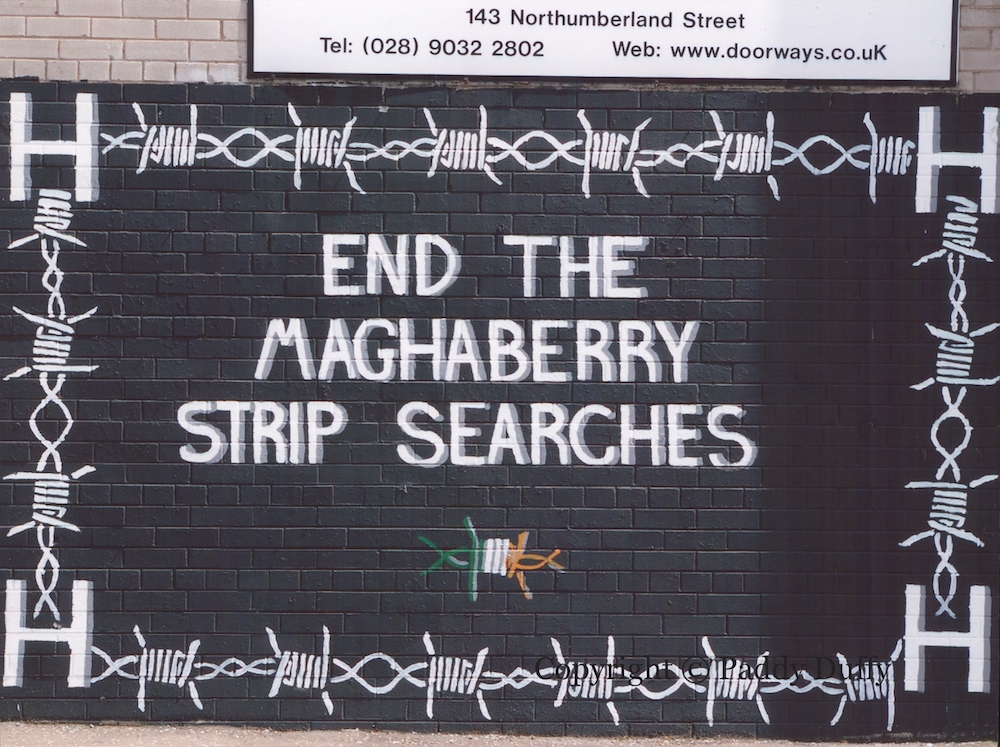
Irish Republican National Congress (Fb | web) board in Northumberland Street. This one features assault rifles and some nasty barbed wire; the one in Beechmount featured a Maid Of Erin harp.
With a small “Support the Palestinians” tarp below.
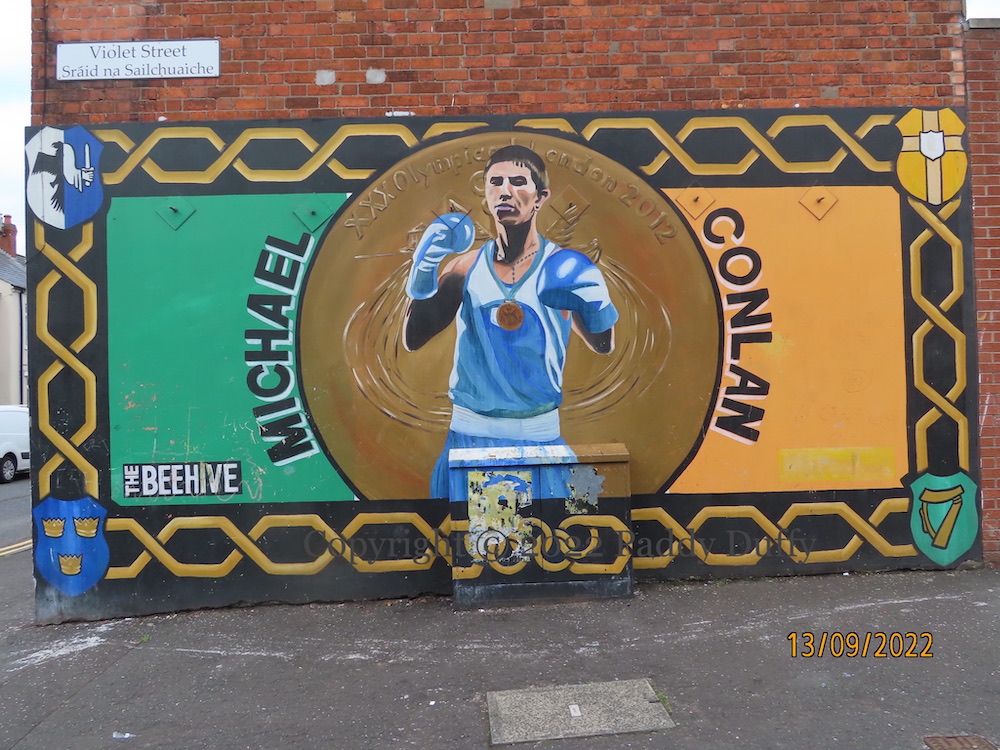
Michael Conlan won bronze in boxing at the 2012 Olympics. Boxing is organized on an all-island basis (WP), though at the Olympics boxers can choose to fight for either Ireland or GBNI. At London 2012, Ireland won four medals in boxing. The other winners were Paddy Barnes (bronze), Katie Taylor (gold) and John Joe Nevin (silver).
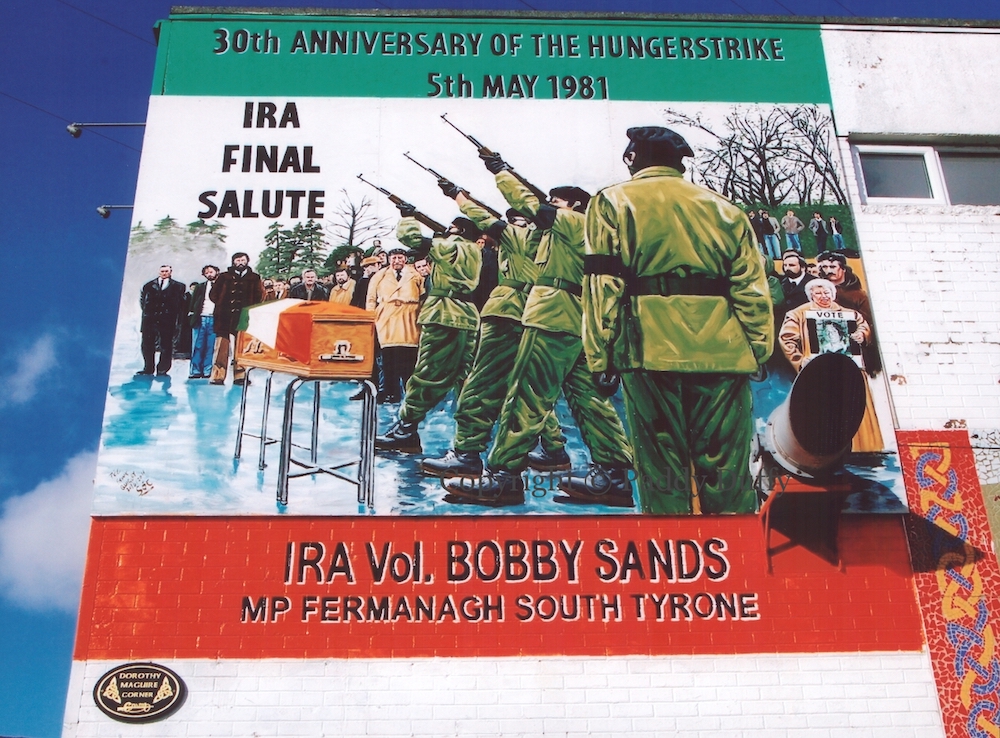
“30th anniversary of the hunger strike. 5th May 1981. IRA final salute. IRA Vol. Bobby Sands, MP Fermanagh South Tyrone.” Gerry Adams watches on as a funeral volley is fired over Sands’s coffin.
Also new is the plaque naming the wall as “Dorothy Maguire Corner”, after the 19-y-o shot in 1971, a member of Cumann Na mBan.
Painted on the Whiterock Road, west Belfast by Lucas Quigley.
RNU mural using the “H” for H-Blocks, along with the barbed wire symbol for POWs, to protest contemporary treatment of republican prisoners in Maghaberry.
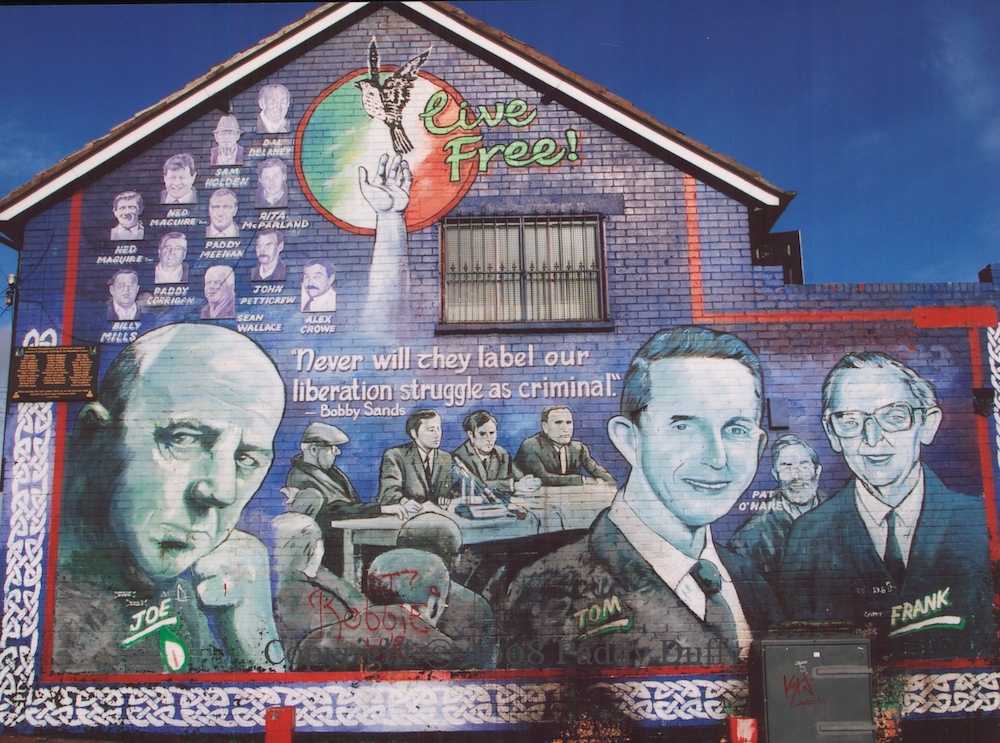
“Never will they label our struggle as criminal – Bobby Sands.” [March 6th Diary]
Joe Cahill joined Na Fıanna in 1937 and was involved in the republican movement from then until his death in 2004, including being in Tom Williams’s company in 1942 and later a founder member and Chief of Staff of the Provisional IRA. In the centre of the image he is at the end of the table at the August 13, 1971, press conference to comment on the introduction of internment (CAIN). He is honoured in the mural above alongside his brothers Tom and Frank Cahill. (Pat O’Hare is painted between Tom and Frank.)
In the top left are small boards with portraits of Ned Maguire Snr, Ned Maguire Jnr, Sam Holden, Dal Delaney, Rita McParland, Paddy Meenan, Paddy Corrigan, Sean Wallace, John Petticrew, Alex Crowe.
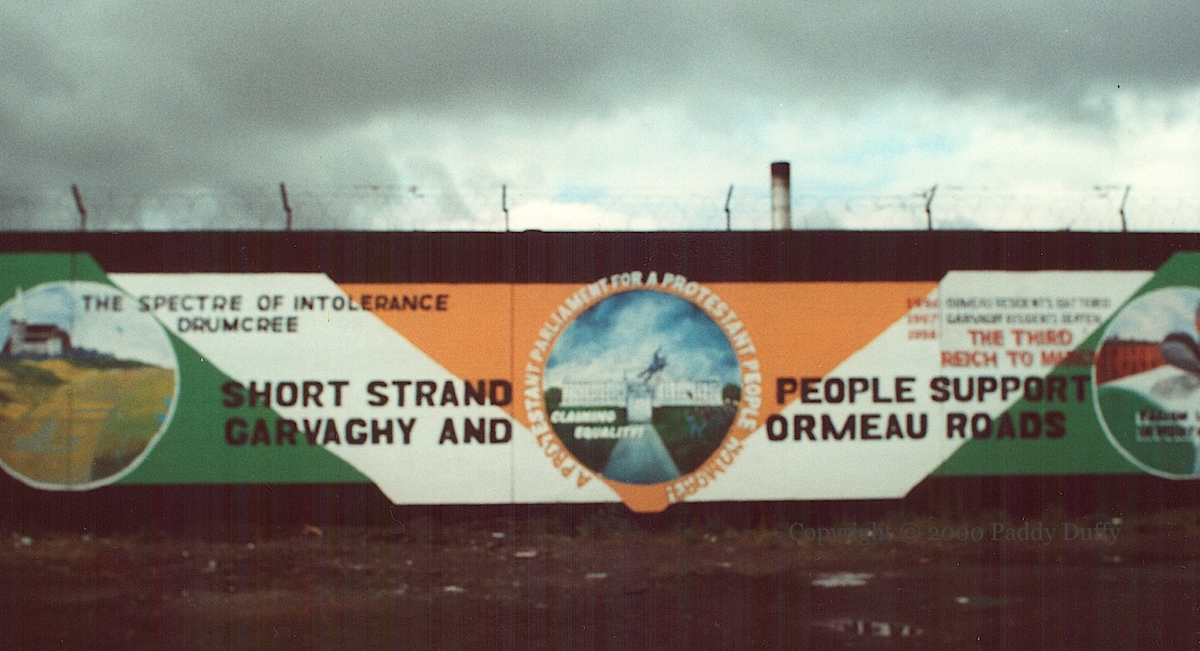
Northern Ireland’s first Prime Minister, James Craig, said in 1934, that Stormont was “carrying on a Protestant Government for a Protestant People” (NI Parliamentary Debates), though the phrase has now been transformed into the doubly alliterative “A Protestant parliament for a Protestant people”. In the centre of a long mural at the waste-ground at the top of Mountpottinger Road, people carrying Irish Tricolours tear down the statue to Northern Ireland’s most prominent leader, Sir Edward Carson, that stands outside Stormont, “claiming equality”.
The main issue that has tested the resolve of governments both local and national to the equality declared in the 1998 Belfast (Good Friday) Agreement is Orange Order parading through nationalist areas, such as the Garvaghy Road below Drumcree church in Portadown, and the Ormeau Road in south Belfast.
“Short Strand people support Garvaghy and Ormeau Roads.” On the left: The spectre of intolerance – Drumcree.” Centre: “A Protestant parliament for a Protestant people no more!” On the right “1996: Ormeau residents battered; 1997: Garvaghy residents beaten; 1998: The third reich to march.” and “Fascism lives! in Portadown”.
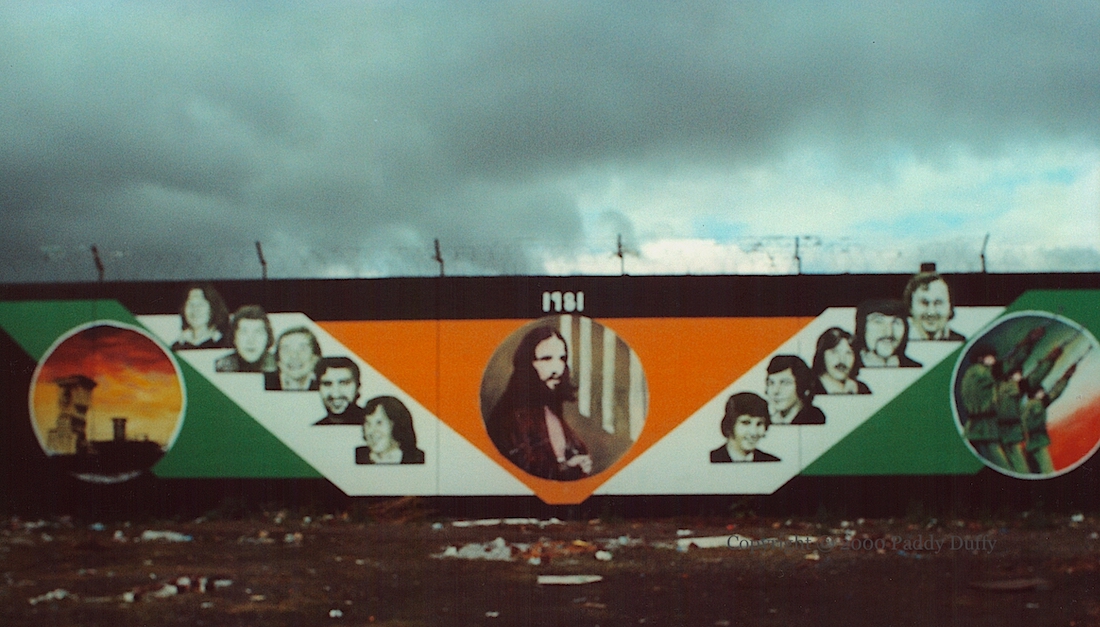
The piece is next to a hunger-strikers commemoration piece with ten portraits on shaped wooden boards against a painted background with blanket-man Hugh Rooney in the center. Between the two is a “spirit of freedom” lark and the names of the ten deceased 1981 strikers.
There was originally a memorial to Bobby Sands and painted crests of the four provinces below this phoenix emerging from the flames – see M01001 from 1991. It was originally painted by Mo Chara Kelly in 1987.
The dying Cú Chulaınn and the Blessed Virgin Mary make an odd pairing in this Ligoniel memorial garden to locals who died during the Troubles. Cú Chulaınn is typically used to memorialise paramilitary volunteers (see the Visual History page) but the plaque does not mention volunteers and the statuary suggests prayer rather than a final salute as a fitting form of remembrance.
The plaque in the centre, which was previously at the crux of a Celtic Cross mural, reads “I ndıl chuımhne [in fond memory]. This plaque is dedicated to the memory of all those from Ligoniel who lost their lives as a result of the conflict in our country. A Mhuıre banríon na nGael guıgh orthu [Mary, queen of the Gael, pray for them]”
The other mural in the yard is a greatly re-designed presentation of Éıre, taking up the whole wall, and replacing the Maid Of Erin harp with Érıu, the mythological queen of Ireland/Éıre, as designed by (or at least, in the style of) Richard J King/Rísteard Ó Cíonga. (Also seen in the Short Strand.)
“Peace with justice”, “Fáılte go dtí Bóthar Garbh Achaıdh”, “Re-route sectarian marches”.
Three murals were painted by three Belfast artists (DD, Marty Lyons, Mo Chara Kelly) in 1997 in Hurson Park (renamed from Churchill Park), Portadown, along the route of the Orange Order parade to and from Drumcree, in order to support the local residents who were attempting to block the march through the CNR Garvaghy Road.
In 1996, an initial decision to block the parade was overturned at the last minute, and 1,200 Orangemen marched down Garvaghy Road. The 1997 march also went ahead and “sit-down” protesters were physically removed from the road. (Here is 90 minutes of news footage from 1997 (youtube). There are brief clips of the muralists at work, at 20m44s, 28m48s, 35m16s, 37m32s, 43m26s, 53m23s, and 58m44s. The images of protestors being removed begin at 1h02m)






 Paddy Duffy Collection