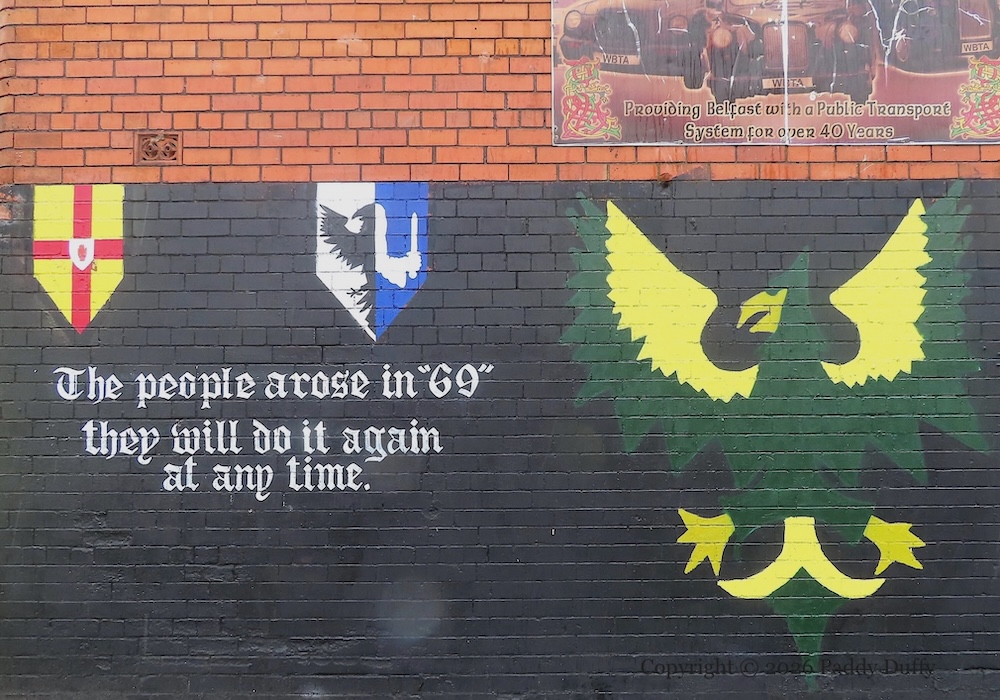
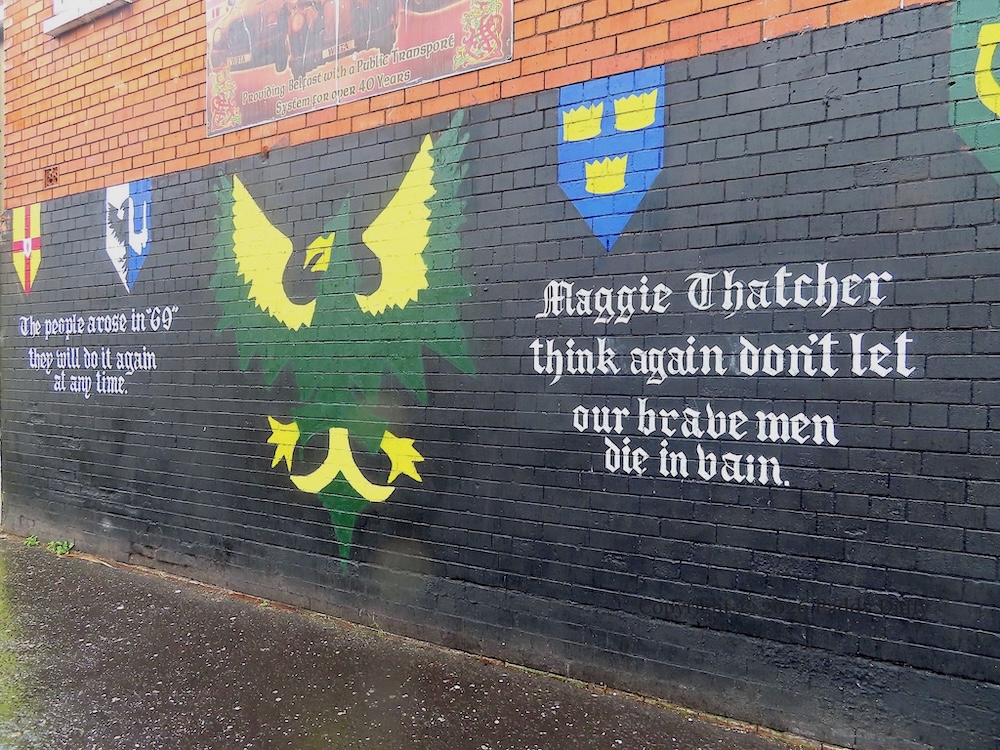
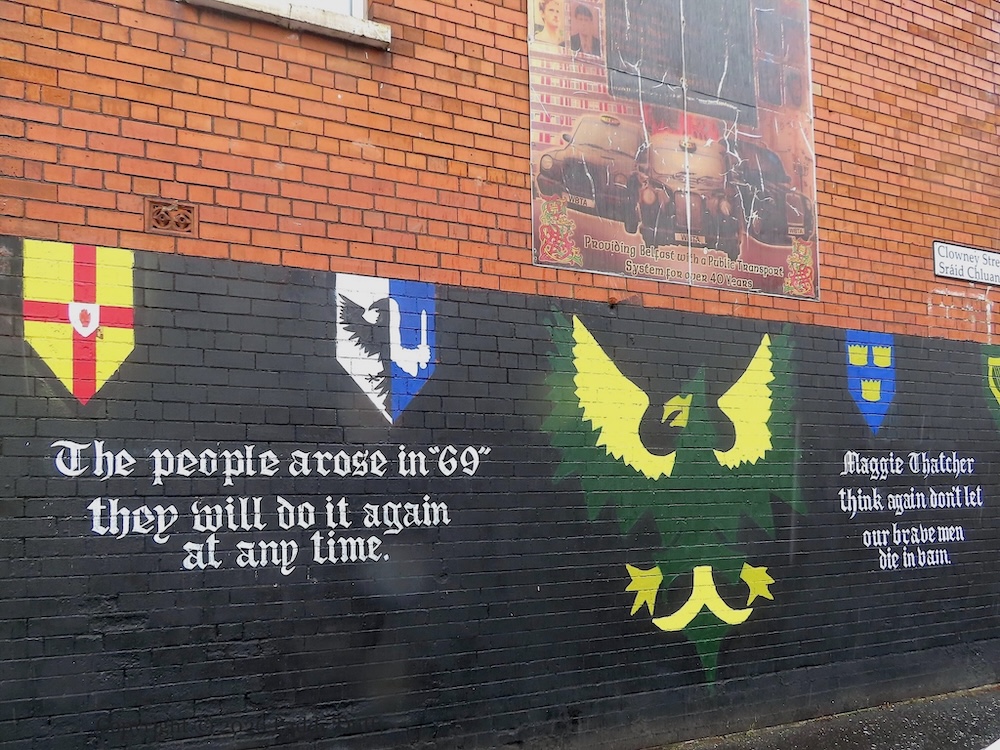
The phoenix in Clowney Street was first painted in 1981 and has been repainted periodically in the same form. (For a brief history, see The Oldest Murals.) In this update, the only noticeable changes are the quotation-marks around “69” and the golden feet on the phoenix.
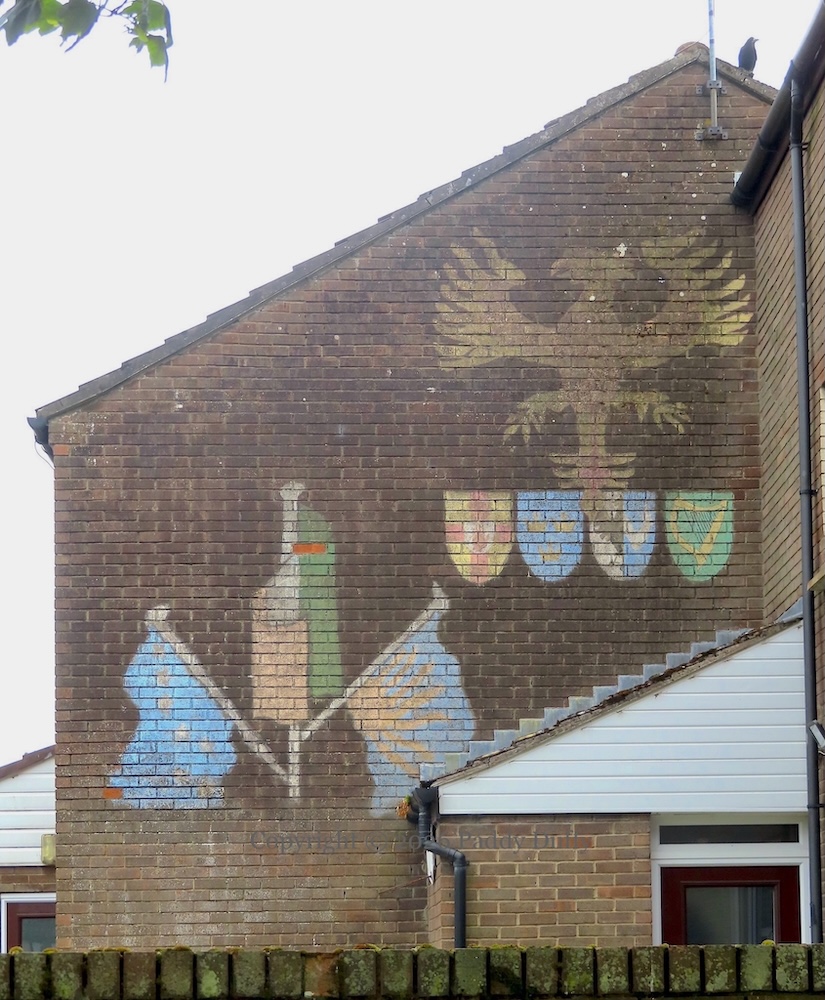
This mural, painted in 1981, still exists as is and is thus the oldest original mural in the north. It shows a phoenix rising from the shields of the four provinces and a stand of three flags: Starry Plough, Tricolour, and Sunburst.
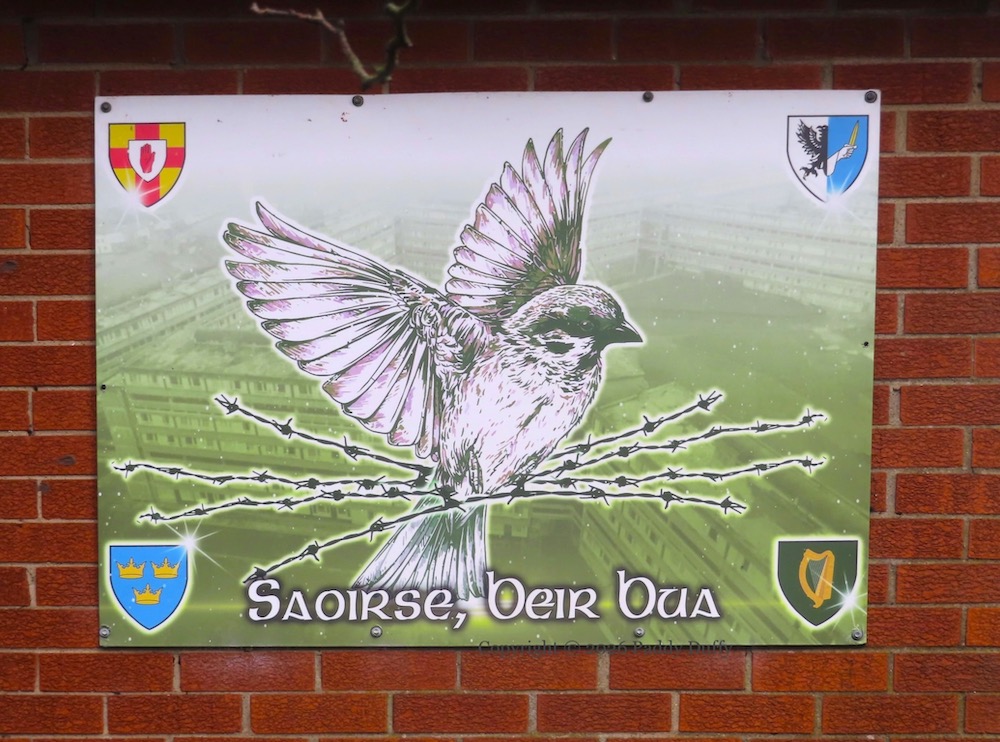
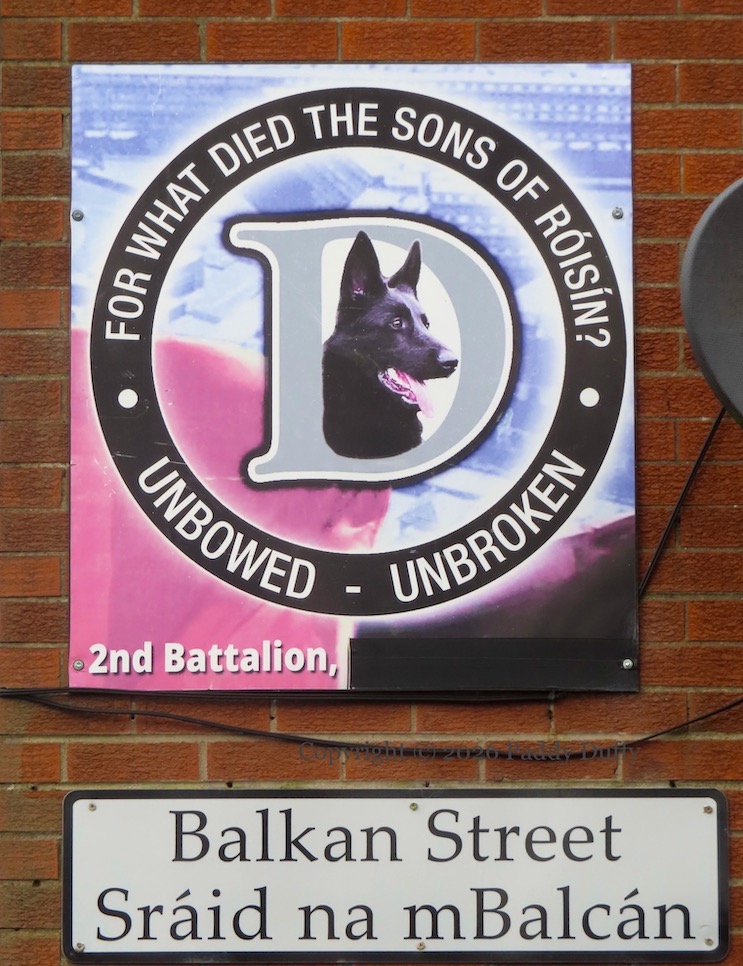
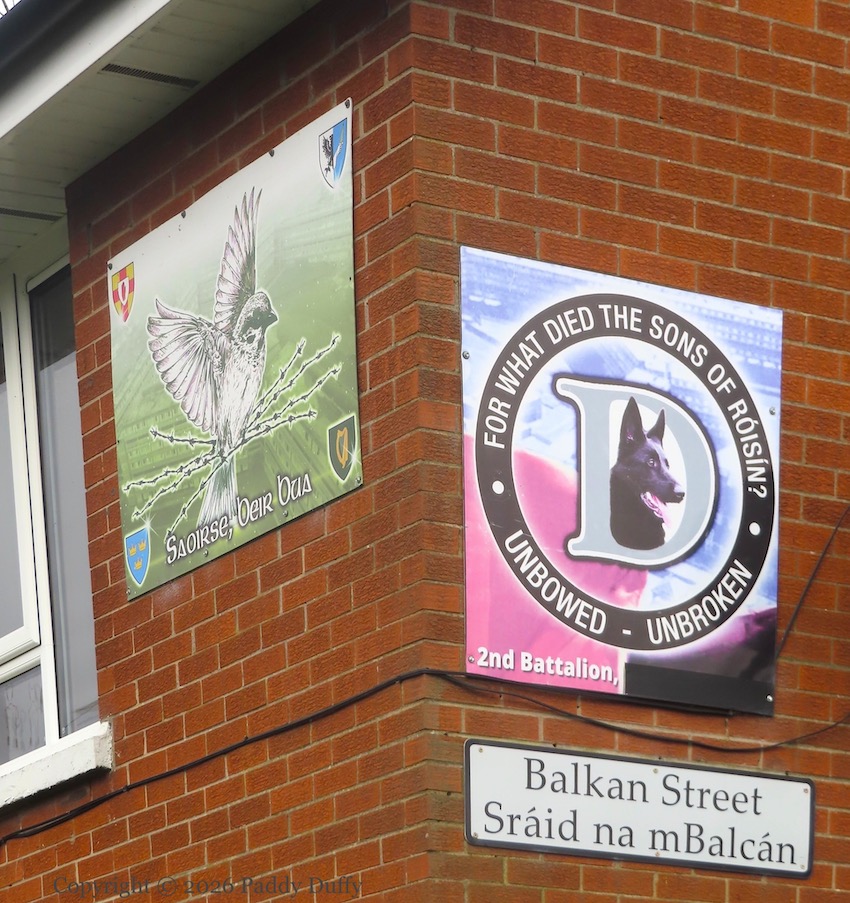
This is a pair of small boards at the corner of Balkan Street and Leeson Street, Divis, west Belfast.
Above, “Saoırse [freedom]” and “beır bua [seize victory]” and imagery of the four provinces and a lark in barbed wire are on top of the old Divis flats. The flats were built to replace the tightly-packed streets of the lower Falls. After the first three blocks were completed in 1969, there was a plan to have a mixture of flats all the way up to Dunville Park (“Phase 2” in this 30-minute BBC video on the flats, which also includes the story of its eventual demise.
Below, “For what died the sons of Róısín [Dubh]?” The Dogs of IRA D company, second battalion [Belfast brigade] are “unbowed” and “unbroken”.
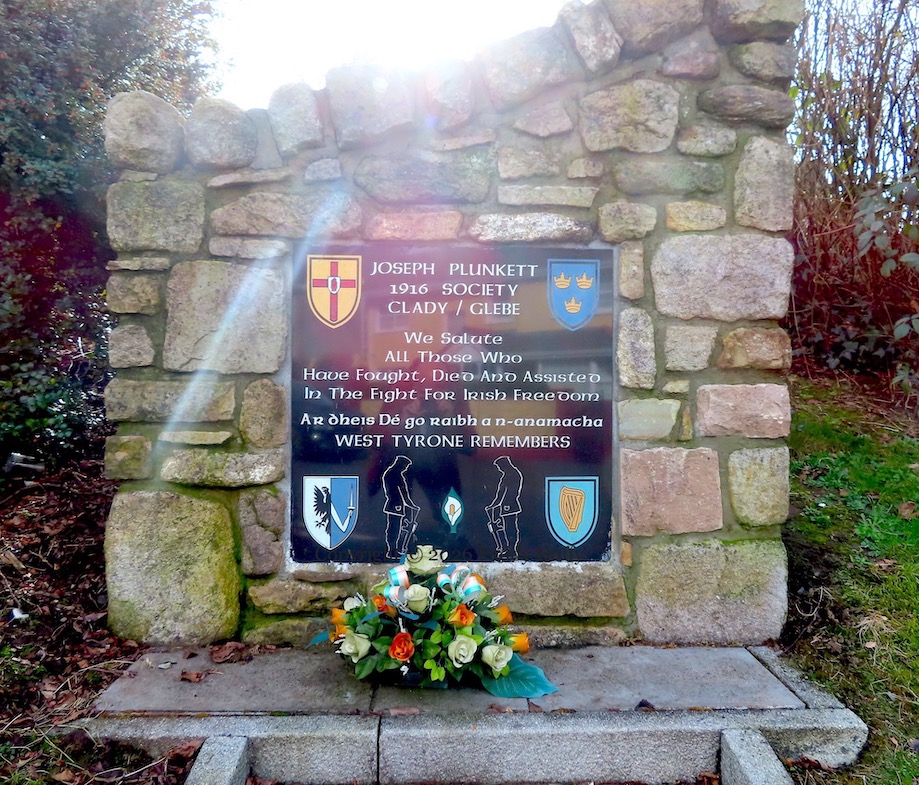
“We salute all those who have fought, died and assisted in the fight for Irish freedom. Ar dheıs Dé go raıbh a n-anamacha. West Tyrone remembers.”
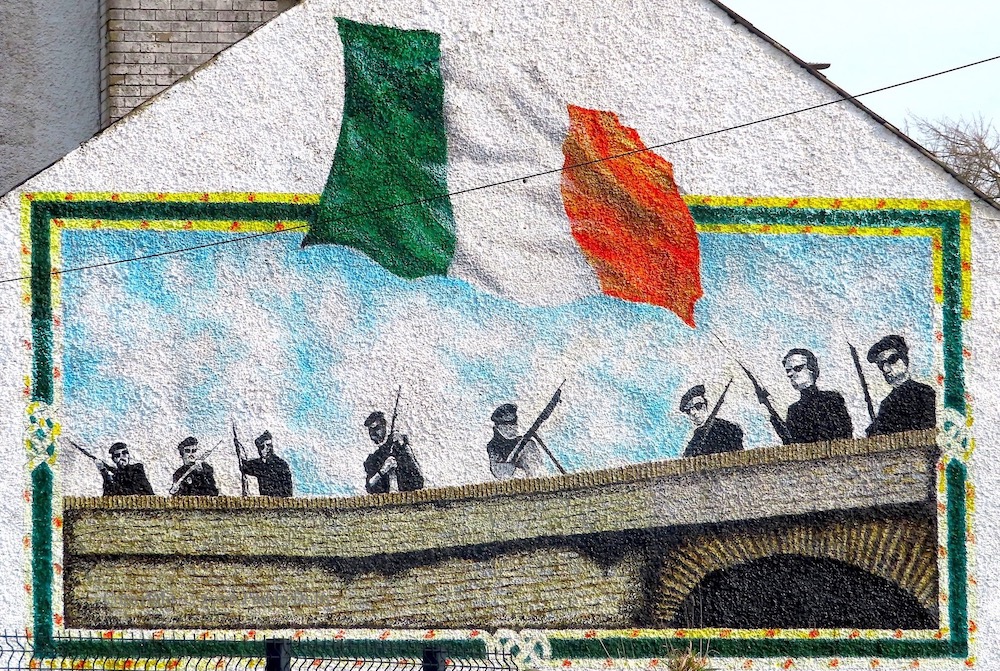
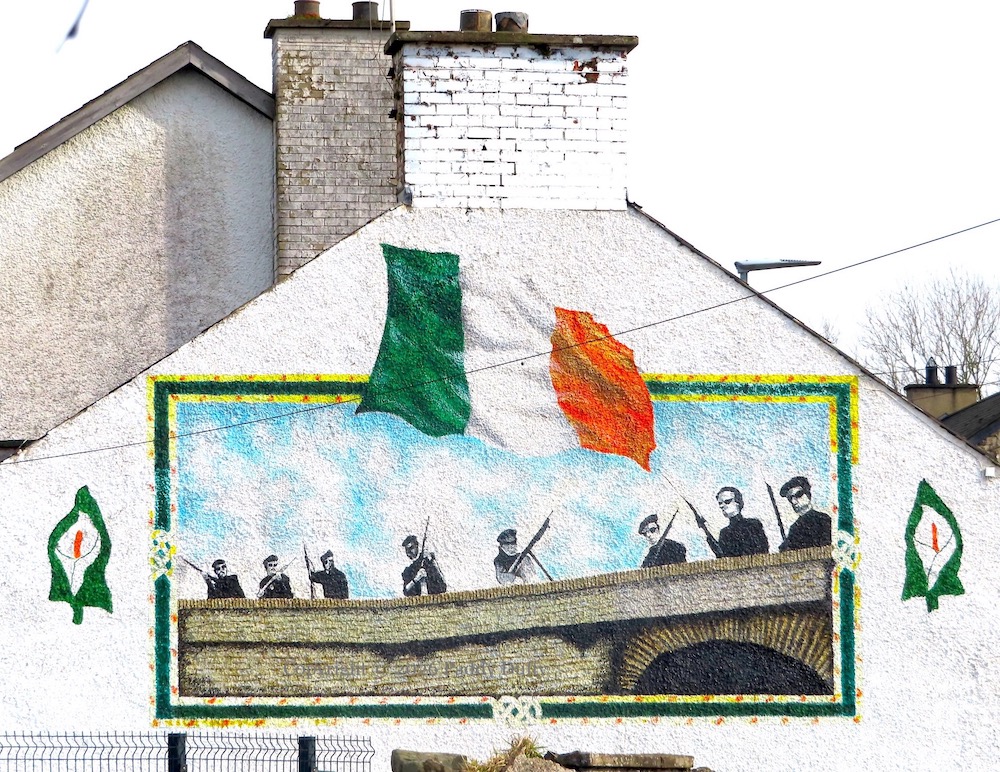
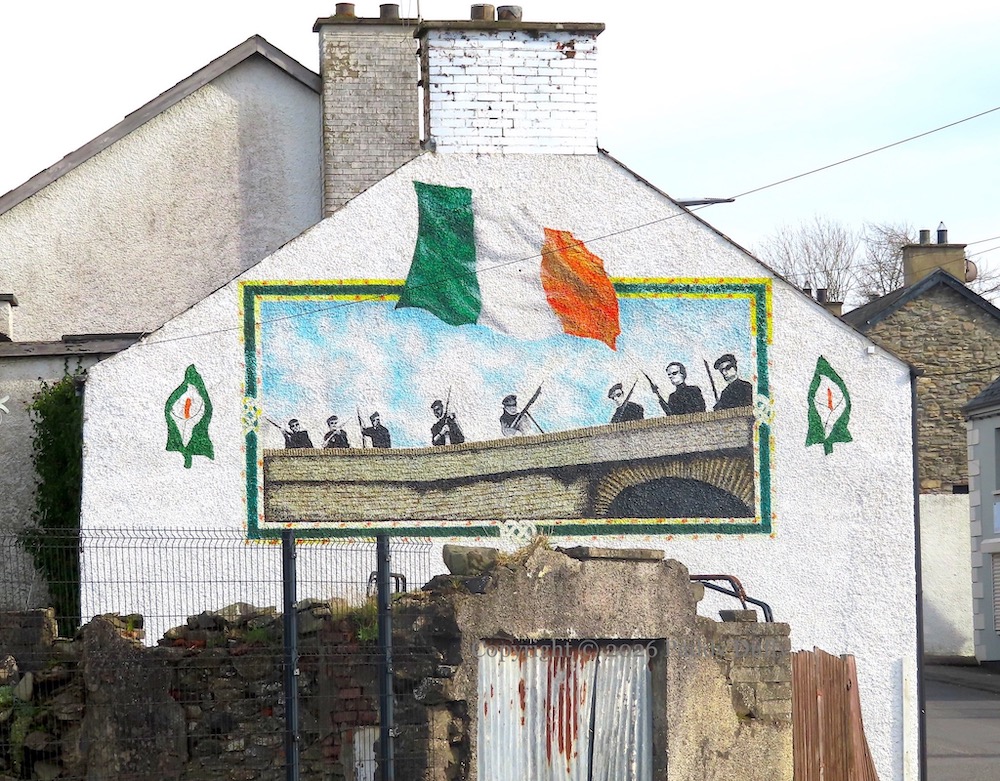
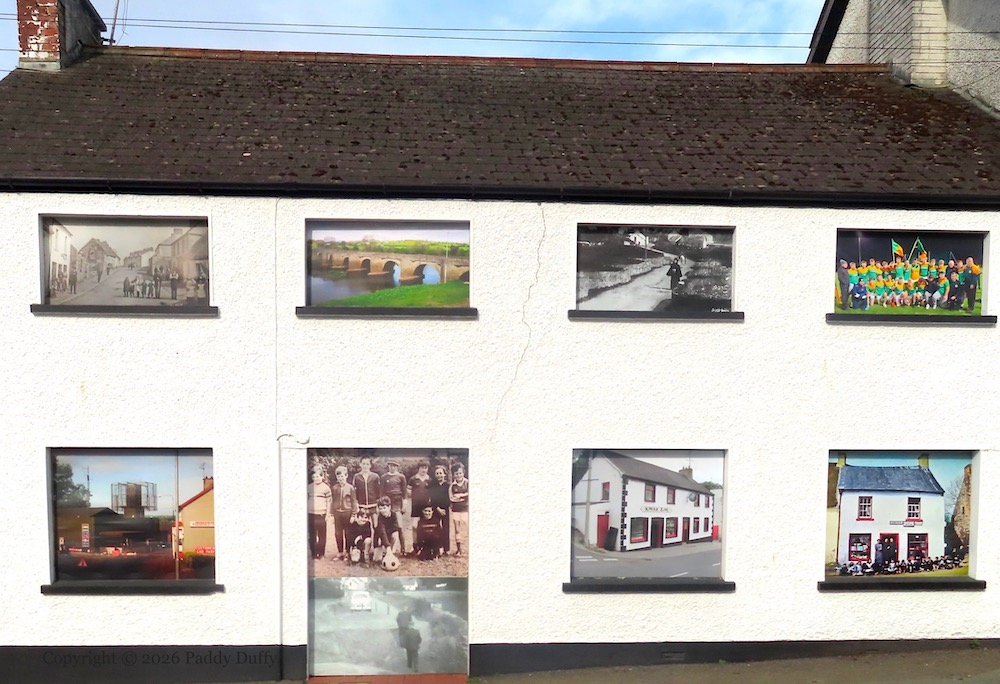
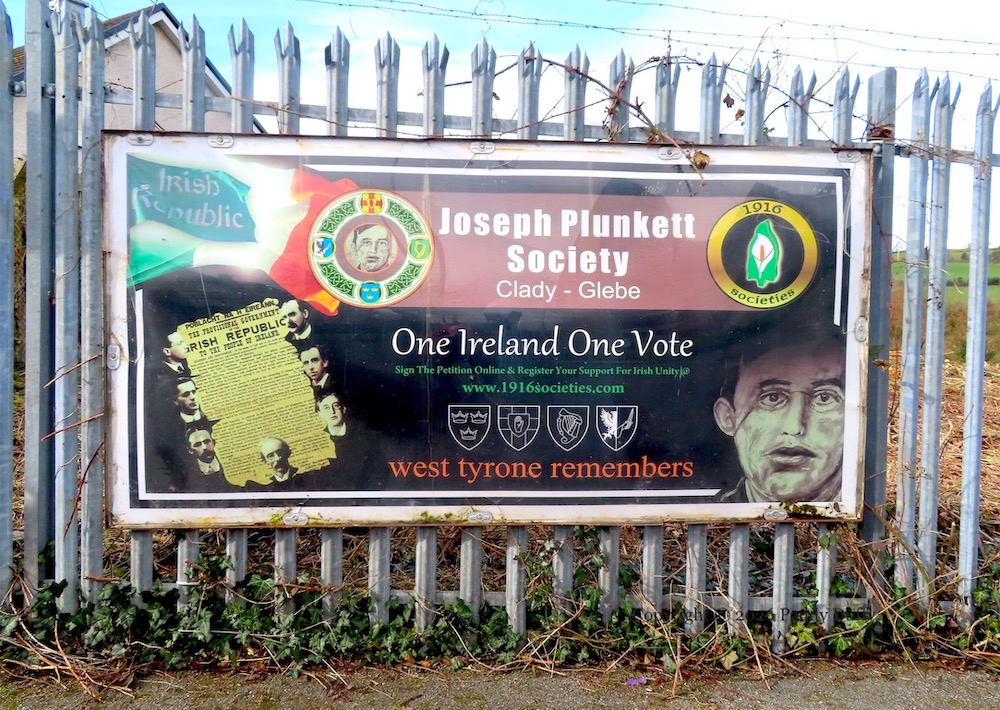
Above is a recent (2025-06) mural painted in Clady of IRA volunteers c. 1971 defending the bridge a stone’s throw outside the town, to prevent it from being blown up by the British Army. A history of the bridge, and the photograph which the mural reproduces, can be found at The Pensive Quill. The work of painting the mural and refreshing the window-boards of the building has been undertaken by the Joseph Plunkett 1916 Society Clady/Grebe (Fb).
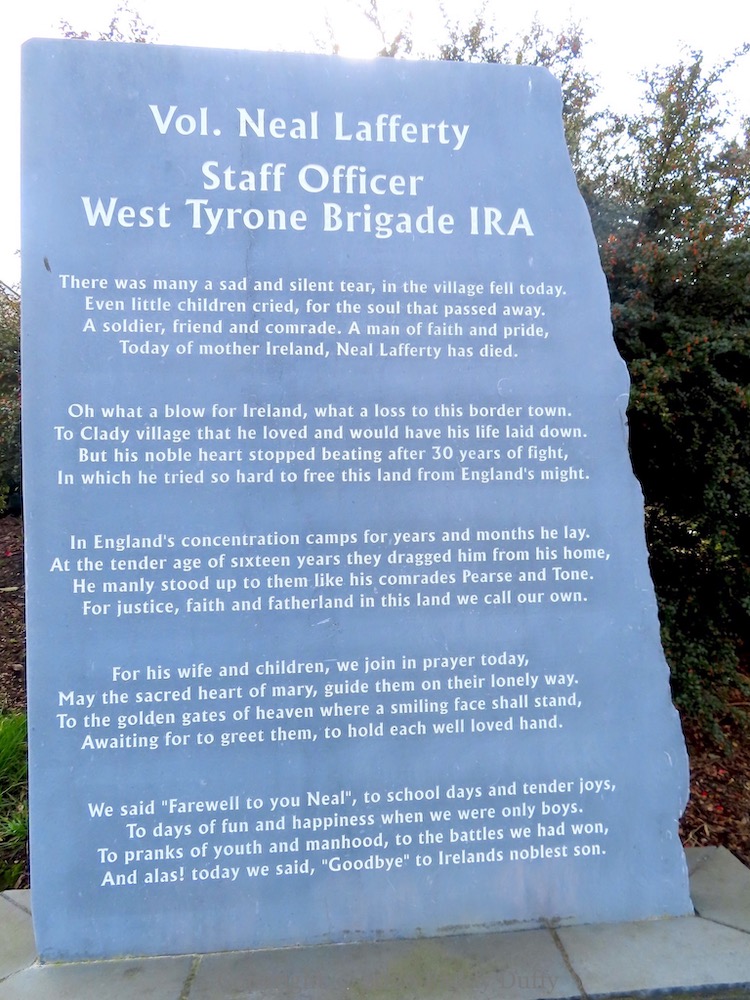
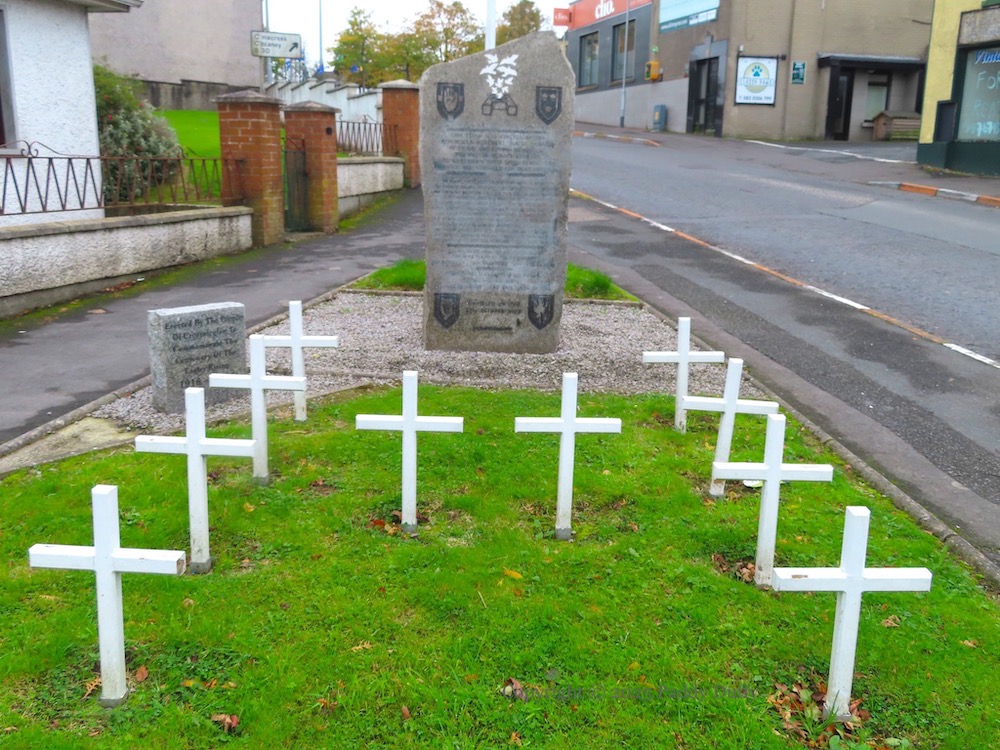
The two monuments, to volunteers generally and Neal Lafferty (d. 1975) specifically (Fb), stand together at the junction with Cluney Gardens. There is also a memorial to James McPhelimy (d. 1988) on the other side of Urney Road, and one to Jim McGann (d. 1973) on the bridge.
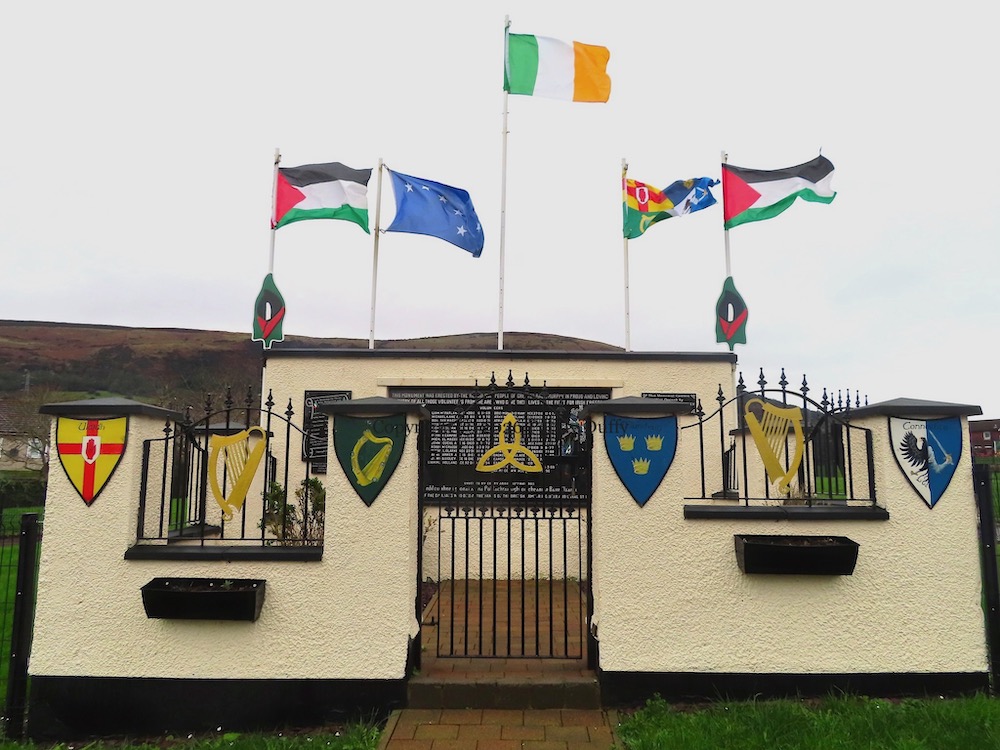
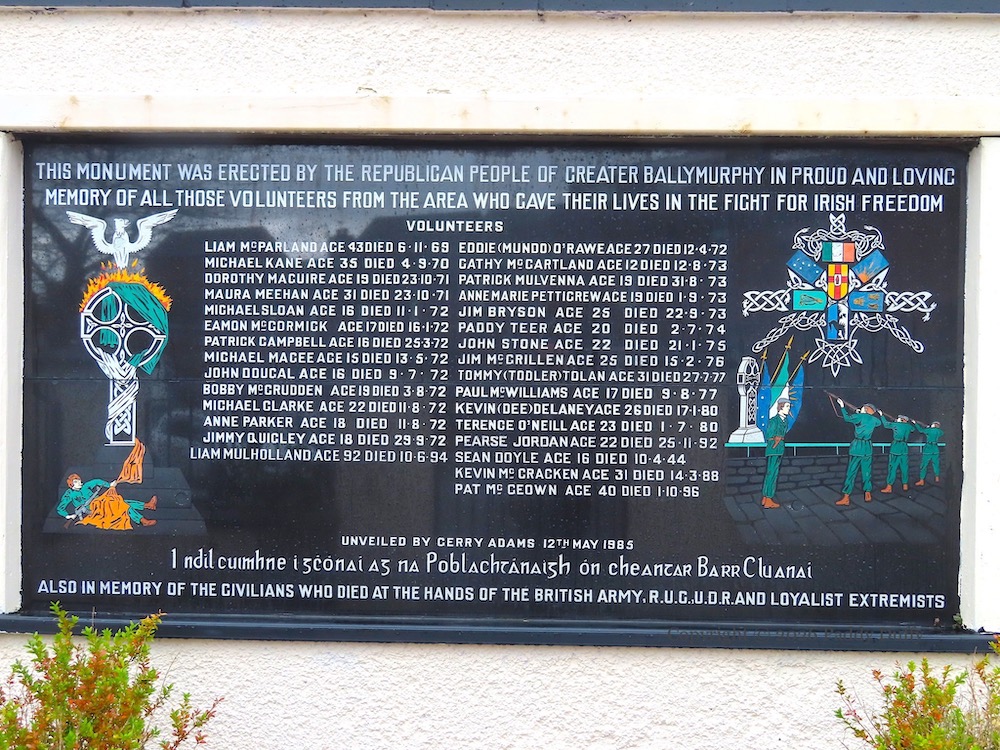
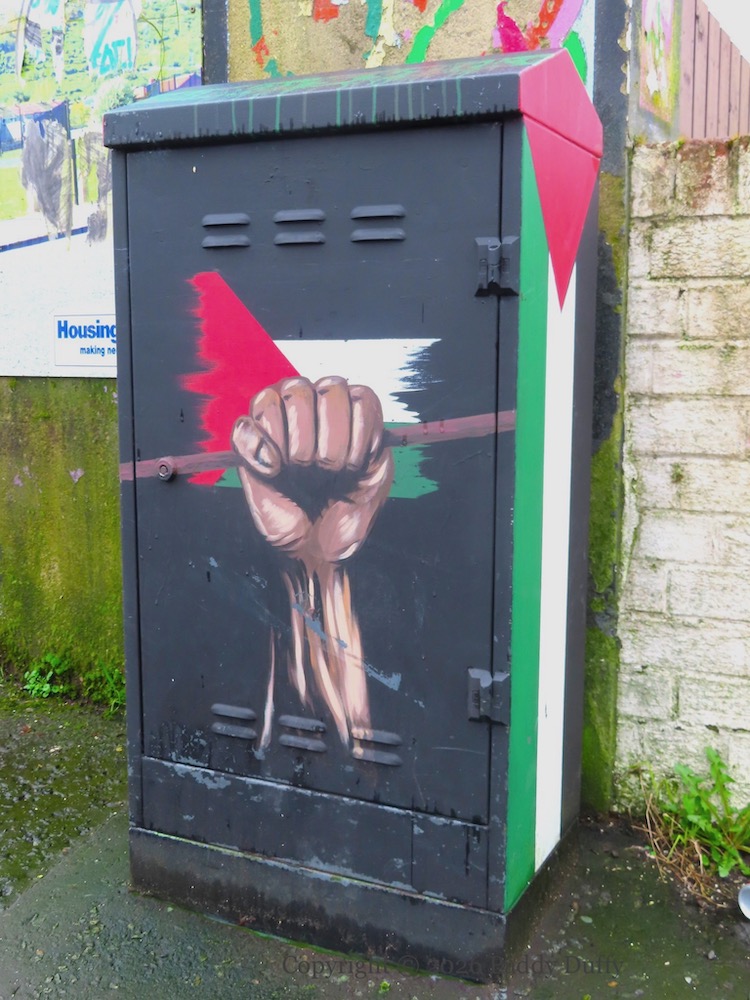
A pair of wooden lilies – symbol of the 1916 Easter Rising – are painted in the colours of the Palestinian flag and are placed below Palestinian flags on the Greater Ballymurphy memorial garden. (For the the names on the plaque, see the Peter Moloney Collection.)
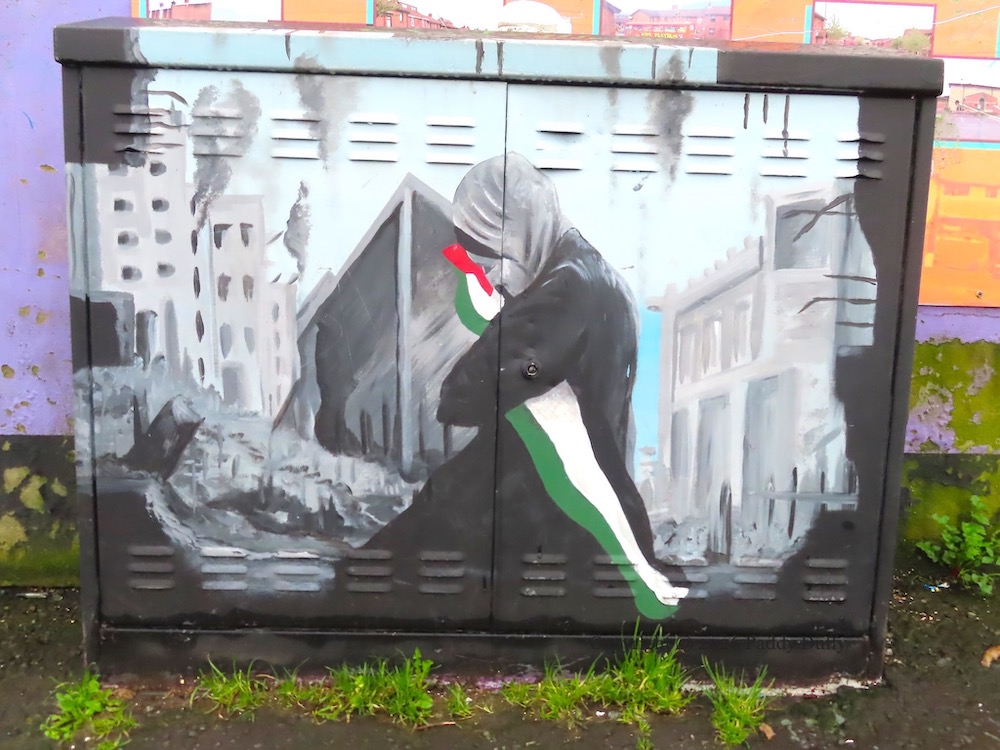
The electrical boxes (below) are from the community mural at the bottom of Springhill. The imagery on the second one is by Emmalene Blake – see Seas Leıs An Phalaıstín.
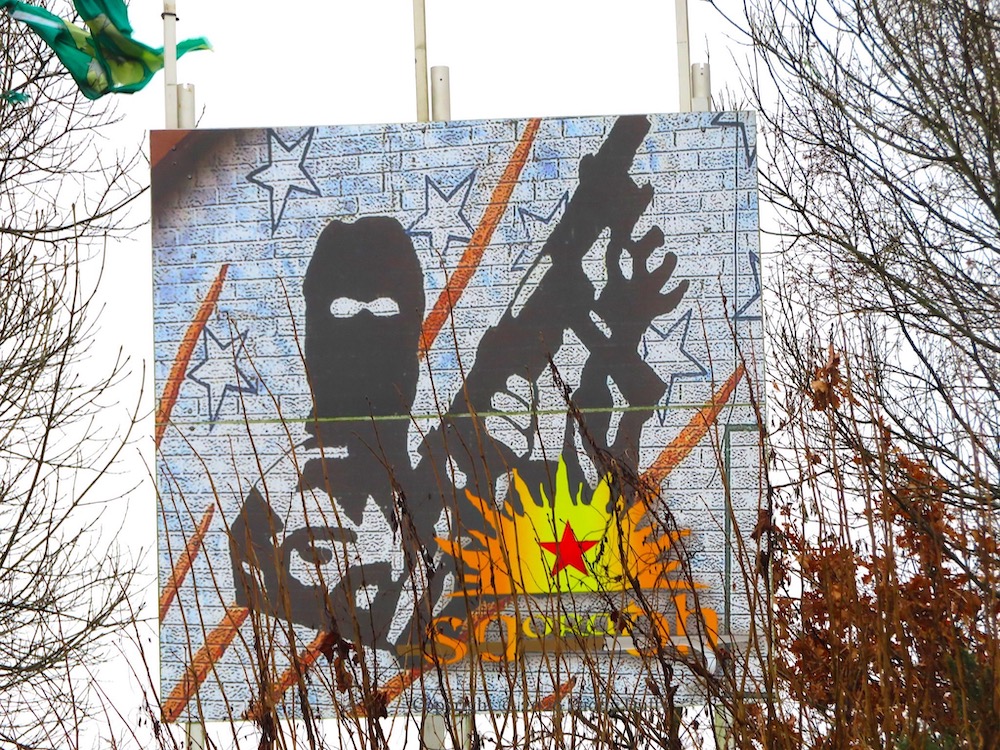
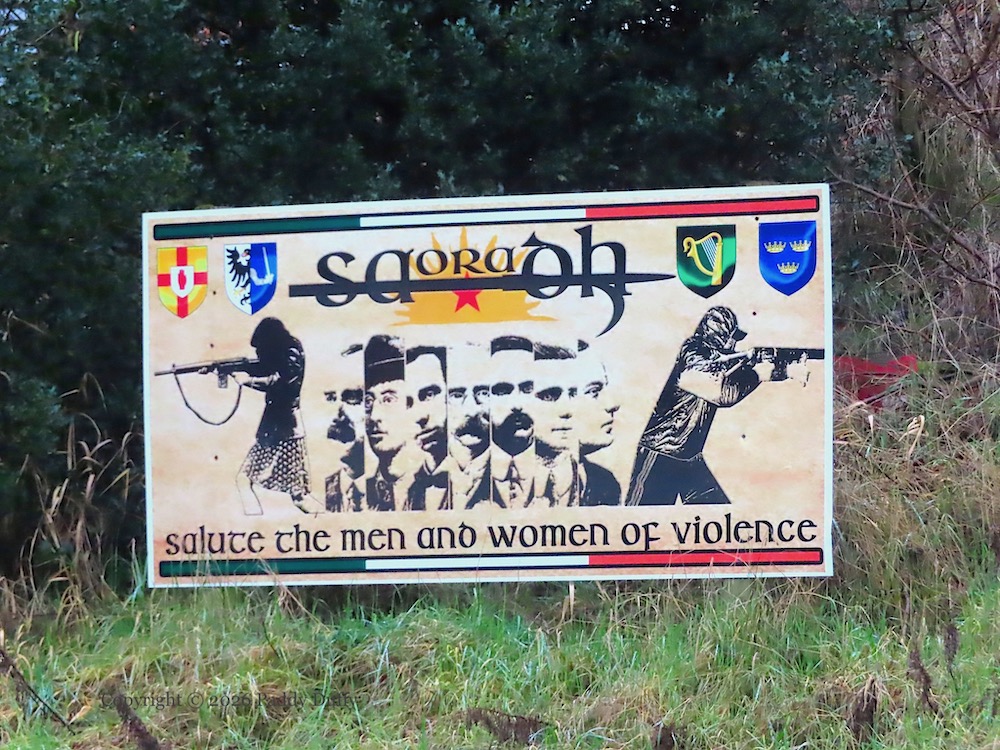
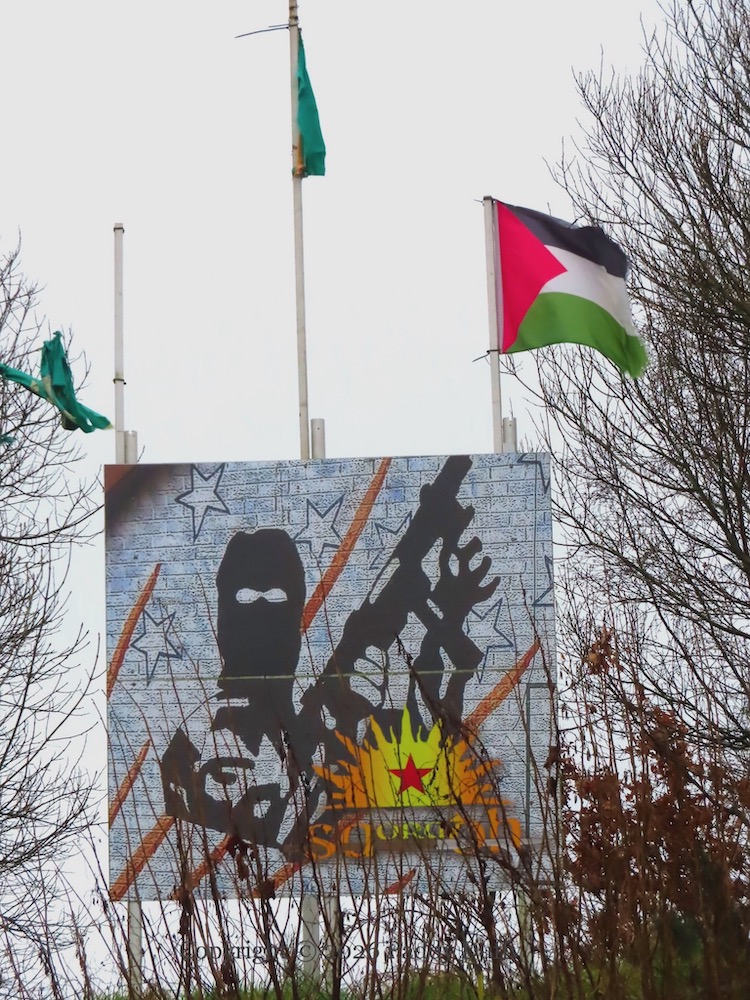
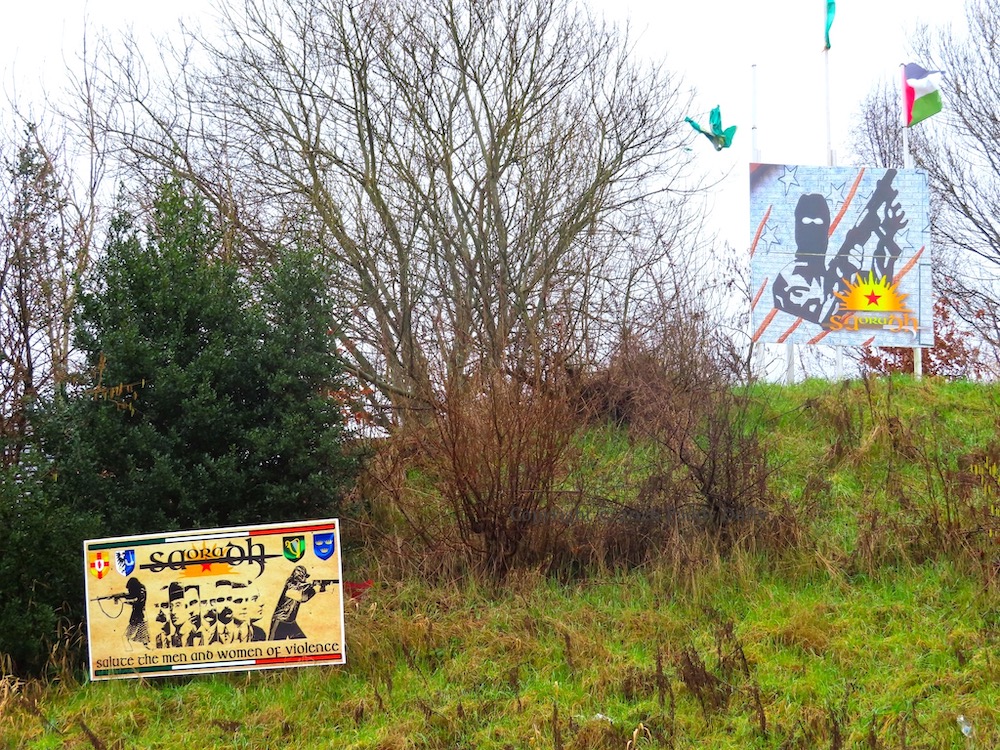
These two Saoradh (web) boards are at the roundabout on Camlough Road, Newry. The one above shows a vintage mural from nearby Carnagat Road that goes back to (at least) 1994 – the version painted in 2000 can be seen in the Peter Moloney Collection.
The other board reads “Salute the men and women of violence”, among whom are the seven signatories to the 1916 Proclamation, the IRA of the Troubles era – illustrated by Colman Doyle’s famous ?1973? (staged) photograph of a female IRA volunteer with AR-18 – and the post-Agreement groups (such as the New IRA) – illustrated by a home-made RPG (shown in Resistance).
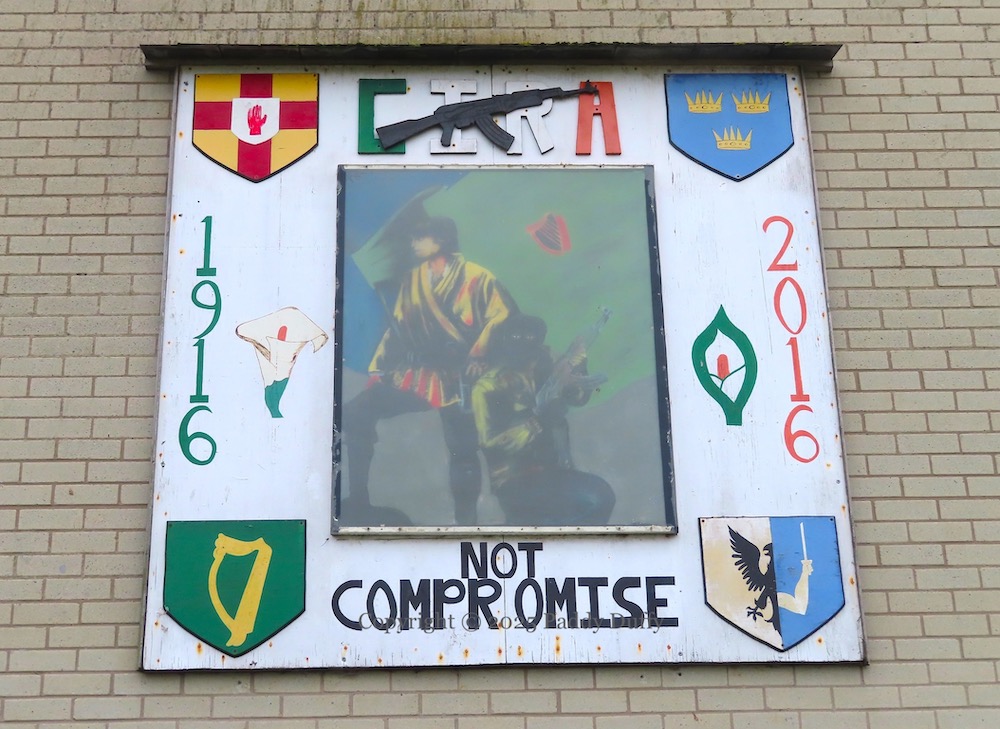
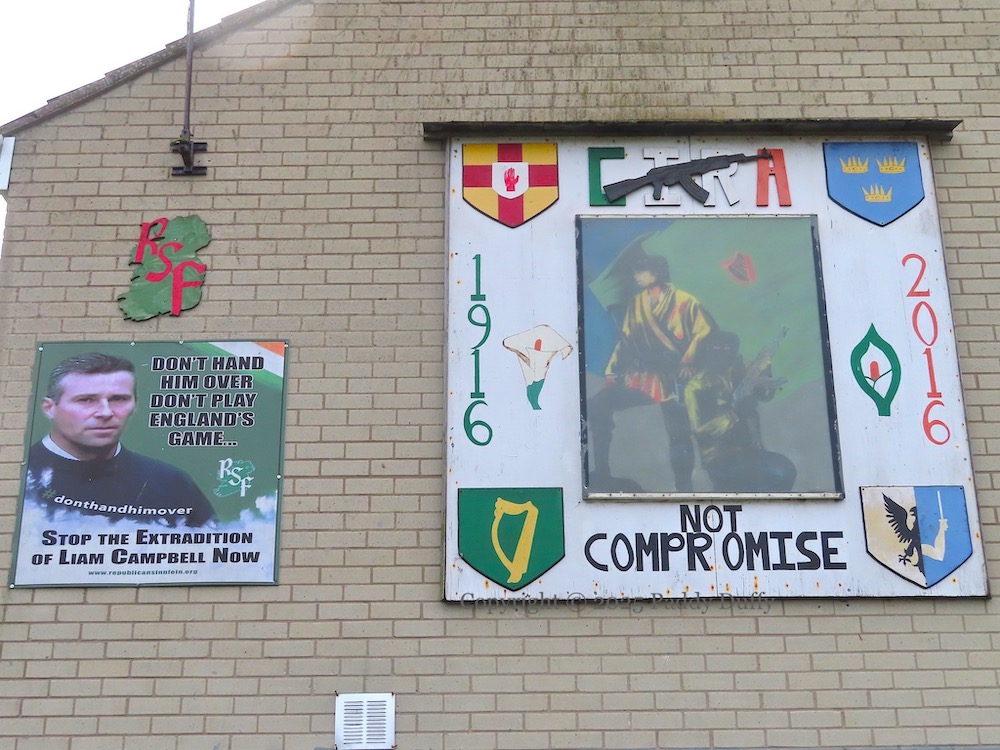
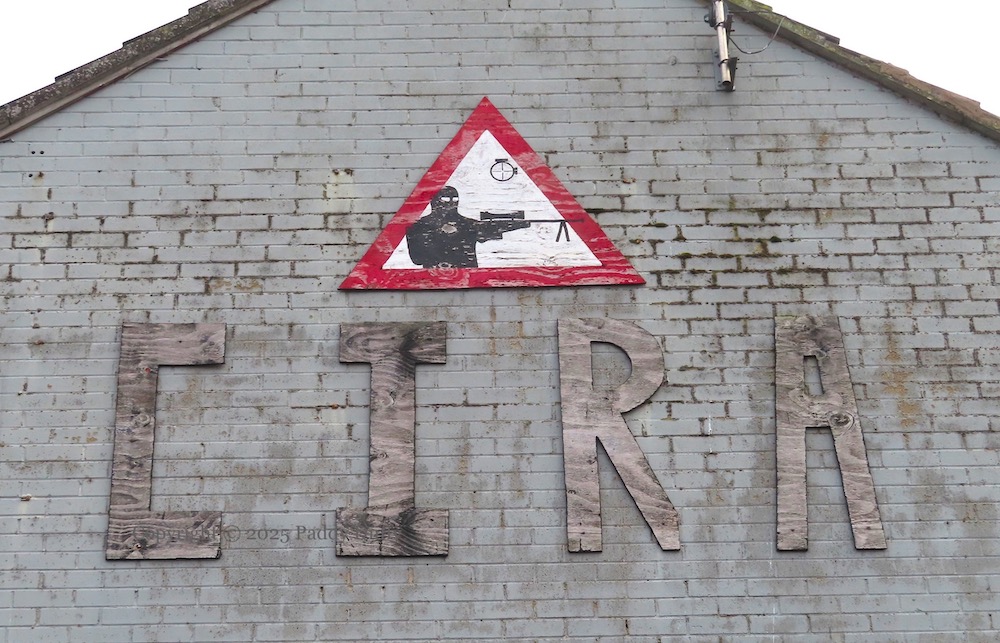
The CIRA (Continuity IRA) is the military wing of Republican Sınn Féın (RSF web), which split from Provisional Sınn Féın in 1986, though the military campaign did not begin until the Provisional IRA ceasefire in 1994. Like all of the various IRAs, the CIRA claims to be continuing the fight for (all-island) Irish freedom begun with the 1916 Easter Rising – the board (above) commemorates the centenary of the Rising.
To the left is a slightly newer RSF board: “Stop the extradition of Liam Campbell now – don’t hand him over, don’t play England’s game”. Campbell was extradited from the Republic to Lithuania in 2022 (BBC) but was returned to Ireland later the same year when a court ruled the statute of limitations has expired (RN).
The CIRA’s armed campaign is represented by the hooded gunman in the ‘warning sign’ below.
Also included (last below) is a small IRSP (web) stencil.
The pieces are in the adjacent Meadowbrook and Drumbeg areas of Lurgan.
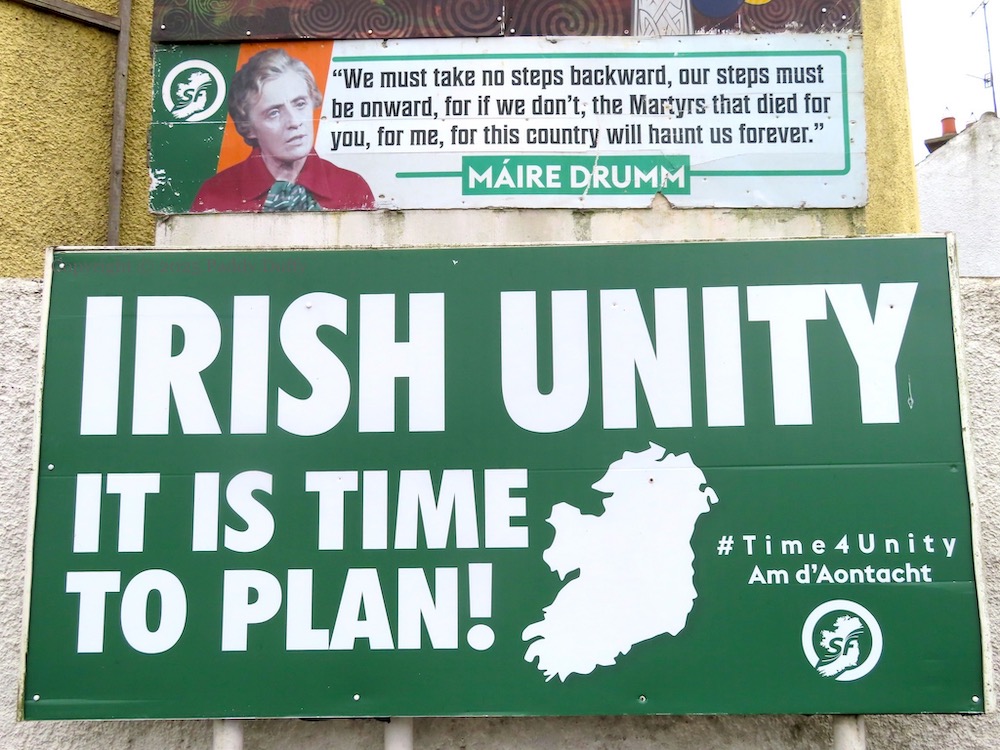
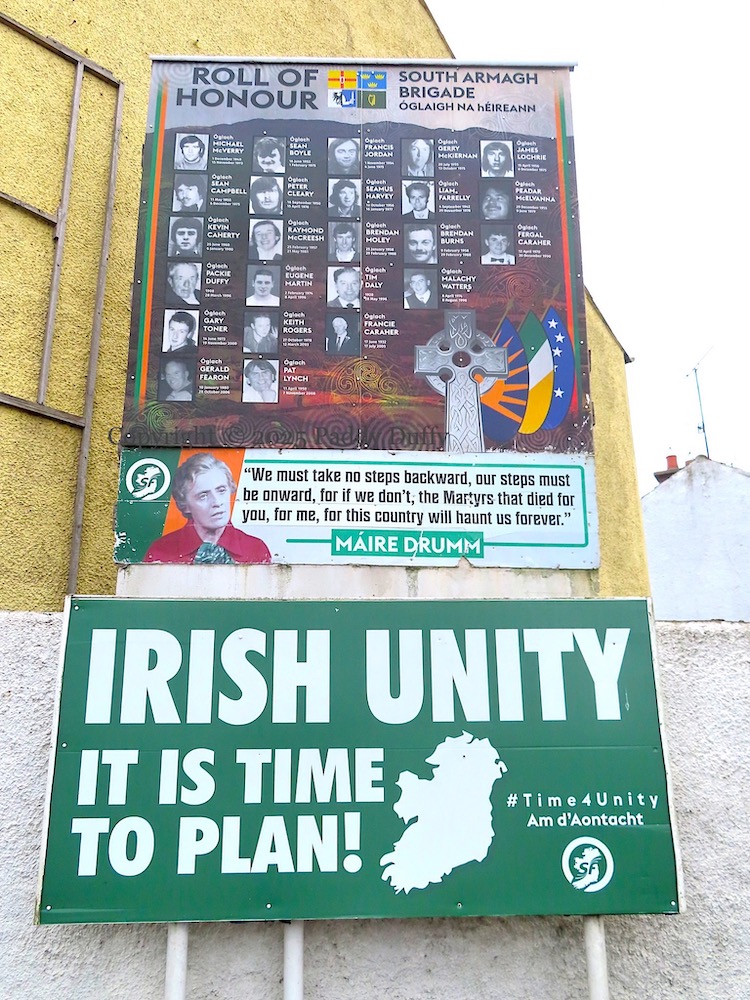
“We must take no steps backward, our steps must [or: will] be onward, for if we don’t, the [ghosts of the] martyrs that died for you, for me, for this country will haunt us forever [or: for eternity].” The words of Máıre Drumm (from an anti-internment rally in Dunville Park on 10th August, 1975 – RN p. 4) appear below a roll of honour for the IRA’s South Armagh Brigade. The list of volunteers is included below; in 1976 Drumm herself was shot dead in her bed by the RHC in the Mater hospital where she was a patient (WP) – she was Vice President of Sınn Féın at the time.
Michael McVerry, Sean Boyle, Francis Jordan, Gerry McKiernan, James Lochrie, Sean Campbell, Peter Cleary, Seamus Harvey, Liam Farrelly, Peadar McElvanna, Kevin Caherty, Raymond McCrees, Brendan Moley, Brendan Burns, Fergal Caraher, Packie Duffy, Eugene Martin, Tim Daly, Malachy Watters, Gary Toner, Keith Rogers, Francie Caraher, Gerald Fearon, Pat Lynch
Twelve more of the martyrs – the Troubles-era hunger-strikes – are on the stone across the street (for a close-up, see the Peter Moloney Collection).
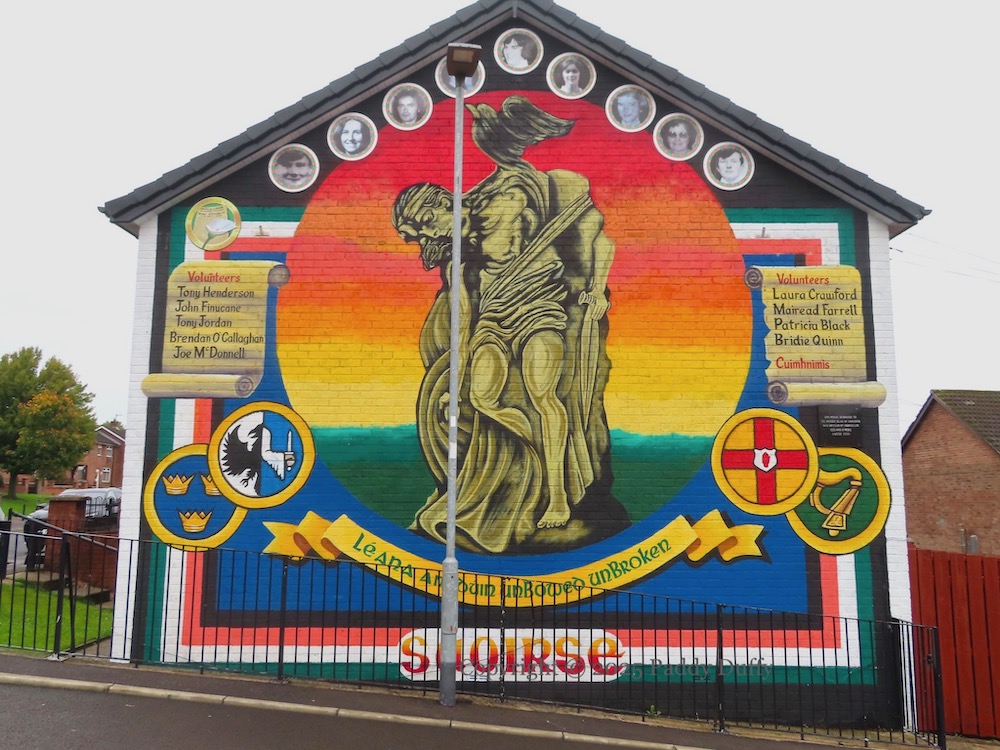
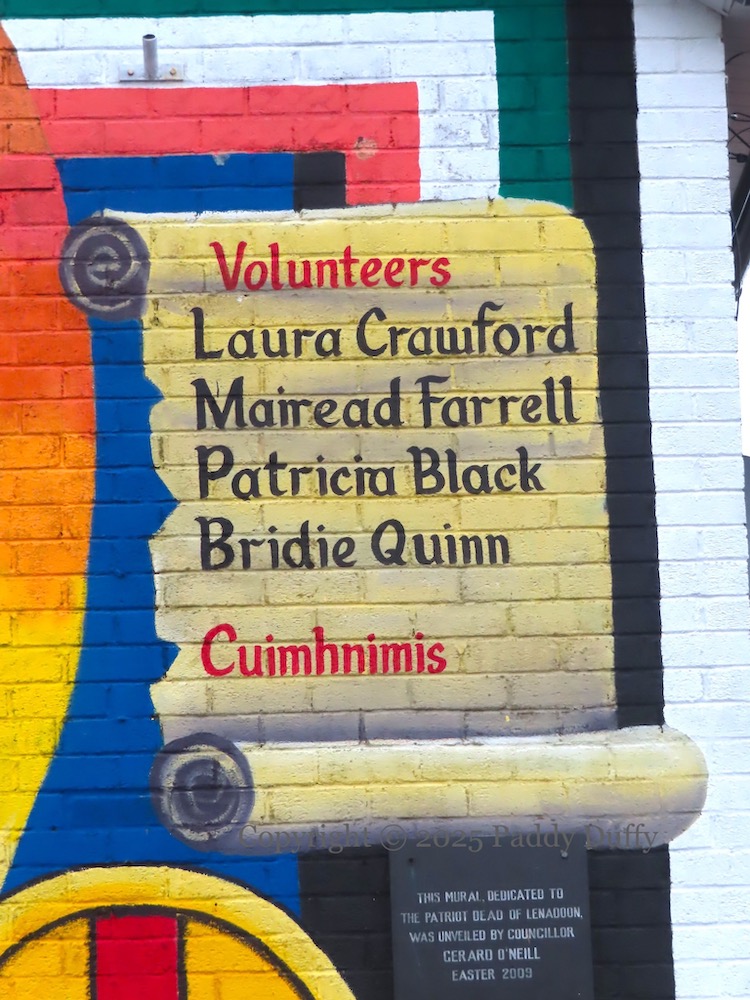
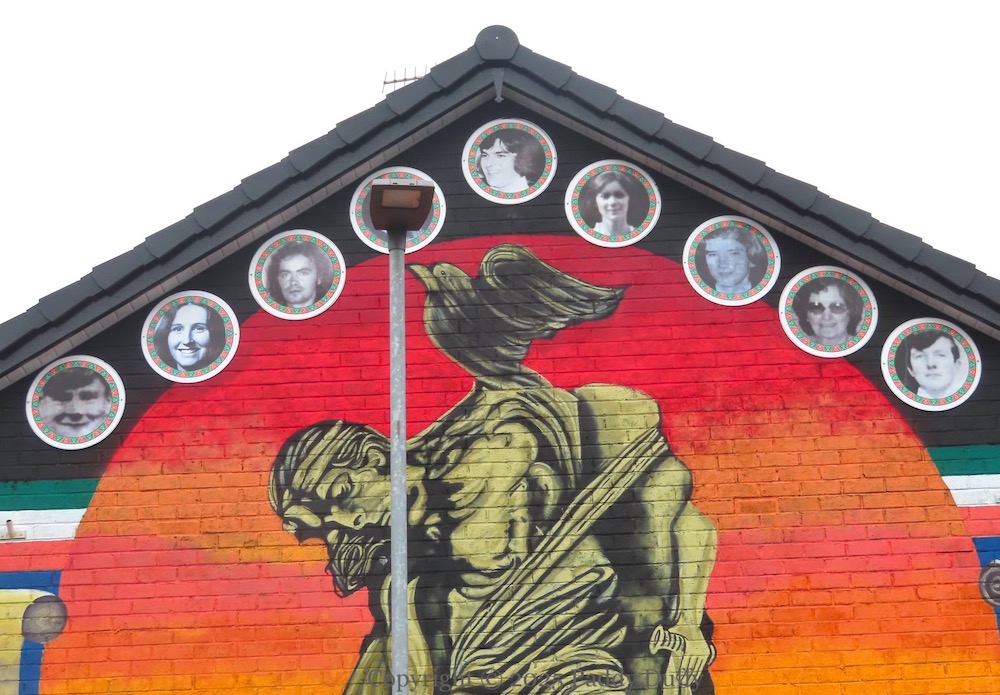
Oliver Sheppard’s statue of Cú Chulaınn dying – see the Cú Chulaınn Visual History page – memorialises nine IRA volunteers from the Lenadoon area, whose names are listed on the scrolls to each side and whose portraits appear in the apex: Tony Henderson, John Finucane, Brendan O’Callaghan, Joe McDonnell, Laura Crawford, Maıréad Farrell, Patricia Black, Bridie Quinn. Below the statue are the shields of the four provinces and the words “Léana An Dúın – unbowed, unbroken” and “saoırse” [freedom].
The mural dates back to 1996 (see T00160) and was repainted in 2009 (see M05134) and c. 2014 (see M11028, which includes a close-up of the plaque added in 2009.) In this version, nothing has changed in the composition of the mural and the photographic portraits and the Easter Rising centenary board have been retained.
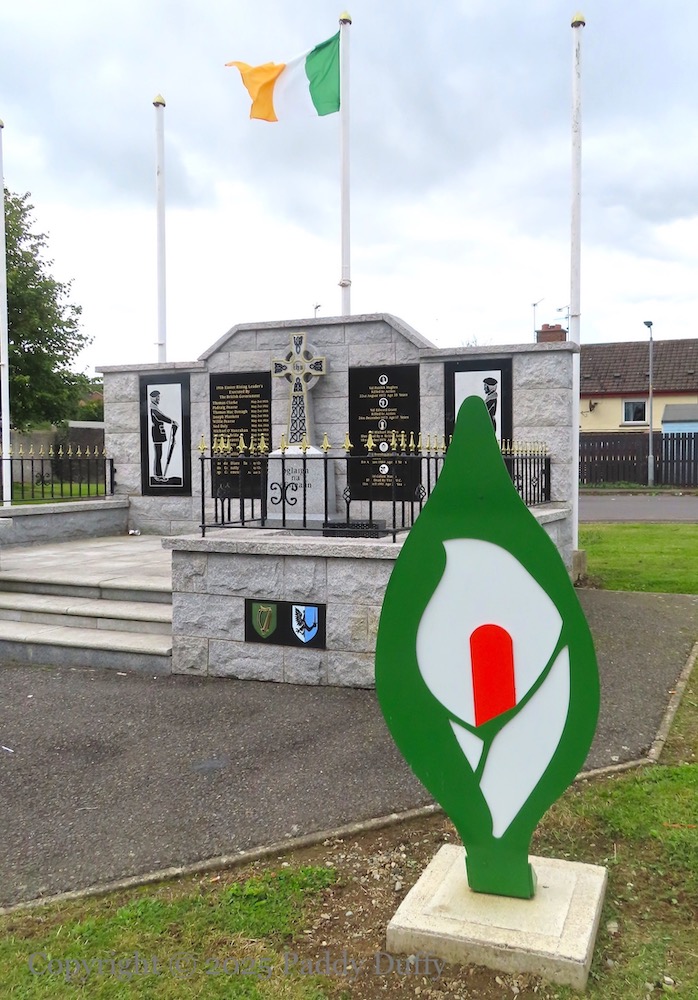
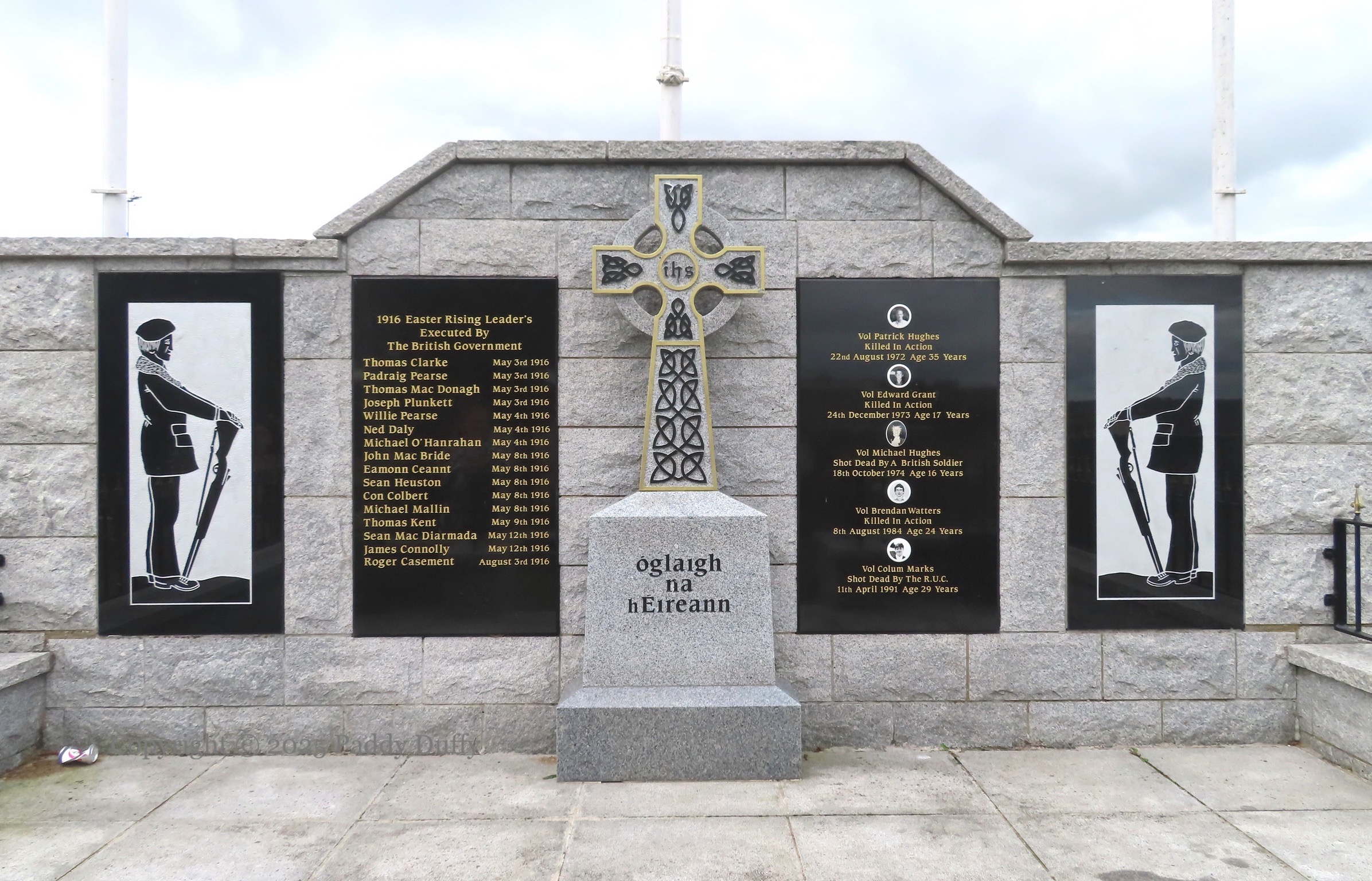
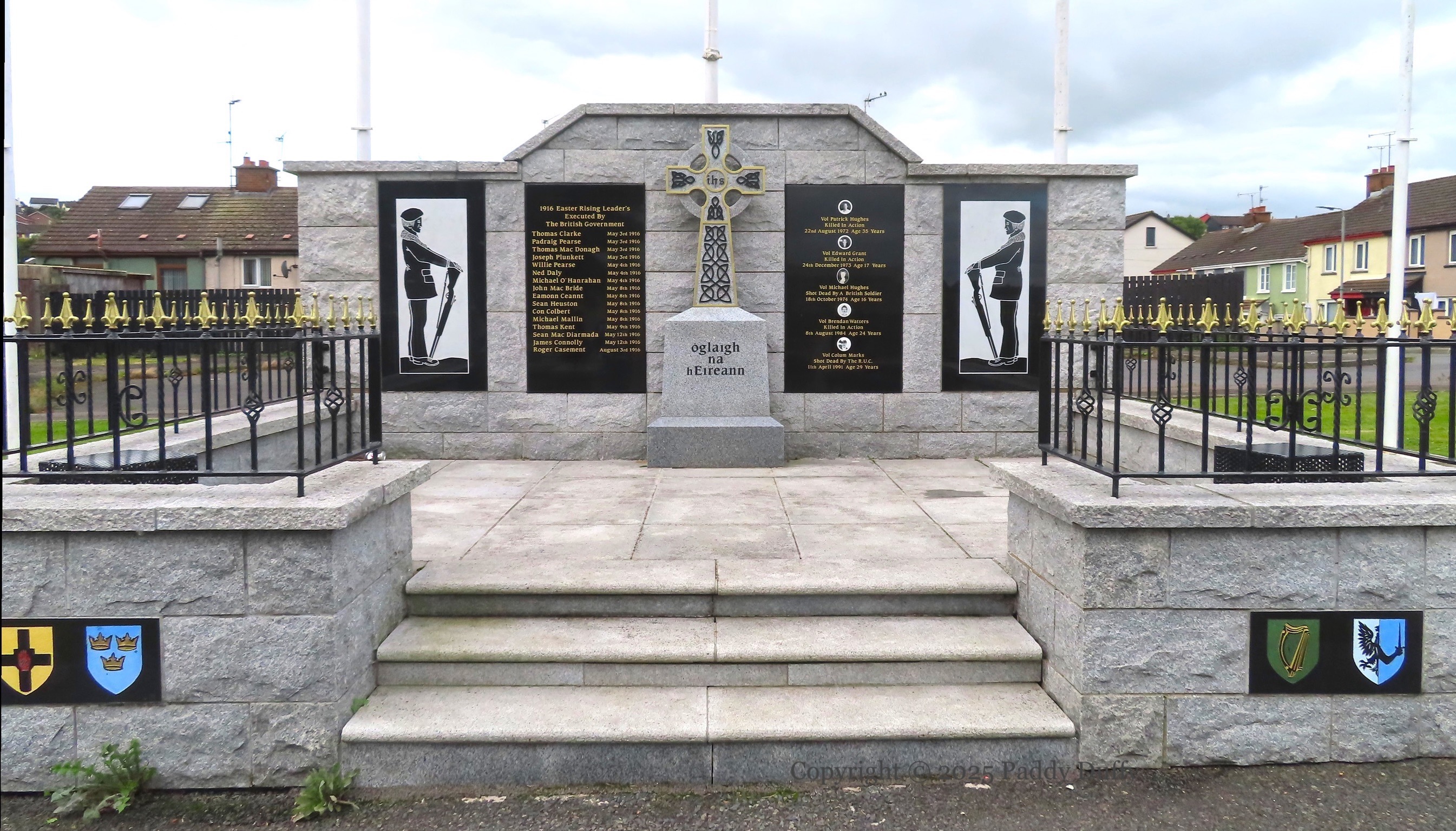
On the left of this Newry memorial is a list of the “1916 Easter Rising Leaders executed by the British government: Thomas Clarke, Padraig Pearse, Thomas Mac Donagh, Joseph Plunkett, Willie Pearse, Ned Daly, Michael O’Hanrahan John Mac Bride, Eamonn Ceannt, Sean Heuston, Con Colbert, Michael Mallin, Thomas Kent, Sean Mac Diarmada, James Connolly, Roger Casement.”
On the right are five members of the local Óglaıgh na hÉıreann: Patrick Hughes, Edward Grant, Michael Hughes, Brendan Watters, Colum Marks.” Michael Hughes/Mıcheál Ó hAodha is commemorated at the western entrance to the estate and the plaque also mentions the death of his father, Patsy, and the death by premature explosion of his friend Eddie Grant in 1973. Brendan Watters likewise died by premature explosion (UPI). There is a memorial stone in Downpatrick at the spot where Colum Marks was killed.
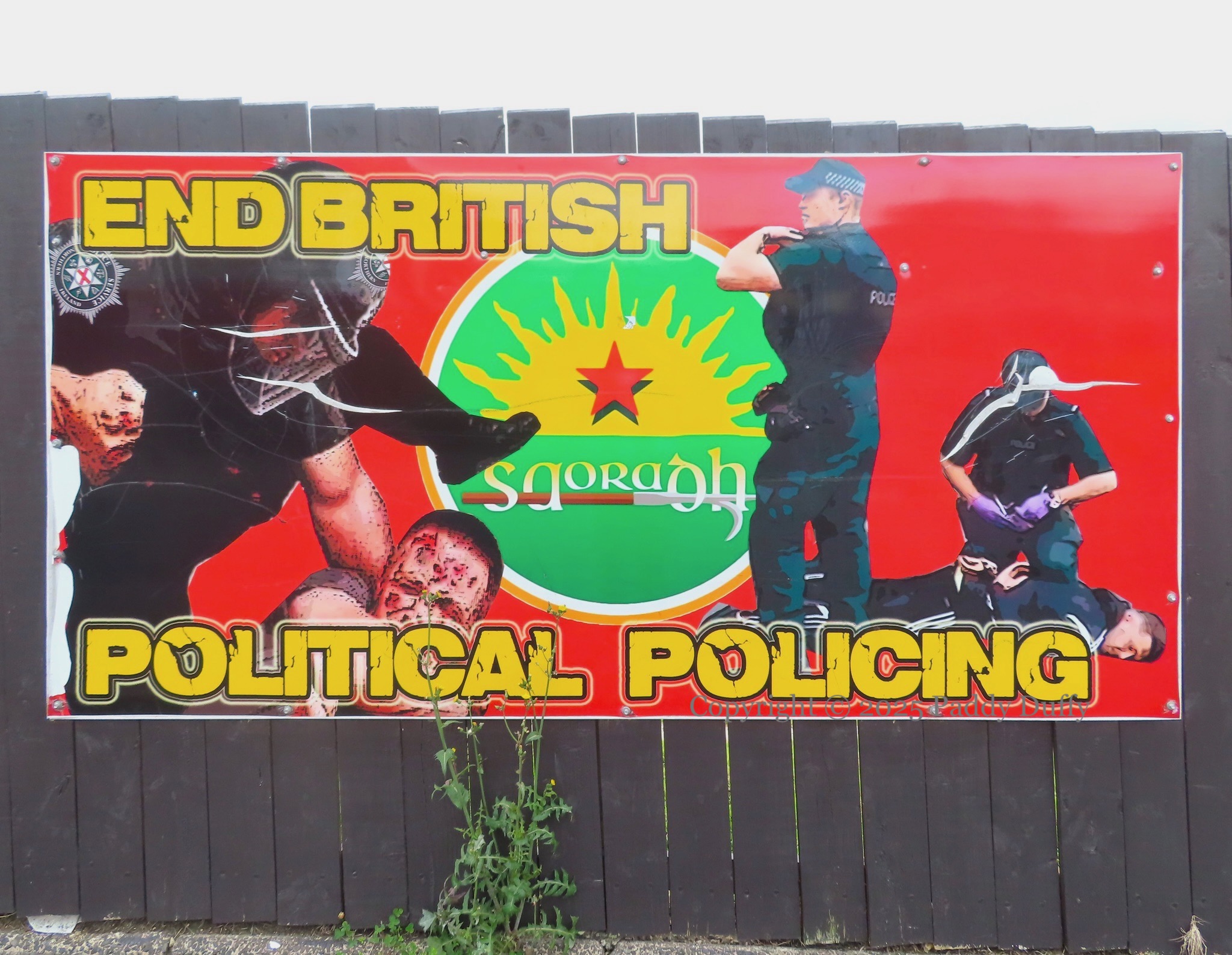
Included last below is a Saoradh (web) board: “End British political policing”.




 Paddy Duffy Collection