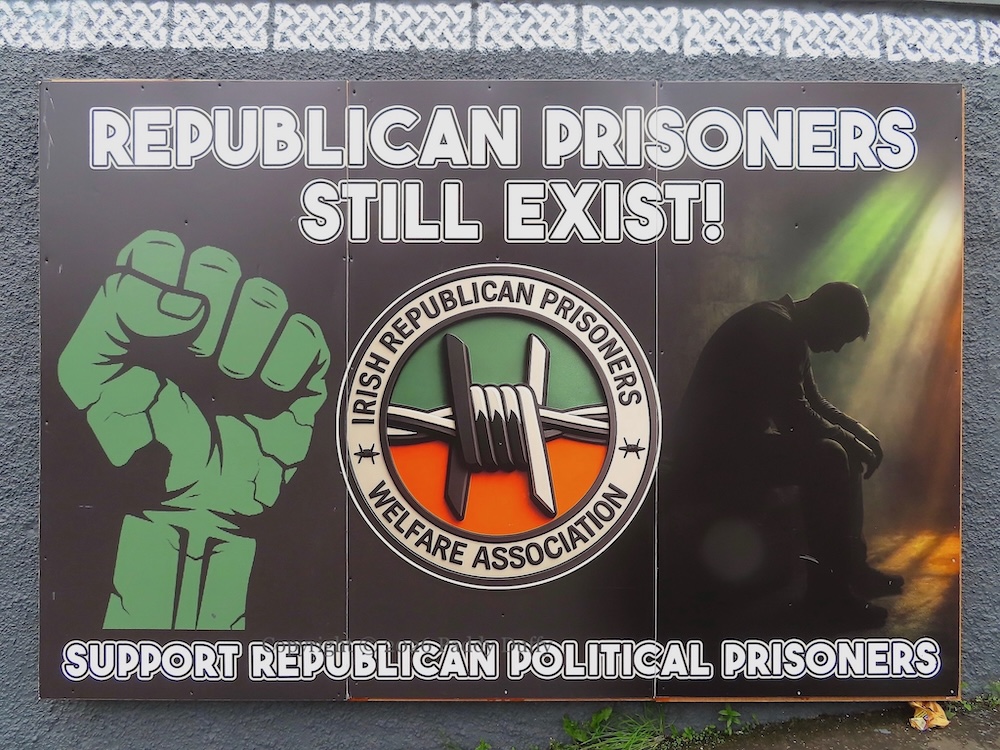
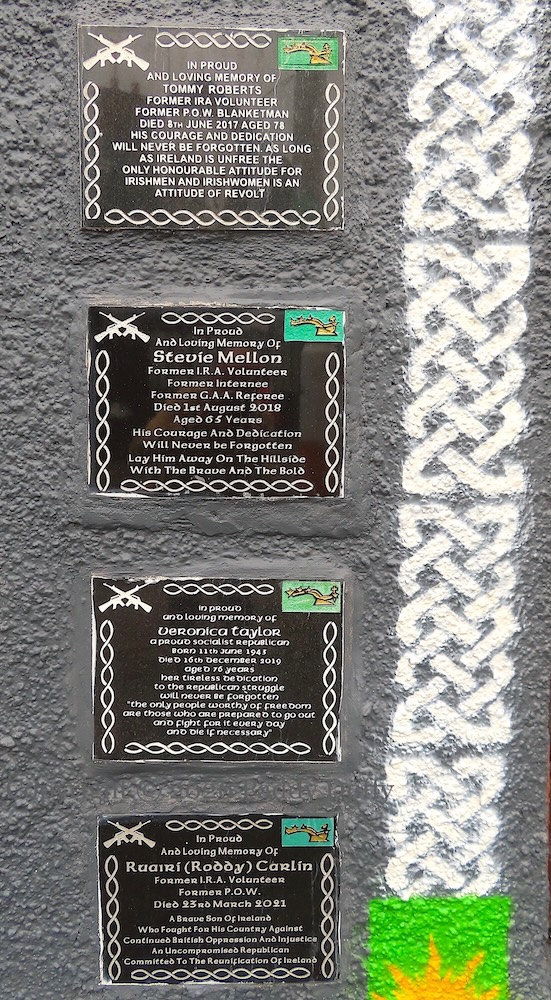
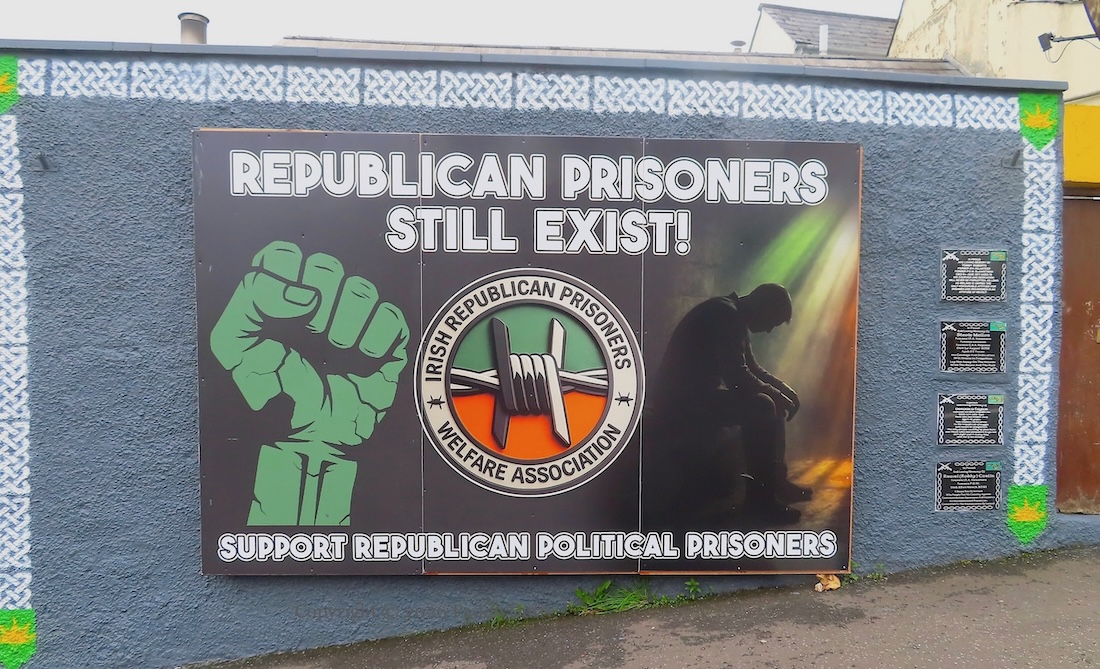
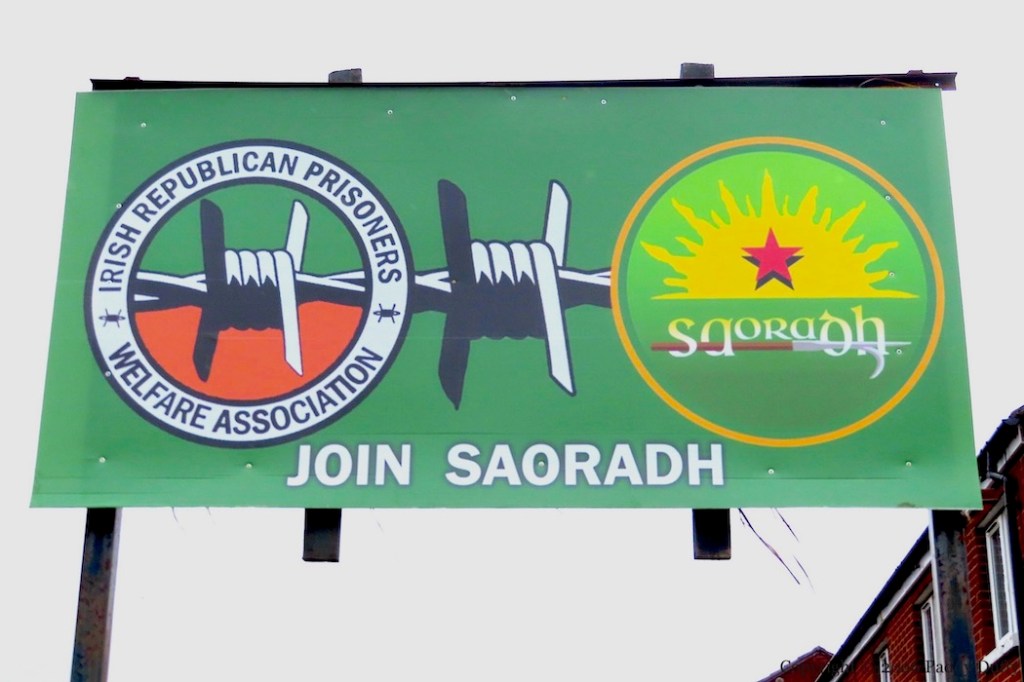
This entry updates An Attitude Of Revolt from 2022, which showed the same four plaques as in the image below – to Tommy Roberts, Stevie Mellon, Veronica Taylor, Ruaırí (Roddy) Carlin – but a different board featuring Roberts and Mellon and an oak leaf with crossed rifles. In addition to the generic IRPWA board, the entire wall was been painted grey and a knotwork surround added, with the Saoradh (web) sunburst in the corners.
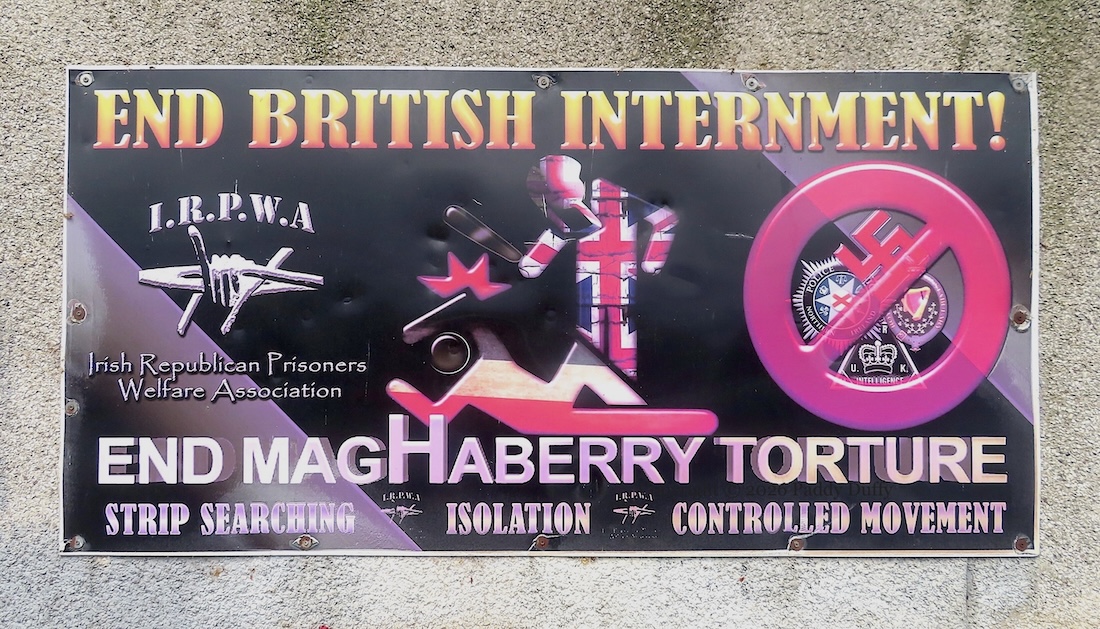
“End Maghaberry torture: strip searching, isolation, controlled movement.” This is an older (c. 2020) board that has been re-presented to the world because the trees above it have recently been trimmed back. Nonetheless, the IRPWA still maintains a list of republican prisoners, including sixteen at Maghaberry, and provides updates on prisoners.
Saoradh describes itself as an all-Ireland, revolutionary, socialist, republican party (web) with the IRPWA (web) as its “prisoners’ welfare” department and Éıstıgí as its youth wing. The “revolutionary” is perhaps in reference to its (alleged) association with the New IRA.
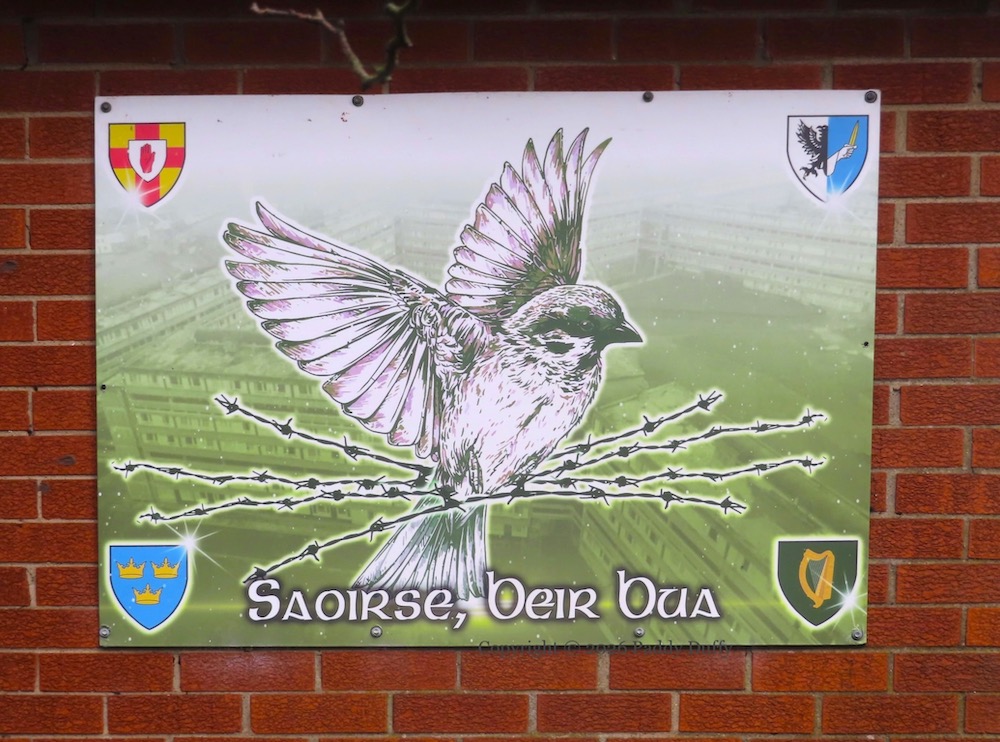
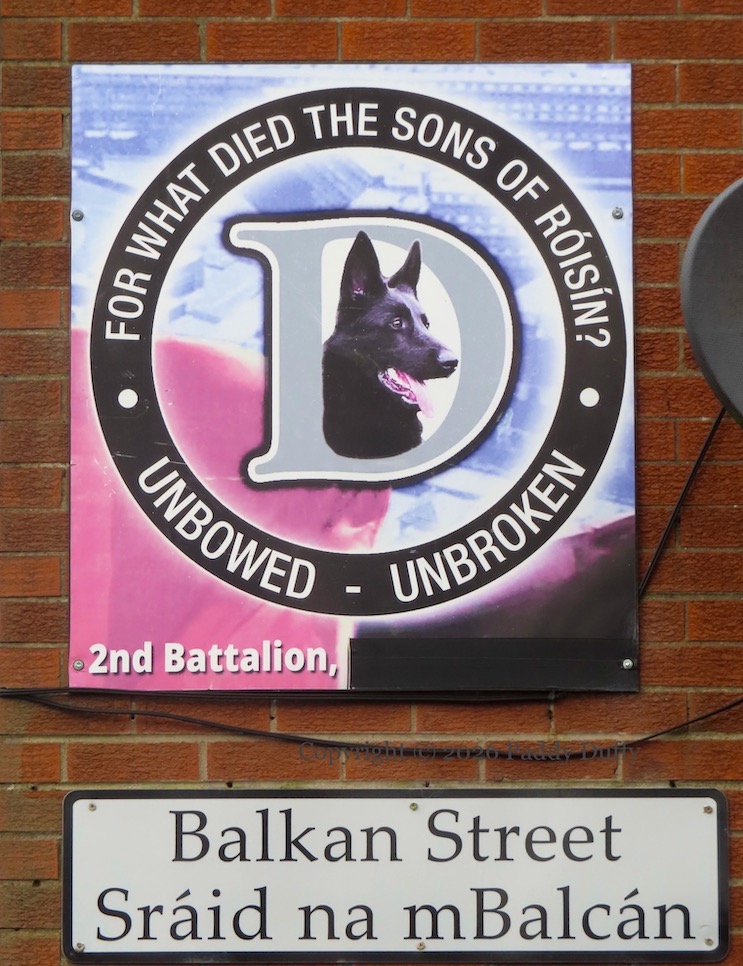
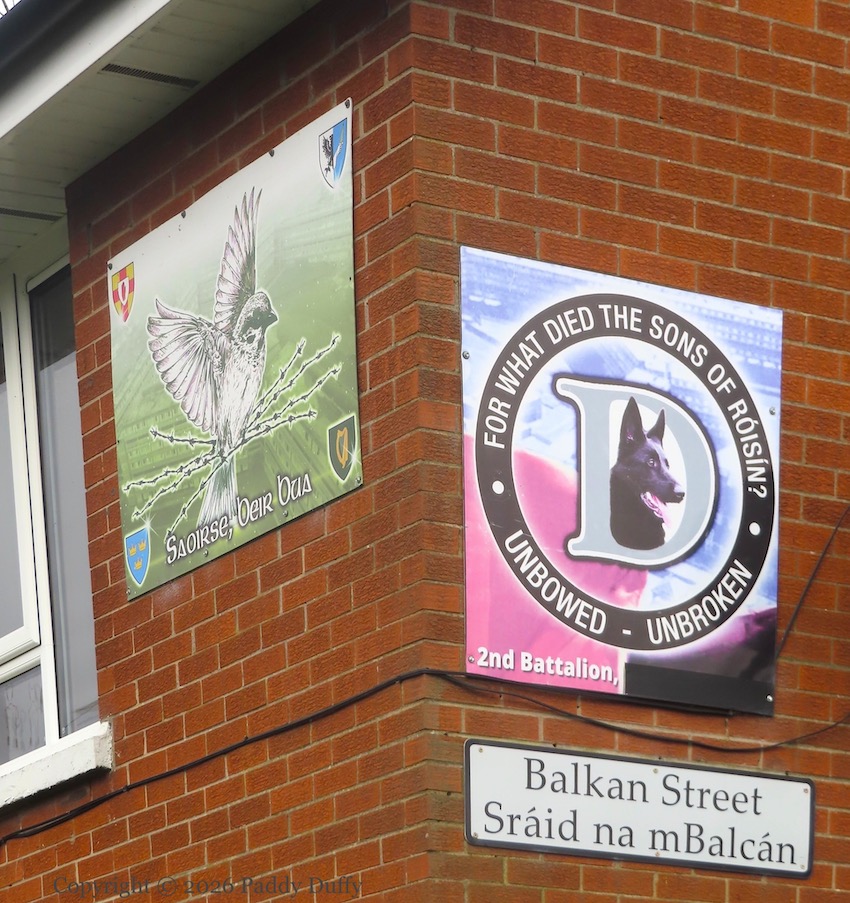
This is a pair of small boards at the corner of Balkan Street and Leeson Street, Divis, west Belfast.
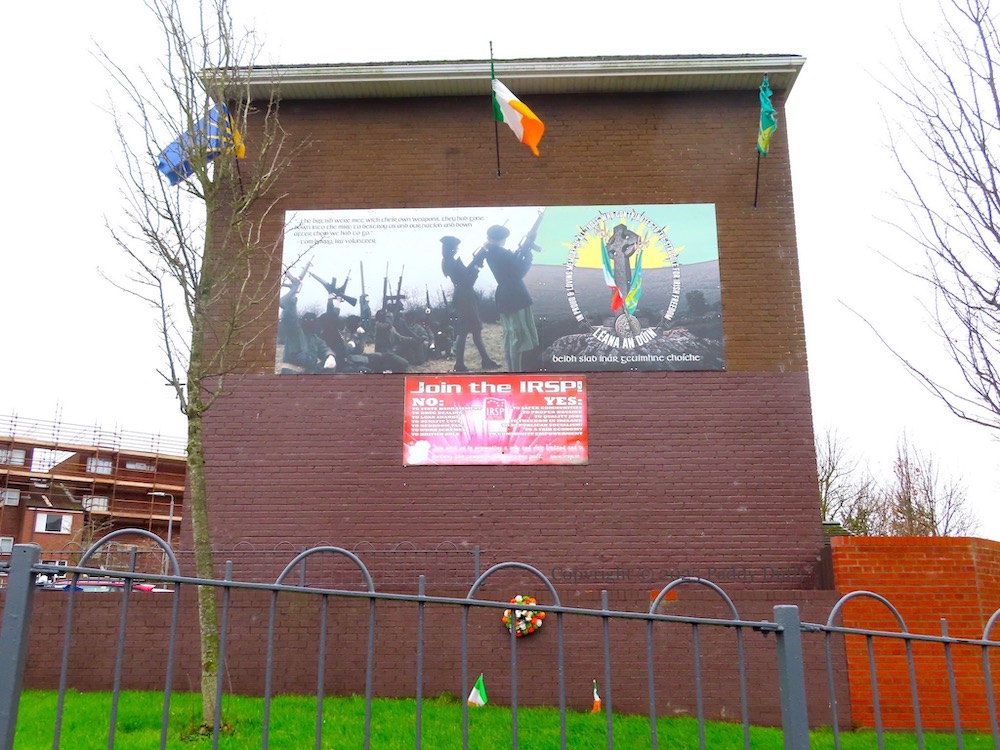
Above, “Saoırse [freedom]” and “beır bua [seize victory]” and imagery of the four provinces and a lark in barbed wire are on top of the old Divis flats. The flats were built to replace the tightly-packed streets of the lower Falls. After the first three blocks were completed in 1969, there was a plan to have a mixture of flats all the way up to Dunville Park (“Phase 2” in this 30-minute BBC video on the flats, which also includes the story of its eventual demise.
Below, “For what died the sons of Róısín [Dubh]?” The Dogs of IRA D company, second battalion [Belfast brigade] are “unbowed” and “unbroken”.
“[They said I was ruthless, daring, savage, blood thirsty, even heartless. The clergy called me and my comrades murderers; but] The British were met with their own weapons. They had gone down into the mire to destroy us and our nation and down after them we had to go. – Tom Barry, IRA volunteer.”
Tom Barry served in the British Army as a teenager and saw action in Mesopotamia and Egypt. The military training served him well when he joined the IRA and soon became commander of the West Cork brigade’s flying column. The quotation above offer a justification for the guerrilla tactics which helped drive the British to the negotiating table. In the Civil War, Barry was on the anti-Treaty side. (WP)
“In proud and loving memory of all those who contributed to the struggle for Irish freedom. Léana An Dúın. Beıdh sıad ınár gcuımhne choíche.”
The red board below is an old (2019) IRSP board, reading, “Join the IRSP. No to state harassment, to drug dealing, to loan sharks, to benefit cuts, to bedroom tax, to work schemes, to British rule. Yes to safer communities, to proper housing, to quality jobs, to freedom in Ireland, to republican socialism!, to a fair economy, to community empowerment. Join with us in promoting a new and fair Ireland and in building the campaign for a border poll. www.irsp.ie“
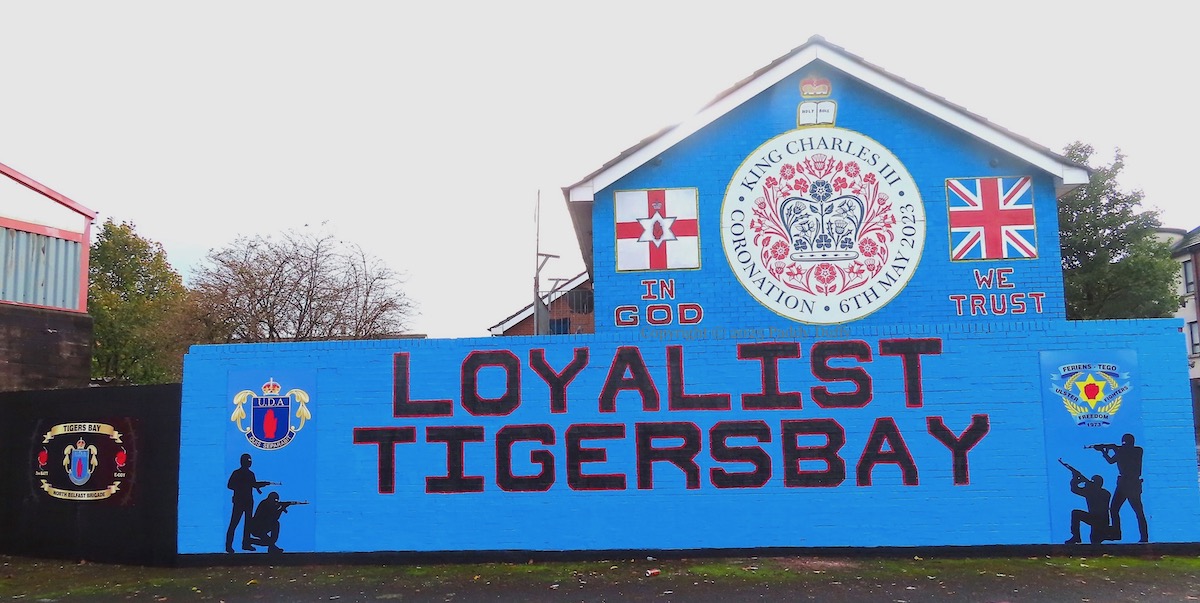
Stop The Boats has been painted out below the large “Loyalist Tiger’s Bay” and the entire wall painted in solid blue and book-ended by UDA and UFF boards showing silhouetted gunmen in active poses.
The side-wall, home to painted Orange Order symbols since 2017, has been painted black and a board (above) added to E company from Tiger’s Bay. (It’s possible “North Belfast brigade” and “3rd battalion” are the same thing.)
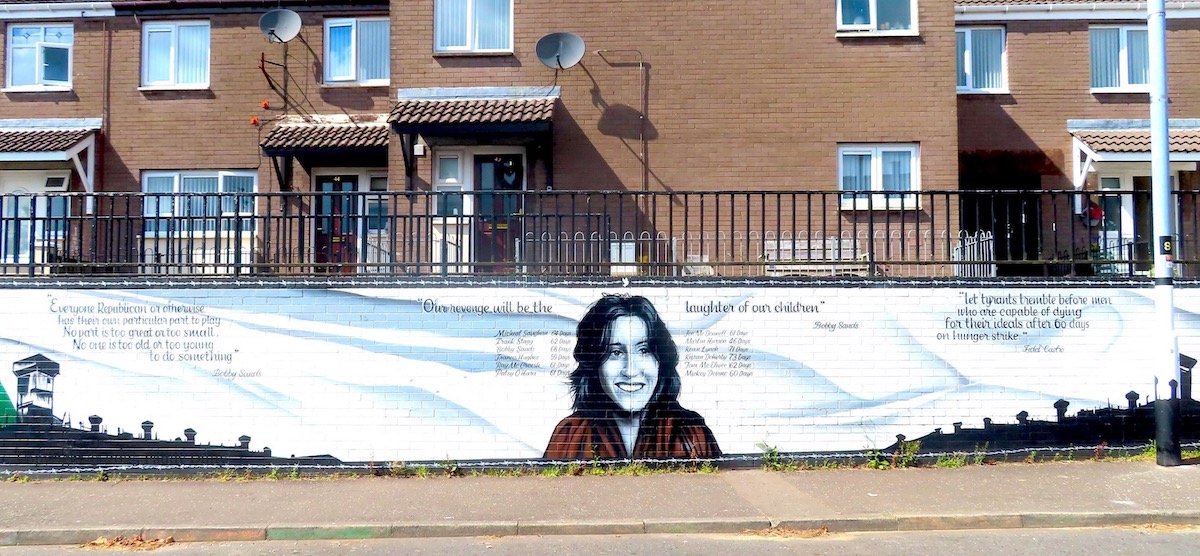
This entry updates Cuımhníonn Doıre from August 2024, in which the central part of the mural, showing Maıréad Farrell (above), was incomplete. In addition to a completed portrait of Farrell there are two quotations from Bobby Sands and one from Fidel Castro (along with a list of the twelve dead hunger-strikers of the Troubles era):
“‘Everyone, Republican or otherwise, has their own particular part to play. No part is too great or too small, no one is too old or too young to do something’ – Bobby Sands” [Diary, March 14th, 1981]
“‘Our revenge will be the laughter of our children’ – Bobby Sands”
“‘Let tyrants tremble before men who are capable of dying for their ideals after 60 days on hunger strike’ – Fidel Castro” [The line comes from Castro’s opening address on September 15th, 1981, to the Inter-Parliamentary Conference (pdf)]
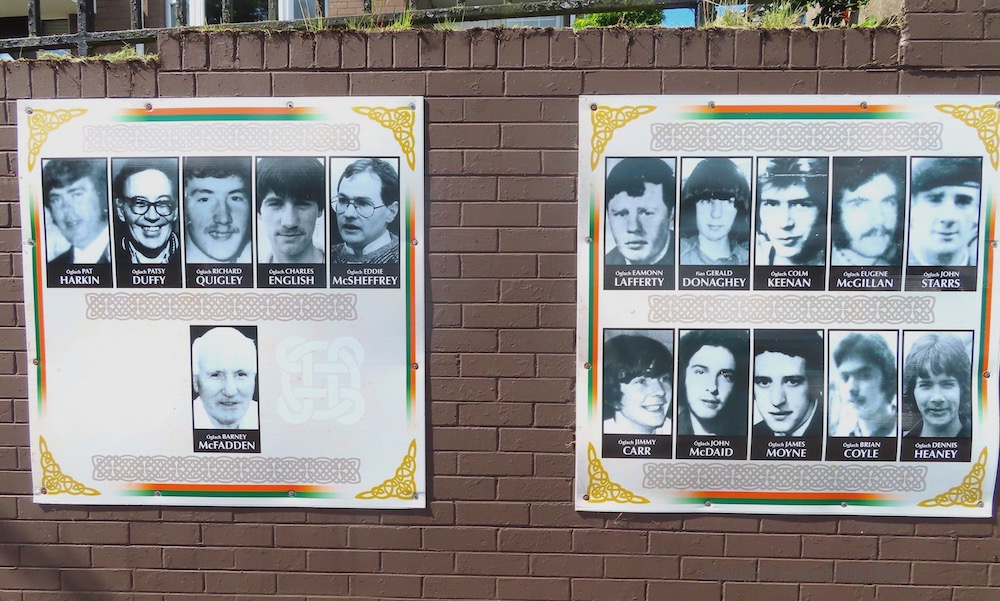
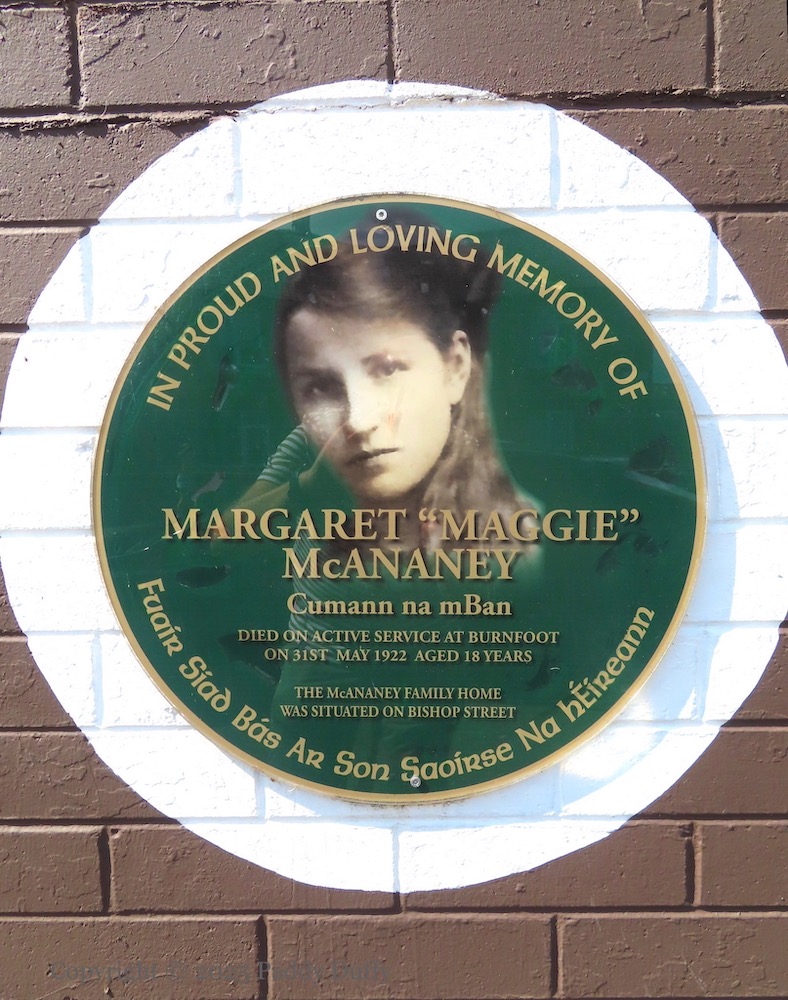
Also included below are an adjacent IRA Derry Brigade roll of honour and a plaque to Maggie McAnaney.
McAnaney died when a gun went off at an IRA checkpoint near Burnfoot, Co. Donegal, a month before the Civil War began (Derry Journal). This is an unusual use of the phrase “active service”, as McAnaney was travelling to a picnic at the time, rather than on exercises or preparing munitions; the phrase would later come to be associated primarily with a premature bomb explosion.
“In proud and loving memory of Margaret “Maggie” McAnaney, Cumann na mBan, died on active service at Burnfoot on 31st May 1922, aged 18 years. The McAnaney family home was situated on Bishop Street. Fuaır sıad bás ar son saoırse na hÉıreann.”
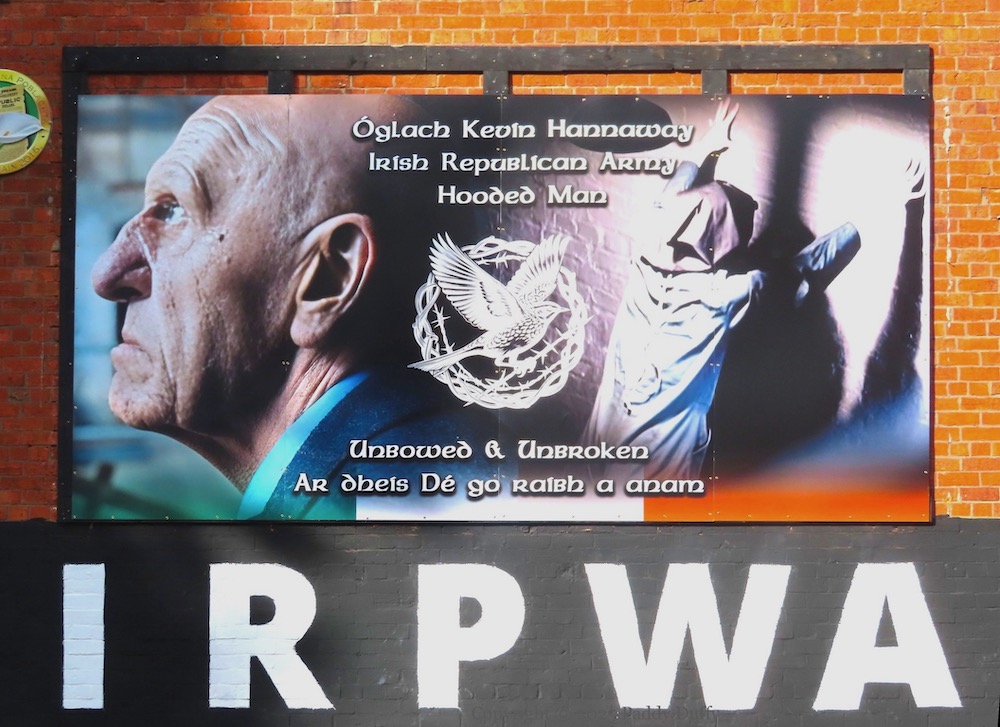
“Óglach Kevin Hannaway, Irish Republican Army, hooded man. Unbowed & unbroken. Ar dheıs Dé go raıbh a anam.”
Kevin Hannaway died in January (2025), aged 77. In 1971 he was interned (Belfast Media) and subjected, along with thirteen others, to the “five techniques” – deprivation of food/drink and of sleep, subjection to noise, prolonged stress positions, and hooding (WP) – as well as being beaten and dropped out of a helicopter (Irish Times). The ‘five techniques’ were found to constitute torture in 2021 (RTÉ) and the PSNI apologised to the victims in 2023 (BBC | Irish Legal News).
Hannaway remained a republican throughout his life and was anti-Agreement in recent years (BBC). The board in Hannaway’s honour was launched on Sunday July 13th (Fb video). The panels of the board were siezed by the PSNI during a drug raid on a home in St James’s on the 11th but returned the next day (BelTel).
“IRPWA [web]. Republican prisoners still exist! Unfinished revolution. Unbowed, unbroken.”
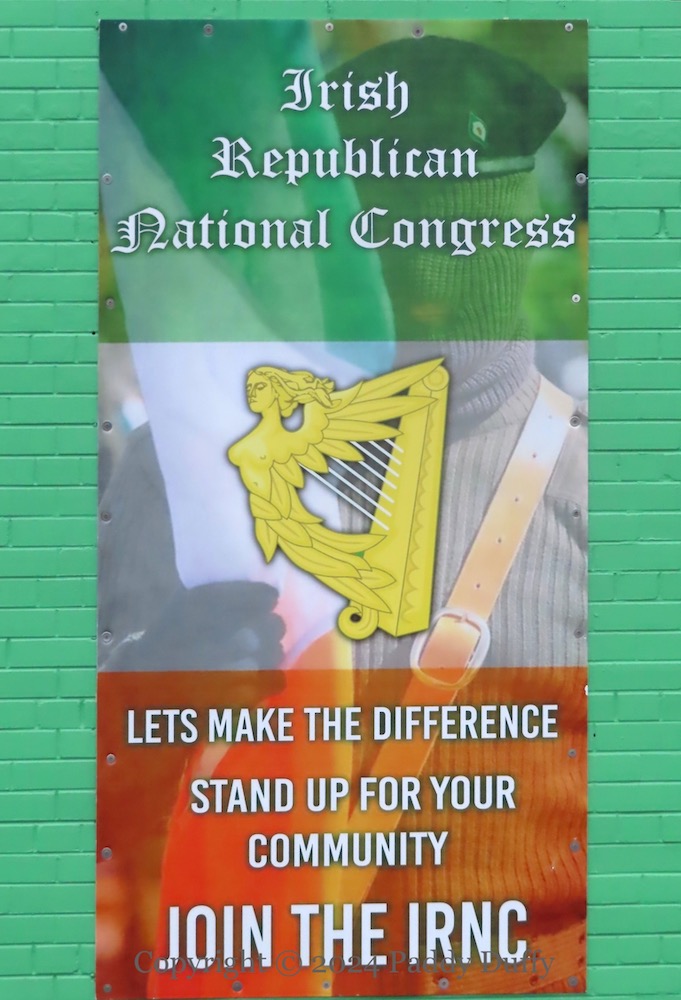
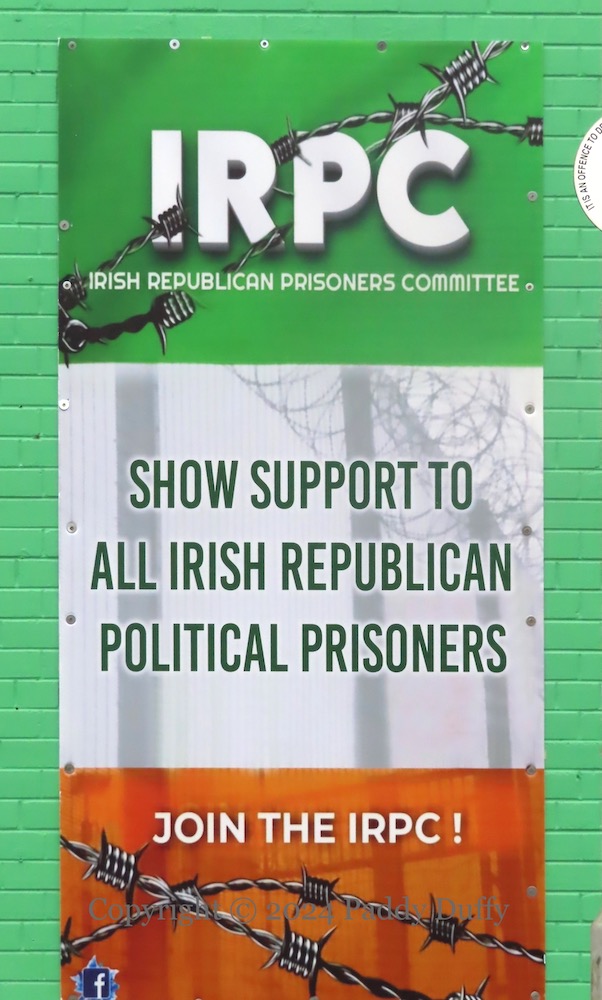
Hugo Street, west Belfast. For a close-up of the Pearse Jordan plaque on the left, see the Peter Moloney Collection.
“Let’s make the difference – stand up for your community – join the IRNC”, “Show support to all Irish republican prisoners – join the IRPC”. These are new IRNC and IRPC (Fb) boards on Northumberland Street (Visual History), west Belfast. See previously on Northumberland Street: IRPC prisoner Niall Lehd | Join The IRNC
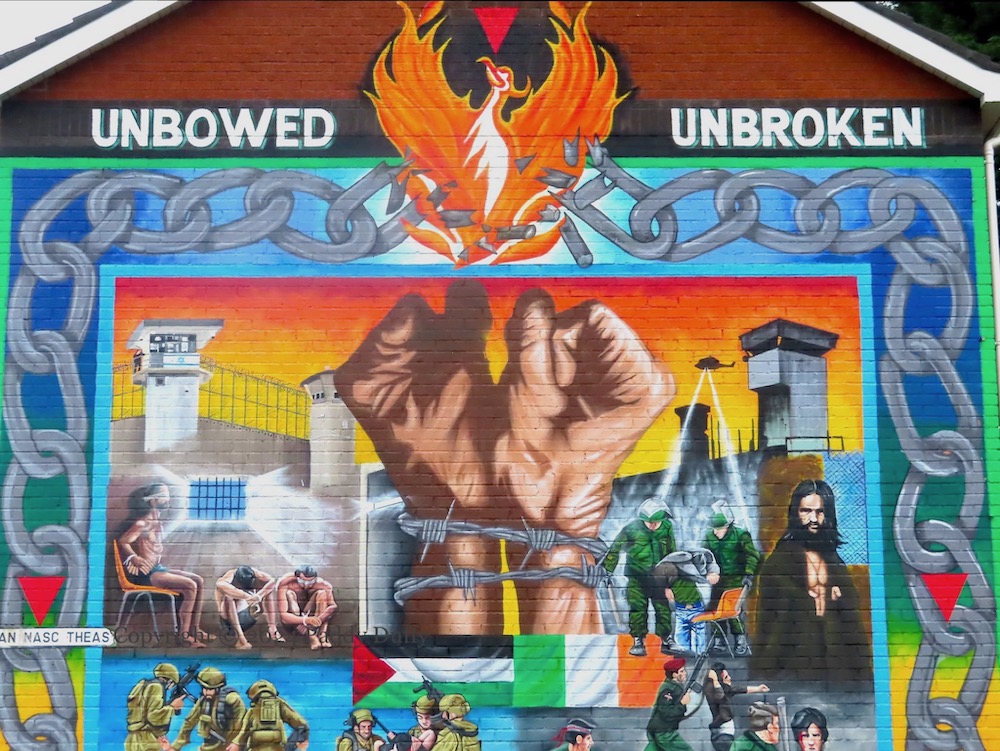
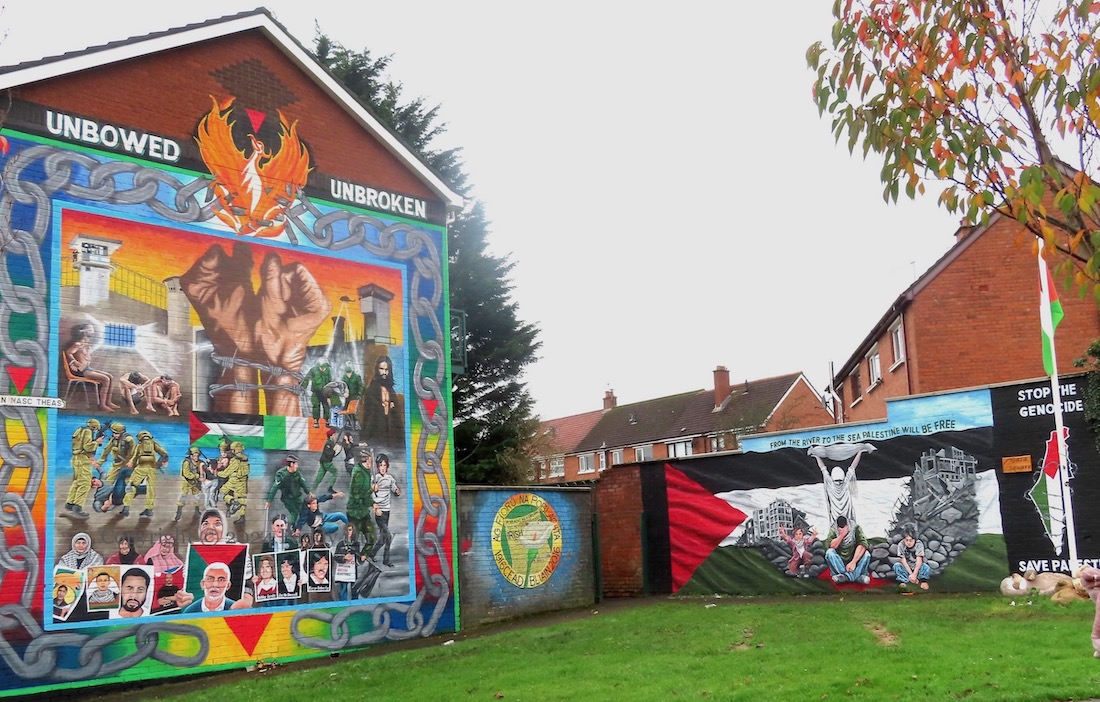
The 1916 centenary mural in Andersonstown has been repurposed and repainted to express solidarity with the people of Palestine.
From the frame of the previous mural – see Unbowed, Unbroken – the title, phoenix, and chains have been preserved but two instances of the inverted red triangle have been added at the top and bottom – see Resist! (and My Kite You Made).
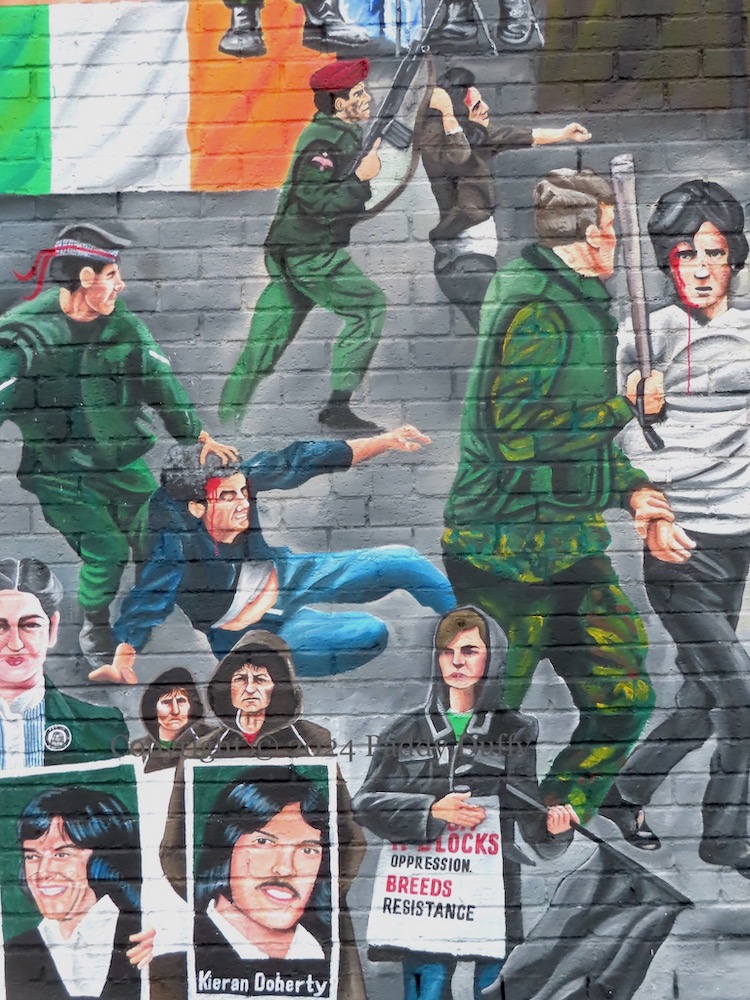
The main panel puts the struggles in Palestine and Northern Ireland in parallel, showing (from top to bottom on each side) political prisoners, violence against protesters, and relatives carrying portraits.
On the left, Palestinian prisoners languish in Israeli jails (based on a photo of Hamza Abu Halima and on this Reuters photograph of prisoners sitting in the street, both from December 2023) and IDF soldiers make violent arrests – the one on the left is from 2016 (CCUN) and the one on the right is perhaps based on this Reuters photograph.
On the right: British soldiers restore order after the Burning Of Long Kesh (see Operation Pagoda), next to blanket-man Hugh Rooney, above three arrests made by British Army soldiers – their caps indicates that they are from the Argyll & Sutherland Highlanders (left) and the Paratroop regiment (centre). (For two of the original photos, see BBC | Getty.)
Along the bottom of both sides, marchers hold portraits of the dead, including the recently-killed leader of Hamas Yahya Sinwar (BBC).


















 Paddy Duffy Collection