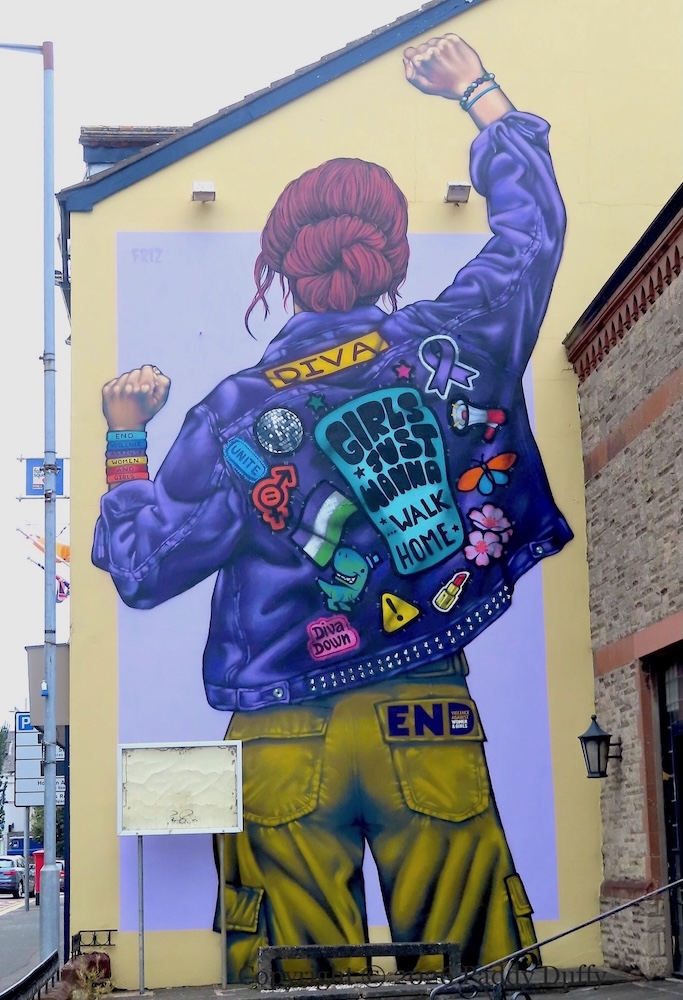
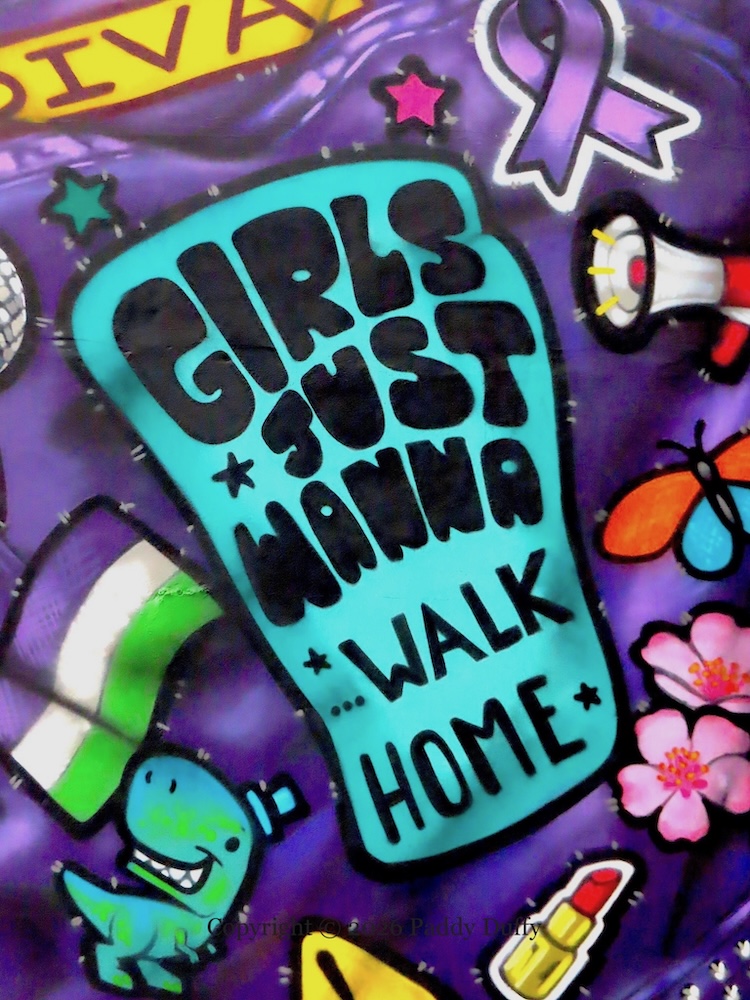
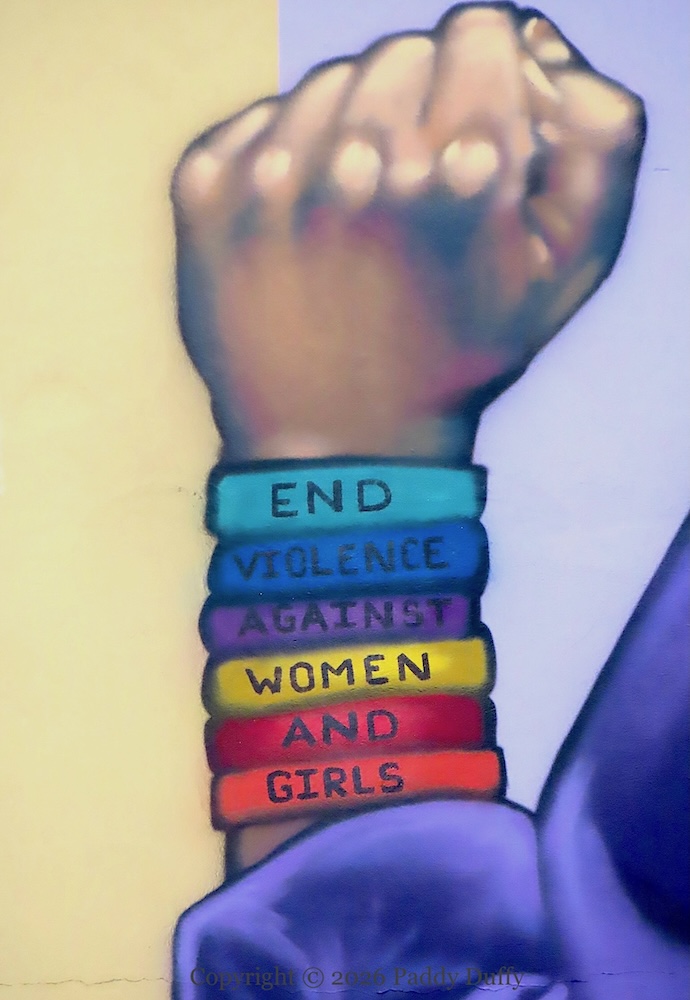
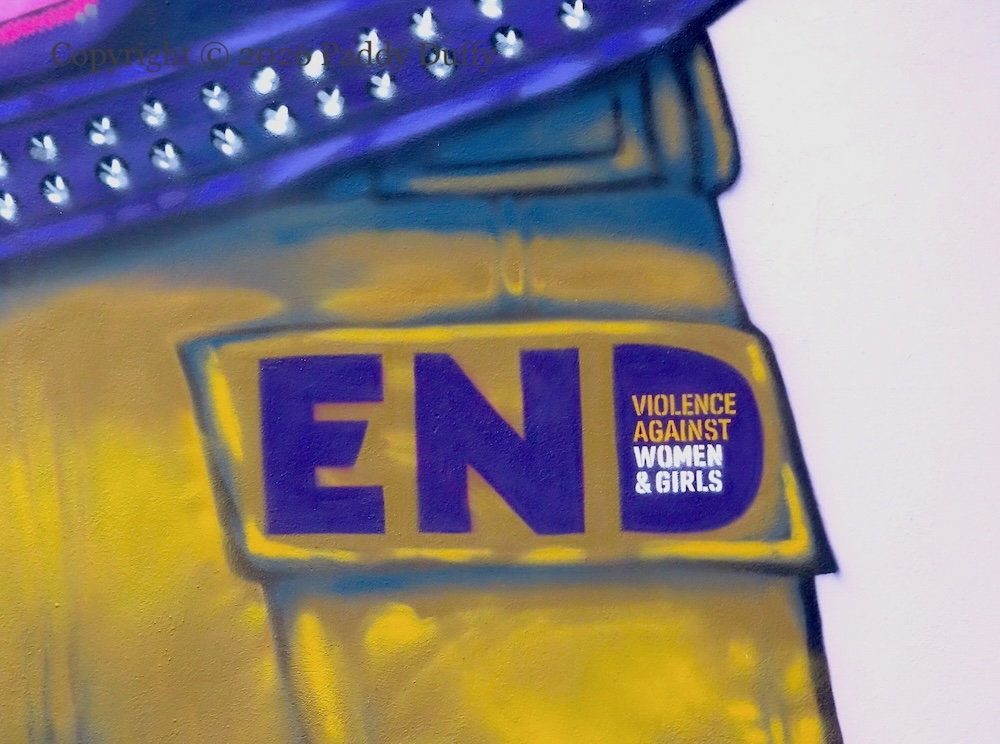
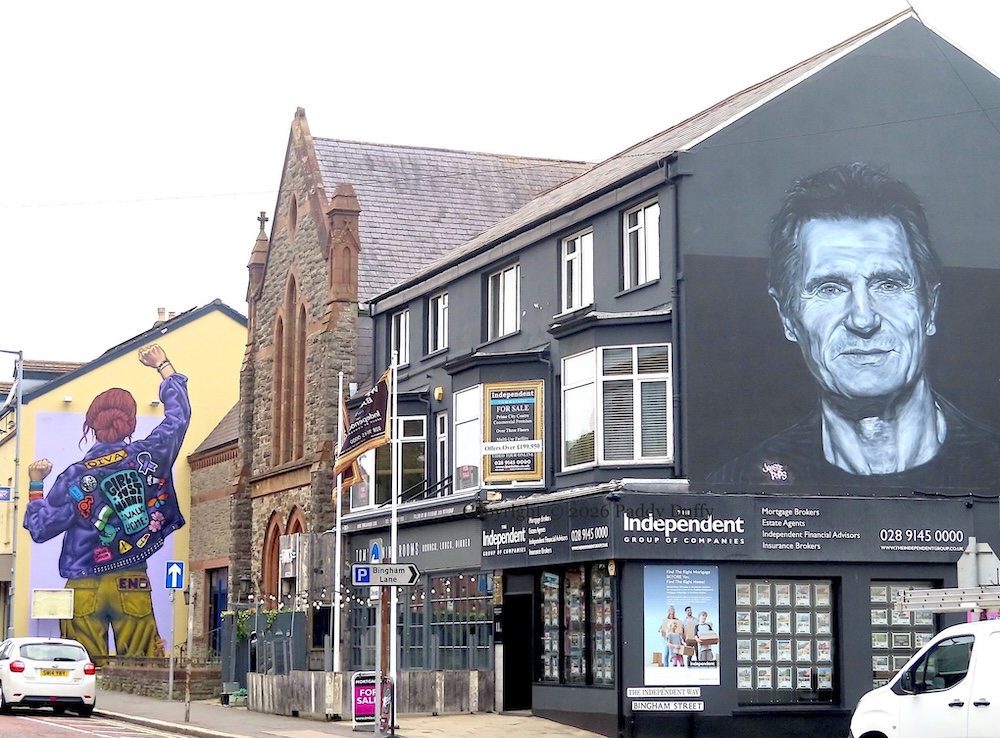
This new wall-painting in Bangor encourages people to “end violence against women and girls”. It was painted by local artist Friz (web) in collaboration with young women from North Down YMCA’s “Flip The Script” programme (Belfast Live) and officially launched on August 25th (Ards & North Down).
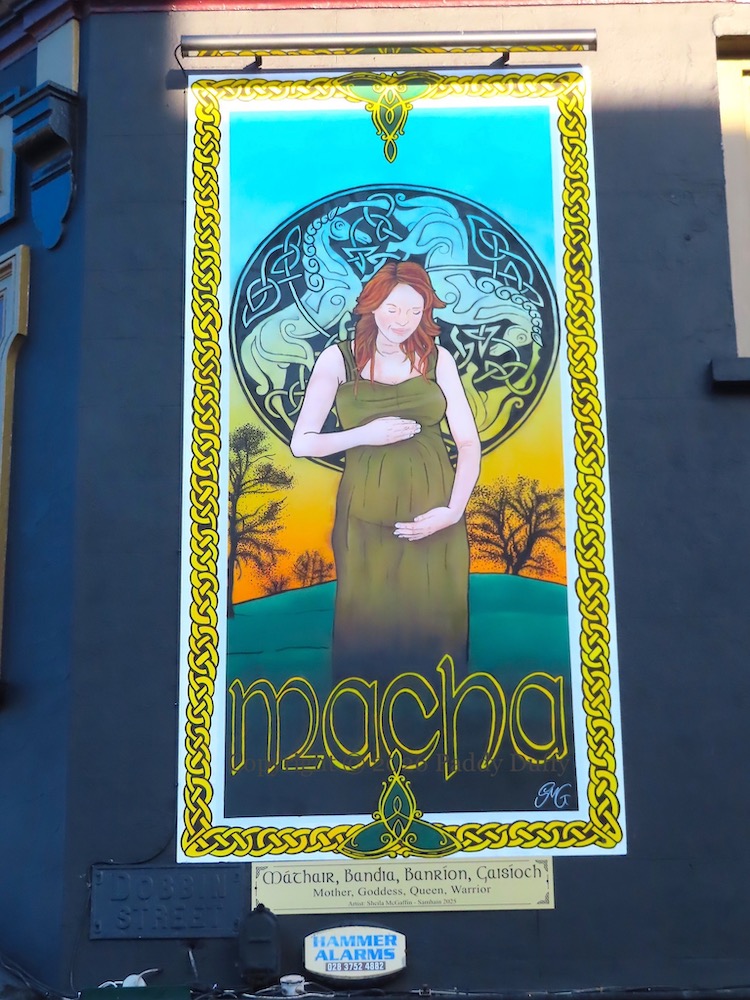
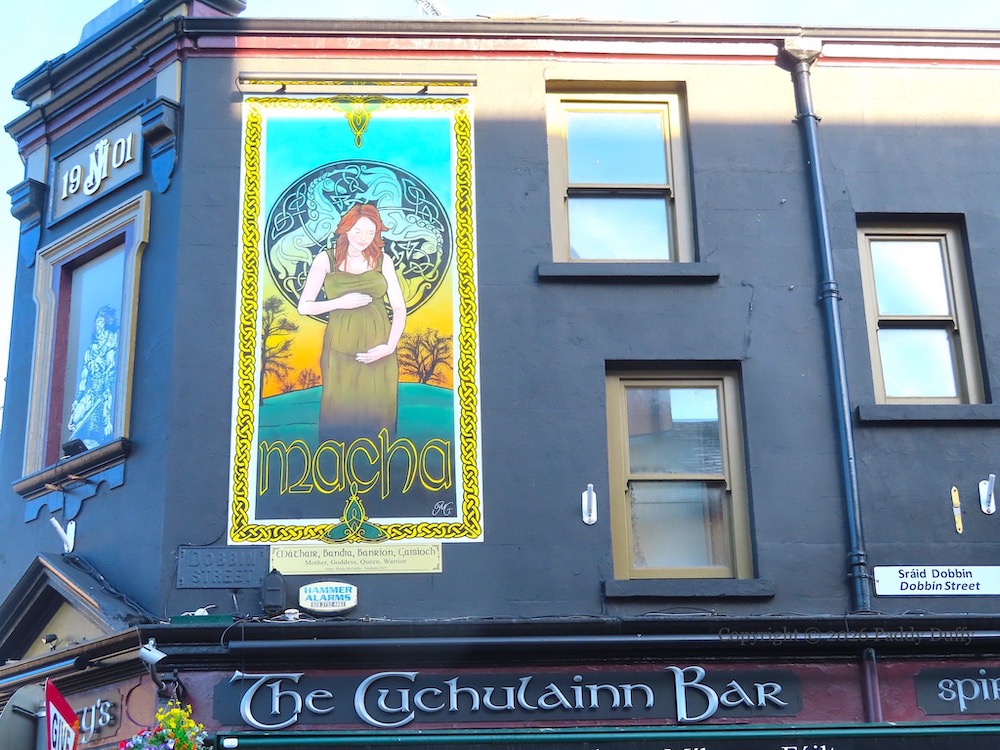
“Macha – máthaır, bandıa, banríon, gaıs[c]íoch/mother, goddess, queen, warrior.” Armagh is named after Macha, who is shown here pregnant against knot-work of three interwoven horses. In one story about Macha, she wins a race against the horses of Connor, the king of Ulster, even though she is pregnant. The race caused her to give birth and she cursed the men of the Red Branch for nine generations, which would leave them all – except for Cú Chulaınn – unable to fight to the forces of Medb (Visual History).
This entry updates 2023’s 800 Years Of Irish Resistance, showing images of the republican memorial garden in Drumarg, Armagh. The main change is the removal of Cú Chulaınn (Visual History) and the elevation of the James Connolly board into its place: “If you strike at, imprison, or kill us, out of our prisons or graves we will still evoke a spirit that will thwart you, and, mayhap, [here “perhaps”] raise a force that will destroy you. We defy you[, England]! Do your worst!” – James Connolly, Courtsmartial And Revolution, 1914.
There is also a new board in the ‘Women In Struggle’ gallery, next to a portrait of Maıréad Farrell and a “Republican Women’s Roll Of Honour”. It shows Colman Doyle’s famous ?1974? image (NLI | Treason Felony) of a female volunteer with assault rifle accompanied by the words, “This is not a man’s war but a people’s war, and very, very much suffering has been borne by the women, be they mothers, wives, political activists, or volunteers, and the men ought to remember that without the sacrifice of women there would be no struggle at all.” The words seem to come from a 1982 poster (CAIN) part of which was turned into a mural in Ballymurphy.
There is also a small plaque below the Connolly board to local woman Dympna McCague, who died in 2019 (Fb).
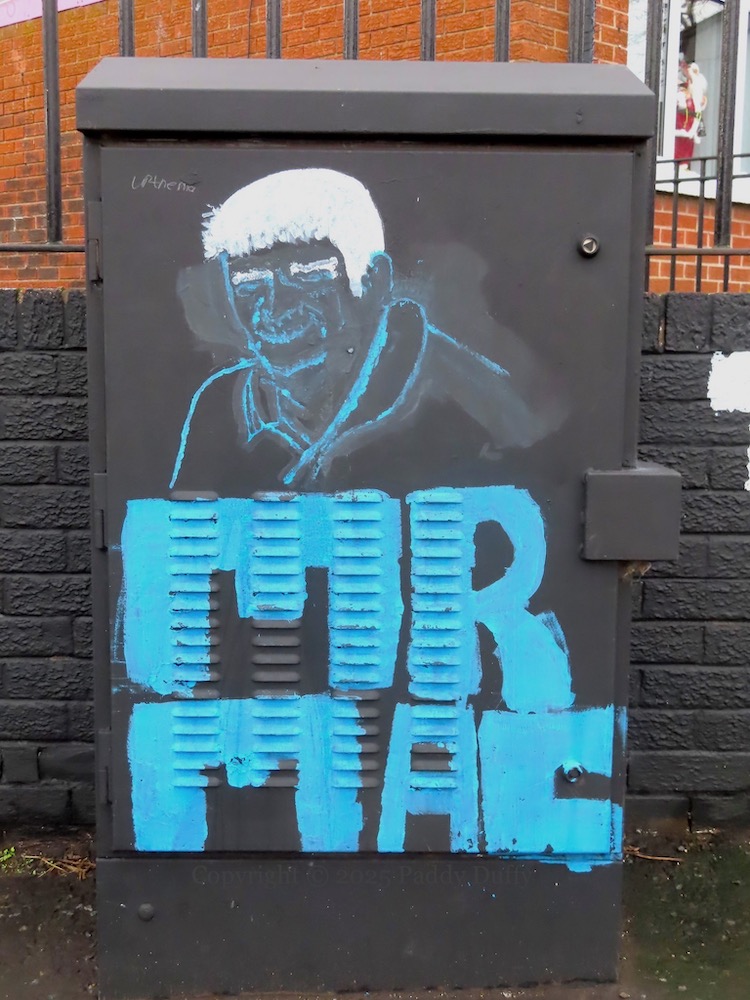
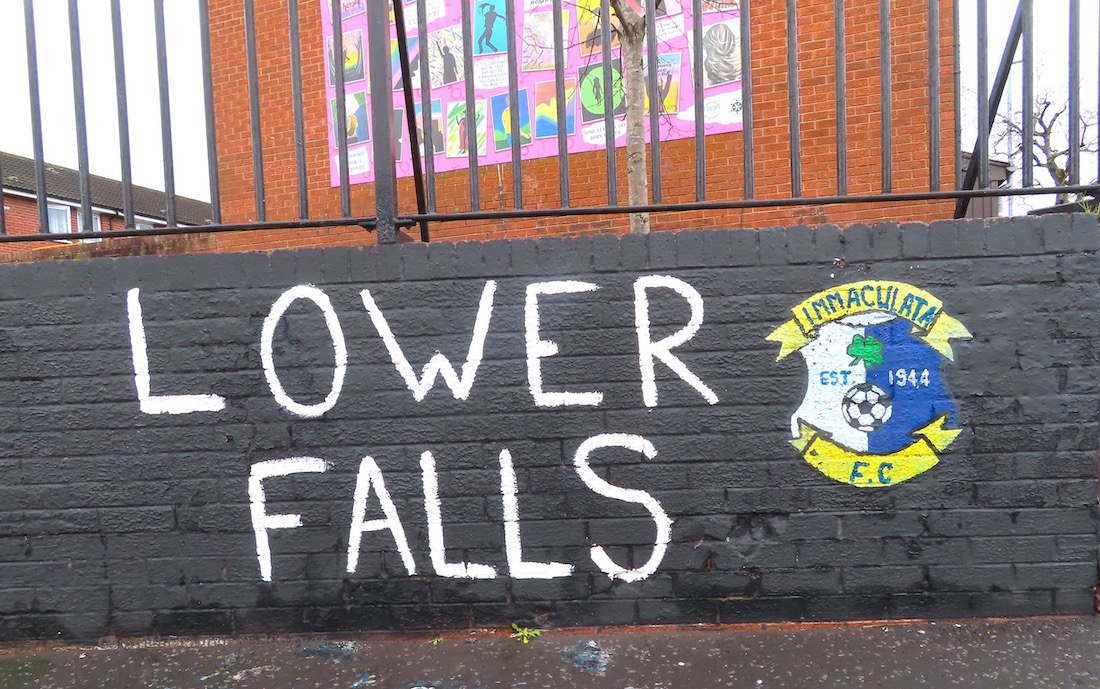
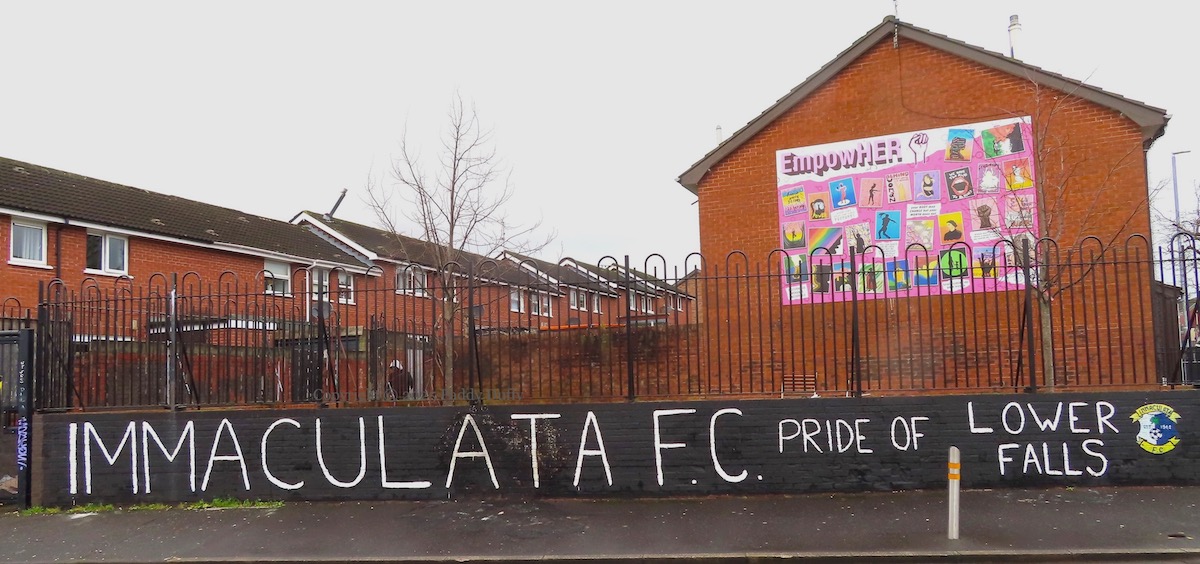
This is a painted tribute to Jim McKee, who was known as “Mr Immaculata” for his long-time support of Immaculata FC (Fb). McKee died in August when he was hit by a car near the Grosvenor community centre (BBC).
See also: Come On, The Mac, which is a stone’s throw further down Albert Street.
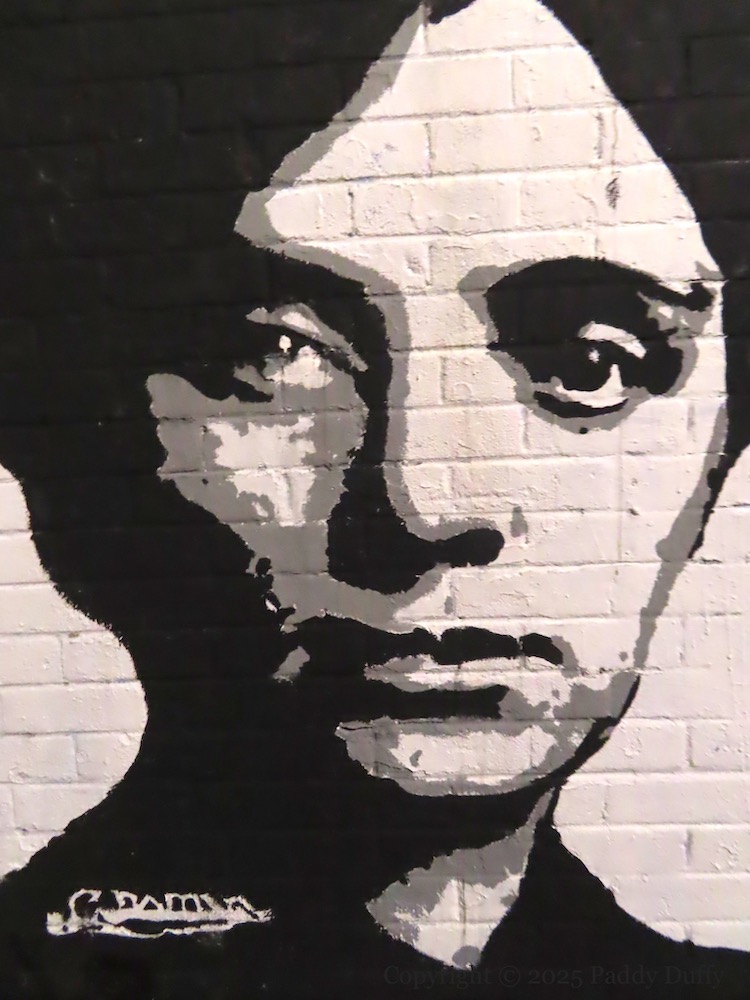
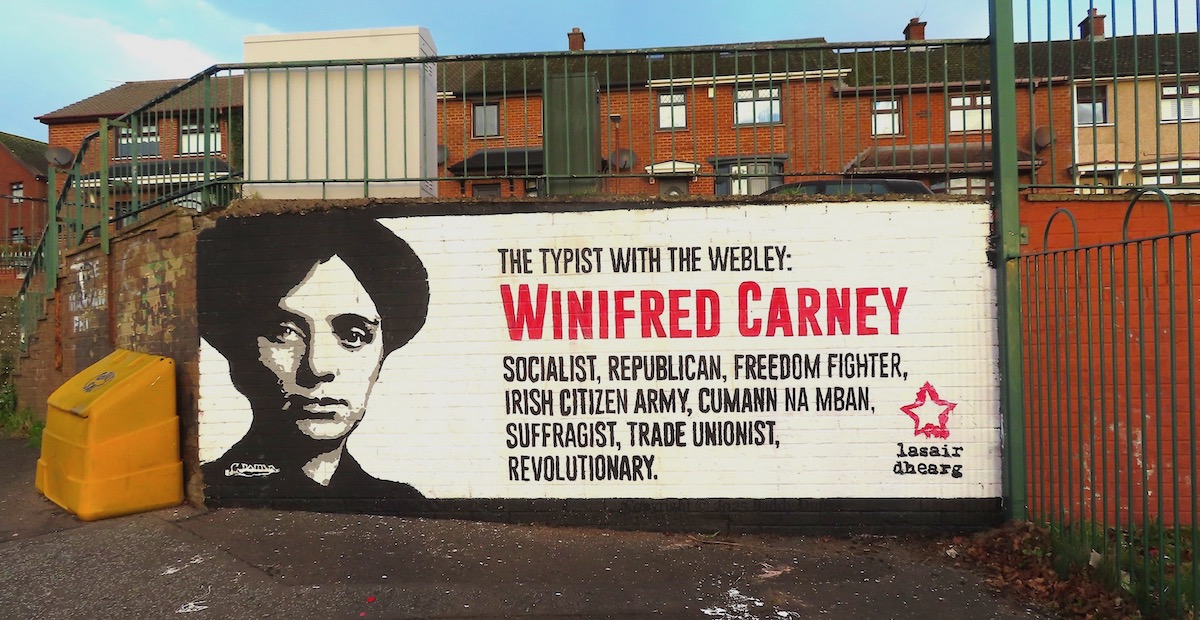
Winifred Carney was a qualified secretary and typist, and became secretary of the Irish Textile Workers’ Union in 1912, in which position she met James Connolly, who was secretary of the Belfast branch of the ITGWU. She was a member of Cumann Na mBan and participated in the Easter Rising of 1916. Carney was in the GPO when it was taken over and was among those who surrendered at the end; during the occupation she typed up dispatches from the Moore Street headquarters – this is how she was portrayed in the the 1916 Centenary mural.
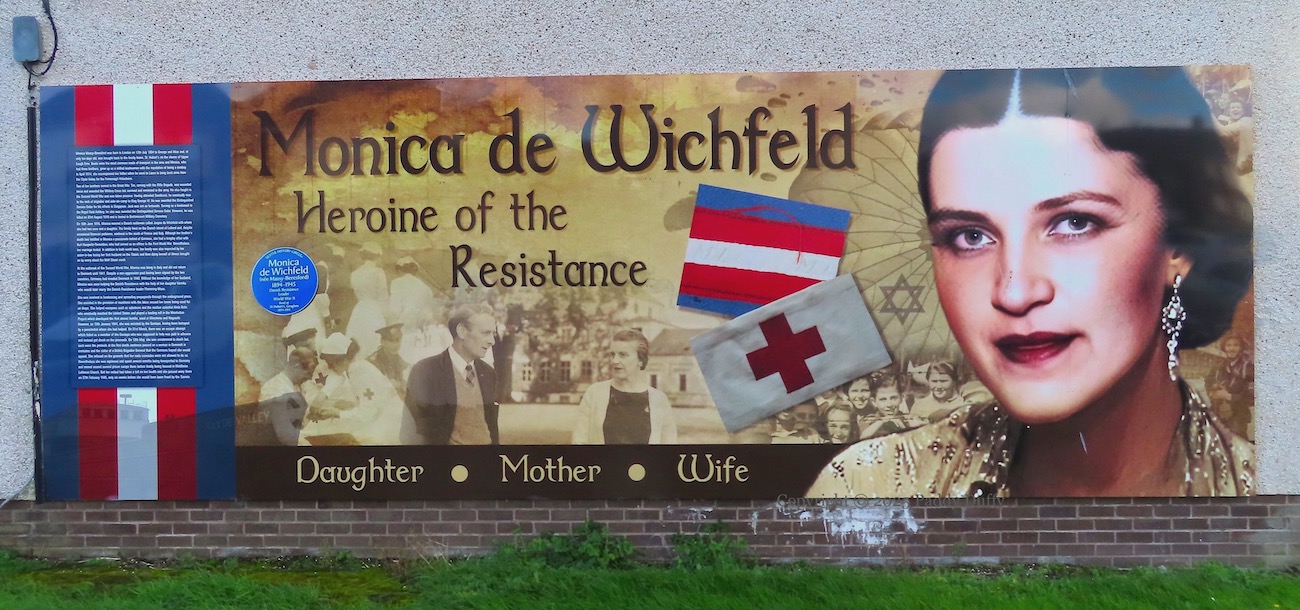
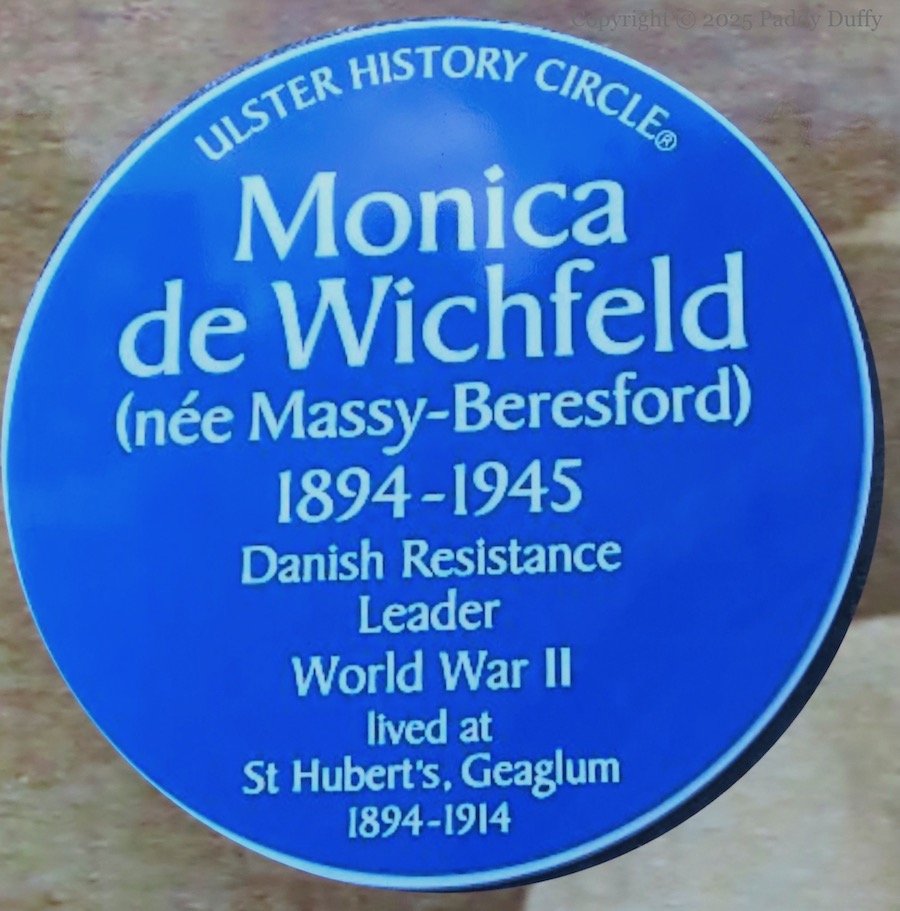
“Monica de Wichfeld, heroine of the resistance, daughter, mother, wife”. The blue plaque to Monica Massy-Beresford is at the Kinawley Holy Trinity church in Derrylin, Fermanagh, (Street View), near where she grew up. She moved to Denmark upon her marriage and had a long and varied career in the Danish resistance to the German occupation in WWII, raising money for the Communists, using her estate to shelter fleeing families and receive arms and train volunteers, and eventually heading the regional group on Lolland (WP).
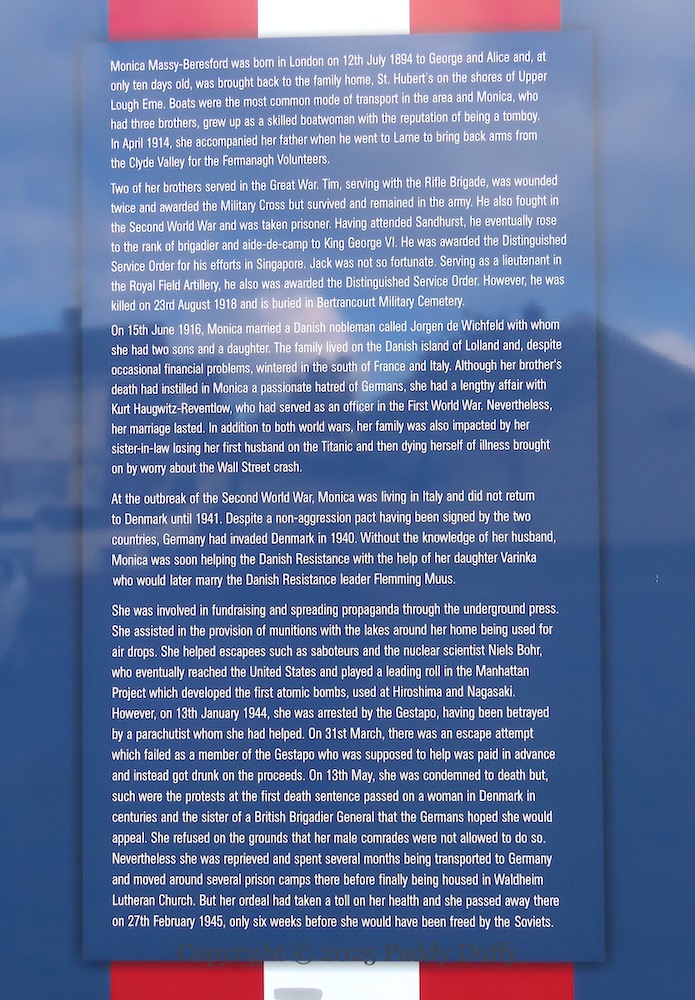
“Monica Massy-Beresford was born in London on 12th July 1894 to George and Alice and, at only ten years old, was brought back to the family home, St Hubert’s on the shores of Upper Lough Erne. Boats were the most common mode of transport in the area and Monica, who had three brothers, grew up as a skilled boatwoman with the reputation of being a tomboy. In April 1914, she accompanied her father when he went to Larne to bring back arms from the Clyde Valley for the Fermanagh Volunteers. … On 15th June 1916, Monica married a Danish nobleman called Jorgen de Wichfeld with whom she had two sons and a daughter. The family lived on the Danish island of Lolland and, despite occasional financial problems, wintered in the south of France and Italy. Although her brother’s death had instilled in Monica a passionate hatred of Germans, she had a lengthy affair with Kurt Huagwitz-Reventlow, who had served as an officer in the First World War. Nevertheless, her marriage lasted. … At the outbreak of the Second World War, Monica was living in Italy and did not return to Denmark until 1941. Despite a non-aggression pact having been signed by the two countries, Germany had invaded Denmark in 1940. Without the knowledge of her husband, Monica was soon helping the Danish Resistance with the help of her daughter Varinka who would later marry the Danish Resistance leader Flemming Muus. “She was involved in fundraising and spreading propaganda through the underground press. She assisted in the provision of munitions with the lakes around her home being used for air drops. She helped escapees such as saboteurs and the nuclear physicist Niels Bohr, who eventually reached the United States and played a leading roll [role] in the Manhattan Project which developed the first atomic bombs, used at Hiroshima and Nagasaki. However, on 13th January 1944, she was arrested by the Gestapo, having been betrayed by a parachutist whom she had helped. On 31st March, these was an escape attempt which failed as a member of the Gestapo who was supposed to help was paid in advance and instead got drunk on the proceeds. On 13th May, she was condemned to death but, such were the protests at the first death sentence passed on a woman in Denmark in centuries and the sister of a British Brigadier General that the Germans hoped she would appeal. She refused on the grounds that her male comrades were not allowed to do so. Nevertheless she was reprieved and spent several months being transported to Germany and moved around several prison camps there before finally being housed in Waldheim Lutheran Church. But her ordeal had taken a toll on her health and she passed away there on 27th February 1945, only six weeks before she would have been freed by the Soviets.”
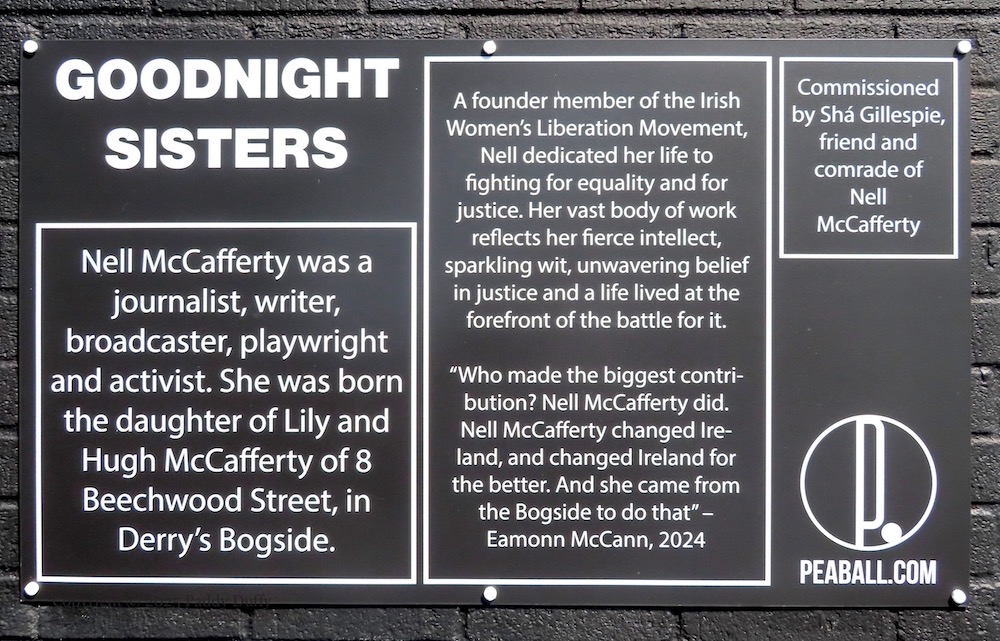
Derry native Nell McCafferty is commemorated by a mural in the Maiden City, launched on International Women’s Day (March 8th), 2025, and the annual Femme Sesh event was also dedicated to McCafferty (ig | Derry Journal).
McCafferty died last year (2024) after a long career as a journalist and activist (BBC). “Goodnight, sisters” was her parting phrase at the end of her segments on The Women’s Programme, which aired on RTÉ between 1983 and 1986 (Journal).
Here is RTÉ footage of Nell and Marian Finucane on the Late Late in 1991 and in 1980.
The mural was painted by Peaball (web) on a gable in Lisfannon Park and is visible from Lecky Road. The portrait of McCafferty appeared on the cover of (the Penguin Ireland edition of) her autobiography Nell.
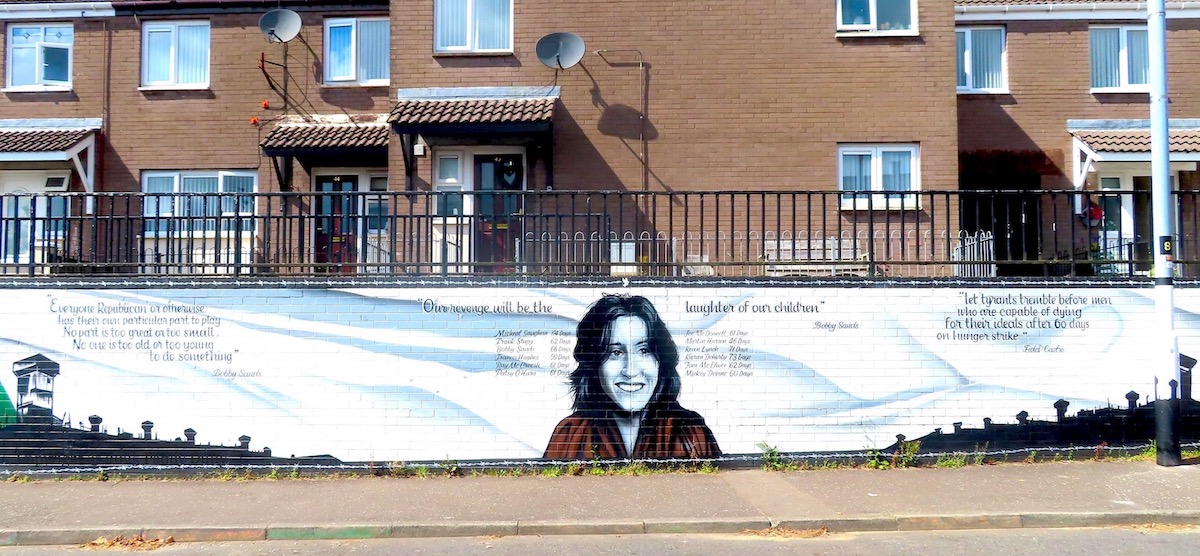
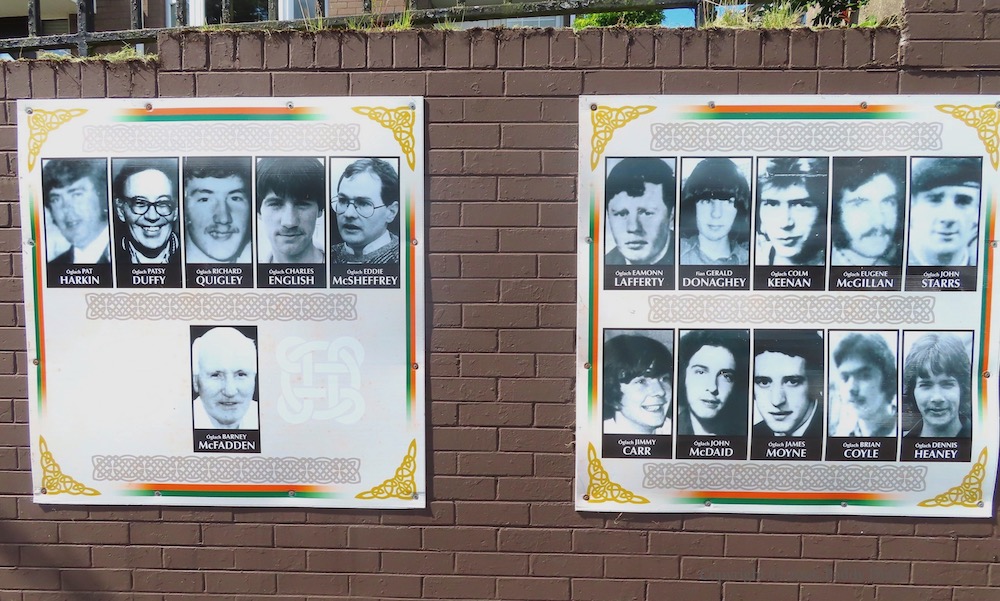
This entry updates Cuımhníonn Doıre from August 2024, in which the central part of the mural, showing Maıréad Farrell (above), was incomplete. In addition to a completed portrait of Farrell there are two quotations from Bobby Sands and one from Fidel Castro (along with a list of the twelve dead hunger-strikers of the Troubles era):
“‘Everyone, Republican or otherwise, has their own particular part to play. No part is too great or too small, no one is too old or too young to do something’ – Bobby Sands” [Diary, March 14th, 1981]
“‘Our revenge will be the laughter of our children’ – Bobby Sands”
“‘Let tyrants tremble before men who are capable of dying for their ideals after 60 days on hunger strike’ – Fidel Castro” [The line comes from Castro’s opening address on September 15th, 1981, to the Inter-Parliamentary Conference (pdf)]
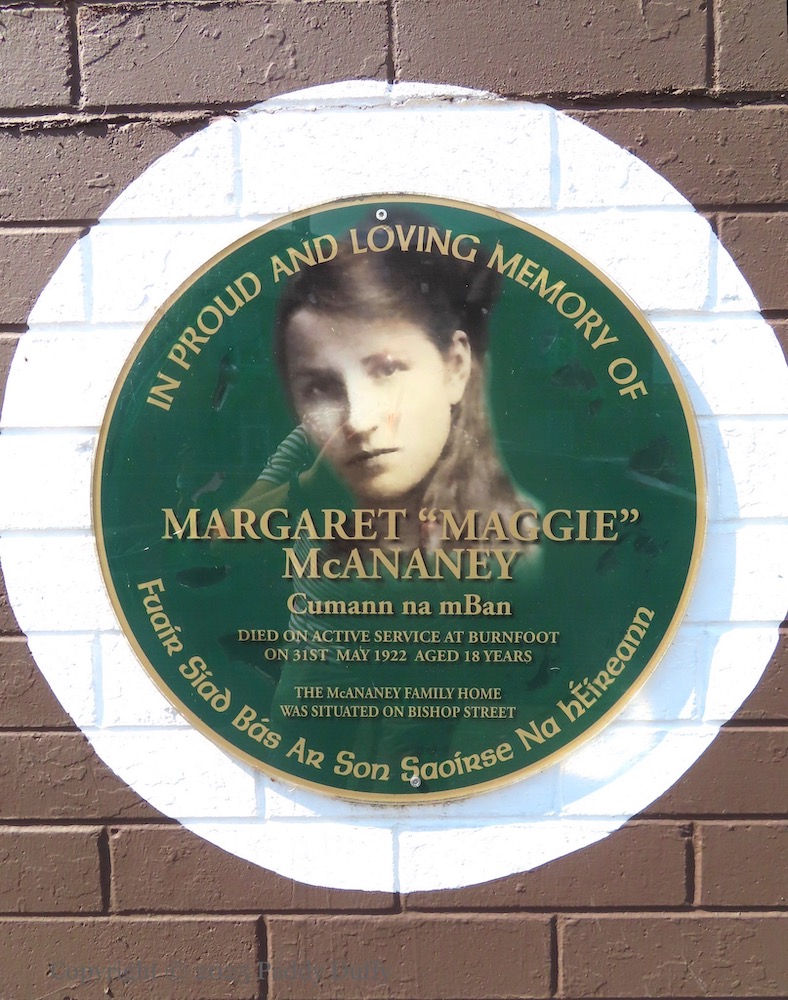
Also included below are an adjacent IRA Derry Brigade roll of honour and a plaque to Maggie McAnaney.
McAnaney died when a gun went off at an IRA checkpoint near Burnfoot, Co. Donegal, a month before the Civil War began (Derry Journal). This is an unusual use of the phrase “active service”, as McAnaney was travelling to a picnic at the time, rather than on exercises or preparing munitions; the phrase would later come to be associated primarily with a premature bomb explosion.
“In proud and loving memory of Margaret “Maggie” McAnaney, Cumann na mBan, died on active service at Burnfoot on 31st May 1922, aged 18 years. The McAnaney family home was situated on Bishop Street. Fuaır sıad bás ar son saoırse na hÉıreann.”
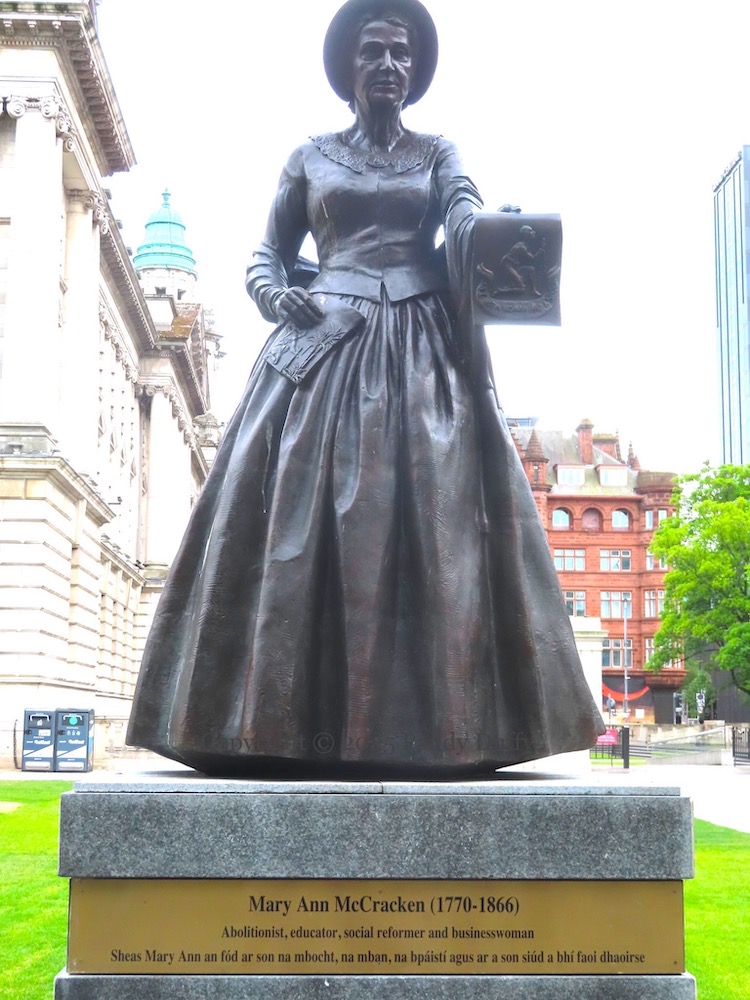
“Mary Ann McCracken (1770-1866) Abolitionist, educator, social reformer and businesswoman. Sheas Mary Ann an fód ar son na mbocht, na mban, na bpáıstí agus ar son sıúd a bhí faoı dhaoırse. [Mary Ann stood up for the poor, women, children, and for those who were enslaved.]”
“Mary Ann McCracken’s feminist ideals and commitment to the principles of Equality, Liberty, Fraternity applying equally to the Rights of Woman defined her participation in the United Irish Movement.” For McCracken’s connection to the 1798 Rebellion, see These Are Times That Try Men’s Souls.
The statue was unveiled in the grounds of Belfast City hall together with a statue to Winifred Carney on International Women’s Day (March 8th) 2024; both statues were produced by Ralf and Naomi Sander (BCC).