This photo of children taking a ride on a coal cart joins more than a dozen others depicting life during the 20th century in Carrick Hill – see Old Carrick Hill and The Tea Bar. Here is a Belfast Forum thread of people reminiscing about the various items that used to be delivered by horse-drawn cart.
For the anti-drugs art on the left of the wide shot below, see You Have The Power.
(lower) Regent Street, Carrick Hill, west Belfast. A new archive featuring recordings of local people opened earlier this month in the Carrick Hill Community Centre (Belfast City Council).
Lyra McKee was shot and killed in April 2019 while observing a riot in Creggan, Derry (BBC). A tribute in Belfast city centre was painted by Emmalene Blake during Hit The North (in May). The piece survived fairly well for a few years (here is a 2022 image) before being repainted with a flat blue background in 2025, which in turn had to be repainted in 2026 (for before and after images see 2026). People have taken to placing stickers with positive messages on top of the graffiti that immediately began to accumulate, such as “You did so well today”, “Fuck being average”, and “Never lose your sparkle”.
repainted during this year’s (2026) Hit The North.
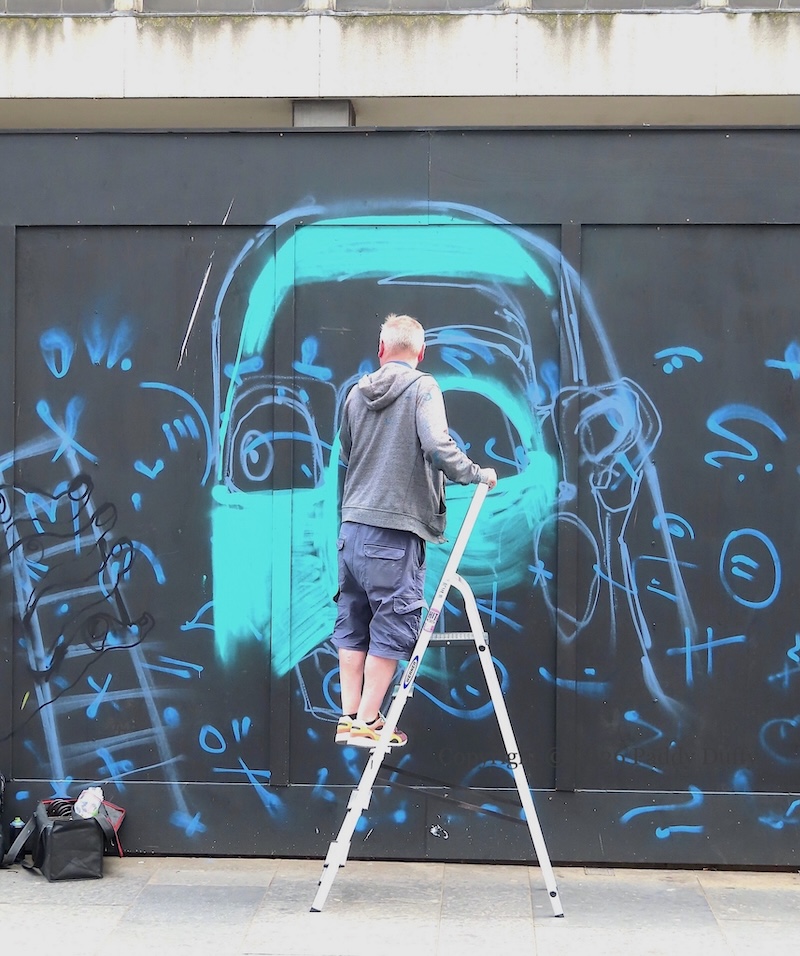
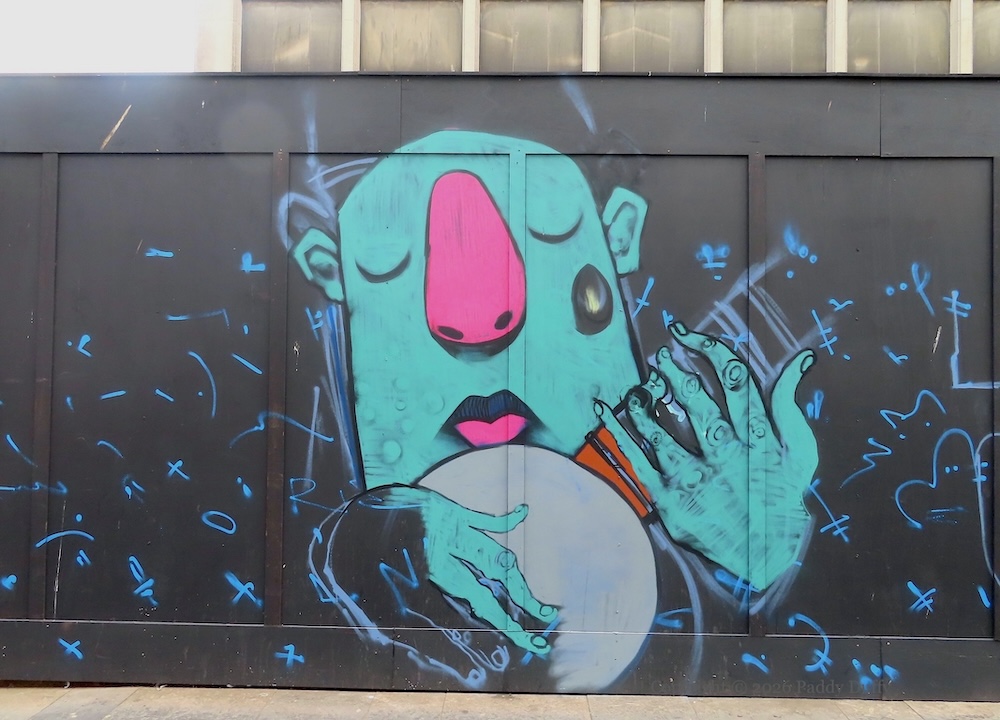
Avenue Hall – the building at the junction of Lower Garfield Street and North Street – was built in 1896, with ground-floor shops and upstairs ballrooms. The upstairs rooms were damaged by fire in 1990 and the last occupied unit on the ground floor was the Tivoli barbers, which held on until 2013 before moving to North Street. The shutters of the ground-floor shops, along with much of the derelict (lower) North Street, were covered with graffiti, and in 2012 became the epicentre of ‘Shutter Scape’, the first year of what came to be called Hit The North (see Visual History 11 and the historical map). The blocked-up windows of the upper floor were also painted, in 2014.
Future Belfast lists three potential developments and developers, in 2000, 2012, and 2016, and there were others in 2017 and in 2020. Castlebrooke currently has request for comments on its latest plan for the whole Garfield and Donegall Street area (RSUA | pdf). The current scaffolding was erected in 2018 along with the hoarding around the bottom, which was painted by Danni Simpson (‘Bout Ye, Belfast). Some demolition of the interior took place; the facade is protected by a grade B2 listing in 1991 (Plan Belfast | Future Belfast). Seven years later, the hoarding and the scaffolding still stand, and the hoarding has been repainted with a variety of Belfast sayings – “Aye”, “Dead on”, “Grand”, “Class”, “Awk, hiya” – painted by Alana McDowell (ig). The first part, above, replaces the anti-homelessness art in Life In A Bag.
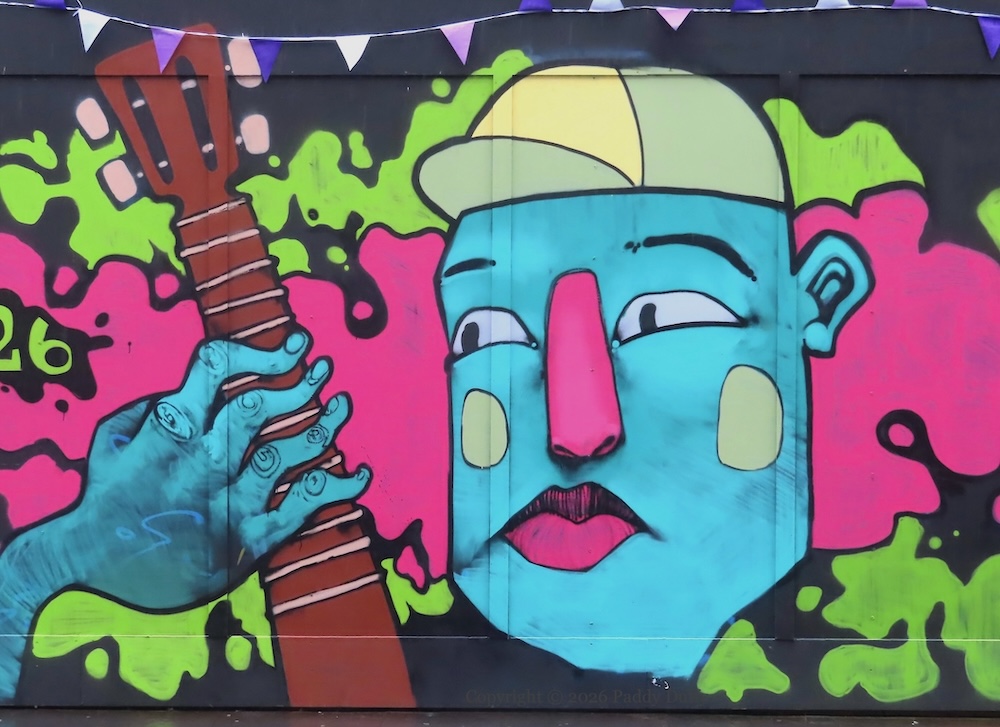
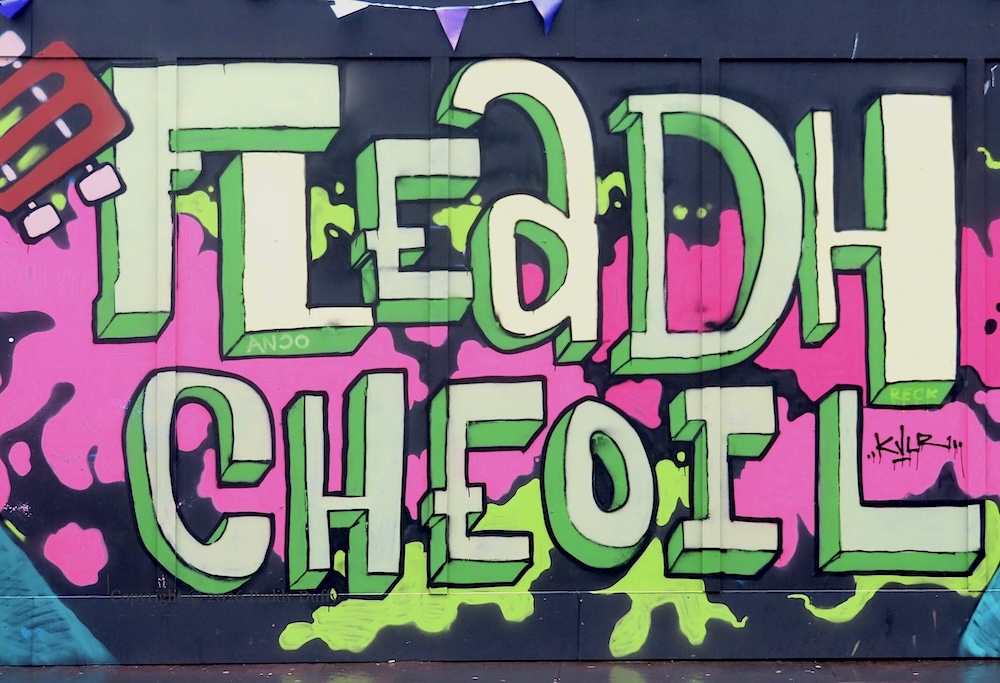
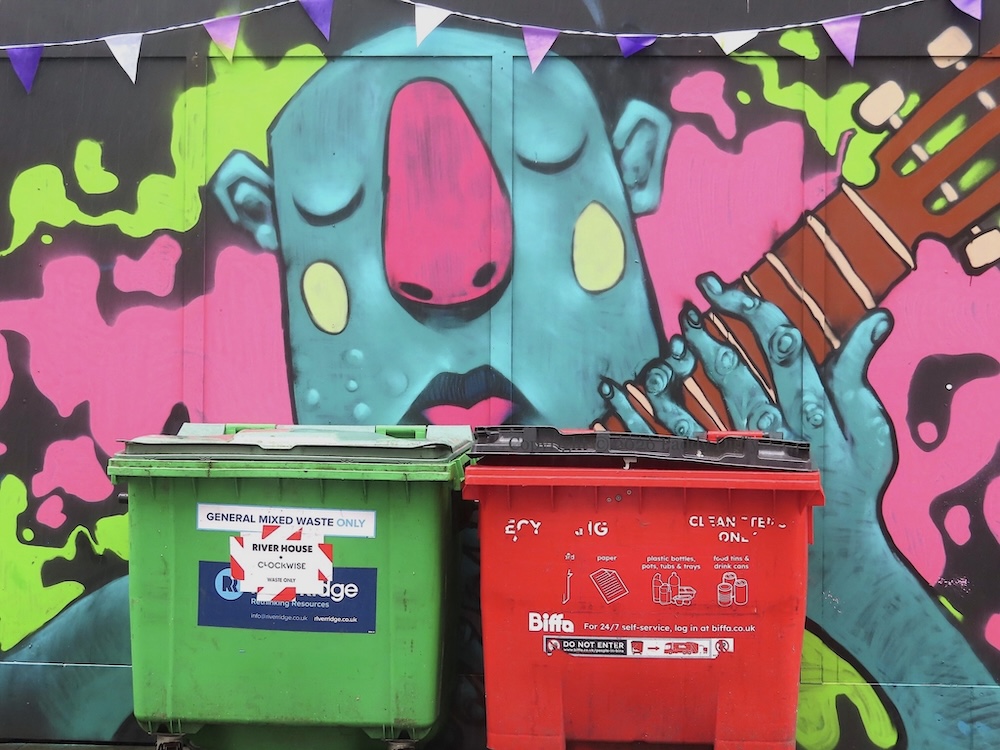
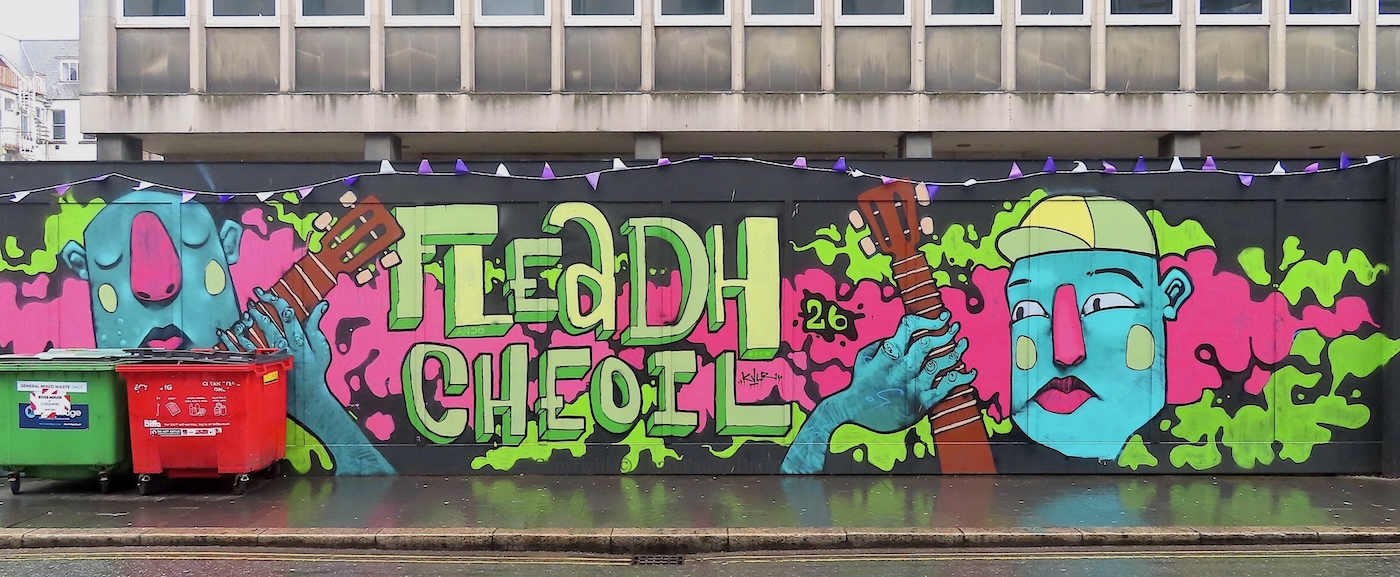
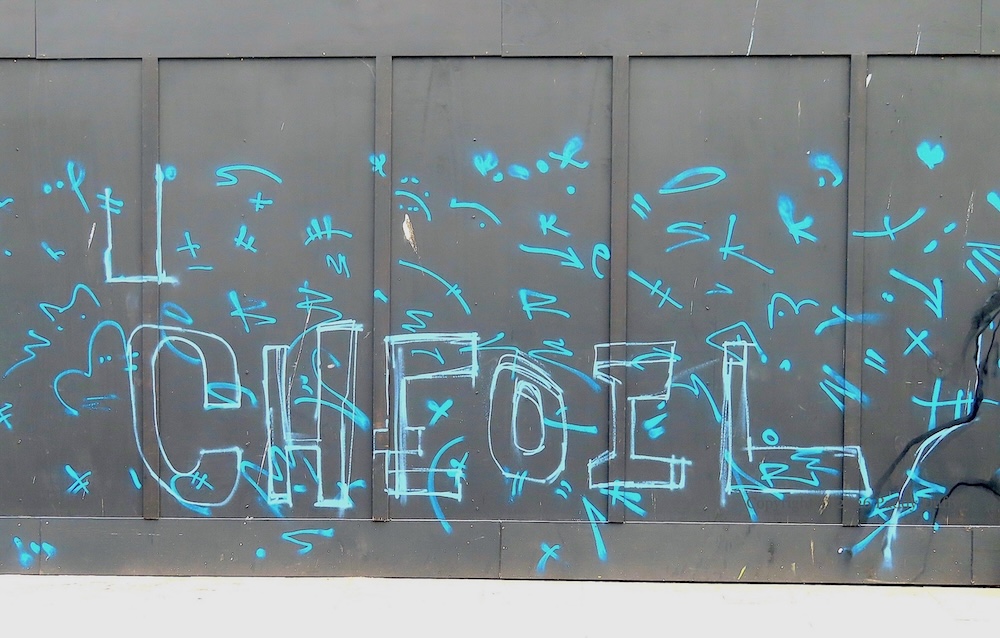
Fleadh Cheoıl Na hÉıreann takes place in Belfast from Sunday August 2nd to Sunday August 9th. Approximately 20,000 musicians will perform and compete, around 100,000 people are expected to attend each day, (Irish Times | Irish News | BBC), and 1,300 volunteers have signed up to assist with the event (Belfast Media), which also takes place the week after TradFest (web) during the second week of Féıle An Phobaıl (pdf).
This large painting of dancers and musicians outside the Duke Of York in Commercial Court (one drinking a “Belfast Session”, an American pale ale from MashDown Brewery (ig)) is by Ciaran Gallagher (web) in the courtyard of the Dark Horse bar. Launched July 2nd.
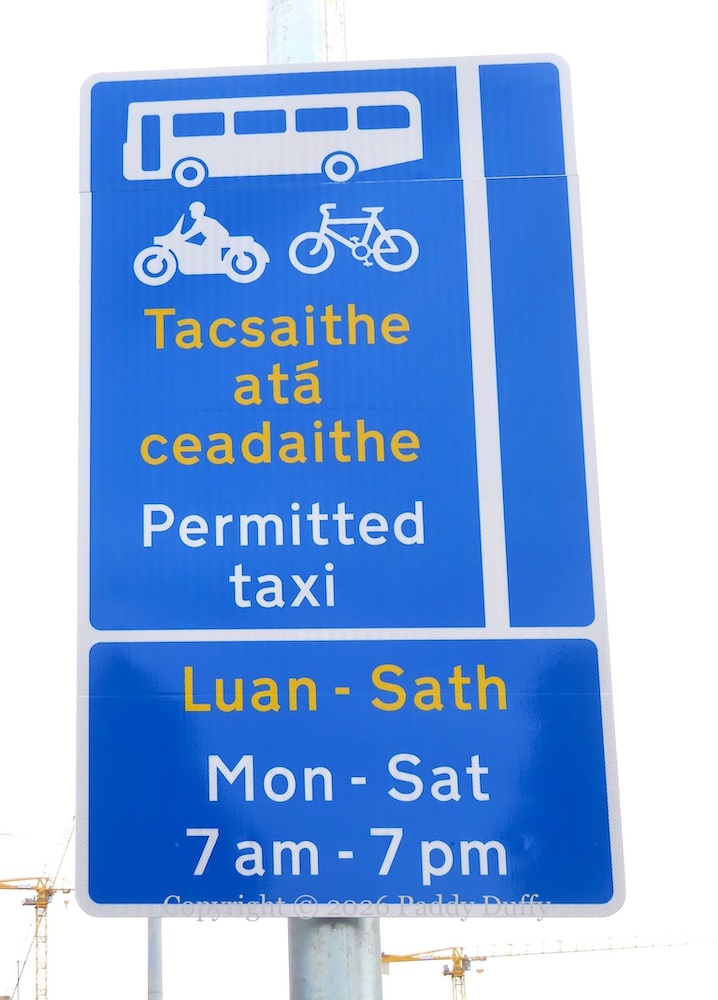
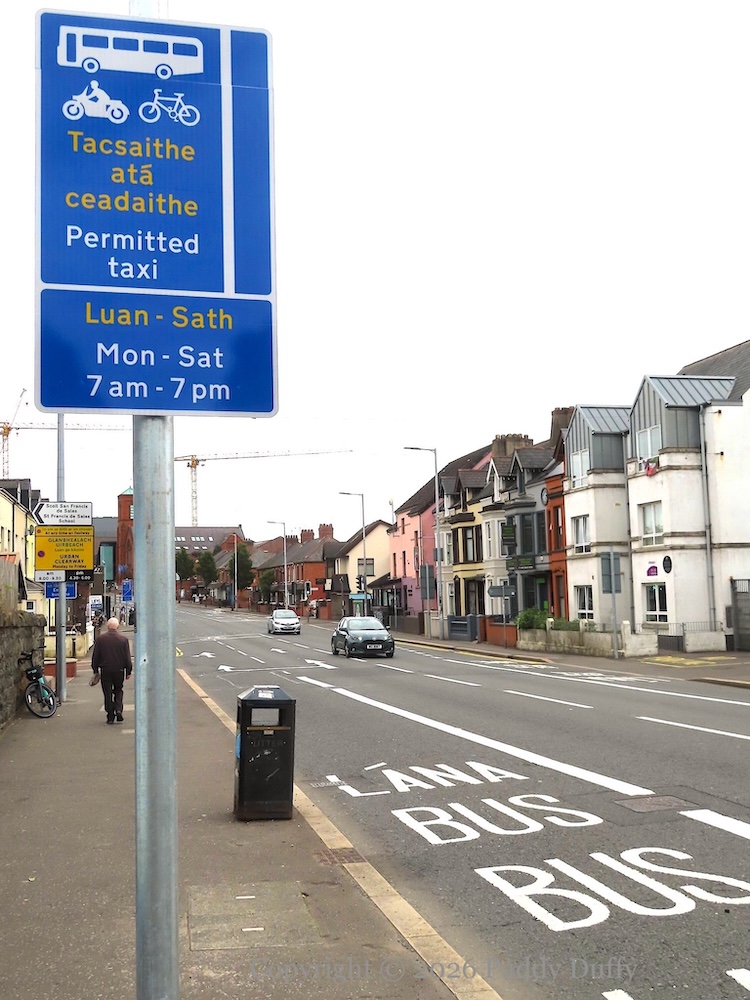
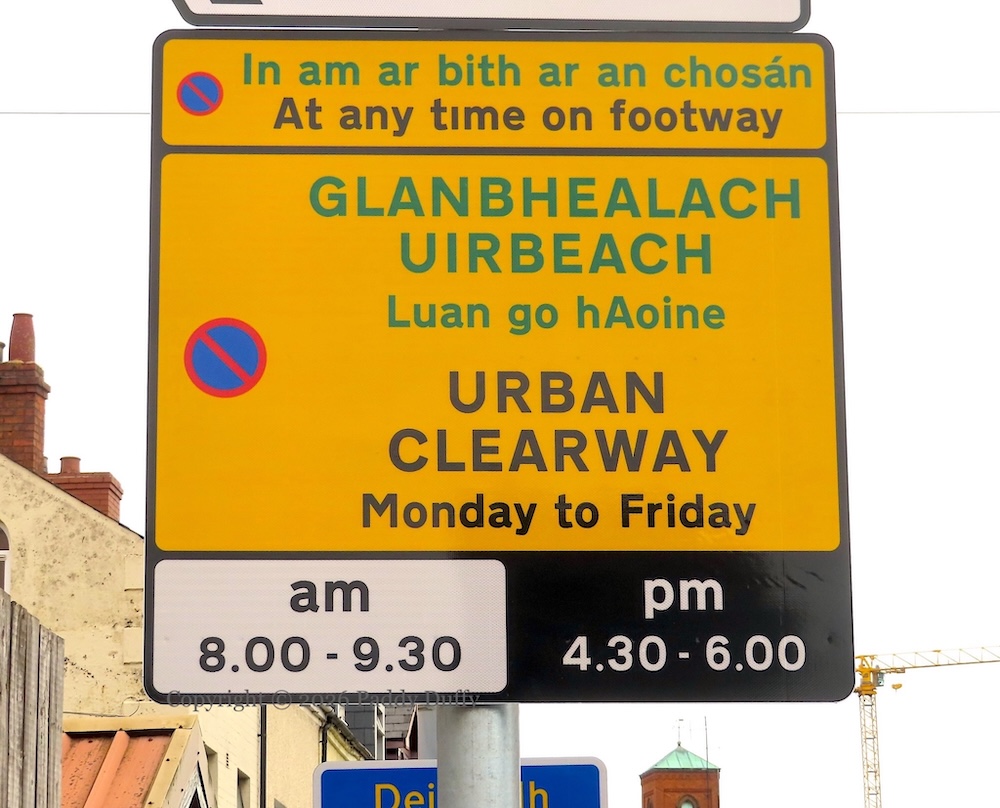
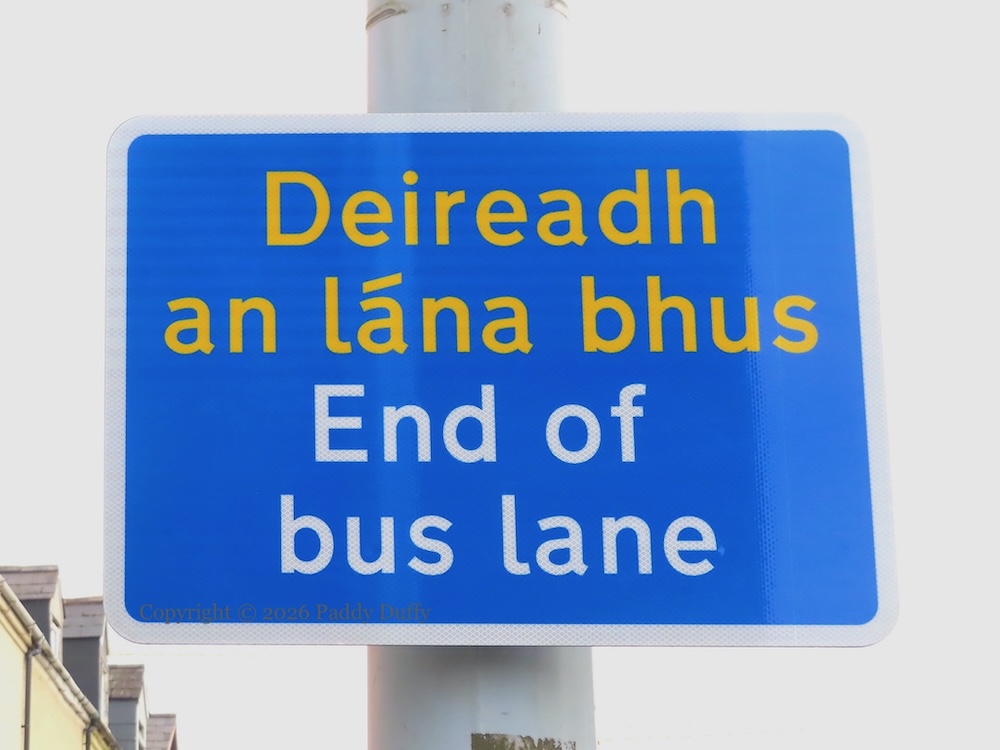
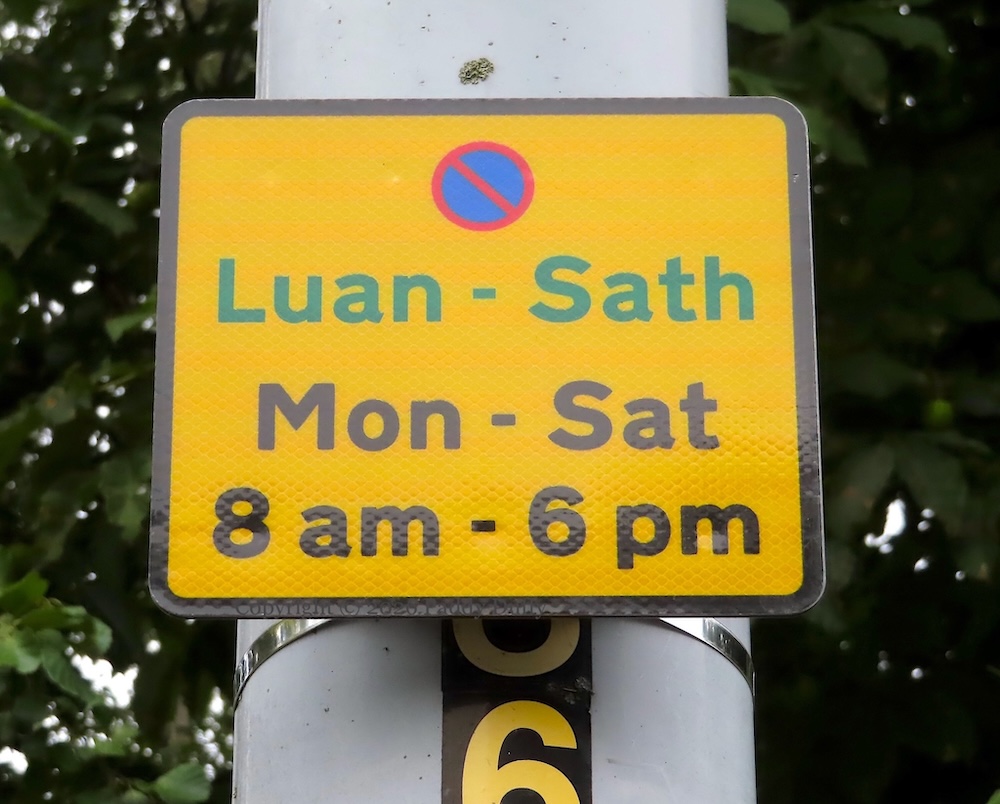
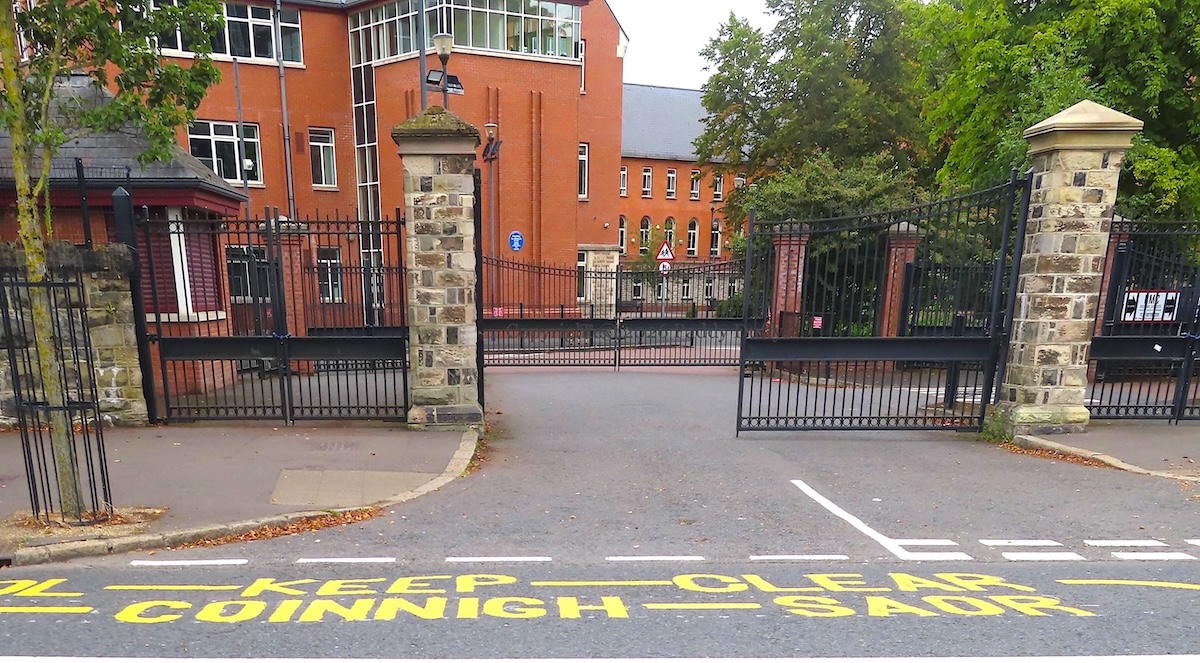
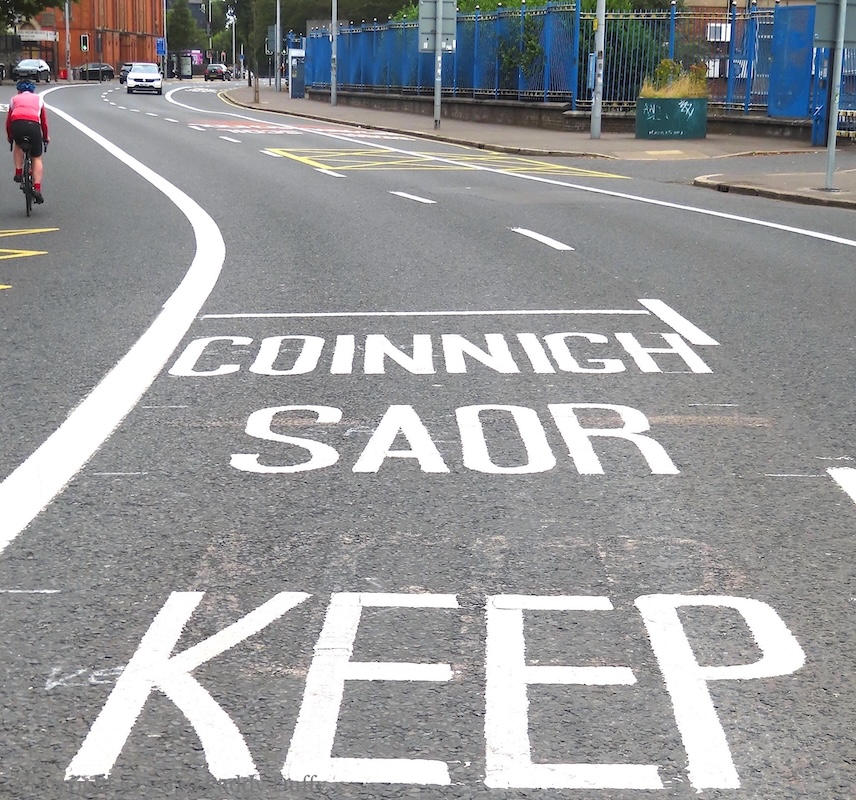
The full Belfast City Council last week overturned a committee decision to place dual-language (English and Irish) street-signs only on the CNR parts of long roads that pass through both CNR and PUL areas (Belfast Live). A TUV councillor at the meeting promised that any new signs would be “cut down” (BelTel) but the motion was carried by 31 votes to 25.
Currently at issue are Donegall Park Avenue, Oldpark Road, and Skegoneill Road. Donegall Park Avenue reaches a PUL area of the Shore Road at its eastern end, the site of the recent bonfire and anti-immigrant banners. In protest at the plan, and to make the identity of the area clear, the current street-sign at the junction has been papered over with “Loyalist Donegall Park Avenue”.
The policy statement on street-signs can be found at the Council’s web site (pdf).
A crude stencil pays tribute to IRA volunteer Sean Clinton, who died in April (2026) (Pensive Quill).
The stencil re-creates a famous photograph (CAIN), taken by Brendan Murphy of the Irish News (November 2025 BBC obituary), showing Clinton firing from this spot at an RUC checkpoint on Ormeau bridge. Clinton/the photo is also known as “The Last Gunman”, as the ceasefire was renewed a few days later, on July 19th, 1997.
Artana Street, lower Ormeau, south Belfast
For the Parades Protest mural, see Stand Off, Trade Off, which gives links back to its original appearance in 1998.
Street artist emic (web) visited Titanic Men’s Club (Fb) in 2024 to give an indoor tutorial on painting art on walls and the group moved outdoors in 2025 to paint this mental-health message on the wall of the Connswater Community Centre.
The group also has a large board on the Greenway – see This Is the Crew.
“Chest, Heart & Stroke – Improving lives across Northern Ireland since 1946.”
2026 is the eightieth anniversary of the Northern Ireland Chest, Heart & Stroke Association. It was founded on June 14th 1946 as the first Northern Irish branch the National Association For The Prevention Of Tuberculosis (previously the National Association For The Prevention Of Consumption And Other Forms Of Tuberculosis) and in 1959 became the Chest And Heart Association and in 1976 the Chest, Heart & Stroke Association. The Stroke Association (web) was formed in 1992, but there remain the NI (web) and Scotland (web) CHS associations.
The landmarks, from left to right (top to bottom) are: Carrickfergus castle, Grand Opera House, Titanic Centre, the Harland & Wolff cranes (Samson and Goliath), Carrick-A-Rede rope bridge, St Peter’s pro-cathedral, Mussenden Temple, Devenish Round Tower, Scrabo tower, the Giant’s Causeway, Dunluce castle, Gosford castle, the Peace Bridge.
Painted by Visual Waste (web) on the shutters of NICHS headquarters at the junction of Bruce Street and Dublin Road. With support from Linen Quarter BID (web).
The “Roden Street Bonfire And Cultural Festival 2026” has events every day this week, leading up fireworks and the lighting of the bonfire on the Eleventh (Fb). This new board, at the Donegall Road end of Roden Street, was unveiled on June 28th (Fb video).
“William III and II, also known as William of Orange, was the sovereign Prince of Orange from birth, Stadtholder of Holland, Zeeland, Utrecht, Guelders, and Overijssel in the Dutch Republic from 1672, and King of England, Ireland, and Scotland from 1689 until his death in 1702.”
“Historical Significance. The Glorious Revolution: William was invited by English Protestant leaders to invade England depose his Catholic father-in-law, King James II. Battle of the Boyne (1690): He secured his rule in Ireland by defeating James II’s forces at this pivotal battle. Constitutional Monarchy: His reign with his wide, Mary II, marked a shift toward parliamentary power through the 1689 Bill of Rights. Cultural Legacy. The Orange Order: A Protestant fraternal organisation named in his honour, which celebrates his victory at the Boyne annually on The Twelfth (July 12). Iconography: He is famoulsy depicted on murals in Northern Ireland, often riding a white horse and wearing an orange sash. Place Names: He is the namesake of Williamsburg, Virginia, and the College of William and Mary. ‘Remember 1690 – King Billy’s on the Wall [youtube]'”
The portrait of William on the left is by Godfrey Kneller and part of the collection in the National Gallery Of Scotland.