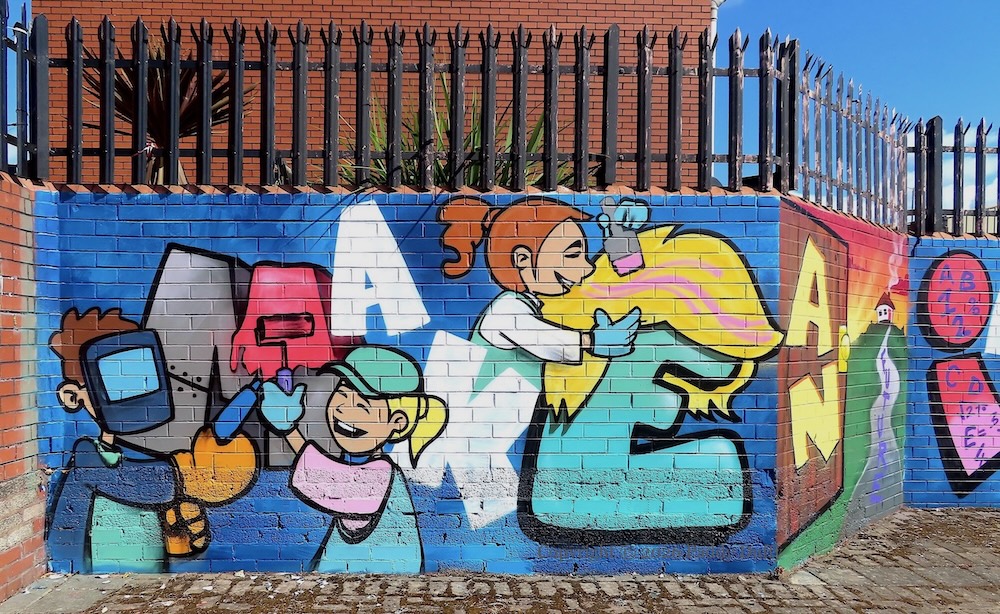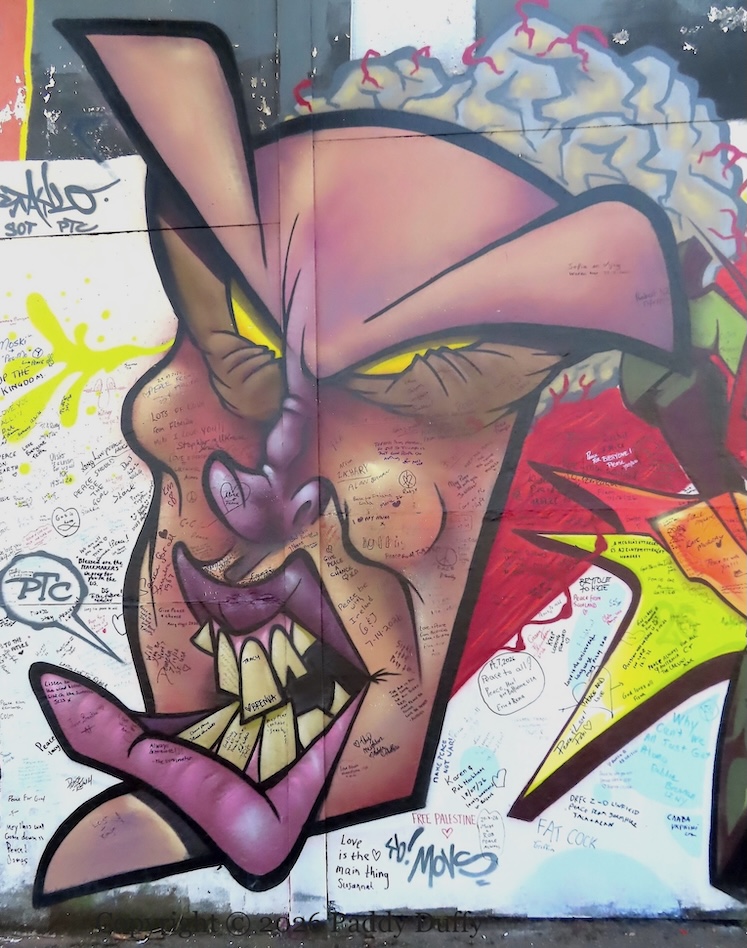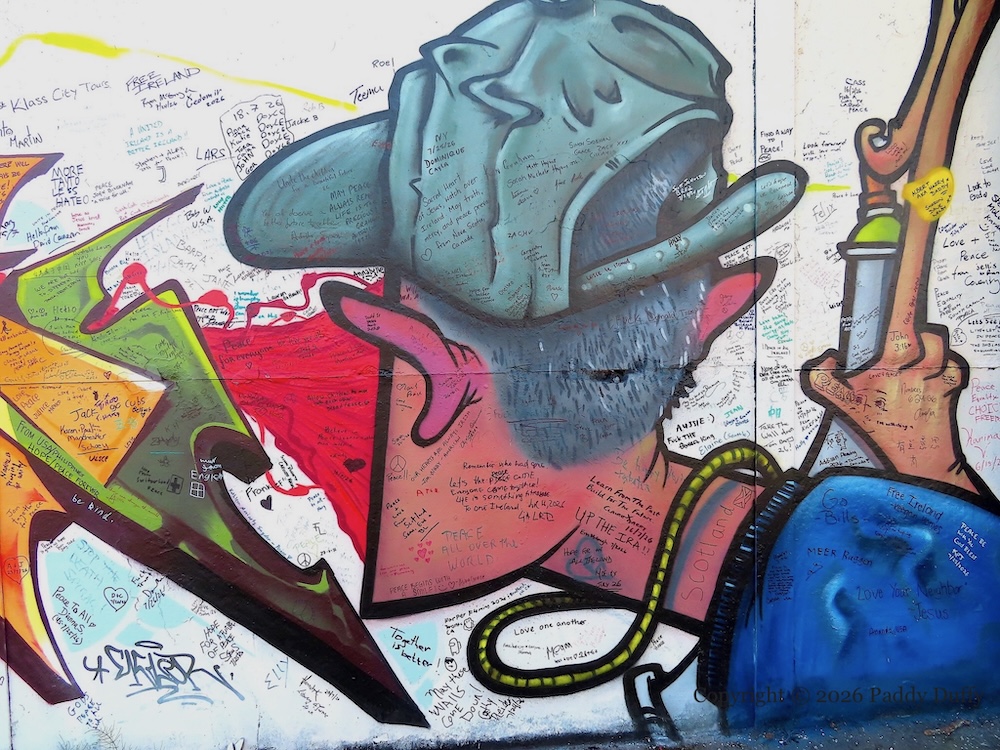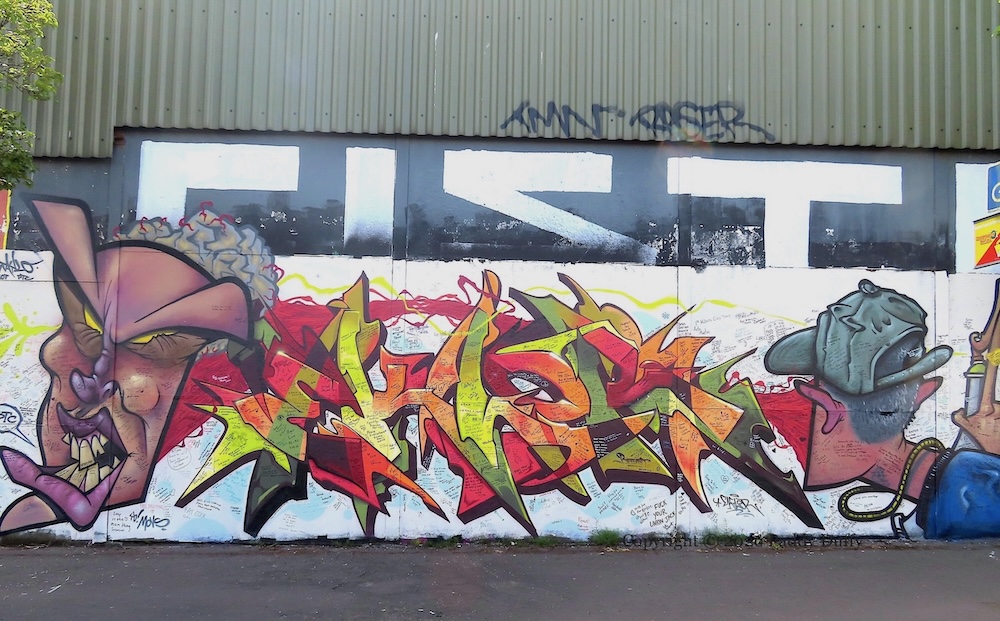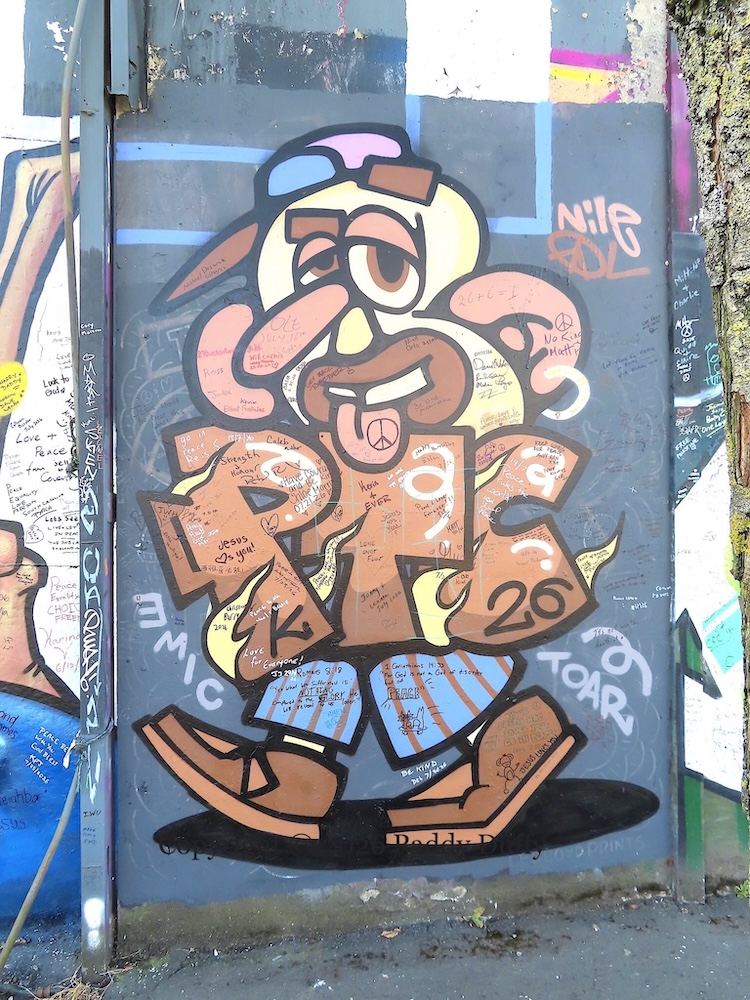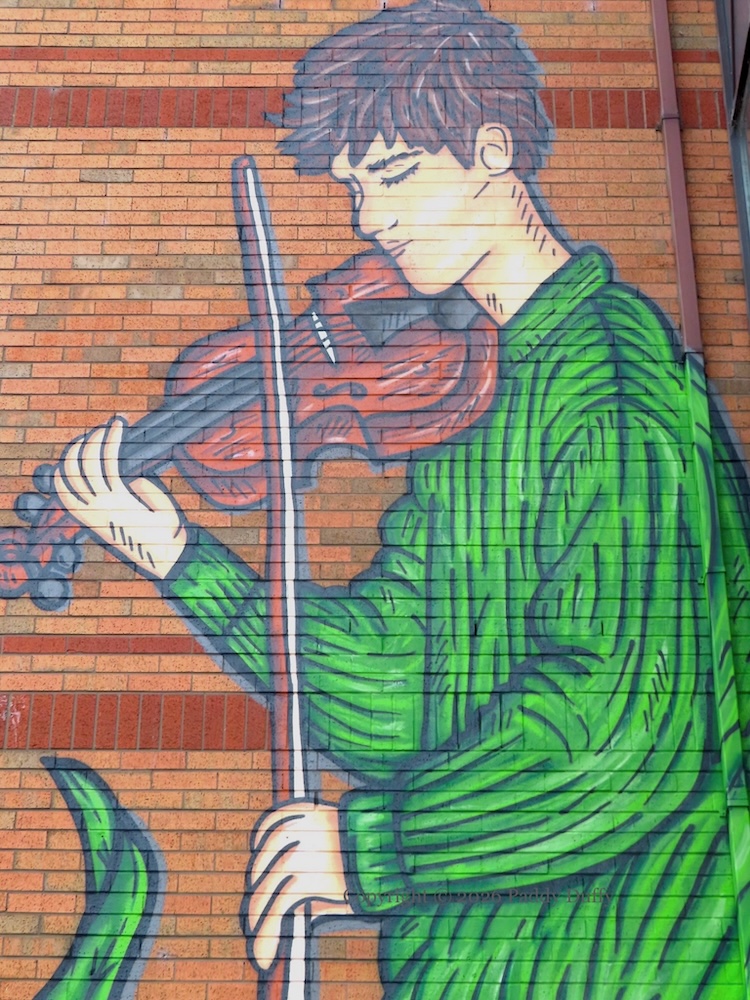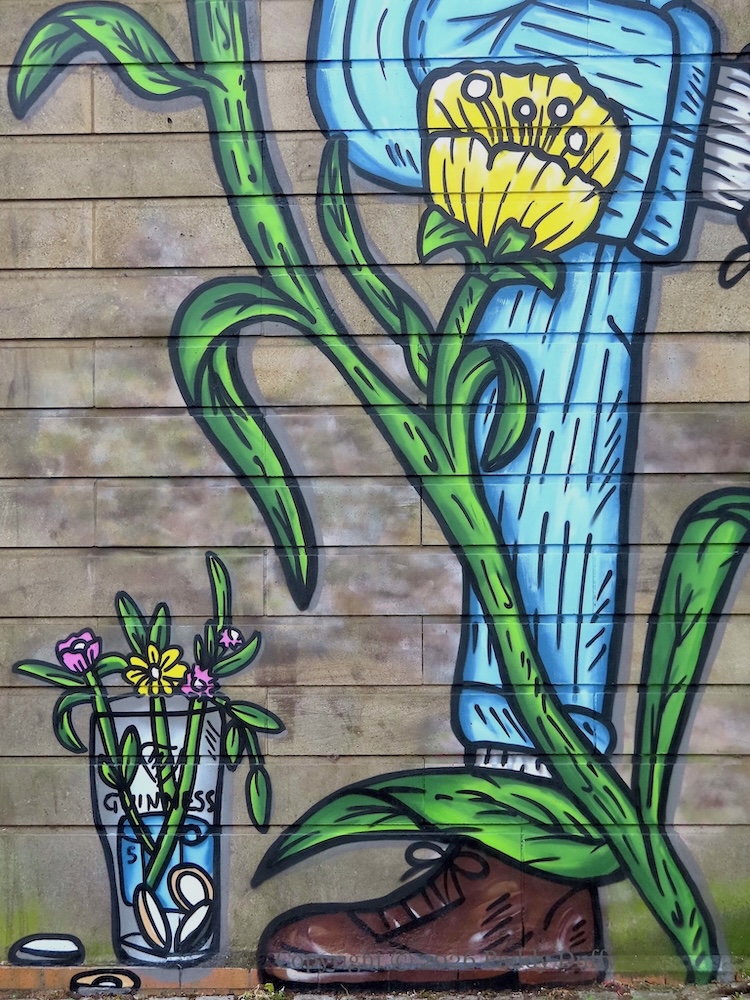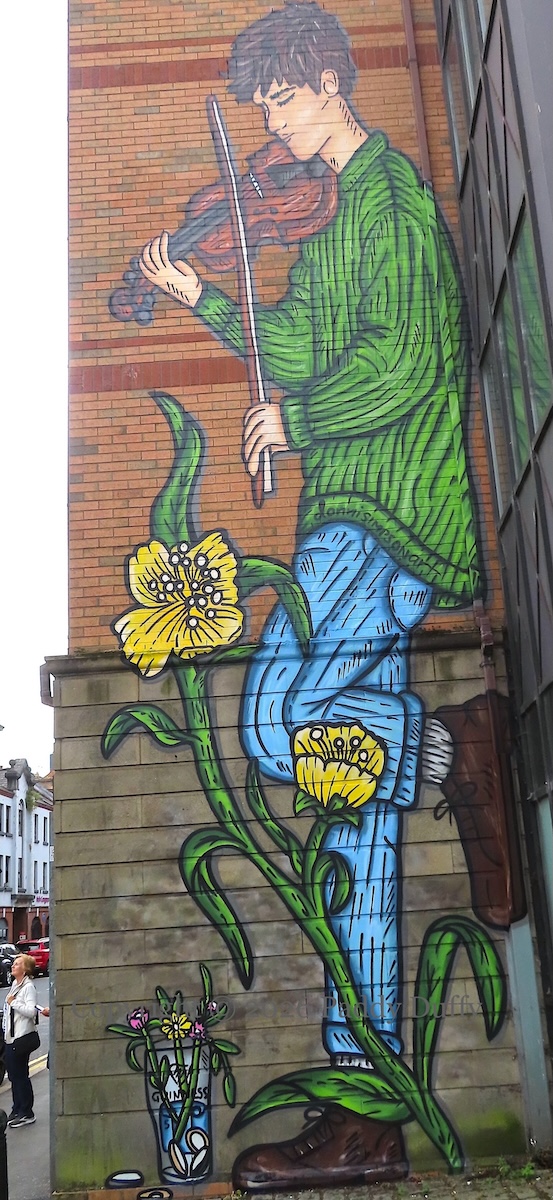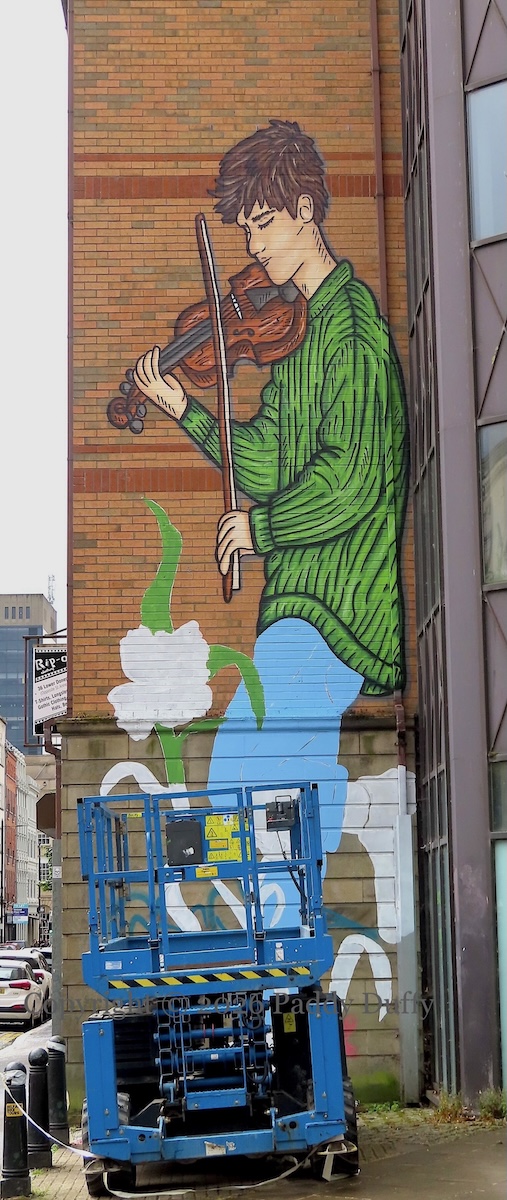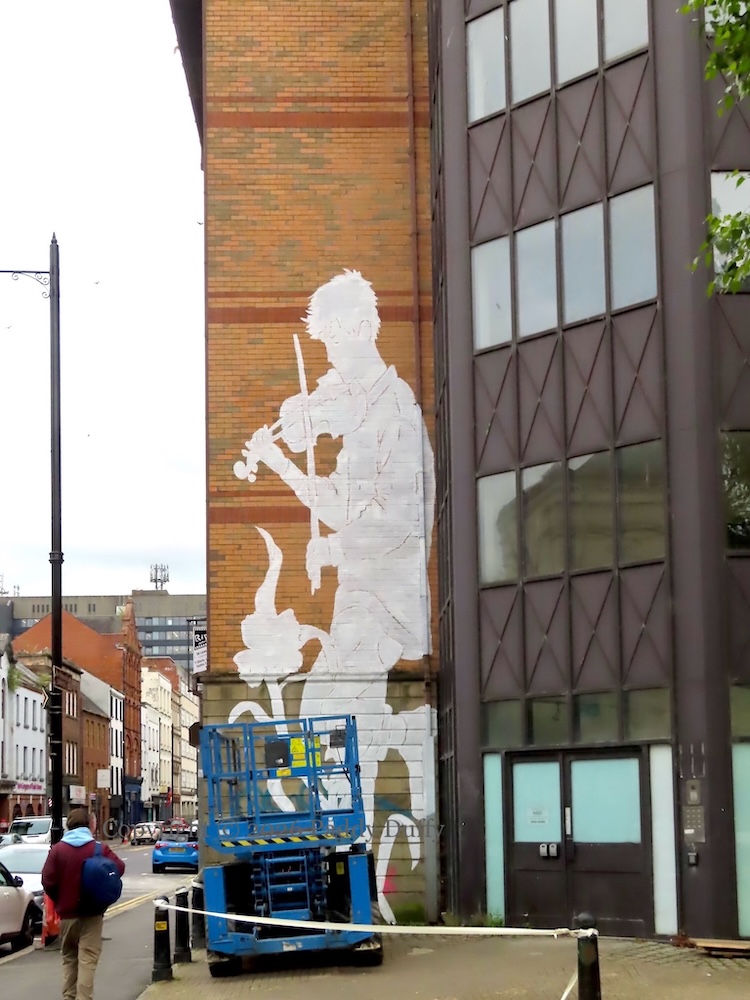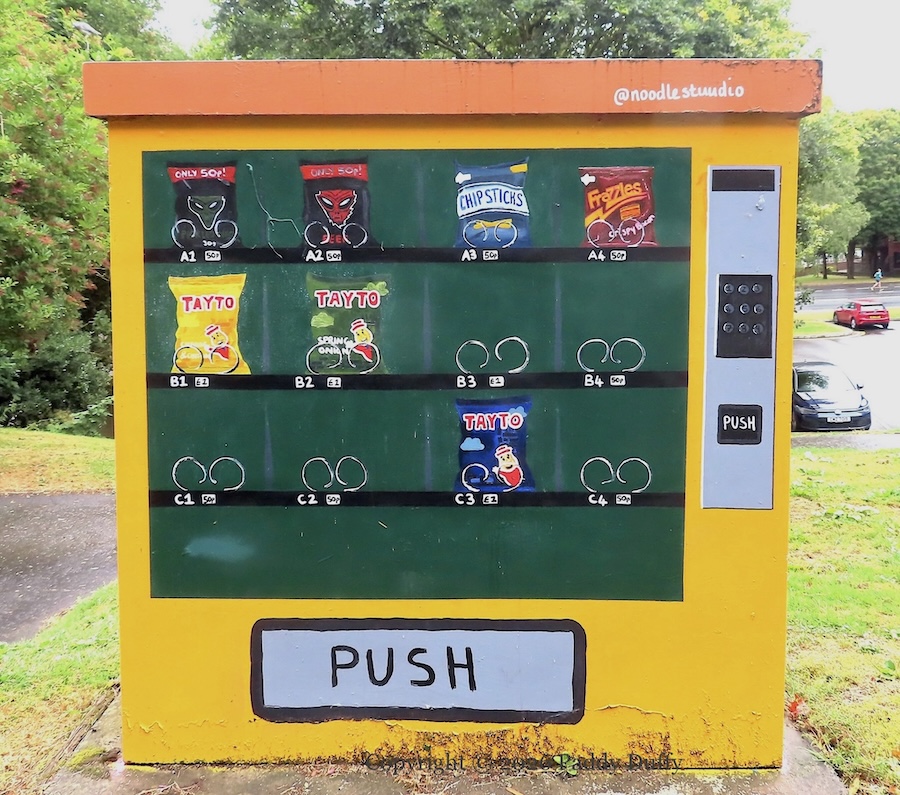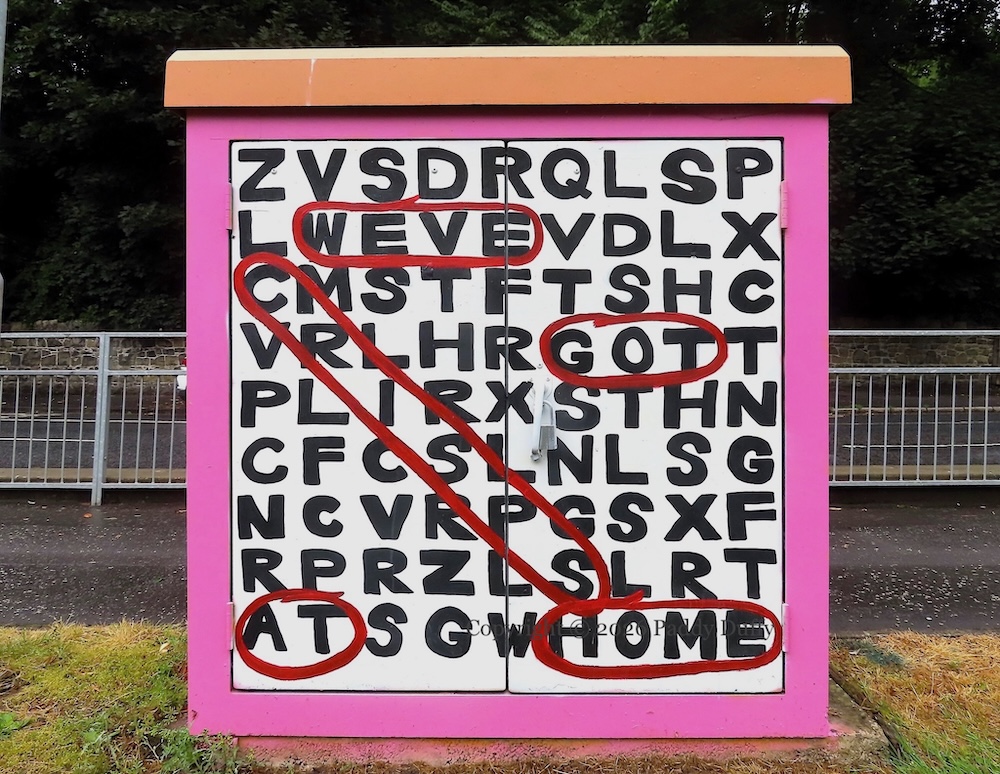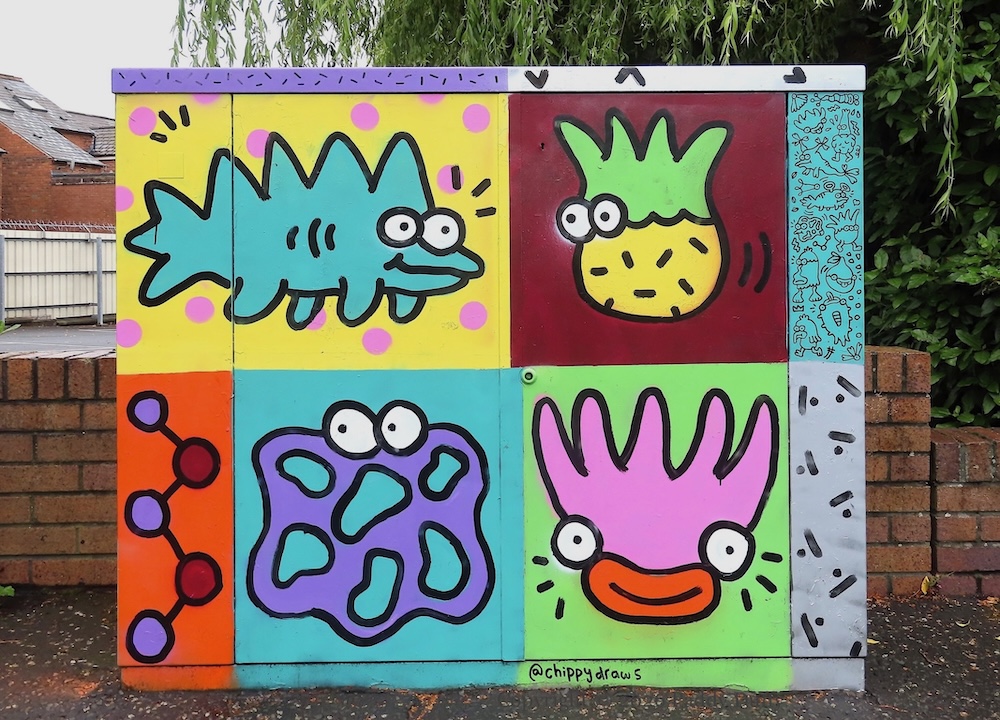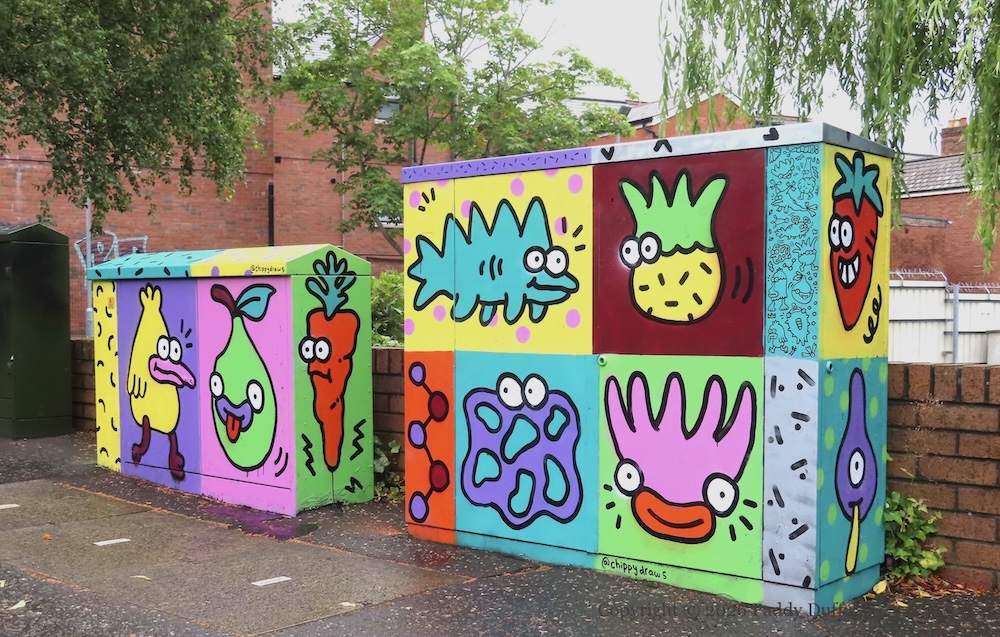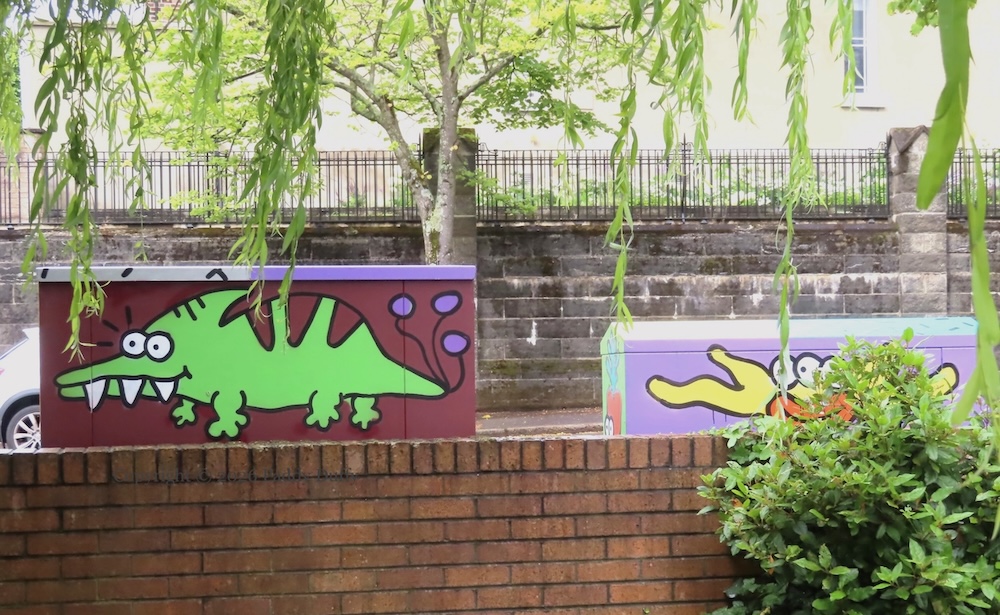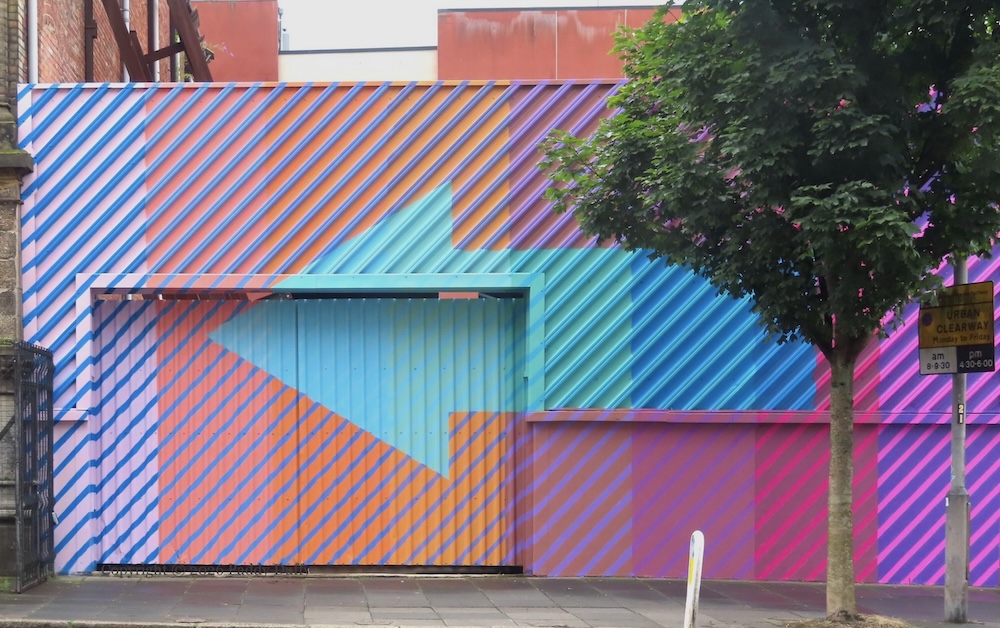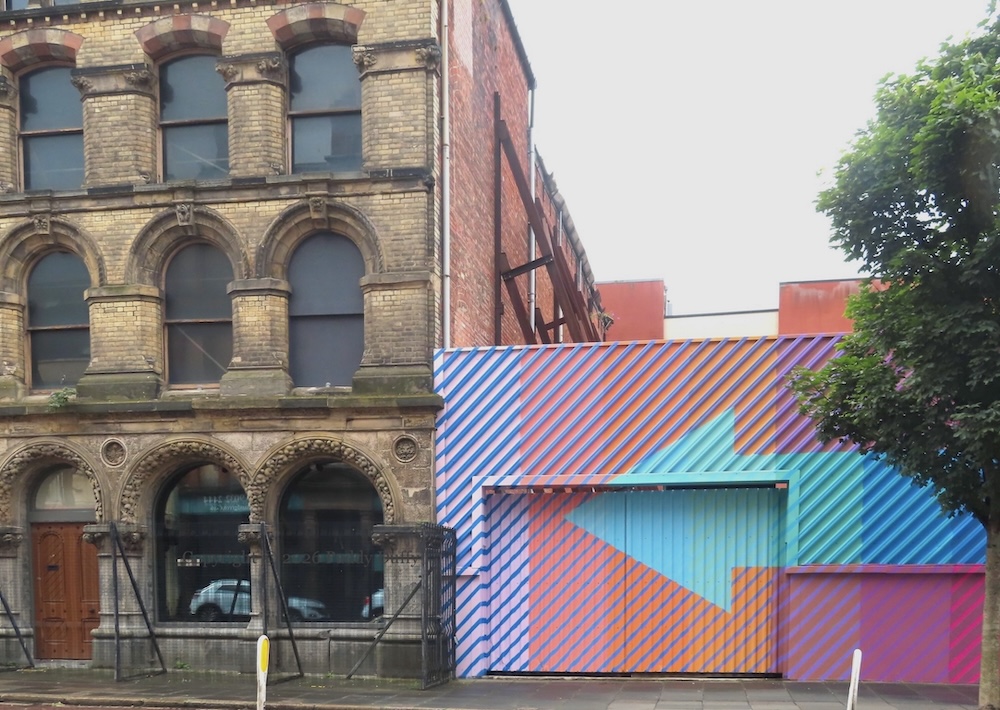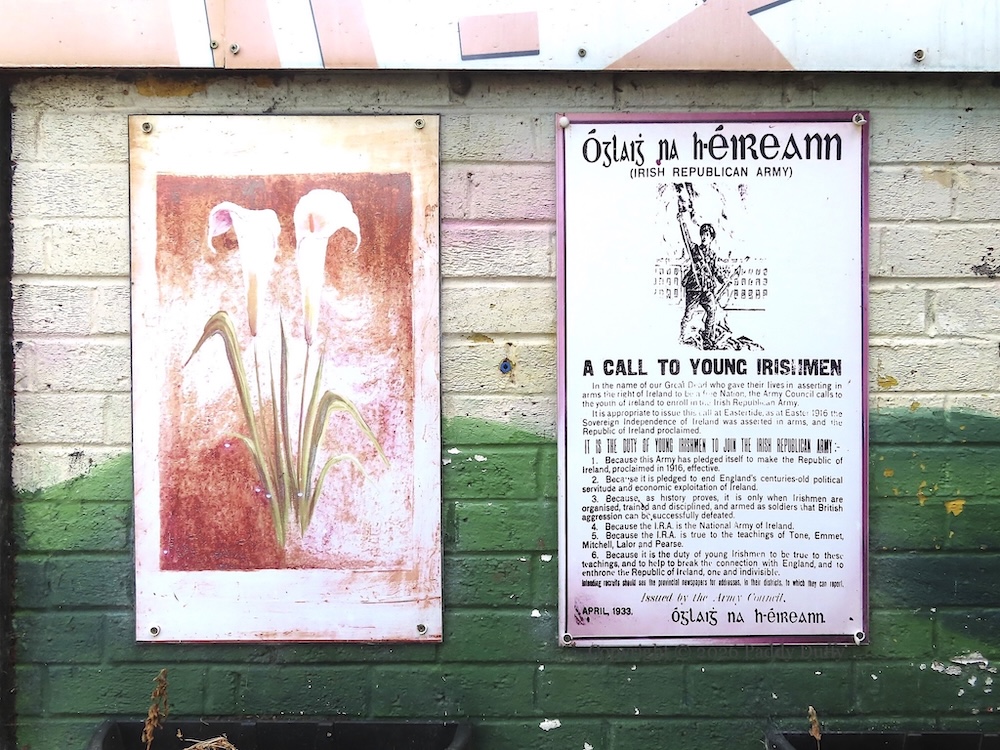
Smiley-faced flowers on the shutters of Donegall Pass Community Enterprises (web).

Click image to enlarge
Copyright © 2026 Paddy Duffy
T09494 T09493

Smiley-faced flowers on the shutters of Donegall Pass Community Enterprises (web).

Click image to enlarge
Copyright © 2026 Paddy Duffy
T09494 T09493

The United States Of America celebrates the 250th anniversary of its adoption of the Declaration Of Independence today, July 4th, 2026. In the Declaration, delegates from the thirteen (former) colonies set out their reasons for voting to overthrow British rule on July 2nd, noting twenty-seven grievances against the reigning monarch, George III of Great Britain And Ireland. At the time, the American Revolution was ongoing, and the Continental Congress meeting this time in Philadelphia was soon compelled to move to Baltimore, Maryland; the permanent Congress was not established until 1781.
On the left of the board, various symbols of the eventual United States Of America – John Trumbull’s painting ‘Declaration Of Independence’ (image at WP) and a bald eagle upon a Stars And Stripes formed by an outline of the eastern sea-board (which for an unknown reason lists New Castle (not “Newcastle”) alongside Philadelphia), the Liberty Bell, an “America 250 years” pin, the Seal, the Declaration, and a trapper or frontiersman who represents the westward expansion of European Americans – including the Scotch-Irish (Ulster Sails West) – across the continent.
The “liberty and law” emblem, with the red hand against the stars and stripes, surrounded by a garland of thistle and shamrock, is unknown.
The seated gentleman is James Hoban, a Catholic from Co Kilkenny, who studied architecture in Dublin and (after emigrating in 1878) designed the White House – a three-storey model (later reduced to two) is on the desk behind his quill – and (in the framed picture behind him) the Charleston (South Carolina) court-house.
In the centre is a quote attributed to James Buchanan, “My Ulster blood is my most priceless heritage”; for confusion over the quote see James Buchanan. Buchanan is also pictured (next to the word “Donegal”). The Great Seal was designed by Charles Thomson, originally from Maghera. He was also a signatory to the Declaration.
The crown above the red hand is probably the Tudor Crown, destroyed in 1649 (WP). A bed of shamrock supports the title banner.
The Ulster-Scots lineage of seventeen presidents (plus vice-president Andrew Calhoun) is presented along the bottom between the mottos “E pluribus unum” and “In God we trust”. (The Ulster-Scots Agency has a pdf of the Presidents.)
On the right, the poster marked “Eagle’s Wings”, under the Buchanan quote, also appears to come from the Ulster-Scots Agency. It is actually about the Eagle Wing, the ship pictured to the poster’s left (as imagined by water-colour painter Dan Parsons) that undertook the first voyage of Scots-Irish to North America in 1636. The journey was not a success: the roughly 140 dissenters returned to Ireland and some went to Scotland to avoid continued persecution (Presbyterian History.)
The ‘Blue Plaques’ of various notable figures are superimposed upon a period map: John Wallace Crawford, Francis Makemie, James McGregor, Charles Thomson, John Dunlap, Ezekiel Donnell, James Buchanan, Oliver Pollock, Thomas J ‘Stonewall’ Jackson, Robert Adrain, James Holmes. The portraits are of James Buchanan, Teddy Roosevelt (above Andrew Jackson’s ancestral cottage in Carrickfergus), Davey Crockett, and an unknown female figure (comment/get in touch if you can identify her).
The gravestone is to the Rev William Martin, a Reformed Presbyterian (Covenanter) minister, who led a contingent of 1,000 people in five ships in 1772 to Charlestown, South Carolina (Reformation History | History Ireland). The flag is the flag of the Covenanters (WP).
See also the Visual History page on Ulster-Scots Murals.
Lawnbrook Avenue, upper Shankill, west Belfast
For two other celebrations of USA 250, see the Visual History page on Ulster-Scots Murals.


Click image to enlarge
Copyright © 2026 Paddy Duffy
T09463 T09467 T09462 T09468 T09464
T09465 T09466 T09478 [T09461] [T09469] [T09479]

“1914 West Belfast regiment, Ulster Volunteer Force – 36th (Ulster) division, Royal Irish Rifles.” Men from the West Belfast Ulster Volunteers – which included the Shankill and Woodvale areas – joined the 9th battalion of the Royal Irish Rifles, which became part of the 107th brigade of the 36th division.
The main part of this new gable-sized board places two colourised photographs on top of each other. The first (upper) photo shows shows the first and second battalions of the West Down regiment being presented with their colours in May, 1914 (CyberProd). The second (lower) photo shows the first and second battalions of the West Belfast regiment receiving the Kings colours in May, 1914 (CyberProd).
In the bottom left corner is a poem called “Sons of Ulster” written on a scroll: “Muster round me Sons of Ulster,/And pay heed to what I speak,/Of the war to end all wars,/In the place where hell is deep.//Go and help to save the Empire,/Glorious deeds shall Ulster reap./Go and fight for King and Country,/In the place where hell is deep.//The order goes out – “Fix Bayonets!”/As Zero Hour does creep,/Ulster’s prime stands tall in line,/In the place where hell is deep.//No-Man’s Land hears a whistling band,/From Thiepval Wood they sweep./The crosses grow where the Ancre flows,/In the place where hell is deep.//With bomb and gun they repelled the Hun,/The Redoubt they die to keep./They fought as one did Ulster’s Sons,/In the place where hell is deep.//To the Glory of God on this sacred sod,/Where Ulster’s Blood does seep,/Yours and mine slaughtered like swine,/In the place where hell is deep.//Death patiently waits in this stalemate,/For Ulster’s love will weep,/The poppies grow where the Ancre flows,/In the place where hell is deep.”
In the bottom right, the Ulster Tower is dedicated: “‘Field Marshall Sir Henry Hughes Wilson, 1st Baronet, GCB, DSO, MP, Colonel Commandant, Rifle Brigade, Chief Of The Imperial General Staff. Field Marshall Sir Henry Hughes Wilson of County Longford, was one of the most senior British Staff Officers to serve int he First World War. On 18th November 1921, in the stead of Sir Edward Carson and Sir James Craig, who were both ill at the time, Sir Henry undertook the solemn duty of dedicating the newly constructed Ulster Memorial Tower, on the site of the Somme battlefield. Tragically, on 22nd June 1922, Sir Henry, who also served as a Unionist politician, was assassinated outside his London home.”
Conway Street, Shankill, west Belfast, replacing Ulster Tower.


Click image to enlarge
Copyright © 2026 Paddy Duffy
T09471 T09472 T09473 T09476 T09474 T09475
T09477c [T09470]

Donegall Pass began life in the late 1600s as a lane-way (loning, loney, loanen) made by one of the early earls of Donegall (the first three of whom were all called Arthur Chichester) through what was then Cromack Woods (Library Ireland). The woods are remembered in local street-names such as Walnut Street, Elm, Street, Pine Way (which are all included in the mural), as well as Cromac Street itself.
Clara Copley was born in Rotherham, moved to Liverpool, and then to Belfast c. 1900, where she lived for about fifty years. Her career was a colourful one that included running a fish-and-chip stall, an amusement arcade, a waxworks, a theatre, and a boxing ring, which was initially unlicensed but made official in 1936, when Copley was aged 70. She retired to a house in Donegall Pass where she died in 1949; there is a ‘blue plaque’ at the site (with an incorrect date of birth, faithfully reproduced here) in her memory. (DIB)
Apsley Street, south Belfast, opposite In Harmony With Nature.


Click image to enlarge
Copyright © 2026 Paddy Duffy
T09455 T09456 T09457 T09458 T09459 T09460

“Open gates. Open borders. Open season. Your sheep. Their feast.” Politicians from Sınn Féın, the SDLP, Alliance, and People Before Profit are shown opening the gates for masked and armed men who are coming from the sea and bidding them to enter a sheepfold of “our constituents”.
The PSNI are investigating the banner as a “hate incident” (rather than a “hate crime” – see A New Evil for the difference) (BelTel). The banner was later (July 1st) removed and replaced with Union Flags and an Ulster Banner (Belfast Media | News Letter).
Shore Road, north Belfast
Update, July 3rd: the banner has been restored – see the Seosamh Mac Coılle collection.


Click image to enlarge
Copyright © 2026 Paddy Duffy
T09446 T09444c T09445 T09443

Shore Crescent prepares for Eleventh Night with a bonfire and a large sign explaining the positive impact of the tradition:
“Shore Crescent bonfire – a proud loyalist tradition. Standing firm in our heritage, our loyalty & our values. Faith – loyalty – respect – heritage. [The bonfire …] Celebrates our heritage – honours our history, culture and the sacrifices made by those who went before us; strengthens our community – brings families, friends and neighbours together, building unity, pride and a sense of belonging; affirms our loyalty – a clear and proud expression of our loyalty to the Crown and the United Kingdom; educates & remembers – teaches future generations the importance of our traditions and the true meaning behind them; promotes respect & pride – shows respect for our values and beliefs and promotes pride in being Loyalist; supports local [groups] & raises funds – helps support local groups, charities and initiatives that make a real difference; secures our future – by standing together today, we protect our identity, freedom and way of life for tomorrow. One tradition. One community. One loyal people. Shore Crescent loyal.”
Next to Loughside Playground, Shore Road, north Belfast

Click image to enlarge
Copyright © 2026 Paddy Duffy
[T09447] T09448 T09449

The Irish men’s soccer team is scheduled to play Israel in the Nations’ League, on September 27th and – at home – on October 4th, 2026. A campaign was launched to “Stop the game” in Dublin as a form of protest and disengagement, most prominently in the form of an open letter (instagram) sent to the FAI signed by footballers and various musicians.
The FAI instead appealed to UEFA to have the game played behind closed doors in a neutral country, saying that while it was “deeply conscious” of the suffering in Gaza and the West Bank, it did not want to forfeit the points or be disqualified from the competition (FAI).
The large tarp shown above has been added (on June 18th) on top of the long Painting For Palestine mural on Divis Street.
The various placards reading “No to hate”, “Fight racism”, and “Yes to all!” were added last week (June 17th) in response to the rioting in east Belfast and elsewhere – see McMaster Street Remembers. (These additions are reminiscent of the ‘Free Marian Price’ additions in 2013 – see Scaoıl Saor Marian Price in the Peter Moloney Collection.)


Click image to enlarge
Copyright © 2026 Paddy Duffy
T09298 T09299
T09297 T09300 T09301

McMaster and Lendrick streets – part of a conservation site of Victorian terraced houses (Dept For Communities) – were the epicentre of last week’s anti-immigration riots, with cars and houses in the street set ablaze and families evacuated to safety by the security forces (BBC video).
Also in the street: An Act Of Betrayal (about the Sea Border) and (before that, c. 2010) Young Newtown UDA.
Click image to enlarge
Copyright © 2026 Paddy Duffy
T09293

“1st south Belfast LSC [Fb] remembers. Lest we forget.” “To the glory of God and in honourable memory of the former players from Linfield Football Club who laid down the glory of their youth upon the altar of freedom during the Great War of 1914 – 1918.
The main part of this new board in the Village shows the Linfield memorial at Bertrancourt, France. The memorial was unveiled in 2022 (BBC). The BBC article explains the reference to “Rifleman Walker” in the poem by Johnny Jamison at the centre of the memorial: Walker had been a Linfield player before joining the Royal Irish Rifles and dying on May 6th, 1916. Jamison recites his poem in this Fb video. In the background is the familiar Ulster Tower.
Broadway, the Village, south Belfast. For the small boards above, see Village Team On Tour and I Would Rather Be An Ulsterman.


Click image to enlarge
Copyright © 2026 Paddy Duffy
T09251 T09253 T09254 T09252

The association of lions with the English monarchy goes back to Henry II and his sons Richard (“the lionheart”) and John (WP). Why they were represented by lions is unclear; it perhaps stems from the prominence of lions in the Bible and the Lion Of Judah from Genesis 49:9.
These lions, somehow carrying Union Flags, are in Lord Street at Lord Street Mews, east Belfast


Click image to enlarge
Copyright © 2026 Paddy Duffy
T09233 T09234 T09235 T09236 T09237