A memorial service was held at the Times Bar on Friday (June 5th) (News Letter) to mark the fiftieth anniversary of the attack on the Times Bar in 1976, in which Edward McMurray and Robert Groves were killed by a republican bomb. (An image of the bombed bar can be found on Xitter.)
Three plaques were added to the memorial garden where the service took place, to William Haddock, James Smyth, and William Flynn. (Compare to 2019.)
As the images from May 10th, below, show, a painted mural was originally planned for the spot.
This UDA emblem is on a gable wall at the back of a house in Queen’s Road, but serves as the upper limit between the UVF Steeple (Parkhall Road) and the UDA Kilgreel Road areas of Antrim. Some of the UDA board have gone from Kilgreel Road, and those that remain are in poor condition, but this one was re-painted/repaired relatively recently (c. 2020). The original, which dates back to at least 2008, was black – see the Peter Moloney Collection. The main mural in the estate is kept in good condition.
“In eternal memory, UVF Volunteer Jimmy Fee.” This entry updates 2023’s Pass Not This Spot In Sorrow, which showed a painted UVF flag in memory of Jimmy Fee. This has been replaced by a printed board which contains a photographic portrait of Fee. As reported in that earlier entry, there is no information readily available about Fee, who perhaps died around 2016, when the original mural was painted. The two upper boards (in the shape of gravestones) have been retained from the earlier work, while the “north Antrim/Londonderry battalion, south Antrim brigade – remember them with pride” board is new.
Parkhall Road, Steeple, Antrim. The WWII banner is in the nearby Steeple Park.
Christopher “Crip” McWilliams has been added this new version of the INLA memorial on Northumberland Street (Visual History). McWilliams was a long-time member of the IPLO and was present at the Lenadoon shout-out with the RUC in Lenadoon in which Bonanza McCann died. He joined the INLA while in prison for the 1991 killing of a snooker-hall manager (Independent) and in 1987 was the gunman in a team of three that killed the LVF’s Billy Wright in the H-Blocks (IRSN | Cory Report (pdf) | MacLean Report (pdf)).
The info board in the final image was originally mounted in 2014 to accompany the version painted on a board which featured Loughran, McLarnon, McCann, and Gallagher, and updated in 2019 for the printed version which added McElkerney.
The UVF boards at the junction of London and My Lady’s roads in east Belfast have been completely replaced (compared to 2022). The hooded gunmen on the short side have been replaced by “Joy, peace, love” while a tribute to David Ervine now replaces the lettering reading “East Belfast Ulster Volunteer Force”. Ervine was a UVF member from 1972 to 1980 before turning to a career in politics. “He asked the question “why can’t I be an Irish citizen of the UK?” … “An architect of peace. An inspiration to us all.” Always remembered by his family, comrades, colleagues and friends.”
Next to Ervine is a UVF roll of honour in which Roy Walker joins Robert Bennett, James Cordner, Joseph Long, and Robert Seymour, who were previously portrayed (Ulster’s Brave). Walker was killed in a feud with the UDA in 1976. And around the corner the UVF emblem has been replaced by a board to the Ulster Volunteer Force Regimental Band.
The largest panel remains a tribute to the dead of WWI, specifically now the “3rd battalion (Mountpottinger)” of the East Belfast regiment of the Ulster Volunteers who “marched to the old town hall in Victoria Street accompanied by the Duke Of York Pipe Band and around 270 members volunteered”. The long text explains the negotiation between Kitchener and Craig over the formation of the 36th Division; the East Belfast volunteers joined the 8th Battalion of the Royal Irish Rifles; “training took place at Ballykinlar in County Down and the Battalion became known as “Ballymacarret’s Own””.
“Remembered with pride – Stevie McCrea, Village, south Belfast”. A plaque has been added below the large board describing Stevie McCrea’s life in Kilburn Street (seen in 2022’s Here Lies A Soldier, which includes the text on the board).
Also included below are close-ups of the plaques to McCrea and Sammy Mehaffy in Tavanagh Street, (seen together in Village UVF).
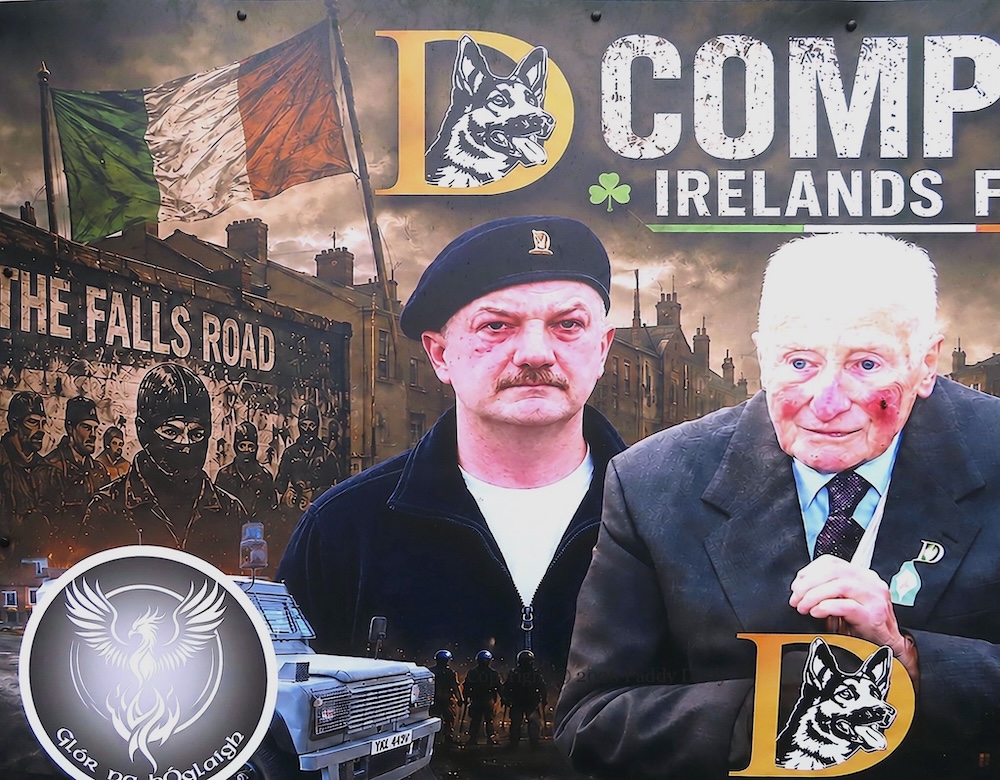
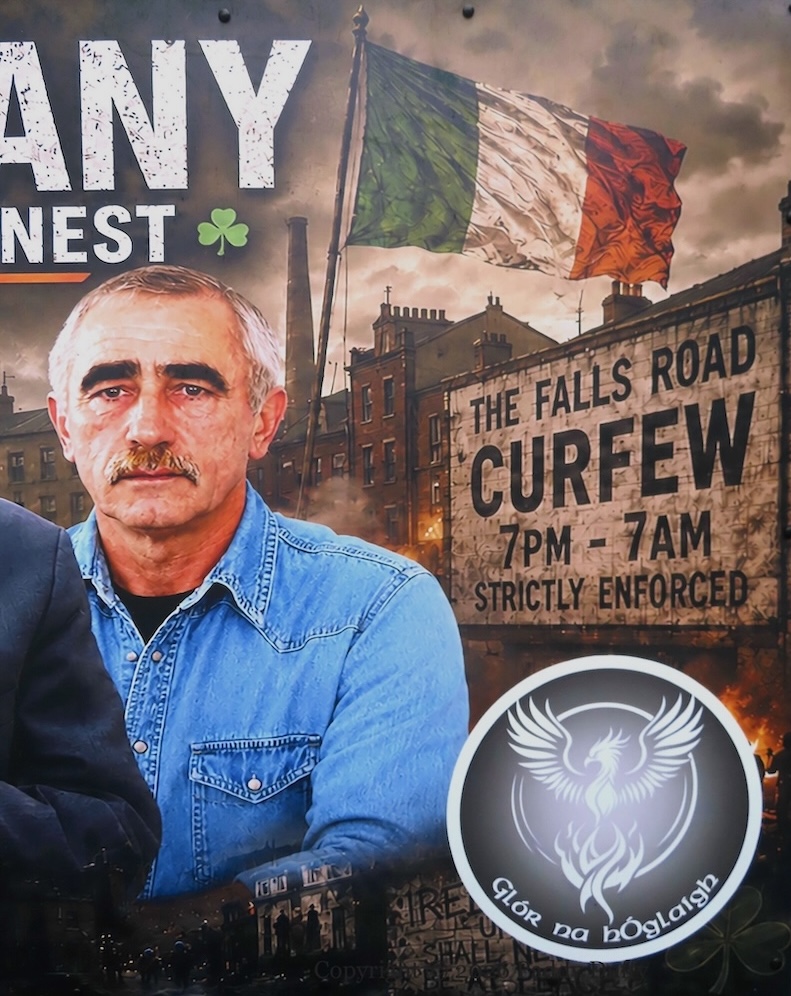
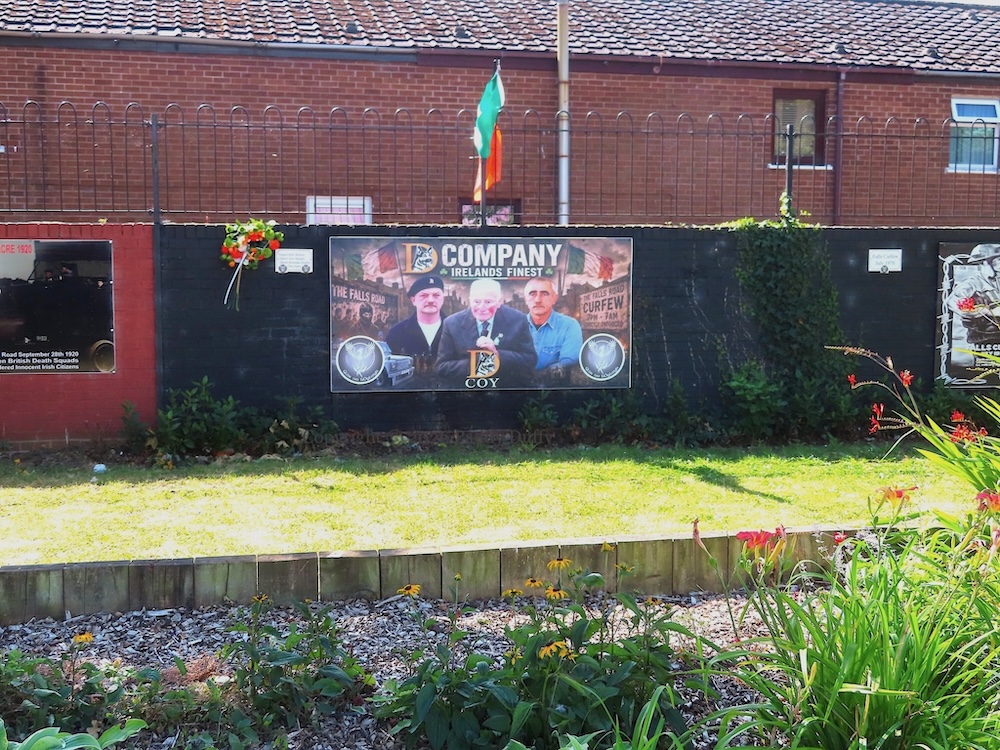
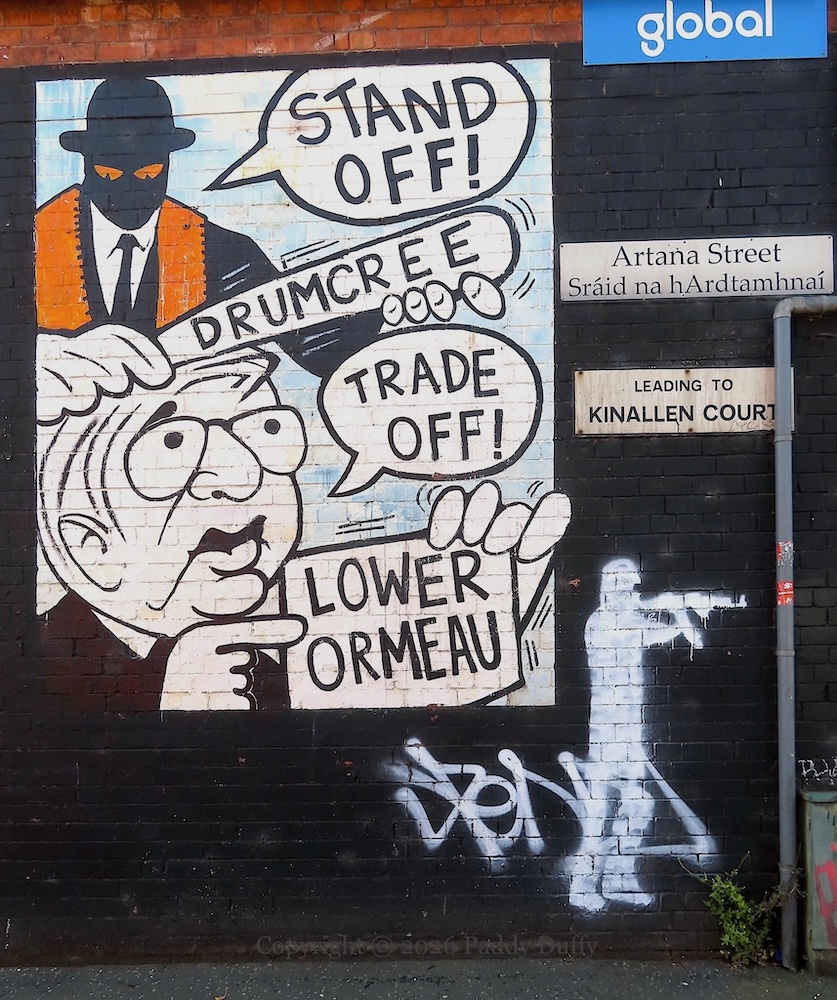
Here are three banners/posters spotted along the Falls Road during the Easter Rising parade on April 5th:
Above: “Sainsbury’s supports Israel! Don’t shop there. Easter Sat 4th [April, 2026].” For background see the post and reel on the BDS Belfast Fb page.
Below: “U.S. military not welcome in Ireland! Not in Shannon, not in Aldergrove.” For background, see Al-Jazeera | ShannonWatch. April 13th: a person was arrested for taking a hatchet to a C-120 Hercules (Democracy Now).
Last below: “PSNI target Catholics at much higher rate for stop-and-search. Source: PSNI stop-and-search data. Do not join the RUC/PSNI. Same aim, different name. IRSP [web] – the party of Connolly & Costello.” The data in question might be from the 2020-2021 period (PSNI | TheDetail) as the current (2025) data do not appear to report on sectional identification.
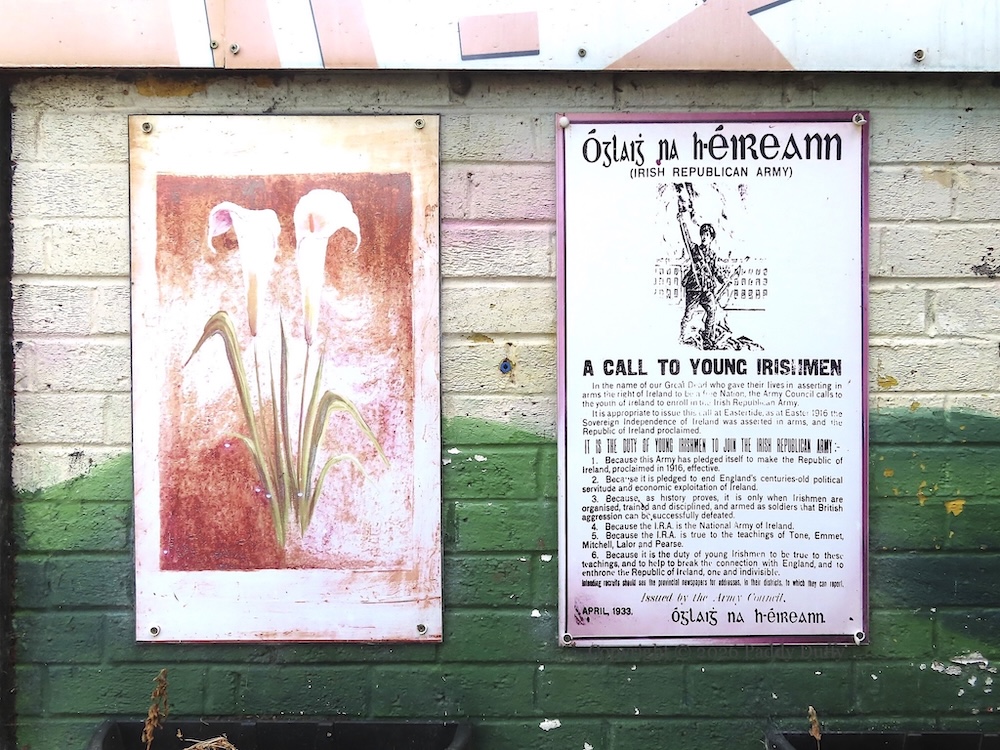
“100 years. Lıle na Cásca. Wear your Easter lily with pride. Tabhaır ómós do laochra na hÉıreann. [Pay respect to Ireland’s warriors]”
Shown here are Sınn Féın (web) and Lasaır Dhearg (web) invocations to commemorate the 1916 Easter Rising. The lily as a symbol of the 1916 Easter Rising was introduced by Cumann Na mBan in 1926 as a fund-raising device. For a history and vintage posters from across the century, see An Phoblacht.
This is a new information board below the Ballymurphy Massacre board at the Glenalina Road corner with the Whiterock Road.
The first panel (on the left) reads, “On Monday 9th of August 1971 Internment Without Trial was introduced by the British Government. The policy was directed and implemented by the British Army with the stated aim to “shock and stun the civilian population”. Between 9th and 11th of August 1971 eleven people were killed in the Ballymurphy area of west Belfast. All eleven were murdered by the British Army’s Parachute Regiment. All eleven were unarmed civilians. One of the dead was a parish priest and another the mother of eight children. Fifty-seven children were left without a parent. There was No proper criminal investigation. The Royal military police were assigned as sole investigators. Not one member of the British Army was held to account. It is believed that had justice been administered and those held to account charged, the events of Bloody Sunday would not have happened.”
The remaining panels give a day-by-day account of the eleven deaths, of Father Hugh Mullan, Frank Quinn, Noel Philips, Joan Connolly, Danny Teggart, Joseph Murphy, Eddie Doherty, Joseph Laverty, Joseph Corr, Paddy McCarthy, John McKerr.