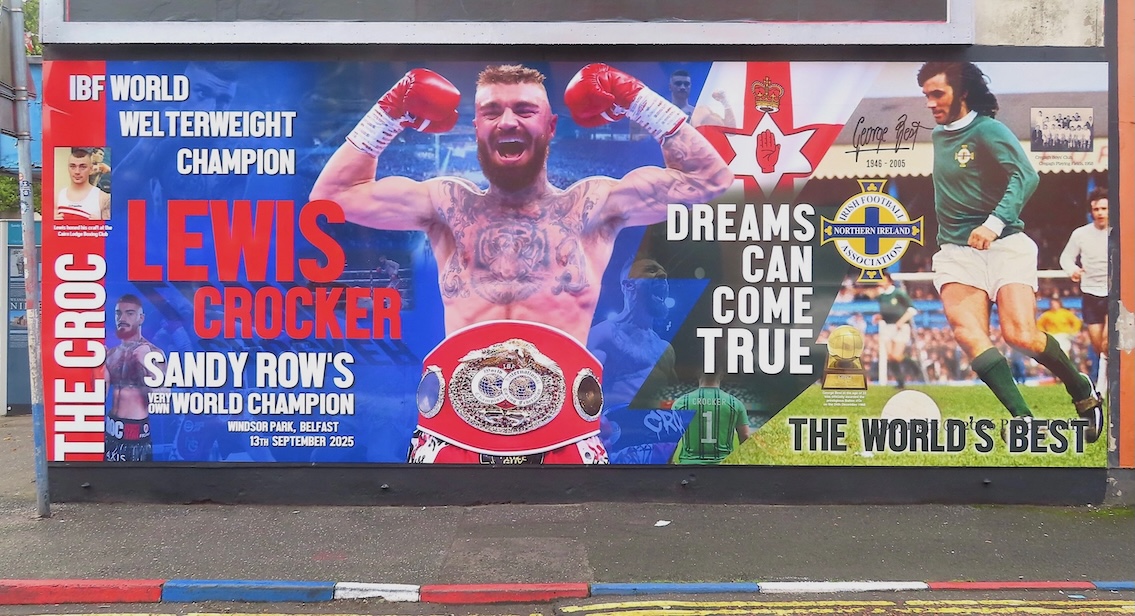
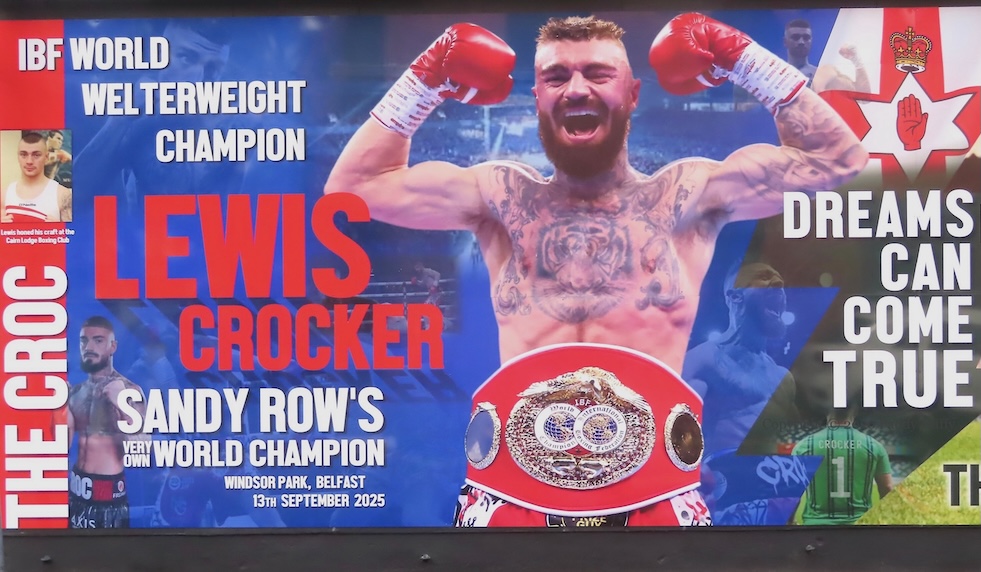
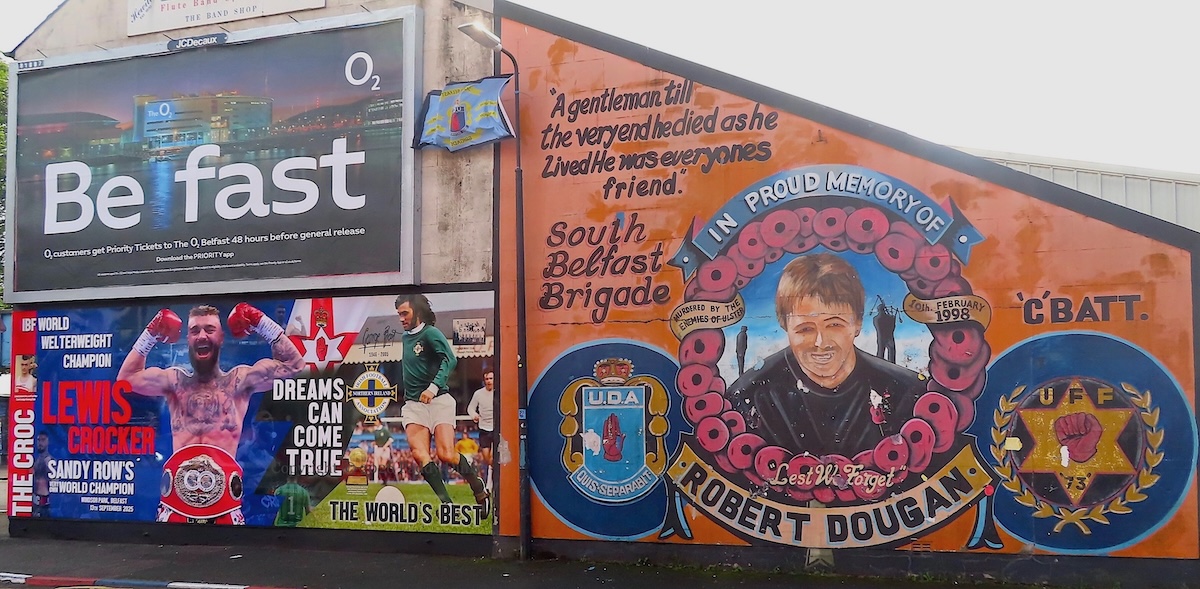
“The world’s best.” A new board has been mounted in Sandy Row to pay tribute to Lewis ‘The Croc’ Crocker, Sandy Row’s very own world champion, who “honed his craft at Cairn Lodge boxing club” on the West Circular and became “IBF world welterweight champion” at “Windsor Park, Belfast, 13th September 2025.” Crocker lost the title in June 2026, to the Australian Liam Paro.
On the right is soccer-player George Best, who grew up in Cregagh and debuted for Manchester United at the age of 17. “George Best at the age of 22 was awarded the prestigious Ballon d’Or on the 24th December 1968.”
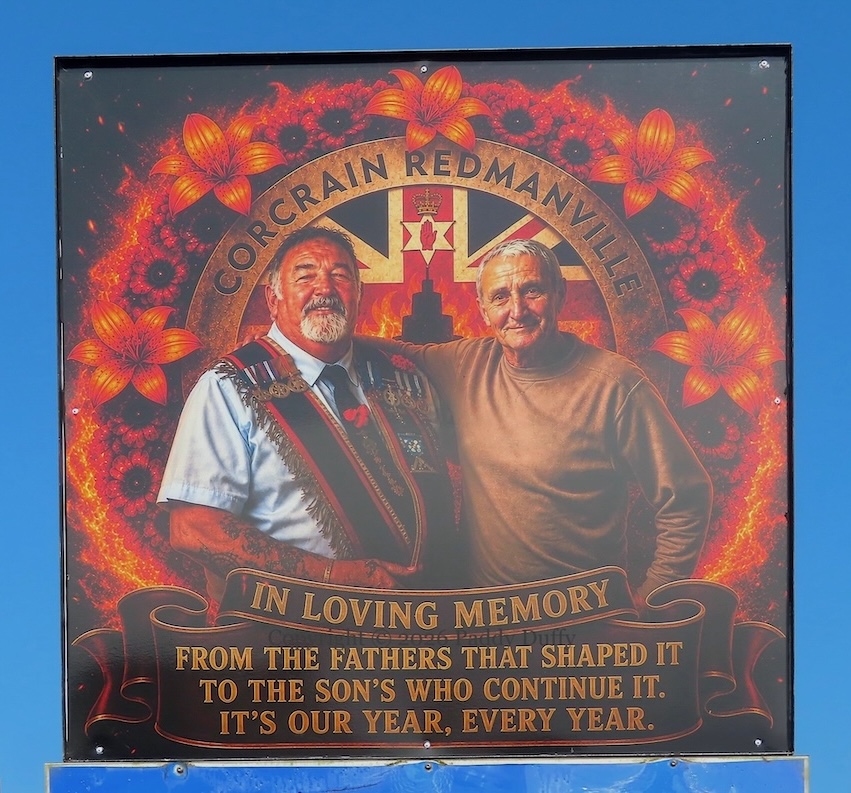
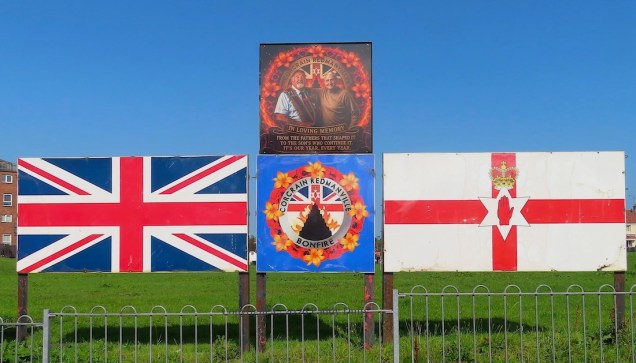
Here is a small gallery of images from the Redmanville and Corcrain estates in Portadown, specifically Westland Road and the bonfire site. To the trio of boards at the site (seen previously in January, 2026) has been added the board shown above: “In loving memory – from the fathers that shaped it to the son’s [sic] who continue it. It’s our year, every year.” The bonfire, which is lit on the 10th (of July) has its own Facebook page.
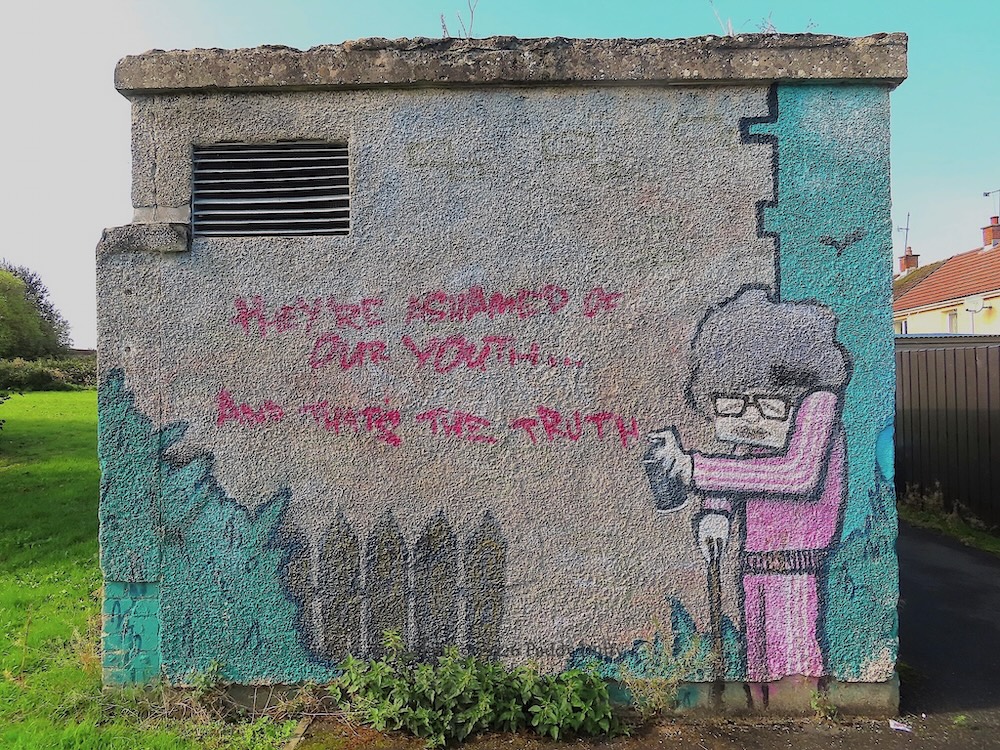
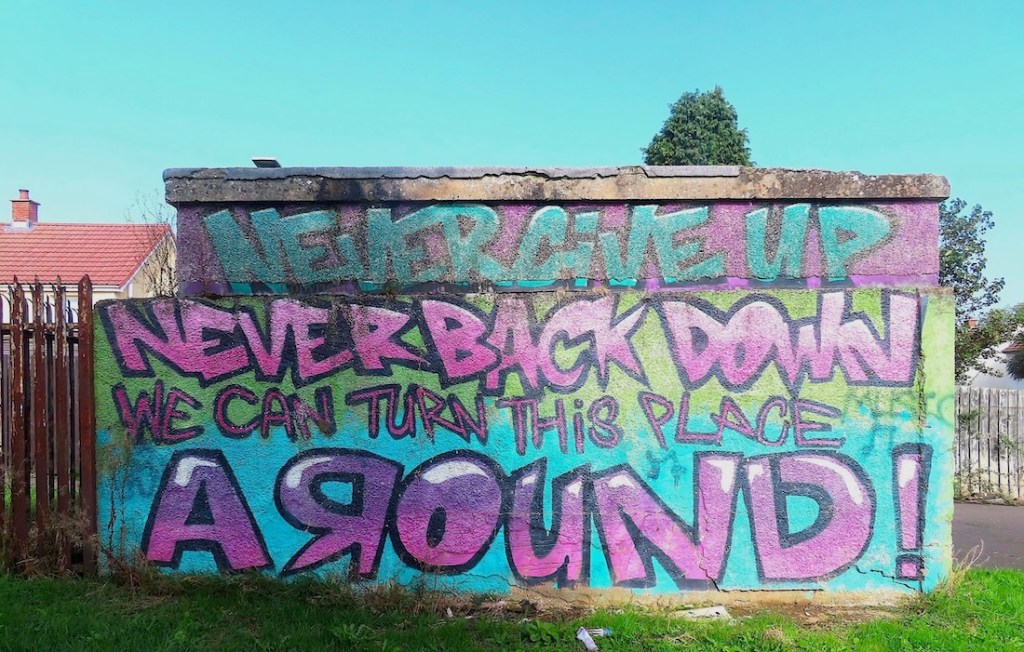
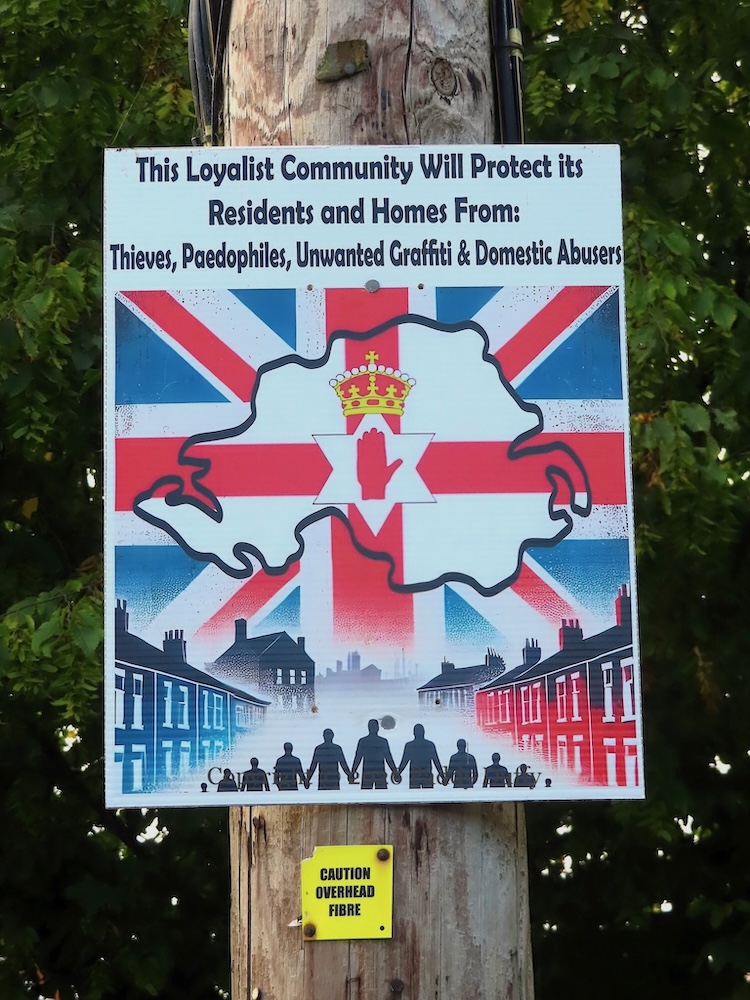
Elsewhere in the estates: An elderly woman is drawn spraying graffiti that reads “They’re ashamed of our youth … and that’s the truth” along with “Never give up, never back down. We can turn this place around!”, and an anti-immigrant placard, the same as the one recorded in January.
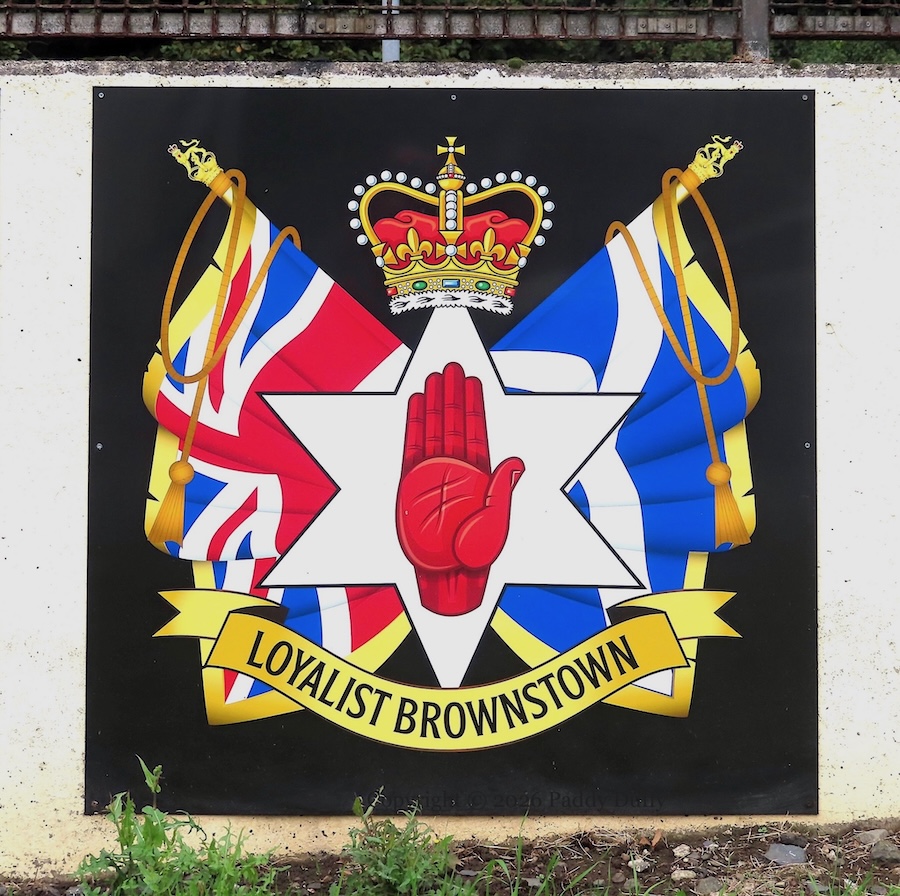
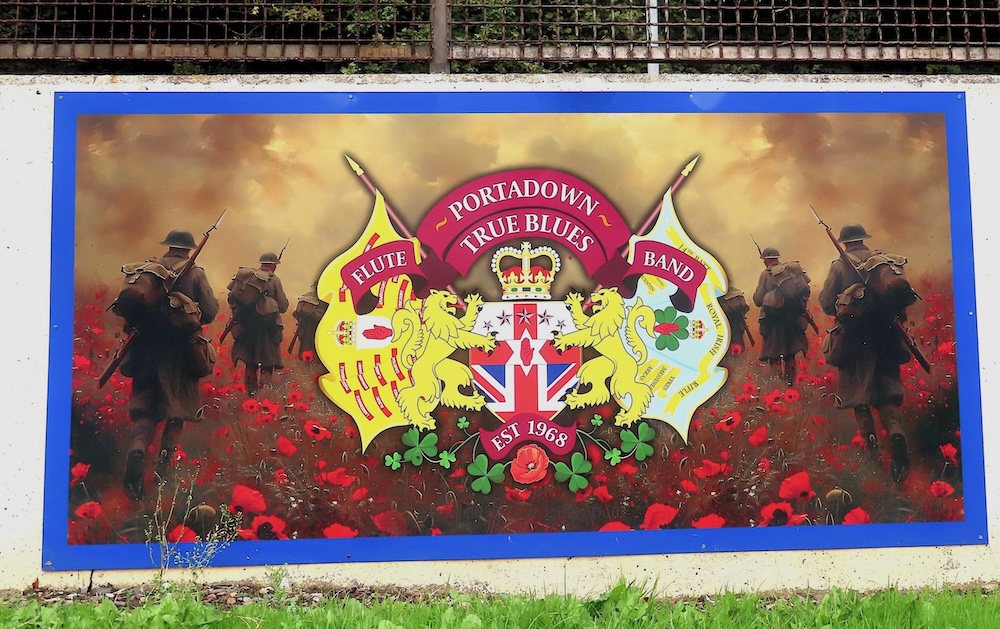
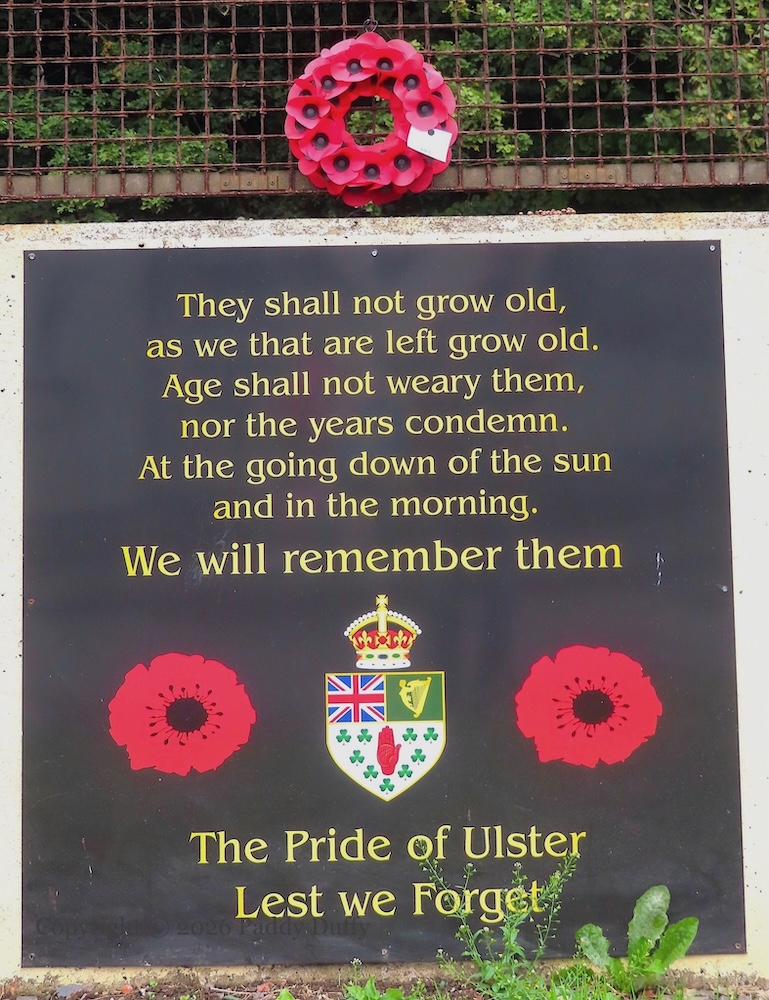
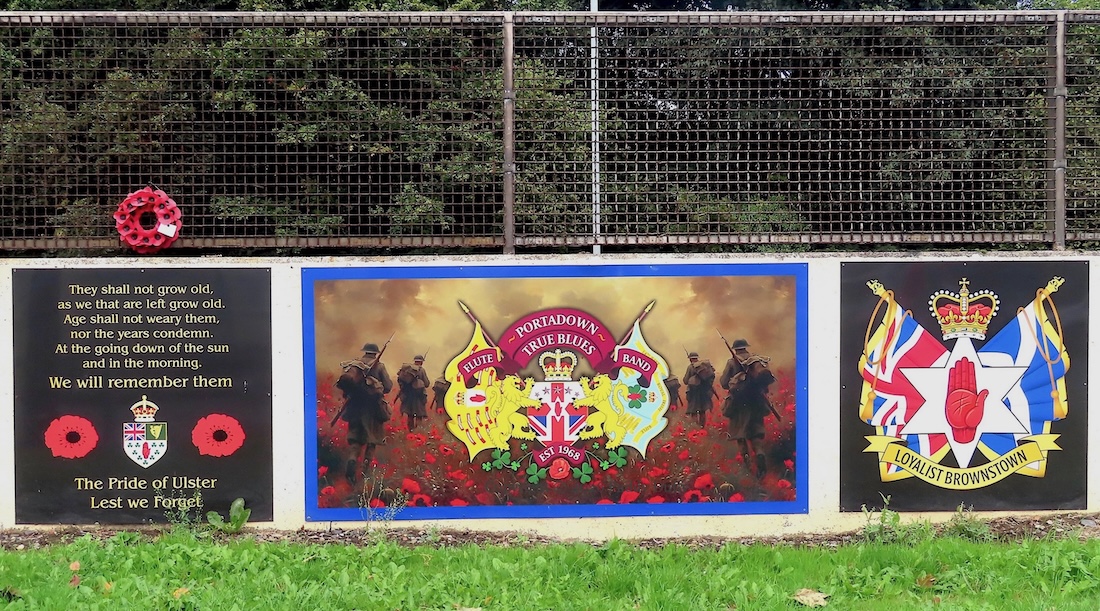
“Portadown True Blues flute band, est. 1968 [Fb].” This is a trio of boards at the top of the Brownstown estate, on the fence overlooking the “Northway” that separates Brownstown from Edgarstown. The flute band draws from both estates and has murals in both.
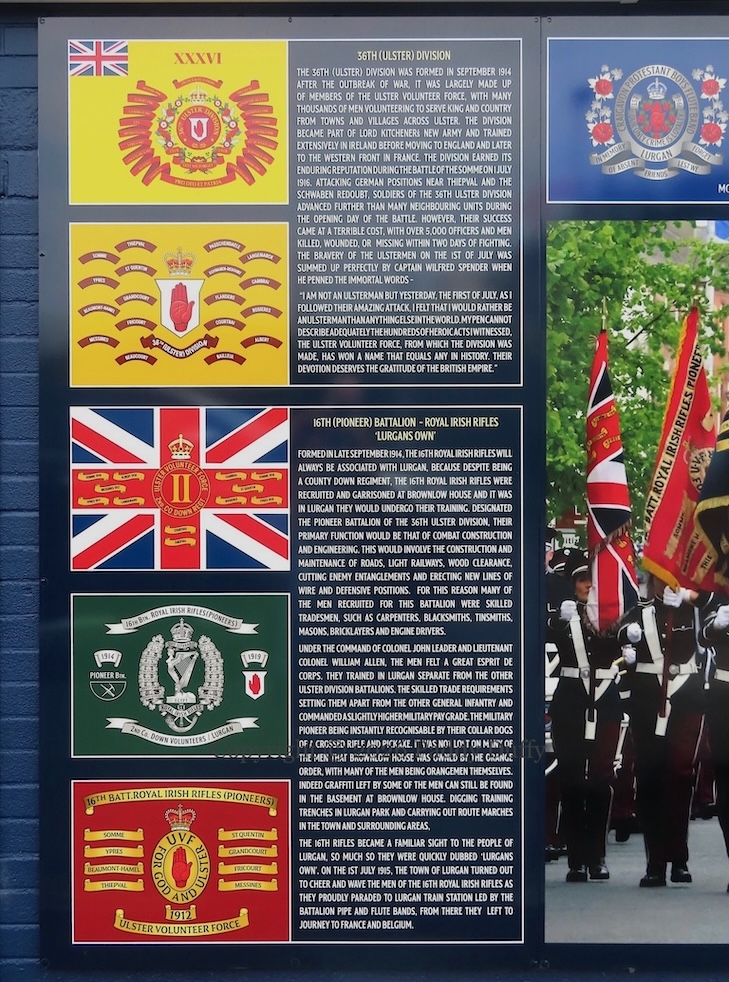
Both the main panel (immediately below) and the one to the left features WWI soldiers and the 36th Division – the band is associated with the Mid-Ulster brigade UVF (see the old Edgarstown mural in the Peter Moloney Collection).
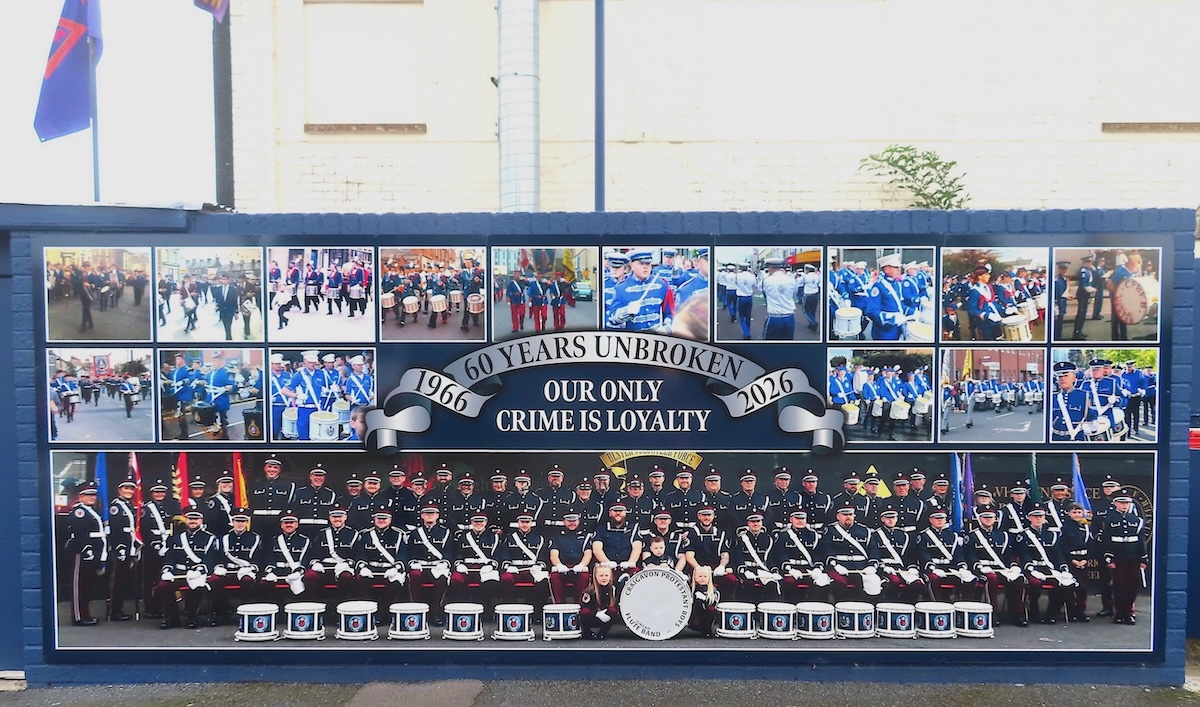
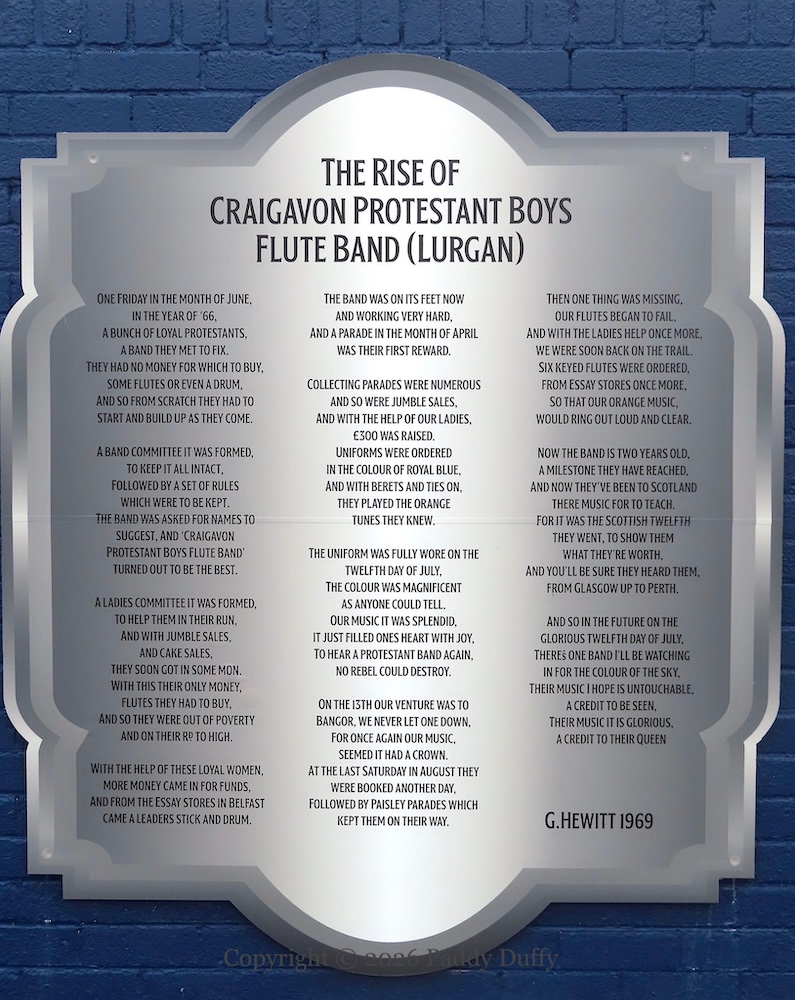
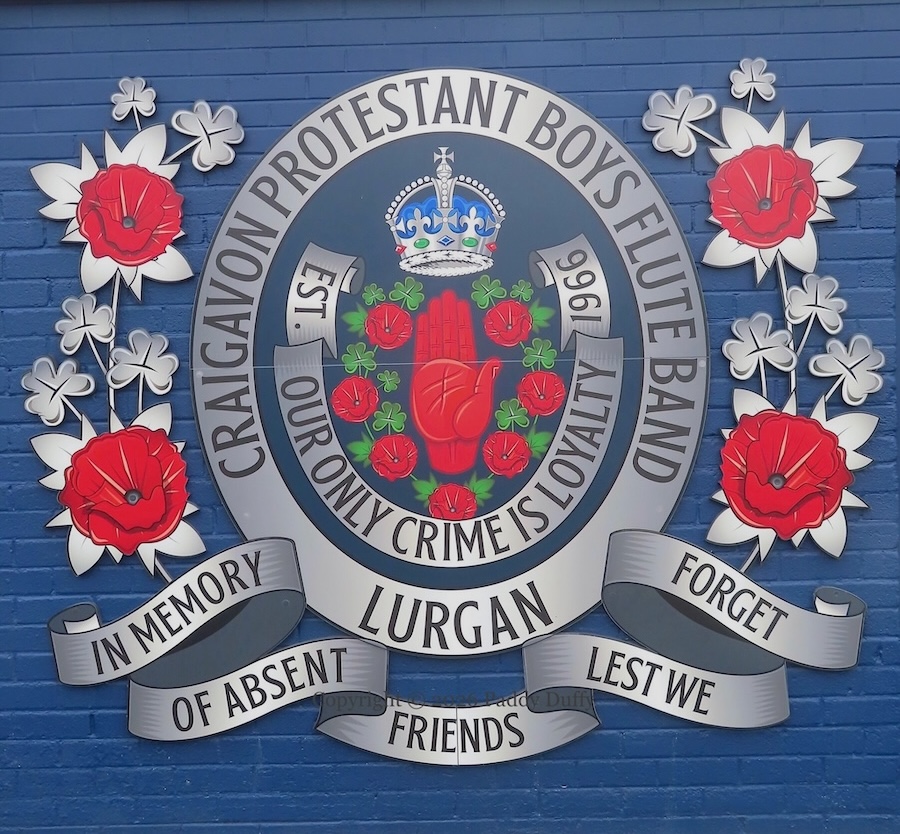
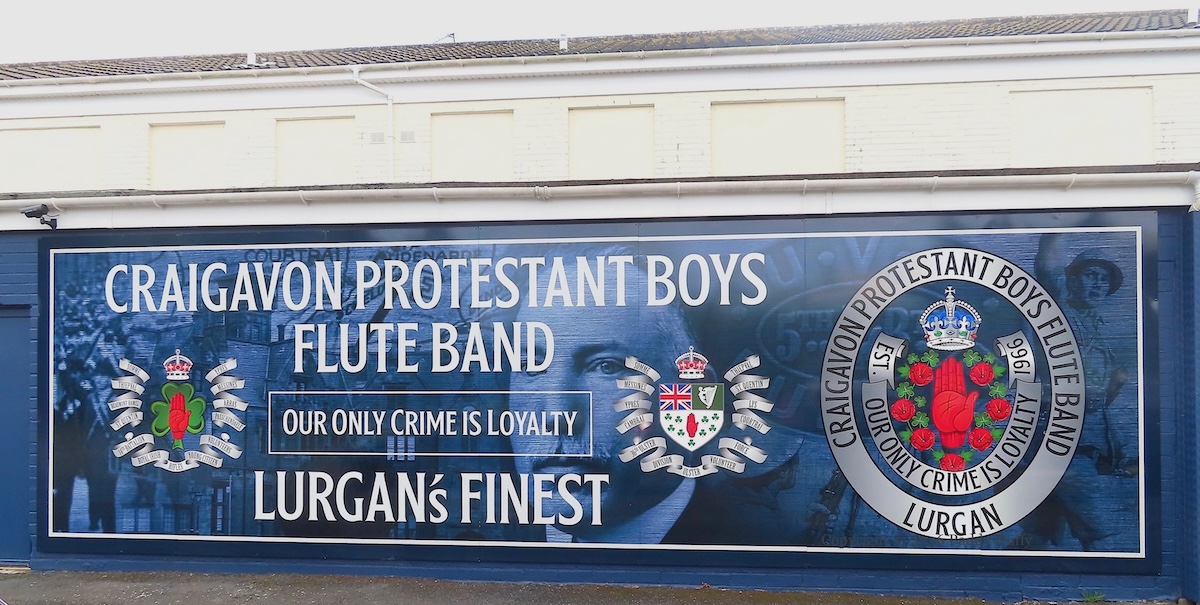
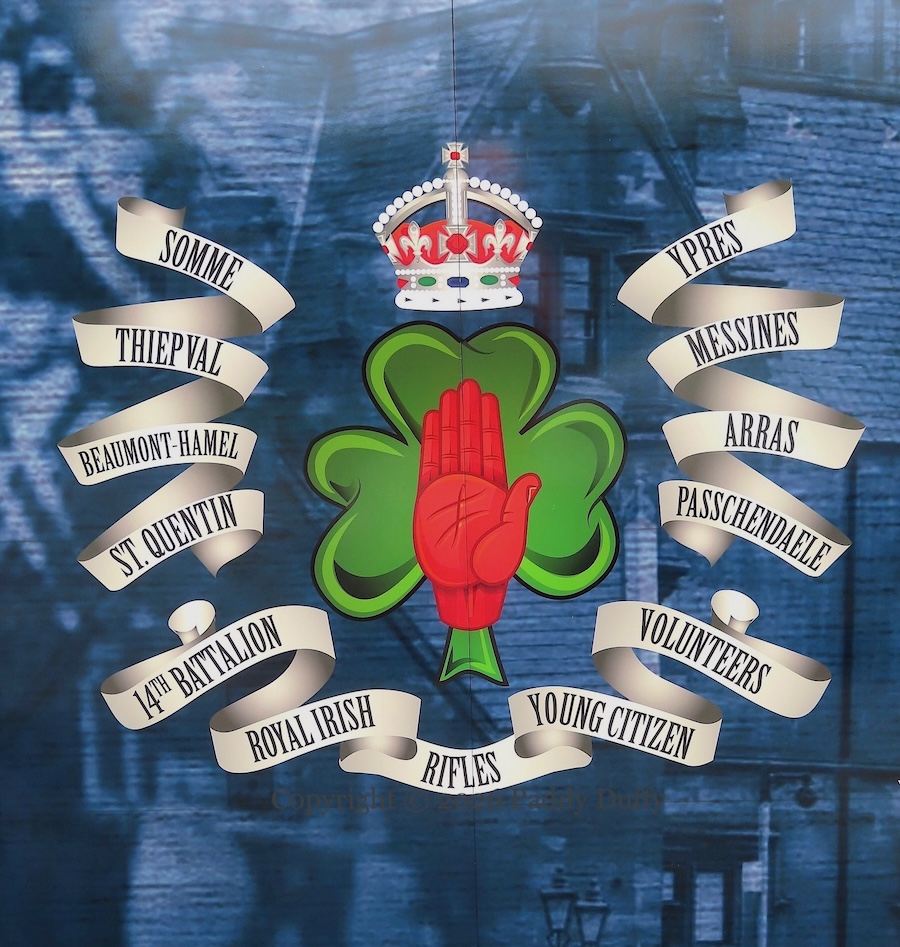
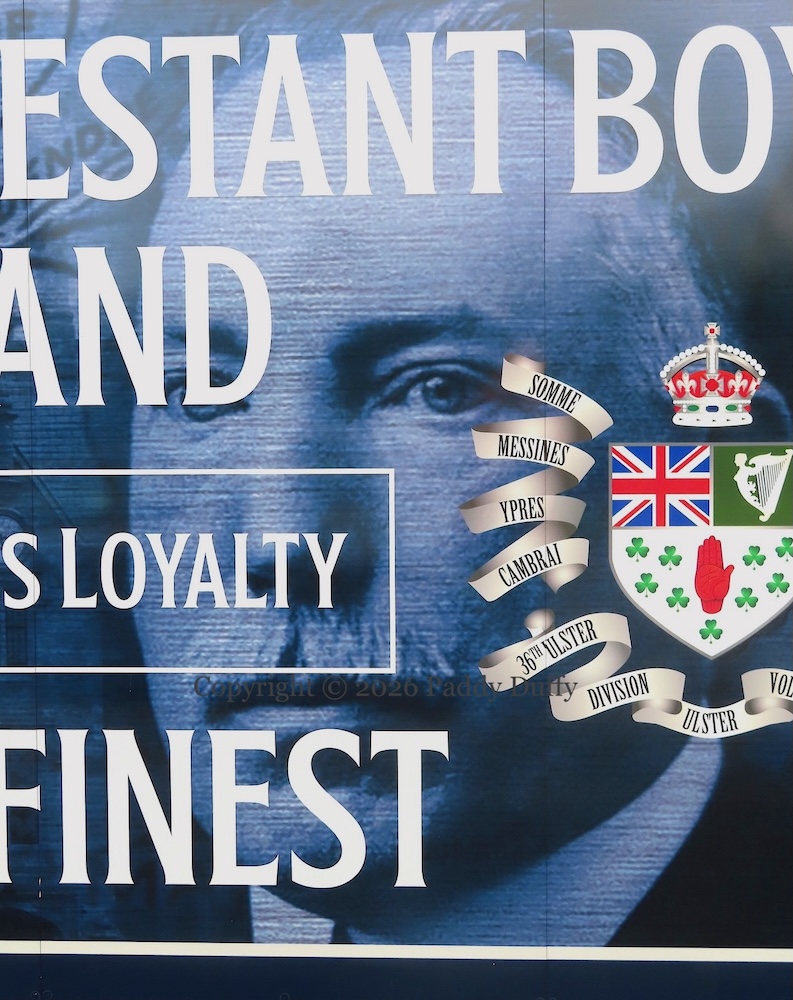
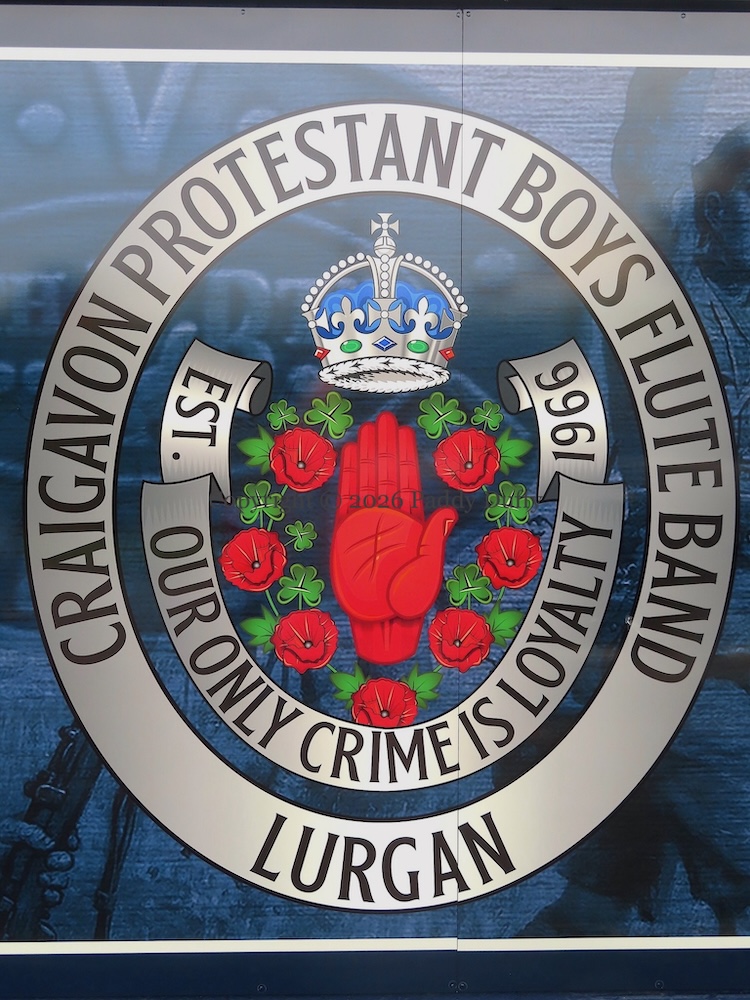
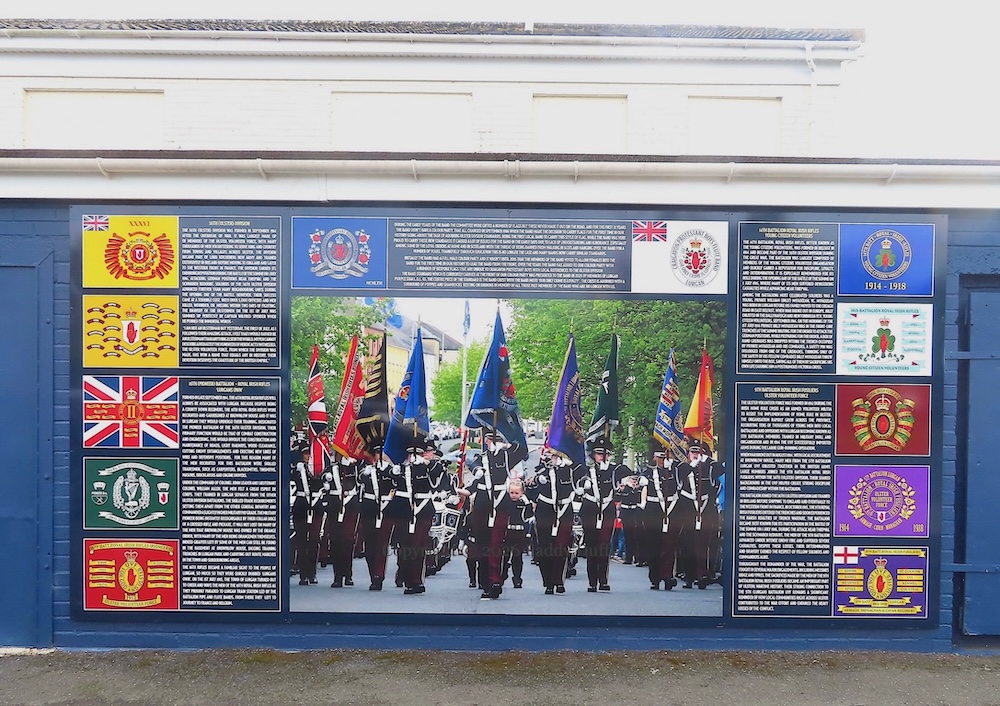
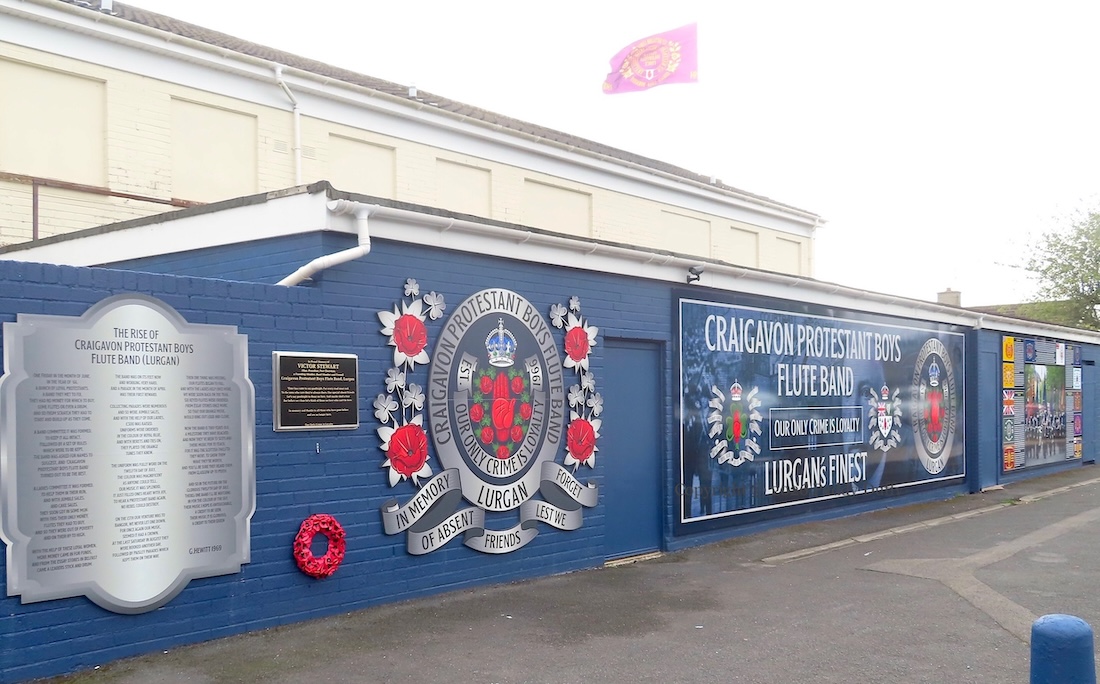
“Craigavon Protestant Boys flute band (Lurgan), 60 years unbroken, 1966-2026. Our only crime is loyalty.” Five new boards have been mounted at Mourne Road/Pollock Drive to celebrated the sixtieth anniversary of the Craigavon Protestant Boys (Fb).
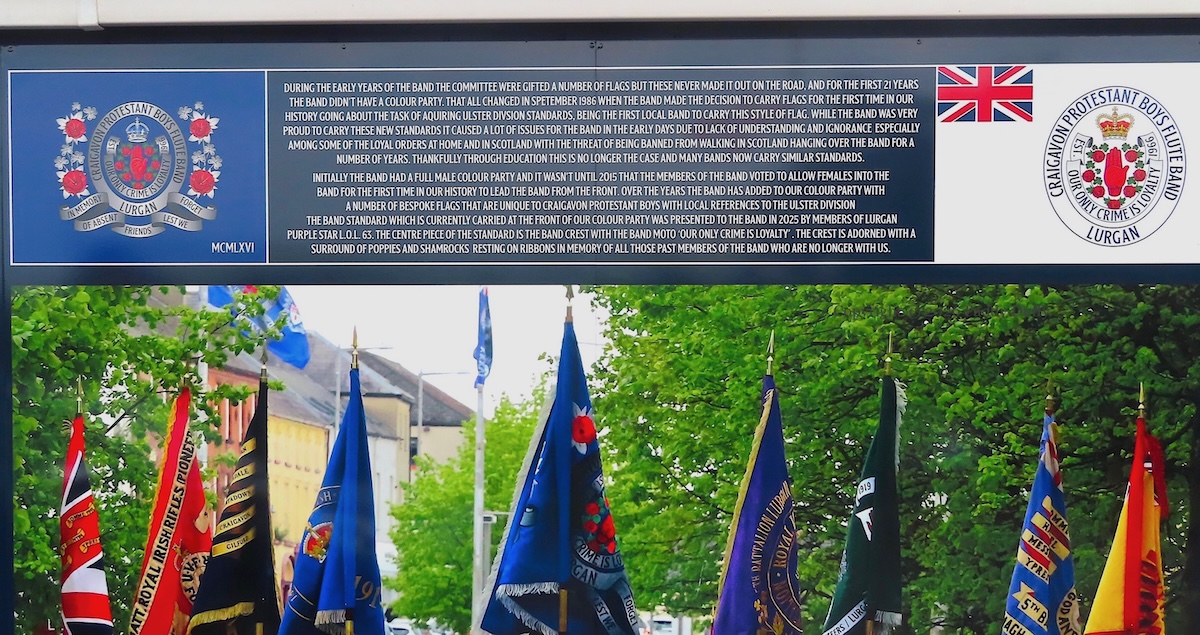
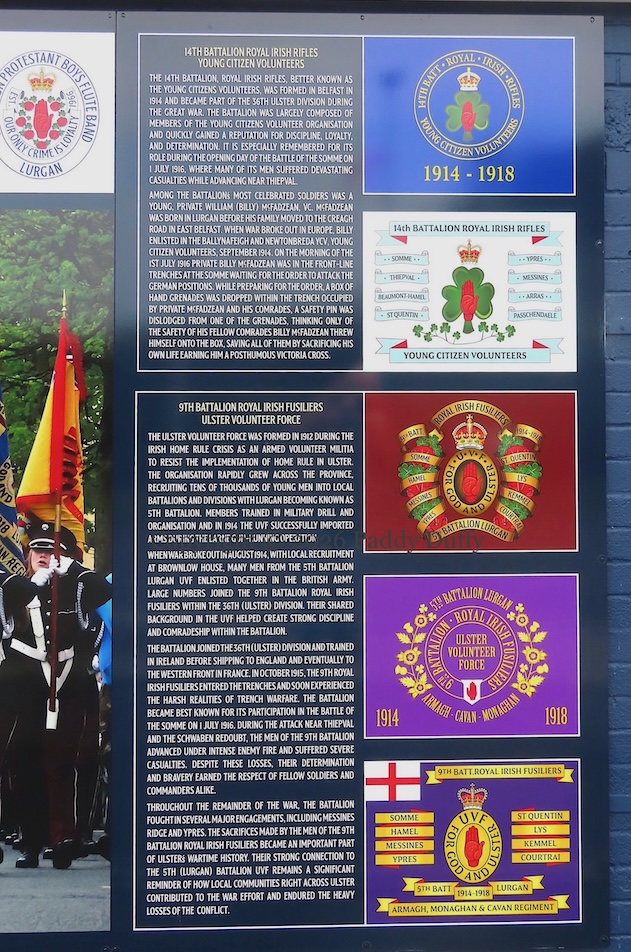
The final/right-most board mostly concerns the transformation of the Ulster Volunteers and Young Citizen Volunteers into the 36th Division of the British Army in WWI but the central text alludes to the dispute in the 1980s between some bands and the Orange Order, over the conflation of the different forms of the “Ulster Volunteer Force” from the beginning and end of the twentieth century. It reads, “During the early years of the band the committee were gifted a number of flags but these never made it out on the road, and for the first 21 years the band didn’t have a colour party. That all changed in Spetember [sic] 1986 when the band made the decision to carry for the first time in our history going about the task of acquiring Ulster Division standards, being the first local band to carry this style of flag. While the band was very proud to carry these new standards it caused a lot of issues for the band in the early days due to lack of understanding and ignorance especially among some of the loyal orders at home and in Scotland with the threat of being banned from walking in Scotland hanging over the band for a number of years. Thankfully through education this is no longer the case and many bands now carry similar standards.”
The Orange Order was not happy that bands that were affiliated with paramilitary groups were carrying the flag and wearing uniforms of the 36th Division. In Scotland, Greengairs Thistle flute band – which is associated with the Shankill Protestant Boys and C Company in the west Belfast UVF (see the Peter Moloney Collection) – was banned in 1988 from marching in Orange parades (CAIN), though it continued to march in Apprentice Boys parades (Fb).
Nowadays, blending the Ulster Volunteers/36th Division with the Troubles-era UVF is standard practise among loyalist groups, even if the authorities disapprove. In Bangor, for example, funds were secured for a WWI memorial to which paramilitary stones were added at the last minute (see Shared Space).
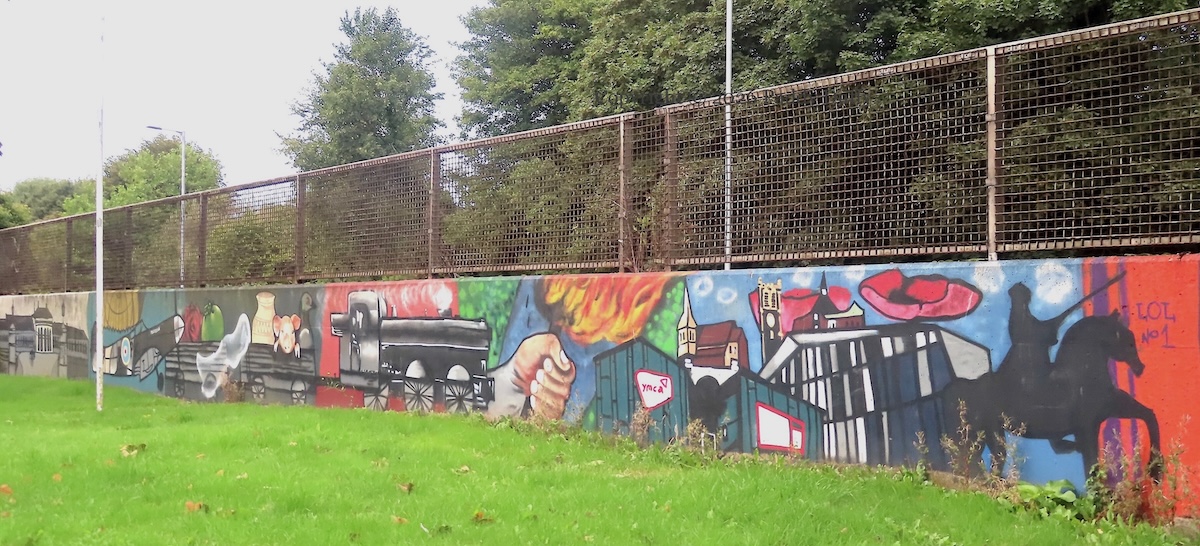
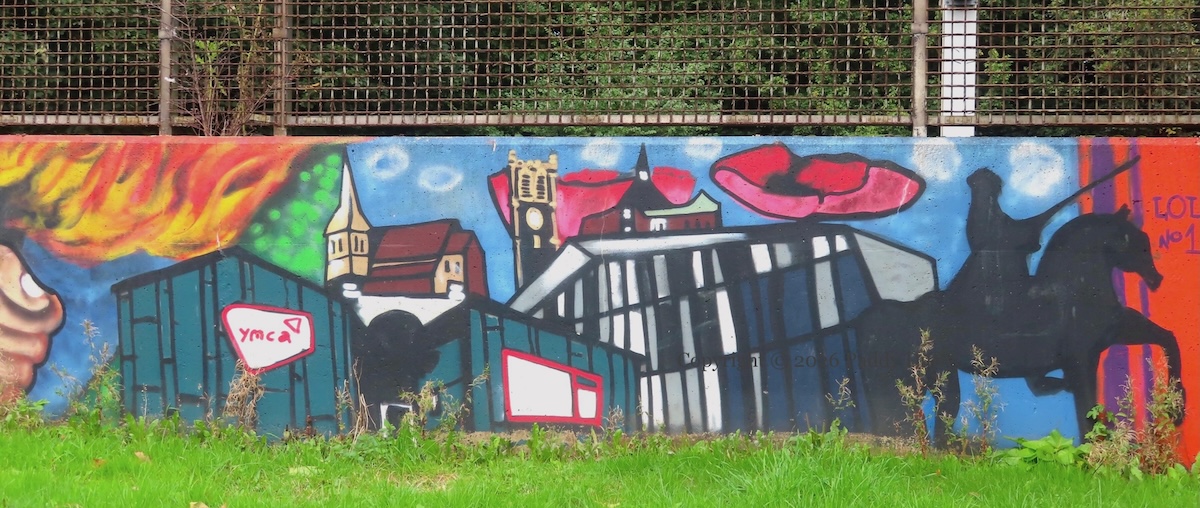
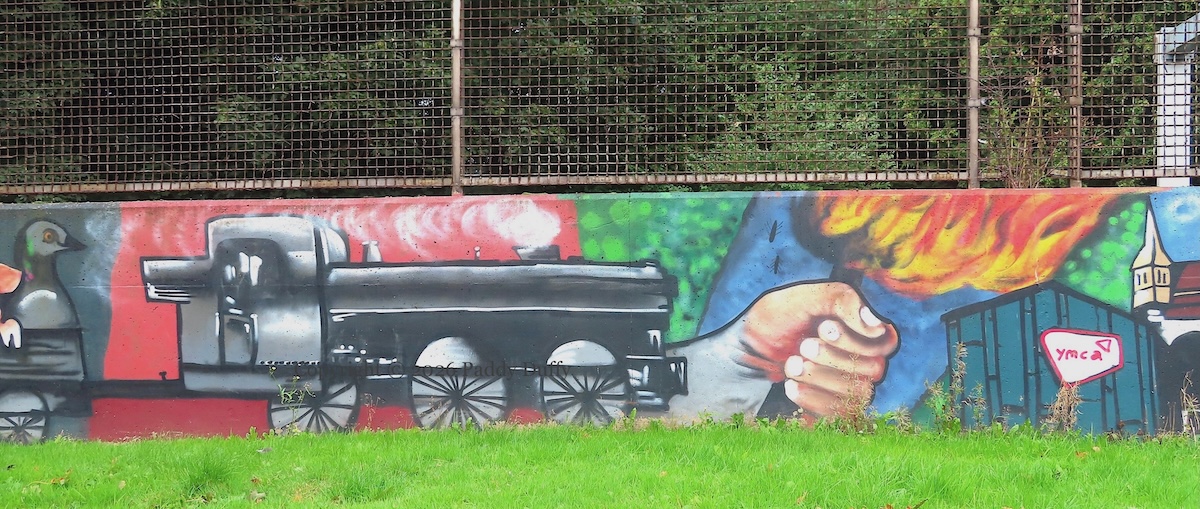
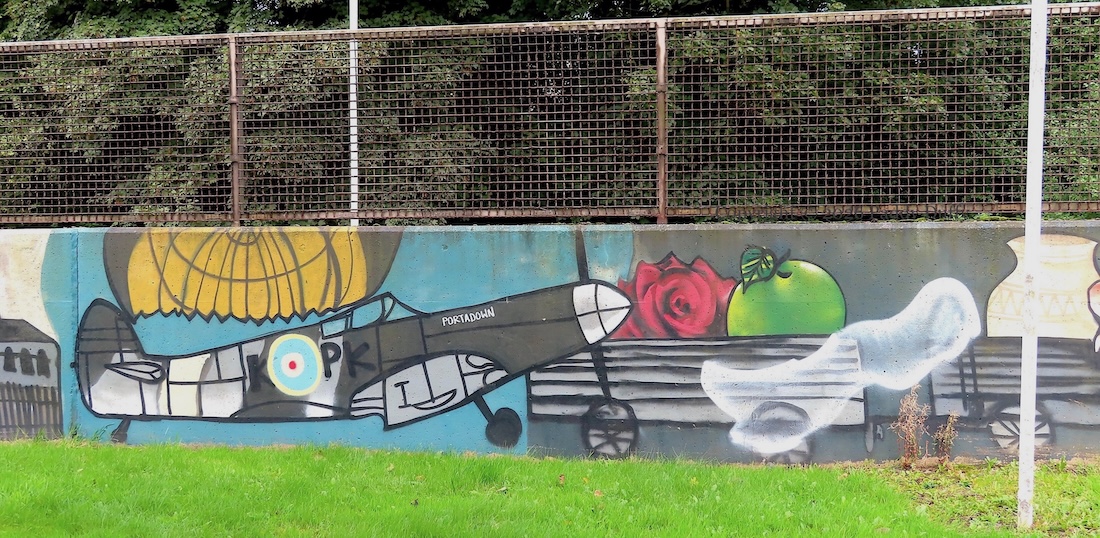
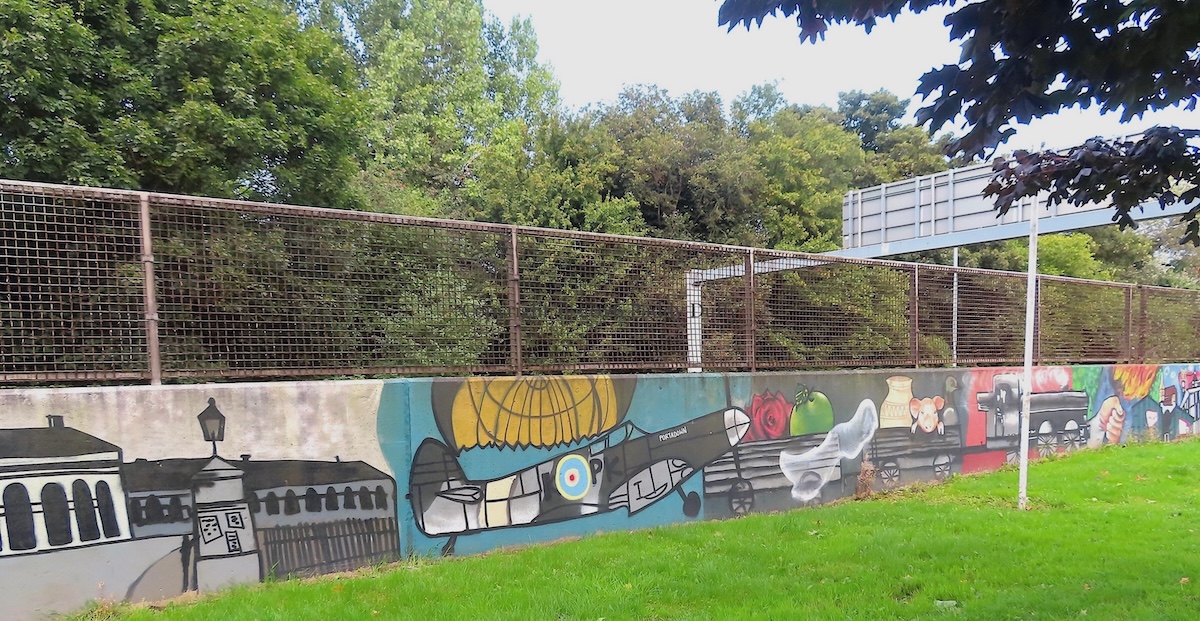
On the near side of this long mural of Portadown landmarks and history is the collarette of “LOL No. 1” and a silhouette of King William III on his horse. The Orange Order’s first district lodge was formed in 1796 in Portadown (LOLNo1), the same year that the first parades took place on the Twelfth, in Portadown, Lurgan, and Warrenpoint. (The first individual lodge was founded in Dyan, Co Tyrone. (Lurgan Ancestry))
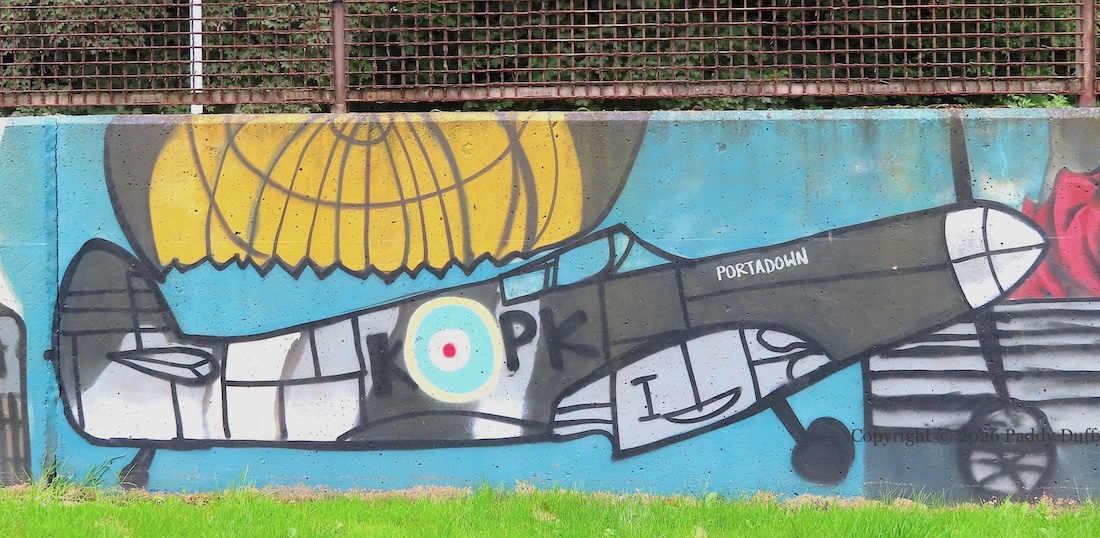
Also included in the mural is the “Portadown” spitfire – one of 17 spitfires purchased by a Belfast Telegraph fund-raising drive. See also the mural of the “Ballymena” spitfire.
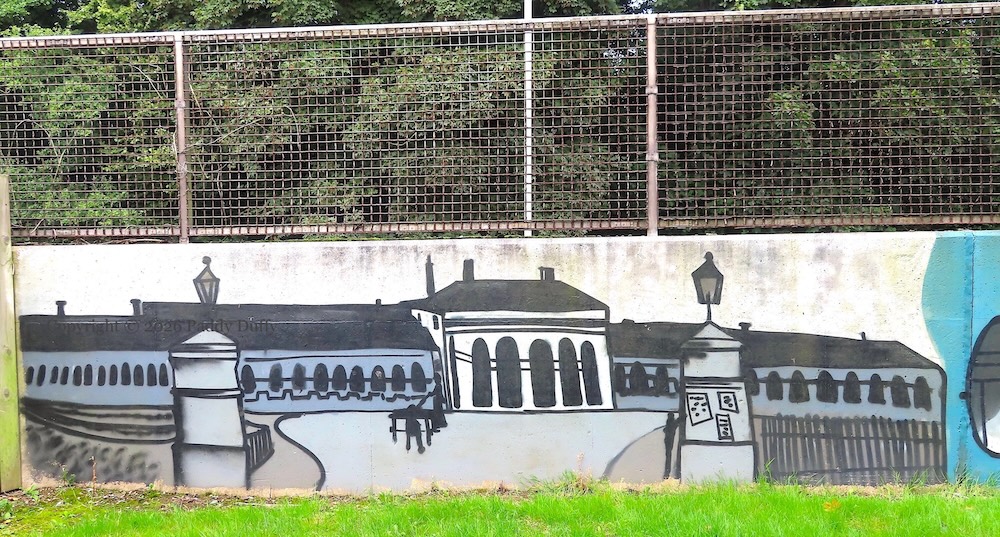
The grand building on the far left is the former Portadown Railway station, in Watson Street – see FamilyPedia for a photograph.
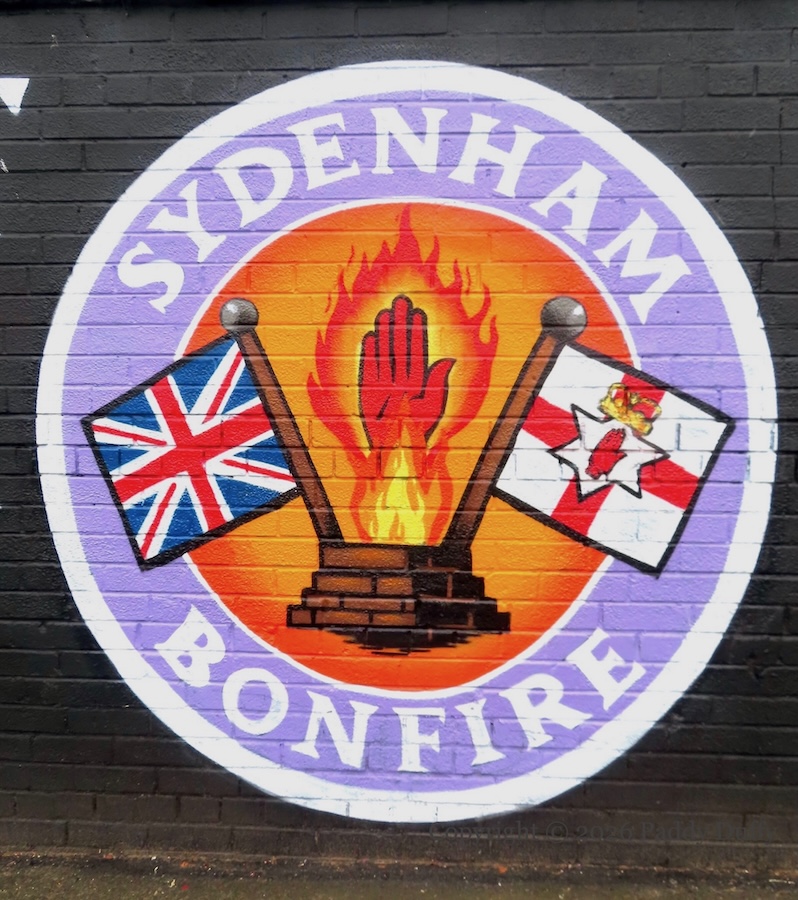
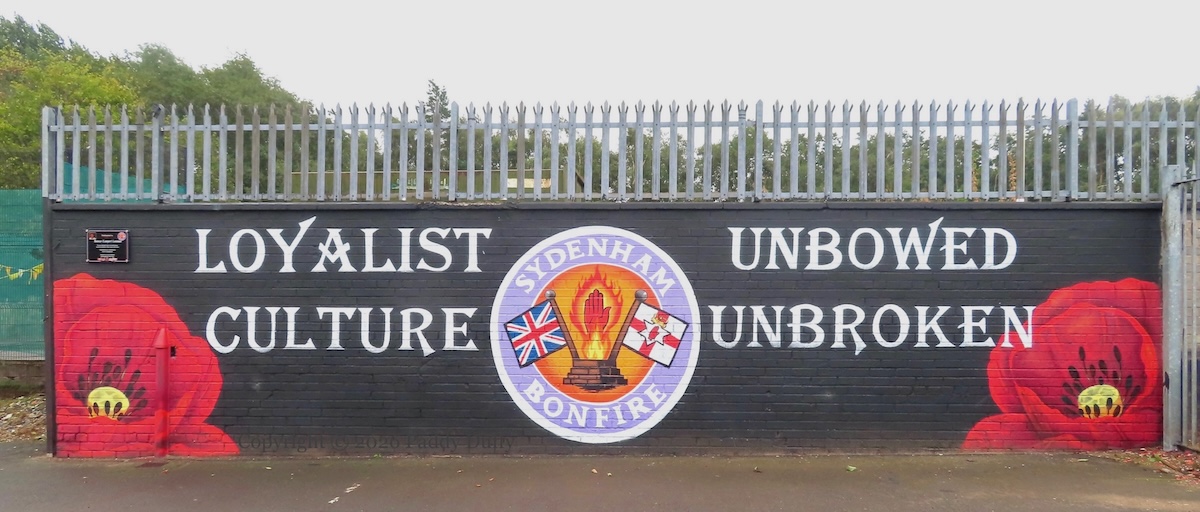
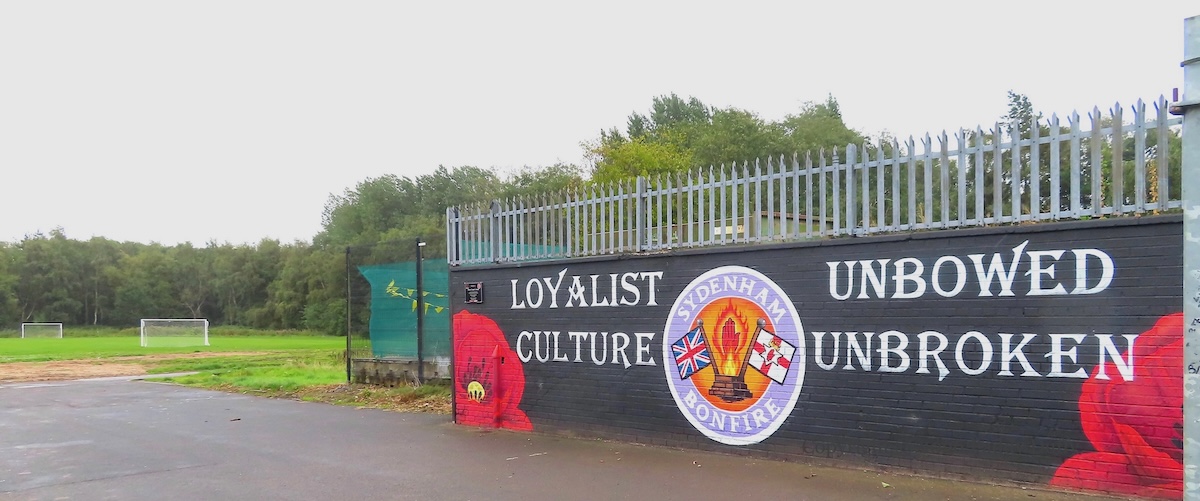
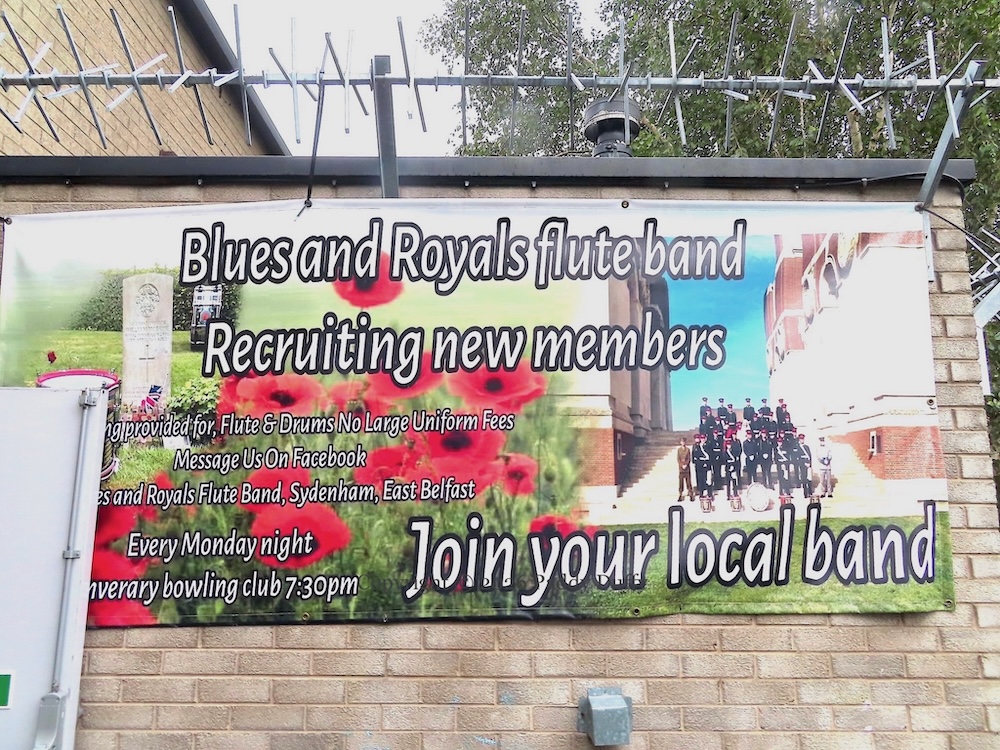
“Loyalist culture – unbowed, unbroken.” The Sydenham Bonfire is constructed annually on the Inverary playing field and there is now a mural announcing the group who build it, to go along with the bonfire’s Facebook page. The phrase “unbowed, unbroken” has been frequently seen in CNR muraling, beginning with a 1996 mural in Lenadoon.
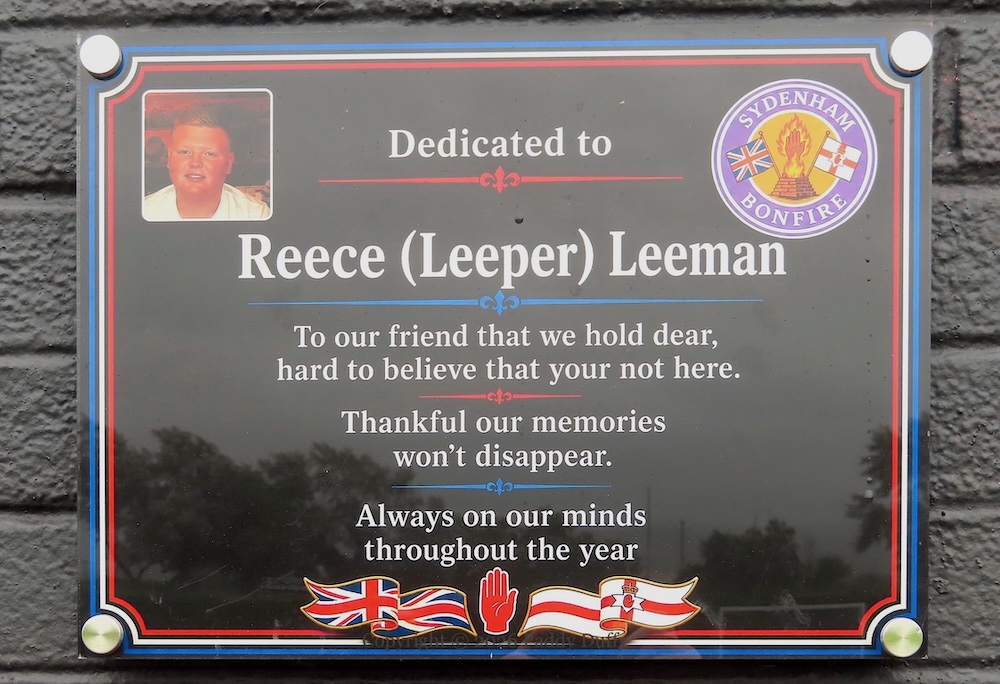
There is a memorial plaque in the top left: “Dedicated to Reece (Leeper) Leeman. To our friend that we hold dear, hard to believe that your [sic] not here. Thankful our memories won’t disappear. Always on our minds throughout the year.” Leeman, aged 21, was stabbed to death in 2019 (BBC) when he and a friend attempted to raid cannabis from the Kyle Street house of an aquaintance (ITv | News Letter).
Inverary pitches and bowling green, Sydenham, east Belfast
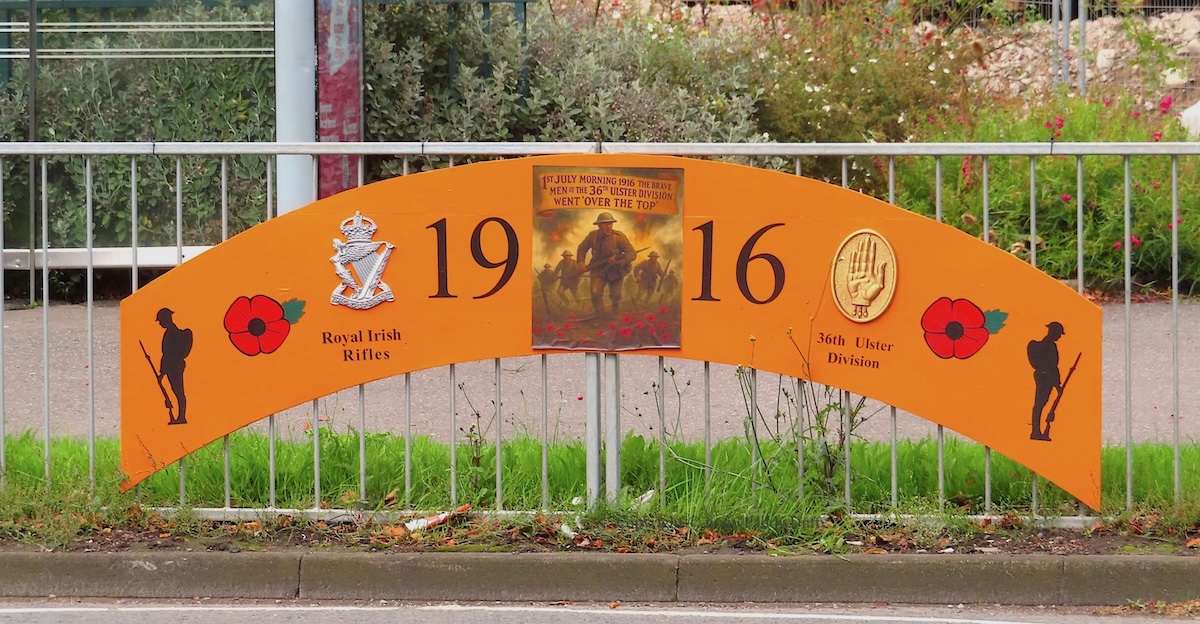
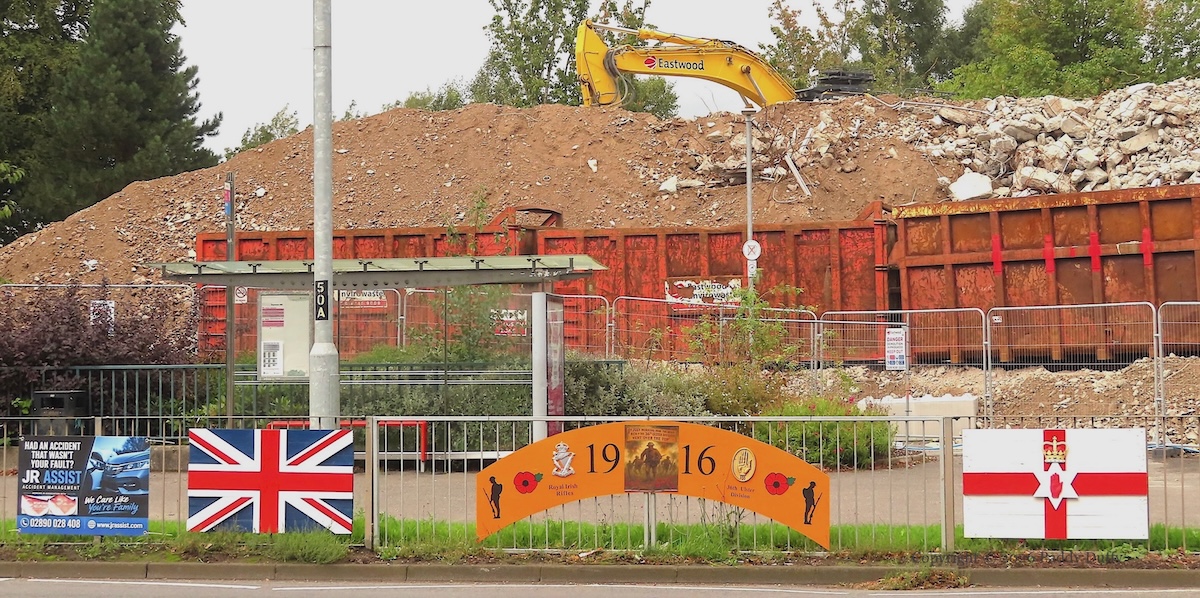
Demolition of Rathmoyne House and Coolmoyne House – the tower blocks at Seymour Hill – began in July (NIWorld | Belfast Media). Their rubble can be seen in the background of a new trio of boards on the railings, with freshly repainted Union Flag and Ulster Banner, and a new arched memorial to the dead of the Battle Of Albert on the first day of the Somme. The central poster reads, “1st July morning 1916 the brave men of the 36th (Ulster) division went over the top.” and the Maid Of Erin emblem of the Royal Irish Rifles appears on the left and the Red (right) Hand of the 36th (Ulster) Division on the right.
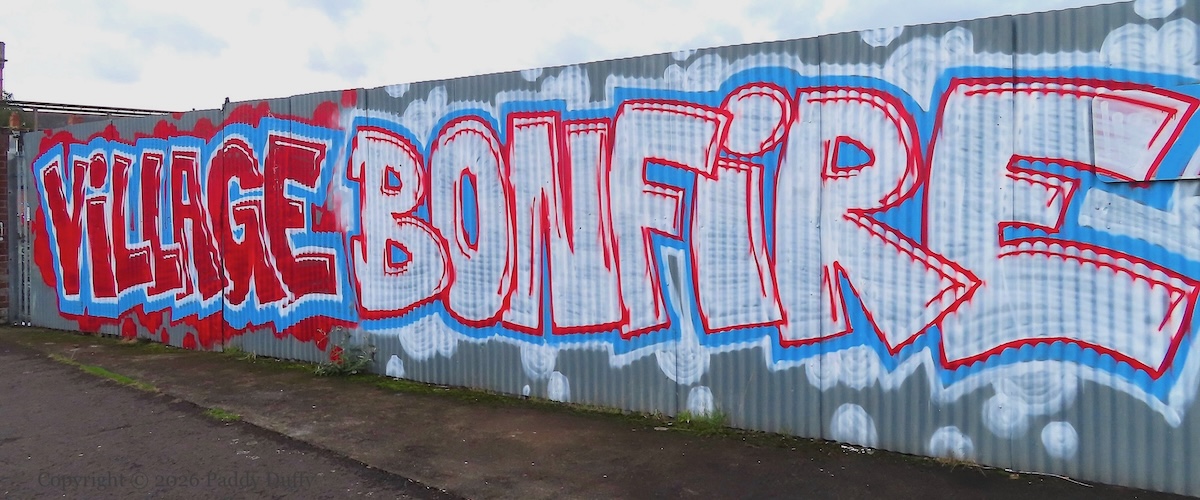
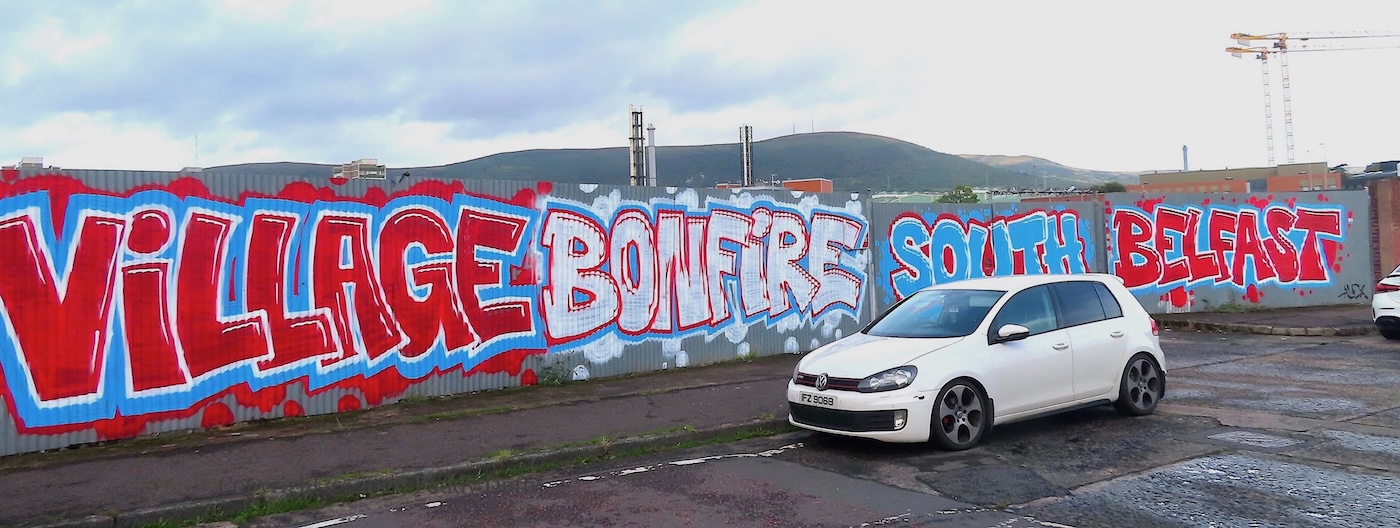
The Village Bonfire (Fb) proved controversial last year because of asbestos in an old factory roof lying near the site. The Council recommended that the bonfire be removed but the police refused to intervene; instead, the owners of the land secured the hazardous materials (BBC | BBC). This year, organisers were selling badges showing a person at the bonfire in a haz-mat suit (Reddit | image at Irish News Fb).
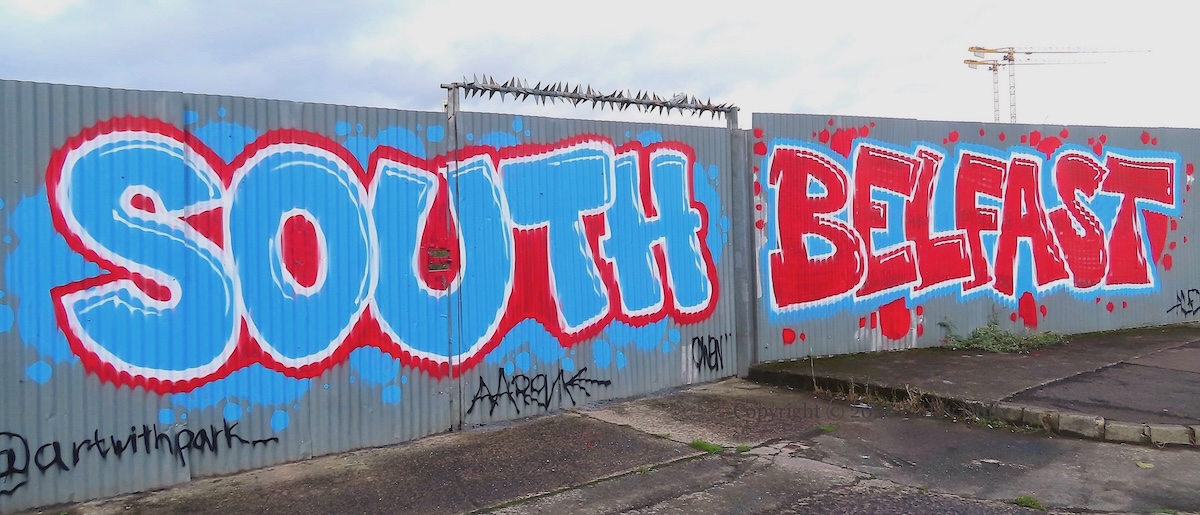
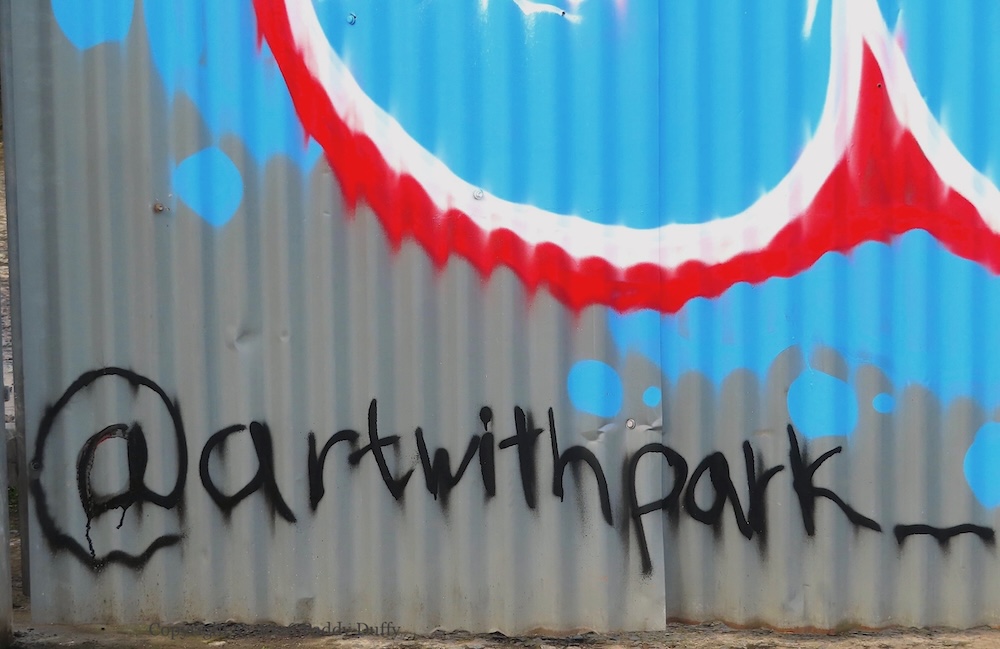
This writing is by Art With Park (ig), Alex Reed (ig), and Owen Watts (ig) in Maldon Street, Village, south Belfast
The walkway along the Six Mile Water below Main Street, Ballyclare, has been painted with biblical quotations which are transcribed below, replacing the inspirational messages seen in 2025’s Let Your Light Shine. There is also a comment suggesting that the religious art is a form of re-imaging or beautification (see Visual History 11): “Graffiti is a world-wide culture – please stop covering our culture”.
“I lift my eyes to the mountains – where does my help come from? My help comes from the Lord, the maker of heaven and Earth. – Psalm 121” “We love because he first loved us – 1 John 4:19” “Praise the Lord, proclaim his name, make known what he has done. – Isaiah 12:4” “How wide, how long, how high, how deep is the love of Christ! – Ephesians 3:12” “Greater Ballyclare Youth For Christ [Fb]”
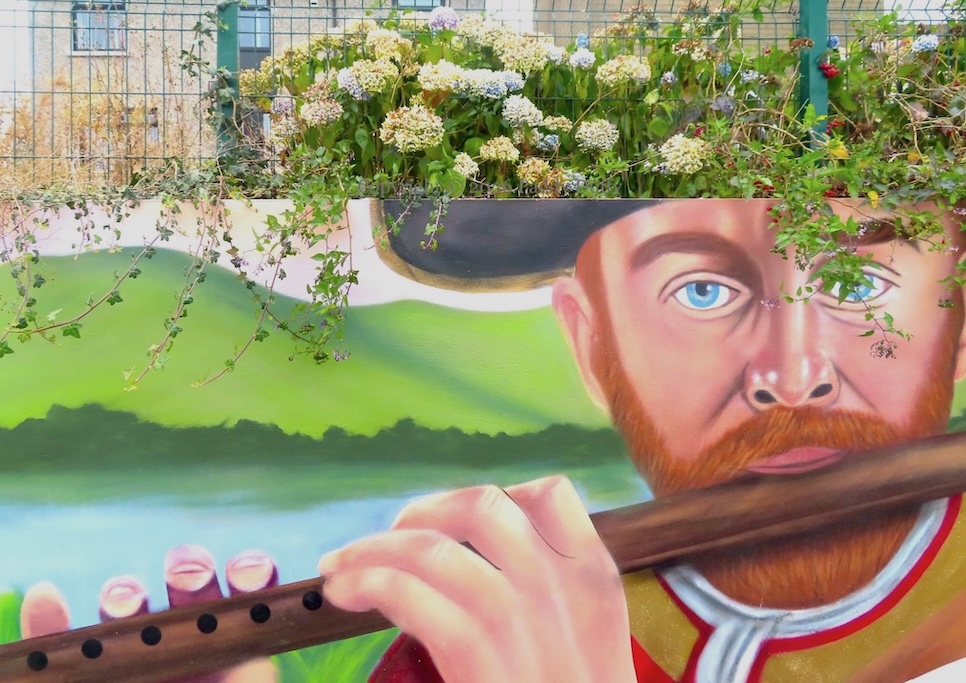
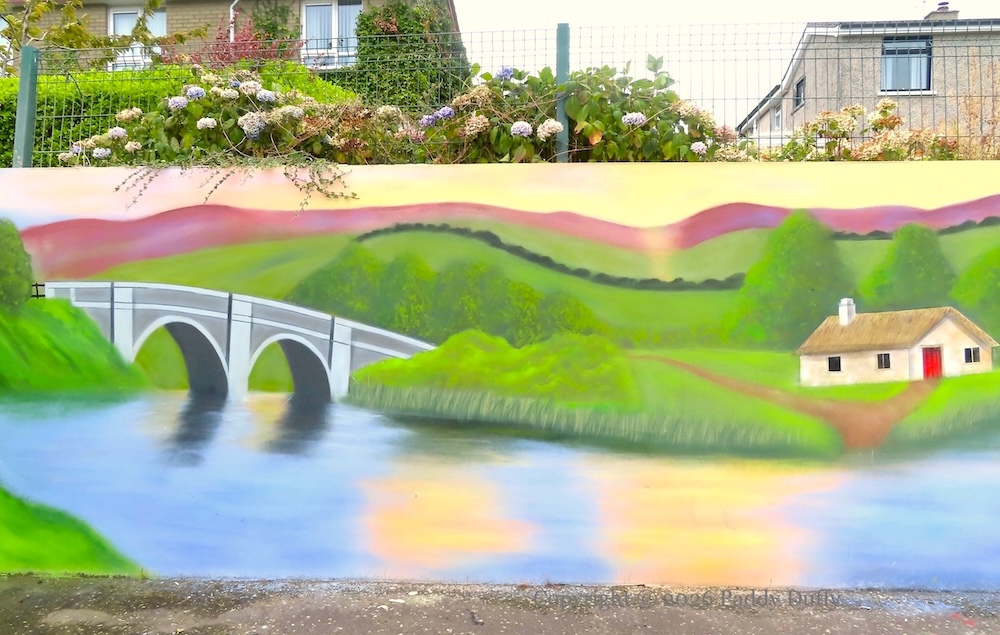
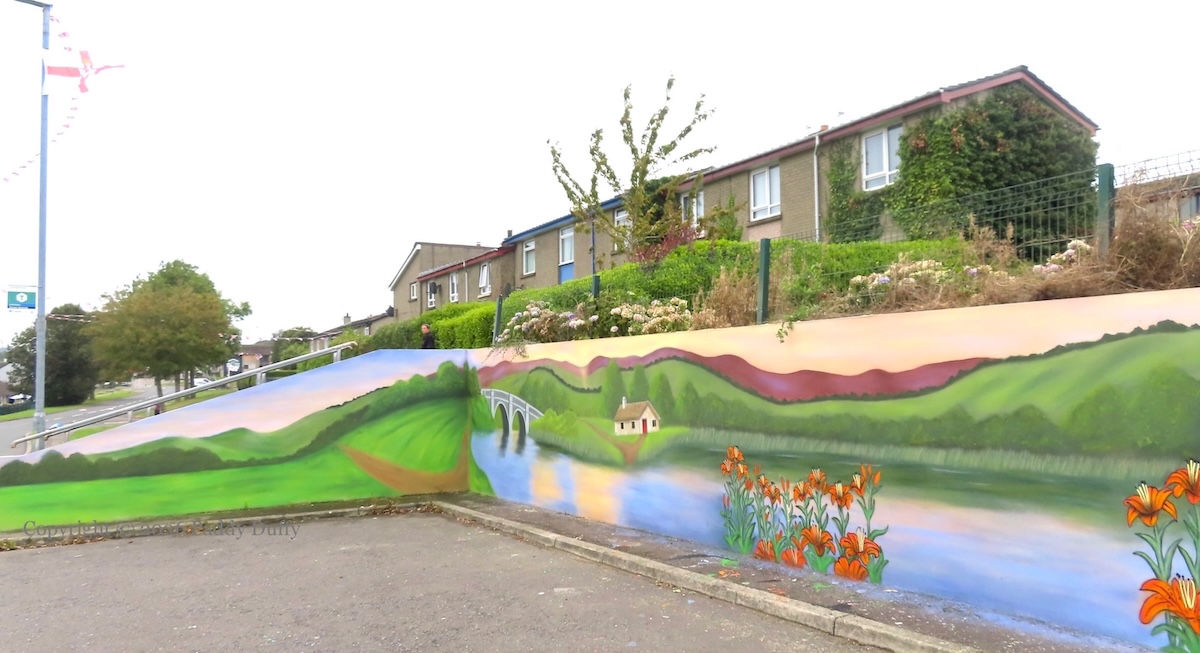
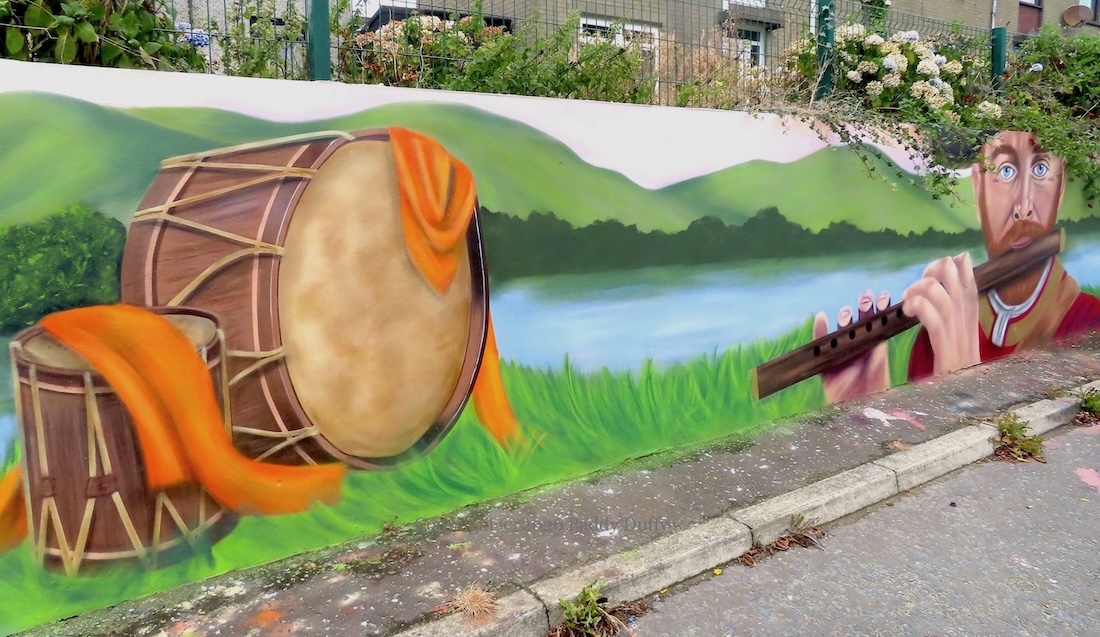
The local flute band in the Kilcooley estate is the North Down Defenders (Fb), which was formed in 2004. This new art, however, suggests that drumming and piping go back to the time of thatched cottages and stone bridges – perhaps, as the orange lilies and blankets might suggest, to the 1795 founding of the Orange Order.
In the lay-by at the top of Owenroe Drive, Kilcooley, Bangor



 Paddy Duffy Collection