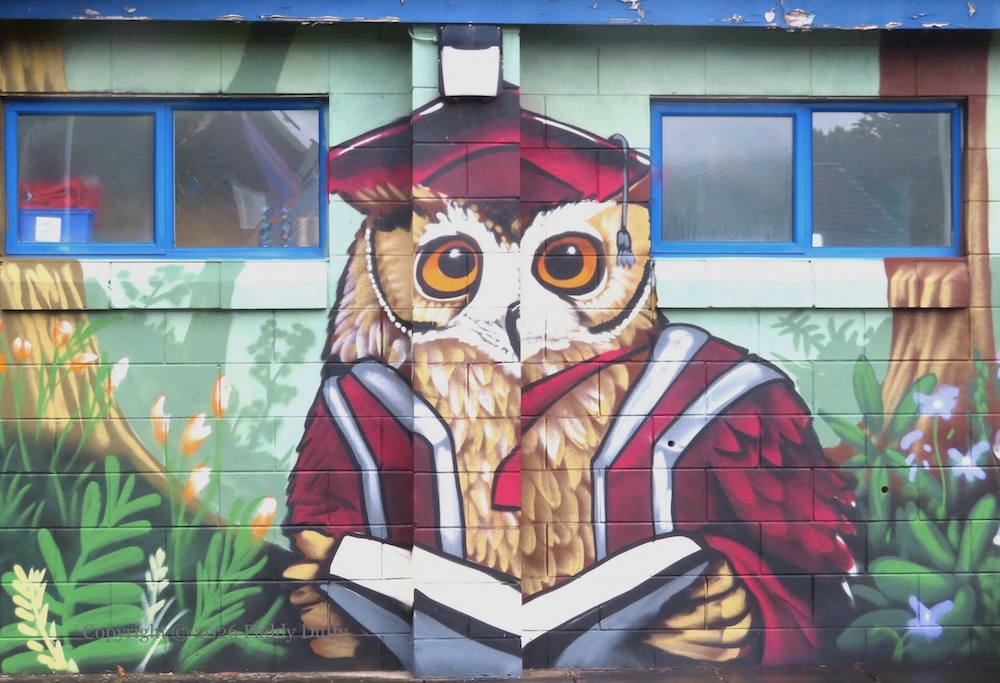
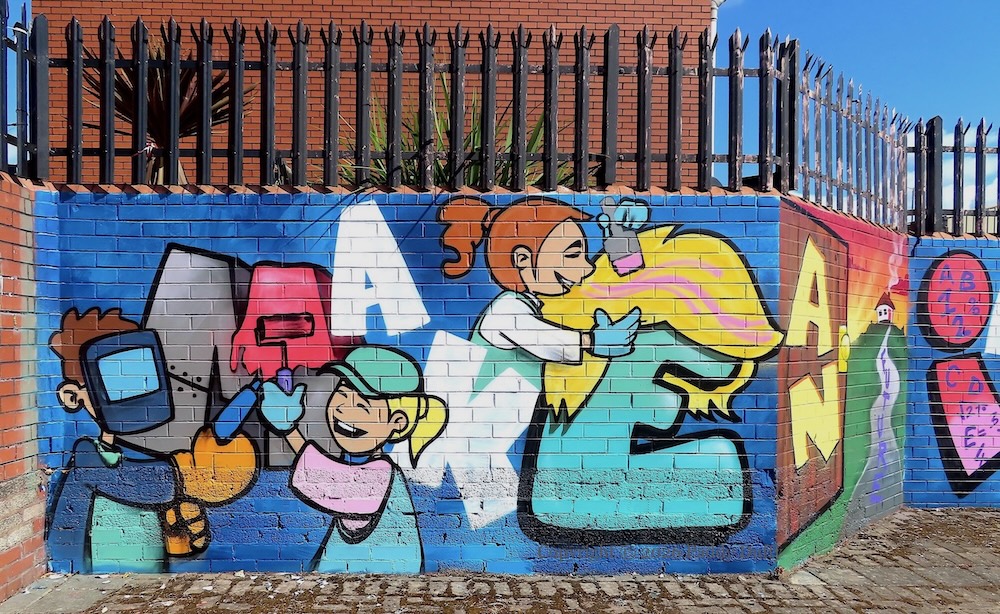
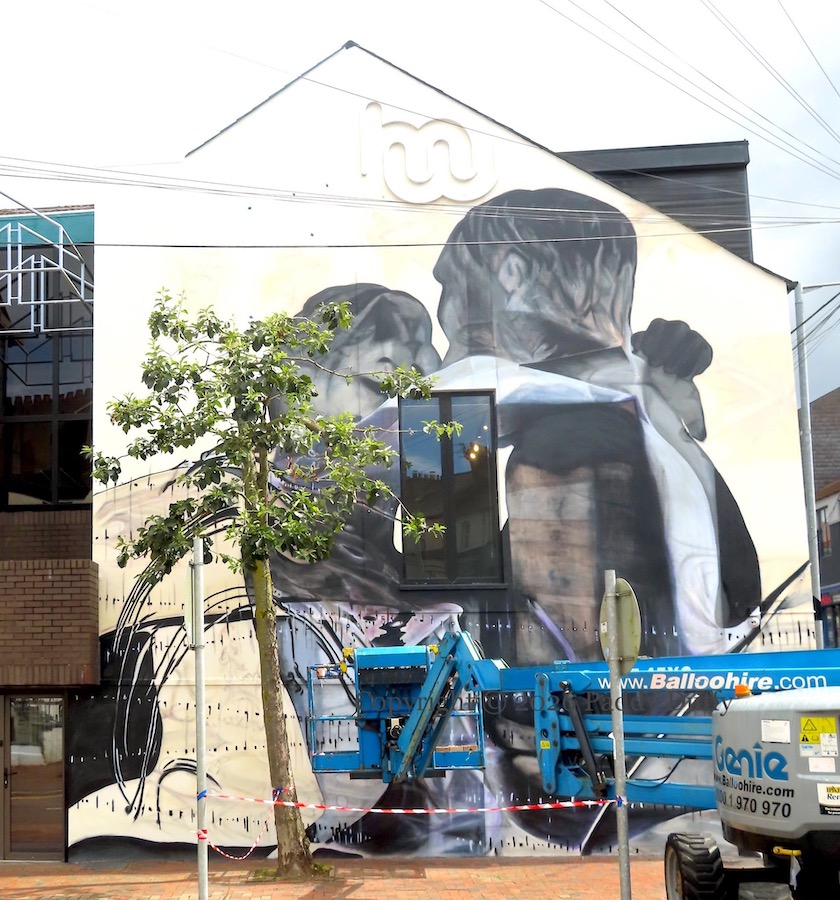
This nature mural – with badger, fox, rabbit, squirrel, and owl – is integrated with the bushy tree the lies along the top of the wall it is painted on. It was painted as part of the rejuvenation efforts of the Linen Quarter BID, which describes it as inspired by Cromac Wood, which existed “till the latter half of the 18th century” (Belfast Street Names) before becoming the site of the Markets (Market Social History) and Donegall Pass areas.
Painted by Visual Waste (web) in Apsley Street, south Belfast, towards the Ormeau Avenue end.
“Rathcoole remembers 11th November. Lest we forget”, “In remembrance” with some lines from For The Fallen, and “Remember them, generation to generation”.
This trio of WWI memorial boards is on the fence of the basketball court along Derrycoole Way, Rathcoole, Newtownabbey, next to an installation of gravestones and sandbags – Row On Row.
The sponsors in the corners of the board shown above are RATH Community Group (Fb) and Dalaradia (web); they previously jointly supported a QEII mural “On The Occasion Of Her Platinum Jubilee“. RATH holds a commemorative service annually in November.
This entry updates the images in Sorry It Was All For Nothing, which showed the central board a few days before its official launch, on May 8th. In the few days before the launch, the “garden” area was added, the pebble-dashed wall was repainted, and the small boards of kneeling soldiers – both WWI and modern British forces – were added on either side.
Here are four flags from “Ulster Carrickfergus Loyalists [Fb]” attached to the fencing at the top of Woodburn Avenue in Carrickfergus. For (limited) background on the UCL, see No Illegal Migrants.
First, “Ulster loyalist – unite and fight.” with a fiery-eyed skull (reminiscent of Eddie The Trooper).
Second, “We are united as one & united we shall remain. Never surrender.” with the flags of the “four nations” that make up the current United Kingdom.
Third, “Christ is king. Stand up to radical Islam. Islam is not a race – it’s an ideology of hate.”
“The Ulster-Scots and the making of America” is a new mural in Carrickfergus celebrating the impact of Ulster-Scots (or, Scotch-Irish) emigrants to the colonies that became the United States.
On the left and right of the main gable (above), the arrivals are shown expanding the territories as they travel in a covered wagon and as embodying Appalachian culture in the form of “old time” (fiddle and banjo) music. (For the Ulster-Scots as frontiersmen, see Ulster Sails West in Ballymoney.)
In the centre are images of space travel, the rocket (perhaps the Saturn V) is heading to the moon (shown in the apex of the wall), upon which Buzz Aldrin walked in the 1969 mission on Apollo 11.
(These are the same themes as deployed in the new mural for the 250th anniversary of the United States in the Shankill – see We Lead Across Time And Space.)
The tartan pattern is called “Ulster Scots” (Tartan Register). The emblem combining a thistle and two red hands within a circle of shamrocks appears to be original work. The Great Seal of the United States was designed by Charles Thomson from Maghera; his contribution is commemorated in his home town.
The UVF boards at the junction of London and My Lady’s roads in east Belfast have been completely replaced (compared to 2022). The hooded gunmen on the short side have been replaced by “Joy, peace, love” while a tribute to David Ervine now replaces the lettering reading “East Belfast Ulster Volunteer Force”. Ervine was a UVF member from 1972 to 1980 before turning to a career in politics. “He asked the question “why can’t I be an Irish citizen of the UK?” … “An architect of peace. An inspiration to us all.” Always remembered by his family, comrades, colleagues and friends.”
Next to Ervine is a UVF roll of honour in which Roy Walker joins Robert Bennett, James Cordner, Joseph Long, and Robert Seymour, who were previously portrayed (Ulster’s Brave). Walker was killed in a feud with the UDA in 1976. And around the corner the UVF emblem has been replaced by a board to the Ulster Volunteer Force Regimental Band.
The largest panel remains a tribute to the dead of WWI, specifically now the “3rd battalion (Mountpottinger)” of the East Belfast regiment of the Ulster Volunteers who “marched to the old town hall in Victoria Street accompanied by the Duke Of York Pipe Band and around 270 members volunteered”. The long text explains the negotiation between Kitchener and Craig over the formation of the 36th Division; the East Belfast volunteers joined the 8th Battalion of the Royal Irish Rifles; “training took place at Ballykinlar in County Down and the Battalion became known as “Ballymacarret’s Own””.
“Sorry it was all for nothing – It’s on each and every one of us to save what our forefathers fought and died for.”
According to this Facebook post, the perceived threat being warned against here is “Communistic Islamification”. The “Islamification” is represented by a partial flag of Pakistan (an Islamic republic) being carried by yelling Caucasian figures in long black robes, advancing through a graveyard, in which an elderly man – perhaps King Charles – kneels in front of a headstone bearing a red Christian cross. That the cemetery is a military one is indicated by the medals on the mourner’s chest and the line from Binyon’s ‘For The Fallen’, which provides a referent for the apology and the word “forefathers”.
How the “communistic” threat is conveyed is less clear.
Two men were cautioned by the police for displaying offensive material (Sunday Life). The Cloughfern Young Conquerors declined to play at the launch and family fun-day (Sunday Life), but the event went ahead (on May 8th) (youtube). Additional changes were made to the site in the days prior to the launch; see What Our Forefathers Fought And Died For.
“Remembered with pride – Stevie McCrea, Village, south Belfast”. A plaque has been added below the large board describing Stevie McCrea’s life in Kilburn Street (seen in 2022’s Here Lies A Soldier, which includes the text on the board).
Also included below are close-ups of the plaques to McCrea and Sammy Mehaffy in Tavanagh Street, (seen together in Village UVF).
“We don’t just inherit, we lead across time and space.”
Here is the second half of the Ulster-Scots (Visual History) mural painted in North Howard Street and Fifth Street, continuing the work seen in Echoes Of The Ulster Scots, which took the Scotch-Irish from Ulster to the Appalachians.
The new panels bring us from the founding of the United States in 1776 to the space age. The panel above is a rendition of John Trumbull’s painting ‘Declaration Of Independence’ (image at WP) along with (below the “250”) the signature of “Cha[rles] Thomson”, who was born in Maghera, served as Secretary of the Continental Congress, designed the Great Seal Of The United States (which appears next to the right), and signed the Declaration (Ulster Scots Agency pdf).
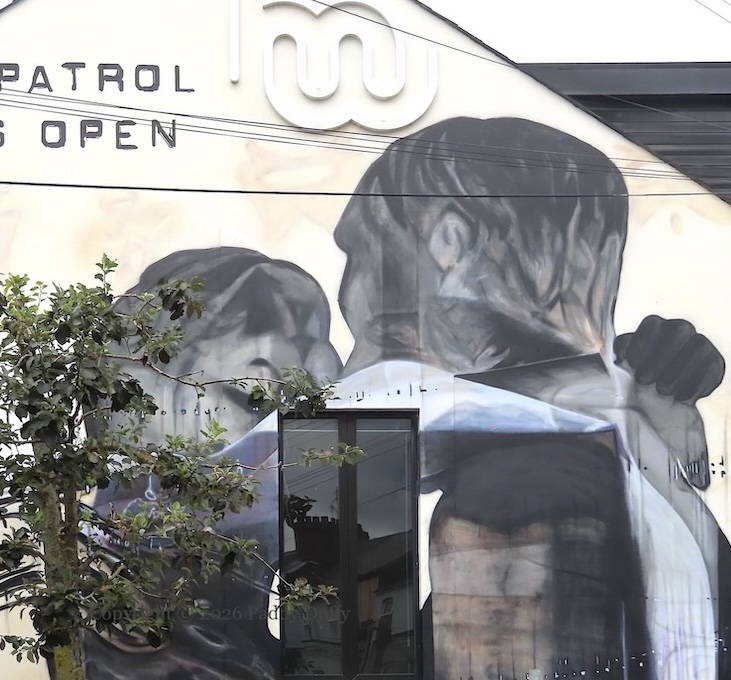
The person third from the left is Robert R. Livingston, one of the Committee Of Five that prepared the Declaration; he also negotiated the Louisiana Purchase in 1803 (Discover Ulster Scots).
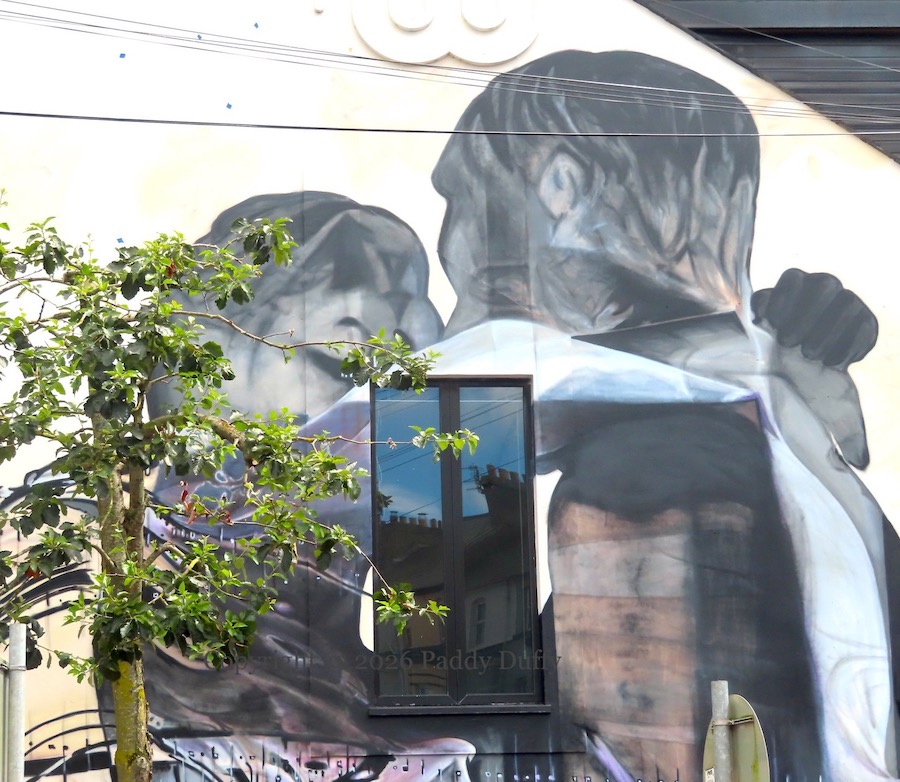
The flag is a combination of a proposed Ulster Scots flag and the Stars And Stripes of the United States.
North Howard Street/Fifth Street, west Belfast
April 19th: Artist DMC at work on the second half of the mural.
“In memory of the lost, 15 April, 1912.” The majority lifeboats on the RMS (not “SS”) Titanic were made of wood, constructed at Harland & Wolff at the same time that Titanic was built. Of the 2,209 people on board the ship at the time of her collision with an iceberg late in the evening of April 14th, 706 people survived in lifeboats that could have carried 1,178 people. (WP)
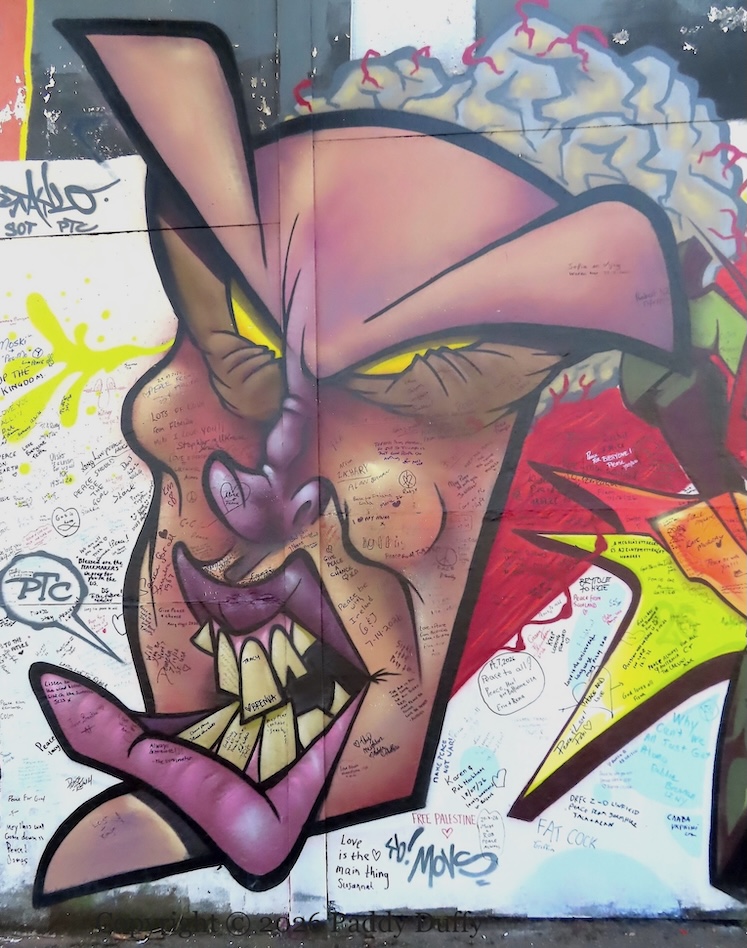
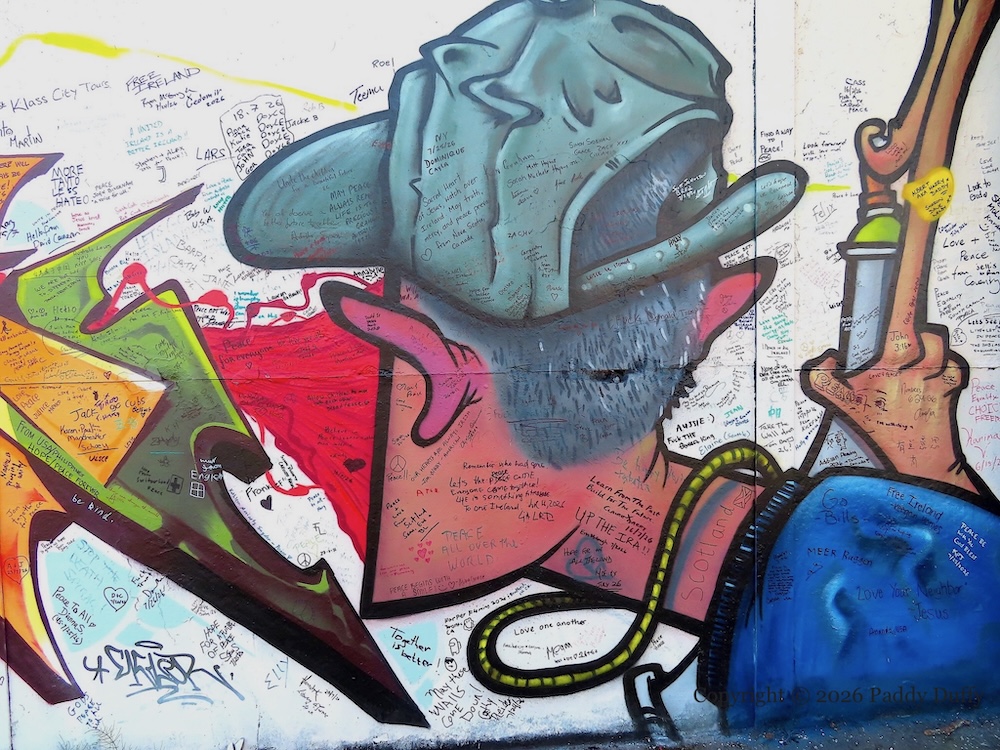
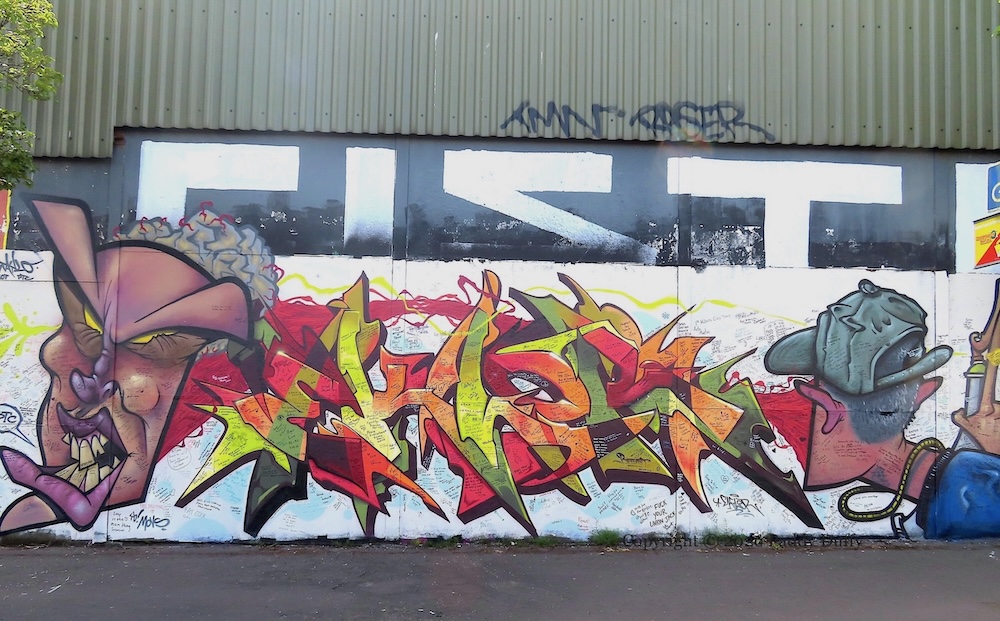
This tribute to those who died in on a short section of pedestrian railings on the Cupar Way “peace” line (Visual History). In the background are the specially designated spots for tourists to sign the wall (see Collecting Signatures).