“There are special people in our lives who never leave us even after they are gone. In loving memory of all the men that have passed away since the burning of Long Kesh 15th & 16th October 1974. Rest in peace. Also remembering the blanket men and women, all republicans who have lost their lives in our fight for freedom. Rest in peace. Ní fhéadfaıdís sınn a bhrıseadh [They cannot (lit. would not be able to) break us].”
This Celtic cross memorial was erected to commemorate the fiftieth anniversary of the burning of Long Kesh. According to Derry Now (which has photos of the launch) the cross is one of four to be be raised in various areas. For the one in Newry, see Davey Morley.
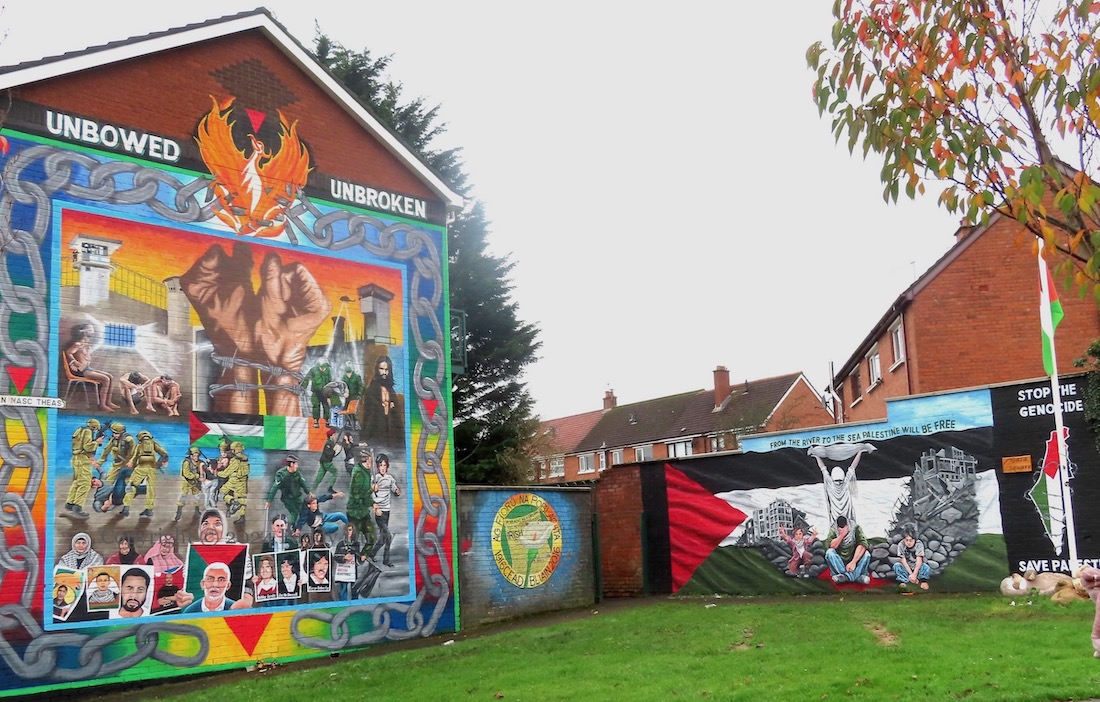
The 1916 centenary mural in Andersonstown has been repurposed and repainted to express solidarity with the people of Palestine.
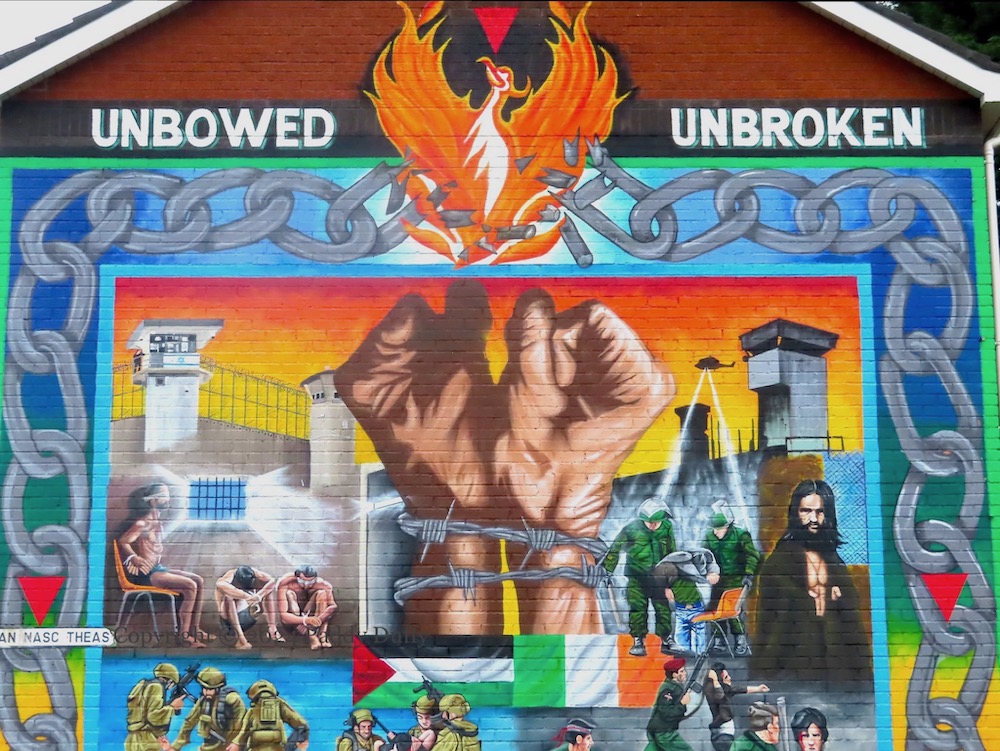
From the frame of the previous mural – see Unbowed, Unbroken – the title, phoenix, and chains have been preserved but two instances of the inverted red triangle have been added at the top and bottom – see Resist! (and My Kite You Made).
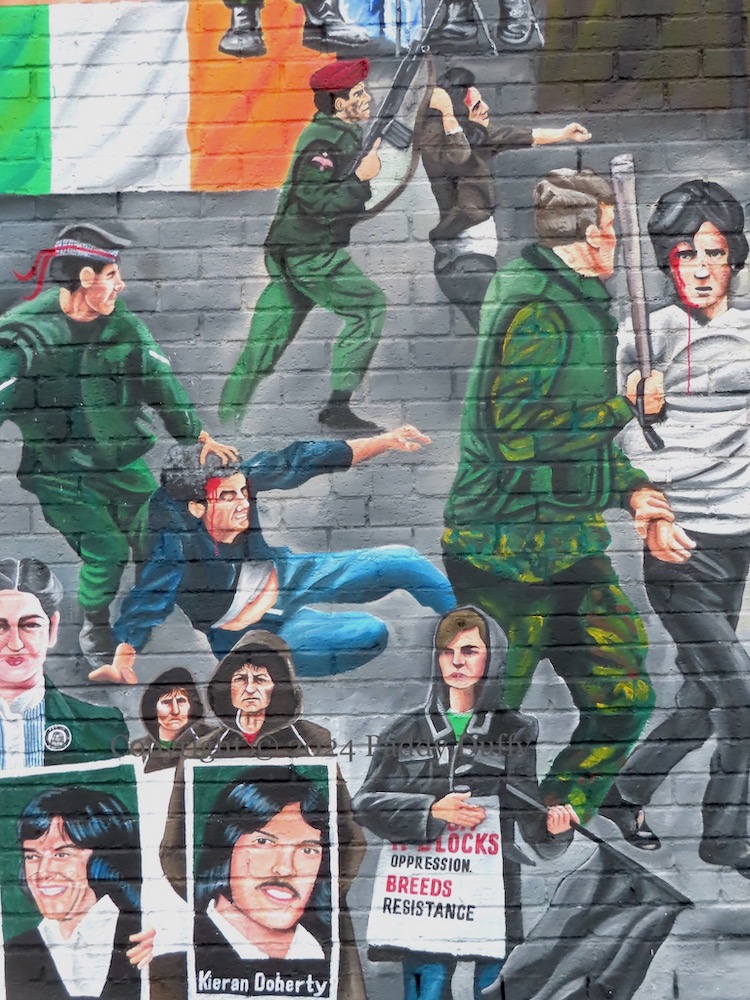
The main panel puts the struggles in Palestine and Northern Ireland in parallel, showing (from top to bottom on each side) political prisoners, violence against protesters, and relatives carrying portraits.
On the left, Palestinian prisoners languish in Israeli jails (based on a photo of Hamza Abu Halima and on this Reuters photograph of prisoners sitting in the street, both from December 2023) and IDF soldiers make violent arrests – the one on the left is from 2016 (CCUN) and the one on the right is perhaps based on this Reuters photograph.
On the right: British soldiers restore order after the Burning Of Long Kesh (see Operation Pagoda), next to blanket-man Hugh Rooney, above three arrests made by British Army soldiers – their caps indicates that they are from the Argyll & Sutherland Highlanders (left) and the Paratroop regiment (centre). (For two of the original photos, see BBC | Getty.)
Along the bottom of both sides, marchers hold portraits of the dead, including the recently-killed leader of Hamas Yahya Sinwar (BBC).
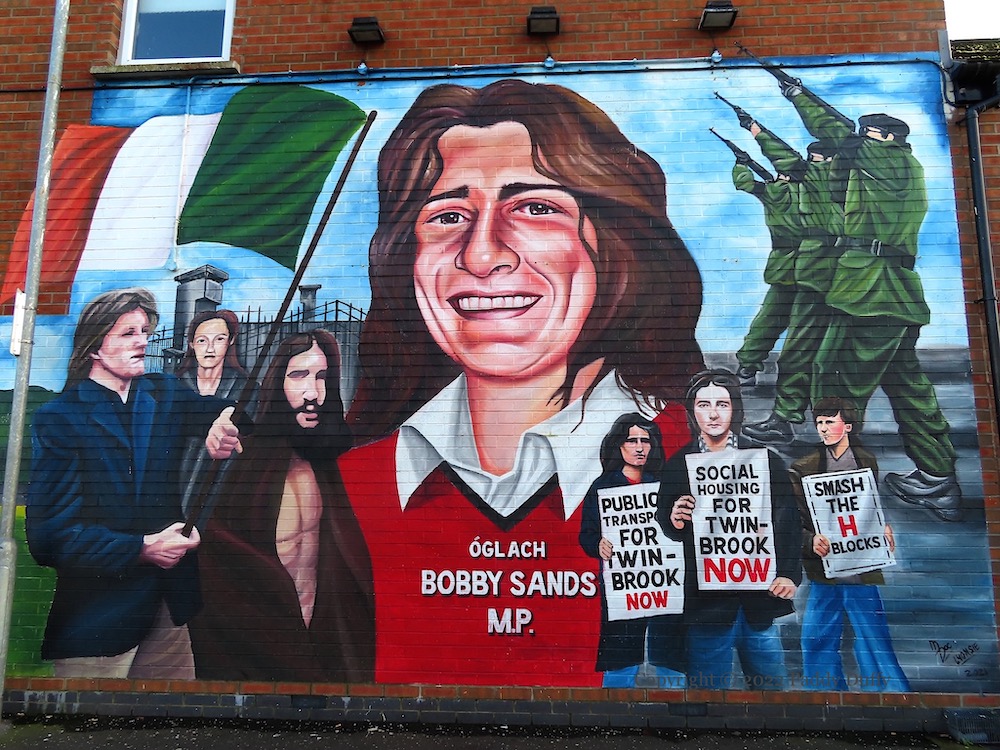
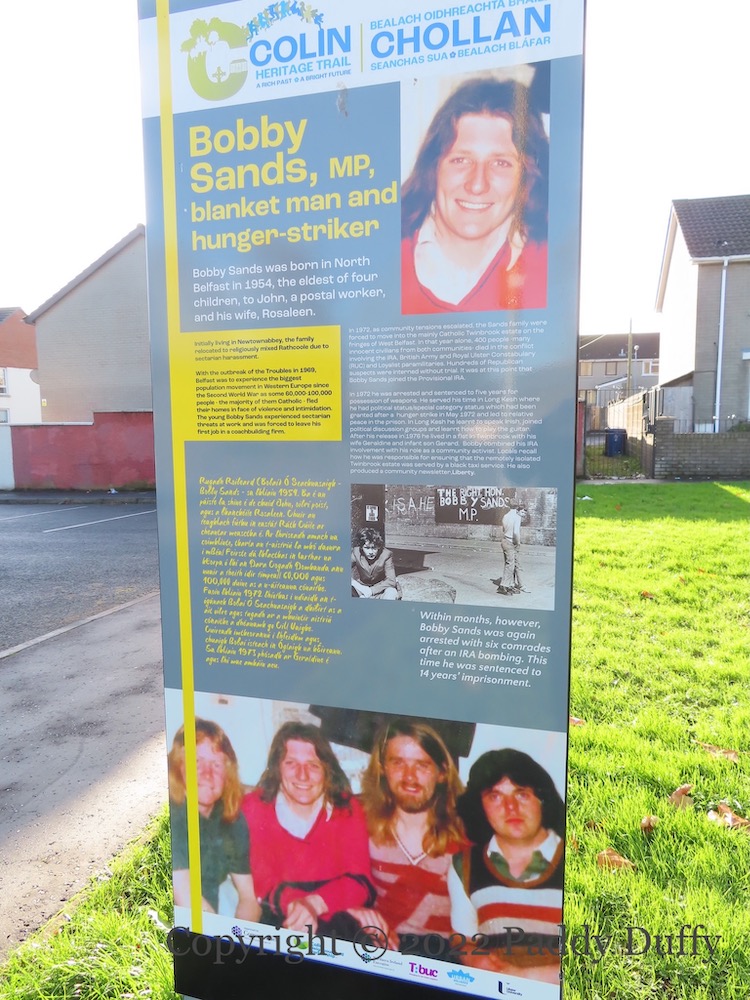
In 2019, images of Bobby Sands before his (second and final) arrest and imprisonment were rediscovered in the collection of French photographer Gérard Harlay. Sands was serving as a flag-bearer in an August 1976 march from the Busy Bee to Dunville Park to protest the withdrawal of political status. (For some of Harlay’s images, see Bobby Sands Trust.) This new mural in his home area of Twinbrook copies one of the images (though presents him as carrying a Tricolour rather than a harp) along with protesters protesting for “Public transport for Twinbrook now” and “Social housing for Twinbrook now”.
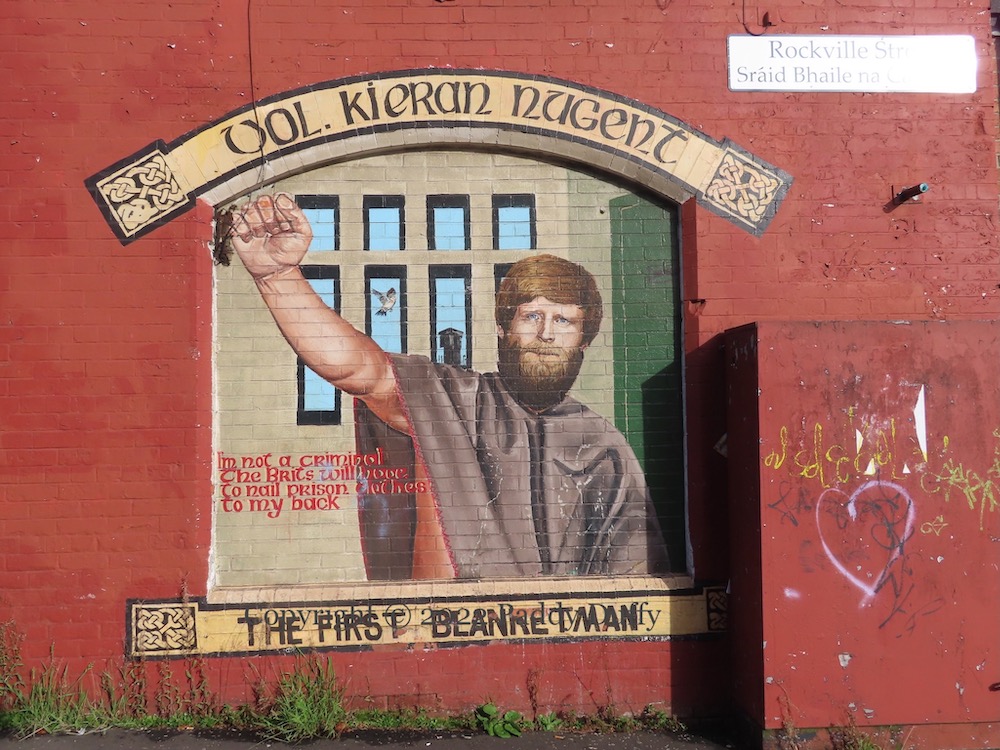
“The first blanketman”. IRA prisoner Kieran Nugent is reputed to have said – upon being imprisoned after the removal of Special Category status in 1976 – “I’m not a criminal – the Brits will have to nail prison clothes to my back.”
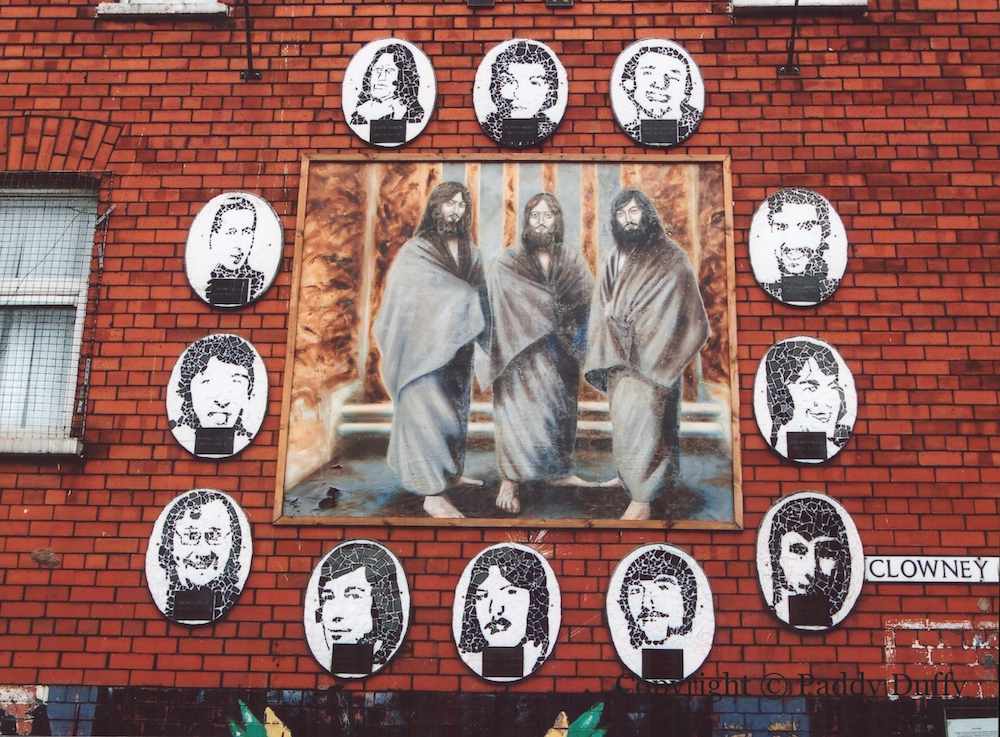
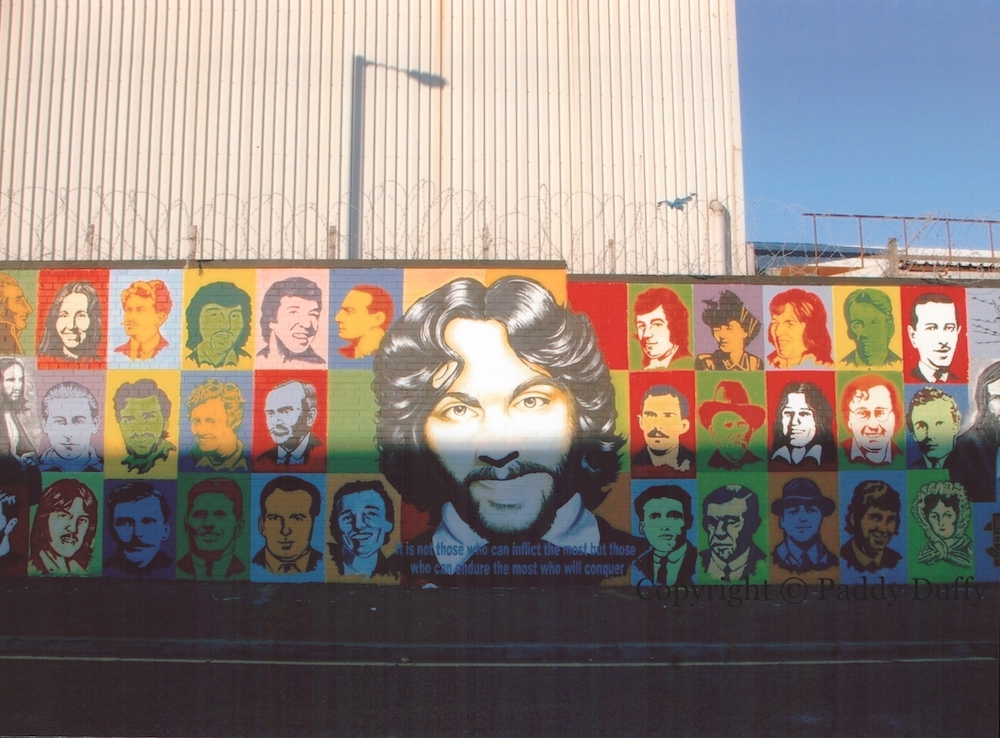
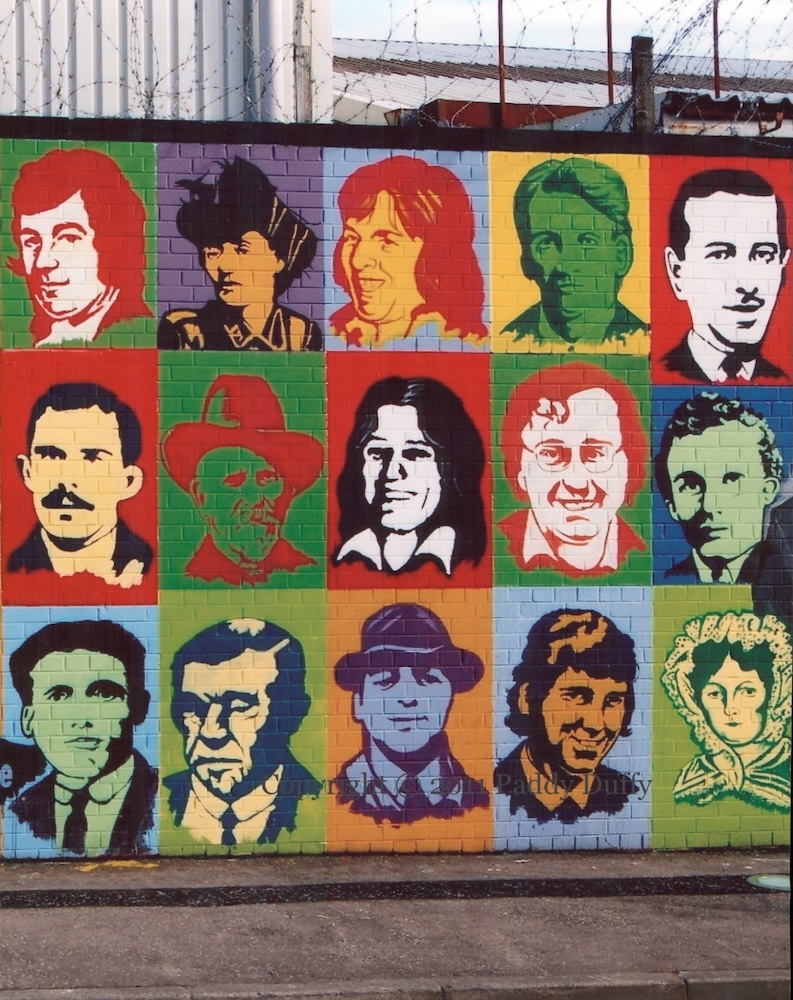
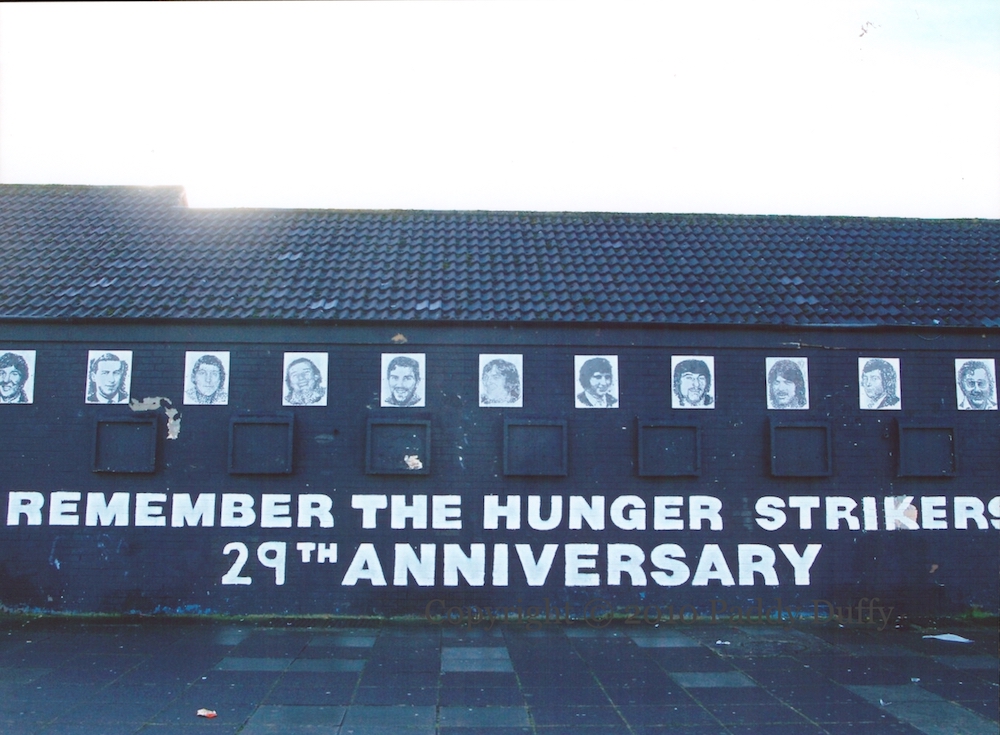
For the 30th anniversary of the 1981 hunger strike, the mosaics of the Troubles-era hunger strikers were mounted around the blanket-men board and above the Phoenix in Clowney Street; for a few years they were previously at the Falls-Beechmount corner.
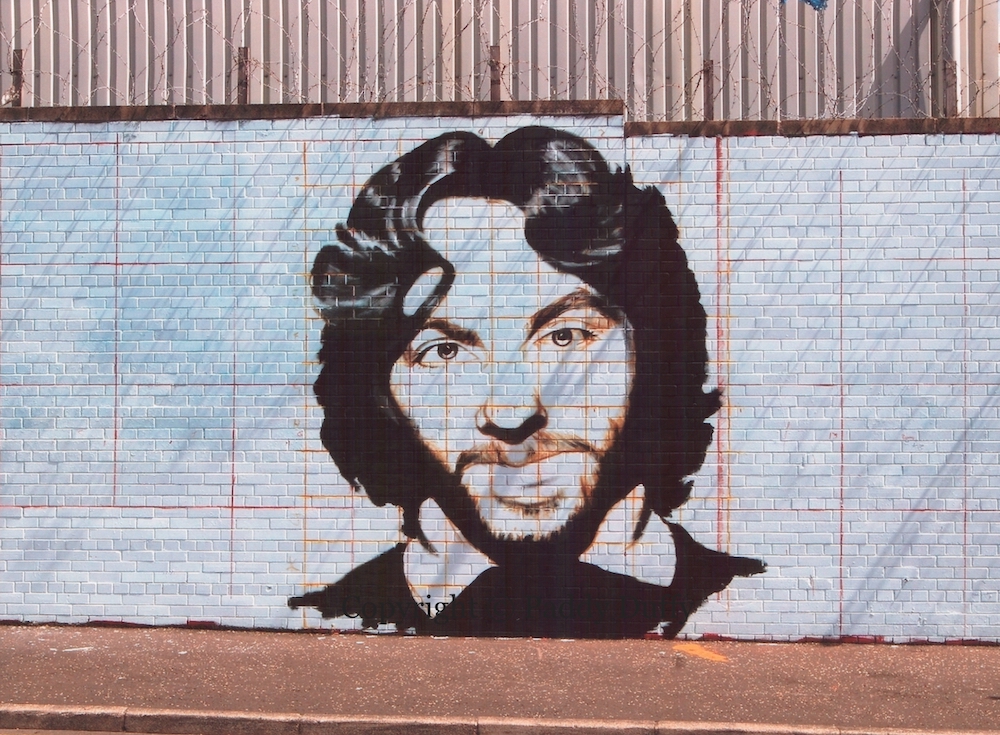
“It is not those who can inflict the most but those who can endure the most who will conquer.” 1981 hunger-striker Francis Hughes is flanked by blanketmen Hugh Rooney and Freddie Toal and surrounded by a host of other republican faces in this 2011 mural commemorating the 30th anniversary of the strikes. Painted by Seany McVeigh.
Top 1. Wolfe Tone 2. Mairead Farrell 3. Thomas Ashe 4. Kevin Lynch 5. Michael Gaughan 6. Padraig Pearse, [FH] 7. Thomas McElwee 8. Constance Markievicz 9. Joe McDonnell 10. Terence MacSwiney 11. Frank Stagg 12. fuiseog
Middle 1. Hugh Rooney, 2. Kevin Barry 3. Patsy O’Hara 4. Máire Drumm 5. James Connolly, [FH] 6. Denis Barry 7. James O’Donovan Rossa 8. Bobby Sands 9. Mickey Devine 10. ? 11. Freddie Toal
Bottom 1. Roger Casement 2. Kieran Doherty 3. Michael Fitzgerald 4. Seán McNeela 5. Tony D’Arcy 6. Ray McCreesh, [FH] 7. Joseph Murphy 8. Andrew Sullivan 9. Seán McCaughey 10. Martin Hurson 11. Anne Devlin
IRA prisoner Kieran Nugent is reputed to have said – upon being imprisoned after the removal of Special Category status in 1976 – “I’m not a criminal – the Brits will have to nail prison clothes to my back.”
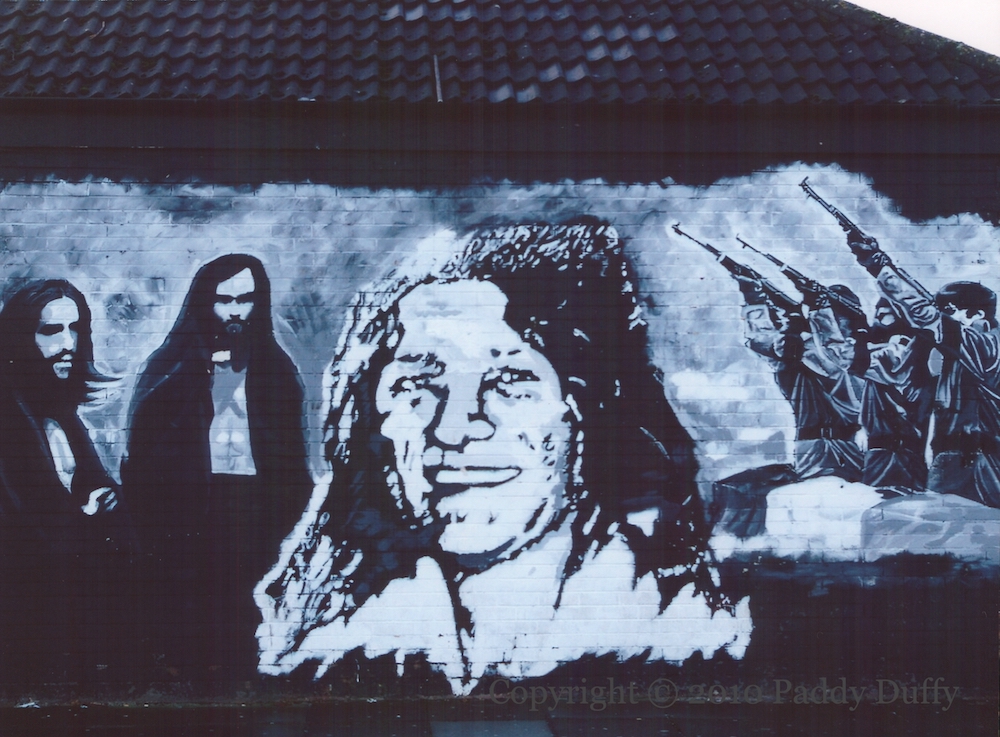
Frank Stagg and Michael Gaughan are included alongside the deceased 1981 hunger strikers in a gallery of portraits that has been updated annually since (at least) 2006. The large panel shows blanket-men Hugh Rooney and Freddie Toal, and Bobby Sands, the first to die in 1981.
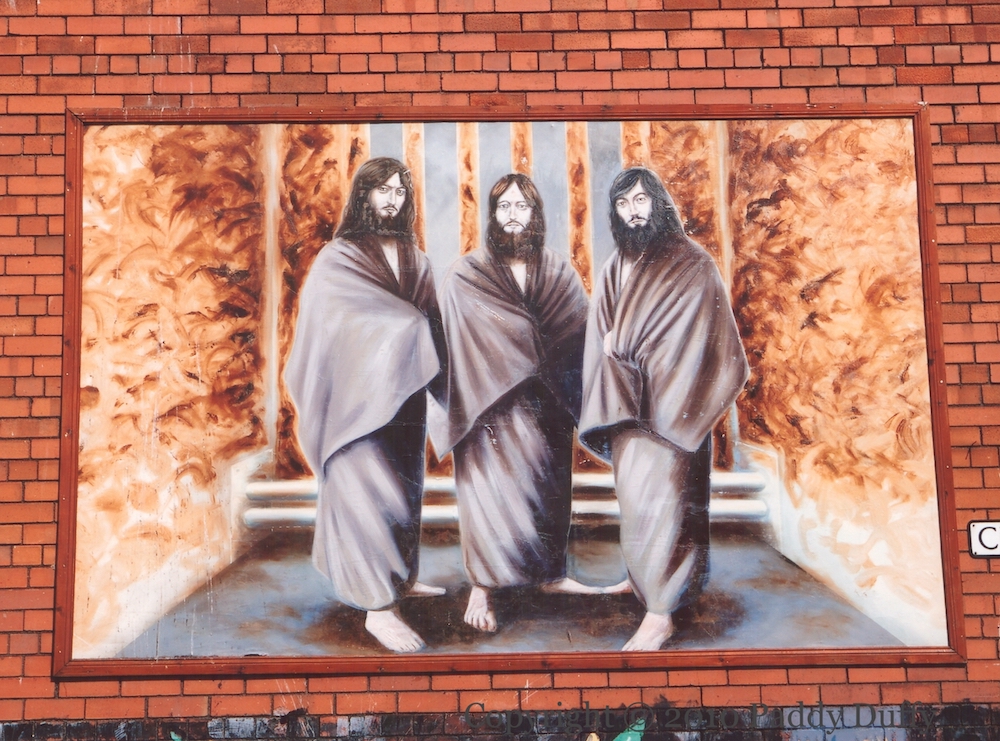
The “blanket” (Gaeilge: pluıd) protest (not wearing prison uniforms) was a response to the removal of political (Special Category) status in 1976 (WP). The “no wash” or “dirty” protest (not using toilet facilities) followed in 1978 (WP). Both forms of protest are illustrated in the board shown above: three unshaven men wear blankets and go barefoot in a cell with excrement smeared on the walls.











 Paddy Duffy Collection