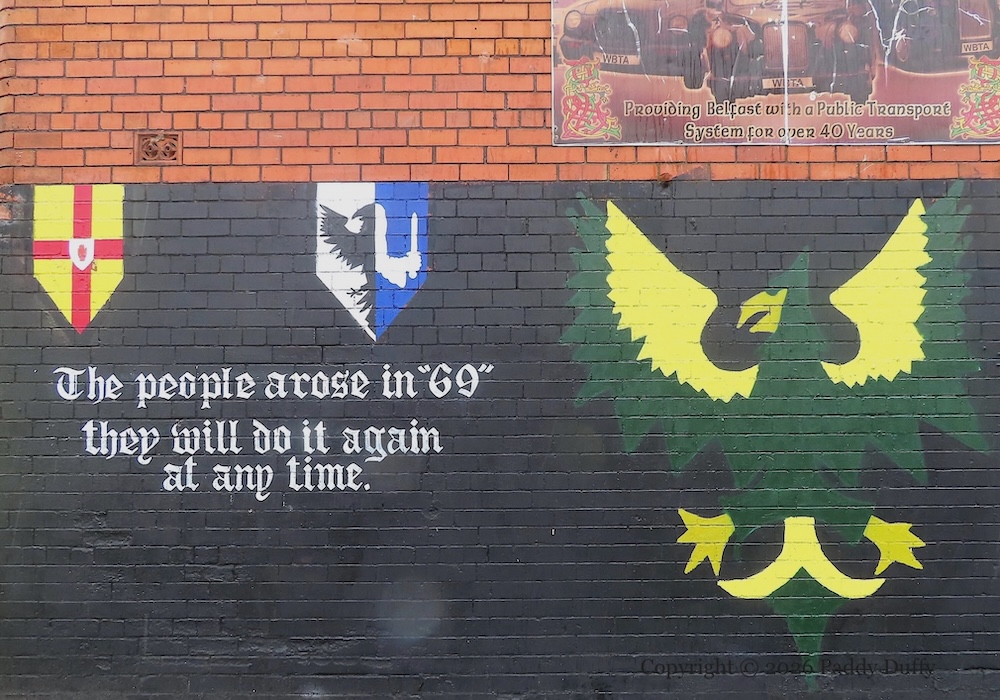
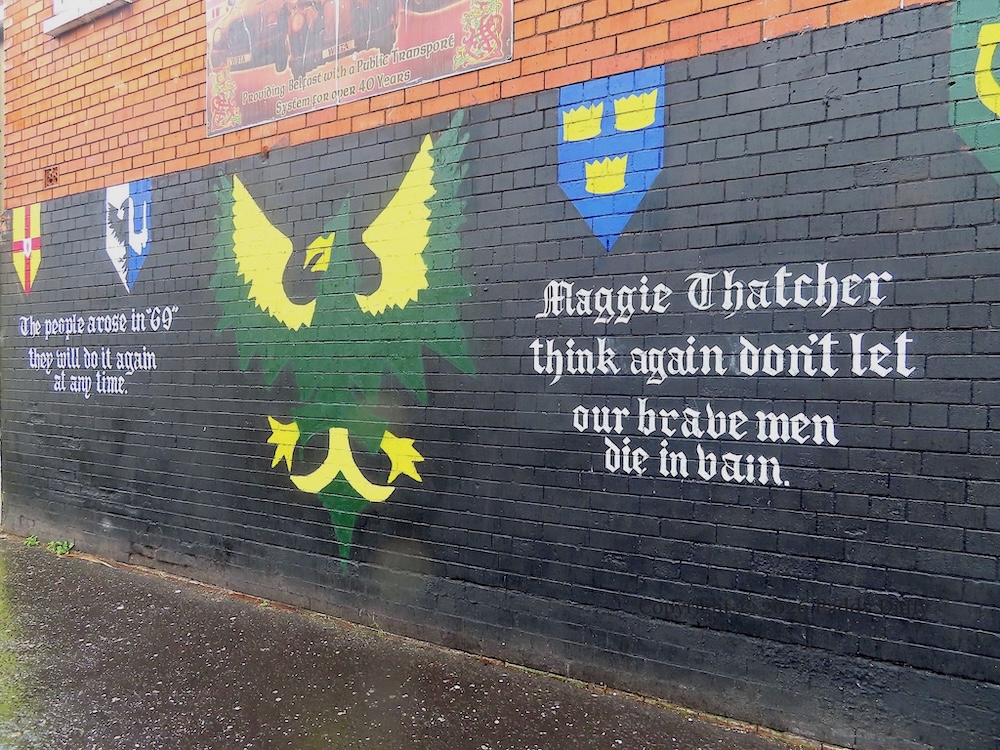
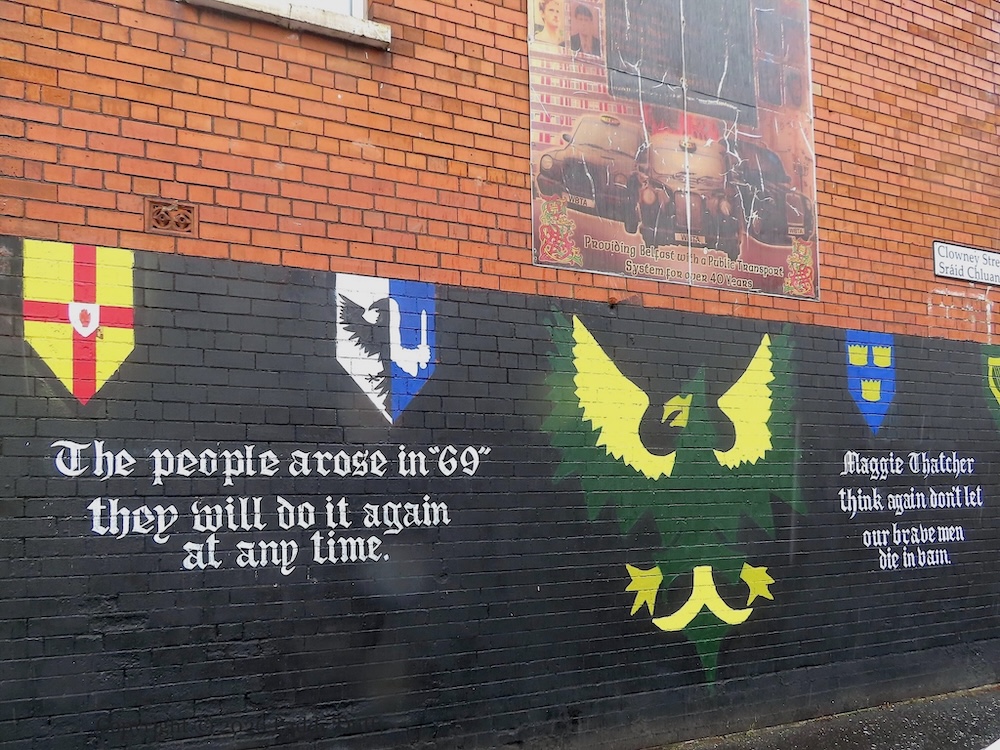
The phoenix in Clowney Street was first painted in 1981 and has been repainted periodically in the same form. (For a brief history, see The Oldest Murals.) In this update, the only noticeable changes are the quotation-marks around “69” and the golden feet on the phoenix.
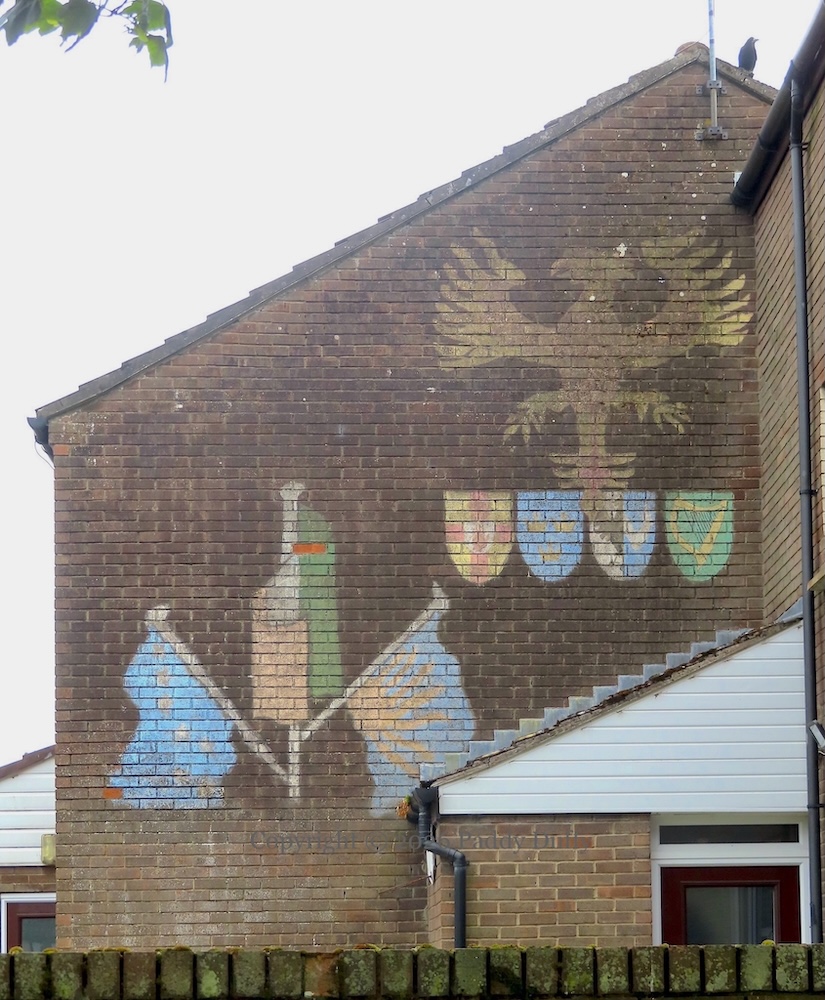
This mural, painted in 1981, still exists as is and is thus the oldest original mural in the north. It shows a phoenix rising from the shields of the four provinces and a stand of three flags: Starry Plough, Tricolour, and Sunburst.
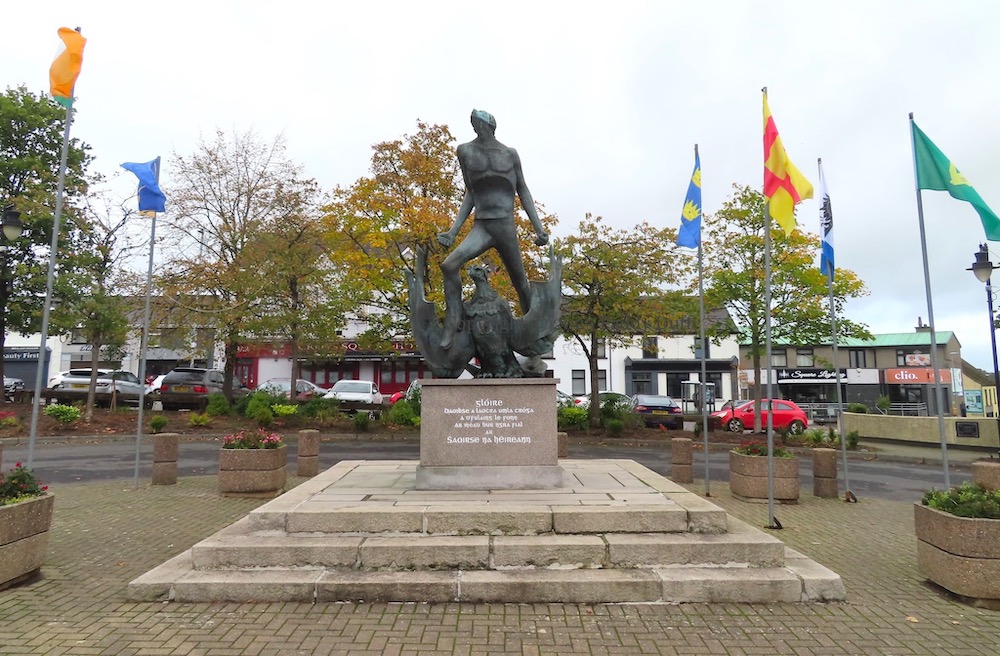
This is the republican memorial in the centre of Crossmaglen (in Cearnóg An Chaırdıneıl Ó Fıaıch). The monument was produced by Yann Goulet (1979), the same sculptor who did the memorial at Ballyseedy (1959), and like that work, this one depicts a young man striding forward in anger and anguish, though in this case he arises from a phoenix.
“Glóıre daoıḃse a laoċra uṁla cróga a d’ḟulaıng le fonn ar ṁéad ḃur ngrá fıal ar Ṡaoırse na hÉıreann.” “Glory to you all praised and humble heroes who have willingly suffered for your unselfish and passionate love of Irish freedom.”
To the right of the statue (in the corner of the car-park) is a plaque marking “the spot where the rosary was said each night during the 1981 hunger strike”, “unveiled by formed hunger striker Paddy Quinn on 6th May 2006”.
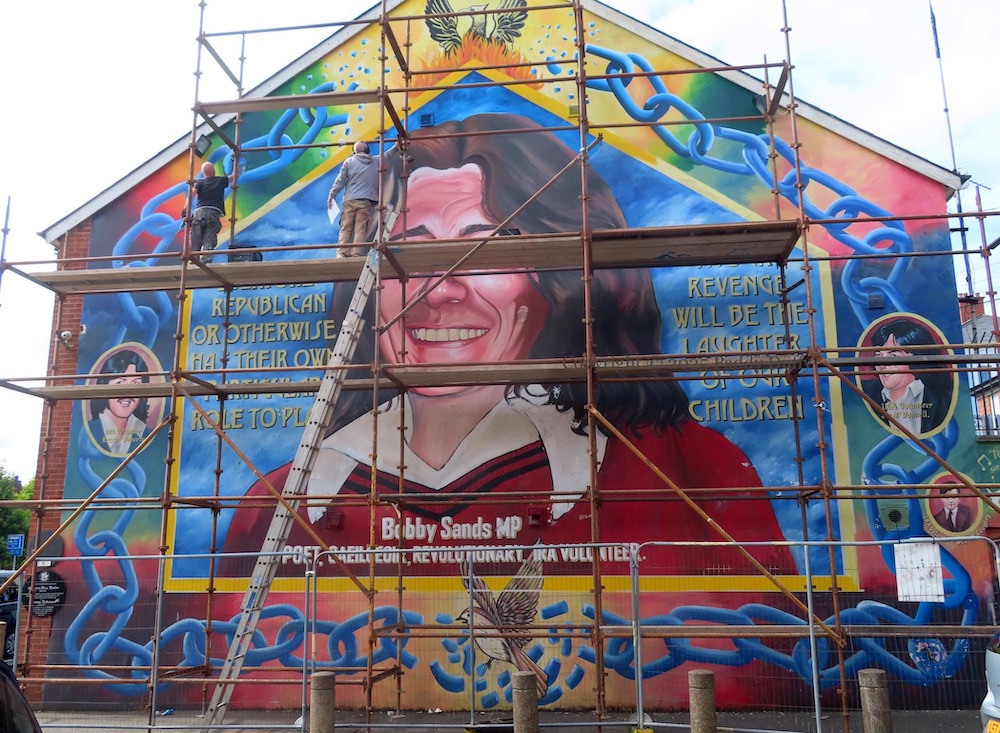
The Bobby Sands mural in Sevastopol Street, on the side of the Sınn Féın offices, is perhaps Belfast’s most famous mural and in general second only to Free Derry Corner in Derry. The main wall of the mural has just been touched up, in time for the march that took place in Belfast on August 24th as part of the national hunger-strike commemoration.
The first mural of Sands was painted on the wall in 1989 and the most recent re-painting prior to this one was in 2015 – see the wall’s Visual History page.
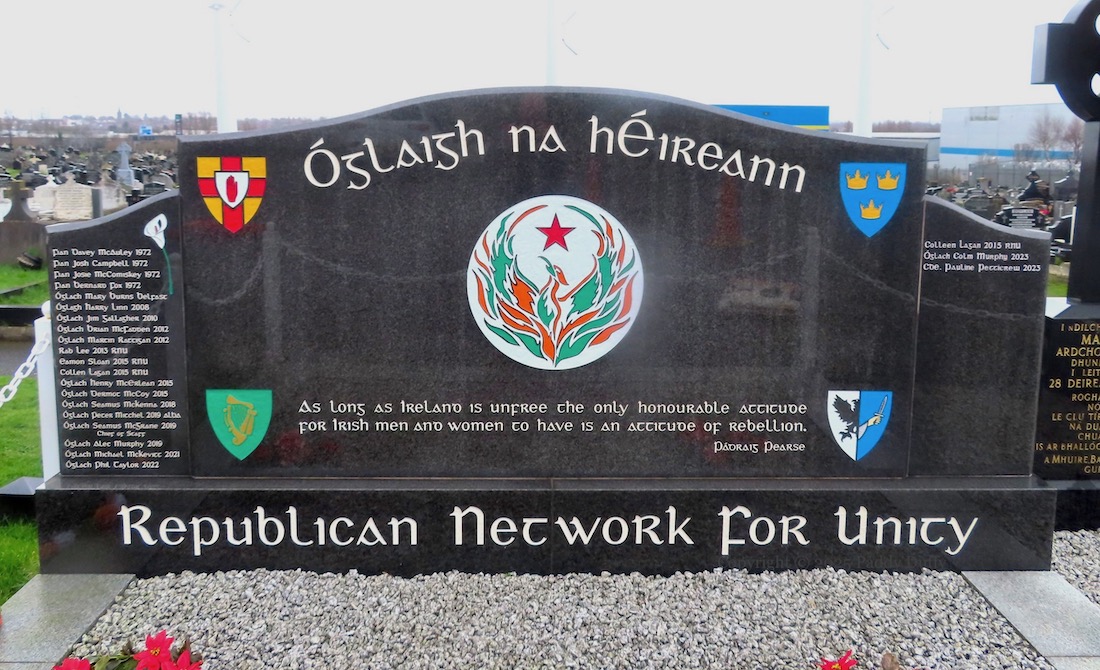
“”As long as Ireland is unfree the only honourable attitude for Irish men and women is an attitude of rebellion” – Pádraıg Pearse”. Pearse wrote the lines in July 1913, in an essay for Irish Freedom (Cartlann), though with “revolt” rather than “rebellion”.
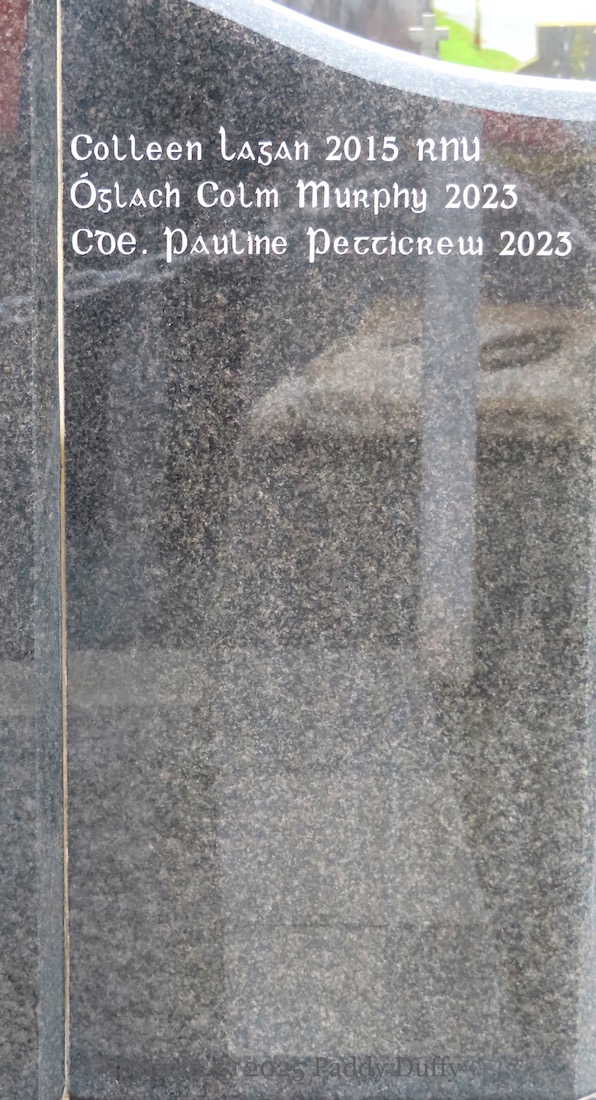
The stone features the phoenix and the lily, and the crests of the four provinces of Ireland. It was unveiled in 2023 and an image of it was used in an RNU board on the Falls Road.
Among the volunteers listed are the four Ardoyne Fıanna who died in 1972 (commemorated in Ardoyne) and Michael McKevitt, founder and (alleged) chief of staff of the RIRA/Óglaıgh Na hÉıreann (WP) who died in 2021.
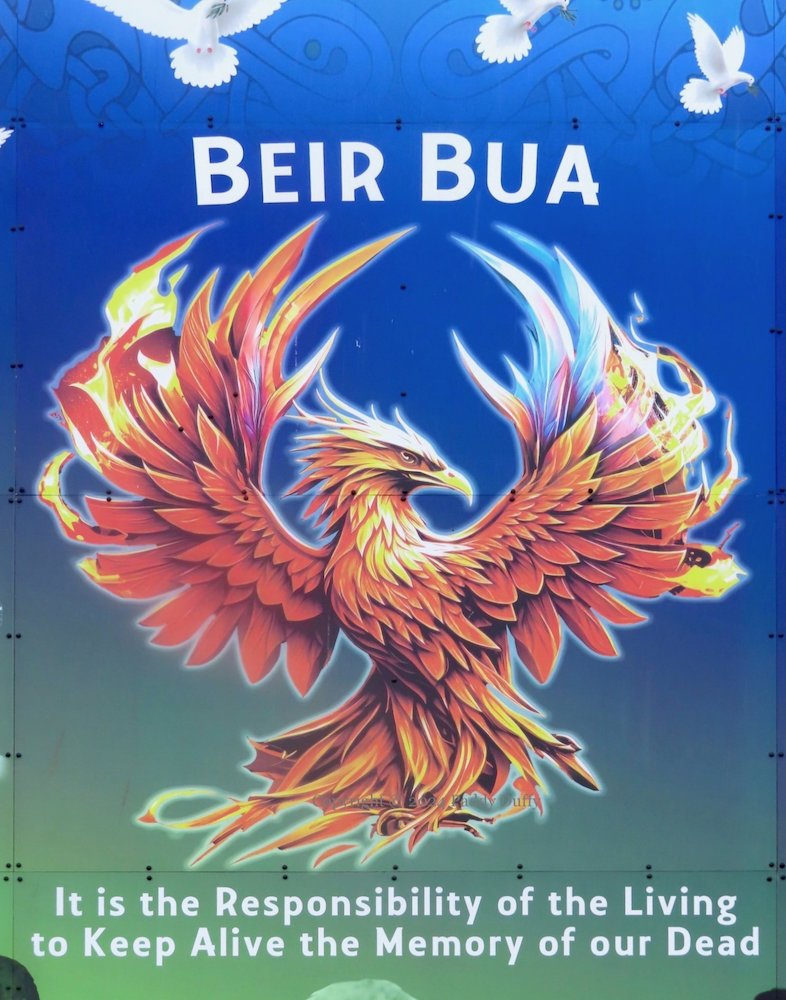
“Beır bua – It is the responsibility of the living to keep alive the memory of the dead.” This is the second ‘Working Class Heroes’ piece in Ballymurphy. The other, from 2014, features Tommy “Toddler” Tolan, who appears here to the left of the phoenix.
The plaque on the right reads “This mural was unveiled by Johnny Doc and Maureen Tolan, 5th November, 2023.” There is video of the launch on Facebook, which contains a reading of the names of all the people pictured from the 1m 57s mark onwards.
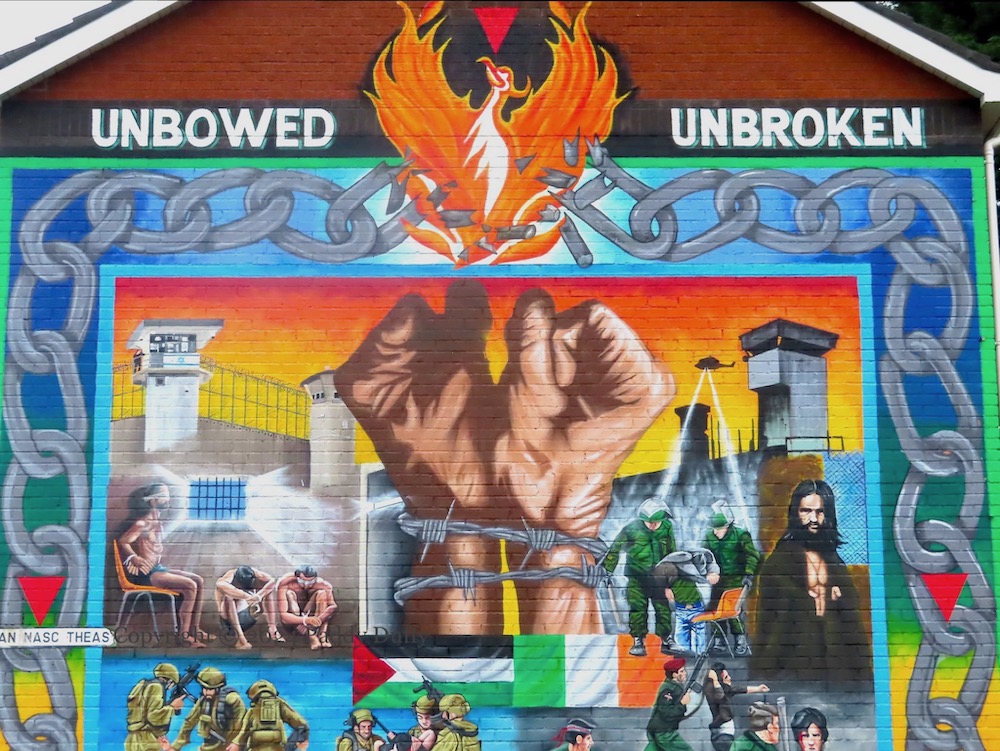
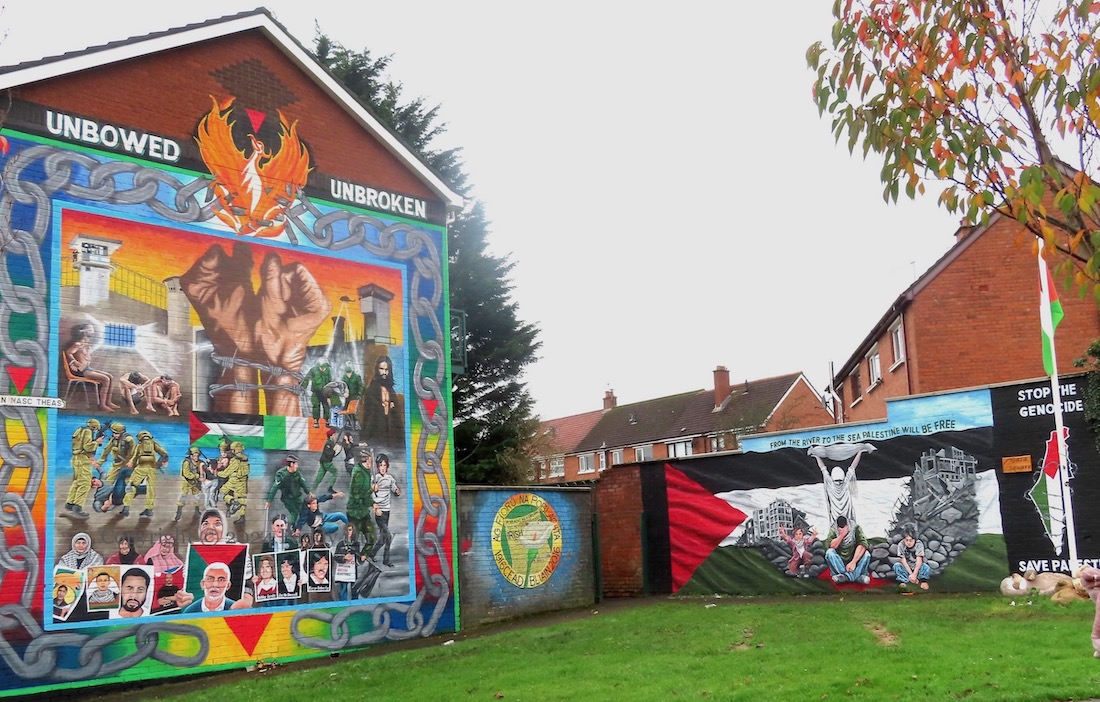
The 1916 centenary mural in Andersonstown has been repurposed and repainted to express solidarity with the people of Palestine.
From the frame of the previous mural – see Unbowed, Unbroken – the title, phoenix, and chains have been preserved but two instances of the inverted red triangle have been added at the top and bottom – see Resist! (and My Kite You Made).
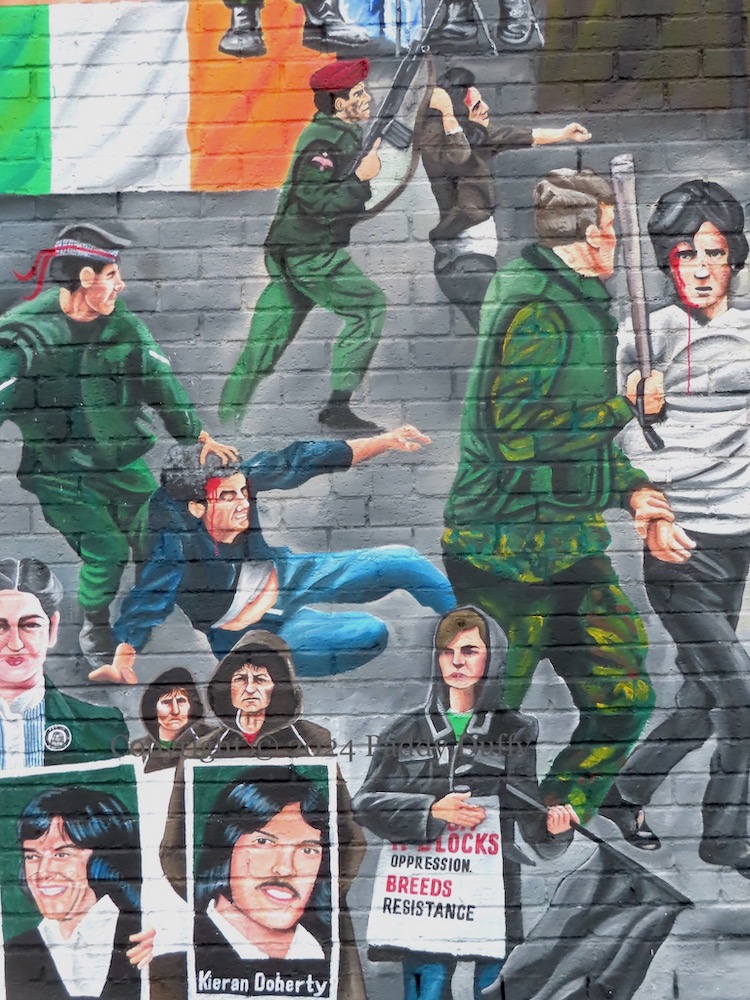
The main panel puts the struggles in Palestine and Northern Ireland in parallel, showing (from top to bottom on each side) political prisoners, violence against protesters, and relatives carrying portraits.
On the left, Palestinian prisoners languish in Israeli jails (based on a photo of Hamza Abu Halima and on this Reuters photograph of prisoners sitting in the street, both from December 2023) and IDF soldiers make violent arrests – the one on the left is from 2016 (CCUN) and the one on the right is perhaps based on this Reuters photograph.
On the right: British soldiers restore order after the Burning Of Long Kesh (see Operation Pagoda), next to blanket-man Hugh Rooney, above three arrests made by British Army soldiers – their caps indicates that they are from the Argyll & Sutherland Highlanders (left) and the Paratroop regiment (centre). (For two of the original photos, see BBC | Getty.)
Along the bottom of both sides, marchers hold portraits of the dead, including the recently-killed leader of Hamas Yahya Sinwar (BBC).
IRA volunteer Raymond McCreesh, originally from Camlough, died on May 21st, 1981, after 61 days on hunger strike. “In proud and loving memory of ten brave Irish soldiers who died on hunger strike in 1981 for their five just demands. I gcuımhne ar ıobaırt [íobaırt] cróga na staılceoırí ocraıs 1981 ní dheánfar [dhéanfar] dearmad orthu.”
This is a new version of a long-standing board to McCreesh in Taghnevan Drive, Lurgan. For the previous (painted) version (from 2009) see M05408.
Twenty portraits in circular frames have replaced the twenty-one square portraits seen on the ‘Out Of The Ashes Of 1969’ mural in the New Lodge. From left to right, those portrayed are Michael P Neill, Seamus McCusker, Gerard Crossan, Colm Mulgrew, Francis Liggett, Brian Fox, John Kelly, Robert Allsopp, Louis Scullion, Billy Reid, Danny O’Hagan, Michael Kane, Sean McIlvenna, Jim O’Neill, Rosemary Bleakley, Martin McDonagh, James McCann, James Sloan, Dan McCann. Paddy McManus is no longer included, as compared with the earlier portraits.
For the mural without any portraits, at the time of its launch in 2012, see X00857.
As can seen above, there were originally three framed republican boards here but the Cogús (POWs) one has gone entirely and the other two – Belfast Brigade ONH, 1981 hunger strikers – are in bad shape. Compare with the image from 2012.














 Paddy Duffy Collection