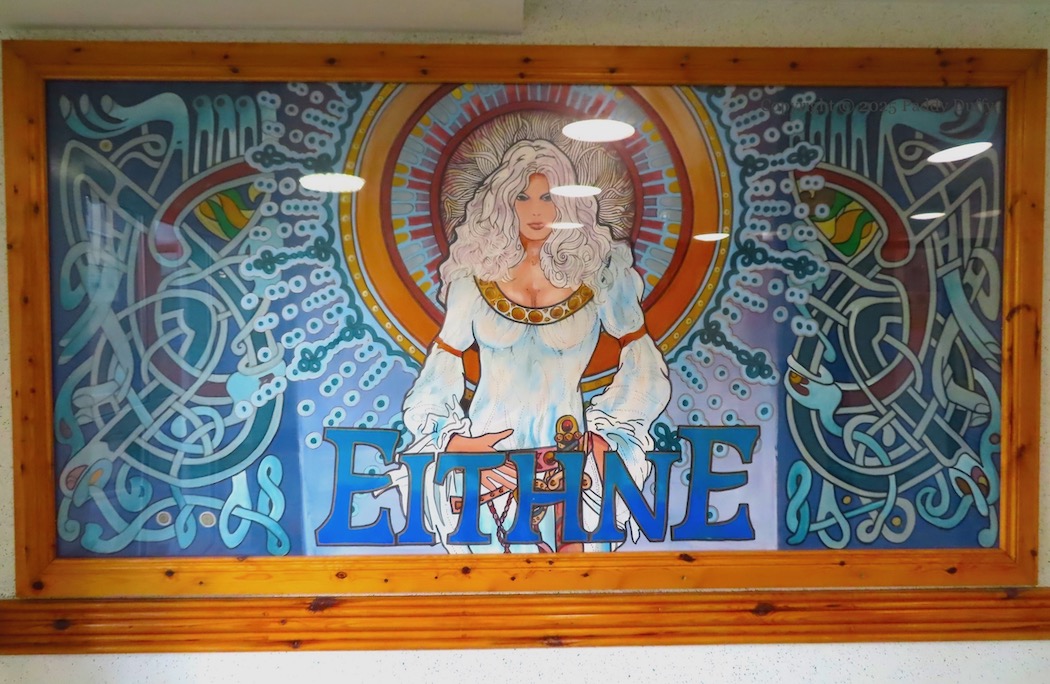
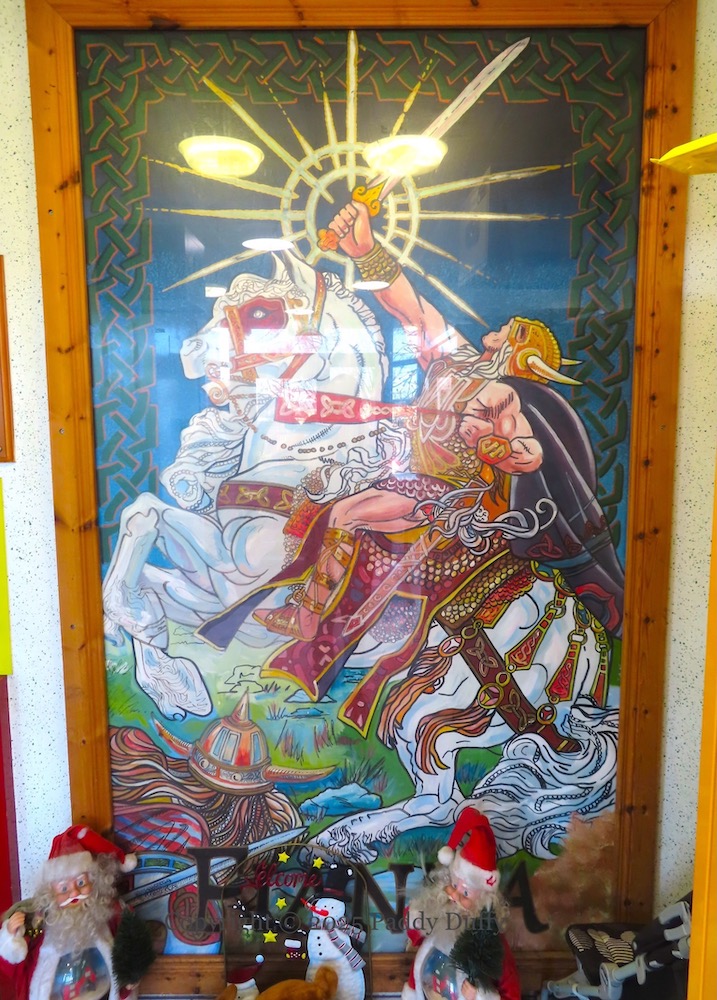
The seven “houses” (tower blocks) in the New Lodge are named after figures from Irish mythology: Méabh, Eıthne, Cú Chulaınn, Fınn, Na Fıanna, Gráınne, and Oısín. In the foyer of each house there is a painting of the eponymous hero, painted by Danny D and Marty L in imitation of Jim Fitzpatrick (as is explicitly acknowledged in the Gráınne painting, below): Eıthne is represented by Fitzpatrick’s Palu The Cat Goddess; Na Fıanna are represented by Lugh; Gráınne is represented by Fann. The bulls are by Finbarr O’Connor; Cú Chulaınn is inspired by the Oliver Sheppard statue in the GPO.
For the old names of the buildings, and the pairs of hunger-strikers painted on the tops of six of the seven towers, see New Lodge Flats.
“Fıonn Mac Cumhaıll gained fable knowledge after sucking his thumb which he burned while cooking the magical Salmon of Knowledge. He followed in his father Cumhall’s footsteps becoming captain of the Fıanna. His death at the Battle of Gabhra marked the beginning of the decline in the might of the Fıanna.”
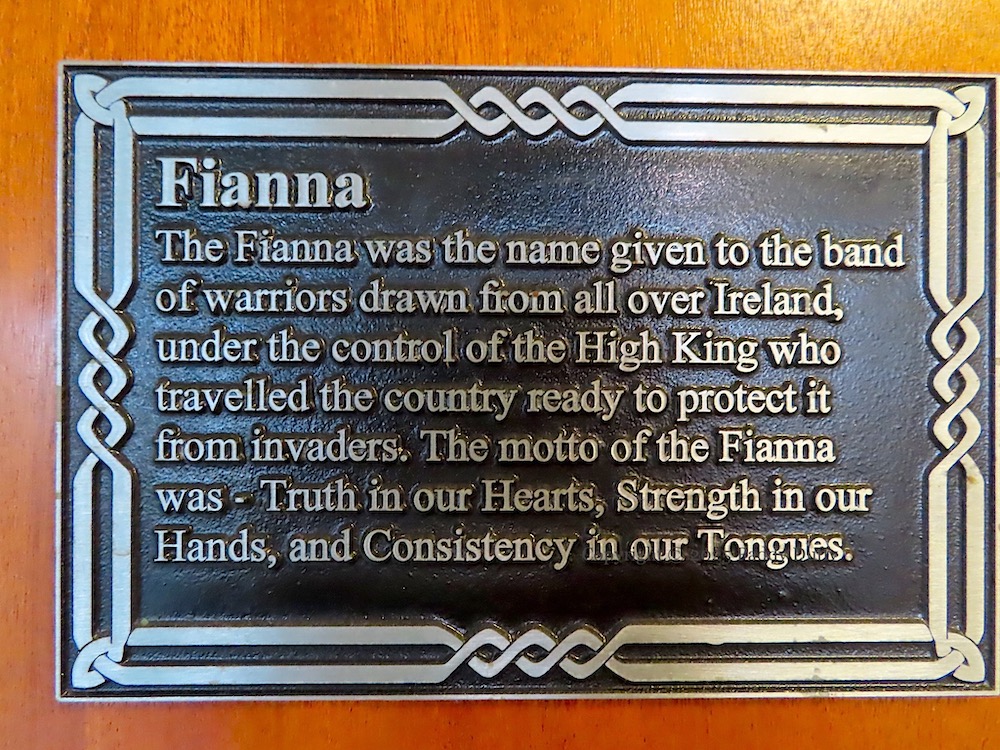
“The Fıanna was the name given to the band of warriors drawn from all over Ireland, under the control of the High King who travelled the country ready to protect it from invaders. The motto of the Fıanna was – Truth in our Hearts, Strength in our Hands, and Consistency in our Tongues.”
“Gráınne, daughter of Cormac Mac Art, High King of Ireland, betrothed to a grey-haired Fıonn Mac Cumhaıll but ran away with the handsome young Dıarmuıd before the marriage took place. She returned to marry Fıonn after Dıarmuıd’s death.”
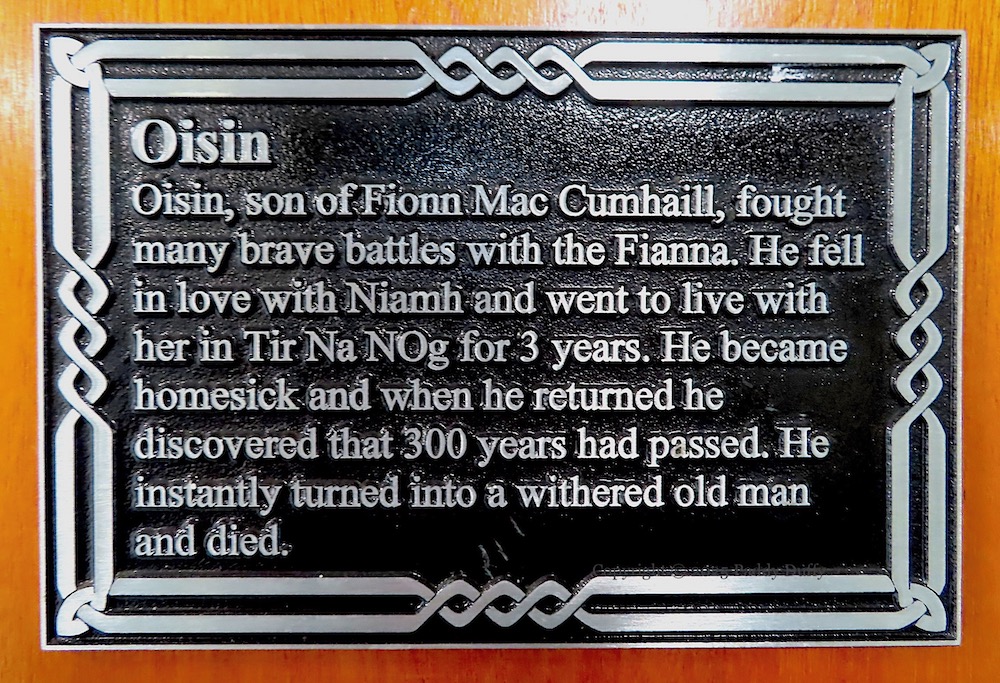
“Oısín, son of Fıonn Mac Cumhaıll, fought many brave battles with the Fianna. He fell in love with Nıamh and went to live with her in Tír Na nÓg for 3 years. He became homesick and when he returned he discovered that 300 years had passed. He instantly turned in a withered old man and died.”
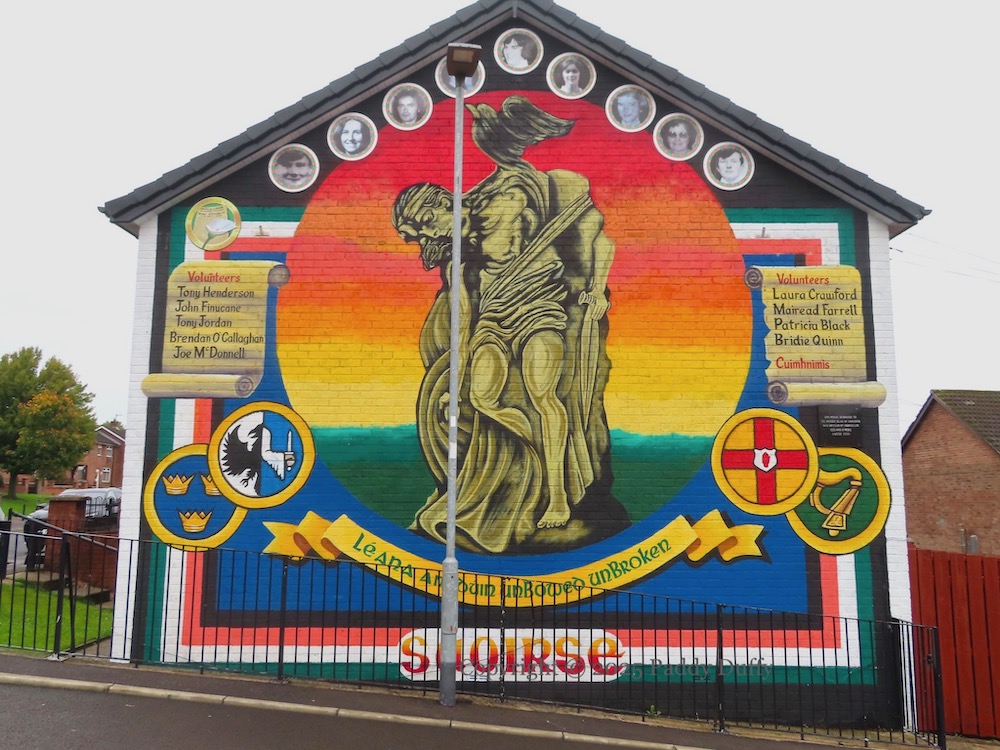
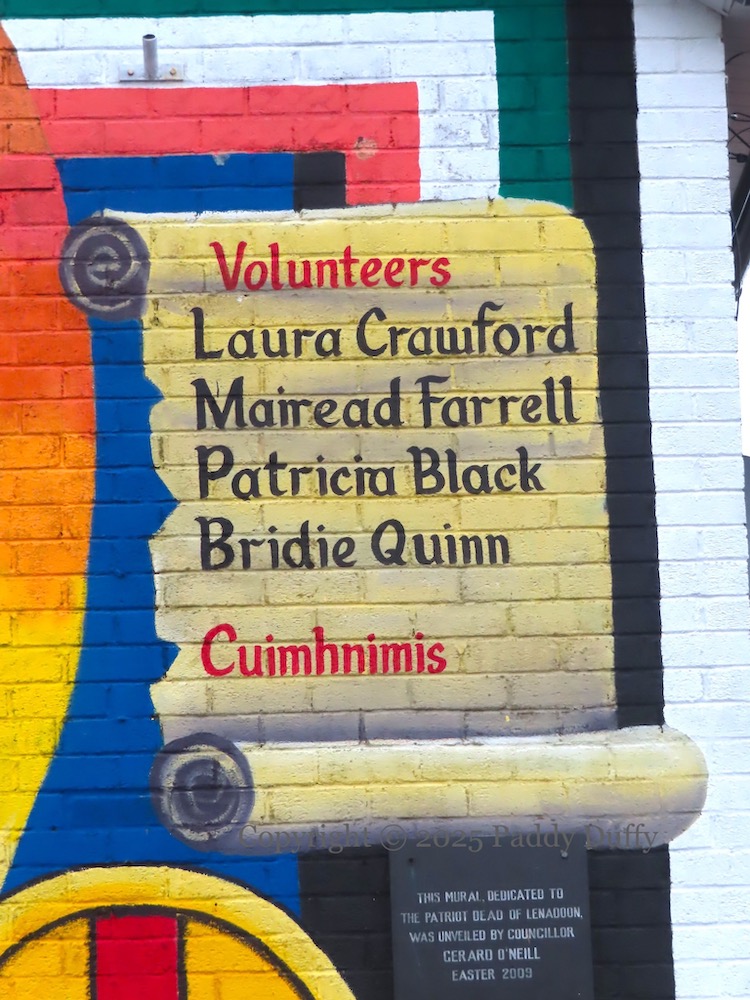
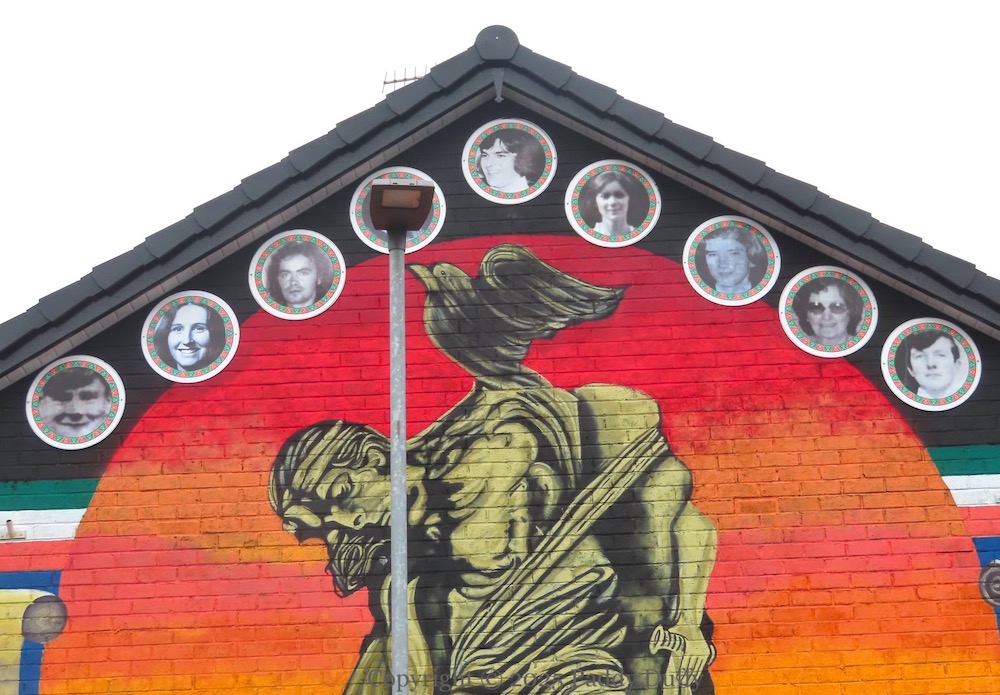
Oliver Sheppard’s statue of Cú Chulaınn dying – see the Cú Chulaınn Visual History page – memorialises nine IRA volunteers from the Lenadoon area, whose names are listed on the scrolls to each side and whose portraits appear in the apex: Tony Henderson, John Finucane, Brendan O’Callaghan, Joe McDonnell, Laura Crawford, Maıréad Farrell, Patricia Black, Bridie Quinn. Below the statue are the shields of the four provinces and the words “Léana An Dúın – unbowed, unbroken” and “saoırse” [freedom].
The mural dates back to 1996 (see T00160) and was repainted in 2009 (see M05134) and c. 2014 (see M11028, which includes a close-up of the plaque added in 2009.) In this version, nothing has changed in the composition of the mural and the photographic portraits and the Easter Rising centenary board have been retained.
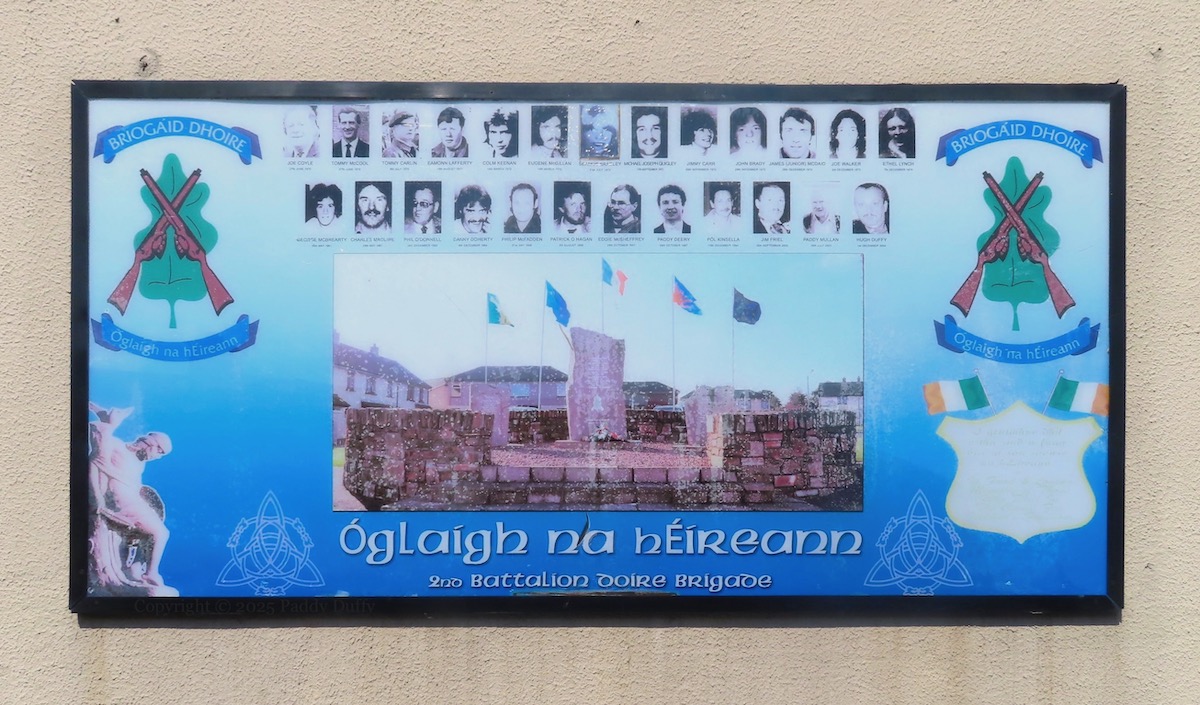
The Linsfort Drive (Creggan) memorial garden (see M02663 and M02775) is featured in the centre of this board of IRA volunteers from the 2nd battalion of the Derry Brigade. There are two similarly designed boards to the 1st battalion in Westland Street and in Lecky Road.
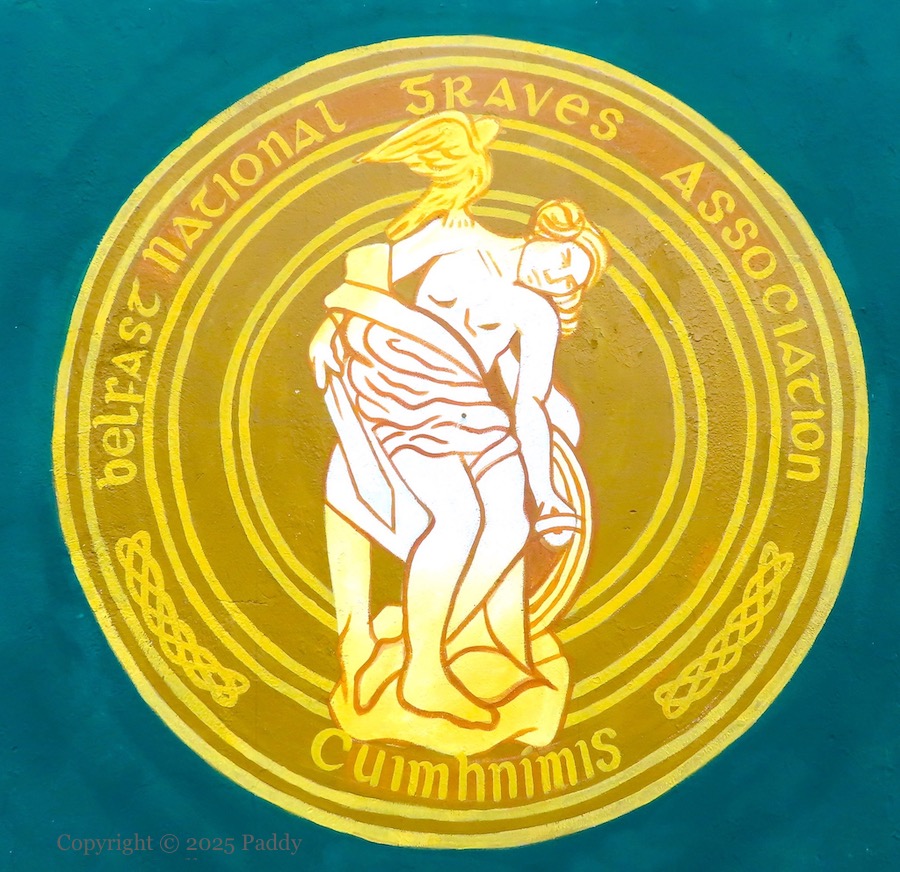
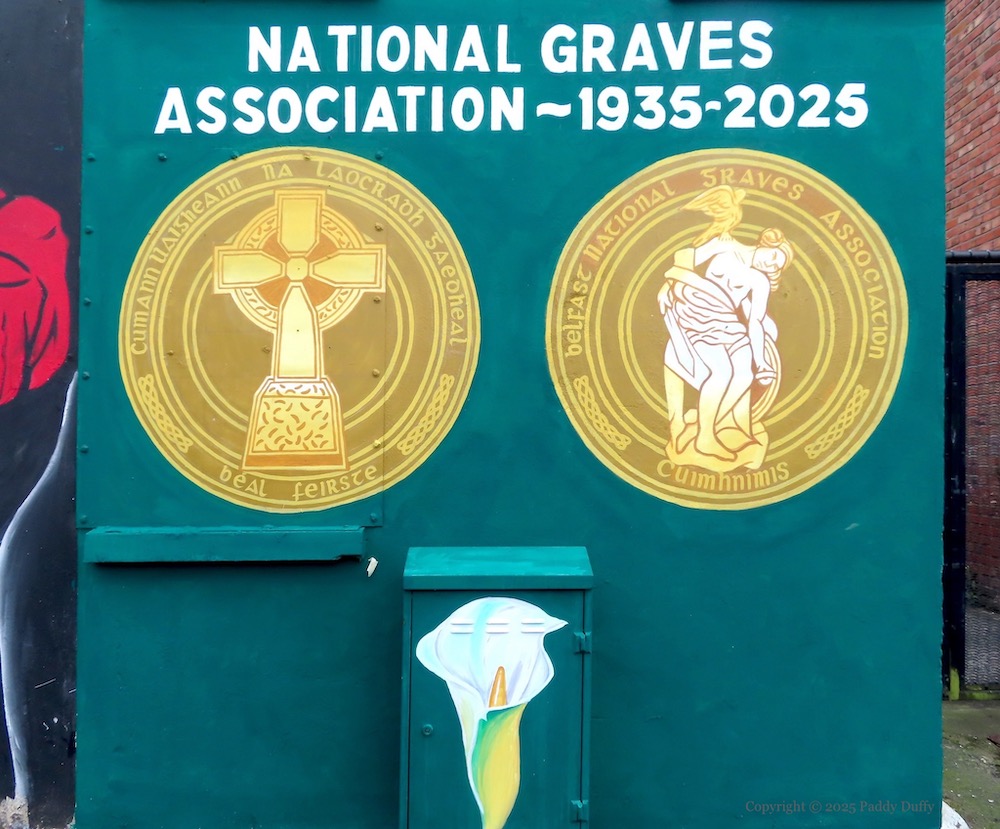
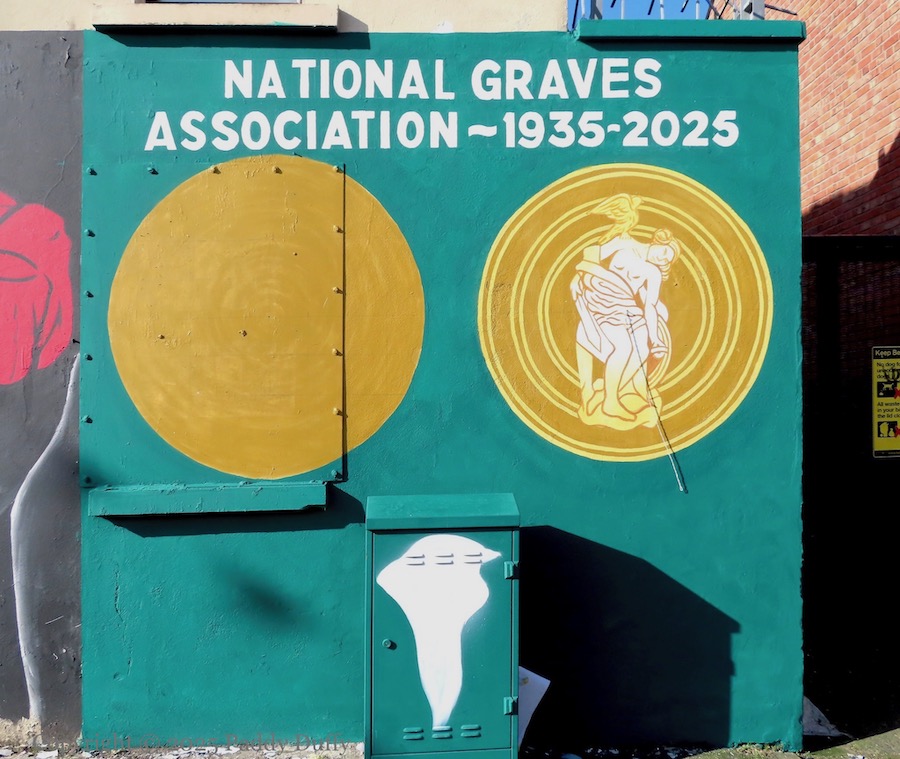
“Honour Ireland’s dead – wear an Easter lily”. This year (2025) is the ninetieth anniversary of the founding of Cumann Uaıgheann Na Laocradh Gaedheal, Béal Feırste (the National Graves Association, Belfast (Fb)) which maintains the graves of about 149 republicans in Milltown Cemetery (Belfast Media).
The graves under its care are marked with a red hand – for an example, see the grave of Joseph (Joe) Malone in Far Dearer The Grave Or The Prison.
This new mural, which features a Celtic Cross (emblem of the Association) and Cú Chulaınn (symbol of republican dead), is part (along with Free Palestine) of the side-wall next to Éırí Amach Na Casca. Easter Monday, this year, is April 21st.
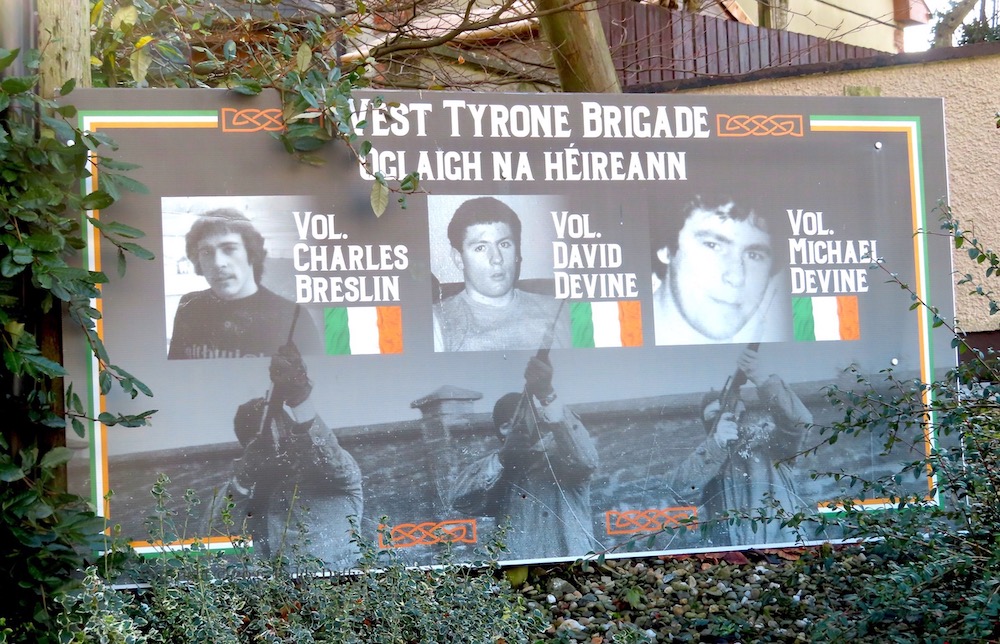
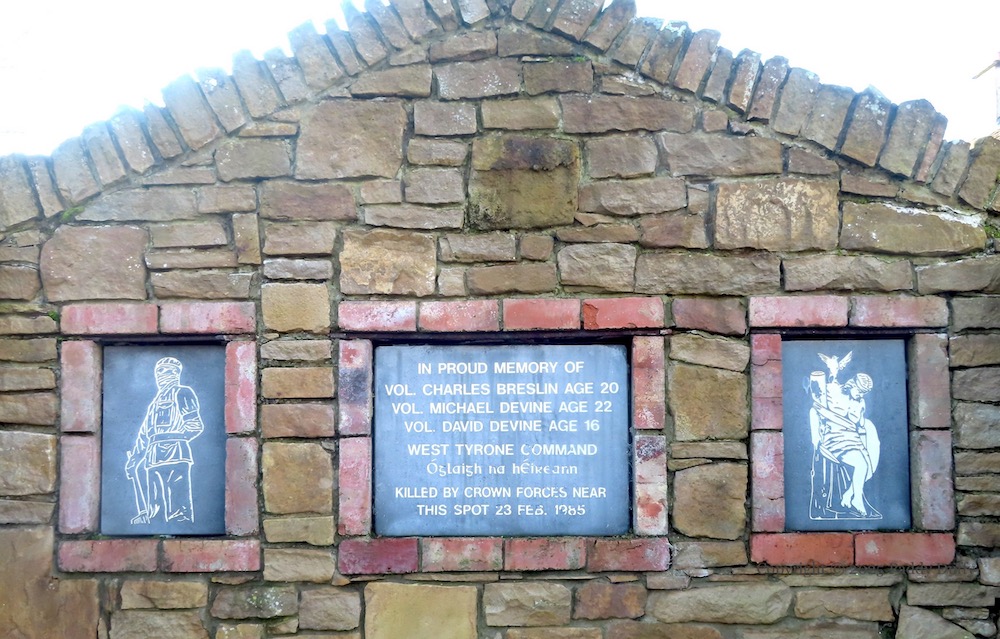
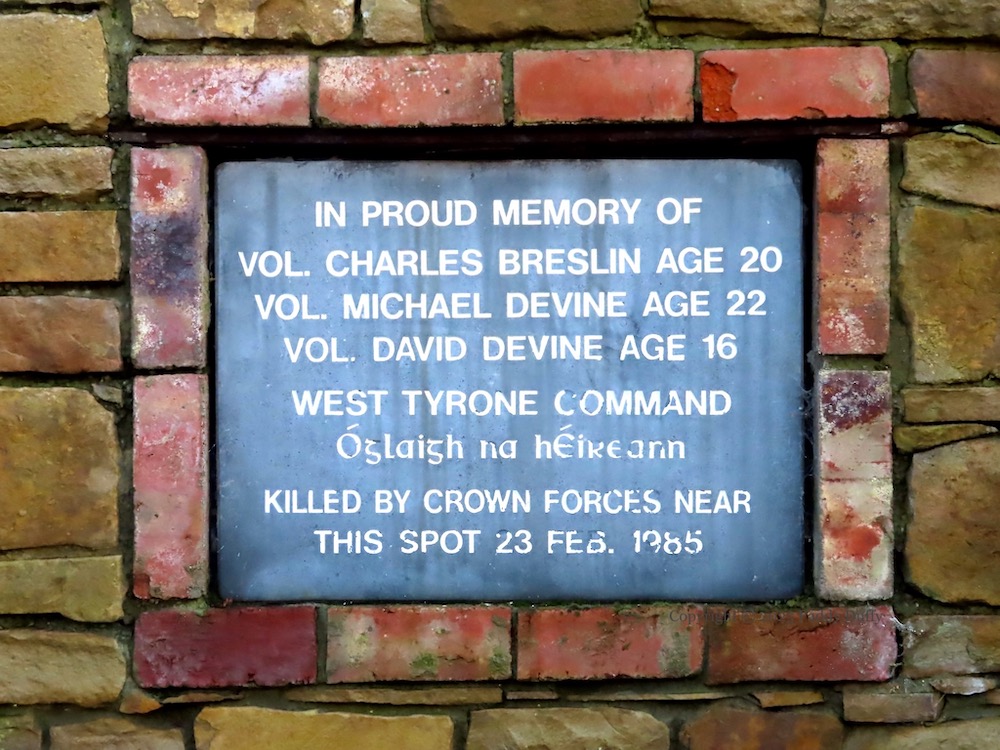
“West Tyrone Brigade, Óglaıgh Na hÉıreann. Vol. Charles Breslin, Vol, David Devine, Vol. Michael Devine”. The three were killed on February 23rd, 1985, in a hail of 100-200 SAS bullets, as they returned arms for an aborted mission to a dump near the Fountain area of Strabane; their families were later (2002) awarded compensation. (An Phoblacht | WP | UTv)
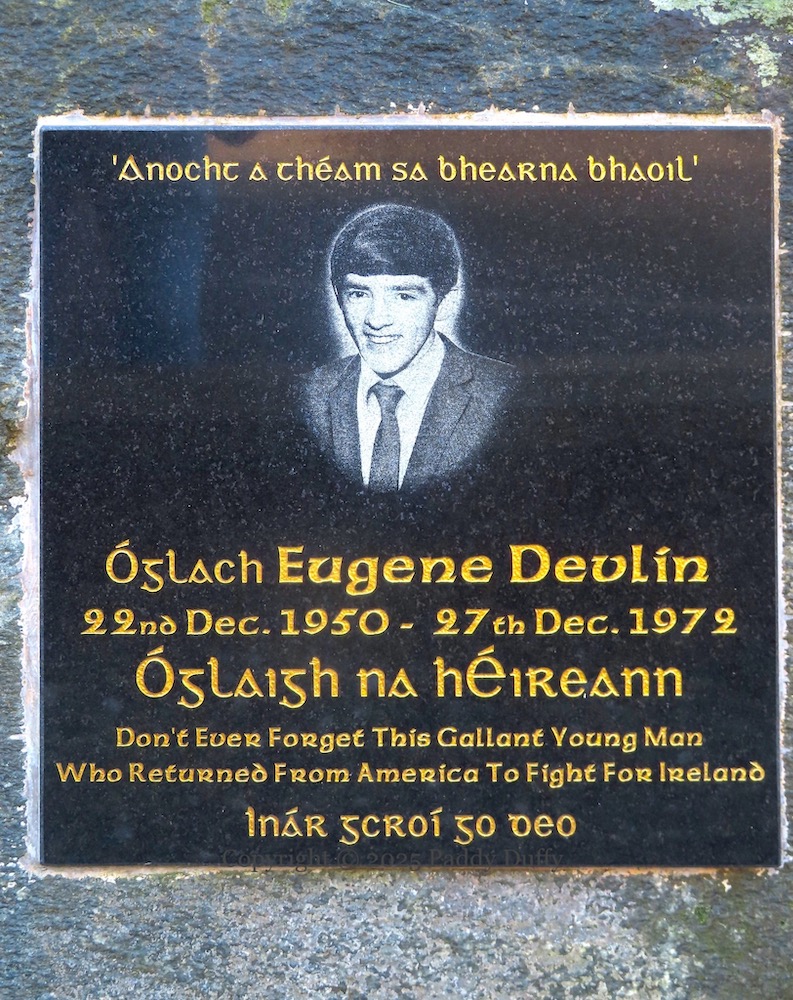
The board shown above is in the Fountain Street memorial garden, which centrally features a stone-wall enclosure to the trio. Individual stones have also been added to the garden, to Danny McCauley (TPQ | An Phoblacht), Tobias Molloy (An Phoblacht), and Eugene Devlin (An Phoblacht) (shown below). The local SF cumann is named after Molloy/Devlin/McCauley (Fb).
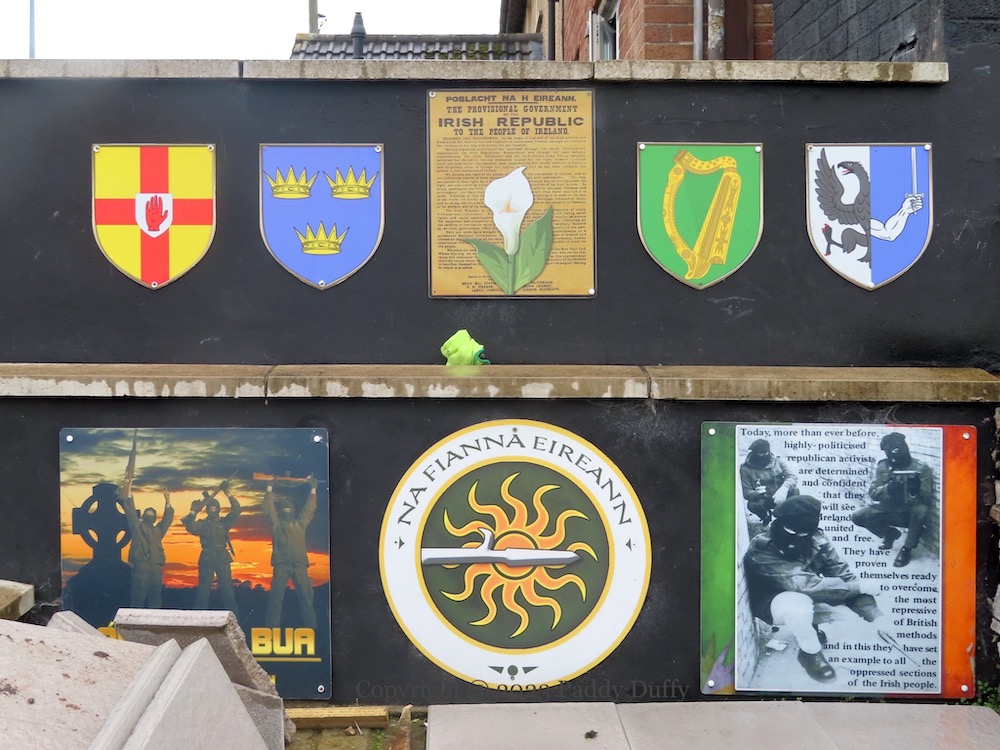
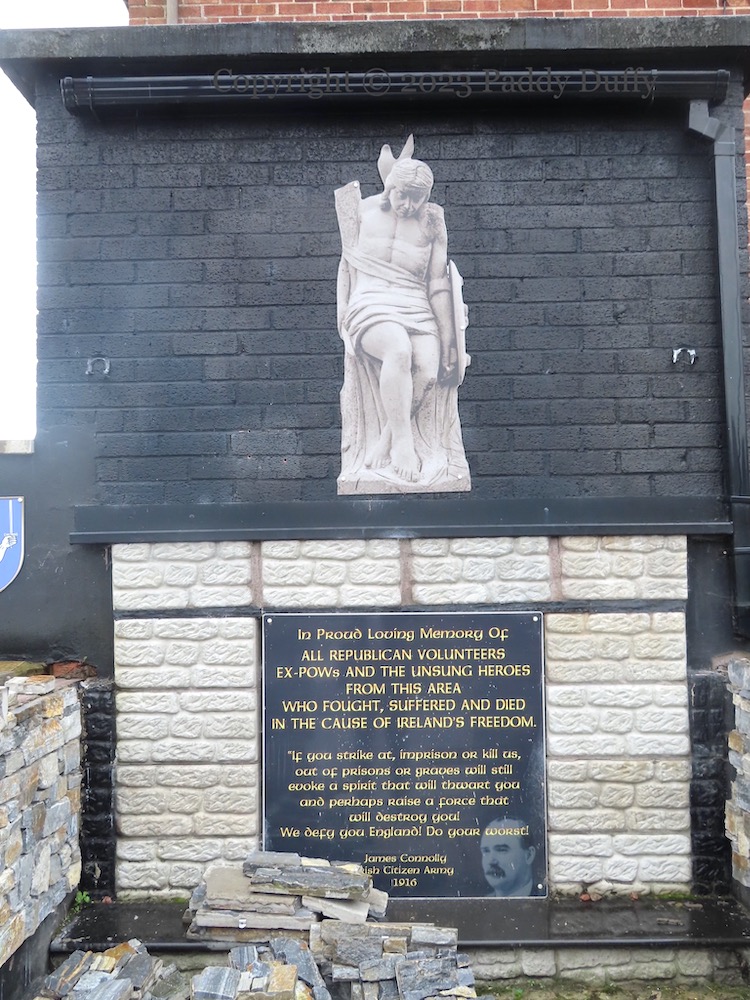
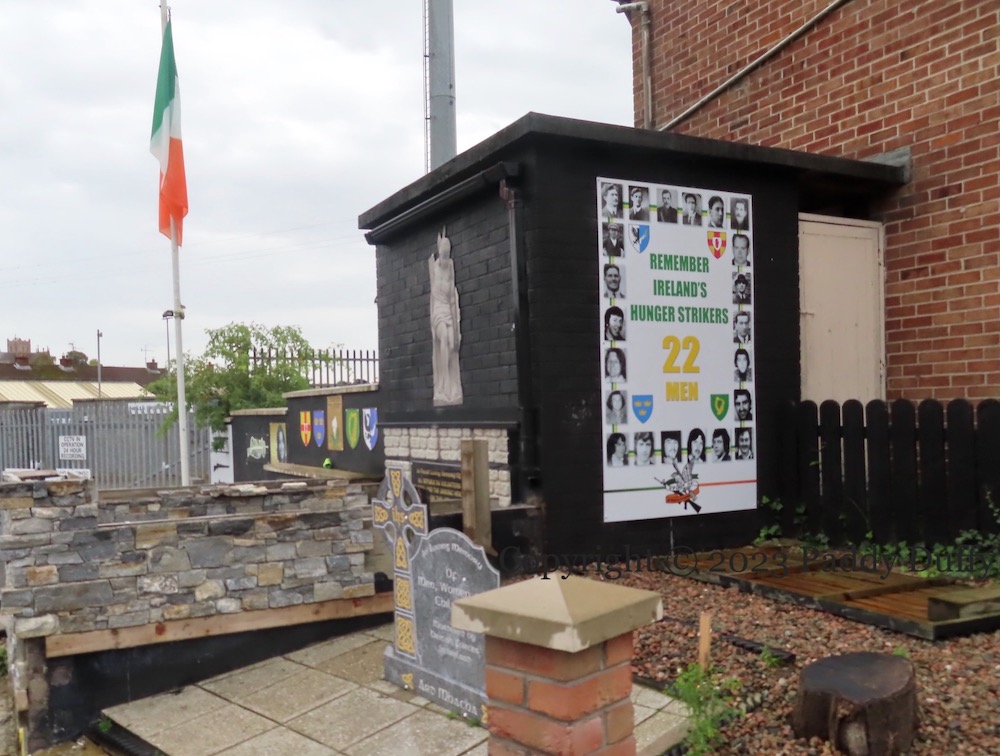
There is a memorial garden to the history of Irish resistance at the entrance to the Athletic Grounds in Armagh. From left to right, the images presented here show:
“More than 800 years of Irish resistence” – a sword for the Norman invasion under Strongbow, a pike for the 1798 and 1803 rebellions, a bolt-action rifle for the Easter Rising of 1916, and an assault rifle for the Troubles;
Cumann Na mBan, Mairéad Farrell and republican women who made “the supreme sacrifice”;
The Proclamation, Provisional IRA and Na Fianna;
The dying Cú Chulainn and a plaque “in proud and loving memory of all republican volunteers, ex-POWs and the unsung heroes from this area who fought, suffered and died in the cause of Ireland’s freedom, with a quote from James Connolly: ‘If you strike at, imprison or kill us, out of prisons or graves will still evoke a spirit that will thwart you and perhaps raise a force that will destroy you! We defy you England! Do your worst!”;
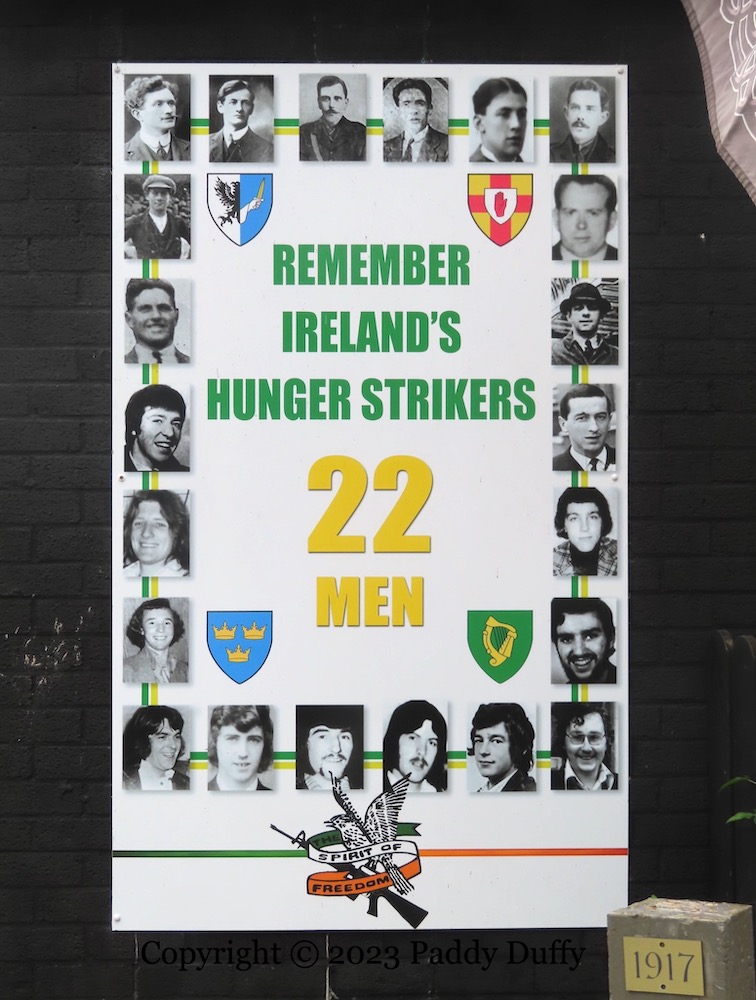
“Remember Ireland’s hunger strikers – 22 men” – the ten 1981 hunger strikers and Thomas Ashe, Terence MacSwiney, Michael Fitzgerald, Joe Murphy, Joseph Whitty, Andy O’Sullivan, Denny Barry, Tony D’Arcy, Jack McNeela, Seán McCaughey, Michael Gaughan, Frank Stagg;
A stone “in loving memory of men, women and children murdered by British forces in Ireland.”
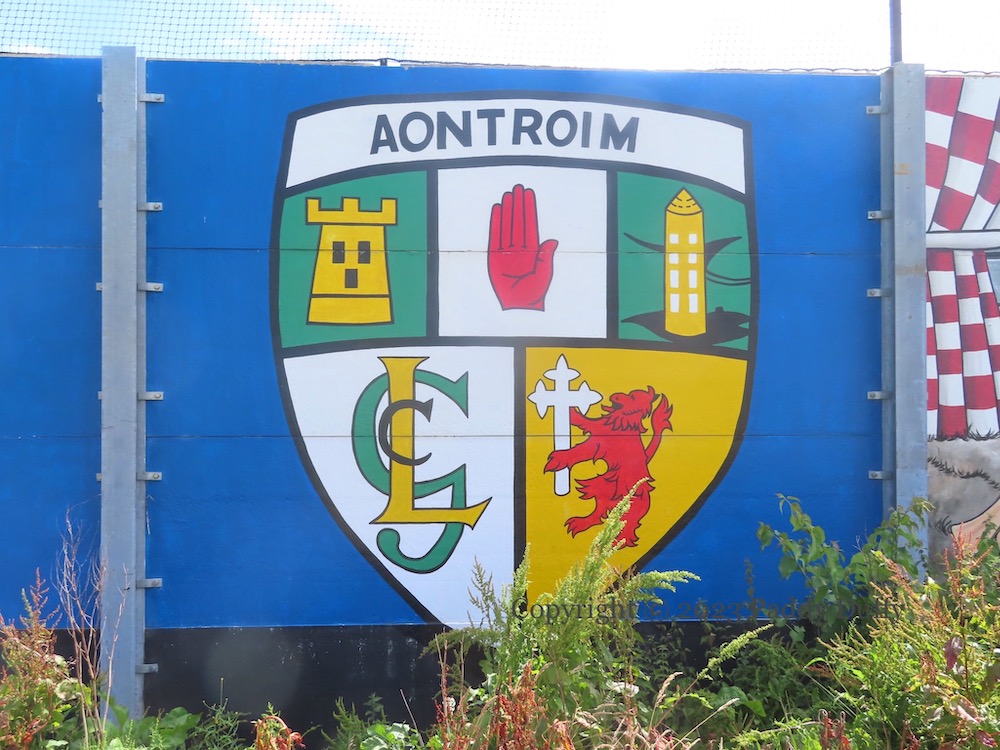
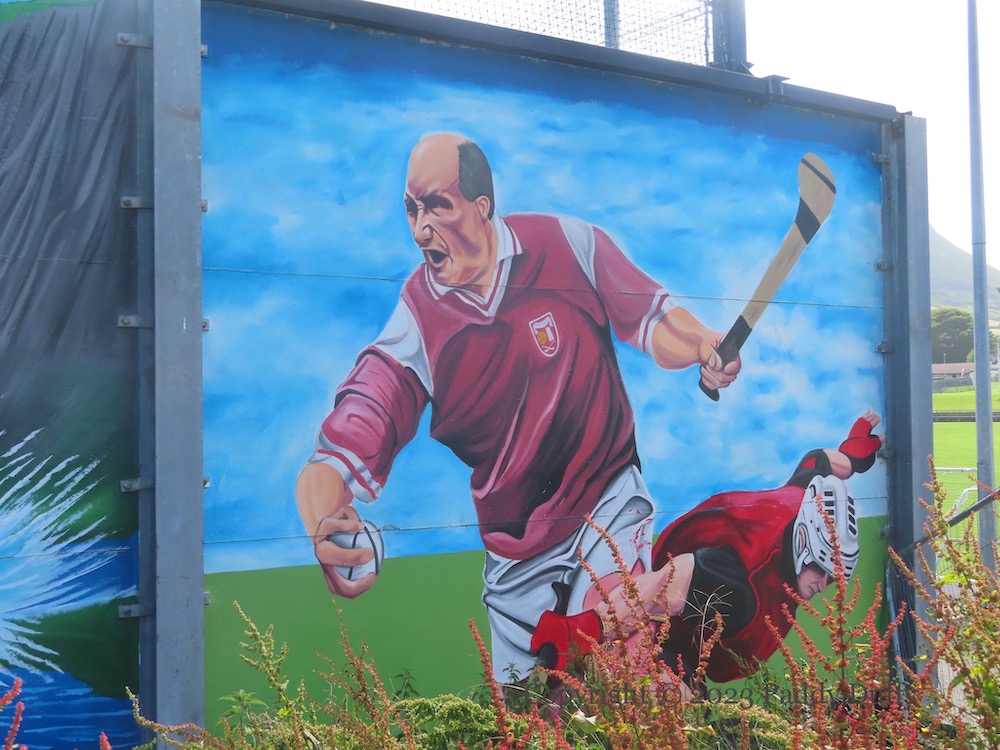
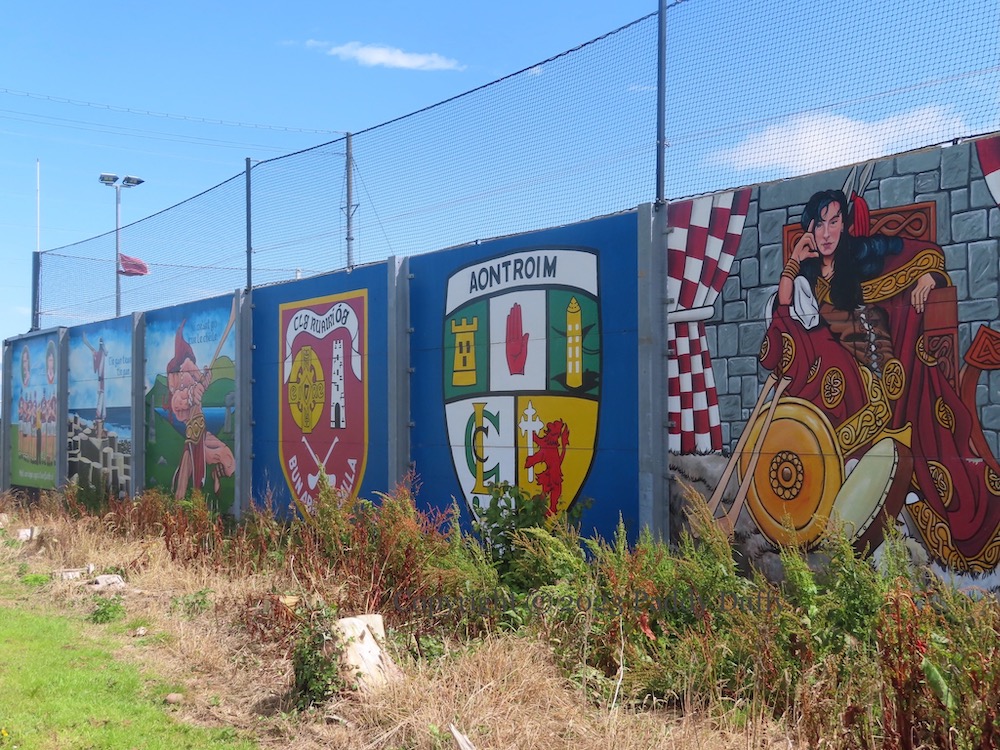
The two laochra featured in the first panel (above) are Danny McNaughton and John Darragh, while GAA hall-of-famer Terence “Sambo” McNaughton is featured in the final panel (BBC | GAA). Also included are Finn MacCool (on Giant’s Causeway), Setanta/Cú Chulaınn, and Queen Meadhbh – the latter two are in the style of Jim Fitzpatrick – the first is based on Fitzpatrick’s Hurling Match and the second takes Leyendecker’s painting of Maeve (WP) and renders it in Fitzpatrick’s style, complete with club-coloured drapes.
Coast Road, Cushendall at the grounds of Ruaırí Óg CLG (web).
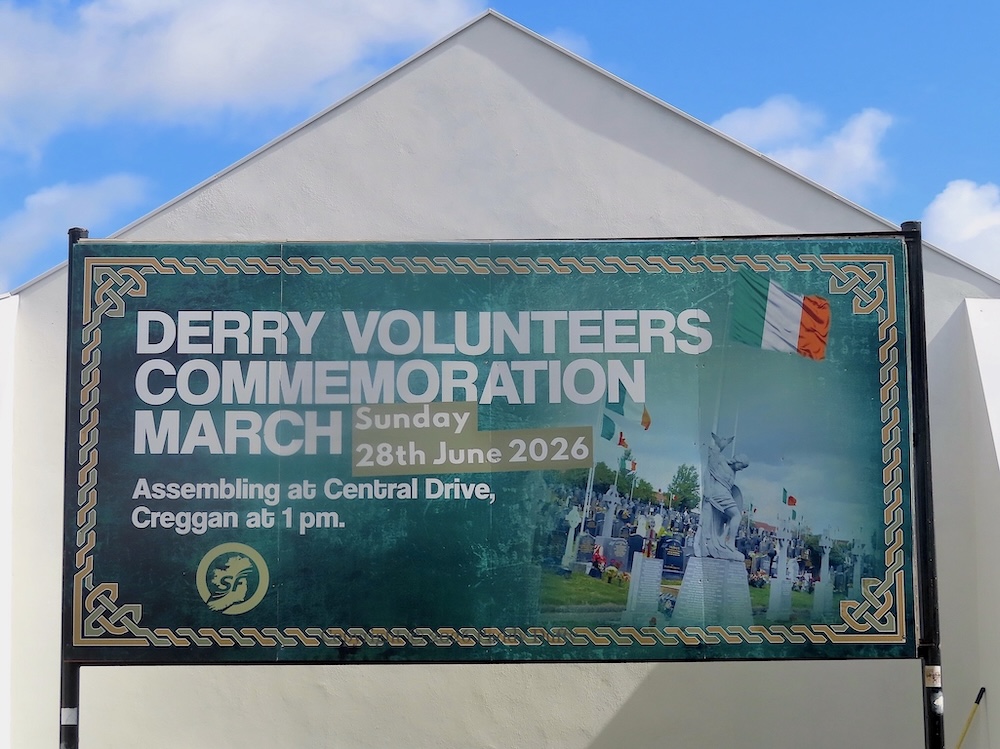
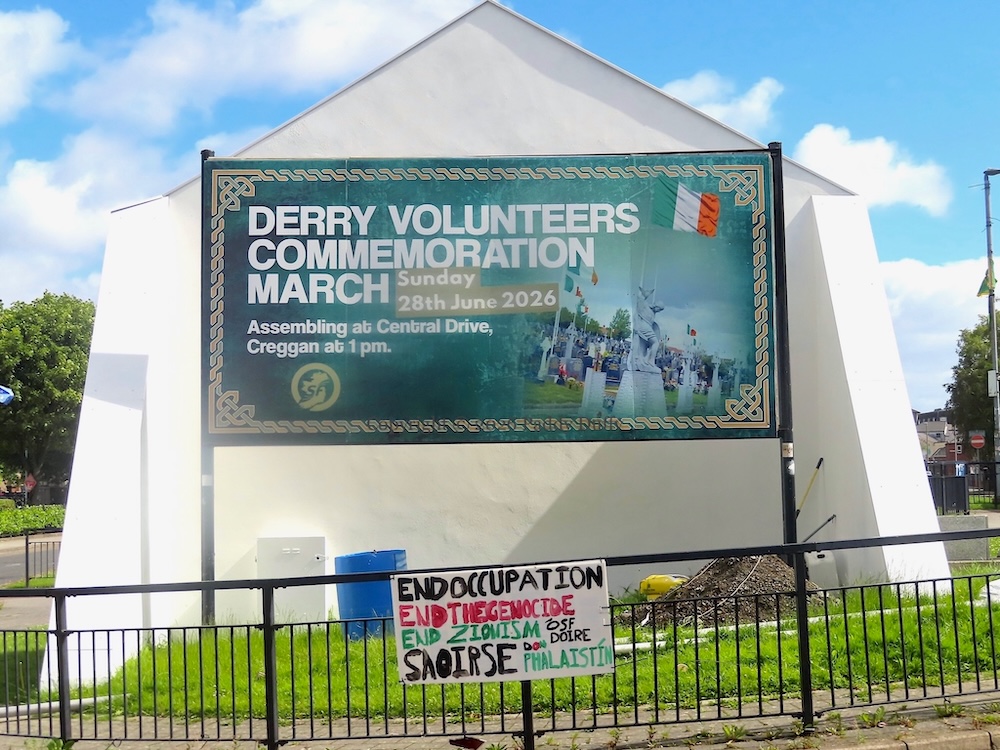
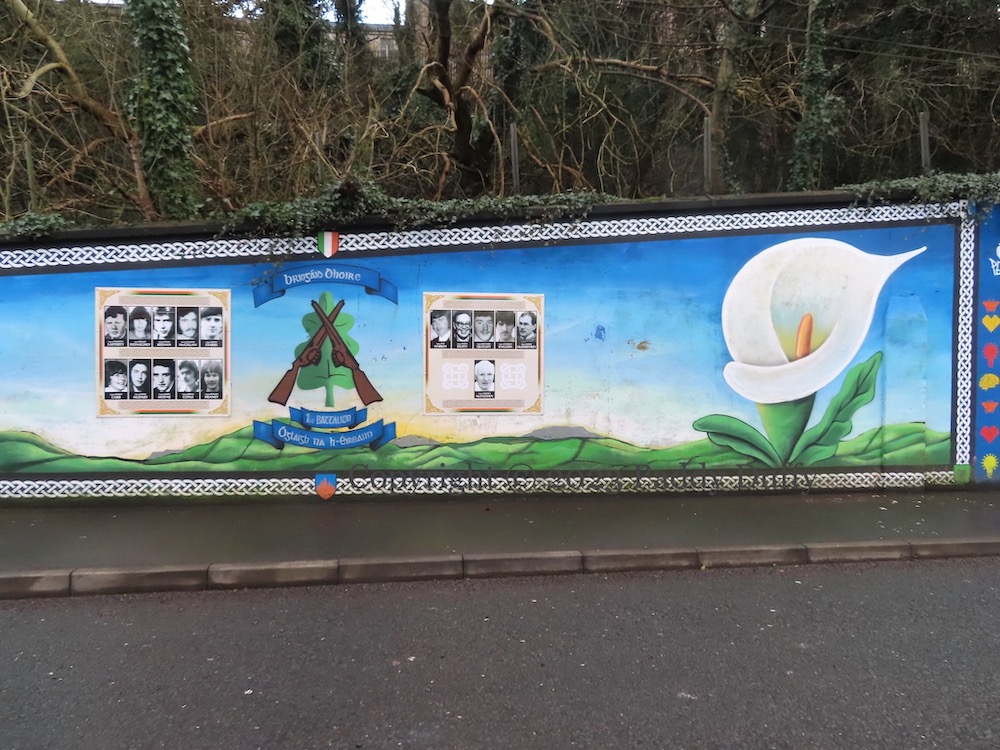
The Provisional IRA emerged from a split in the IRA in the wake of sectarian unrest in 1969. The Derry battalion became the Derry Brigade (An Brıogáıd Dhoıre) in 1972 when the number of people wishing to become volunteers swelled in the aftermath of Bloody Sunday. It is estimated that 1,000 Derry Catholics (2% of the population) were imprisoned for IRA activities in the 70s and 80s. (WP)
The image above shows a mural with Cú Chulaınn (Visual History), an oak leaf with crossed rifles, and a lily. Two boards commemorate volunteers from the 1st battalion. The sixteen portraits are of Lafferty, Donaghey, Keenan, McGillan, Starrs, / Carr, McDaid, Moyne, Coyle, Heaney, // Harkin, Duffy, Quigley, English, McSheffrey, / McFadden.
Ulster’s defenders, past and present, from Cuchulainn “Ancient defender of Ulster from Gael attacks”, via the 1893 UDU and WWI soldiers memorialised in the towers at Messines and Thiepval, to the modern UDA/UFF: “In memory of the officers and volunteers of A. Coy. UDA/UFF West Belfast Brigade who unselfishly dedicated their lives in defence of their country.”





















 Paddy Duffy Collection
