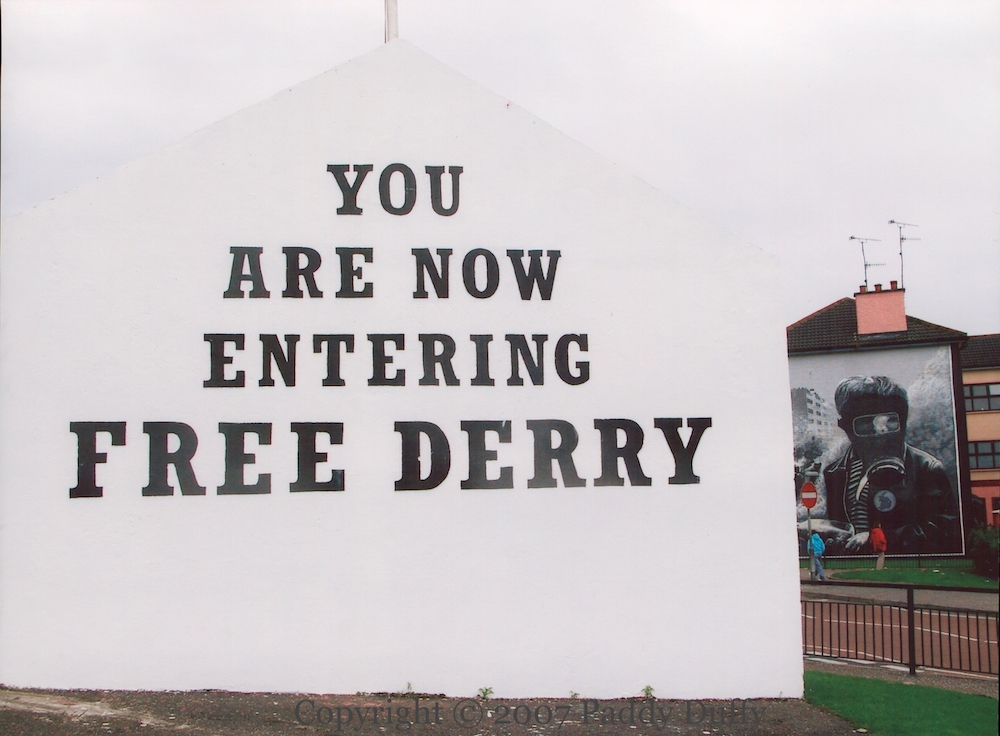
Since 2004, this size and style of lettering has been used on Free Derry Corner. The wall is sometimes painted in other colours and other designs. For a history, see the Visual History page for the front of the wall; there is also a page for the rear.
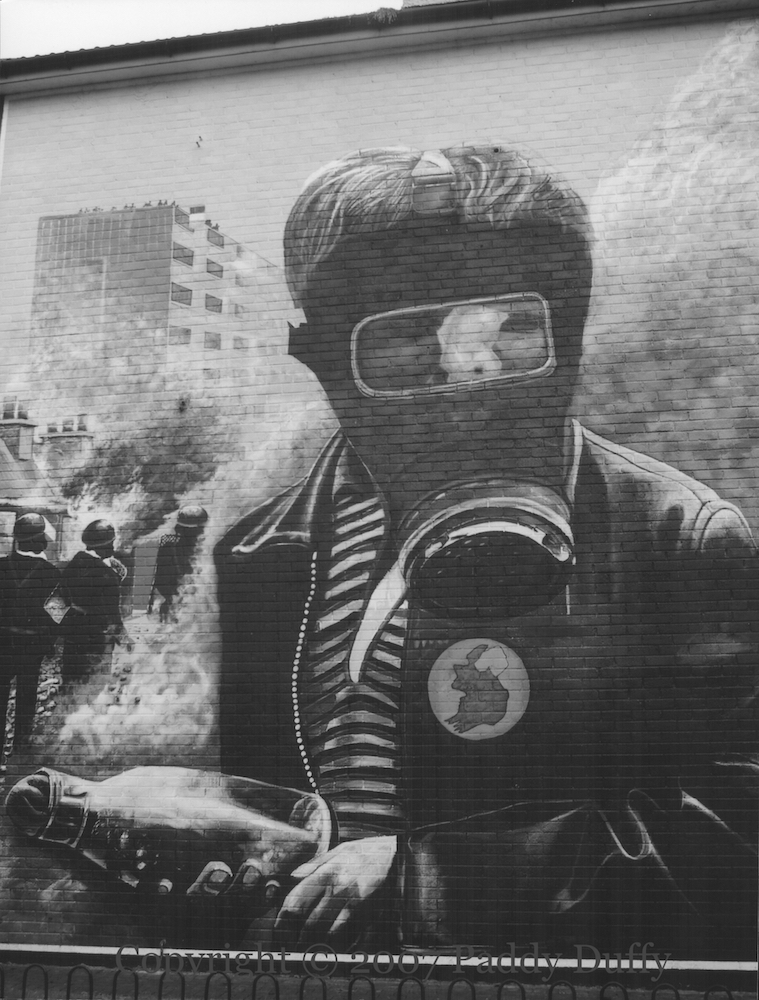
The Petrol Bomber was first painted by the Bogside Artists in 1994 and modified a number of times in the first few years, to change the badge to “No RUC” and to a green ribbon.
Part of The People’s Gallery (Visual History) along Lecky Road and Rossville Street in Derry’s Bogside.
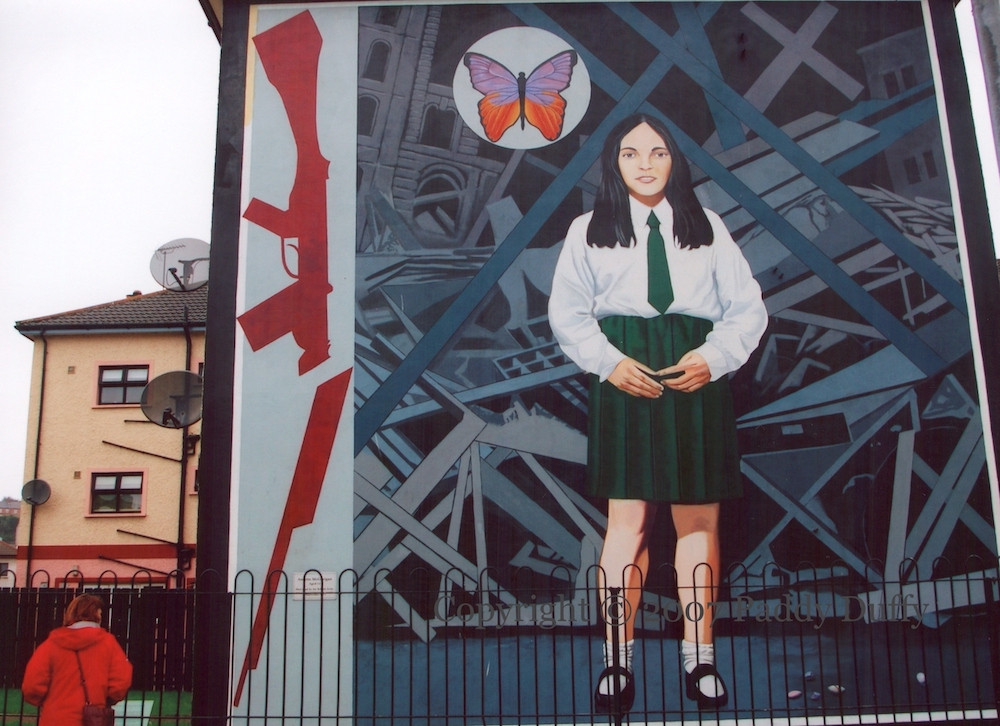
The mural to the first child killed in the Troubles, Annette McGavigan, entitled The Death Of Innocence, was repainted by the Bogside Artists in 2006. On account of the success of the peace process and IRA decommissioning of weapons, the rifle on the left is broken.
“Years from now they will ask you where you were when your comrades were dying on hungerstrike. Shall you say you were with us or shall you say that you were conforming to the very system that drove us to our deaths[?]” INLA (sign the light-pole as well as the flags and red star in the mural) volunteer Patsy O’Hara, from Derry, joined the hunger strike on the same day as Raymond McCreesh (March 22nd) and died, 61 days later, later in the same day (May 21st, 11:29 p.m.) as him (2:11 a.m.).
A Christian cross is added to the Bloody Sunday memorial mural in Westland Street, Derry. A version without a cross was seen previously in 1999 and 2004. (The latter gives the names of the victims.) There is an oak leaf – symbol of Derry – for each of the fourteen victims.
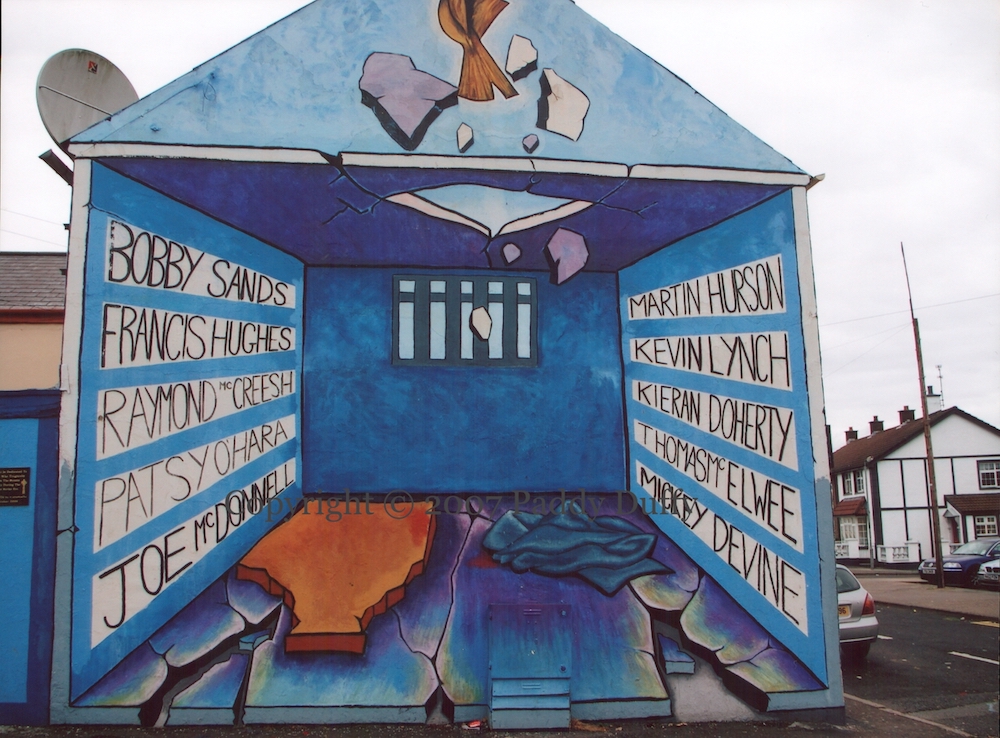
A lark (rather than a dove) bursts through the ceiling of a H-Block cell lined with the names of the ten deceased 1981 hunger strikers. “This mural is dedicated to all those who tragically died on the streets of Derry during the hunger strike era. Suımhneas Dé dá nanamacha. 3rd October 2006.”
These paintings are on boards on the wall around the Cathedral Youth Club in the Fountain.
Above are two boards (on the side) showing the Apprentice Boys crying “No surrender!” and the breaking of the boom that ended the siege. A 2007 entry in the Peter Moloney Collection shows three additional panels to the right, also relating to Londonderry.
“‘My forefathers were … the men who had followed Cromwell and who shared in the defence of Derry, and in the victories of Aughrim and the Boyne.’ – President Theodore Roosevelt, 20th US president, 1901-1904.” The “shutting of the gates” of Derry is represented in the bottom left.
The quote is derived from Volume 1, Chapter 5, of Roosevelt’s The Winning Of The West (available at Project Gutenberg). Roosevelt, however, is describing the forefathers of the Scotch-Irish, rather than his own forefathers, who, as the name suggests, were Dutch.
He writes, “The Presbyterian Irish were themselves already a mixed people. Though mainly descended from Scotch ancestors—who came originally from both lowlands and highlands, from among both the Scotch Saxons and the Scotch Celts—many of them were of English, a few of French Huguenot, and quite a number of true old Milesian Irish extraction. They were the Protestants of the Protestants; they detested and despised the Catholics, whom their ancestors had conquered, and regarded the Episcopalians by whom they themselves had been oppressed, with a more sullen, but scarcely less intense, hatred. They were a truculent and obstinate people, and gloried in the warlike renown of their forefathers, the men who had followed Cromwell, and who had shared in the defence of Derry and in the victories of the Boyne and Aughrim.”
Some sources claim that an ancestor(s) on his mother’s side emigrated from Gleno, Co Antrim in 1729, but this seems to be her great-great-grandfather James, who was a Scot (WP) and appears to have emigrated directly from Scotland, specifically Baldernock, in 1728 or 1729 (WikiTree | Friends Of Bulloch). The search for a connection continues, according to Irish Central.
This mural is one (and perhaps the first to be painted) in the series “From pioneers to presidents”. For more such murals, see the Visual History page about Ulster-Scots murals.
“In loving memory South Belfast Brigadier John McMichael, South Belfast UFF commander Joe Bratty.” Listed on the tombstones are Steven Audley 17 Mar 91, Harry Black 30 Sep 92, Jim Kenna 25 Jul 72, Frankie Smith 31 Jan 73, William Kingsberry 13 Nov 91, Stephen Kingsberry 10 Mar 97, Ernie Dowds 10 Oct 95, Sammy Hunt 5 Sep 76, Raymie Elder 31 Jul 94, William Hamilton 9 Sep 94, Tommy Morgan 29 Aug 94.
A Visual History page details the various appearances of Eddie The Head in his guise as a Red Coat soldier-cum-UDA volunteers. In this Village Eddie, he carries an assault rifle and wears a UDA skull-cap, but, as in the Iron Maiden album cover, is trailed by the Grim Reaper. For the “reaper come to call” verse added to the right, see M02487.
“Village, Donegall Rd, Ormeau Rd, Roden St, Lisburn Rd, Sandy Row” – South Belfast A battalion




 Paddy Duffy Collection