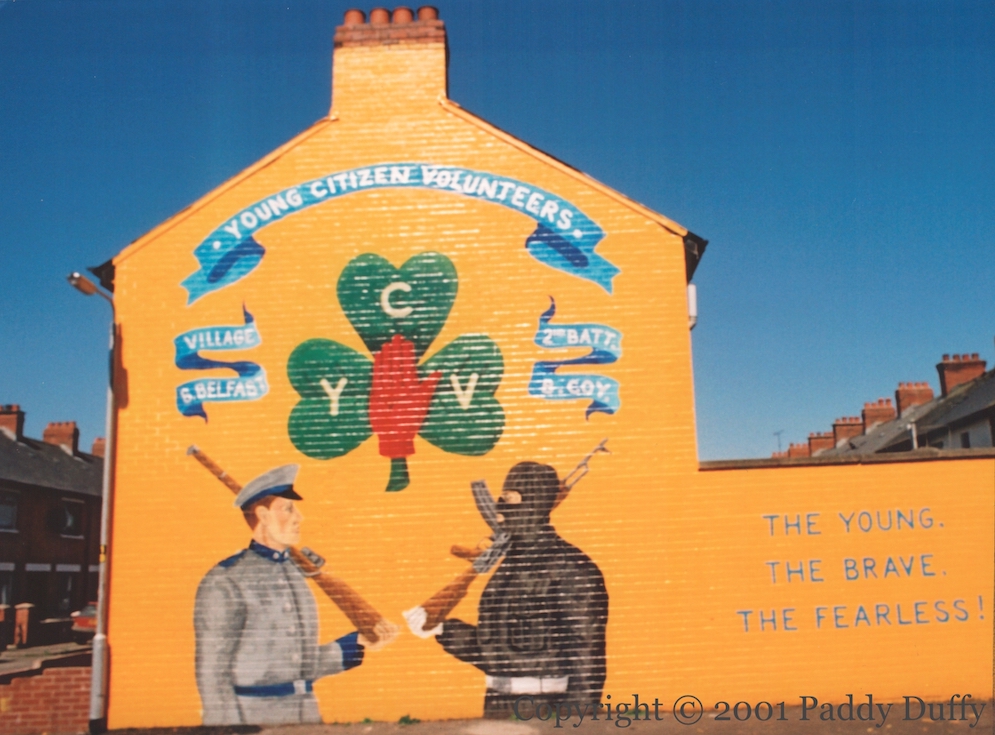
“Village, south Belfast, 2nd battalion, B company.” Young Citizen Volunteers of both the Home Rule (1912) and Troubles periods are shown shouldering rifles.
Broadway, Village, south Belfast
Click image to enlarge
Copyright © 2001 Paddy Duffy
T00636
“Village, south Belfast, 2nd battalion, B company.” Young Citizen Volunteers of both the Home Rule (1912) and Troubles periods are shown shouldering rifles.
Broadway, Village, south Belfast
Click image to enlarge
Copyright © 2001 Paddy Duffy
T00636
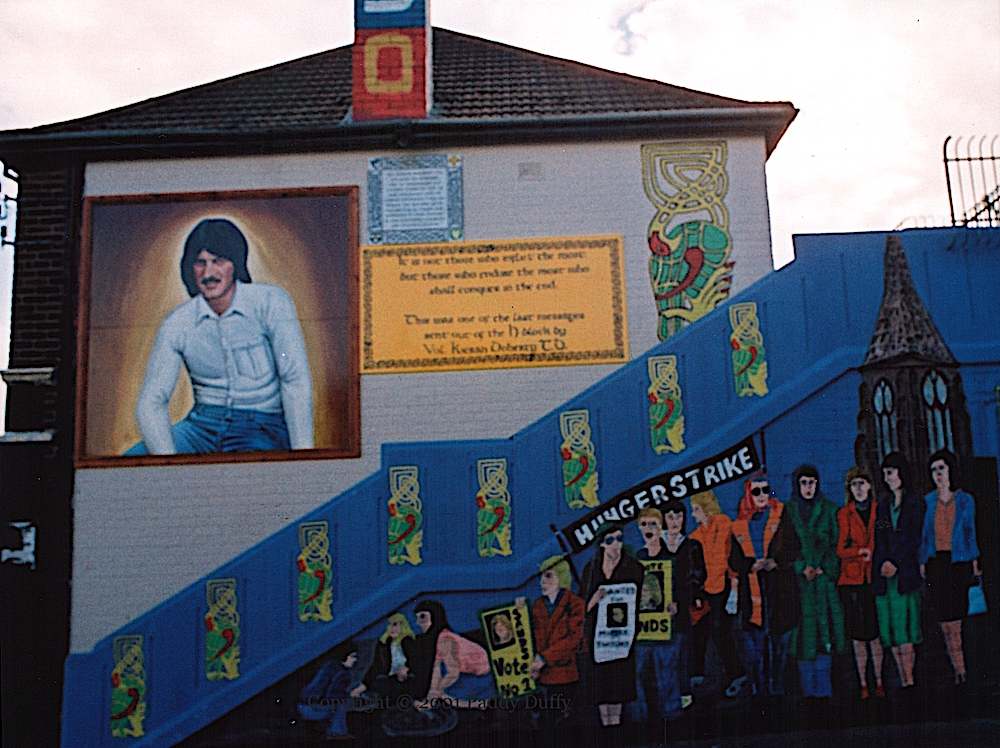
Kieran Doherty was elected TD (Teachta Dála) for Cavan-Monaghan three weeks into his 1981 hunger strike. He held the position for two months, until he died on August 2nd. The portraits, plaques, and mural of marchers are in his home area of Andersonstown. The words “It is not those who inflict the most, but those that can endure who shall conquer in the end” is an echo of Terence MacSwiney, whose hunger strike in 1920 lasted 74 days, one more than Doherty’s.
The chimney retains the “150” from the previous mural about the Great Hunger.
Painted by Lucas Quigley in Slemish Way, Andersonstown, west Belfast
Click image to enlarge
Copyright © 2001 Paddy Duffy
T00491
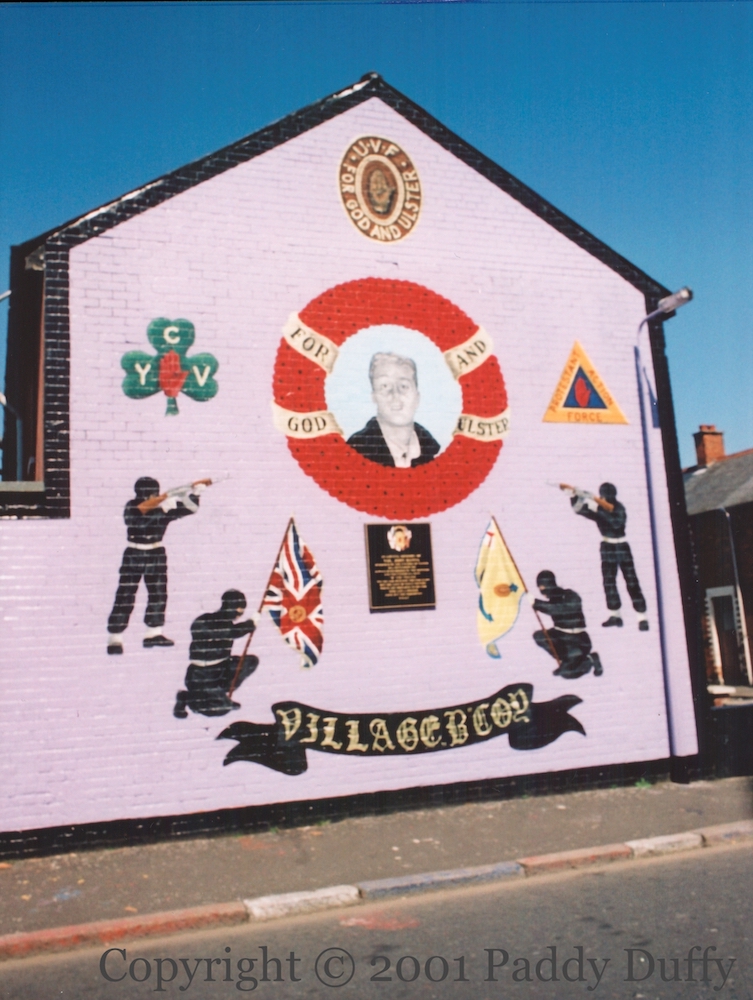
UVF volunteer John Hanna was 19 years old when he was killed by “the enemies of Ulster” (the IRA) at his home on Donegall Road in the Village. The kneeling volunteer on the left carries a WWI regimental flag, connecting the modern UVF to the Ulster Volunteers.
The plaque at the centre of the mural reads, “In loving memory of Vol. John Hanna, murdered by the enemies of Ulster 10th September 1991. Always remembered by the offices and volunteers of 2nd Batt. “B” Coy Village. Its [sic] not for riches nor for glory but the love of one’s country which [we] are prepared to die for. Here lies a soldier. Gone but not forgotten. FGAU.”
Broadway, Village, south Belfast
Click image to enlarge
Copyright © 2001 Paddy Duffy (no date given)
T00638
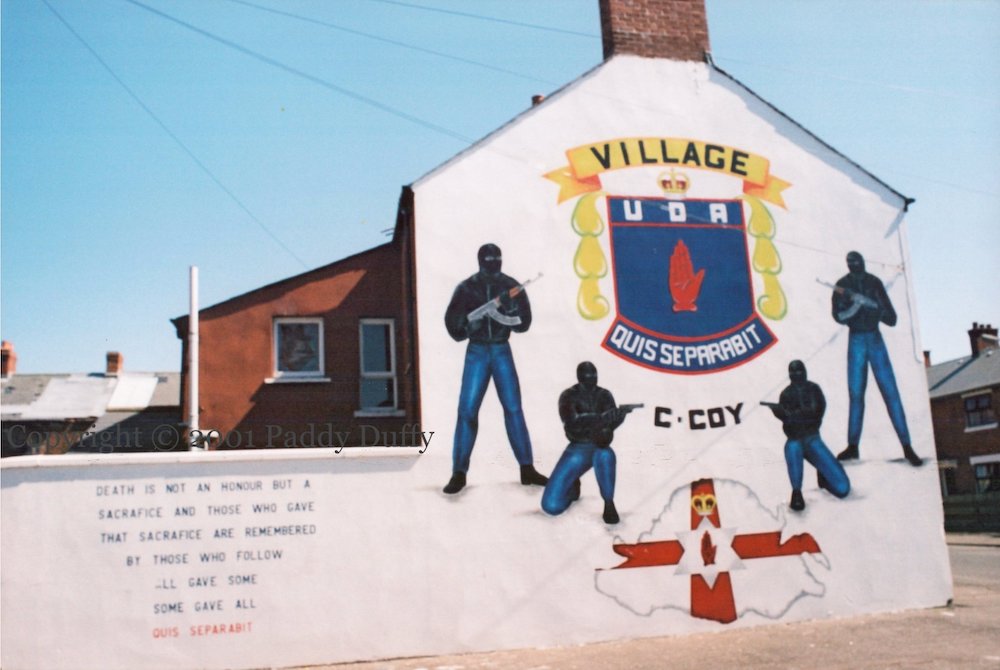
“Death is not an honour but a sacrafice [sic] and those who gave that sacrafice [sic] are remembered by those who follow. All gave some, some gave all. Quis separabit.” Village UDA C company volunteers in balaclava pose with assault rifles around an Ulster Banner in the shape of Northern Ireland.
Rockview Street, south Belfast
Click image to enlarge
Copyright © 2001 Paddy Duffy (no date given)
T00789
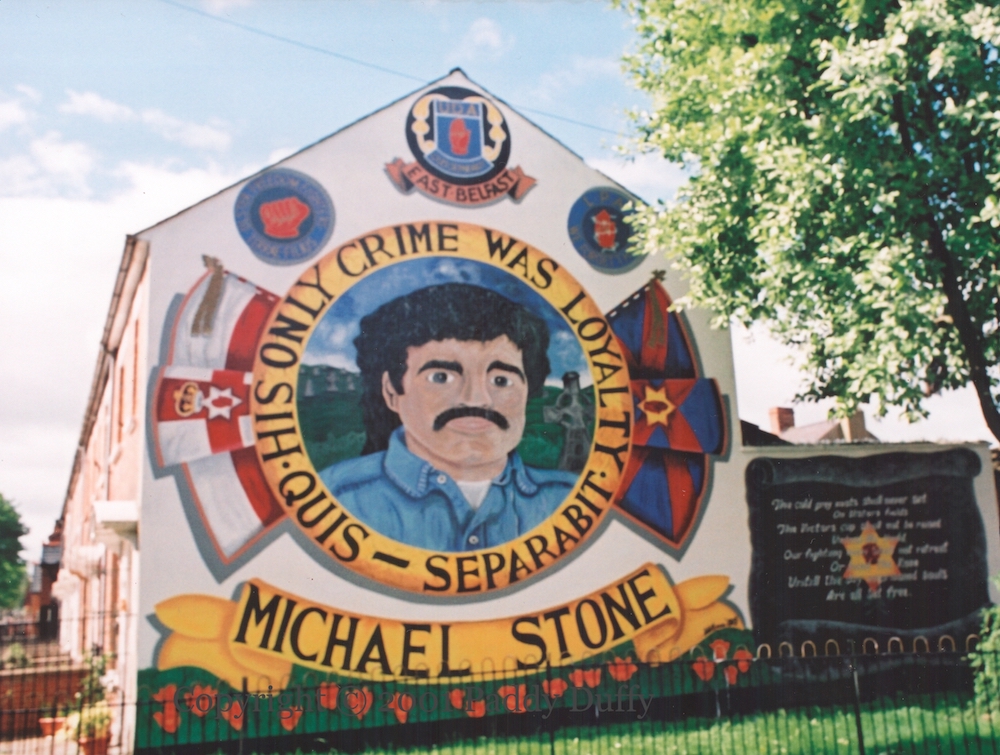
The UDA’s Michael Stone killed three mourners at the funerals of the Gibraltar 3 in Milltown Cemetery in 1988 (16th March). UDA commanders denied that member Michael Stone was acting with their knowledge or approval. This east Belfast mural perhaps is a celebration of his release, under the Belfast/Good Friday Agreement, on July 24th, 2000. “His only crime was loyalty.”
The panel on the right reads, “The cold grey mists shall never set on Ulster’s fields/The Victor’s cup shall not be raised unless we yield/Our fighting men shall not retreat or bend the knee/Untill [sic] the day imprisoned souls are all set free.”
Templemore Avenue, Belfast
Click image to enlarge
Copyright © 2001 Paddy Duffy
T00637

This board on the back of Free Derry Corner (Visual History) commemorates the thirtieth anniversary of the second hunger strike and the ten strikers who died.
Lecky Road, Derry
Click image to enlarge
Copyright © 2001 Paddy Duffy
T00788
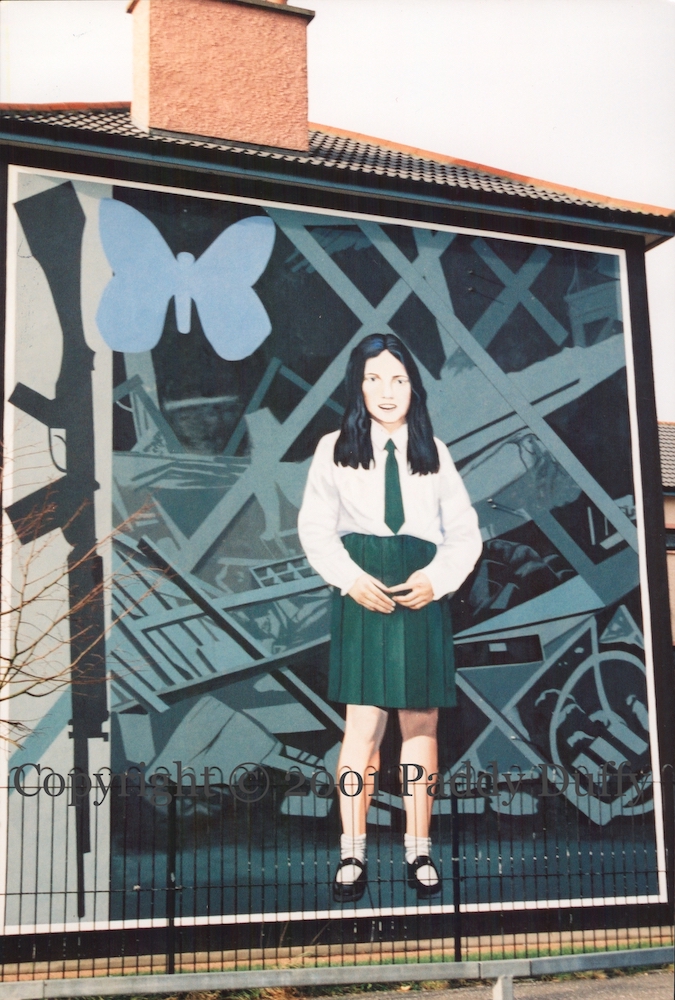
The subject for the fifth mural by The Bogside Artists (Visual History) is Annette McGavigan, the first child to be killed by British forces in the Troubles, in 1971 (WP).
Lecky Road, Derry
Click image to enlarge
Copyright © 2001 Paddy Duffy
T00358
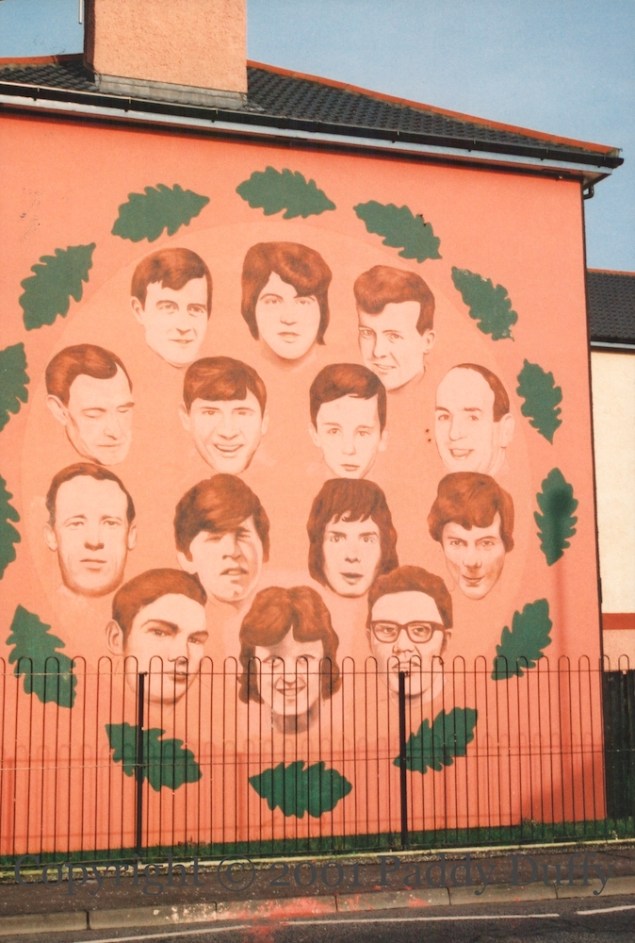
The fourth mural by the Bogside Artists (Visual History) shows the faces of the fourteen people who died on or as a result of Bloody Sunday, January 30th, 1972, shot by the “gun-happy louts” (as described by the Belfast UDA; Vanguard also called for their removal – see the entry for Robert McKinnie in Lost Lives) of the 1st Parachute Regiment; 15 more people were injured.
By row, the victims portrayed are:
Michael McDaid, John Young, Paddy Doherty
John Johnston (d. June 16th), Hugh Gilmour, Gerry Donaghy, Barney McGuigan
Gerry McKinney, William Nash, Kevin McElhinney, Jackie Duddy
Jim Wray, Michael Kelly, William McKinney
The portraits are presented within a circle of oak leaves – symbol of Derry – one for each person.
Westland Street, Bogside, Derry
Click image to enlarge
Copyright © 2001 Paddy Duffy
T00357
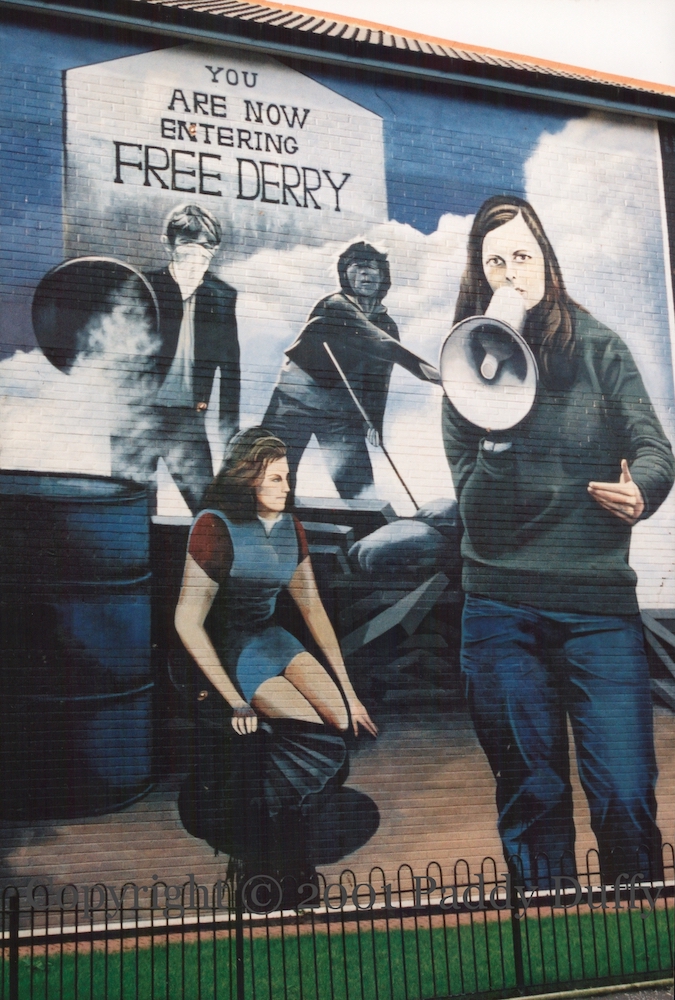
The second mural by the Bogside Artists (after The Petrol Bomber – Visual History) also depicts the battle of the Bogside and features Bernadette Devlin (later McAliskey). Devlin was elected to the British parliament in 1969 at age 21 and was imprisoned in December for her role in the August uprising. The mural reproduces a classic photograph showing Devlin with a megaphone in front of protesters and Free Derry Corner. It replaces another ‘Battle of the Bogside’ mural. The Bogside Artists explain the mural and its history in this short video.
Lecky Road, Derry
Click image to enlarge
Copyright © 2001 Paddy Duffy
T00355

The sixth mural from the Bogside Artists commemorates the 1980 hunger strikes, first in Long Kesh and subsequently in Armagh Women’s Prison. The main figure is Raymond McCartney; the female figure is perhaps Mary Doyle (the other two female strikers were Maıréad Farrell and Maıréad Nugent).
Rossville St, Derry
Click image to enlarge
Copyright © 2001 Paddy Duffy
T00356
 Paddy Duffy Collection