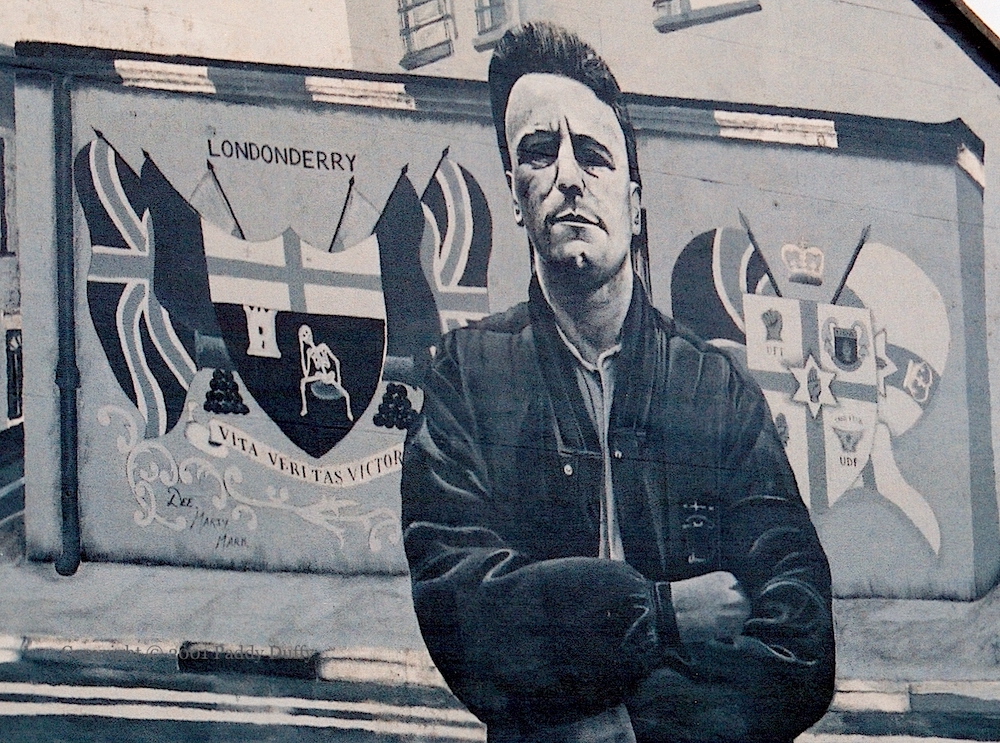
Chained-together padlocks represent Long Kesh and UDA/UFF prisoners of war (LPOW). The Ulster nationalist flag is on the left. For the four-quadrant shield, see Sans Peur.
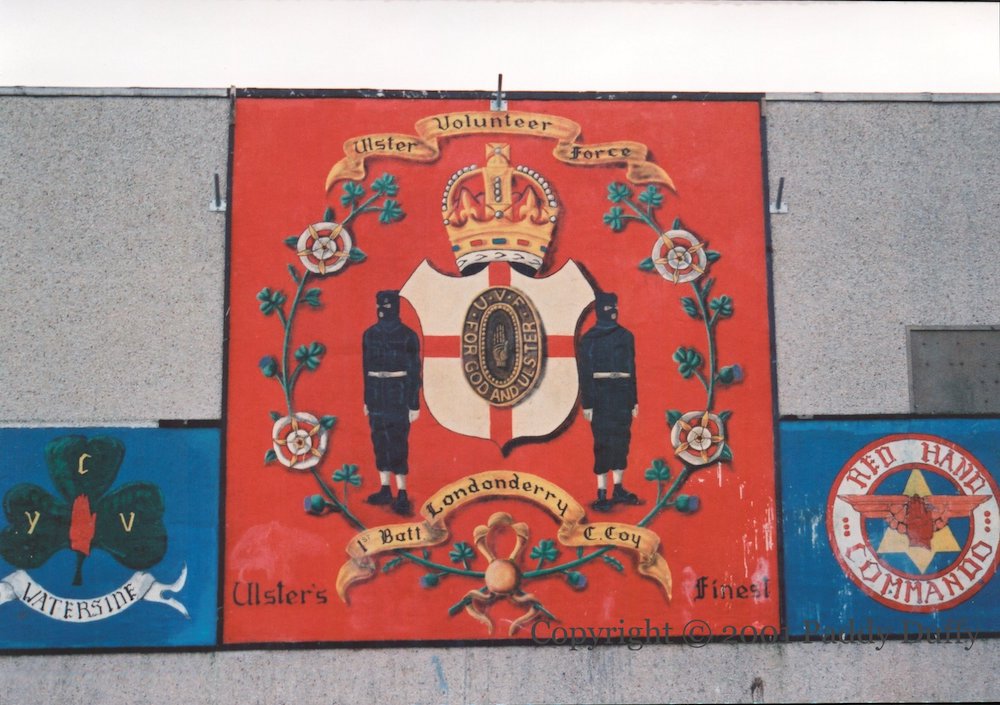
“Ulster’s finest – Londonderry UVF 1st battalion, C company”. Here is a trio of loyalist boards in Dennet Gardens, Londonderry with the insignia of the Young Citizen Volunteers, the Ulster Volunteer Force, and the Red Hand Commandos. The design of a garland of flowers containing a regimental insignia dates to the Ulster Volunteers of 1912; the masked volunteers standing to attention do not.
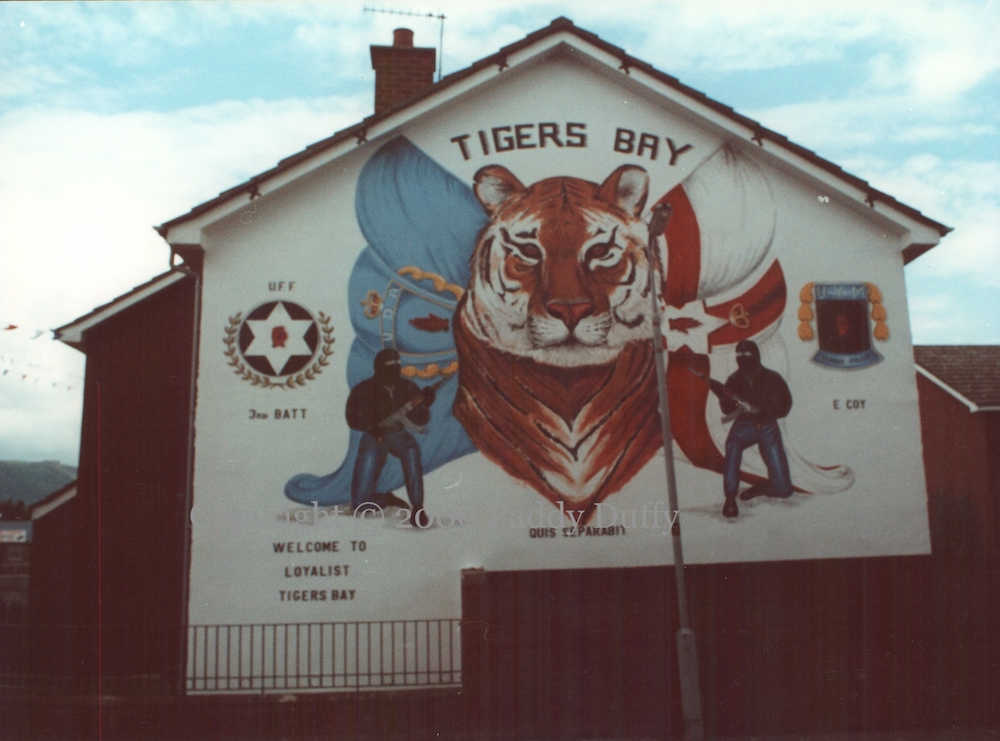
“UFF 3rd battalion, E company.” “Welcome to loyalist Tiger’s Bay.”
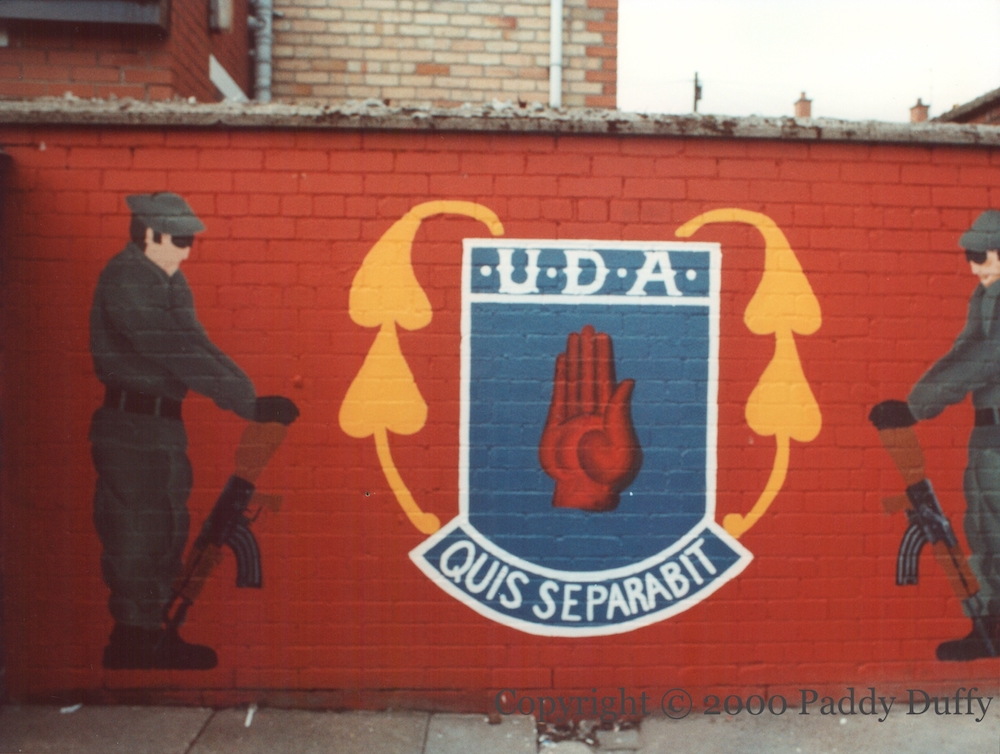
The tiger was used in a 1988 mural in Hogarth Street/Adam Street without any mention of a flute band or paramilitary gang. The tiger here is flanked by two UDA/UFF gunmen in balaclavas and bomber jackets.
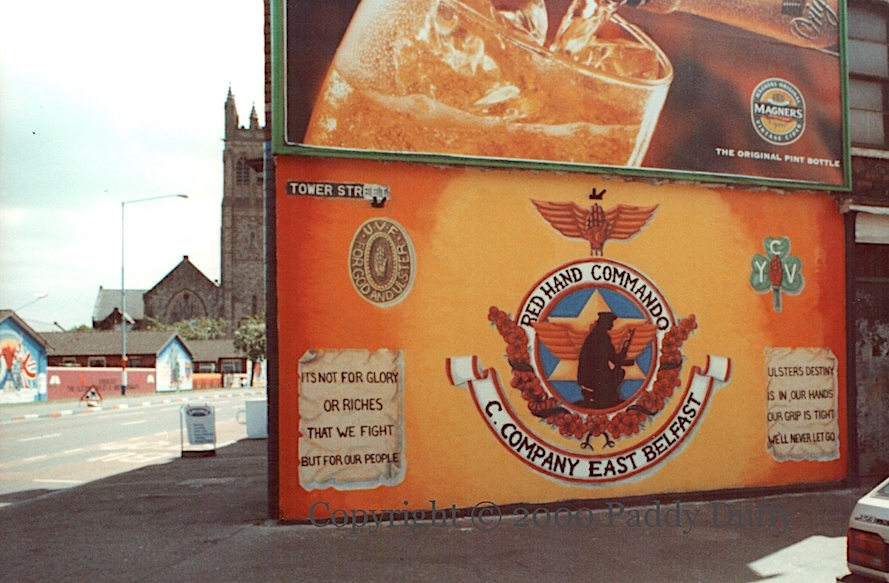
A Red Hand Commando volunteer kneels in a garland of poppies. The quote on the left – “It’s not for glory or riches that we fight but for our people” – is based on the Declaration Of Arbroath and seen also in south Belfast (For Freedom Alone) and in Bangor (Remember Them Who Gave Their All). The Declaration was also used on one of the series of murals that can be seen, in part, to the left of the image above – see Ulster’s Freedom Corner.
The quote on the right – “Ulster’s destiny is in our hands; our grip is tight; we’ll never let go.” – appears to be original to the RHC.
Tower Street, east Belfast, replacing a version that had a solid white background.
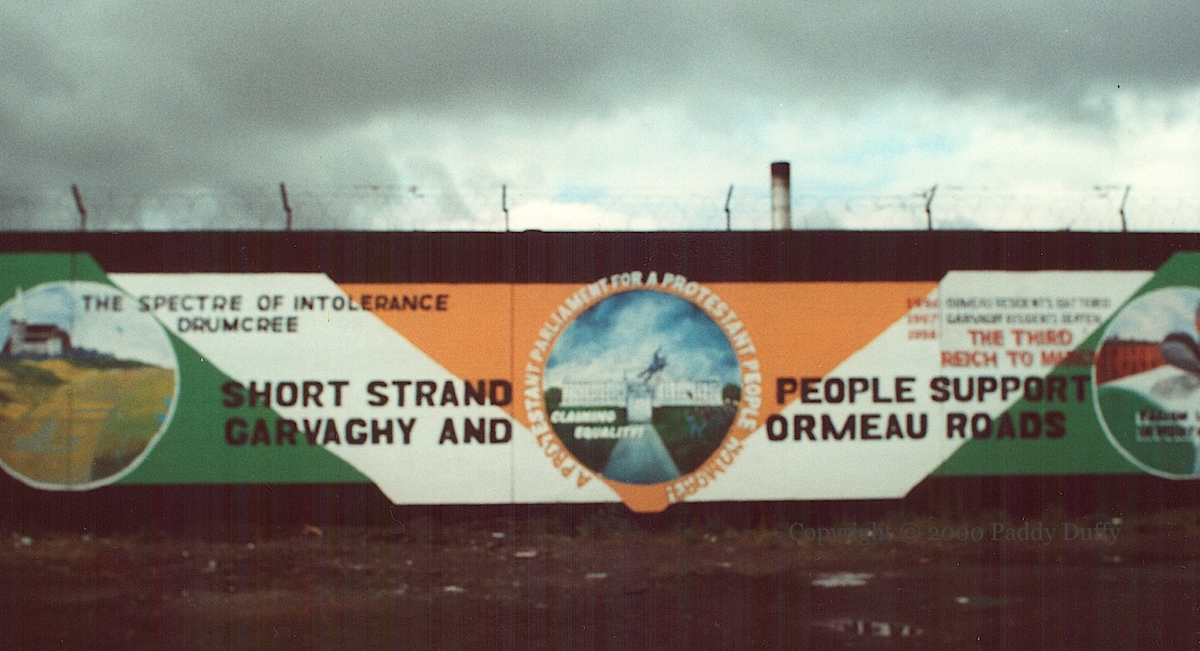
Northern Ireland’s first Prime Minister, James Craig, said in 1934, that Stormont was “carrying on a Protestant Government for a Protestant People” (NI Parliamentary Debates), though the phrase has now been transformed into the doubly alliterative “A Protestant parliament for a Protestant people”. In the centre of a long mural at the waste-ground at the top of Mountpottinger Road, people carrying Irish Tricolours tear down the statue to Northern Ireland’s most prominent leader, Sir Edward Carson, that stands outside Stormont, “claiming equality”.
The main issue that has tested the resolve of governments both local and national to the equality declared in the 1998 Belfast (Good Friday) Agreement is Orange Order parading through nationalist areas, such as the Garvaghy Road below Drumcree church in Portadown, and the Ormeau Road in south Belfast.
“Short Strand people support Garvaghy and Ormeau Roads.” On the left: The spectre of intolerance – Drumcree.” Centre: “A Protestant parliament for a Protestant people no more!” On the right “1996: Ormeau residents battered; 1997: Garvaghy residents beaten; 1998: The third reich to march.” and “Fascism lives! in Portadown”.
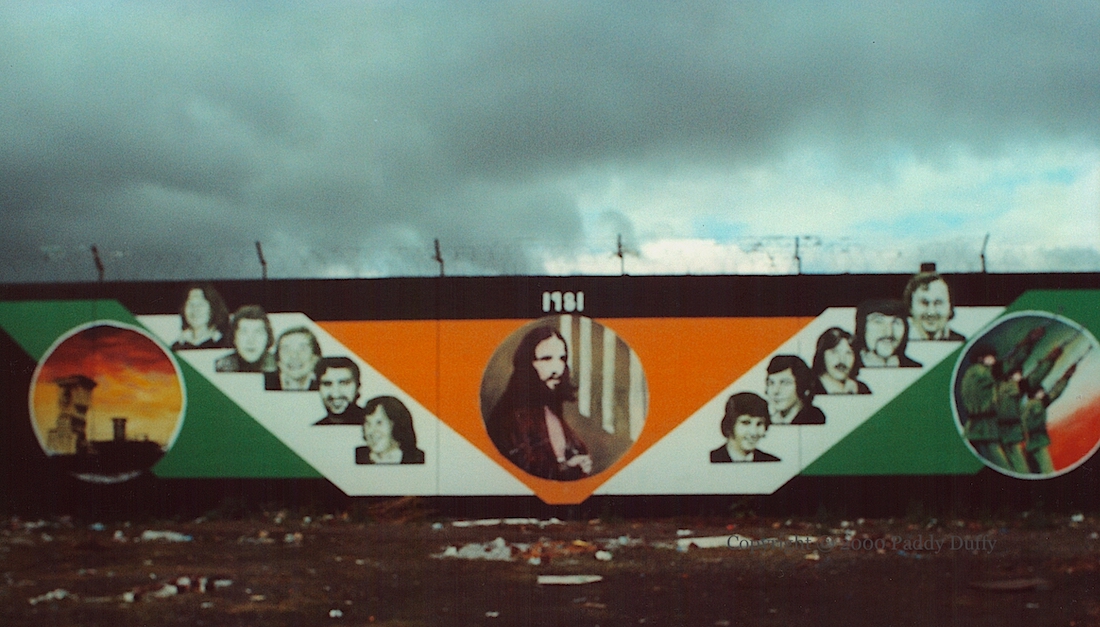
The piece is next to a hunger-strikers commemoration piece with ten portraits on shaped wooden boards against a painted background with blanket-man Hugh Rooney in the center. Between the two is a “spirit of freedom” lark and the names of the ten deceased 1981 strikers.
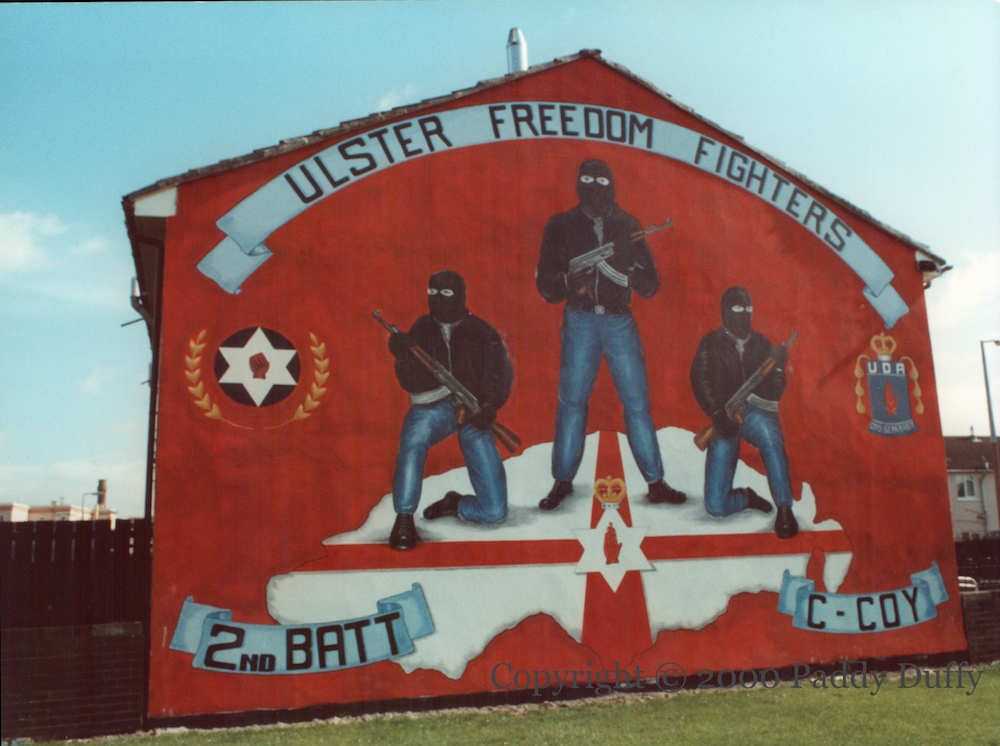
The Woodvale Defence Association (WDA) was the largest of the local associations which merged together in 1971 to form the Ulster Defence Association (UDA) and the WDA became B company of 2nd battalion (WP).
Both pieces are in Heather Street, Woodvale, west Belfast. Between the two are the words “Ulster Freedom Fighters” in large letters – see D00967.
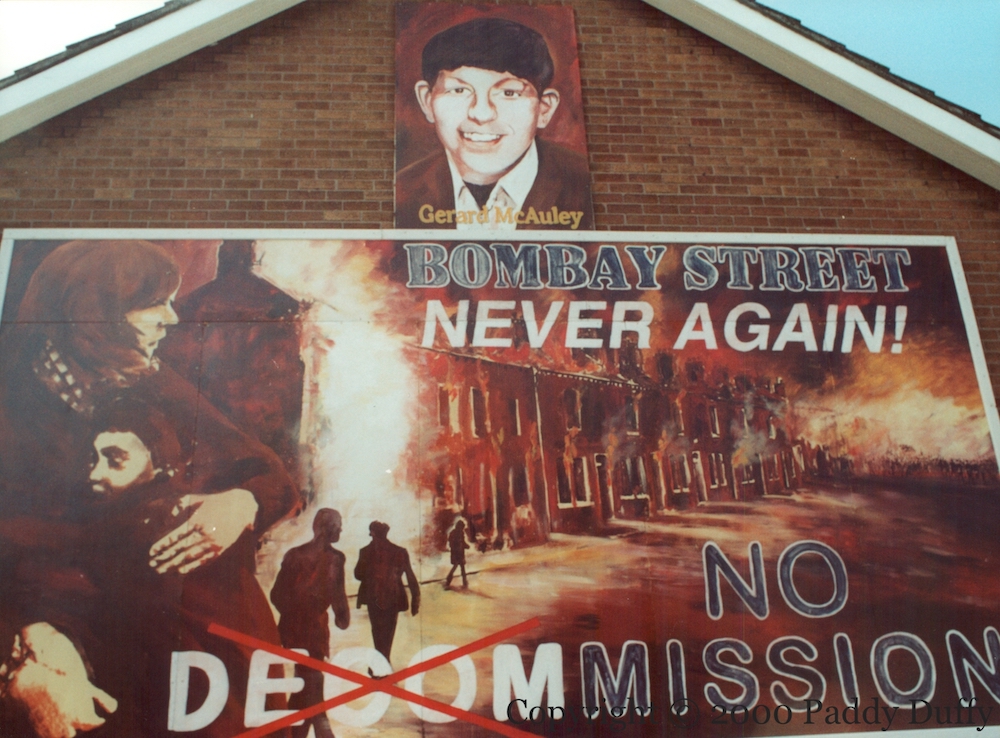
In August, 1969, families, mostly Catholic, were driven out and their homes burned in Bombay Street (and surrounding streets), between the Falls and Shankill (RTÉ news report). The defenselessness of the community then is reflected in the urging for “No decommission” in the present. Fıan Gerard McAuley (aged 15) was shot in nearby Waterville Street.
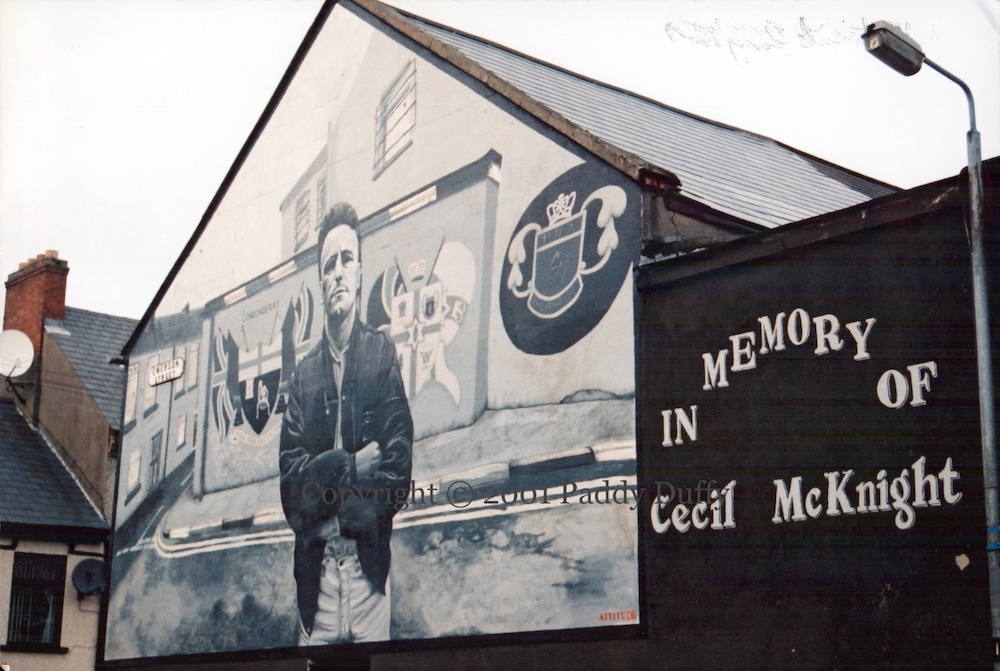
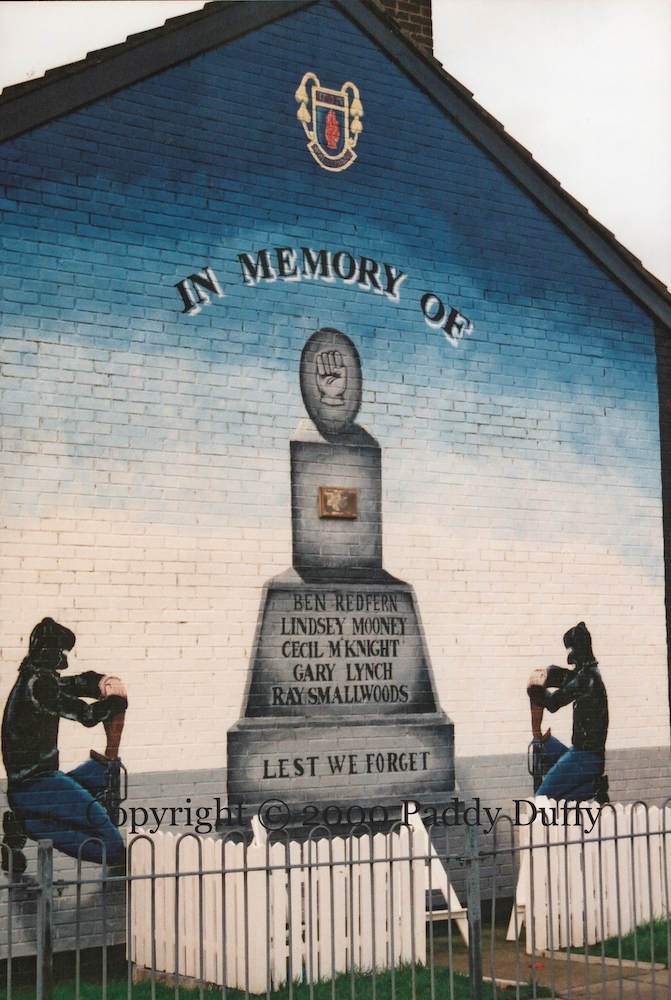
“In memory of Ben Redfern, Lindsay Mooney, Cecil McKnight, Gary Lynch, Ray Smallwoods, William Campbell. Lest we forget.” For Redfern and Lynch, see It’s Still Only Thursday; Smallwoods has a WP page; Campbell died in 2002 in a premature pipe-bomb explosion (Guardian).





 Paddy Duffy Collection