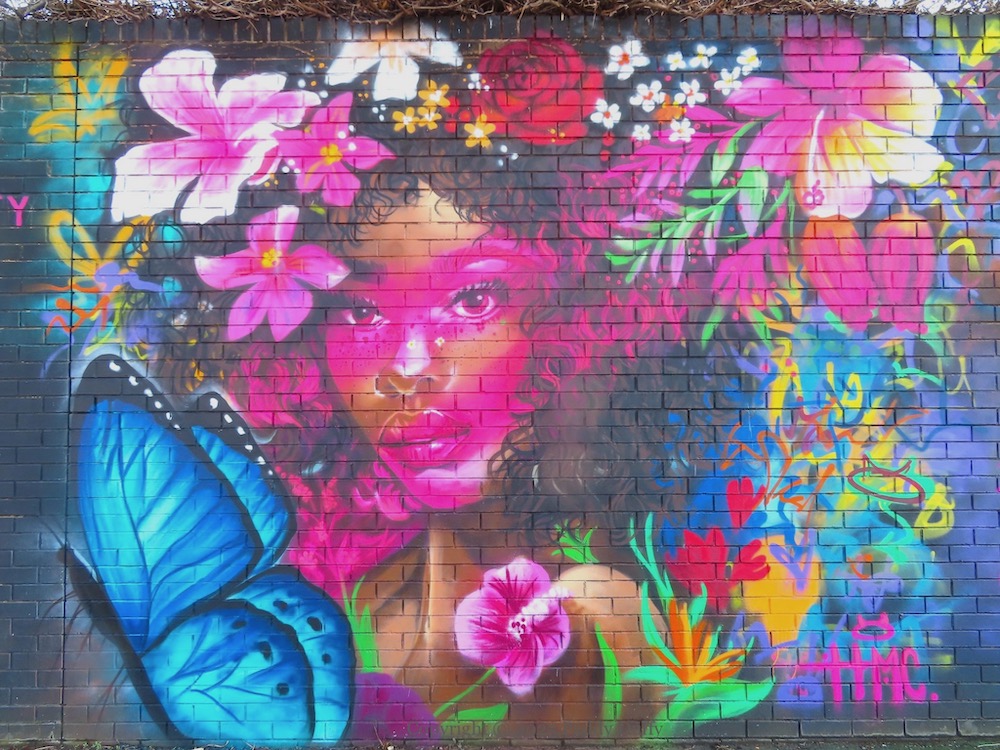
For International Women’s Day (March 8th) HM Constance (web) went to work on Lanark Way (next to Times Change) painting a celebratory piece for SHE Youth Club (“Supporting Her Empowerment” – Belfast Live) that is one of the programmes at R-City (web).
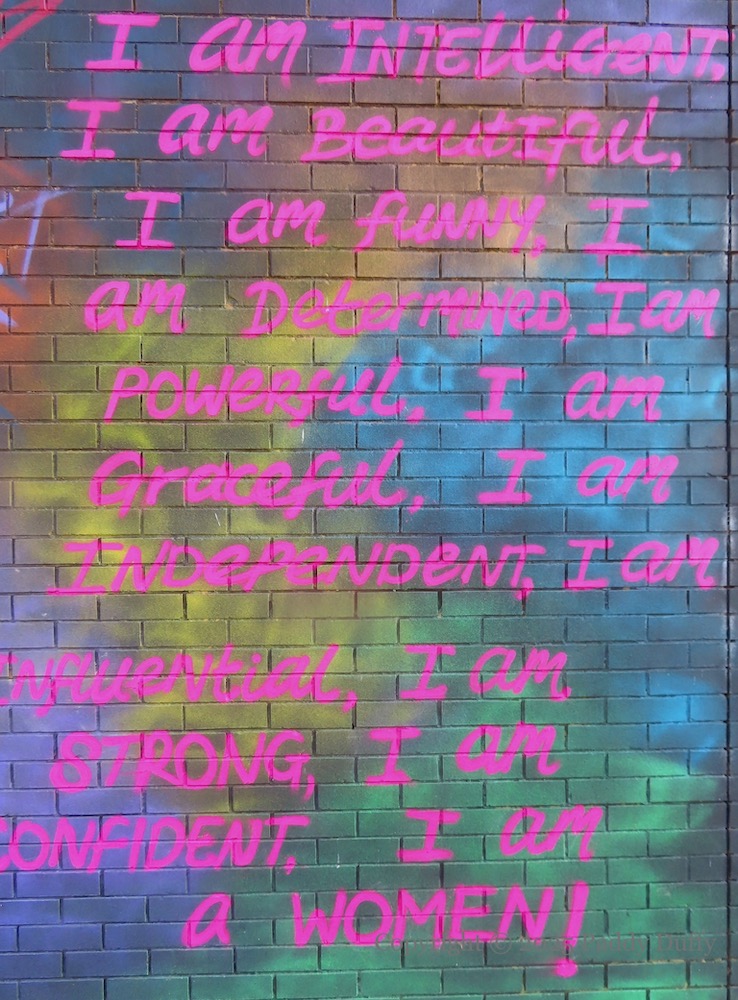
“I am intelligent, I am beautiful, I am funny, I am determined, I am powerful, I am graceful, I am independent, I am influential, I am strong, I am confident, I am a women [sic]”.
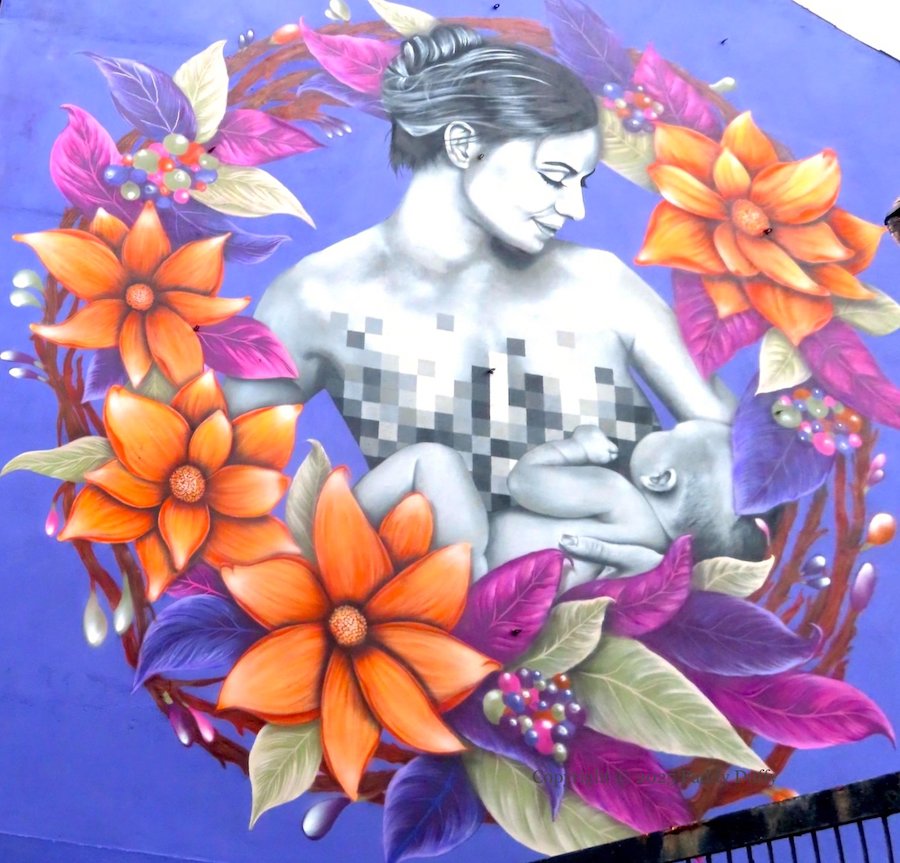
“BAPS” is North West Breastfeeding and Perinatal Support (Fb), a support-group formed in response to the low breast-feeding rates in the region (ZeroWaste). In both 2024 and 2023 it participated in ‘world breast-feeding in public day’ with events at the Guildhall (2024 Derry Now | 2023 Derry Journal).
The art shown here was painted by Peaball (web) on an exterior wall of the Pram Centre (web) in Great James Street, Derry and launched on 2024-11-29. (The pixelation is part of the painting. See also the ‘period products’ mural in Belfast – About Bloody Time.)
The 1918 ‘Representation Of The People’ act gave 8.4 million women in the United Kingdom the right to vote (WP). (For the two women on the left holding the ‘Votes For Women’ sign, see Women’s Hall And Cost-Price Restaurant.) In that same year, Countess Constance Markievicz was the first woman elected to Westminster and became Sınn Féın Minister For Labour in the first Dáıl Éıreann that was established as an alternative. Ten years earlier, she had co-founded Na Fıanna Éıreann with Bulmer Hobson. The names of Derry fianna are listed on the right. “Fuaır sıad bás ar son saoırse na hÉıreann.” (This board replaces the former Fianna mural that celebrated the centenary in 2009.)
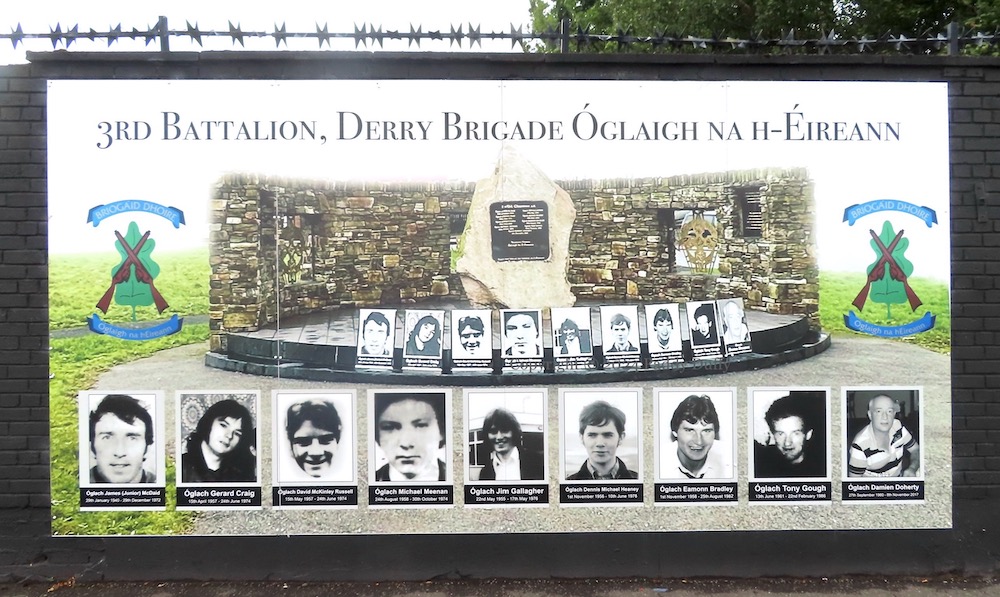
To the left (above) is a “Join RSYM” stencil with the names of the ten deceased 1981 hunger strikers; to the right is a picture of the memorial across the street to the dead of the 3rd battalion of the Doıre Brigade Óglaıgh na hÉıreann.
“But while Ireland is not free I remain a rebel, unconverted and unconvertible. There is no word strong enough for it. I am pledged as a rebel to the one thing – a free and independent republic.”
“Ach a fhad is nach bhfuıl Éıre saor, seasfaıdh mé an fód mar cheannaırceach, gan géılleadh, gan athrú. Níl focal dá bhfuıl atá chumhachtach go leor. Tá gealltanas tugtha agam mar cheannaırceach, cuspóır amháın a chur ı gcrích – poblacht shaor agus neamhspleach.”
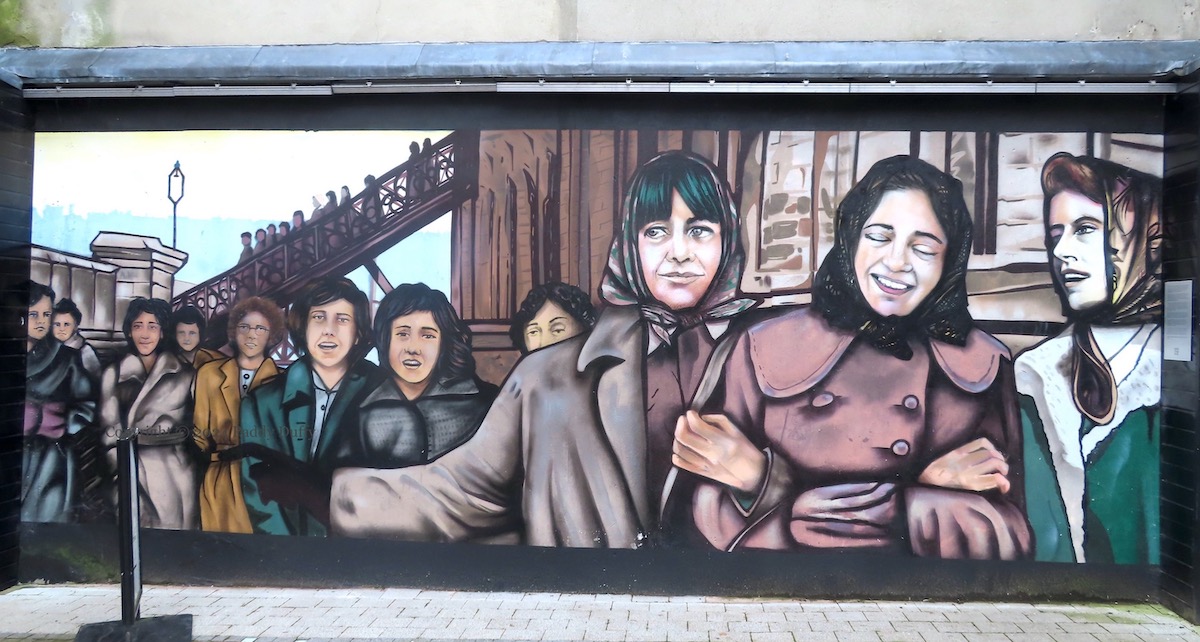
Tillie & Henderson’s shirt factory opened in 1856 at the junction of Abercorn Road and Foyle Road, Derry (next to the ‘Hands Across The Divide’ statue) and survived until 2003 when it was demolished after a fire (BBC); an apartment block was planned for the site (Derry Journal | BBC) but as yet nothing has happened. It was the largest such factory in the world and one of 44 shirt factories in the city in 1900, all of which employed women, many starting in their teens.
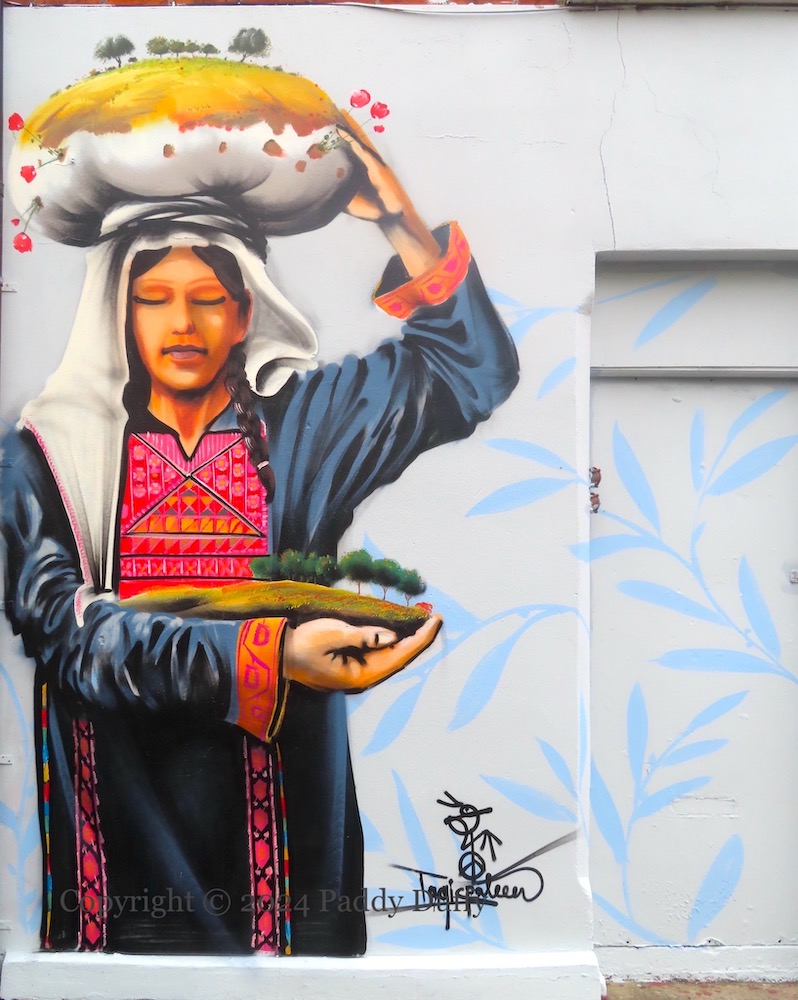
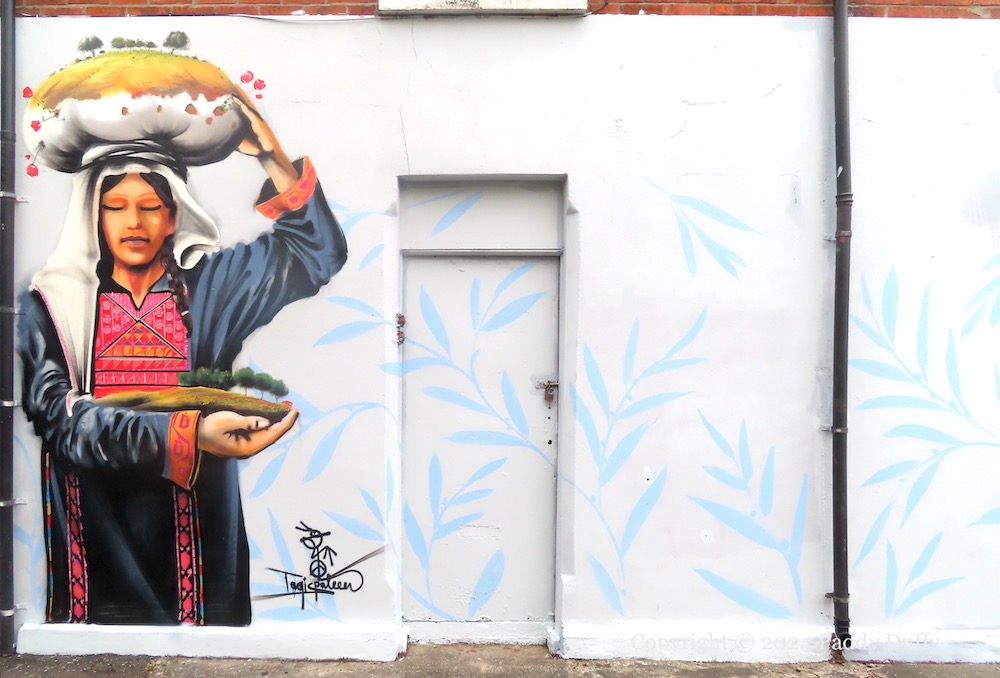
Palestinian artist Taqi Spateen’s (web | ig) second piece in Belfast is in Palestine Street in the Holylands of south Belfast, where he worked with Artists Against Genocide (ig) to produce a piece showing the strength of Palestinian women, carrying the land from which Palestinians have been evicted in the Nakba of 1948.
Ahed Tamimi is a young Palestinian activist famous for slapping and pushing two Israeli soldiers in 2017, when she was 16 (footage at NBC News), after her cousin was hit in the head by an Israeli bullet. She was arrested soon after (USA Today) and served seven months (Al Jazeera | Guardian). She was also arrested last (2023) November (Al Jazeera) and released about three weeks later as part of a prisoners-for-hostages swap on November 29th (BBC).
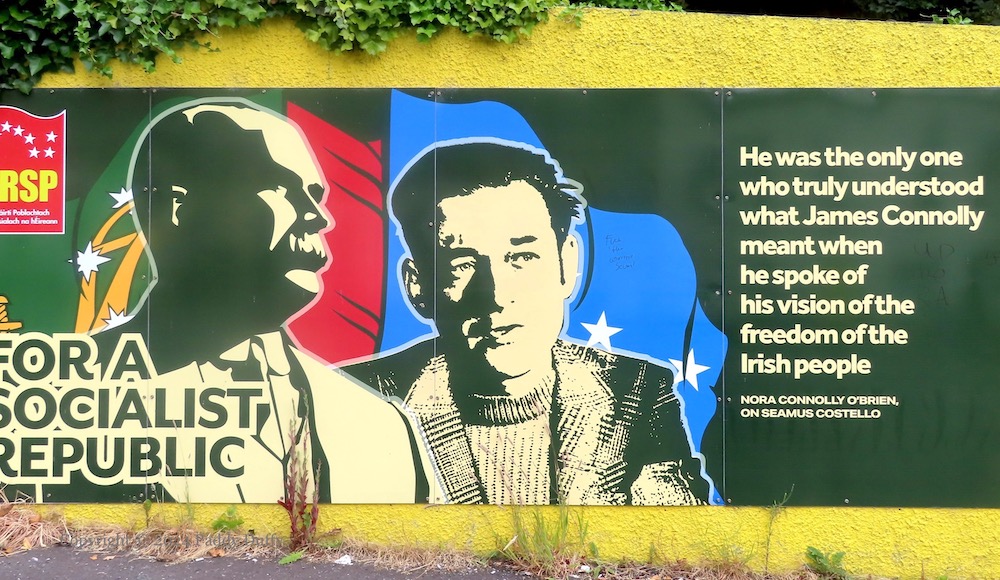
The mural to Tamimi (above) is in Catherine Street, Newry. Also included (below) are an older mural with the cartoon character of resistance Handala (WP) in front of a Palestinian flag with the words “Let this child return home”, and a Connolly-Costello IRSP (Fb) board.
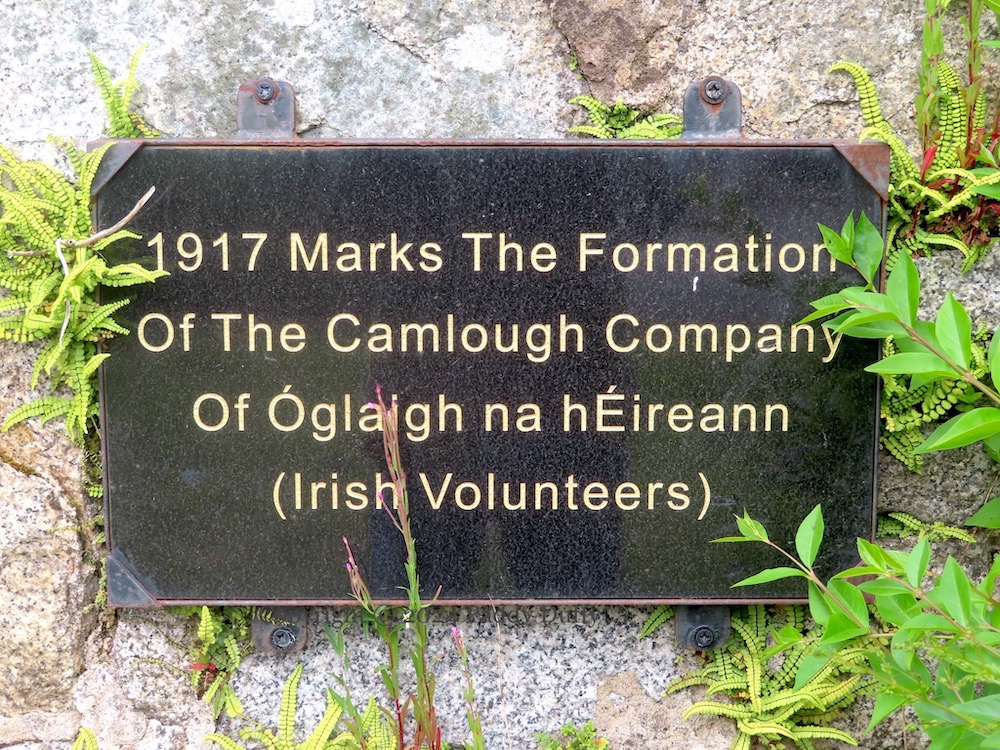
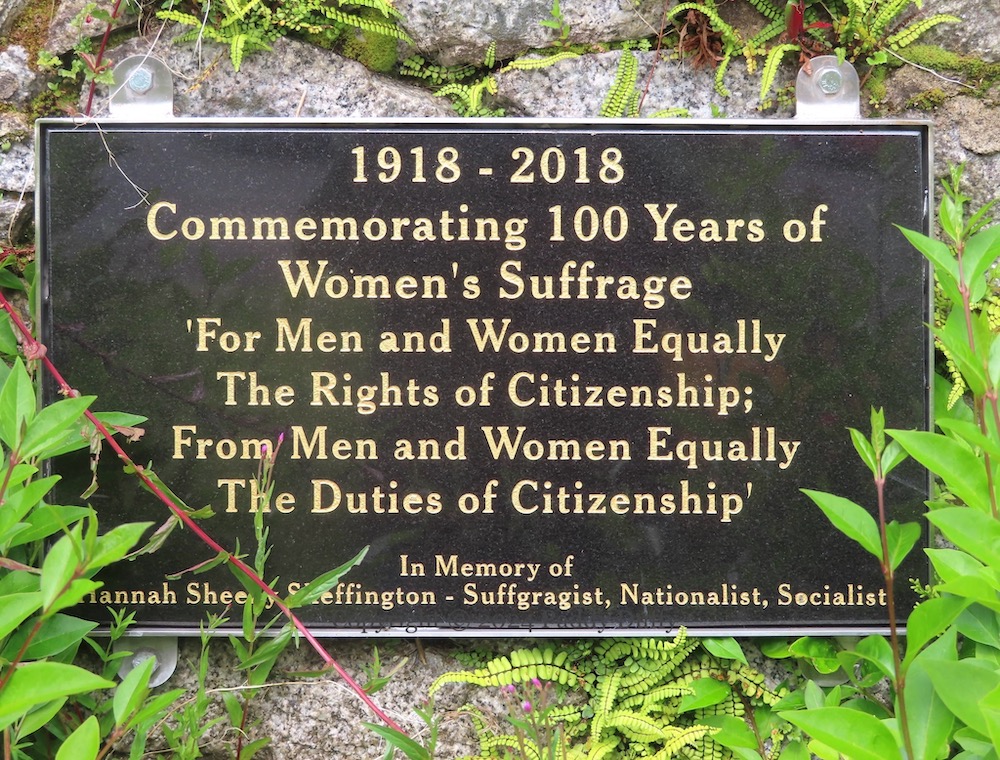
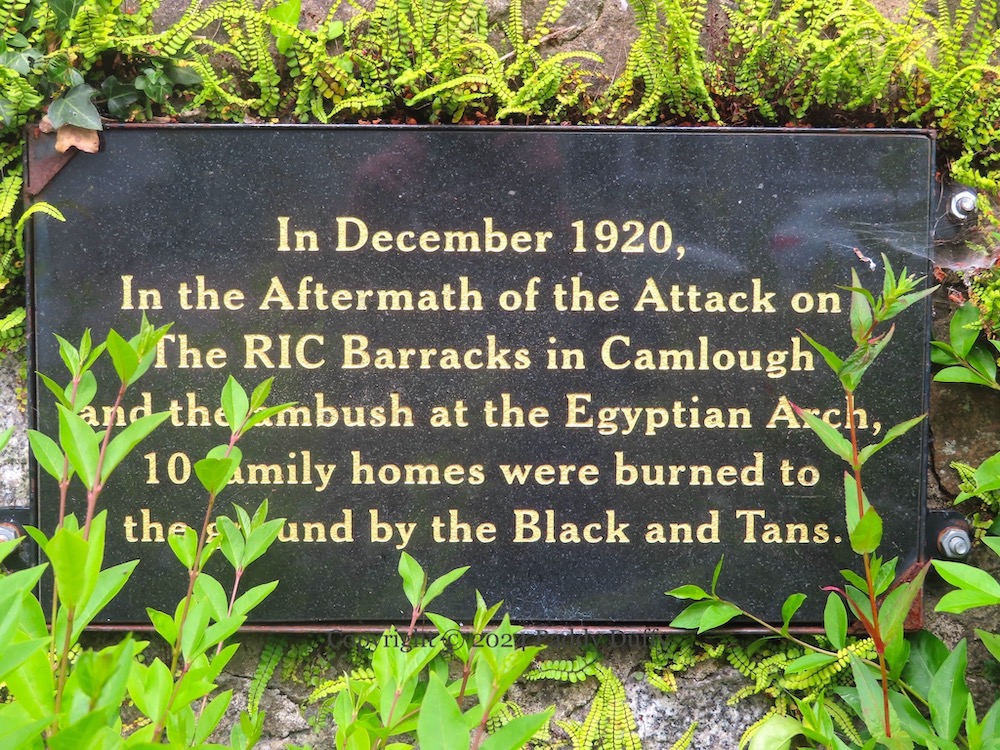
The memorial garden in Quarter Road, Camlough, commemorates deaths and events from 1916 to 1921:
“In memory of the Irish men and women who died in 1916 in conflicts both at home and abroad.”
“1917 marks the formation of the Camlough company of Óglaıgh Na hÉıreann (Irish Volunteers).”
“1917-2017 centenary of the Sınn Féın cumann, Camlough.”
“1918-2018 commemorating 100 years of women’s suffrage ‘For men and women equally the rights of citizenship; from men and women equally the duties of citizenship’. In memory of Hannah Sheehy-Skeffington – suffragist, nationalist, socialist.”
“December 1920, during the Tan War, the RIC barracks in Camlough was attacked by local volunteers of the Irish Republican Army.”
“In December 1920, in the aftermath of the attack on the RIC barracks in Camlough and the ambush at the Egyptian Arch, 10 family homes were burned to the ground by the Black And Tans.”
“In memory of Vol. Sean Doran and his sister Mary Ann Kearney, shot dead by the Black And Tans, 1921.”
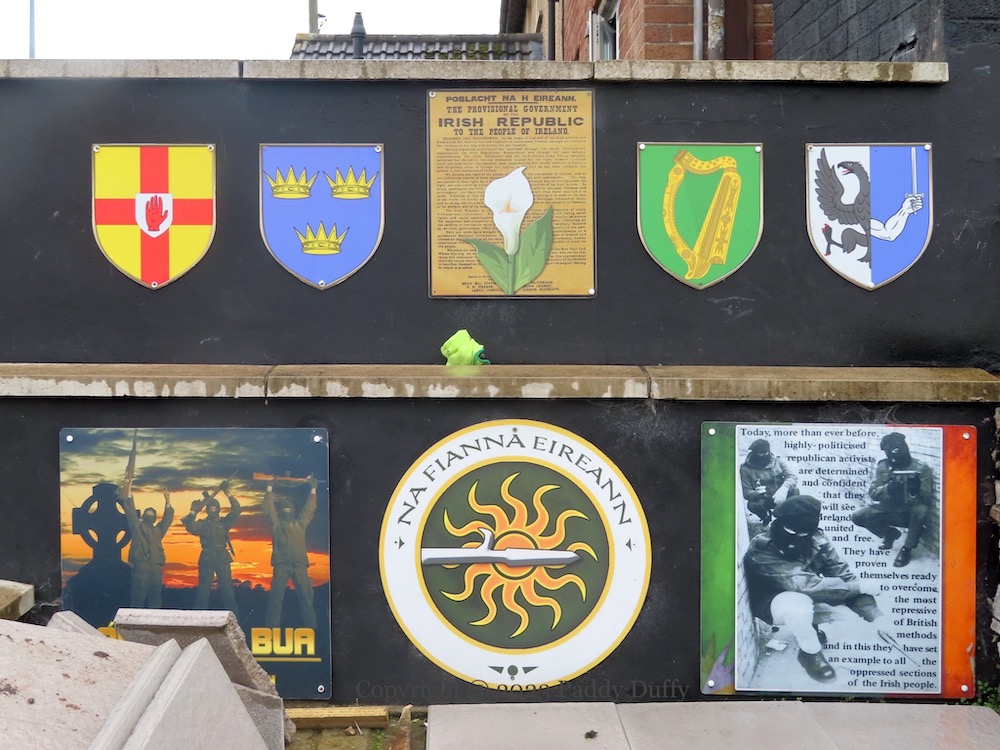
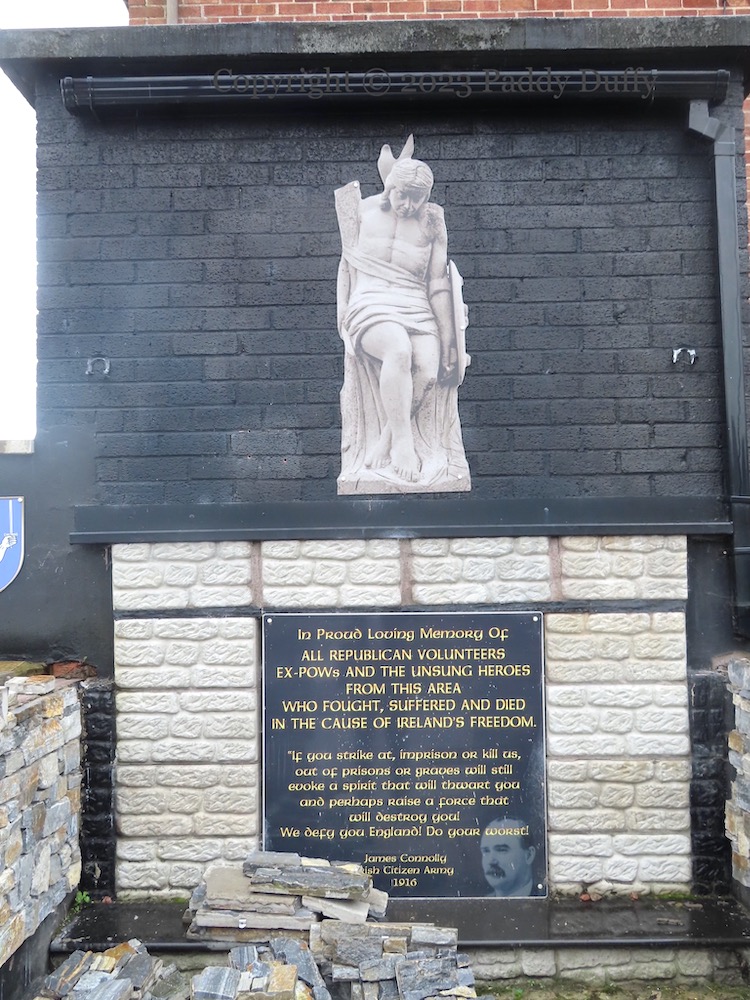
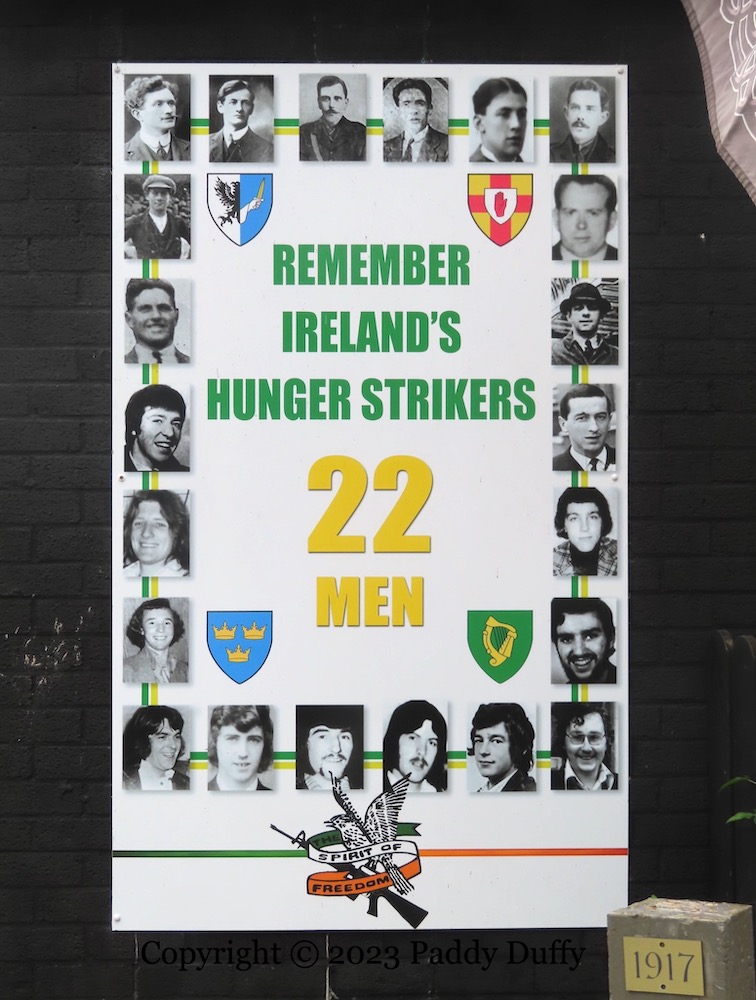
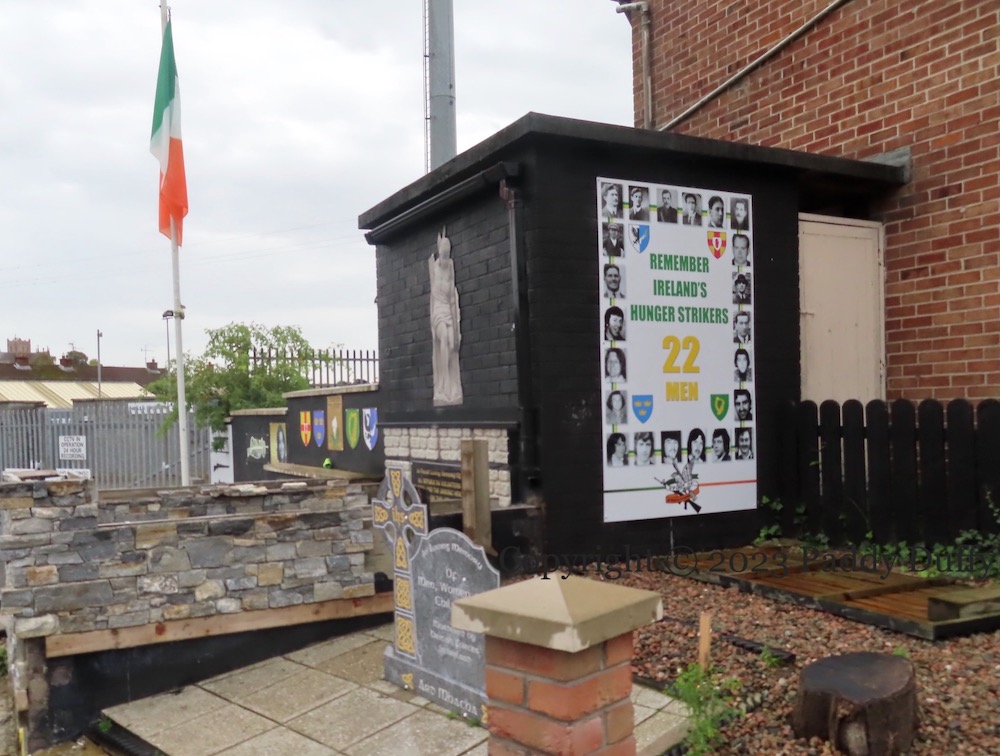
There is a memorial garden to the history of Irish resistance at the entrance to the Athletic Grounds in Armagh. From left to right, the images presented here show:
“More than 800 years of Irish resistence” – a sword for the Norman invasion under Strongbow, a pike for the 1798 and 1803 rebellions, a bolt-action rifle for the Easter Rising of 1916, and an assault rifle for the Troubles;
Cumann Na mBan, Mairéad Farrell and republican women who made “the supreme sacrifice”;
The Proclamation, Provisional IRA and Na Fianna;
The dying Cú Chulainn and a plaque “in proud and loving memory of all republican volunteers, ex-POWs and the unsung heroes from this area who fought, suffered and died in the cause of Ireland’s freedom, with a quote from James Connolly: ‘If you strike at, imprison or kill us, out of prisons or graves will still evoke a spirit that will thwart you and perhaps raise a force that will destroy you! We defy you England! Do your worst!”;
“Remember Ireland’s hunger strikers – 22 men” – the ten 1981 hunger strikers and Thomas Ashe, Terence MacSwiney, Michael Fitzgerald, Joe Murphy, Joseph Whitty, Andy O’Sullivan, Denny Barry, Tony D’Arcy, Jack McNeela, Seán McCaughey, Michael Gaughan, Frank Stagg;
A stone “in loving memory of men, women and children murdered by British forces in Ireland.”
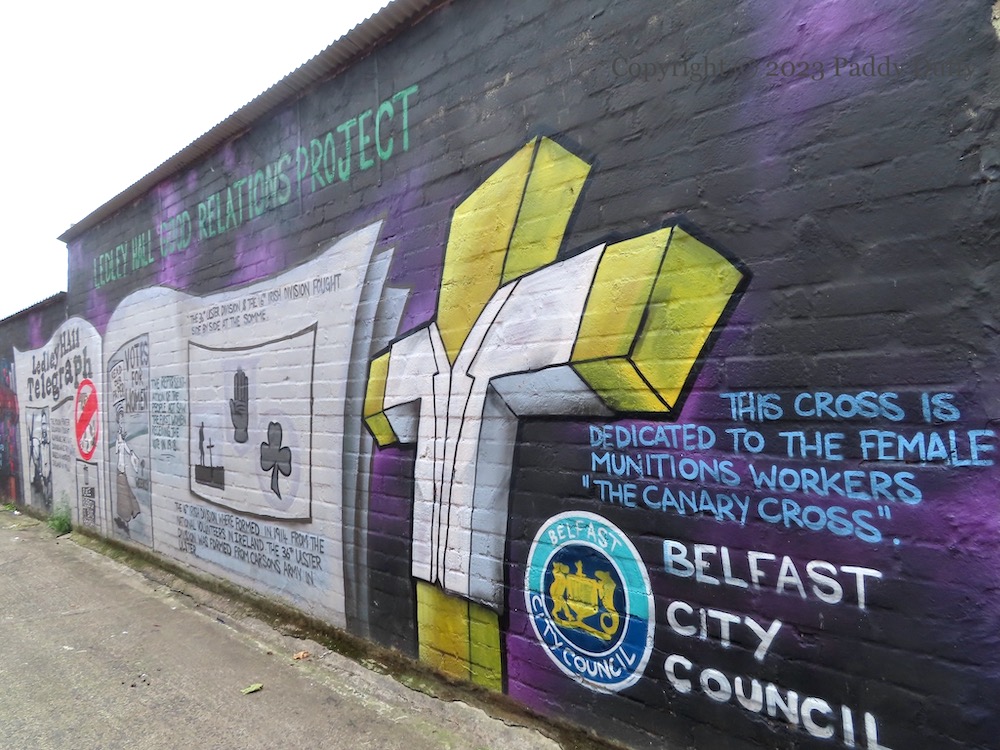
An imaginary newspaper called the “Ledley Hall Telegraph” includes stories on the 303 (Polish) RAF Squadron (which was stationed in Northern Ireland from 1943 to 1944), “Votes for women” (“the Representation Of The People Act saw the first women receiving the vote in 1918”), and the 16th and 36th Divisions (the mural says they “fought side by side at the Somme” – but the 36th was withdrawn on July 2nd after the Battle Of Albert and the 16th arrived in September and fought in the battles of Guillemont and Ginchy; both were withdrawn to Messines and both would take part in the Battle Of Messines in June 1917).
The “newspaper” is bookended by two painted crosses (for Row On Row), one for Guardsman Connor Lilley, a member of the Gertrude Star flute band, who was serving with the 1st battalion Royal Irish Guards when he was killed in an accident in Canada (Fb), and the other for WWI female munitions workers who, because of their work with TNT, risked yellowing skin both from direct exposure and from liver damage (“toxic jaundice”) (WP).
Also included is “The Kindness Hut”: “Be the reason someone smiles today”, “Kindness is free – please share”, “In a world where you can be anything, be kind”, “Take only what you need! If everyone shares there’s enough to go around”.
The Windsor Women’s Centre (web | Fb) provides day-care and educational services for women in the Village, south Belfast. In the mural around the building children are depicted playing at various jobs: the mac on the “lollipop lady” (at a school crossing) is too large, the nurse is listening to the heart-beat of a teddy-bear.
On the other side of the centre from the expression of thanks for the NHS in Together We Are Stronger.


















 Paddy Duffy Collection