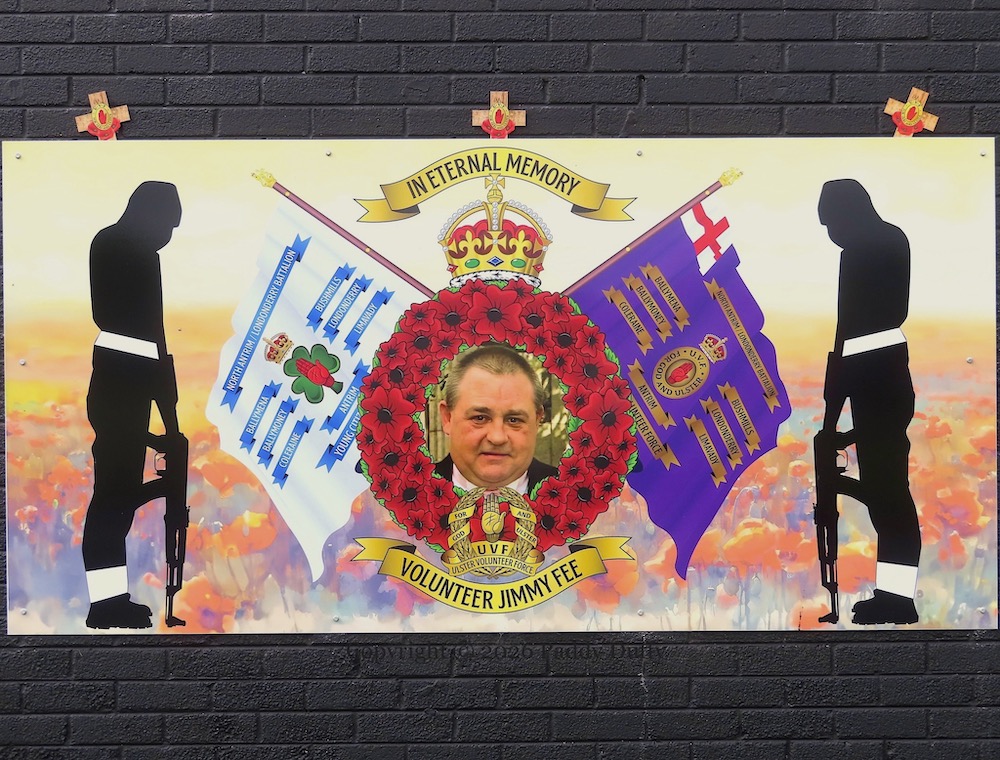
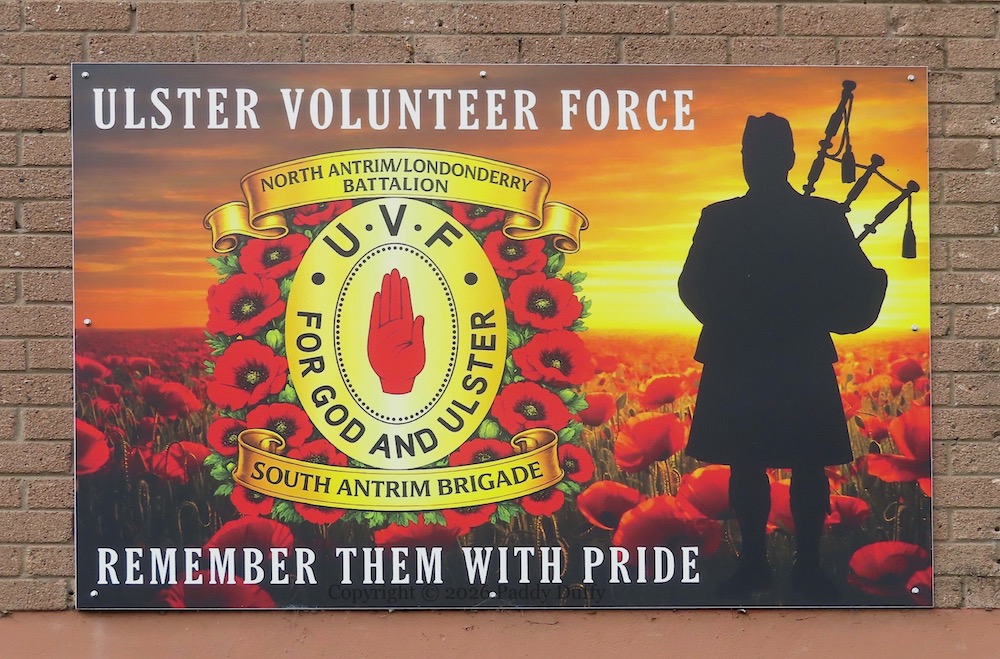
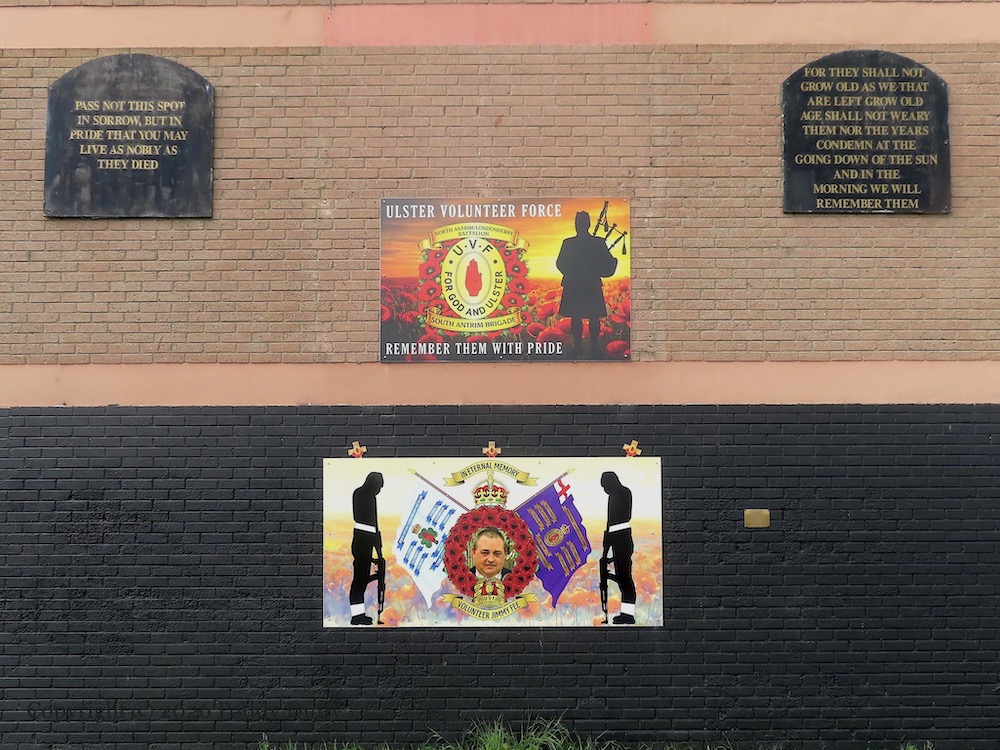
“In eternal memory, UVF Volunteer Jimmy Fee.” This entry updates 2023’s Pass Not This Spot In Sorrow, which showed a painted UVF flag in memory of Jimmy Fee. This has been replaced by a printed board which contains a photographic portrait of Fee. As reported in that earlier entry, there is no information readily available about Fee, who perhaps died around 2016, when the original mural was painted. The two upper boards (in the shape of gravestones) have been retained from the earlier work, while the “north Antrim/Londonderry battalion, south Antrim brigade – remember them with pride” board is new.
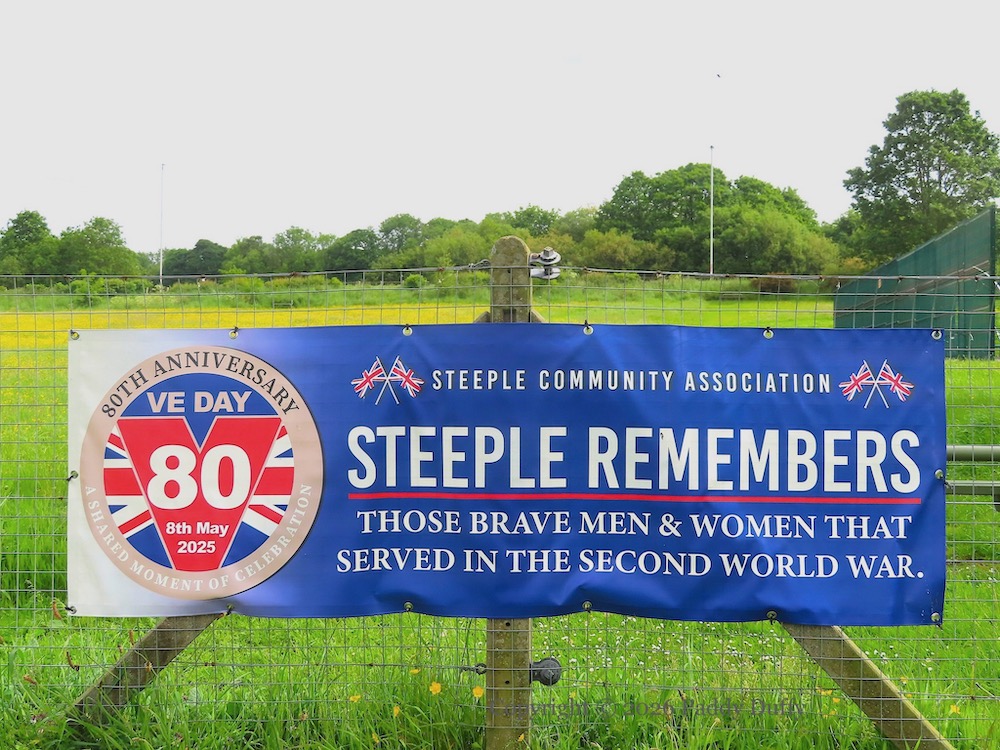
Parkhall Road, Steeple, Antrim. The WWII banner is in the nearby Steeple Park.
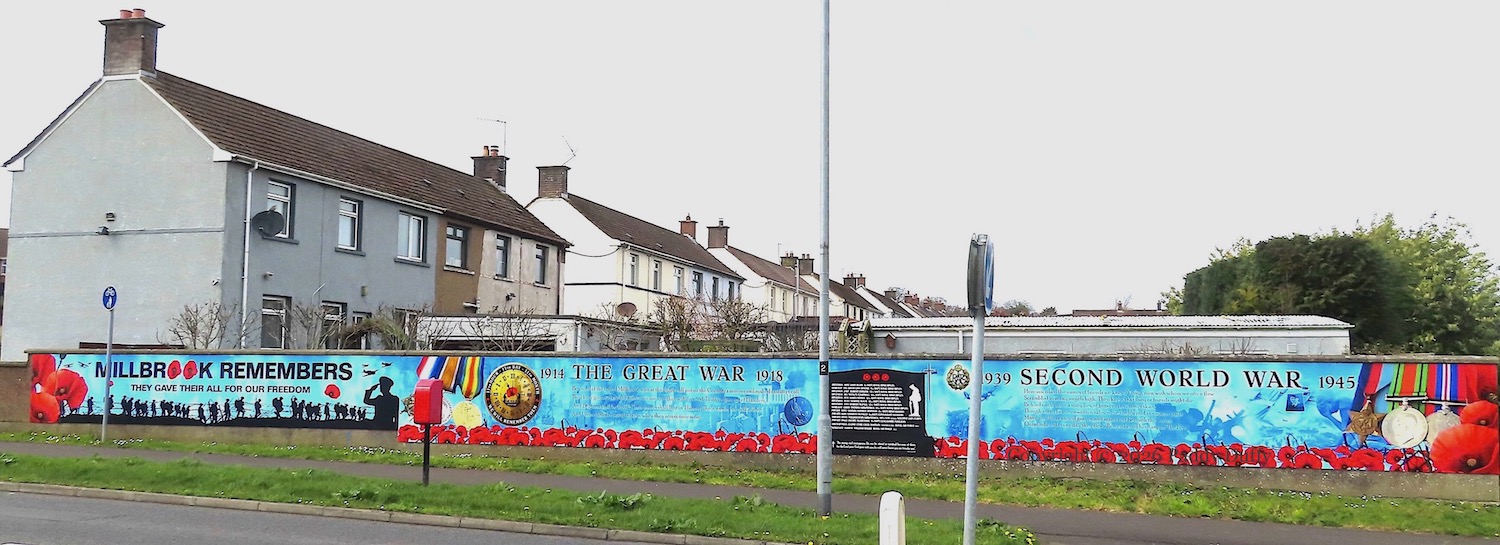
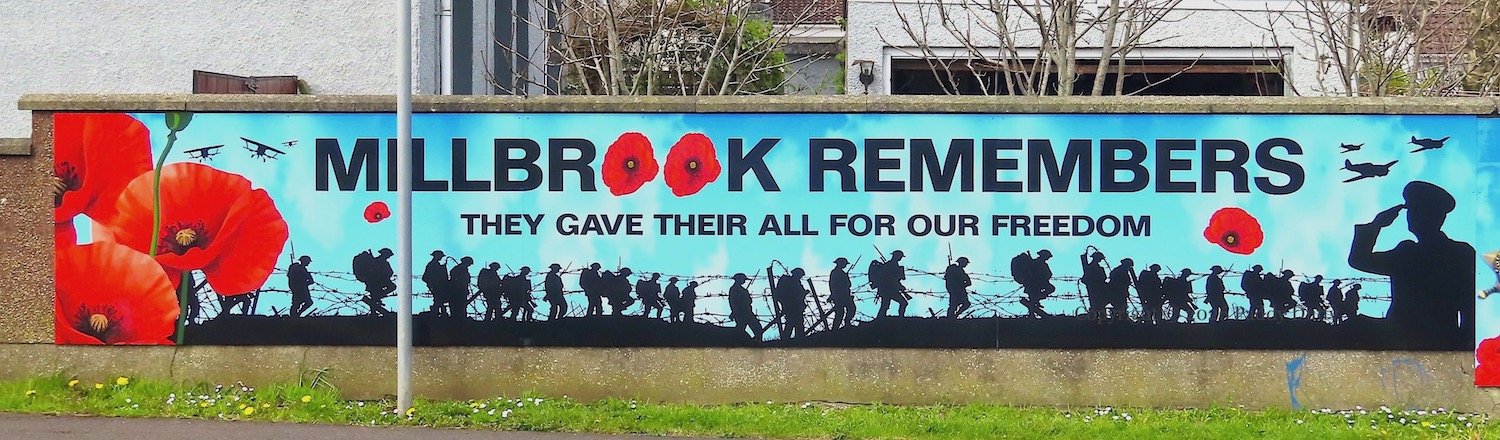
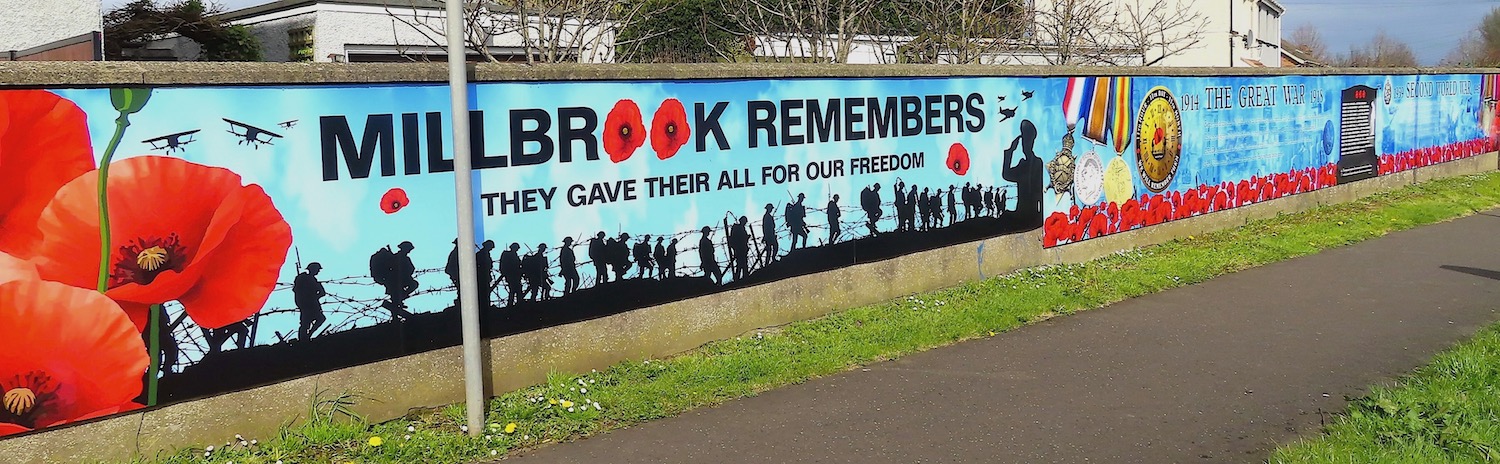
“Millbrook remembers – they gave their all for our freedom.” Here is a new installation in the Millbrook area of/just outside Larne, celebrating and commemorating the sacrifice of locals who lost their lives while serving the British forces during the World Wars.
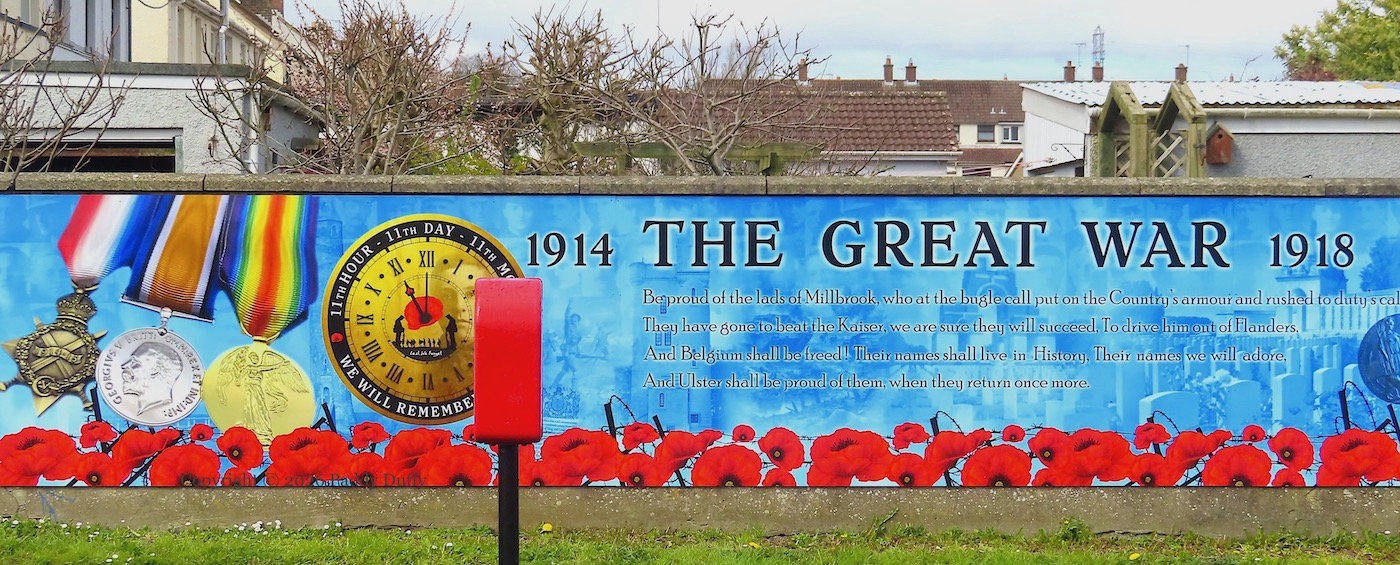
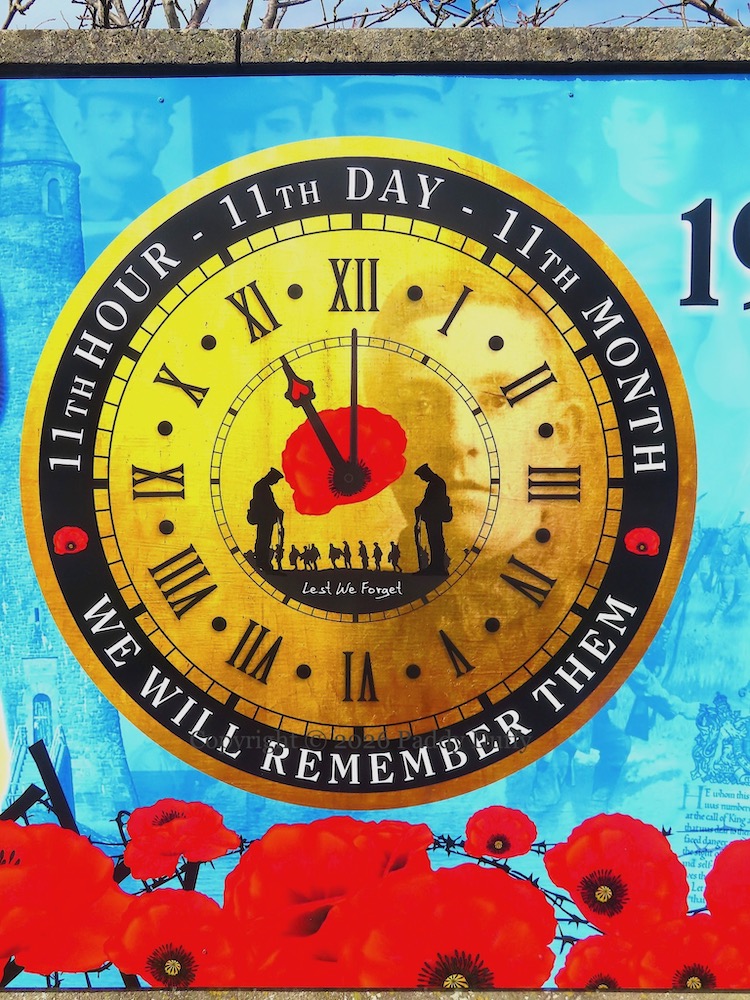
The Great War 1914-1918: “Be proud of the lads of Millbrook, who at the bugle call/put on the Country’s armour and rushed to duty’s call They have gone to beat the Kaiser, we are sure they will succeed,/To drive him out of Flanders, And Belgium shall be freed! Their names shall live in history, Their names we will adore,/And Ulster shall be proud of them, when they return once more.”
On the left are three medals: Pip, Squeak, and Wilfred (that is, the 1914 Star, for service in France or Belgium, the War (service) medal, and the Inter Allied Victory medal) (Identify Medals), with the ‘Dead Man’s Penny’ on the right.
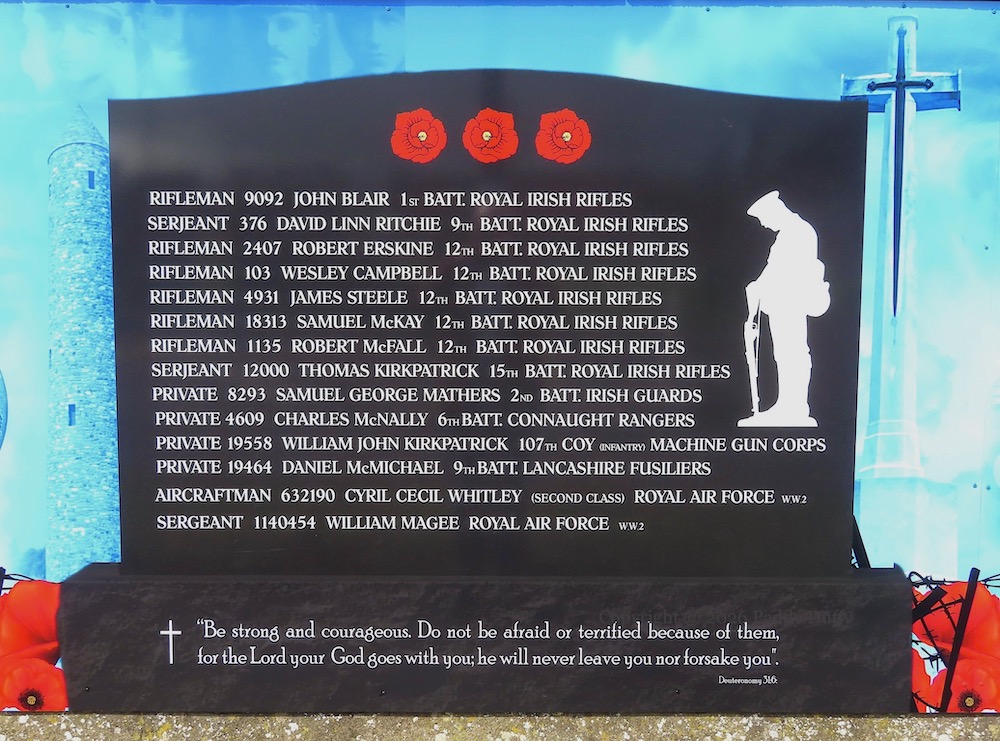
The names on the headstone between the two World War panels are [from WWI] John Blair, David Linn Ritchie, Robert Erskine, Wesley Campbell, James Steele, Samuel McKay, Robert McFall, Thomas Kirkpatrick, Samuel George Mathers, Charles McNally, William John Kirkpatrick, Daniel McMichael, [from WWII] Cyril Cecil Whitley, William Magee. “Be strong and courageous. Do not be afraid or terrified because of them, for the Lord your God goes with you; he will never leave you nor forsake you – Deuteronomy 31:6”
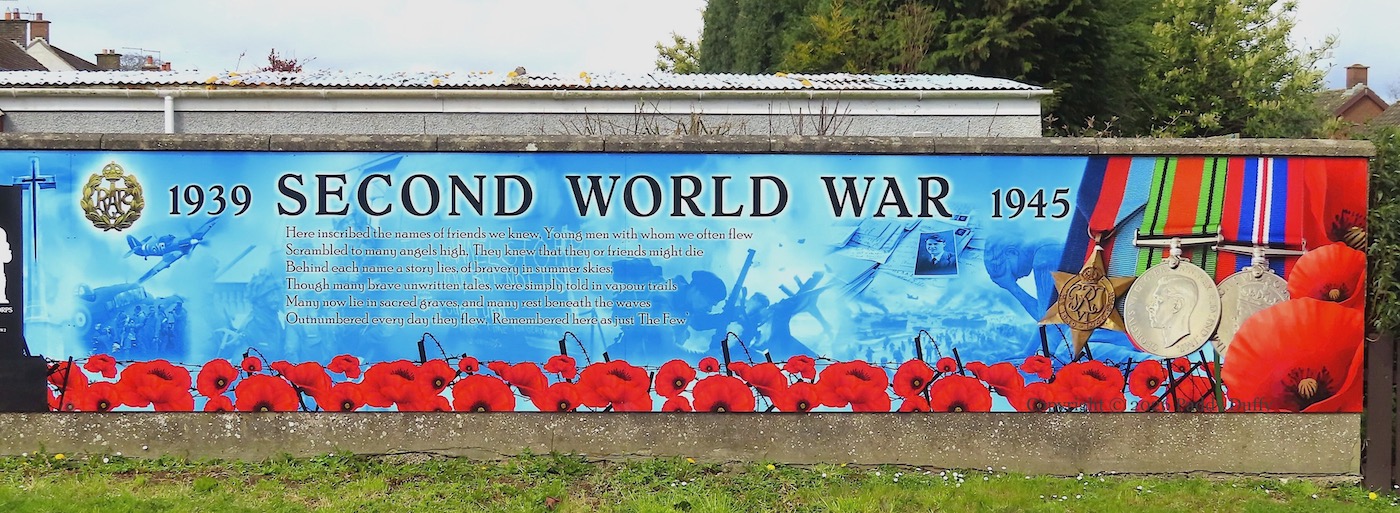
Second World War 1939-1945: “Here inscribed the names of friends we knew, Young men with whom we often flew Scrambled to many angels high, They knew that they or friends might die Behind each name a story lies, of bravery in summer skies; Though many brave unwritten tales, were simply told in vapour trails Many now lie in sacred graves, and many rest beneath the waves Outnumbered every day they flew, Remembered here as just ‘The Few'”
The medals on the right are the Burma Star, Defence Medal, and the War Medal, with the RAF brass cap badge on the left.
Along the main road in Drumahoe Gardens, Millbrook, Larne.
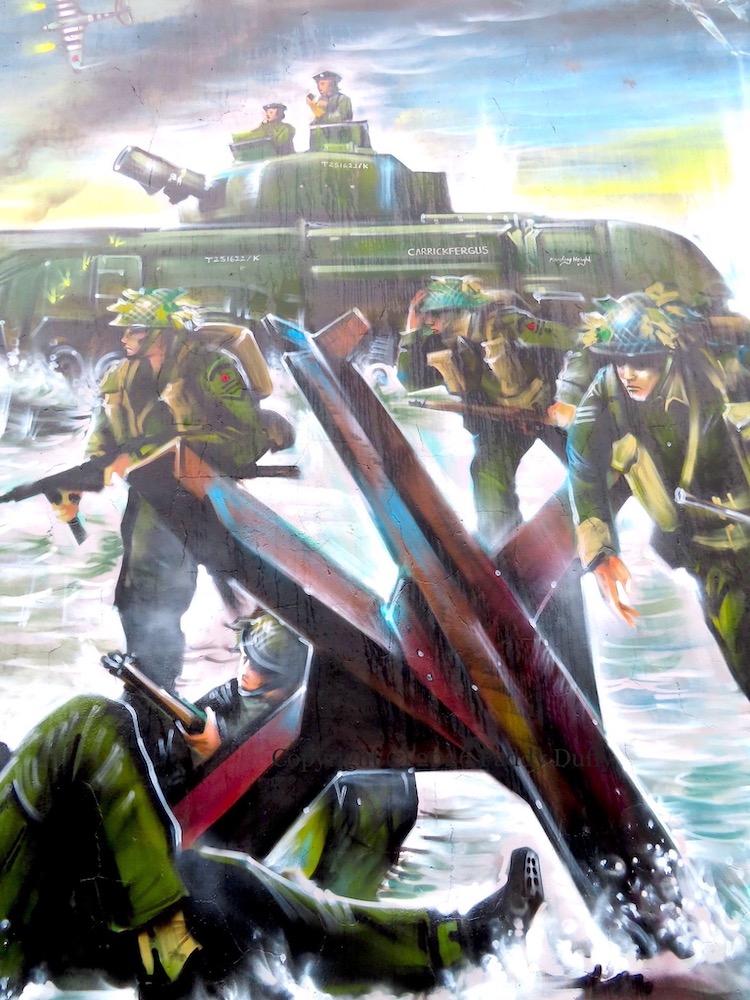
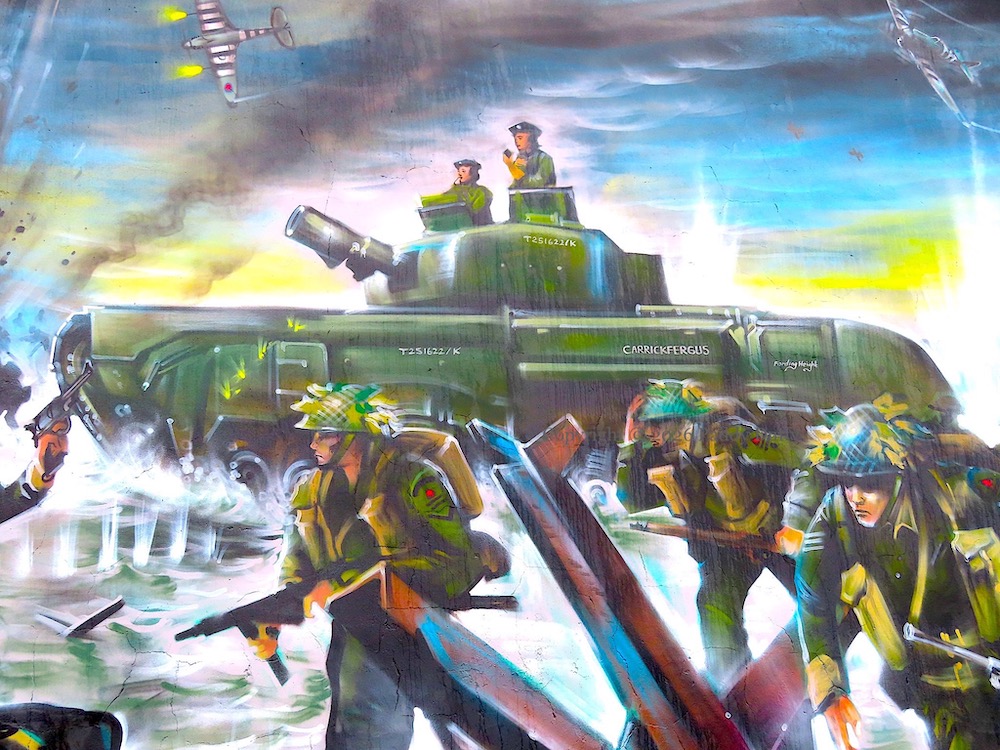
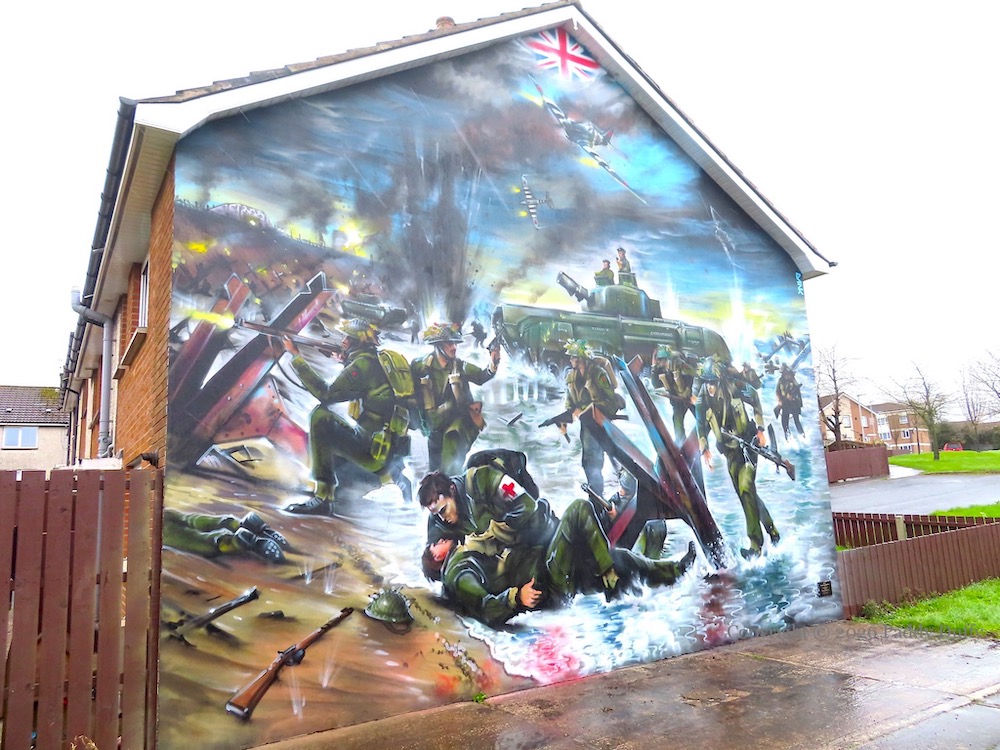
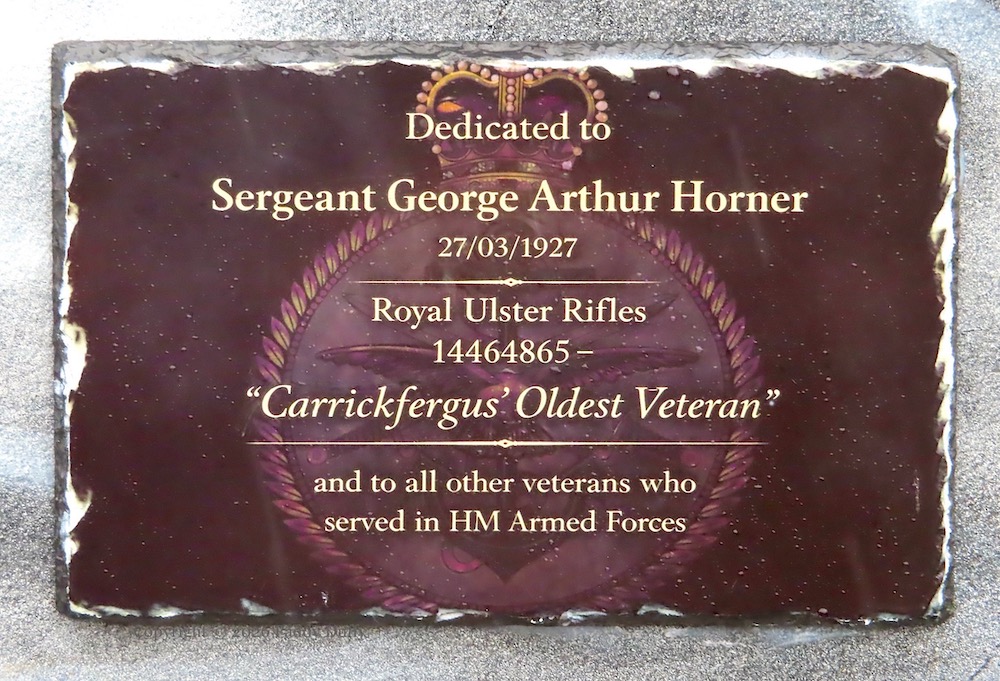
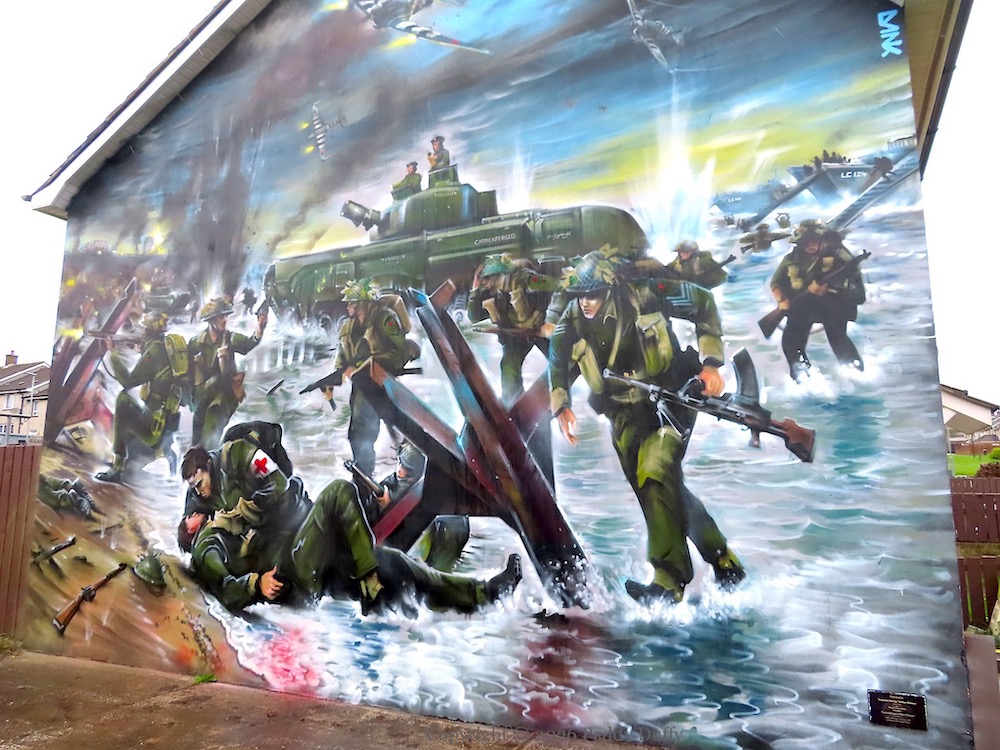
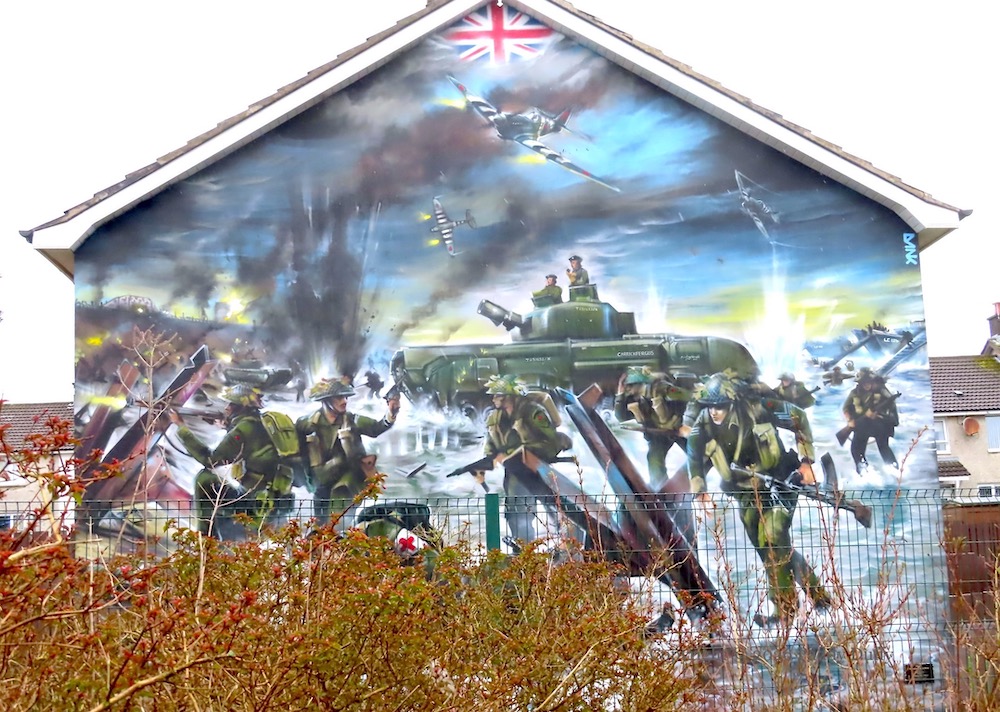
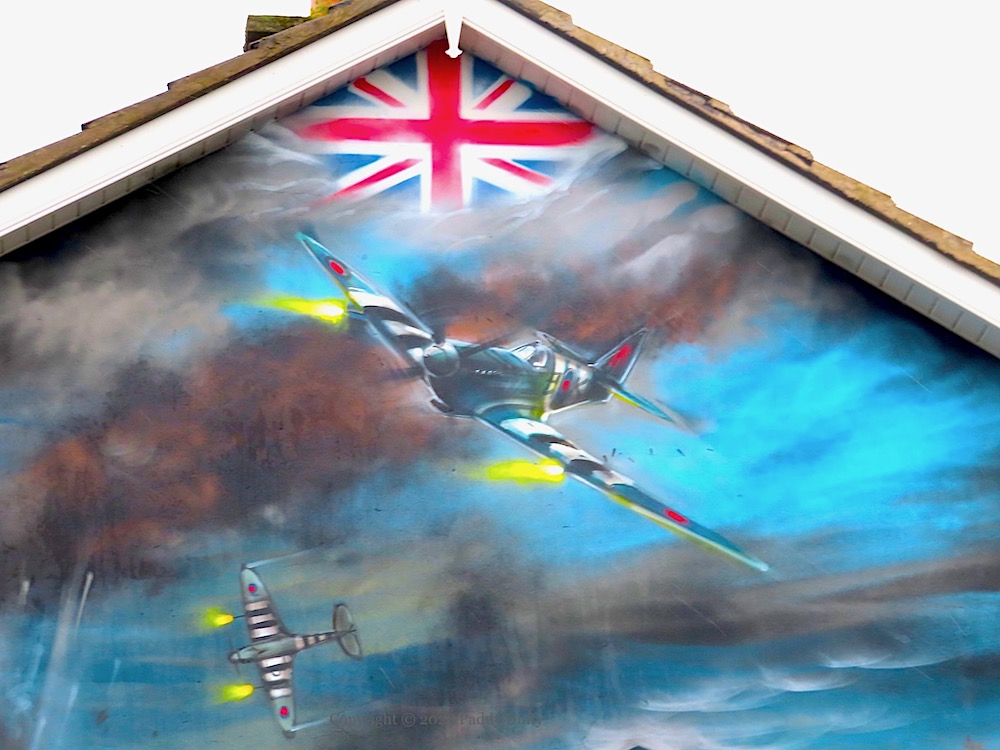
The plaque in the bottom-right corner reads, “Dedicated to Sergeant George Arthur Horner 27/03/1927 Royal Ulster Rifles 14464865 — “Carrickfergus’ Oldest Veteran” and to all other veterans who served in HM Armed Forces.” Horner turned 99 a few days after this mural of D-Day was unveiled (on March 22nd) and he was awarded the freedom of Mid- And East-Antrim Borough (web). He served in the second battalion of the Royal Ulster Rifles, and landed on Sword Beach during the D-Day landings in June 1944 (Fb).
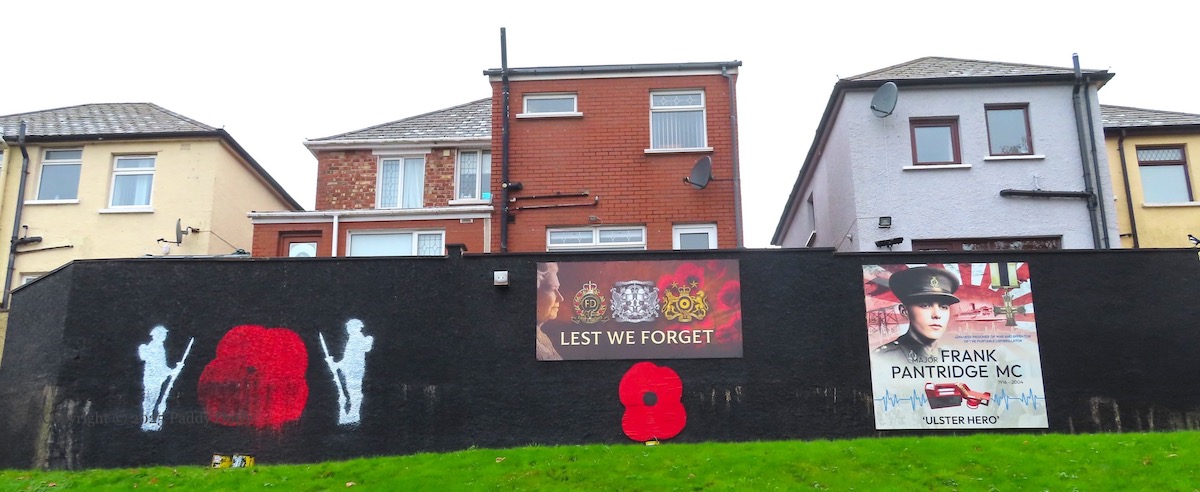
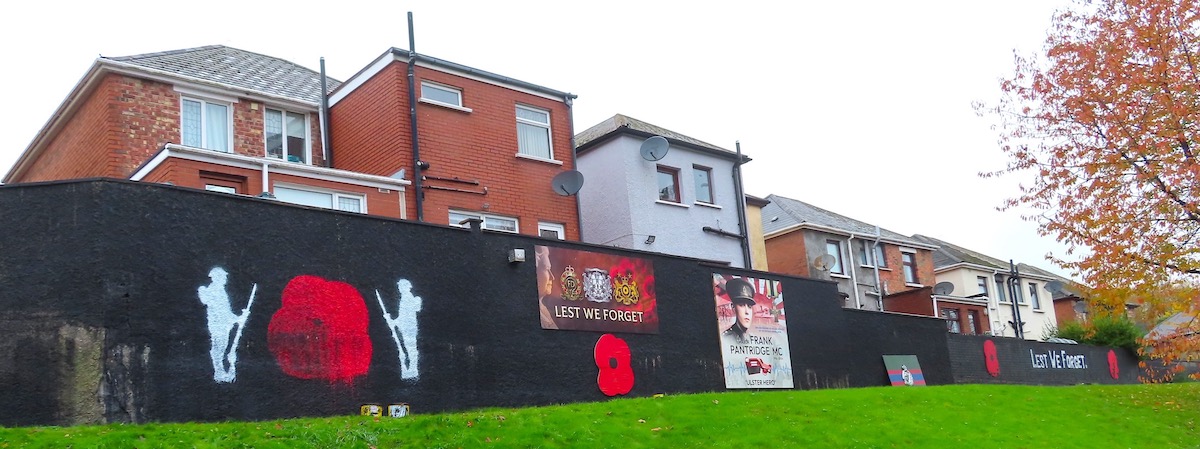
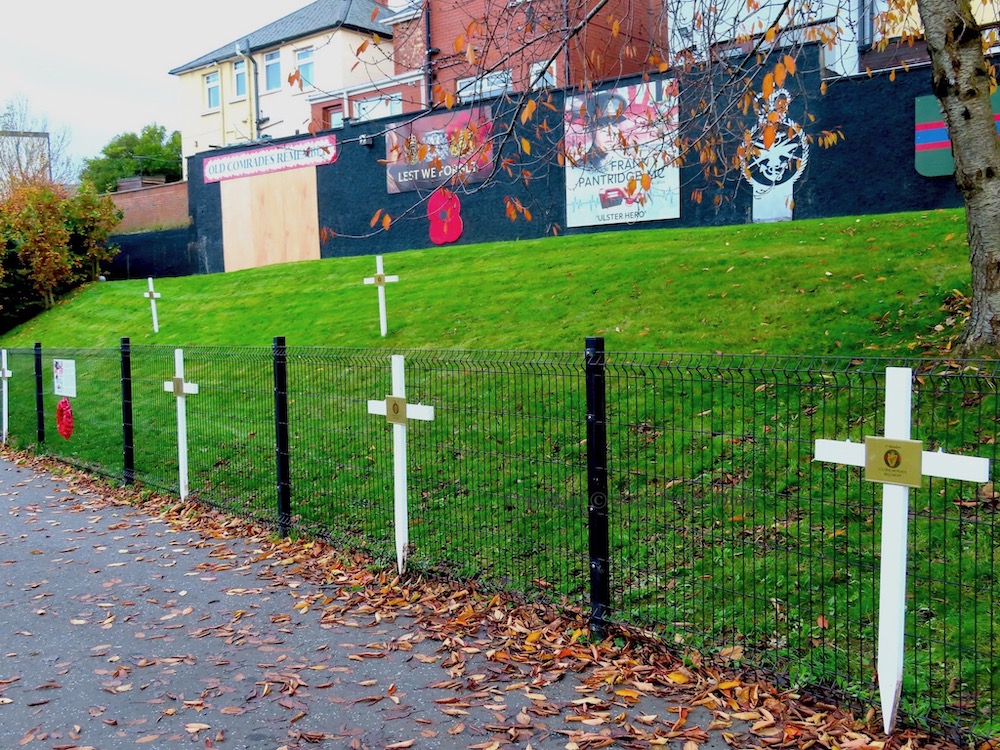
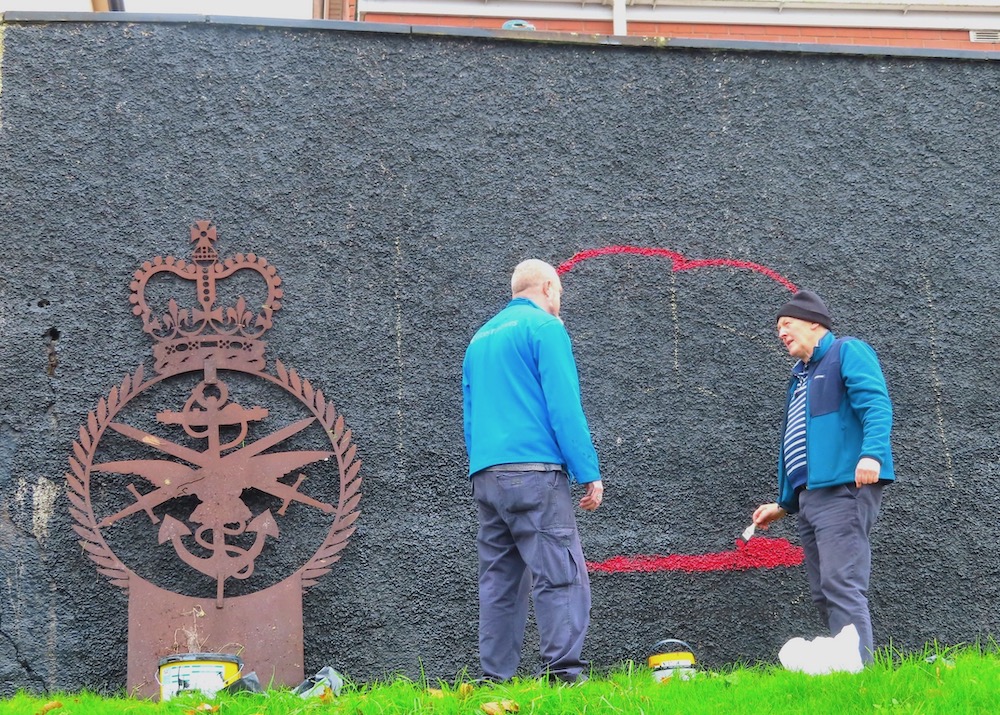
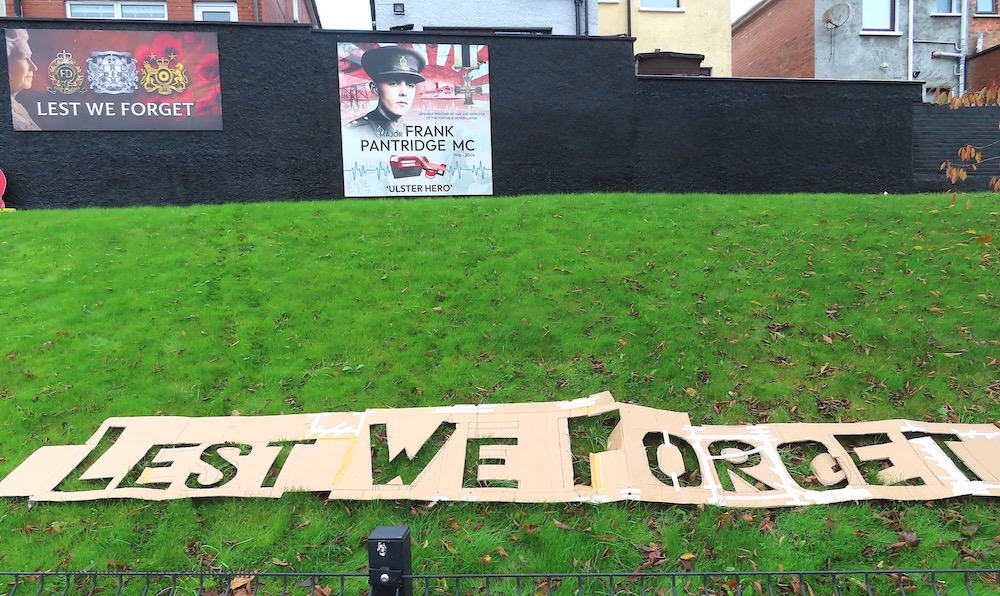
Here is a gallery of images from the wall behind the Shore Road ‘World Wars’ memorial (see Remembrance Sunday) which has a few new additions and re-ordered boards for this year’s commemorations. The main additions are the “Lest we forget” stencil shown above, and a large number of white crosses in the grass and along the fence bearing the emblem of the UDR. The UDR board has been moved from the slanted wall at the far left to what is now the central position on the wall.
For images from Sunday’s ceremonies at City Hall, see BBC.
The 1st Ranger Battalion was formed in 1942 as the United States Army’s equivalent to the British Army’s Commandos and – after training at a camp in Carrickfergus – it saw action in France (at Dieppe (SOF History), resulting in the first US casualties of the war – WP), Algeria, Tunisia, and Italy. (There are four information panels at the Sunnylands shops about the formation and training of the unit.)
The insignia shown – which is here placed on top of the beret patch – is the insignia of the modern (75th Regiment) Rangers, with the lightning-bolt indicating the unit’s quick-strike abilities (SOF History); these are also alluded to by the motto “sua sponte”, meaning “of its/their own accord”.
This new art is by Dan Kitchener (web) in Victoria Parade, Carrickfergus, just outside the train station, produced in co-operation with Wonder Arts, the Communities In Transition programme from the Executive Office (web) and Carrickfergus Alternatives’ Peace Impact Programme (Fb).
It has been criticized by street-artist Wee Nuls (web) as glorifying conflict (ig), a charge the artist rejects, saying that it was produced in co-operation with locals and has been well received by them (MSN). (See also the reactions on the Let’s Talk Loyalism Fb page.)
The tank might be the M4 Sherman “Fury”. The tank appeared in the 2014 film of the same name (Bovington Tank Museum) used by the 66th Armor Regiment under the command of Brad Pitt; the film is perhaps the inspiration for the image (e.g. the scene in which the town of Kirchohsen is captured – youtube).
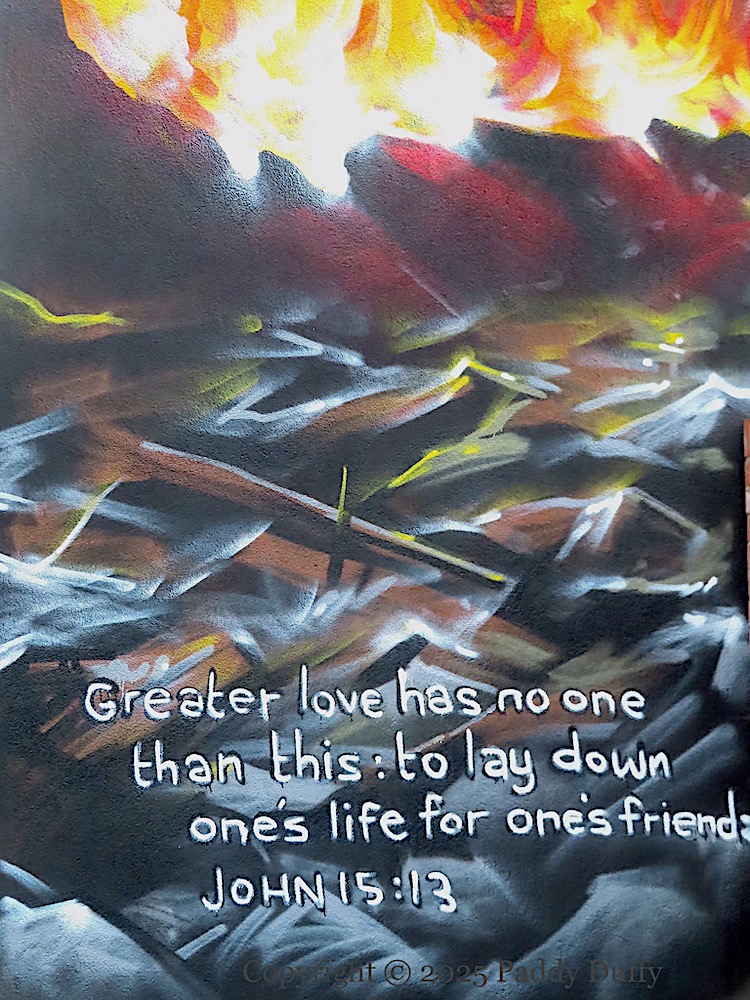
“Great love hath no man than this: to lay down his life for his friends – John 15:13”
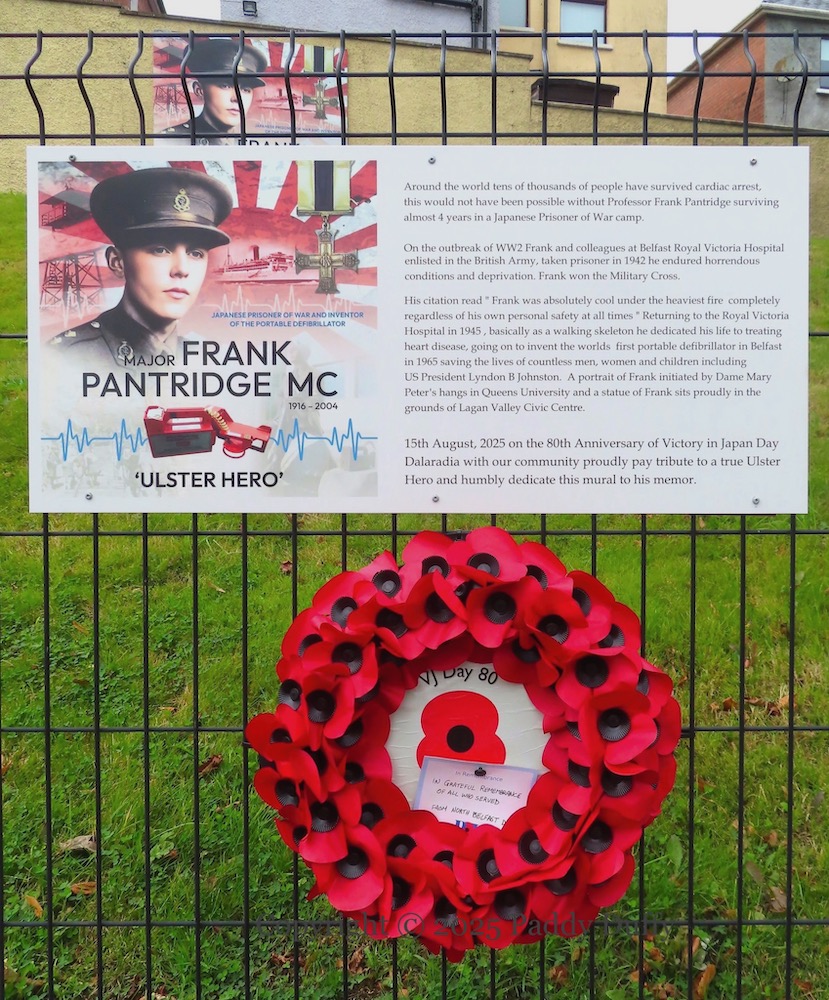
“Japanese prisoner of war and inventor of the portable defibrillator” – Frank Pantridge was born and died in Hillsborough, outside Lisburn and there is a statue of Pantridge with a defibrillator – his key invention – at the Lisburn Civic Centre and he is now remembered by this pair of printed boards on the Shore Road, unveiled on August 16th. He is also included in the nearby gallery of Great Ulster-Scots.
“Major Frank Pantridge, MC, ‘Ulster Hero’. Around the world tens of thousands of people have survived cardiac arrest, this would not have been possible without Professor Frank Pantridge surviving almost 4 years in a Japanese Prisoner of War camp. On the outbreak of WW2 Frank and colleagues at Belfast Royal Victoria Hospital enlisted in the British Army, taken prisoner in 1942 he endured horrendous conditions and deprivation. Frank won the Military Cross. His citation read “Frank was absolutely cool under the heaviest fire, completely regardless of his own personal safety at all times.” Returning to the Royal Victoria Hospital in 1945, basically as a walking skeleton he dedicated his life to treating heart disease, going on to invent the worlds first portable defibrillator in Belfast in 1965 saving the lives of countless men, women and children including Lyndon Johnston. A portrait of Frank initiated by Dame Many Peter’s hangs in Queens University and a statue of Frank sits proudly in the grounds of Lagan Valley Civic Centre.”
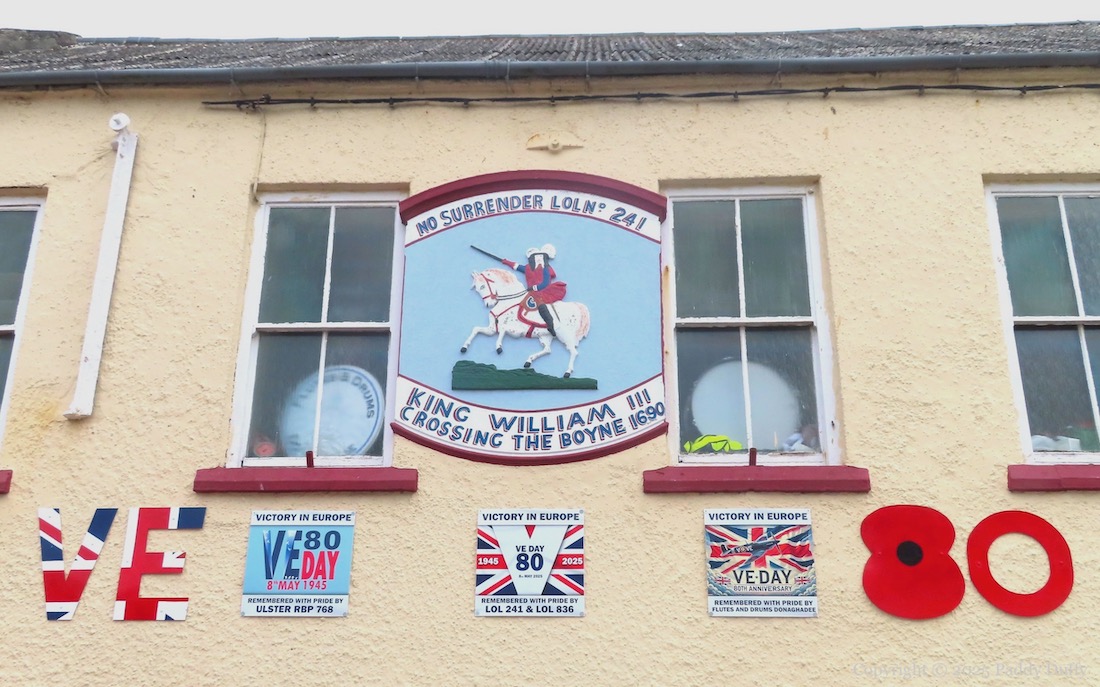
This image of King Billy crossing the Boyne in 1690 is on the No Surrender lodge (LOL 241) in Donaghadee. King William III’s victory in Ireland is celebrated annually on July 12th, with parades and gatherings of fraternal lodges and flute bands.
William’s victory is joined here by a number of small boards commemorating the 80th anniversary of Victory In Europe, on May 8th, 1945, “remembered with pride” by Orange lodges 241 and 836 (Brother Henry Ferguson Memorial), Royal Black Preceptory 768 (Ulster), and Flutes And Drums Donaghadee (Fb).
Manor Street, Donaghadee, replacing two Platinum Jubilee boards.
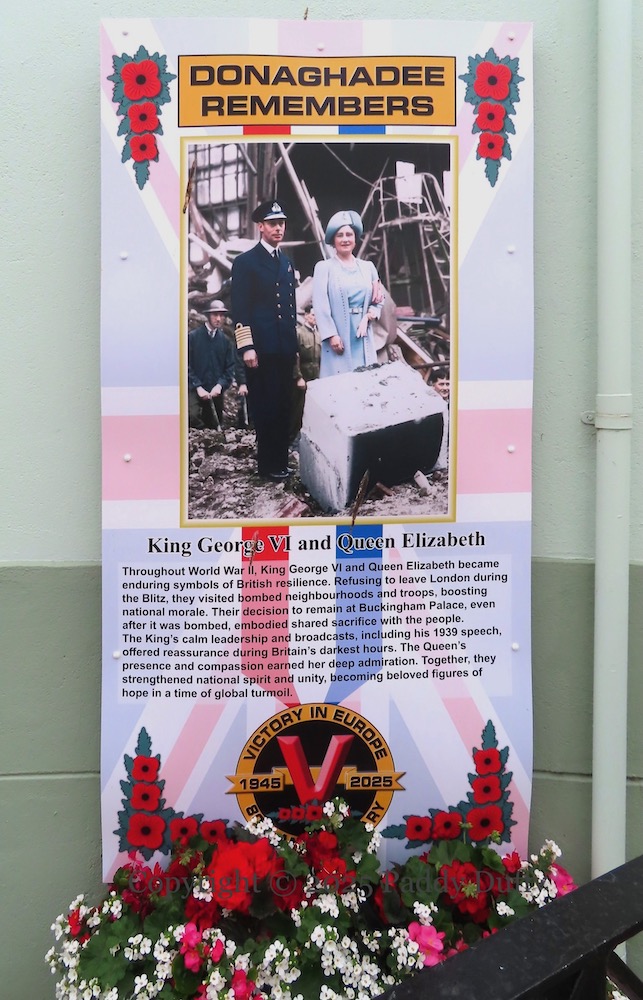
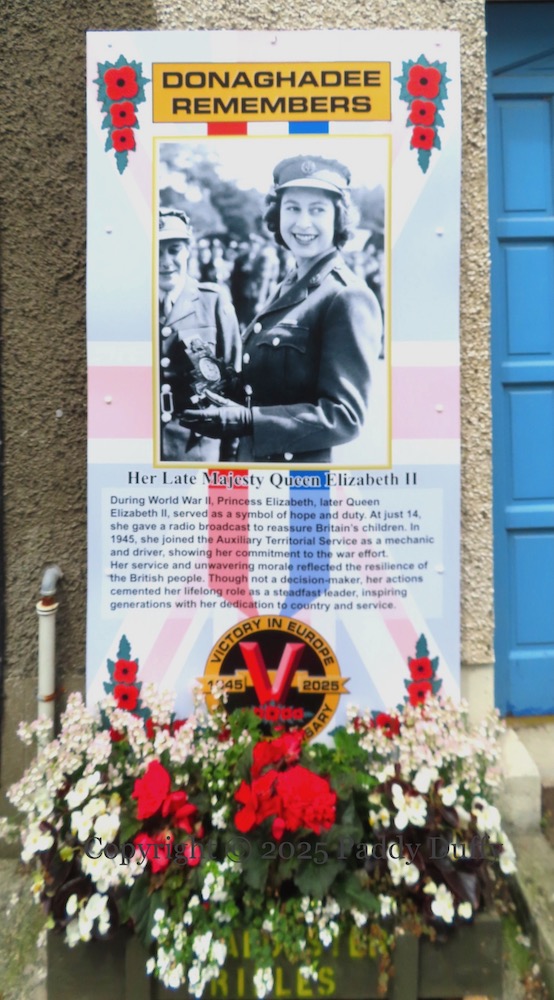
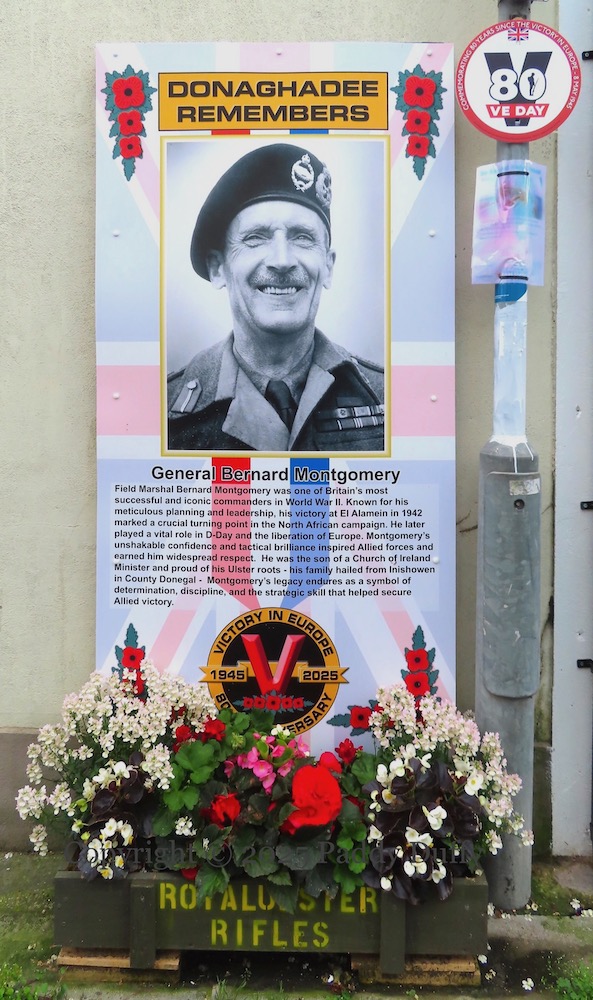
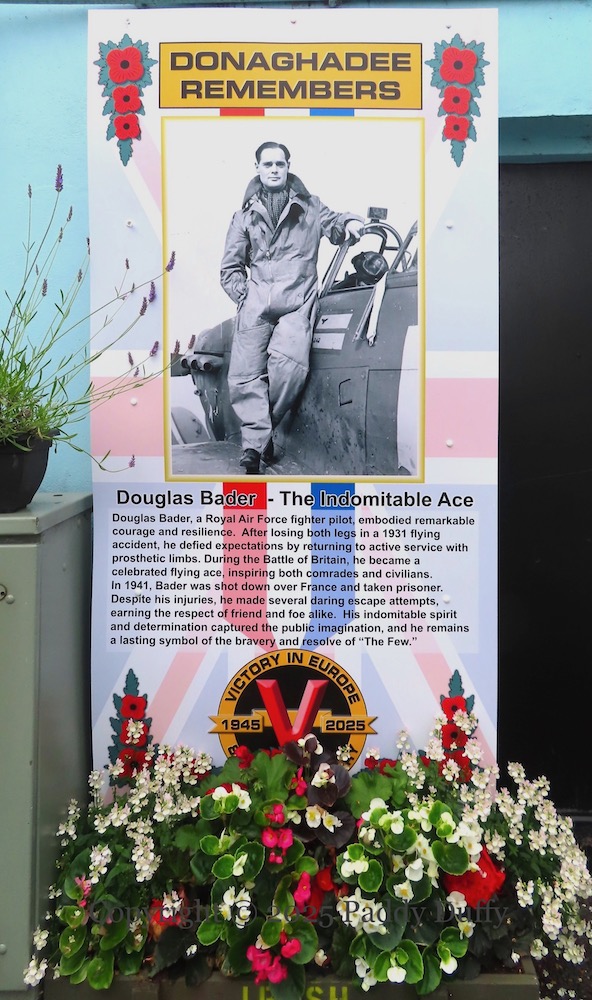
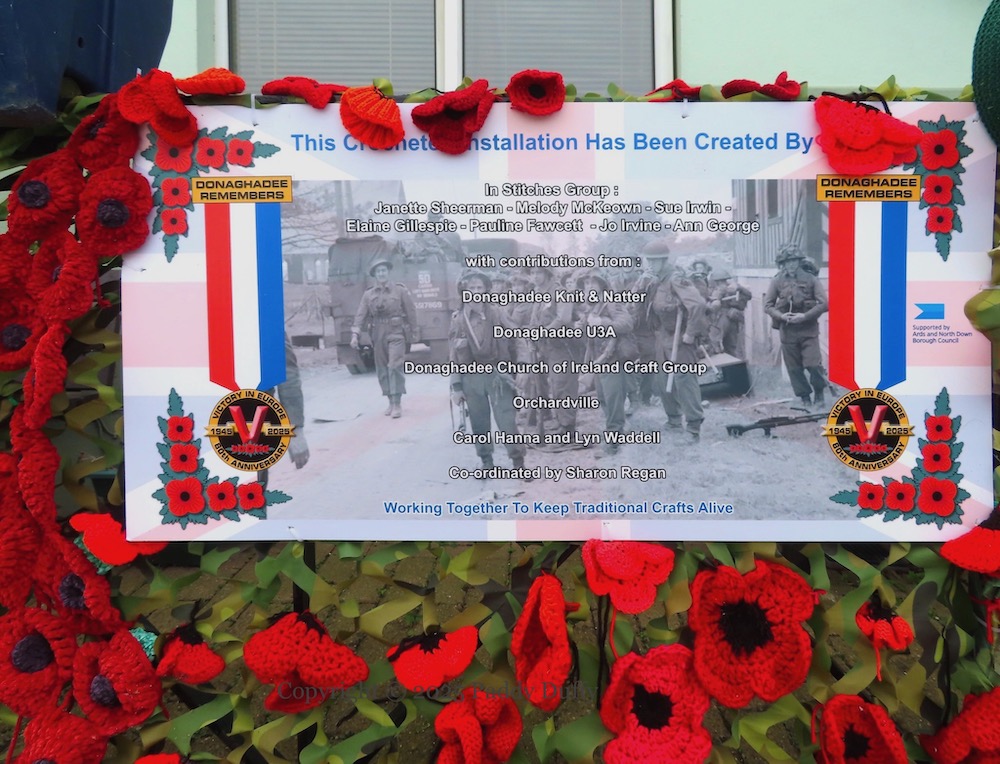
As part of the town’s VE Day celebrations, Donaghadee mounted a series of flower boxes, information boards, and crocheted poppies, along Hunter’s Lane (which runs between High Street and the Parade). Also included are small panels to twenty-three local soldiers who died during the War.
“Donaghadee Community Development Association [Fb], in collaboration with Donaghadee Community Partnership, Donaghadee Historical Society [Fb] and the In Stitches Group, is proud to present this floral and educational display in commemoration of the 80th anniversary of Victory in Europe. With support from Ards and North Down Borough Council, First Presbyterian Church, Abbeyfield, Wesley Housing and local residents, this project brings history to life in the heart of our town. / On 8th May 1945, the guns across Europe fell silent. After six years of devastating conflict, Nazi Germany surrendered unconditionally, marking the end of the Second World War in Europe. VE Day – Victory in Europe Day – was met with celebration, relief, and solemn reflection. Across the United Kingdom and the Commonwealth, crowds rejoiced, even as they grieved for the fallen and the irrevocable loss left in war’s wake. This display honours the 23 men and women from Donaghadee who gave their lives in service during World War II. We remember them with pride, gratitude, and sorrow. Through a series of commemorative panels, we also highlight the stories of eight wartime figures – from global leaders to everyday heroes – whose courage shaped history. / This is more than an remembrance. It is a space to reflect, to learn, and to give thanks. As we mark this significant anniversary, we commit ourselves anew to the values of peace, unity, and understanding. Let us remember – not only what was lost, but also what was won: the enduring freedom we enjoy today.”
The eight notable figures are: “Winston Churchill, the voice of defiance”, “King George VI and Queen Elizabeth”, “Her late majesty Queen Elizabeth II”, “Dame Vera Lynn, the forces’ sweetheart”, “Lt Col Blair Mayne, SAS trailblazer”, “Violette Szabo, the courageous spy”, “General Bernard Montgomery”, “Douglas Bader, the indomitable ace”.
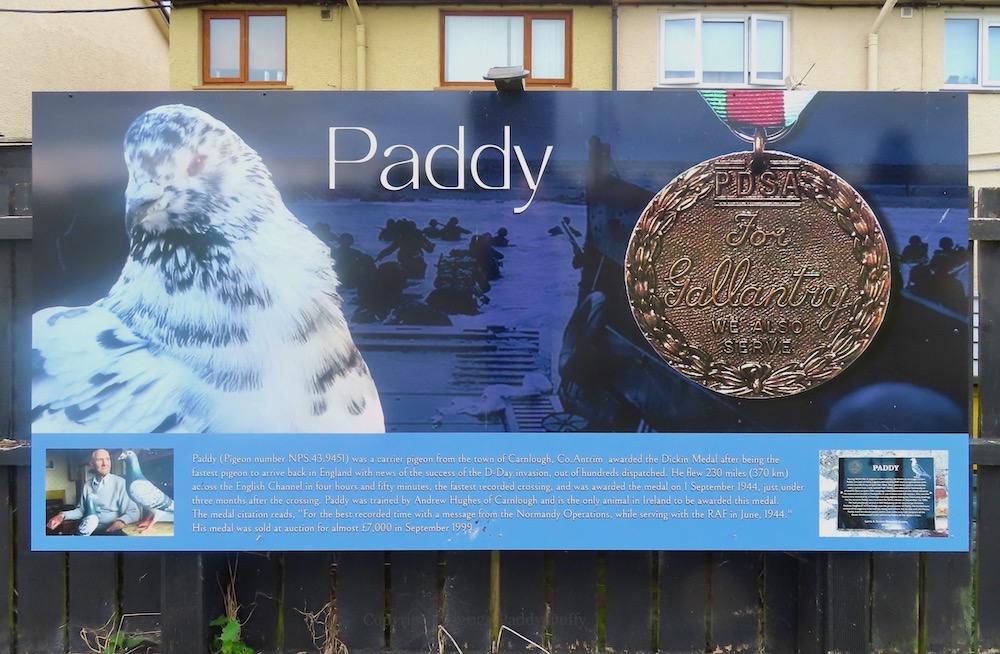
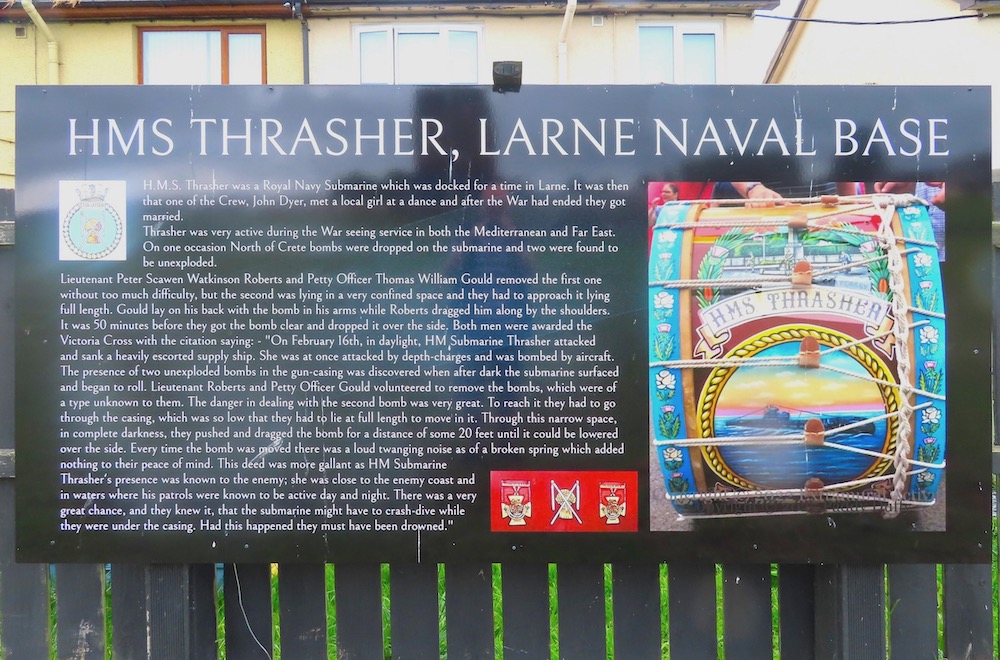
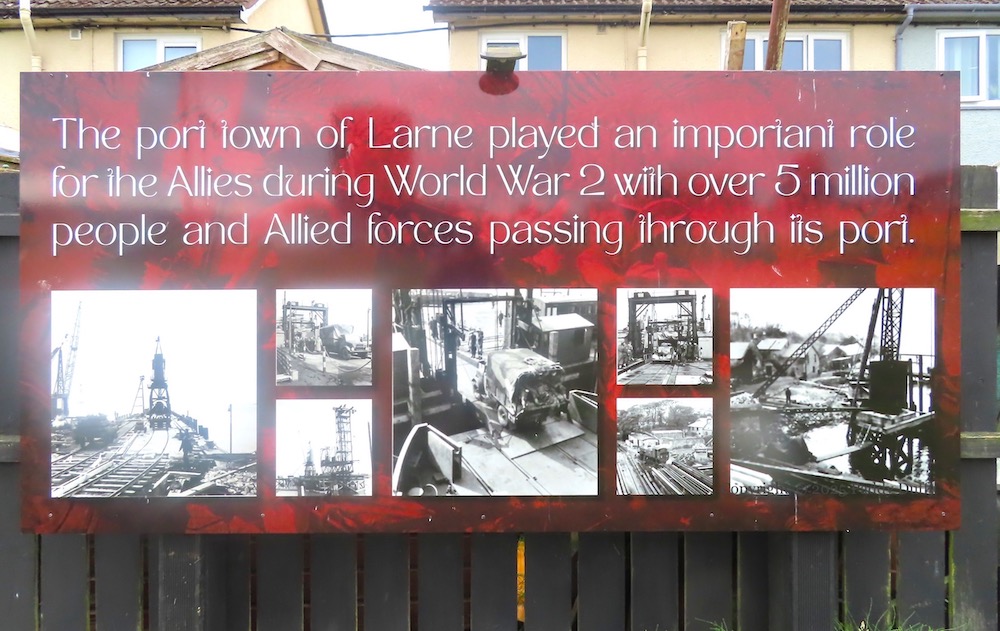
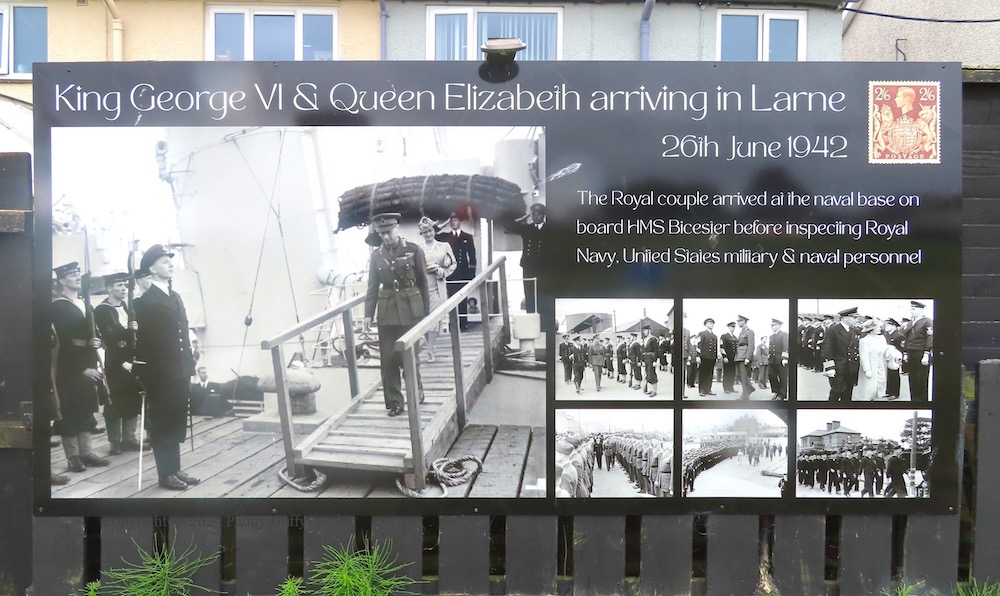
This is a series of ten boards in Craigyhill, Larne about WWII. (It replaces a set of twelve UDA boards – see The Loyalist Executioner.)
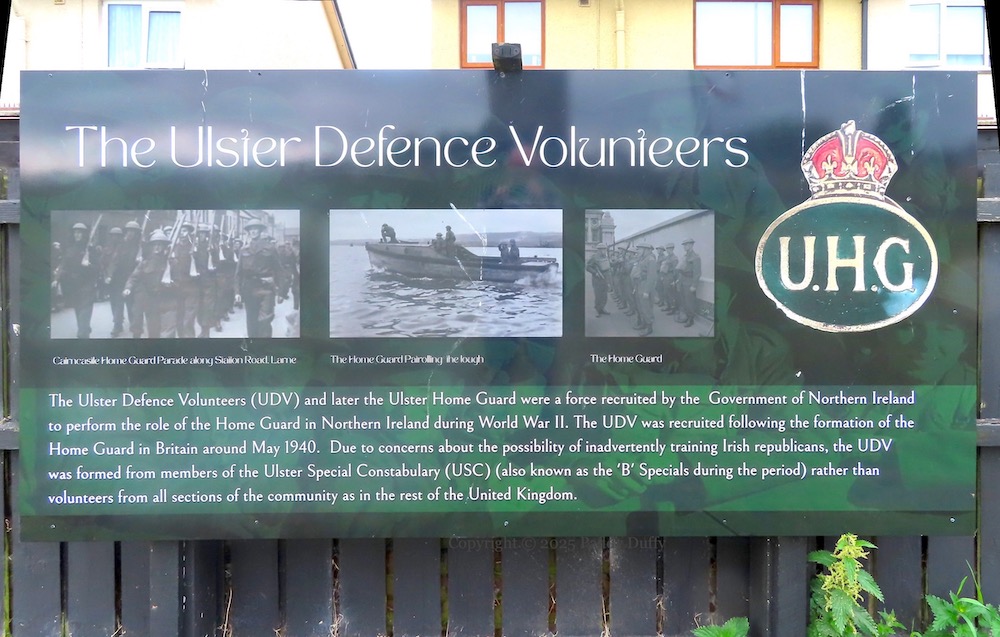
From left to right (top to bottom) their subjects are: the Ulster Defence Volunteers/Ulster Home Guard, formed from the B Specials; Paddy the pigeon; submarine HMS Thrasher (using an image from the Seosamh Mac Coılle collection); HMS Larne, a minesweeper built in Renfrew, Scotland; the port of Larne through which passed “over 5 million people and Allied forces”; Kilwaughter Castle, a training ground for UK and American troops; the royal visit of King George VI and Queen Elizabeth in June 1942; James Stuart Steele of Ballycarry, who served in both WWI and WWII; the Larne Spitfire, one of seventeen spitfires funded by a Belfast Telegraph fund-raising drive (Wartime NI | see also the Ballymena spitfire in Per Ardua Ad Astra); local casualties of WWII – “In remembrance of those from town of Larne that paid the supreme sacrifice during the Second World War”.
39 Allied divisions – 12 of them British – participated in the Normandy Landings – officially “Operation Neptune” – that took place on June 6th, 1944; in planning for the operation, the original “D-Day” was June 5th, but bad weather postponed it until the following day, when 160,000 troops stormed the beaches of the Bay Of The Seine. By the end of August, Paris had been liberated, and by the following May, victory in Europe had been achieved. 2024 was the eightieth anniversary of D-Day and 2025 the eightieth anniversary of VE Day, on May 8th.
This D-Day board and VE Day mural are in Edlingham Street, Tiger’s Bay, north Belfast. Also included below is a WWI memorial electrical box in Mervue Street, though as can be seen from the board (immediately below) the ‘graveside mourner’ silhouette is becoming a generic symbol of lost UK forces.



















 Paddy Duffy Collection