The United Kingdom Of Great Britain And Ireland was created in 1801, a reaction to the 1798 Rebellion, led by (amongst others) Wolfe Tone and Henry Joy McCracken, who were founding members of the Society Of United Irishmen in 1791 in Belfast.
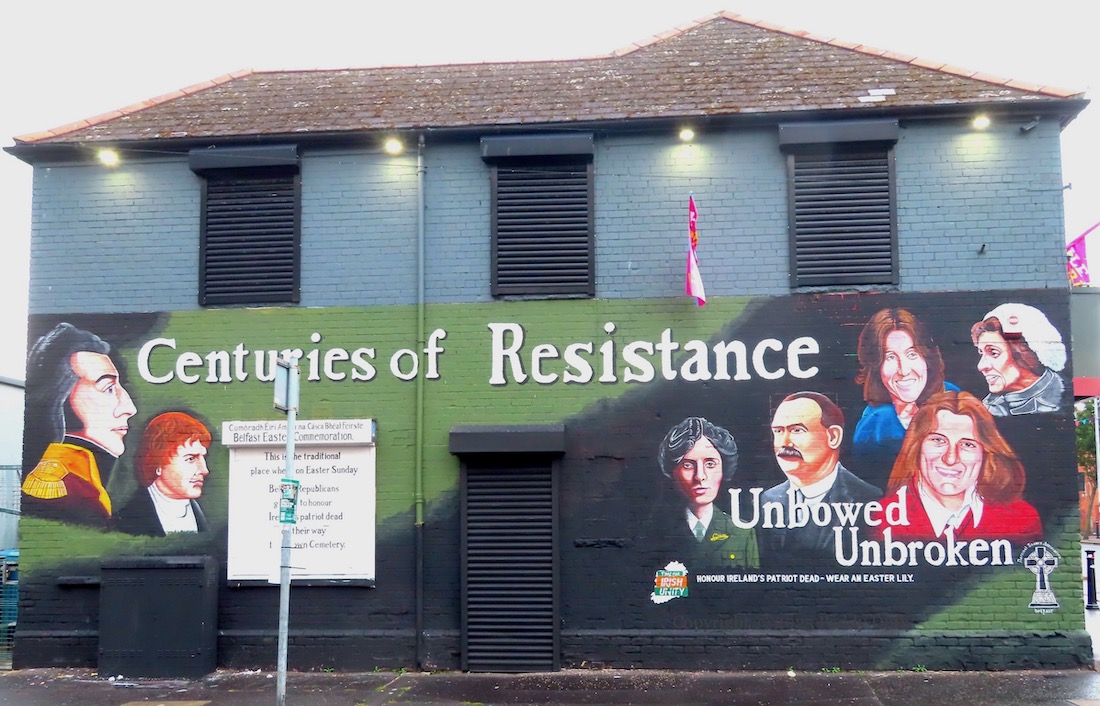
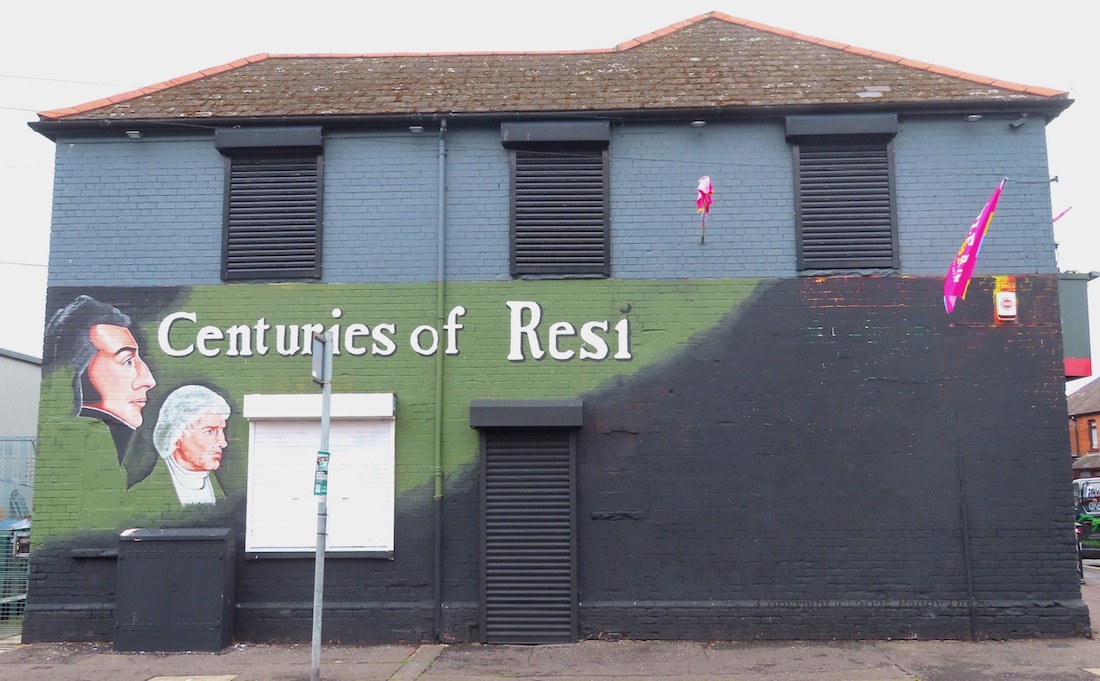
In this mural, Tone and McCracken on the left gaze across the “centuries of resistance” from 1798 to 1916 Rising revolutionaries Countess Markievicz and James Connolly, and beyond to Troubles-era figures Maıréad Farrell, Bobby Sands, and Máıre Drumm.
Around the same time as this mural was painted, a Féıle exhibition called ‘Vibrant Colours, Violent Past’ included A Panorama Of Republicanism which contains dozens of figures but again chooses 1798/Tone, 1916/Connolly, and the Troubles/Martin McGuinness as the pivotal moments and figures.
“Comóradh Éırí Amach Na Cásca Bhéal Feırste/Belfast Easter Commemoration. This is the traditional place where on Easter Sunday Belfast republicans gather to honour Ireland’s patriot dead on their way to Milltown Cemetery.” “Honour Ireland’s patriot dead – wear an Easter lily.” “Unbowed, unbroken.”
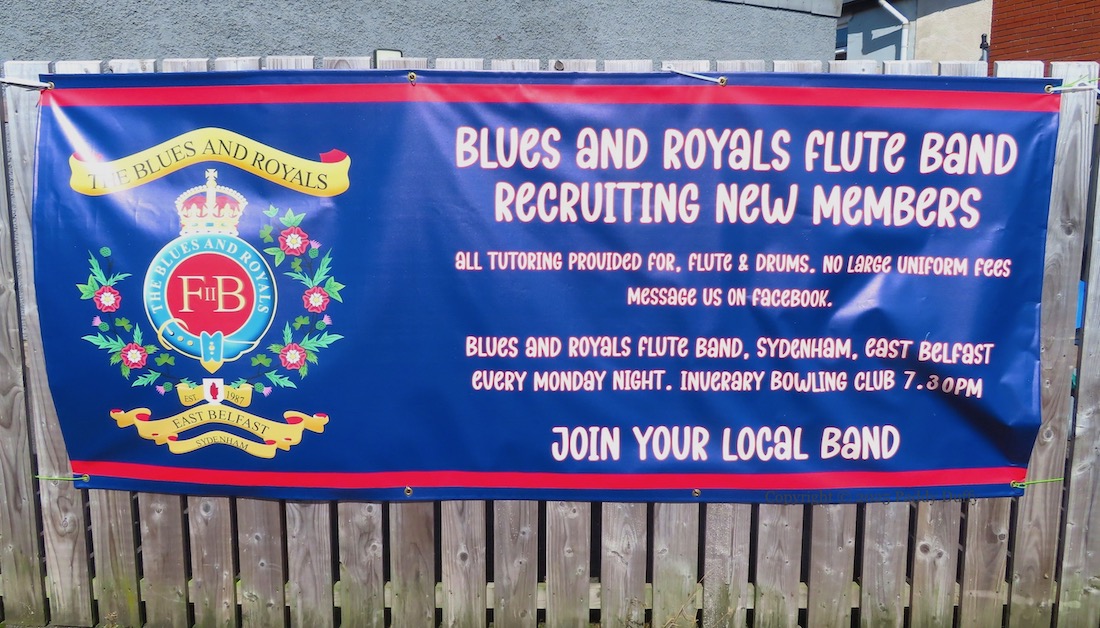
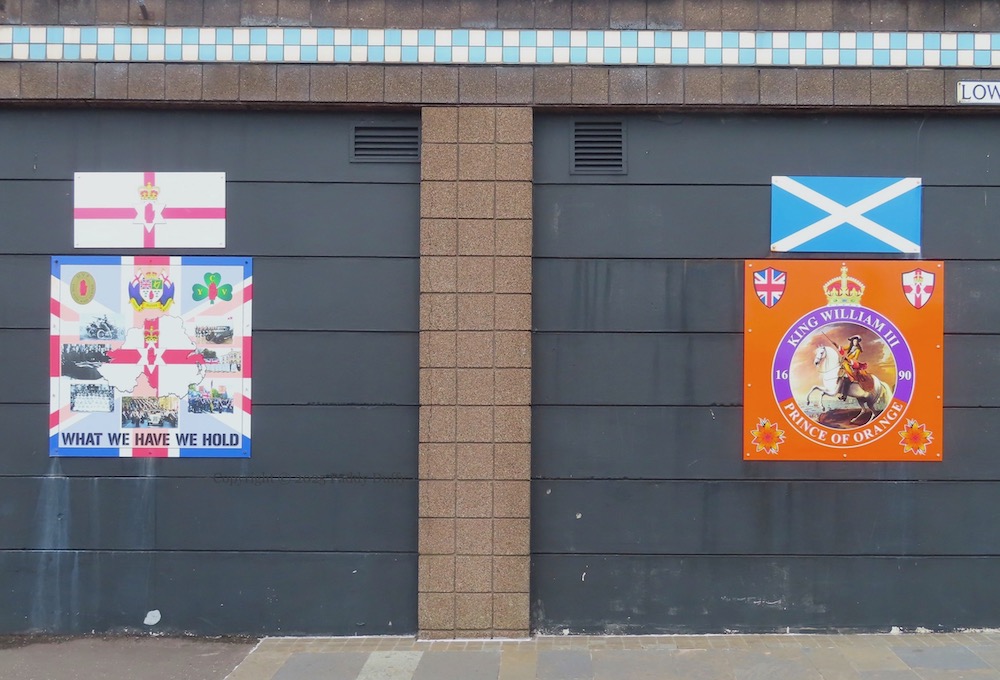
Above, a recruitment tarp for the Blues And Royals flute band (Fb).
Below, (and on the wall above the flute band’s tarp) a NI Centenary board using the St Patrick’s saltire in the background. The saltire is an Anglo symbol of Ireland and was included in the Union Flag when the union was between Britain and Ireland and thus – like the word “Ulster” – has been reduced to signifying Northern Ireland after partition.
Three plaques at the Ballynafeigh Apprentice Boys social club on Blackwood Street:
“In loving memory of Allison Jane Smith – you’re missed so much by so many who knew you in Ballynafeigh”, “Celebrating the 100th anniversary of the foundation of Northern Ireland – Northern Ireland centennial 3rd May 2021”, “In memory of all our past members”.
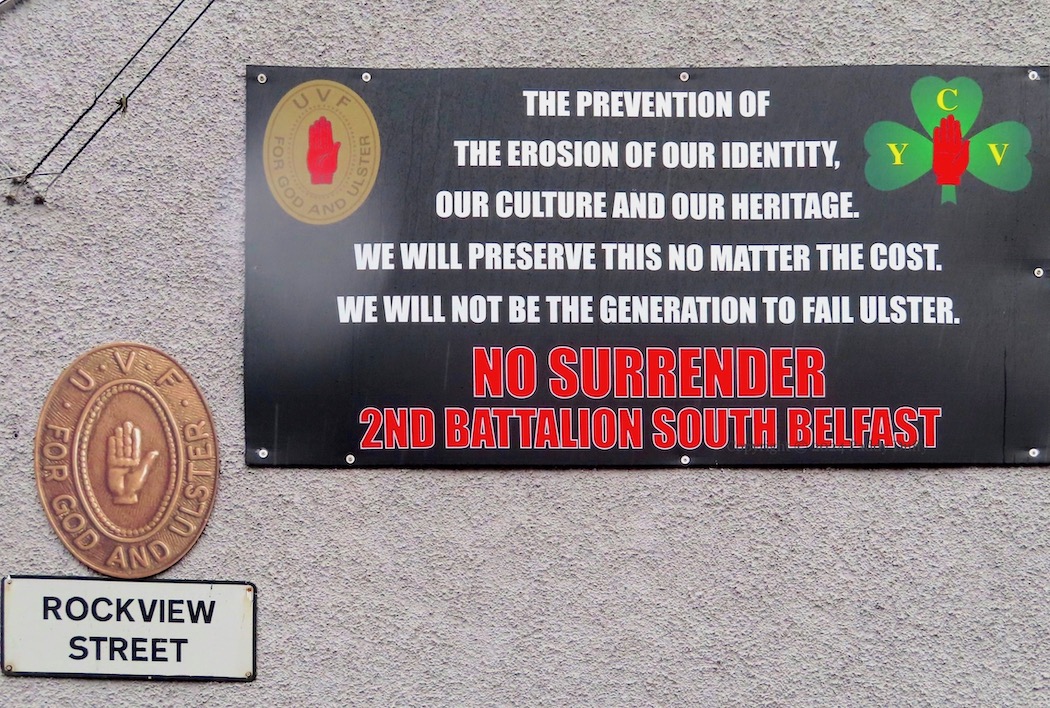
“Loyalist Village, south Belfast.” UVF markings in the Village continue to proliferate with the recently-added board shown above (from the top of Tavanagh Street) alongside a slew of other boards, some of which are included below.
The “Village team” is not Linfield FC but the UVF (the phrase was also used by the Village UDA); “VTOT” (standing for “Village team on tour”) has previously been used as graffiti – see Welcome To Hell!!!
The purple hoarding below gives “1913” as a creation-date for the battalion. The Ulster Unionist Council organised the signing of the Covenant in September, 1912, and in January 1913 voted to bring together the militias that had been formed in various places into an Ulster Volunteer Force. One of these was a South Belfast battalion that had formed in 1912 (History Ireland). Hence, both “1912” and “1913” are given as dates for the creation of the battalion. When the Volunteers were integrated into the Ulster Division for the Great War, the South Belfast Volunteers joined the 10th battalion of the Royal Irish Rifles.
“The Shamrock supports Kneecap”. Kneecap member Mo Chara (Lıam Óg Ó hAnnaıdh) appeared in court (in London) last week to face charges of displaying a flag of a proscribed organisation (Hezbollah). He was released on bail and will return on August 20th. (BBC | AP) In the meantime, the group appeared in front of 10,000 fans on the West Holts stage at Glastonbury on Saturday (June 28th) despite criticism from UK prime minister Keir Starmer (BBC).
The Shamrock Sport & Social Club (Fb) in Ardoyne is running a promotion by which people who post their selfies in front of the new mural in support of Kneecap on social media can claim a bottle of Le Grá lager (web).
A statue to Winifred Carney was unveiled, along with another to Mary Ann McCracken, in the grounds of Belfast City Hall on Friday, March 8th (BCC). At her left hand is a typewriter. Carney was a qualified secretary and typist, and became secretary of the Irish Textile Workers’ Union in 1912, in which position she met James Connolly, who was secretary of the Belfast branch of the ITGWU. The 1913 manifesto addressed ‘To The Linen Slaves Of Belfast’ (marxists.org), exhorting “our toiling sisters” in the mills to join the organisation, was signed by Carney, Connolly, and Ellen Gordon.
Her uniform, and the amorphous pistol (or holster?) in her right hand, refer to her membership of Cumann Na mBan and participation in the Easter Rising of 1916. Carney was in the GPO when it was taken over and was among those who surrendered at the end; during the occupation she typed up dispatches from the Moore Street headquarters. A News Letter editorial described the statue as smuggling terrorists onto the grounds of city hall.
“Winifred Carney, born in Bangor, was a suffragist and a committed trade unionist. She was an organiser in the Irish Textile Workers’ Union and became James Connolly’s personal secretary, political confidante and friend. In 1913, She and Connolly wrote the Irish Textile Workers’ Union manifesto entitled ‘To the Linen Slaves of Belfast’. It was a time when Belfast workers, mostly women and children, were working long hours in horrific conditions, barefoot and hungry. “D’oıbrıgh Winnie ar son oıbrıthe Bhéal Feırste, go háırıthe ar son na mban agus na bpáıstí a bhíodh ag obaır sna muılte ar fud na cathrach. “Many Belfast mills are slaughterhouses for the women and penitentiaries for the children.” Chomh maıth leıs an obaır a rınne sí ar son na gceardchumann, ba Phoblachtánach í Winnie a bhí ına ball de Chumann na mBan agus d’Arm Cathartha na hÉıreann. As an officer in the Irish Citizen Army, Winnie was present with Connolly in the Dublin General Post Office during the 1916 Easter Rising and has since become known as ‘the typist with the Webley’. Carney stood as a Sınn Féın candidate in the 1918 elections, but in an ‘unwinnable’ seat. She retained her commitment to socialism and in 1924, Winifred joined the Northern Ireland Labour Party. Here she met her future husband, George McBride, like her a committed socialist. George was a Protestant from Shankill Road who fought at The Battle of the Somme with the 36th (Ulster) Division. Tá Winnie curtha ı Reılıg Bhaıle an Mhuılınn ar Bhóthar na bhFál ın ıarthar Bhéal Feırste.”
The “Loyalist Lower Shankill” (a UDA stronghold) welcomes you – if you are aligned with the United Kingdom, the crown, and Northern Ireland; to all others who might have wandered in, “no surrender”.
Thursday, May 8th, marks the eightieth anniversary of VE or “Victory in Europe” day, the end of WWII on the continent. About 380,000 British soldiers died during the war. Commemorative events in Belfast include a walking tour of the city centre (City Council) and a dance on the HMS Belfast (IWM); for events elsewhere in Northern Ireland, see VE-VJDay80. Pubs will be open for an extra two hours (until 1 a.m.) on the day.
This printed flag is in Dee Street, east Belfast, previously home to various WWI commemorations (seen in All together Now | At The Eleventh Hour); for more on the KCIII and QEII boards included in the final image, below, see My God-Given Right To Rule.
This board in memory of Queen Elizabeth is on the Orange Hall in Carncullagh Road, which is home to LOL 534 and RBP 401. It was unveiled by Jim Allister at the end of 2022 (Dervock Community Fb).
“Queen Elizabeth II 1926 – 2022. “It’s worth remembering that it is often the small steps, not the giant leaps, that bring about the most lasting change.” Dervock thanks you for your service.” “On her twenty-first birthday, 21 April 1947, Princess Elizabeth pledged “I declare before you all that my whole life whether it be long or short shall be devoted to your service and the service of our great imperial family to which we all belong”. “Your Promise Maintained” – Thank You for Your Service Ma’am.”
“Our late Queen’s greatness came from her steadfast faith in Jesus Christ. On Christmas Day 2002 the Queen state, “I rely on my faith to guide me. I know that the only way to live my life is to try to do what is right. To give of my best in all that the day brings, and put my trust in God.” Jesus says in John 14:6, “I am the way and the truth and the life. No-one comes to the Father except through me.”
With the signatures of masters Roland Hill, James McMaster, and reverend Campbell Mulvenny of Dervock Presbyterian Church.
Last below: a tarp celebrating the coronation of King Charles III