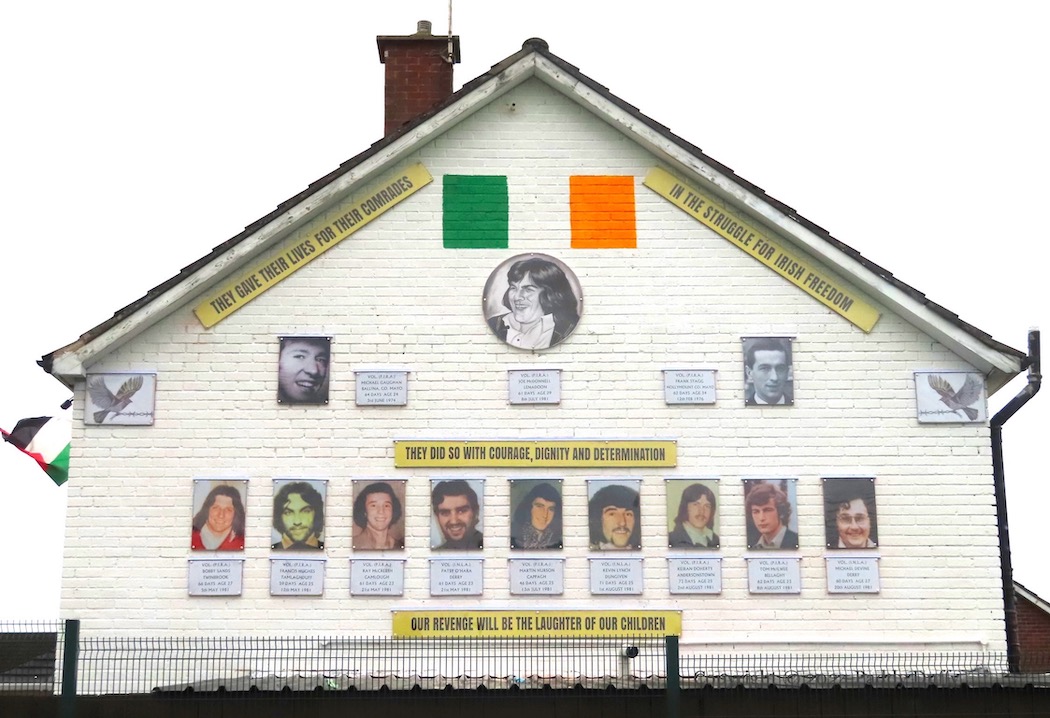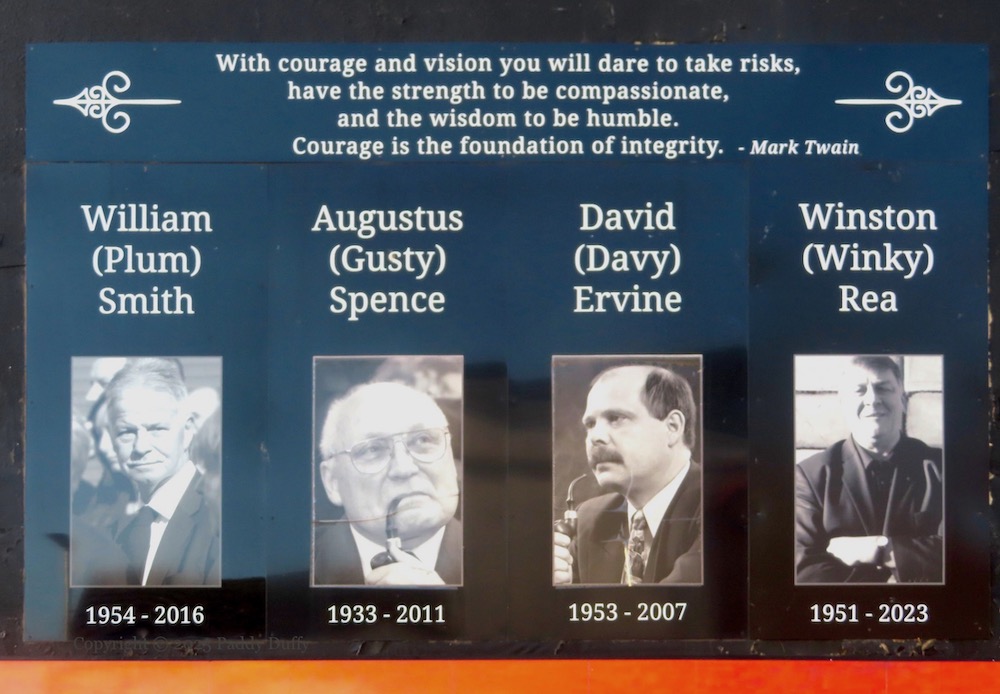
“They gave their lives for their comrades in the struggle for Irish freedom. They did so with courage, dignity and determination.”
The previous piece in this location – A Letter To The 22 – included ten dead hunger strikers from the before the Troubles; this new piece includes only the twelve Troubles-era strikers: Michael Gaughan from 1974 and Frank Stagg from 1976 (on the left and right in the image above) and the “ten men dead” from the 1981 strike: Bobby Sands, Francis Hughes, Ray McCreesh, Patsy O’Hara, Martin Hurson, Kevin Lynch, Kieran Doherty, Tom McIlwee, Michael Devine, and – in pride of place – Joe McDonnell, who was raised on the Falls but lived as an adult in the nearby Lenadoon area.
“Our revenge will be the laughter of our children.”
Benjamin West painted The Battle Of The Boyne in 1778 and his composition – with William moving from left to right on a white horse and Marshal Schomberg dying in the bottom-right corner – has become the standard representation in loyalist culture, perhaps due to versions of it appearing on the covers of songbooks for the Orange Order and the Apprentice Boys soon after (Belinda Loftus 1982 Images In Conflict). It appears here on the wall of Whitehead Orange Hall, along with a board connecting service by Irish soldiers in British forces in WWI and Afghanistan (see previously: The Sacrifice Remains the Same in east Belfast).
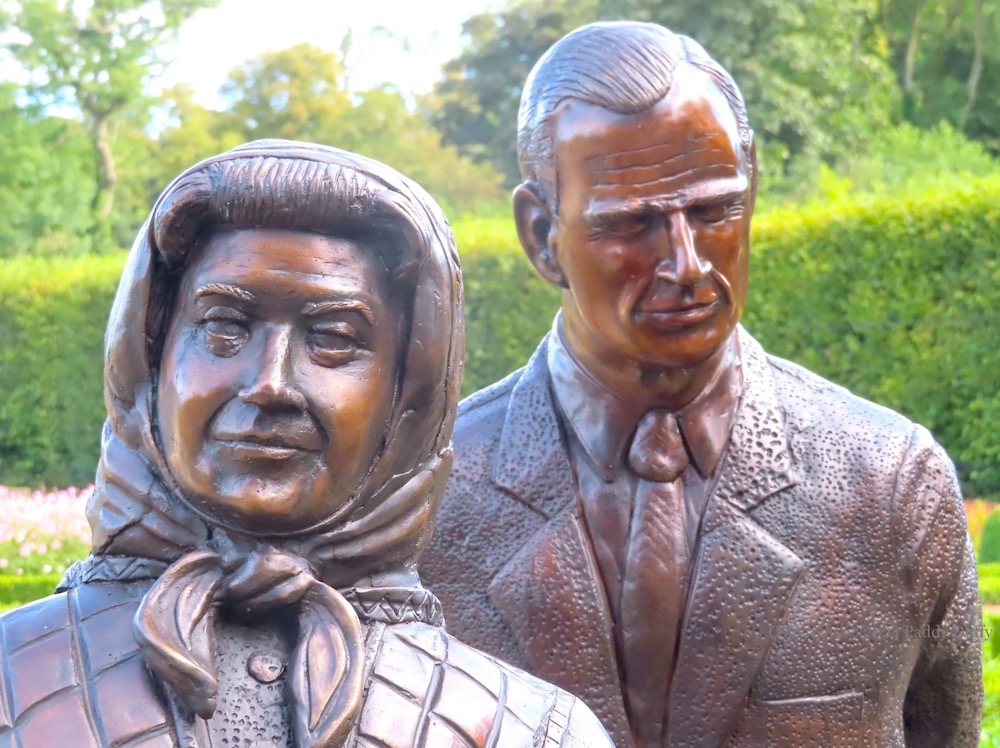
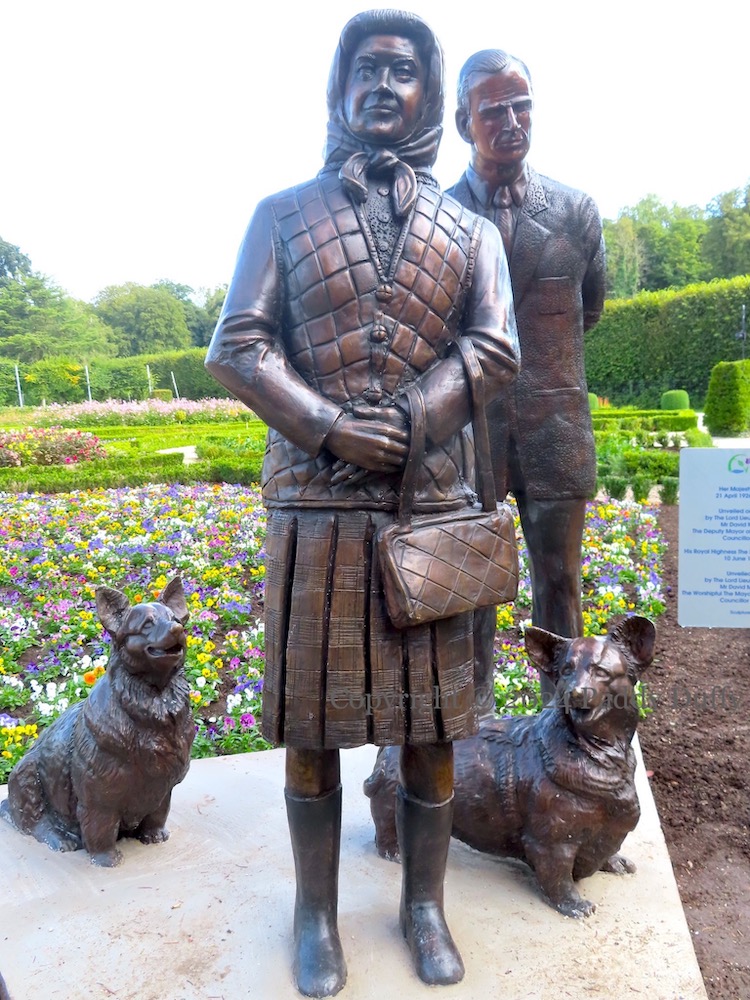
According the Antrim & Newtownabbey Council press-release, the new statue of Queen Elizabeth (and two corgis) unveiled on September 6th next to last year’s statue of Prince Philip in Antrim Castle Gardens “captures Her Majesty in a dignified pose, reflecting her grace, steadfastness and lifelong service to public service”. Others are not so sure that it captures Elizabeth at all, including the A&N’s own councillor Vera McWilliam, who told the BBC that “it does not resemble the queen in any shape or form” (BBC); the controversy was reported on as far afield as Australia, India, and the US.
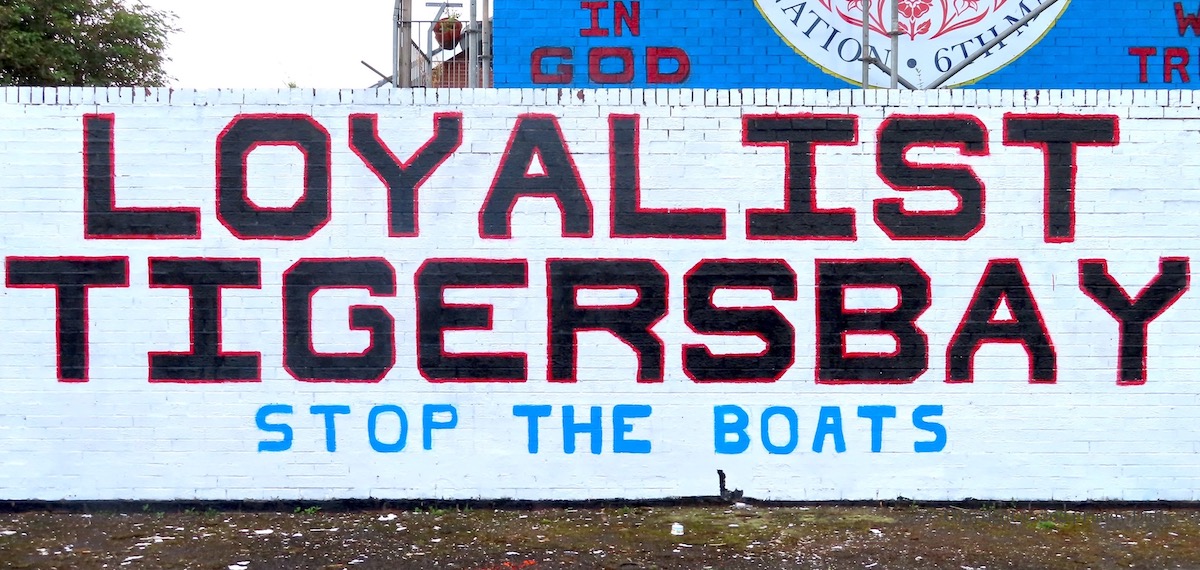
There has been a small but significant addition has been added below the repainted territorial marking “Loyalist Tiger’s Bay” – “Stop the boats”, the pledge given by Rishi Sunak in January 2023 after almost forty-six thousand people entered the UK in small boats in 2022 (BBC). This resulted in a media campaign in March of 2023 (gov.uk). The slogan was also seen on signs during the anti-immigration riots this (2024) summer (Mirror | Telegraph | NPR | Reuters) and heard chanted by rioters (SMH).
“Stop the boats” was for a time paired with “start the flights”. Since 2022, the Conservative government under Boris Johnson had planned to “start the flights” of some asylum seekers to Rwanda, but this required a protracted legal and legislative campaign involving a bill declaring the “Safety Of Rwanda” (January 2024) after a Supreme Court block on the programme (Human Rights Watch | BBC Explainer).
Sunak called a snap general election in late May, 2024; Labour took power and the Rwanda programme was scrapped (CBS). Sunak called a snap general election in late May, 2024; Labour took power and the Rwanda programme was scrapped (CBS). The language of stopping the boats, however, remains on the Labour website.
In the background of the wide shot, below, the main gable wall, it appears, is being painted to honour King Charles III in the same style as inside the estate – see I Will Plant Them.
For the meaning of the pre-existing “Genesis 38:28”, see Pro-Testant Reformation. It might be applied to the context of immigration in that it concerns the order of succession among twins.
Limestone Road, north Belfast
Update 2024-09-12: the words have been ?partially? whitewashed
William III is the only member of the (Dutch) House Of Orange to rule the UK, as his marriage to Mary did not produce any offspring, and the crown passed to Mary’s sister Anne after both Mary (1694) and William (1702) had died (WP). Queen Elizabeth II was from the Saxe-Coburg And Gotha ‘house’ (changed during the Great War to “Windsor”) via her great-great-grandfather Prince Albert (of Victoria & Albert) but she symbolises Orangism to Northern Irish Protestants and in the portrait shown here she wears an orange jacket and an orange hat which has a band of orange lilies; the portrait is framed by a Union Flag and two clusters of orange lilies.
The plaque on the right reads “This mural is a tribute to her majesty Queen Elizabeth II. Funded by the loyal people of Portadown. To God be the glory.”
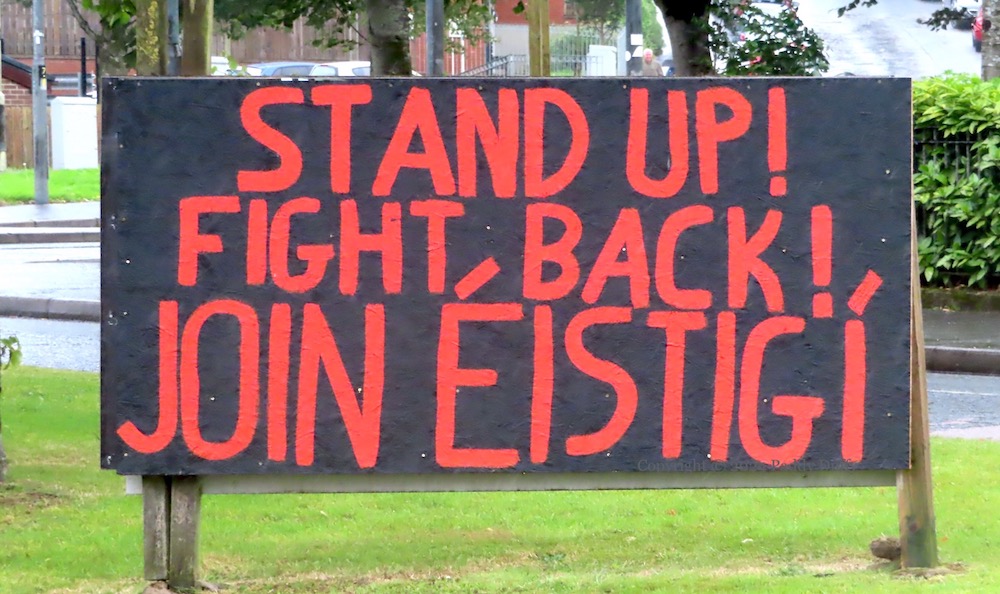
Here is a gallery of boards and flyers from on and around the green-spaces adjacent to Free Derry Corner.
“The “crisis” is capitalism – this is a war on the working class. Don’t fall for their lies. Fight back, join RSYM [Fb]”
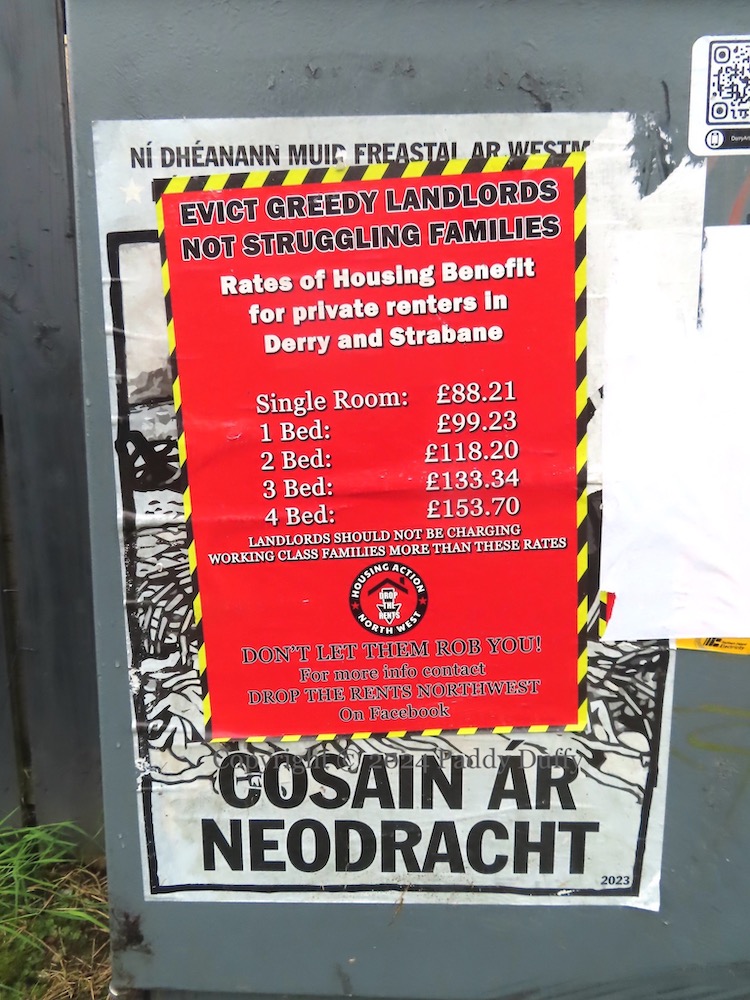
“Evict greedy landlords, not struggling families. Rates of housing benefit for private renters in Derry and Strabane … landlords should not be charging working class families more than these rates. Don’t let them rob you! Drop The Rents North West [Fb]” (on top of Cosaın Ár Neodracht)
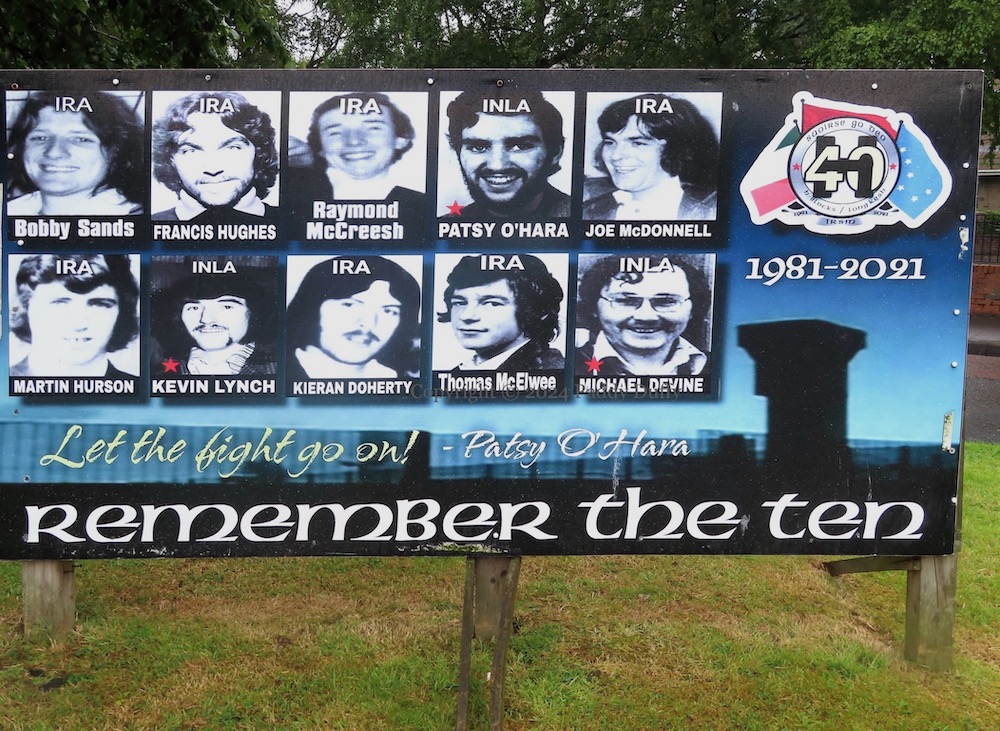
For many years there were portraits of the hunger strikers (either the 10 deceased from 1981 or the 12 from the 70s and 80s) along the long wall in Bishop St Without – see 2009, 2004, and 1998 (before that time the wall was divided into a number of panels for a variety of republican imagery – see 1984 and 1982) but in the portraits – which were on boards – soon started coming off and over the next decade the wall began to fade and become covered in graffiti (as can be seen in Street View). For the 40th anniversary, the deceased hunger strikers were restored to the wall, as shown here. From the info board (to the left of Sands’s head): “Cuımhníonn Doıre: 40th anniversary of the 1980-1981 hunger strikes. Rededication of mural, by the Bogside and Brandywell Monument Committee.”
Patsy O’Hara was born in 1957 Bishop Street, Derry, and joined Na Fıanna in 1970 and the local Sınn Féın cumann in 1971 and, in August was shot in the leg by British soldiers. In 1972 he joined the Republican Clubs and in 1975 the IRSP. He was imprisoned multiple times, the final time being in January 1979 for possession of a hand grenade (Bobby Sands Trust). He went on hunger strike 41 years ago tomorrow (March 22nd) and was the first of the three INLA hunger strikers to die in 1981. The long-standing mural in Bishop Street was repainted for the 40th anniversary of his death. (For the previous version, see Let The Fight Go On.)
“Óglach Patsy O’Hara, INLA Derry Brigade, Irish hunger striker, who died after 61 days on 21st May 1981, age 23. Last words ‘Let the fight go on’.”
“After we are gone, what will you say you were doing? Will you say you were with us in our struggle or where you conforming to very system that drove us to our deaths?” – these words also appeared in the 2013 mural to O’Hara on Shaws Road, west Belfast.
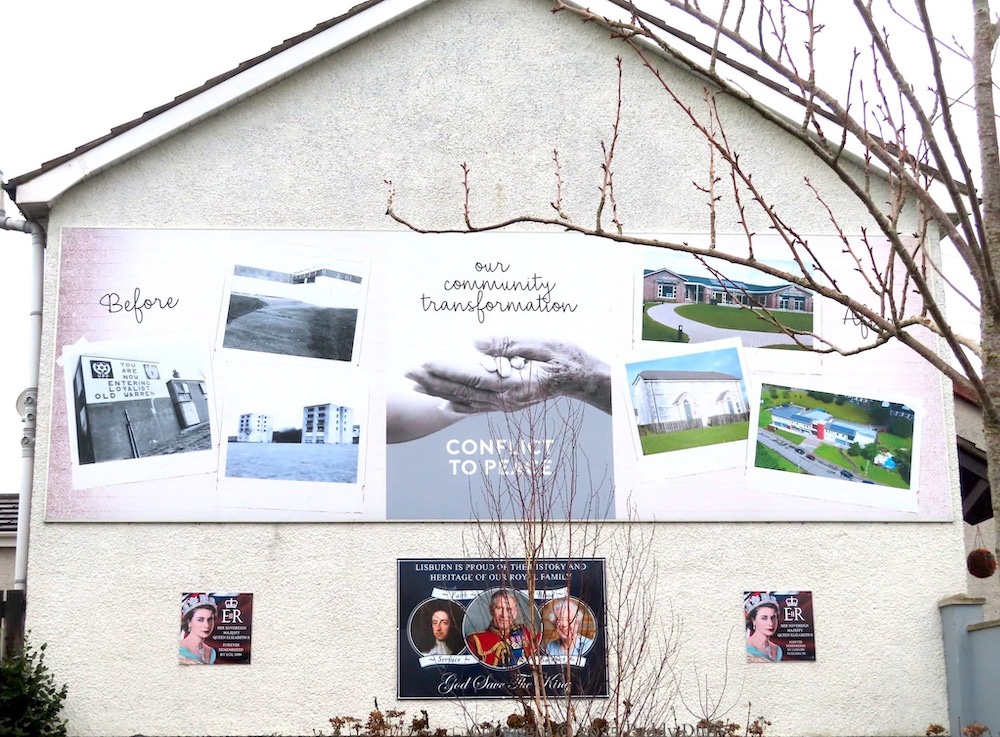
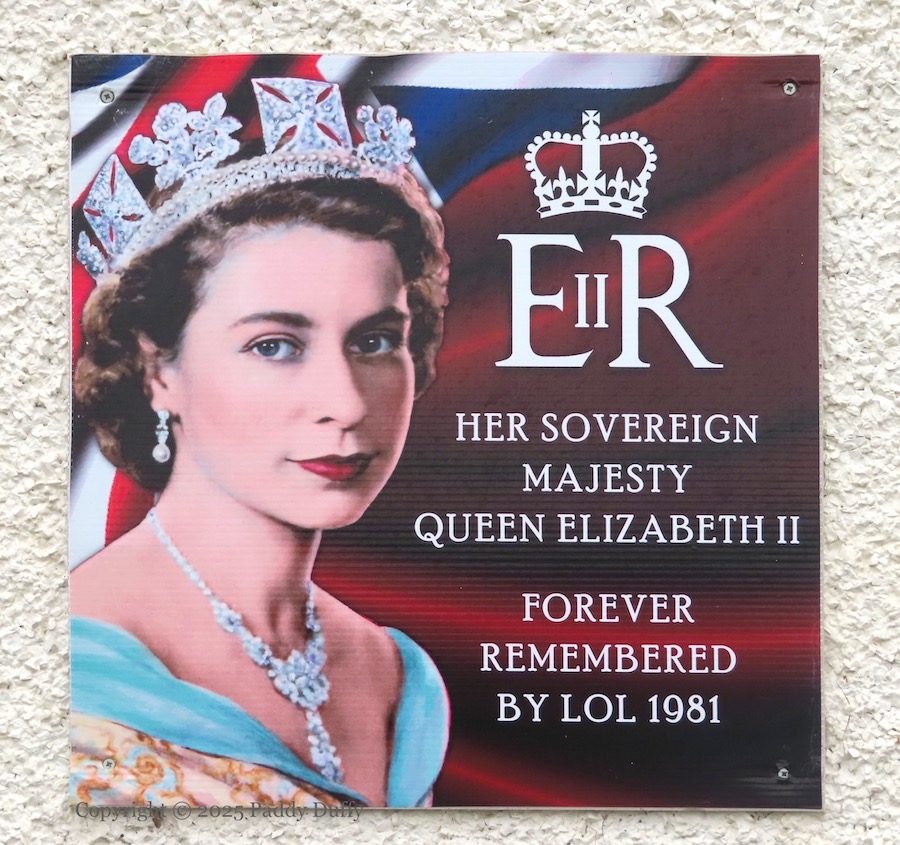
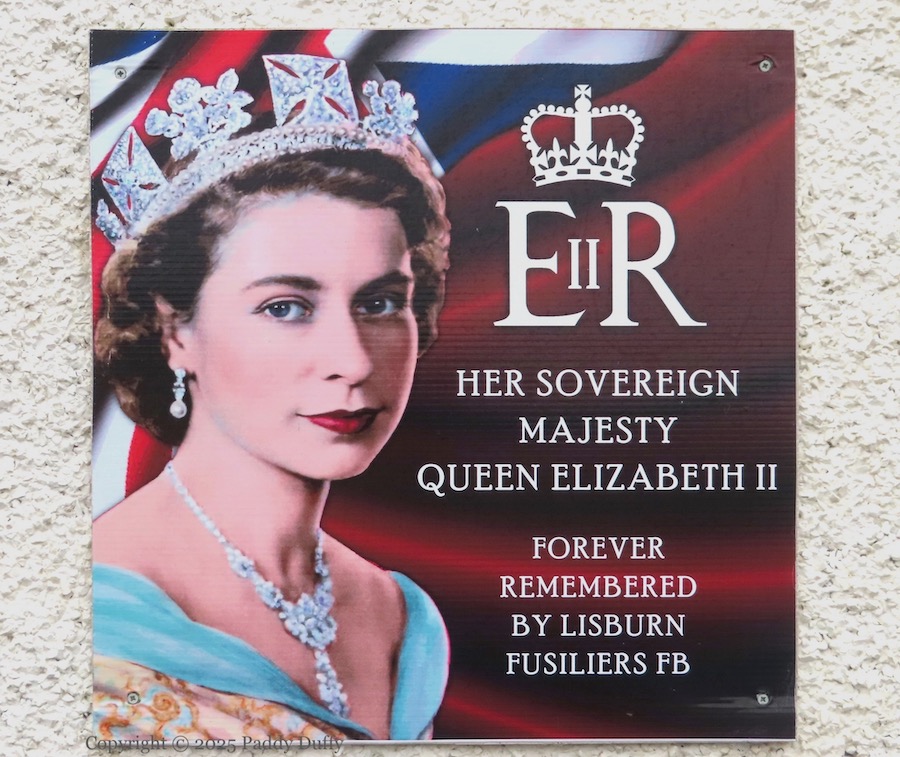
The board remembering Queen Elizabeth II below the Old Warren “community transformation” board has been updated with the accession and coronation of Charles III: “Lisburn is proud of the history and heritage of our royal family – faith, blood, service, sacrifice – God save the King” with images of William III, the present king Charles III, and his mother and predecessor Queen Elizabeth II. For a (brief!) explanation of the line from William (1689) to Elizabeth (1952), see Elizabeth, Queen Of Orange.
For the previous (QEII remembrance) board (and an image of the old UDA mural at the top of the estate which is included in the “Before” panel on the left), see Conflict To Peace.
A new board was unveiled on July 1st 2024, by the 1st Raven Somme Society and The Loyal (Fb) at the Raven social club (Fb), putting together the Ulster Tower (see e.g. A Thought Is Not A Lot), JP Beadle’s painting of the 36th going ‘over the top’ (see The Trenches Have Vanished Under The Ploughs) and Wilfrid Spender’s famous quote about the first day of the Battle Of The Somme (see I Would Rather Be An Ulsterman).
This board takes the place of the King Charles board (seen previously in Long Live The King), which has been moved to the other side of Castlereagh Street and joined by the board that it replaced, to Queen Elizabeth (both on top of some old (2012) panels depicting east Belfast of yesteryear – see Shipyard Workers).