In case the large medallion celebrating Queen Elizabeth’s platinum jubilee (in 2022) was not a sufficient indicator, a small “Loyalist” has been added above the street-sign. In the last century, Glenrosa Street in Tiger’s Bay used to continue across Duncairn Gardens into the New Lodge as Glenrosa Street South.
At the other end of the street is a warning sign next to the bonfire site: “All taigs will be shot – TBH #1. If this boney goes, so does NLR [New Lodge Road]”
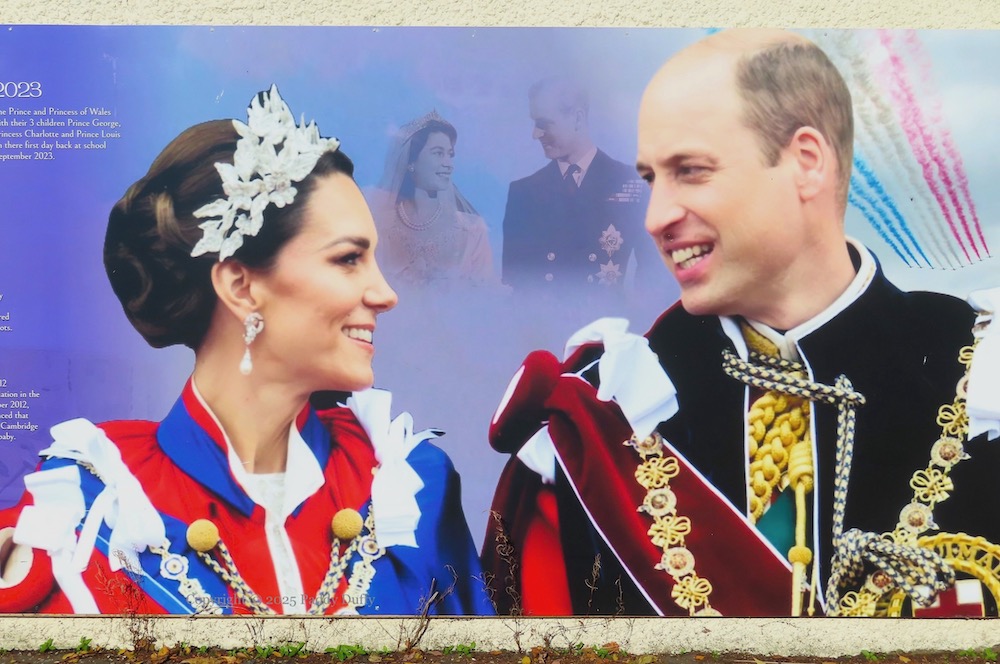
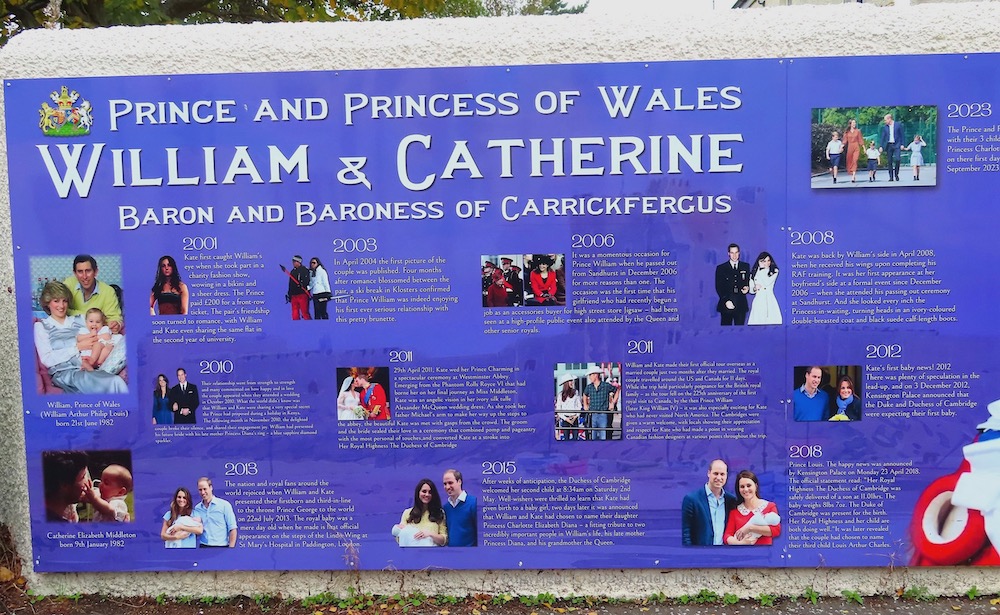
“William & Catherine, prince and princess of Wales, baron and baroness of [sic] Carrickfergus.” Prince William was granted the title of “Baron Carrickfergus” upon his marriage to Catherine Middleton in 2011; he was also made Earl Of Strathearn and Duke Of Cambridge (royal.uk). The couple visited Carrickfergus in 2022 (NI World), shortly after Charles acceded to the throne and William gained the title of Prince Of Wales.
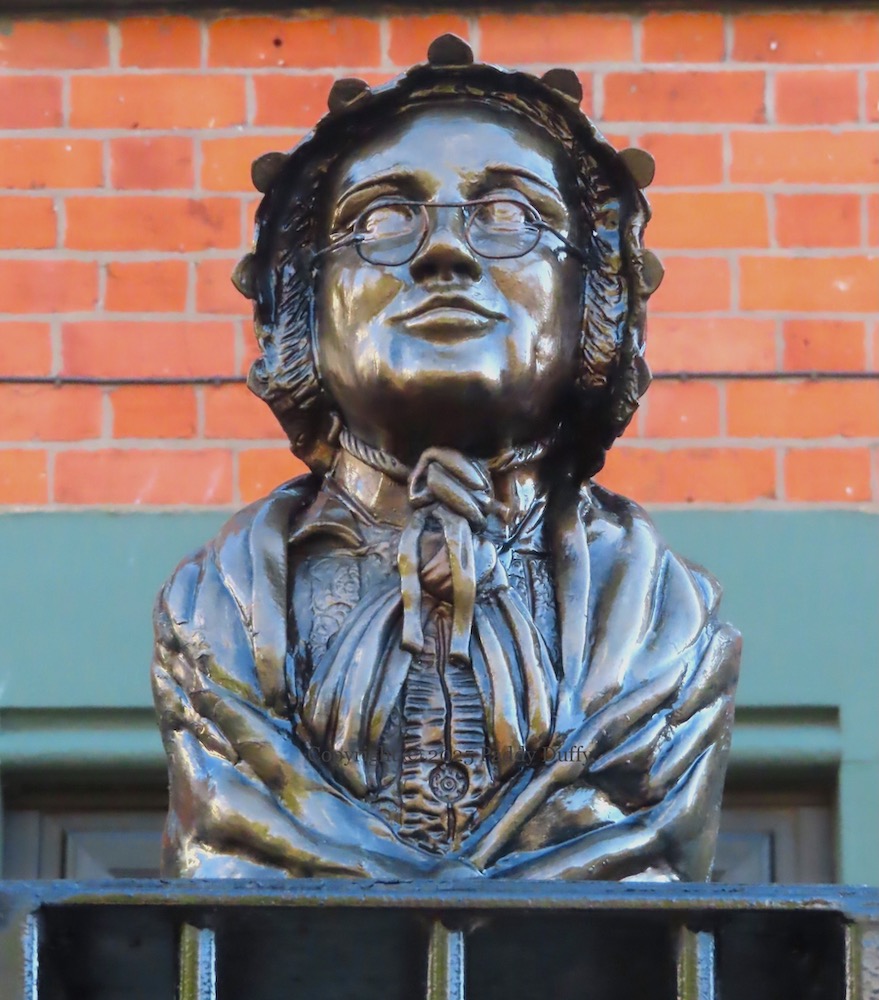
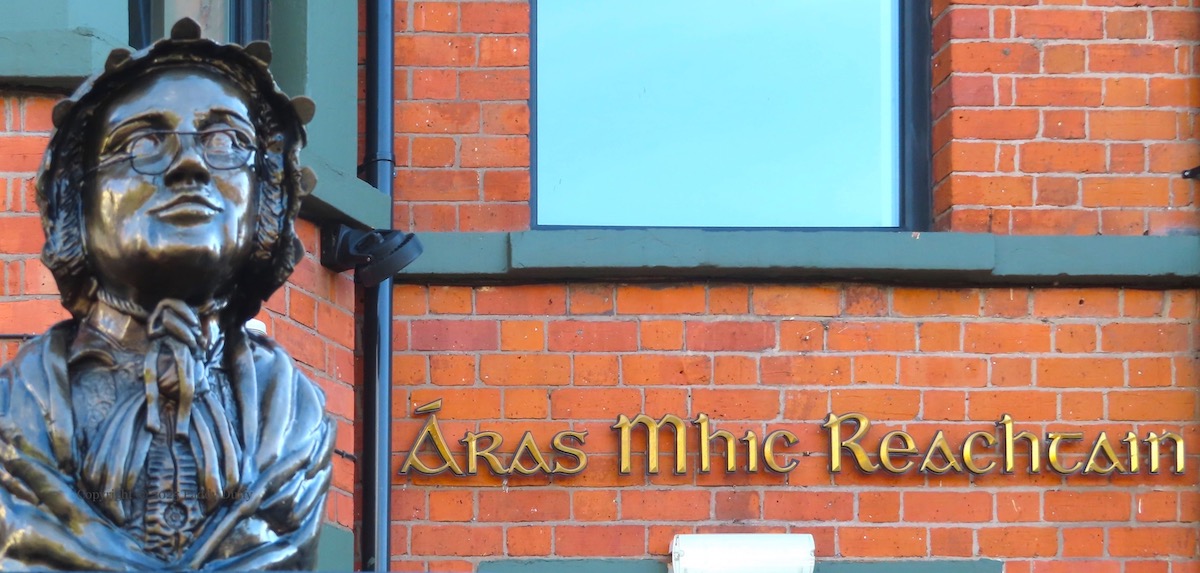
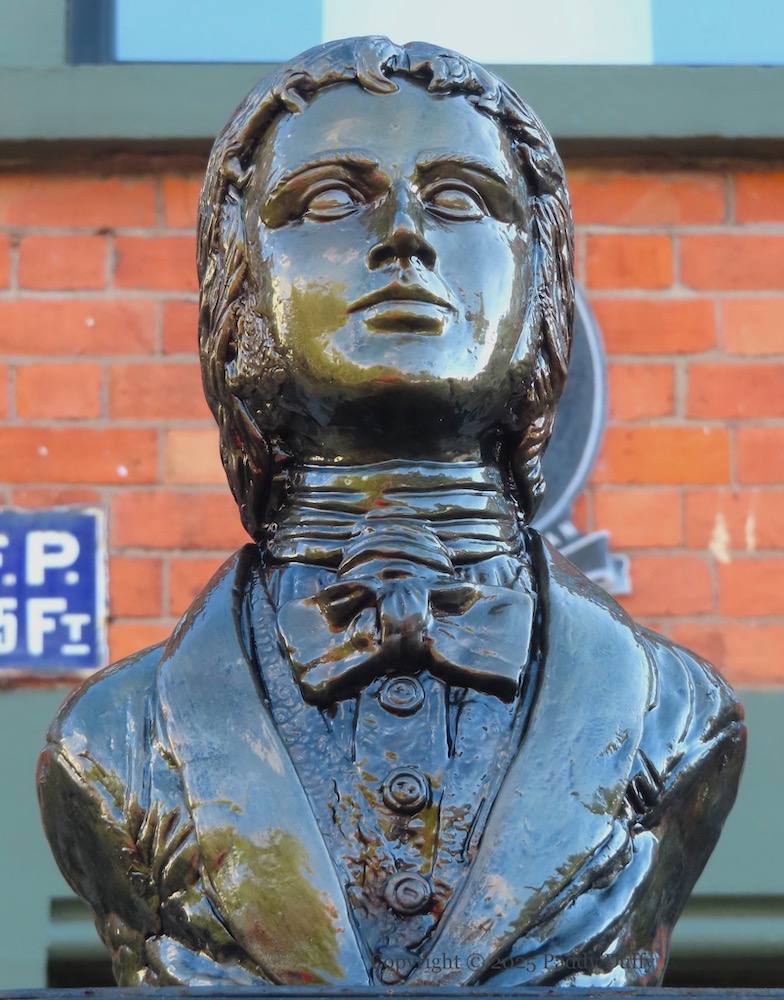
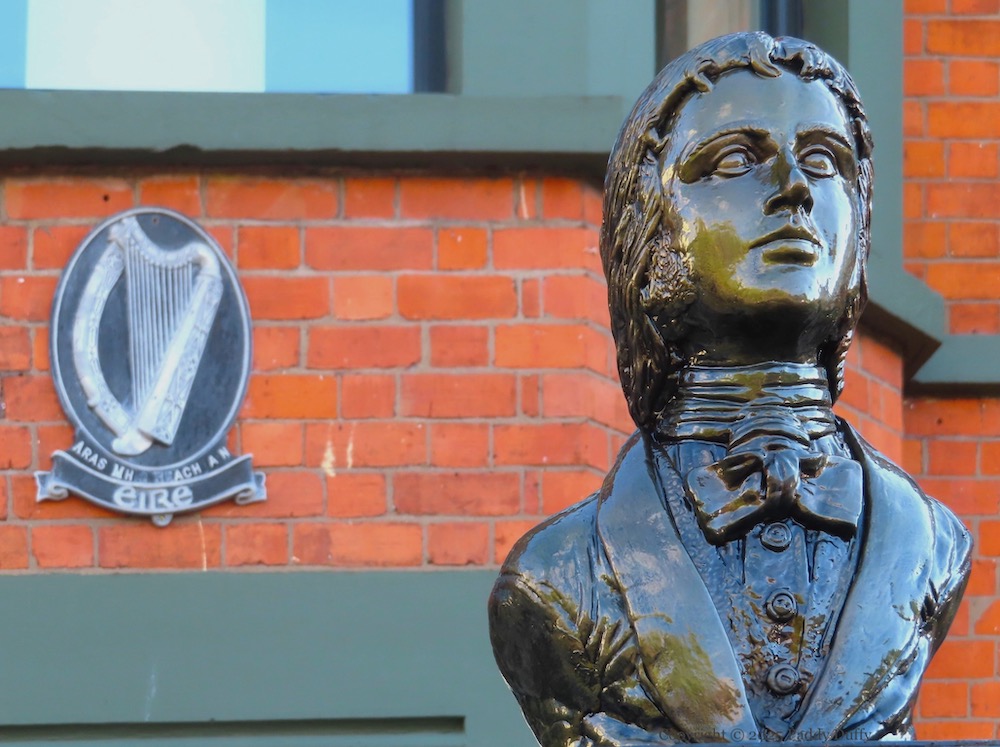
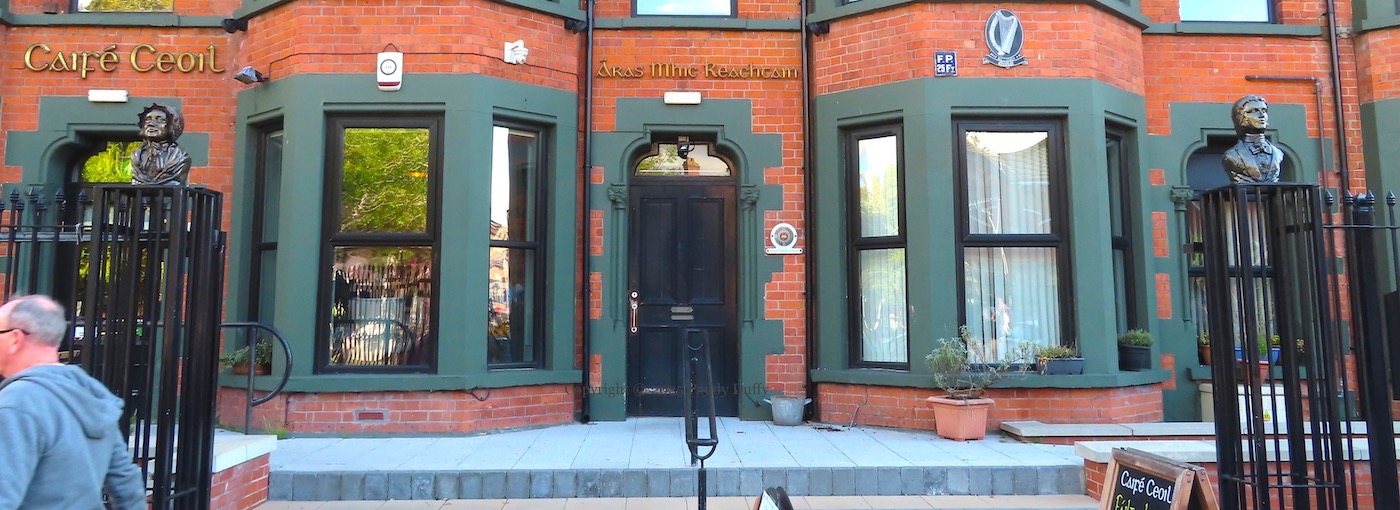
Bronze busts of Máıre Áıne Mhıc Reachtaın/Mary Ann McCracken and Anraí Seoıgh Mhıc Reachtaın/Henry Joy McCracken have been unveiled outside Áras Mhıc Reachtaın, the Irish-language centre on the Antrim Road and home of Cumann Cultúrtha Mhıc Reachtaın (web).
The pair – brother and sister – were Presbyterians and republicans; their mother was Ann Joy, daughter of Francis Joy, linen manufacturer and founder of the Belfast Newsletter. Henry led the Antrim uprising of the United Irishmen in 1798 and was hanged for it in Corn Market at age 30. (WP)
Michael Gaughan and Frank Stagg are presented along with the ten deceased 1981 hunger strikers on the cross-beam of a large wooden “H” at the top of Turf Lodge.
IRA volunteer Michael Gaughan died in Parkhurst prison in 1974 after 64 days on hunger strike. Gaughan’s coffin was draped with the Tricolour used to bury Terence McSwiney in 1920. He was force-fed seventeen times during the strike and his family alleged that he died from food stuck in a punctured lung. The practice was ended after Gaughan’s death.
Frank Stagg was on the Parkhurst hunger strike with Gaughan, and another in Long Lartin prison, and a third in Wakefield in December 1975. He died after 62 days on February 12th, 1976.
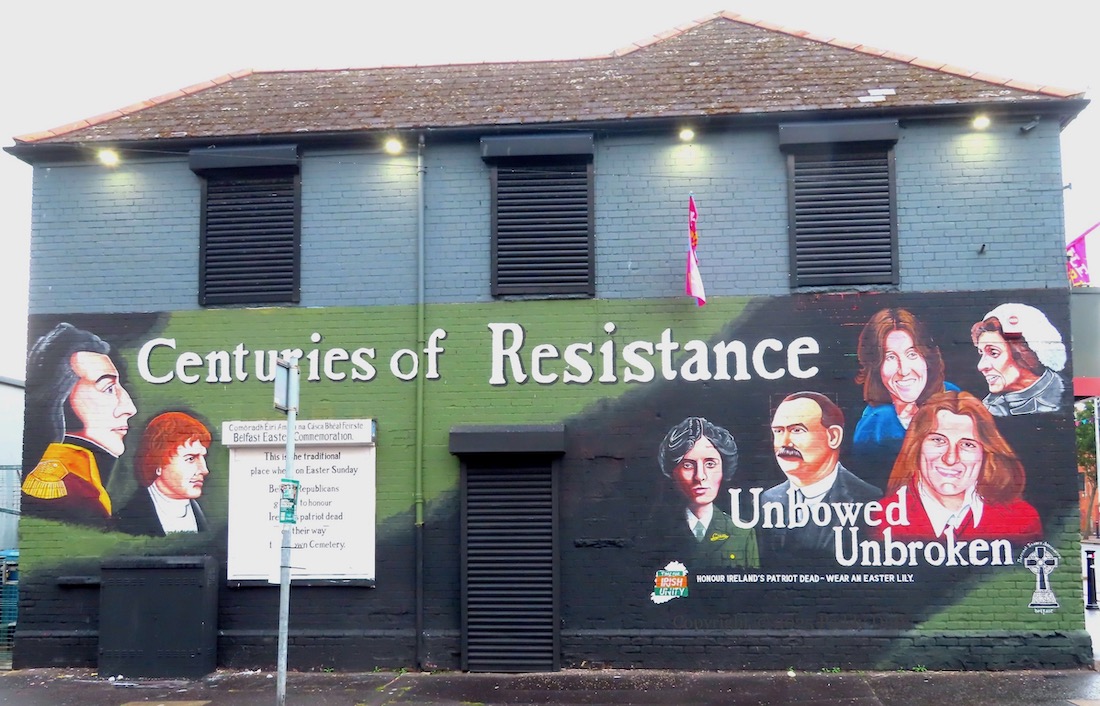
The United Kingdom Of Great Britain And Ireland was created in 1801, a reaction to the 1798 Rebellion, led by (amongst others) Wolfe Tone and Henry Joy McCracken, who were founding members of the Society Of United Irishmen in 1791 in Belfast.
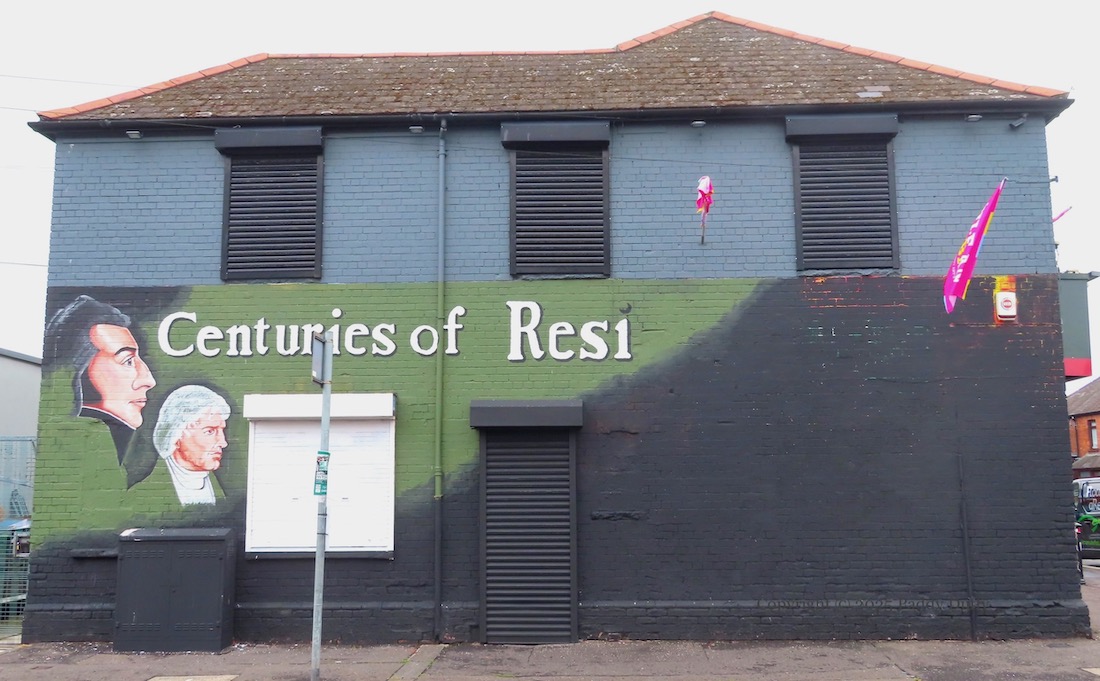
In this mural, Tone and McCracken on the left gaze across the “centuries of resistance” from 1798 to 1916 Rising revolutionaries Countess Markievicz and James Connolly, and beyond to Troubles-era figures Maıréad Farrell, Bobby Sands, and Máıre Drumm.
Around the same time as this mural was painted, a Féıle exhibition called ‘Vibrant Colours, Violent Past’ included A Panorama Of Republicanism which contains dozens of figures but again chooses 1798/Tone, 1916/Connolly, and the Troubles/Martin McGuinness as the pivotal moments and figures.
“Comóradh Éırí Amach Na Cásca Bhéal Feırste/Belfast Easter Commemoration. This is the traditional place where on Easter Sunday Belfast republicans gather to honour Ireland’s patriot dead on their way to Milltown Cemetery.” “Honour Ireland’s patriot dead – wear an Easter lily.” “Unbowed, unbroken.”
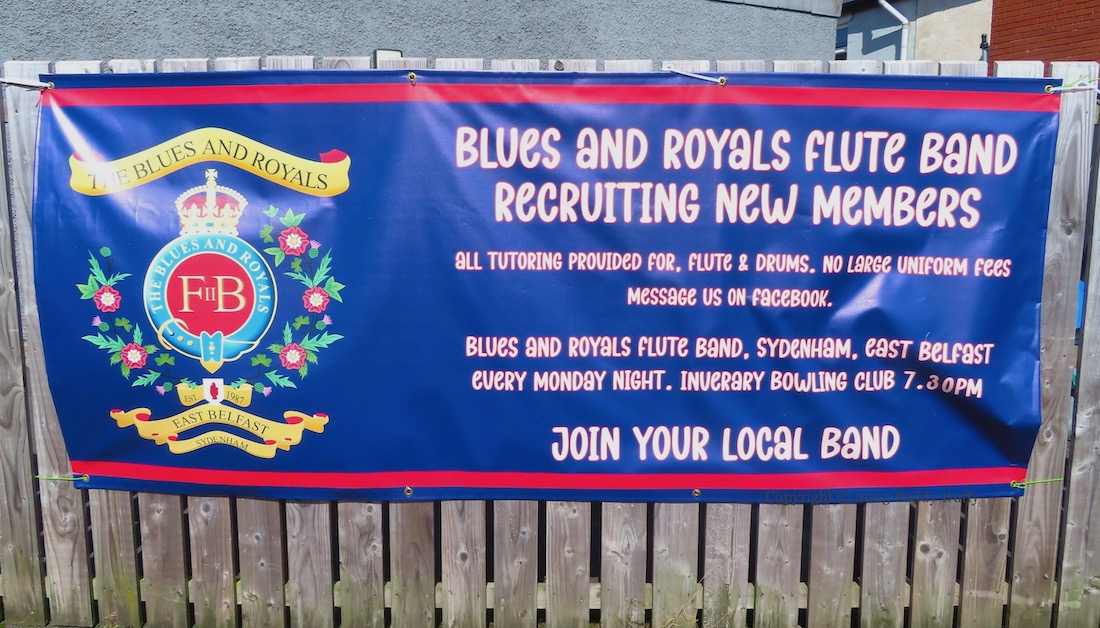
Above, a recruitment tarp for the Blues And Royals flute band (Fb).
Below, (and on the wall above the flute band’s tarp) a NI Centenary board using the St Patrick’s saltire in the background. The saltire is an Anglo symbol of Ireland and was included in the Union Flag when the union was between Britain and Ireland and thus – like the word “Ulster” – has been reduced to signifying Northern Ireland after partition.
Three plaques at the Ballynafeigh Apprentice Boys social club on Blackwood Street:
“In loving memory of Allison Jane Smith – you’re missed so much by so many who knew you in Ballynafeigh”, “Celebrating the 100th anniversary of the foundation of Northern Ireland – Northern Ireland centennial 3rd May 2021”, “In memory of all our past members”.
“Loyalist Village, south Belfast.” UVF markings in the Village continue to proliferate with the recently-added board shown above (from the top of Tavanagh Street) alongside a slew of other boards, some of which are included below.
The “Village team” is not Linfield FC but the UVF (the phrase was also used by the Village UDA); “VTOT” (standing for “Village team on tour”) has previously been used as graffiti – see Welcome To Hell!!!
The purple hoarding below gives “1913” as a creation-date for the battalion. The Ulster Unionist Council organised the signing of the Covenant in September, 1912, and in January 1913 voted to bring together the militias that had been formed in various places into an Ulster Volunteer Force. One of these was a South Belfast battalion that had formed in 1912 (History Ireland). Hence, both “1912” and “1913” are given as dates for the creation of the battalion. When the Volunteers were integrated into the Ulster Division for the Great War, the South Belfast Volunteers joined the 10th battalion of the Royal Irish Rifles.
“The Shamrock supports Kneecap”. Kneecap member Mo Chara (Lıam Óg Ó hAnnaıdh) appeared in court (in London) last week to face charges of displaying a flag of a proscribed organisation (Hezbollah). He was released on bail and will return on August 20th. (BBC | AP) In the meantime, the group appeared in front of 10,000 fans on the West Holts stage at Glastonbury on Saturday (June 28th) despite criticism from UK prime minister Keir Starmer (BBC).
The Shamrock Sport & Social Club (Fb) in Ardoyne is running a promotion by which people who post their selfies in front of the new mural in support of Kneecap on social media can claim a bottle of Le Grá lager (web).