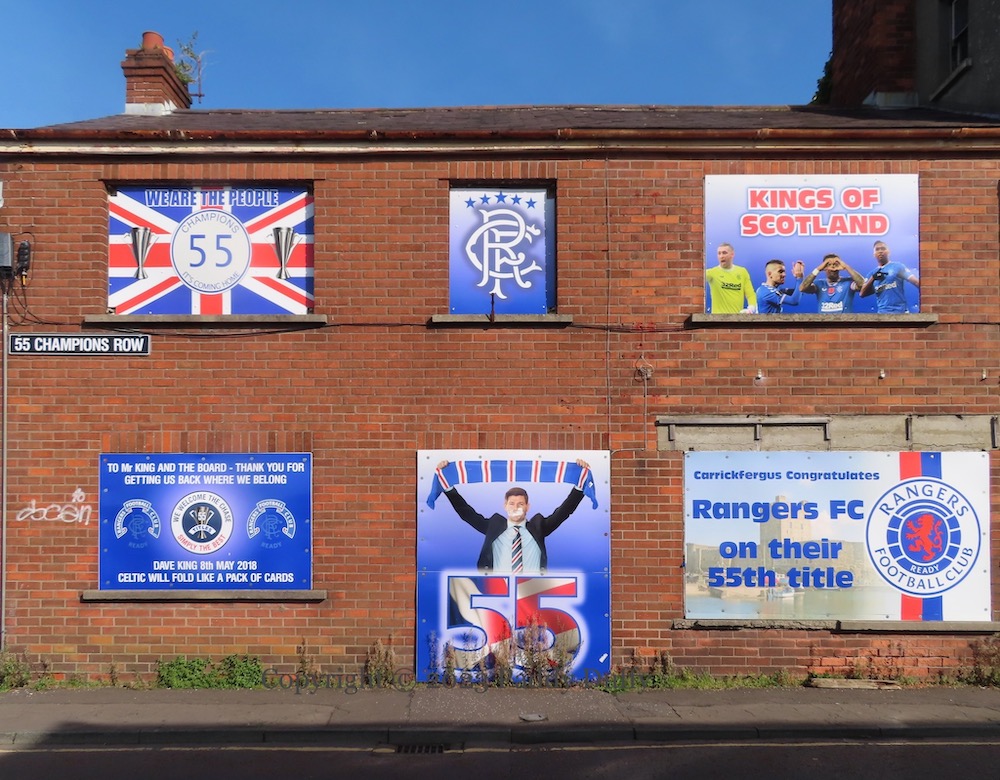
“Carrickfergus congratulates Rangers FC on their 55th title” on “Champions Row” (that is, Irish Quarter West) Carrickfergus.
As Chairman Dave King appointed Steven Gerrard as the new manager of Rangers in 2018, he predicted that a single league win for Rangers would cause Celtic to “fold like a pack of cards” (Sky Sport). Under Gerrard, Rangers clinched their 55th Scottish championship in spring of 2021. Celtic, however, won in 2022 and 2023 (WP).
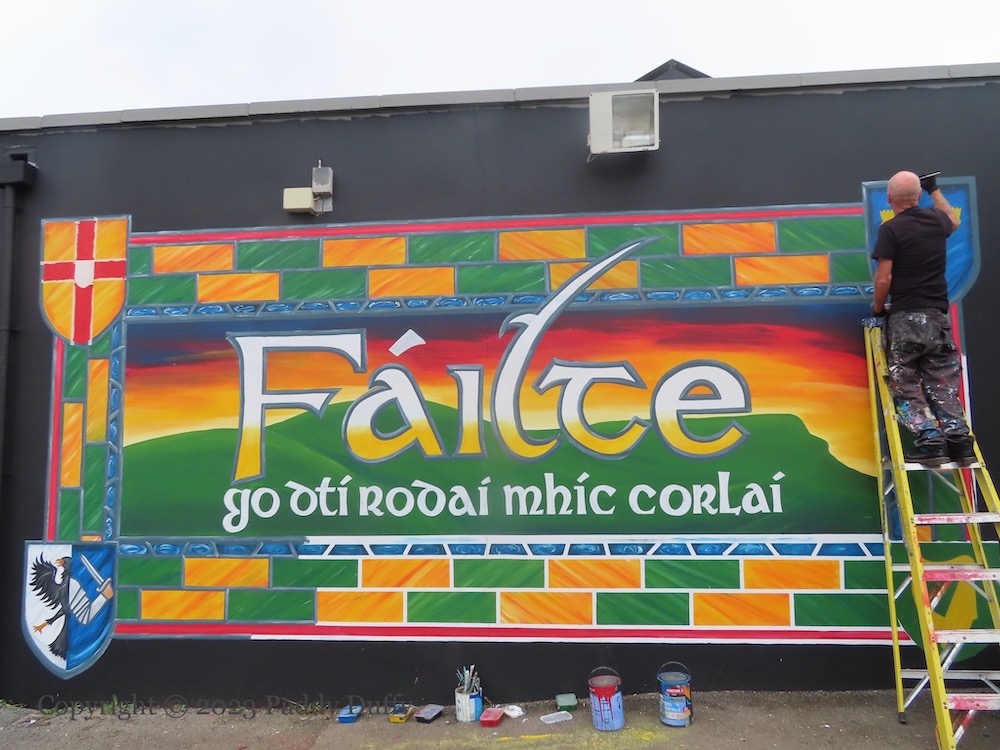
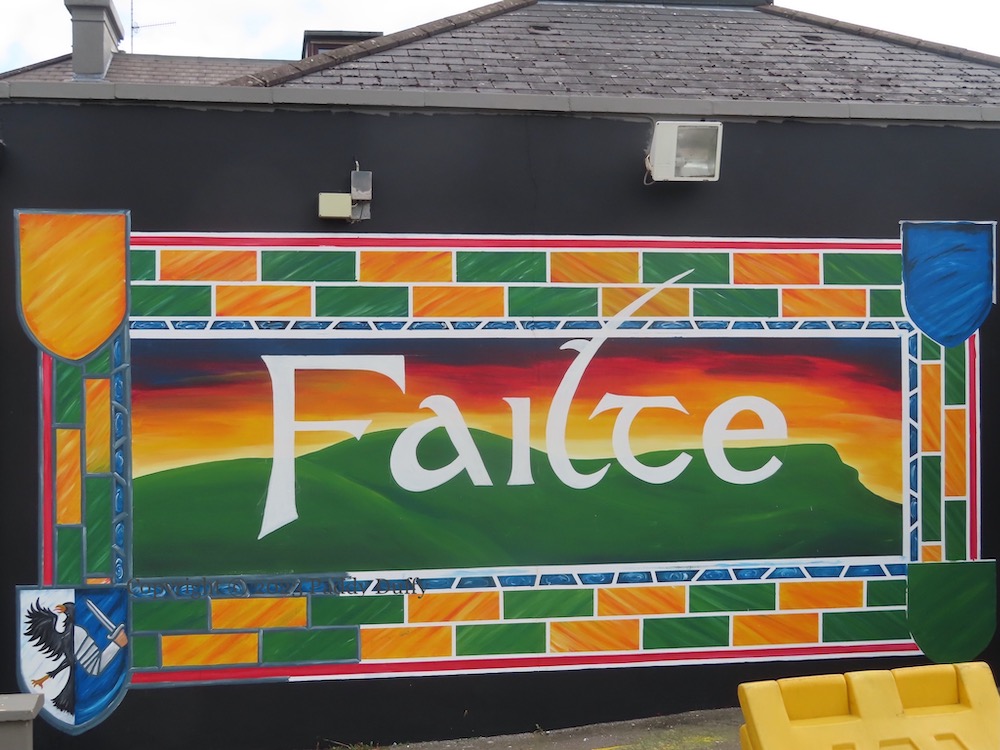
A new “fáılte” [“welcome”] mural was painted at the Roddy’s in anticipation of the official opening of the new republican heritage centre/ıonad oıdhreachta poblachtaí (web) which took place on September 28th. Construction of the museum and the adjacent restaurant began in May 2021 with an investment of 1.35 million pounds (Belfast Live). The museum’s exhibits cover republican history from 1798 to the present, and items on display from the Society’s collection include vintage uniforms and artefacts, historic maps and documents, and prison handicrafts.
“Marching into the future”. The 35th anniversary board – and the Pride Of The Bann flute band (Fb) itself – is still going over a decade after it was mounted in Harpur’s Hill, Coleraine; here is the board in 2012. It has now been joined by a board aimed at young people, designed by members of Sunlea Youth Club.
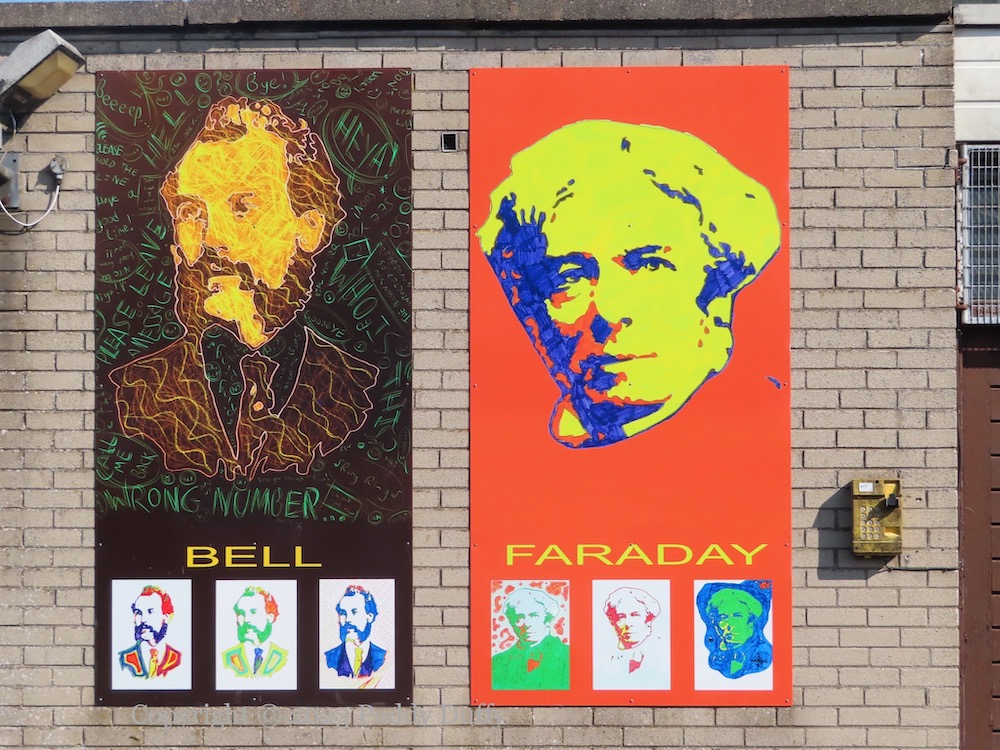
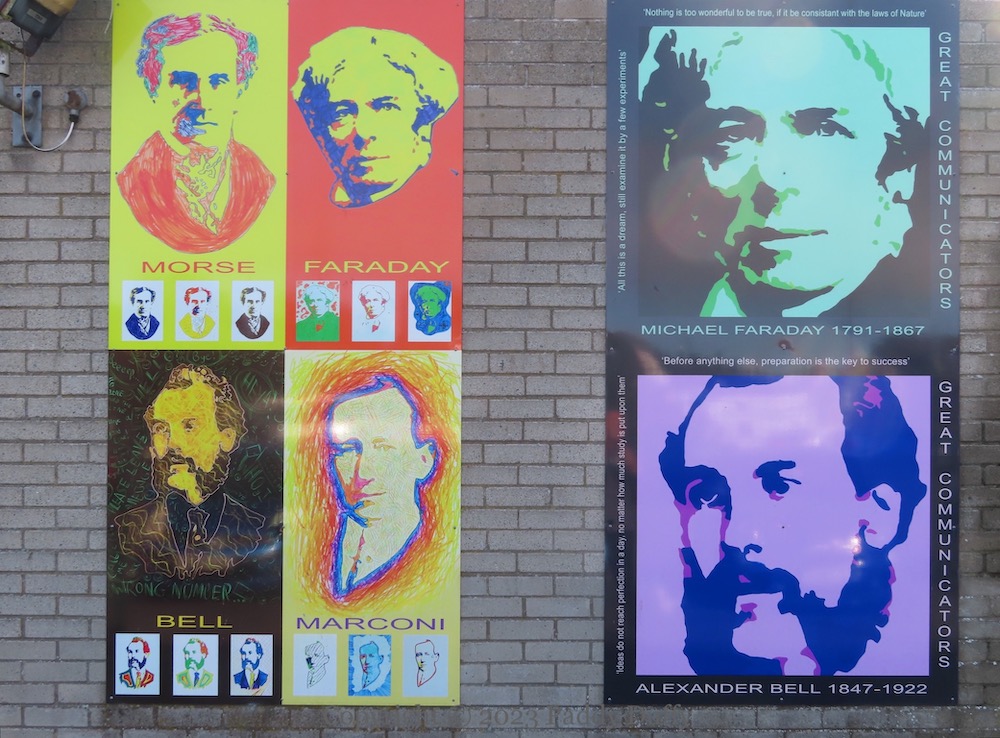
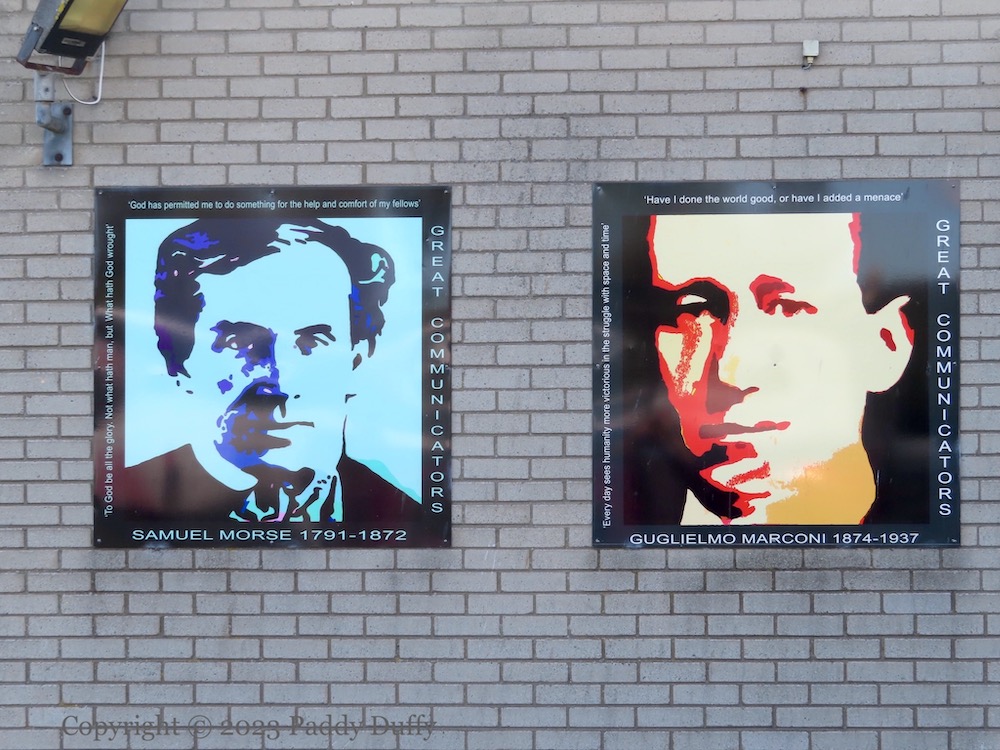
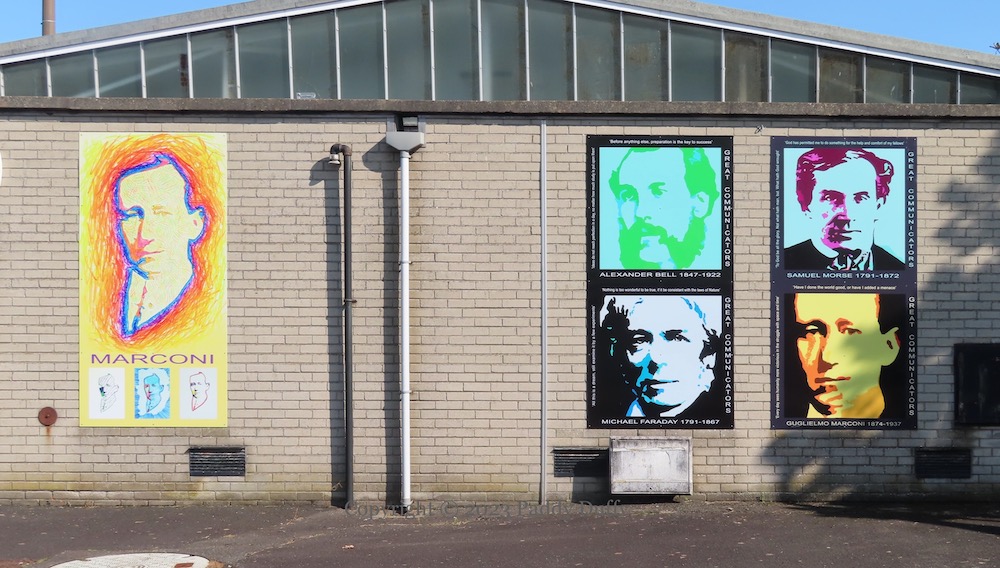
Local children painted portraits of four “Great Communicators” for the BT building at the corner of Main Street and Dundarave Road in Bushmills (NALIL). The set of less colourful boards, which also contain quotes, might be by adults.
Alexander Bell, 1847-1922: “Ideas do not reach perfection in a day, no matter how much study is put upon them.” “Before anything else, preparation is the key to success.”
Michael Faraday, 1791-1867: “All this is a dream, still examine it by a few experiments.” “Nothing is too wonderful to be true, if it be consistant [sic] with the laws of Nature.”
Samuel Morse, 1791-1872: “To God be all the glory. Not what hath man, but what hath God wrought.” “God has permitted me to do something for the help and comfort of my fellows.”
Guglielmo Marconi, 1874-1937: “Every day sees humanity more victorious in the struggle with space and time.” “Have I done the world good, or have I added a menance.” Marconi is well-known in Ballycastle for an 1898 transmission between the town and Rathlin.
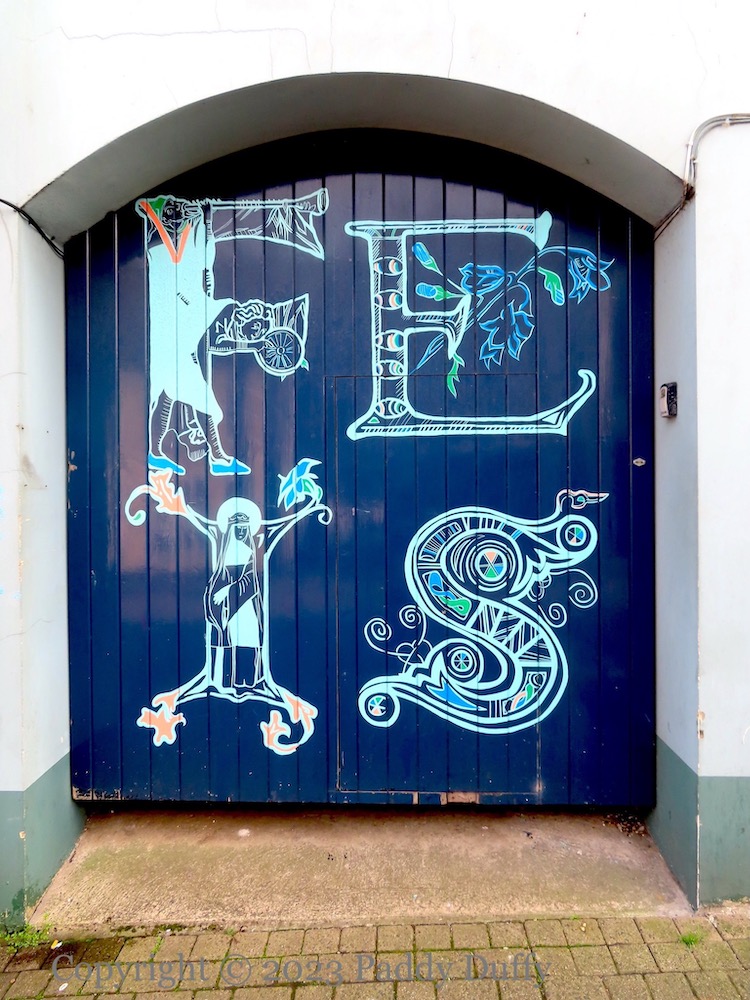
Feıs Na nGleann is an annual festival of Irish language, arts, and crafts, begun in Glenariffe in 1904. The website has not been updated since 2019, presumably due to COVID putting a stop to activity.
The “F” makes reference to the local “Irish (Peasant) Home Industries“, while the “E” shows the harebell (bluebell) in flower. The “I” might be St Brigid as an oak or a reference to Princess Taisie/Taobhgheal of Rathlin.
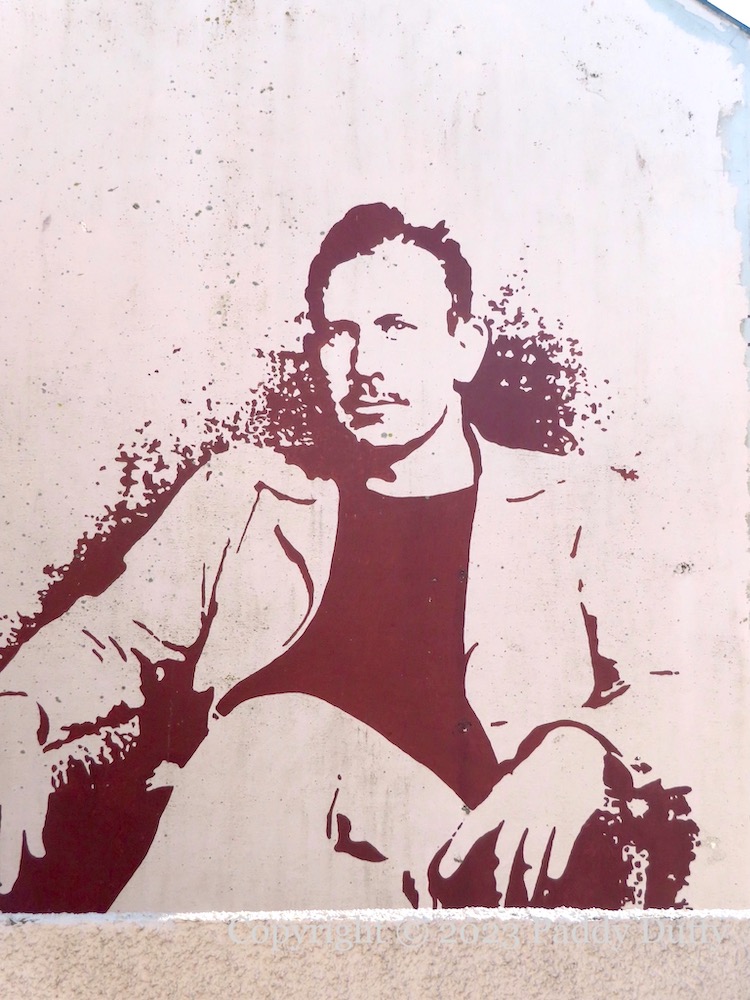
Today (December 20th) is the fifty-firth anniversary of John Steinbeck’s death in 1968. In 1952 he visited Northern Ireland to trace his Hamilton ancestors in Mulkeeragh, Ballykelly, Co. Derry (Irish Times) and wrote about it in Collier’s magazine.
The mural is on the side of (what was) the Hamely Gallery in Bushmills.
Limavady has been the home to an occasional Steinbeck literary festival since 2016 (Steinbeck Now).
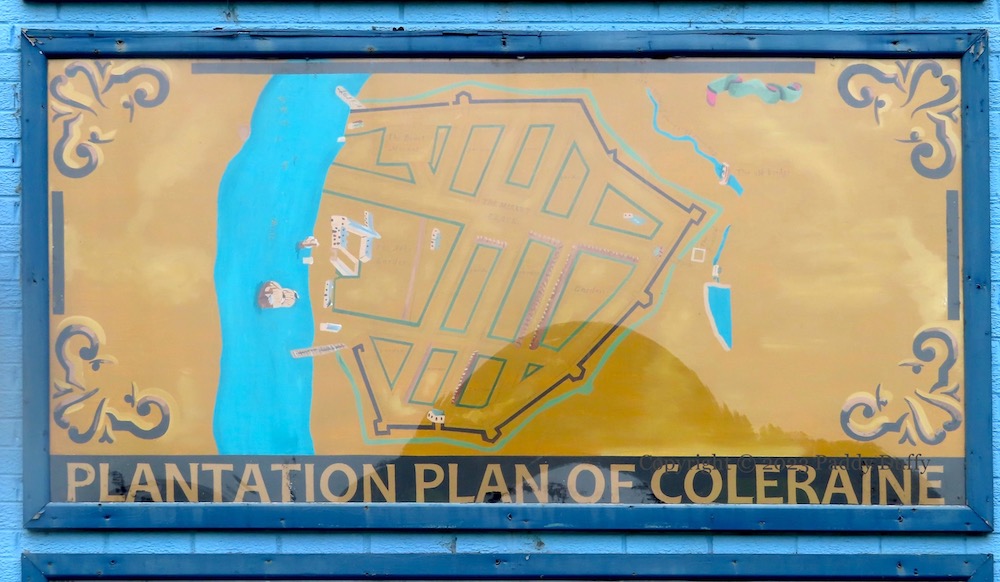
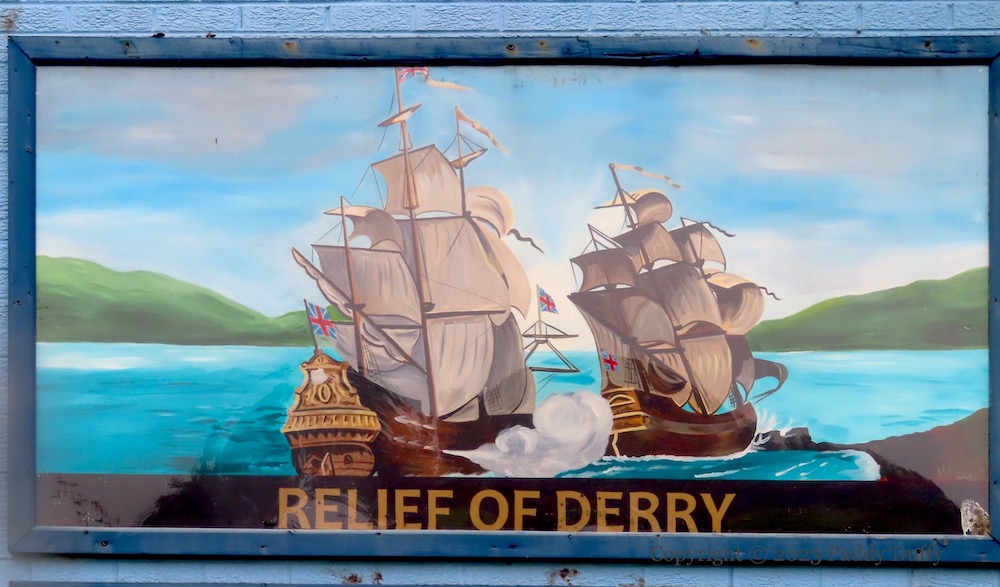
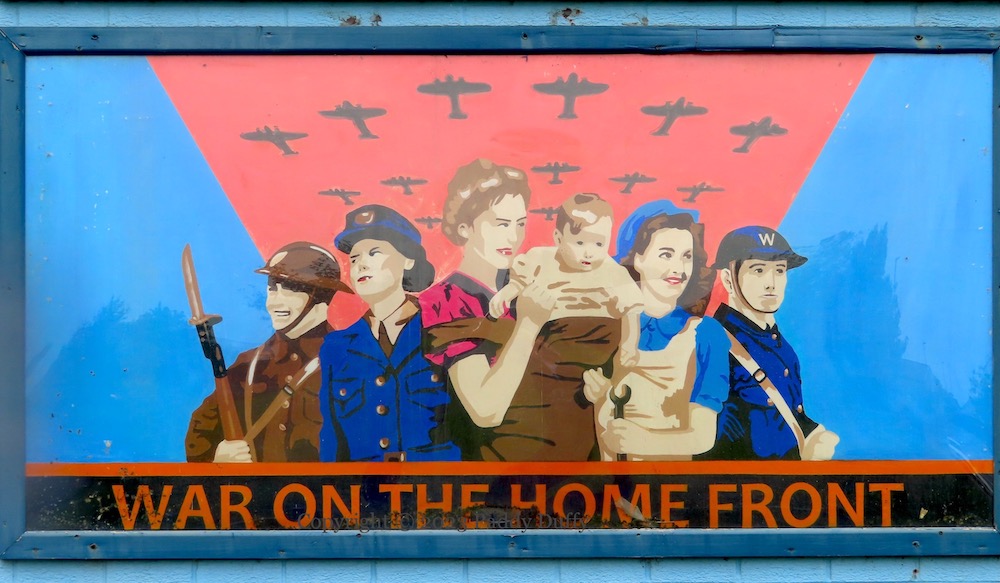
Footsteps through the history of Coleraine, from top to bottom: Martin Luther (c. 1521); John Knox, who led the reformation in Scotland (c. 1560); the plan of Coleraine (c. 1611); the relief of Derry (1689); the Williamite campaign (1690); (and then a jump to) WWI (“Christmas truce, western front”); WWII (“War on the home front”).
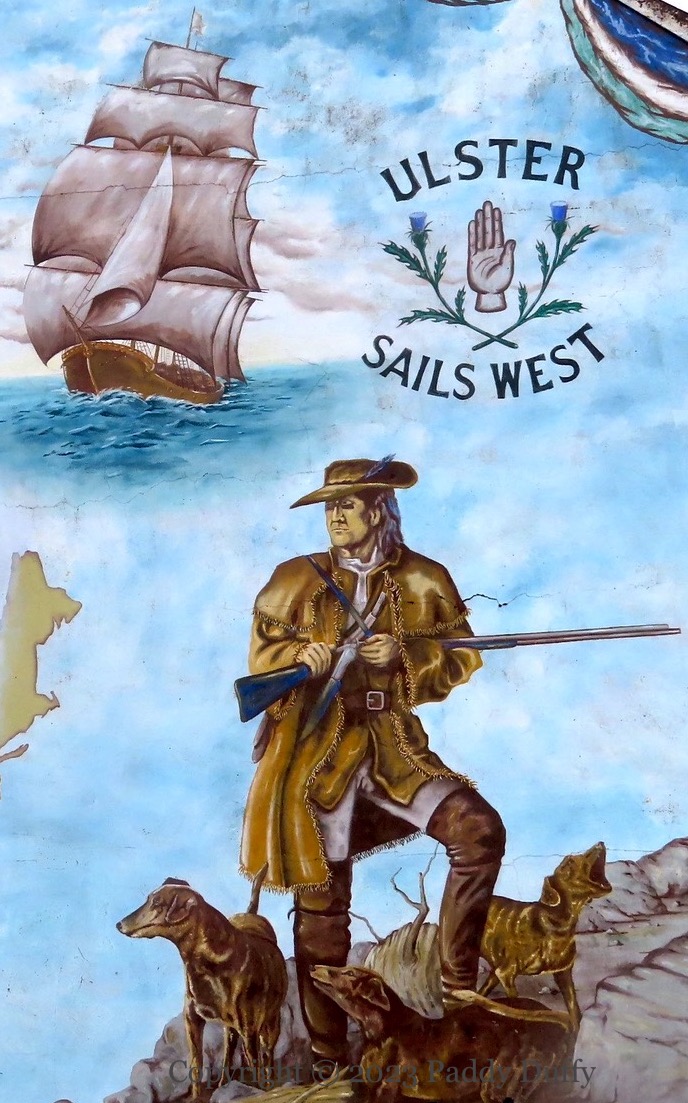
This Ballymoney mural goes all the way back to at least 2004 and to the wave of Ulster-Scots – or as here, “Scotch-Irish” – murals painted in PUL areas after the promotion of Ulstèr-Scotch as a parallel language to Irish by the Good Friday/Belfast Agreement.
As the Visual History page on Ulster-Scots Murals shows, most of these murals made a connection to (what would-become) the United States, to where about a quarter million people emigrated (WP). The mural is intended to tell a story of emigration (signified by the sailing ship), American independence (the McKinley quote), and American expansion (the frontiersman).
The Scotch-Irish were Presbyterians and supporters of breaking the ties to Great Britain. In 1893, Governor Of Ohio (and later US President) (Ulster Nation) William McKinley said, “They were the first to proclaim for freedom in these United States. Even before Lexington [i.e. the outbreak of the Revolutionary War, on April 19, 1775] the Scotch-Irish blood had been shed for American Freedom.” (According to William Marshall’s book Ulster Sails West, the battle McKinley is referring to took place on the Alamace river in North Carolina in 1771 (p. 29).)
The frontiersman on the right is generally taken to be David “Davy” Crockett (Rolston in Al Jazeera | McCormick J2024) because of the Scotch-Irish heritage on his father’s side. Crockett, however, was born in 1786 and so does not fit with the McKinley quote. Daniel Boone – though of English stock – would provide an appropriate referent for the revolutionary period, having lived from 1734 to 1820. The image is in fact a 1991 sketch of a frontiersman by David Wright (web), called “The Long Knife”, and the figure is referred to generically as “a trapper” by the artist (BBC).
None of the conquests of European-American colonists provides a good parallel to unionism, due to the complicated nature of political conflicts both there and here. The Americans, of course, threw off British rule in their revolution; Irish unionists want to remain part of the UK. And Crockett died in the Battle Of The Alamo in the Texas Revolution; that is, he died fighting for Texan independence from the Mexican government, which again doesn’t line up well with the desire of Irish unionists to remain part of the United Kingdom. (For another strained analogy involving the Scotch-Irish and US political history, see The War Of Northern Aggression and its discussion in the Ulster-Scots Murals page.)
The reason for its inclusion is the simpler idea that the Scotch-Irish are a rugged and feisty people who are not to be trifled with, whether in North America or Ireland.
Painted by Kenny Blair (Fb) in Hillview Avenue, Ballymoney; sponsored by the North Antrim Cultural And Musical Society and funded by the Heritage Commission. “Ulster Sails West” is the title of a 1943 book by WF Marshall (Isles Abroad).
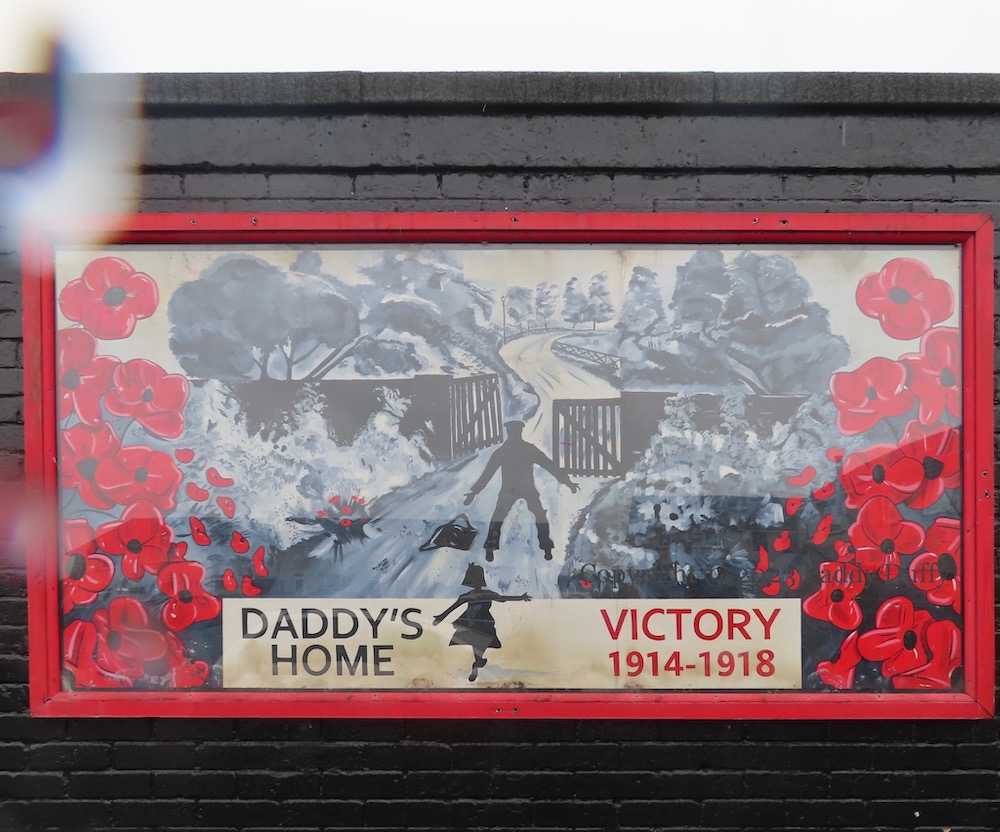
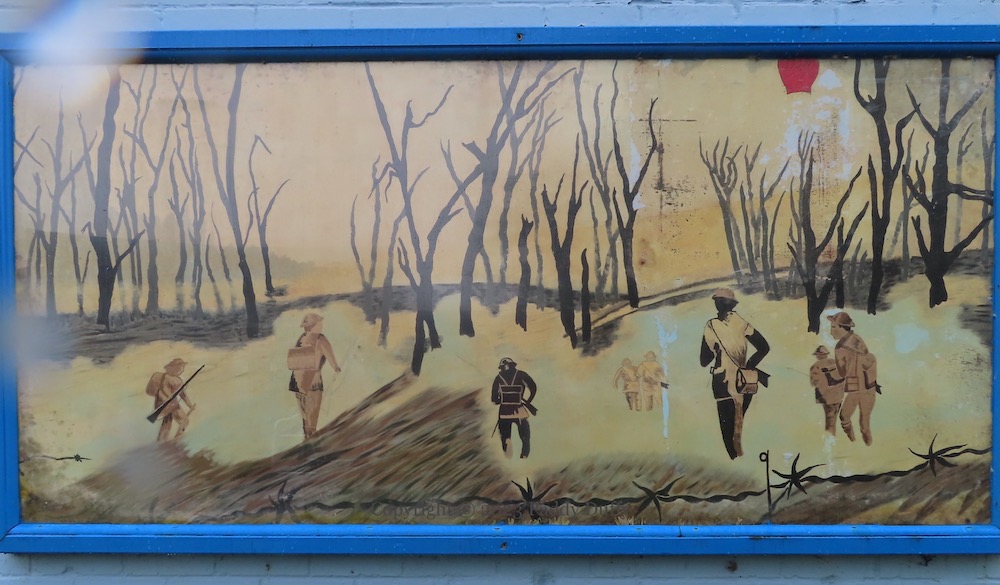
There was previously a mural of the UDA emblem and flags on the substation on the Loughanhill side of Ballysally (Coleraine) (seen in The Hell They Call Highwood) which has now been replaced by the painting of a daughter greeting her father who is returning home after “Victory 1914-1918”. There is also a new version of the painting of the attack on Highwood, as seen below.









 Paddy Duffy Collection