The third of the three murals on Ballee way is a Ballee Flute Band (formerly the Ballee Blues And Royals) mural showing the ‘lion and the unicorn’ from the UK coat of arms. The lion (England) wears a crown but the unicorn (Scotland) does not, since, as the nursery rhyme has it, “the lion beat the unicorn all around the town” (WP).
In place of the Royal Standard, “honi soit qui mal y pense” and “Dieu et mon droit” “, however, we find the Bible. “Drumtara”, and “In God we trust”. Behind are the Union flag and the flags of the Apprentice Boys and the Orange Order.
To the right of frame can be seen part of UDR Checkpoint.
“My conscience is captive to the Word of God. To go against conscience is neither right nor safe. I cannot and I will not recant. Here I stand; I can do no other.” Luther’s last name has fallen off the wall above the main board in Waveney/Doury Road – the installation is about a decade old and replaced a South East Antrim UDA emblem (see Keresapa). Luther’s signature was also painted into the strained glass window of an old Martin Luther mural in the lower Shankill – see Here I Stand I Can Do No Other.
Martin Luther, Father of the Protestant Reformation, 1483-1546. “For with the heart man believeth unto righteousness – Romans 10:10”
Two poems of WWI in Ballykeel 2, Ballymena: above, “We are the Dead. Short days ago/We lived, felt dawn, saw sunset glow,/Loved and were loved, and now we lie/In Flanders fields.” from ‘In Flanders Fields’ by John McCrae.
Below: “They shall not grow old/As we that are left grow old/Age shall not weary them/Nor the years condemn/At the going down of the sun/And in the morning/We will remember them.” from ‘For The Fallen’ by Laurence Binyon.
Cú Chulaınn is revered as a living god who might watch over children and their pets, homes, food, and toys in these devotional panels in Dunclug, Ballymena. As the info board says, “It was prophesied that his great deeds would give him everlasting fame.” Cú Chulaınn has his own Visual History page.
“Through adversity to the stars” – in WWII the Belfast Telegraph conducted a campaign to raise money for spitfire aircraft. 17 were purchased with the roughly 89 thousand pounds raised, and each of them was named for a city or area of Northern Ireland, including one named for Ballymena, which is the site of this new mural recalling the effort. (BelTel | NIWorld)
The plaques to Jimmy Aberdeen on the right-hand side of the second image date back to the previous mural, which is included last below; previously on the wall were Fight To A Finish and, before that, I Can Stand Alone.
Here are three new pieces above the security gates on Northumberland Street, coving over the “Deserted! Well, We Can Stand Alone” graffiti in the last remaining spot on the wall without a mural. From left to right:
Arthur Guinness: “Black Protestant Porter” as a description of Guinness stems from Arthur Guinness’s opposition to the 1798 rebellion (Indo). The Union Star (newspaper in Belfast – A Planet Of Light And Heat) called Guinness a spy and advised that “United Irishmen will be cautious of dealing with any publican who sells his drink.” (An Phoblacht).
Gusty Spence, a former commander of the UVF, read out the ceasefire statement of the “Combined Loyalist Military Command” (UVF, RHC, and UDA): “Let us firmly resolve to respect our different views of freedom, culture and aspiration and never again permit our political circumstances to degenerate into bloody warfare – Gusty Spence, loyalist ceasefire [statement in full], 13 October, 1994.”
“Welcome To The Shankill Road – we are proud, resilient, welcoming”: The original ‘three hands’ was on Northumberland Street, just above this spot – see Proud, Defiant, Welcoming – which was then reproduced in reduced form in Gardiner Street – see Welcome To The Shankill Road.
This is the most conciliatory statement ever made by loyalism and the decision to put it on Northumberland Street, especially in the context of the internationally famous and associated-with-Ireland Guinness and the “welcome” mural, suggests that the trio is directed at tourists rather than locals.
The Spanish galleass La Girona, one of the 130 ships that made up the armada that was unsuccessful against the English in 1588, docked at Killybegs, County Donegal, for repairs to her rudder (WP). When she departed, she got only as far as Lacada Point near Ballintoy, County Antrim, before sinking in a gale with the loss of roughly 1,300 lives and a substantial treasure that was recovered (in part) by Sorley Boy McDonell (portrayed in a Ballycastle mural) and (in part) by modern divers in 1968 (BBC).
Donegal Road, Killybegs, with a bonus image of the docks from the fish shop in Conlin Road.
Boards have been added to the WWI memorial plaque in Stoneyford. On the right, the 36th Division go over the top in Beadle’s ‘Attack Of The Ulster Division’ (see Over The Top); the board on left more specifically commemorates the 2nd battalion of the South Antrim Ulster Volunteers, flanked by the leaders of the anti-Home Rule movement – Carson, Craig, Crawford, and Bonar Law.
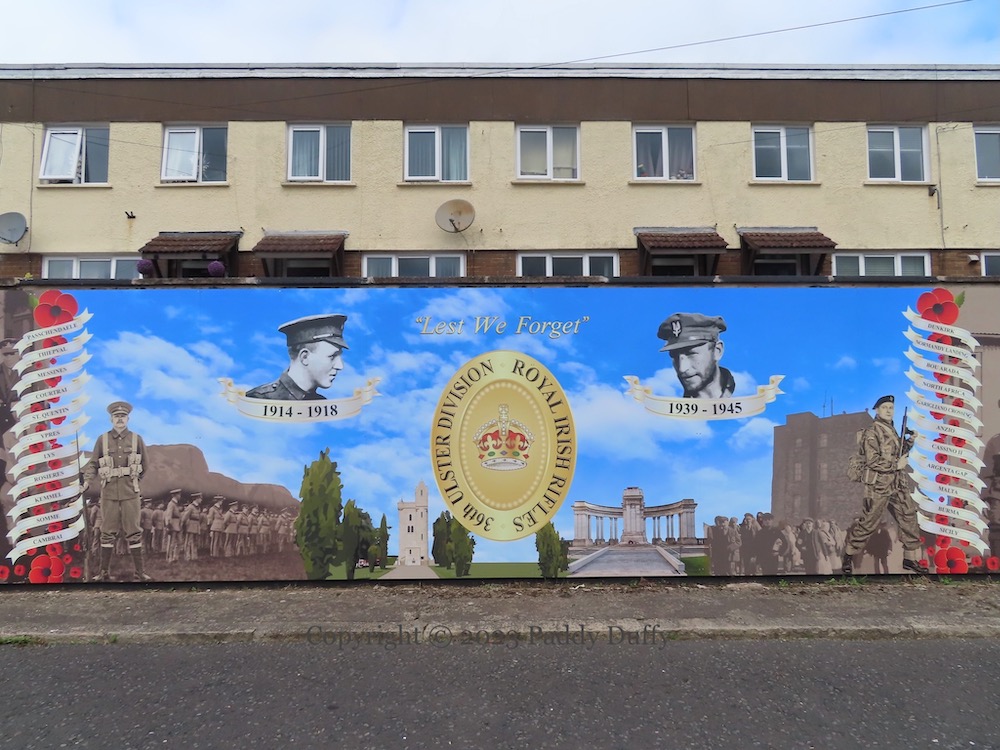
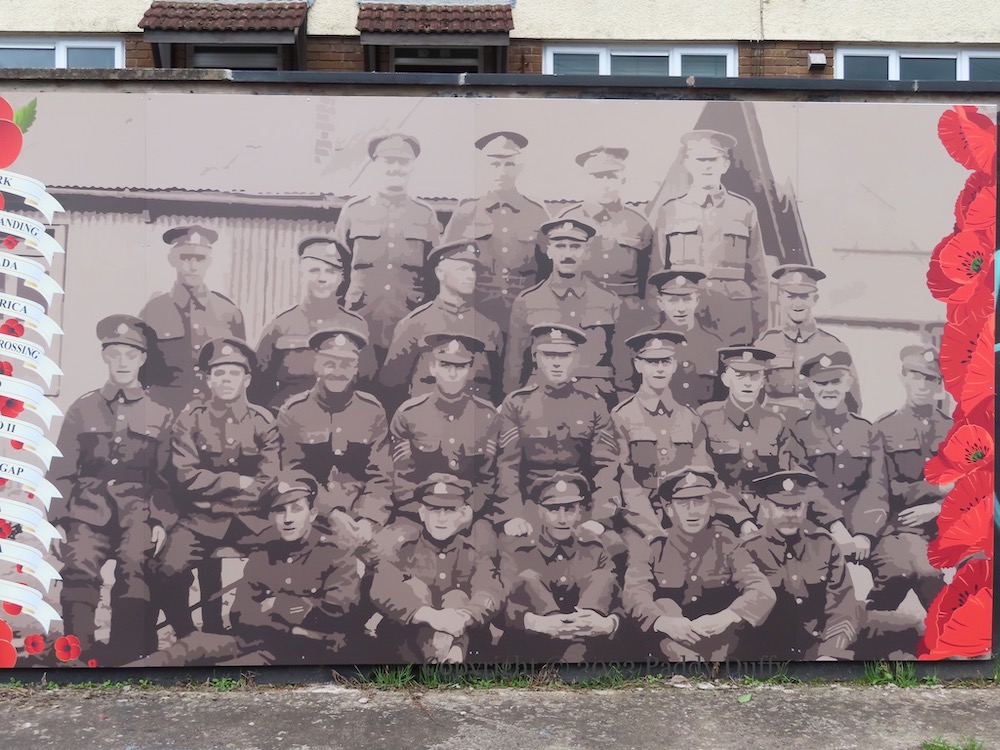
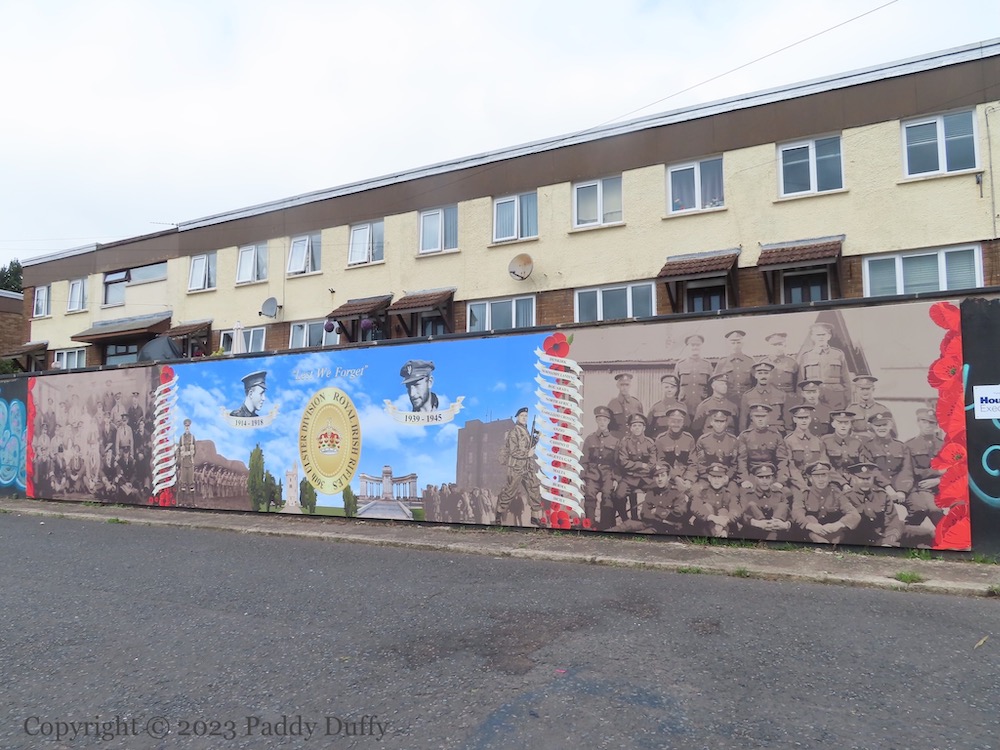
The 11th and 12th battalions of the Royal Irish Rifles were part of the 108th brigade and the 36th (Ulster) Division in WWI.
On July 1st, 1916, the 12th battalion’s objective was to reach the German trenches beyond Beaucourt railway station with the 9th battalion Royal Irish Fusiliers (Armagh, Monaghan & Cavan Volunteers); they were cut down by machine-gun fire and unable to achieve their goal. Robert Quigg of the 12th Rifles and Geoffrey Cather of the 9th Fusiliers were awarded the VC (see previously VCs Of The 36th). The 11th was part of the attack on the Schwaben Redoubt and reached the German second line before being pushed back in the evening. (Royal Irish | Web Matters)
When this mural of Northern Ireland players from Killyleagh was originally painted in 2006 it featured only three players:
– Hugh Davey, from Shrigley, five caps for “Ireland” (that is, for the IFA team) from “1925-1928” (NI Football)
– Terry Cochrane, 26 caps for Nothern Ireland from “1975-1984”; he played in the ’82 World Cup qualifiers but was injured for the tournament itself (NI Football)
A space and a question-mark were left at the bottom of the rainbow for future stars, in particular for then-seventeen-year-old up-and-comer Trevor Carson (Glasgow Times) who indeed went on to win his first (senior) cap in 2018 and currently has eight in total. He was added to the mural in 2021 (tw).
Braeside Gardens/Frederick Street, Killyleagh. Carson’s mother lives in the estate (Sunderland Echo).