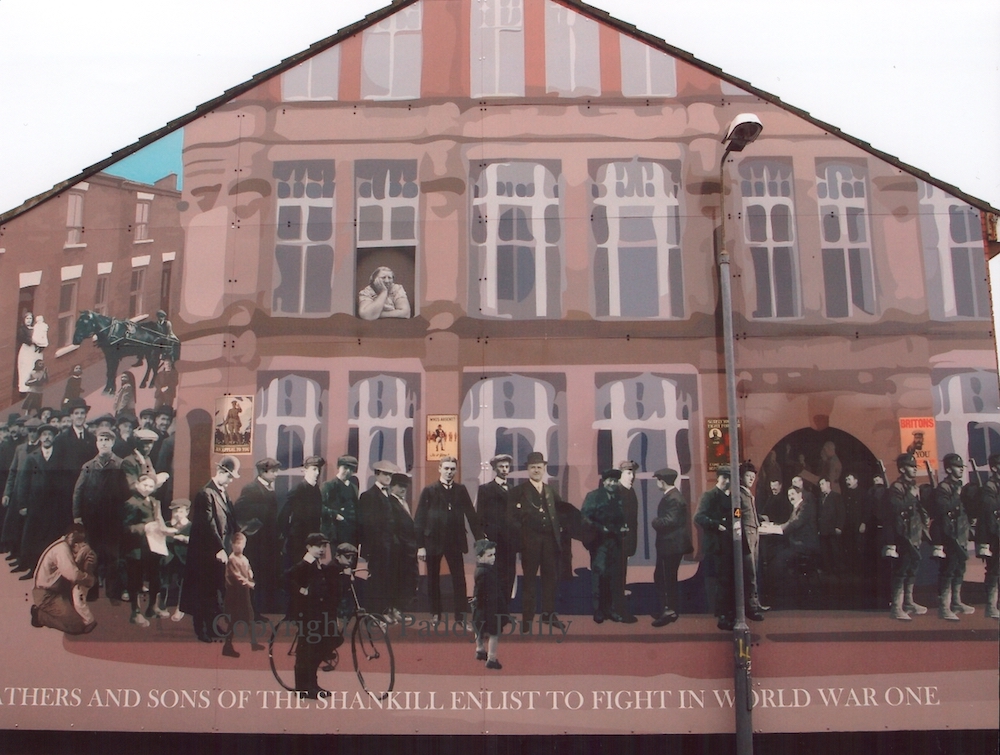
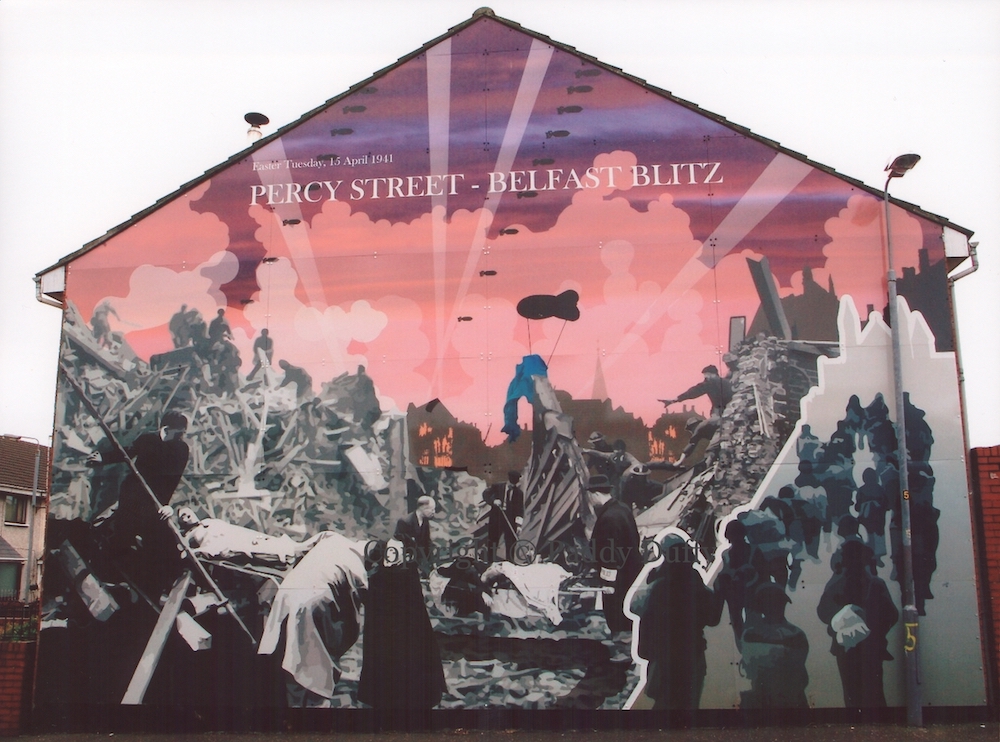
Here are three murals/boards by Steven Tunley for the Re-Imaging Communities programme in Dover Place, lower Shankill.
From left to right: “Fathers and sons of the Shankill enlist to fight in World War One”, “Belfast blitz – Easter Tuesday, 15 April 1941”, and “VE Day – 8th May 1945”.
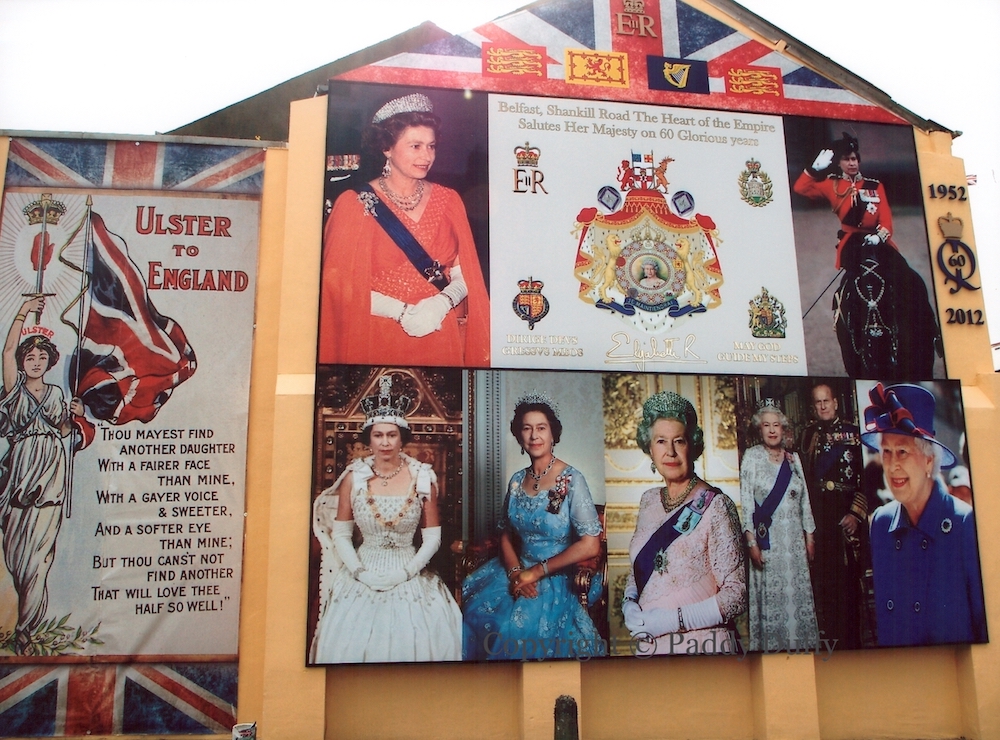
“Belfast, Shankill Road the heart of the empire salutes her majesty on 60 glorious years.” [1952-2012]
This is a new three-part installation of boards on Crimea Street for Queen Elizabeth’s diamond (60th) jubilee. For “Ulster To England” see Ulster Girl. On the left (out of shot) are flags of the home nations along with the Royal Standard and Union Flag.
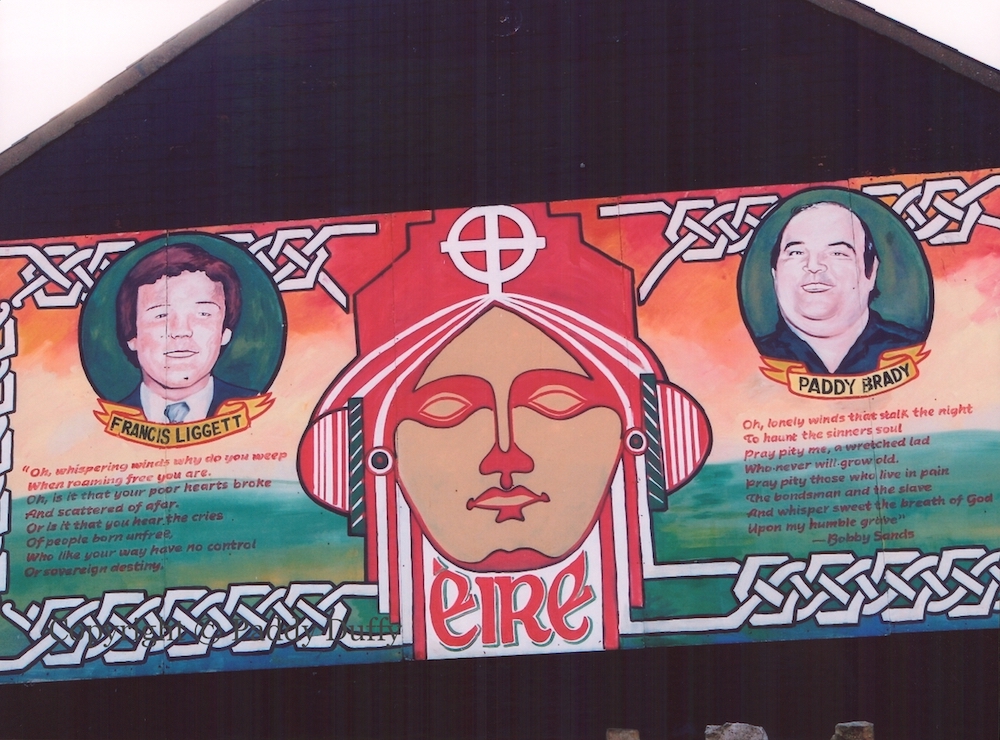
IRA volunteer Francis Liggett was shot by the British Army in January 1973 as he attempted to rob the Royal. One of the images of Gerry Adams in paramilitary beret comes from Liggett’s funeral.
Paddy Brady was a Sınn Féın activist shot in 1984 at his work by the UFF (Sutton). Both were from the St James’s area of west Belfast. Their portraits are on either side of Éıre personified. They are also included in the ‘Roll of Honour’ in the memorial garden below them. The verses are from Bobby Sands’s poem Weeping Winds.
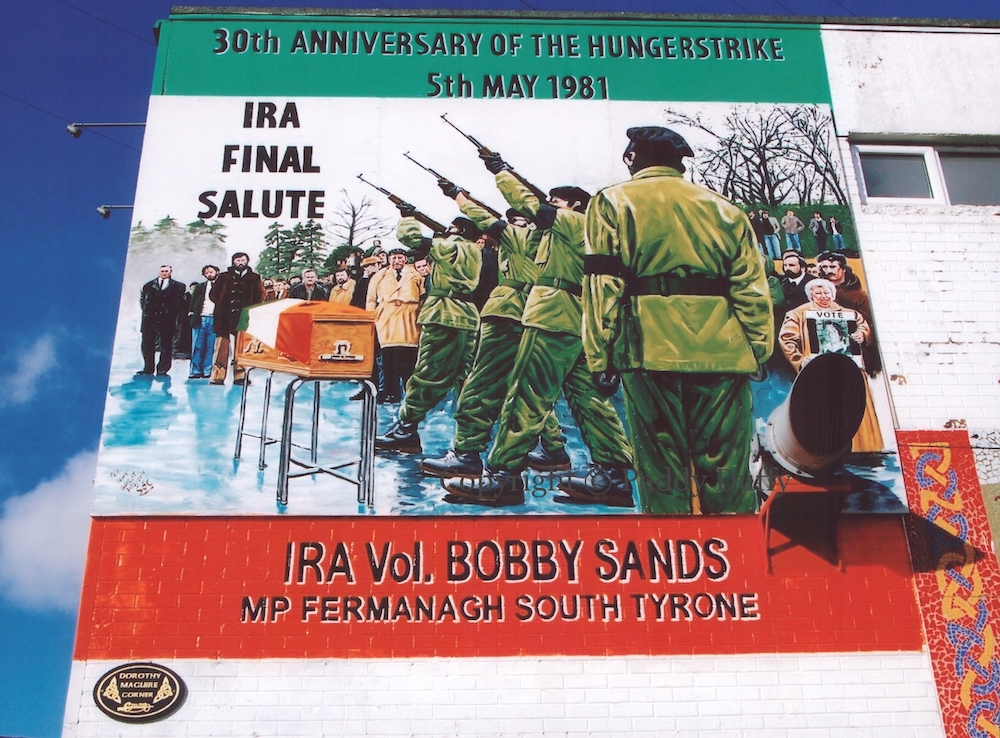
“30th anniversary of the hunger strike. 5th May 1981. IRA final salute. IRA Vol. Bobby Sands, MP Fermanagh South Tyrone.” Gerry Adams watches on as a funeral volley is fired over Sands’s coffin.
Also new is the plaque naming the wall as “Dorothy Maguire Corner”, after the 19-y-o shot in 1971, a member of Cumann Na mBan.
Painted on the Whiterock Road, west Belfast by Lucas Quigley.
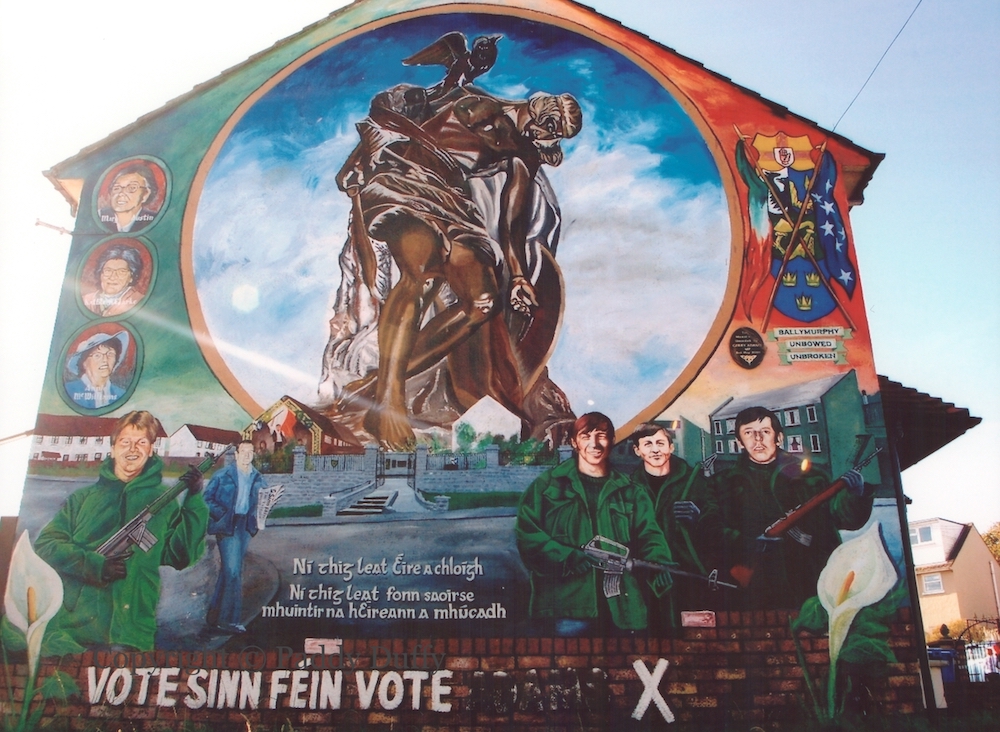
“Ní thıg leat Éıre a chloígh, ní thıg leat fonn saoırse mhuıntır na hÉıreann a mhúc[h]adh.” [“You cannot subdue Ireland; you cannot extinguish the desire for the freedom of the Irish people.”]
The mural presents images of Ballymurphy including the mural of McCrudden-O’Rawe–Jordan and memorial garden on Divismore Way (left) and Springhill (right), under the title “Ballymurphy unbowed, unbroken”.
The male figures in the foreground are unnamed but the four in jackets are presumably Stone, McWilliams, McCracken, and Dougal after their mural in Springhill Drive was blanked; the female activists on the left of Sheppard’s Cú Chulaınn are Mary Austin, Kathleen Clarke, Annie McWilliams. “This mural was unveiled by Gerry Adams MP 2nd May 2010” but Adams’s name has been scratched out from the (painted) low wall.
“Grieve not nor speak of us with tears but laugh and talk of us as though we were beside you”. Óglaıgh Na hÉıreann, Belfast brigade, 2nd battalion, B company volunteers Kevin Delaney, Patrick Campbell, Michael Clarke, Anne Parker, and Michael Sloan are shown on patrol in Ballymurphy Parade, the street just to the left of this mural. Campbell was 16 when killed by friendly fire; the oldest at time of death was Delaney, at 26.
Also named on the plaque are “republican activists” Esther Valelly, Theresa Campbell, and Maggie Campbell.
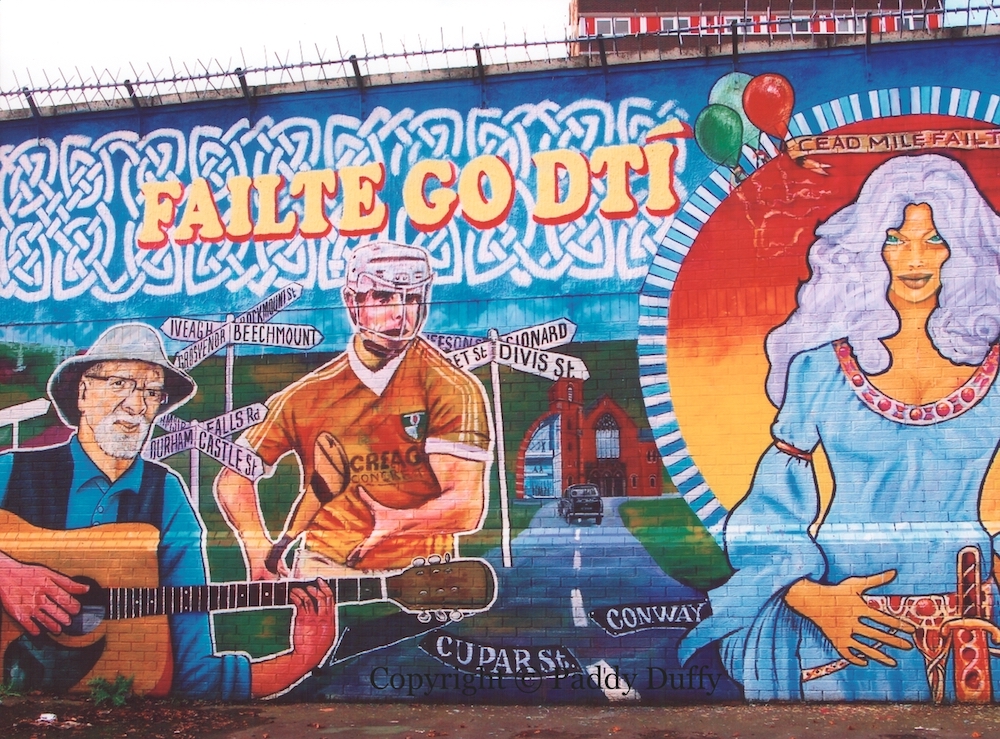
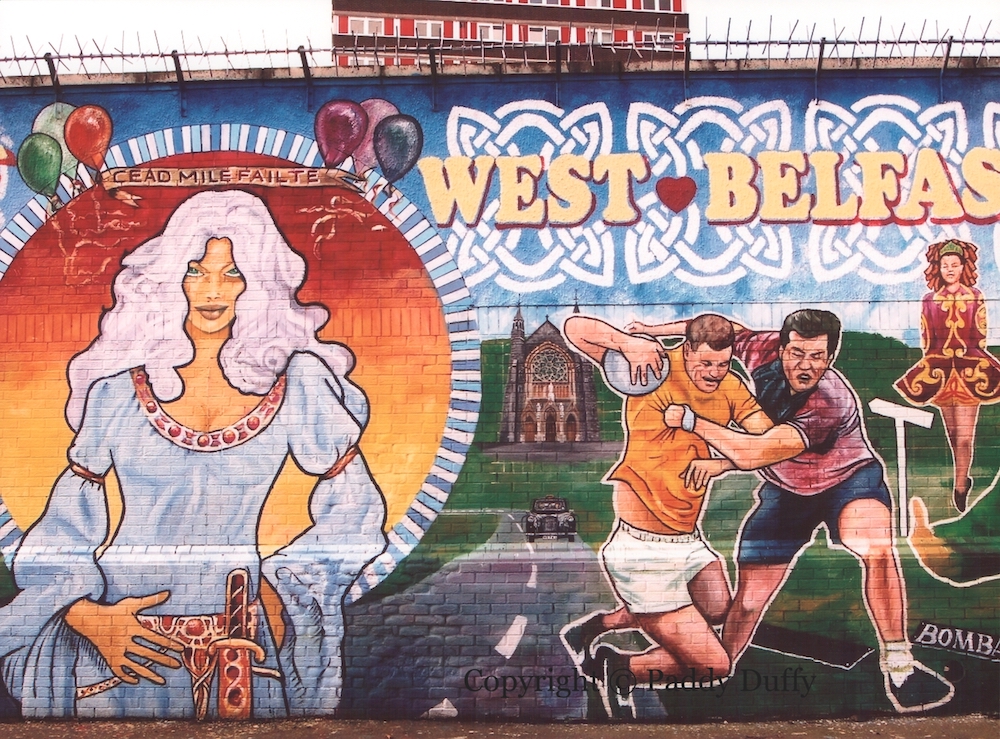
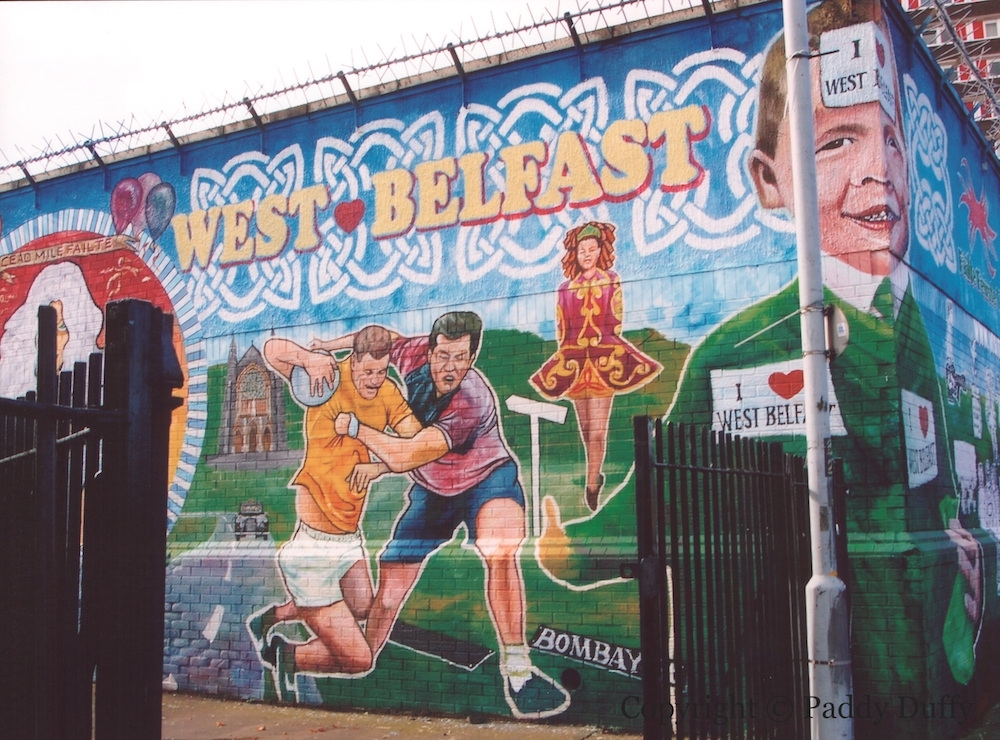
“Welcome to west Belfast”. West Belfast is portrayed as a place of music, sport, and dancing, whose landmark buildings and streets are under the watchful eye (and sword) of the goddess Érıu.
The image of the little boy with the “I [heart] Belfast” stickers and a bag of sweets, standing in the waste ground of Divis flats, is a photograph from the early days of Féıle An Phobaıl/West Belfast Festival.
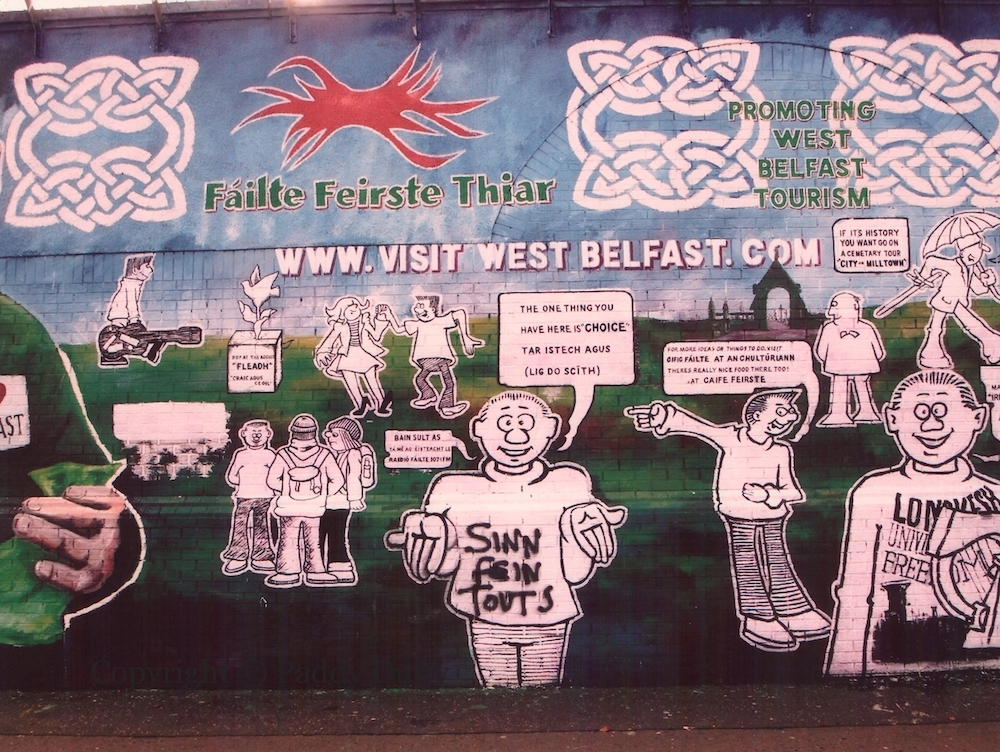
On the Divis Street side, characters in the style of cartoonist Cormac (see e.g. Notes) are “Promoting west Belfast tourism” for “Fáılte Feırste Thıar”, “www.visitwestbelfast.com“. The attractions touted are: “Bop at the August “fleadh”. “Craıc agus ceol” (for Robert Ballagh’s dove coming out of the concrete block, see Féile An Phobail 2008), “The only thing you have here is “choice”. Tar ısteach agus (lıg do scíth)”. “Baın sult as. Tá mé ag éısteacht le Raıdıó Fáilte 107.1 FM”, “For more ideas on things to do, visit Oıfıg Fáılte at An Chultúrlann. There’s really nice food there too! at Caıfe Feırste”, “If it’s history you want go on a cemetery tour “City or Milltown””, “Enjoy a walk on ‘Slıabh Dubh’ (The black … … mountain)”, “Make sure you visit the “Irish republican history museum” at Conway Mill” (with ‘Long Kesh University Of Freedom’ sweater; “Sinn Féin touts” is not a sweater but graffiti.)
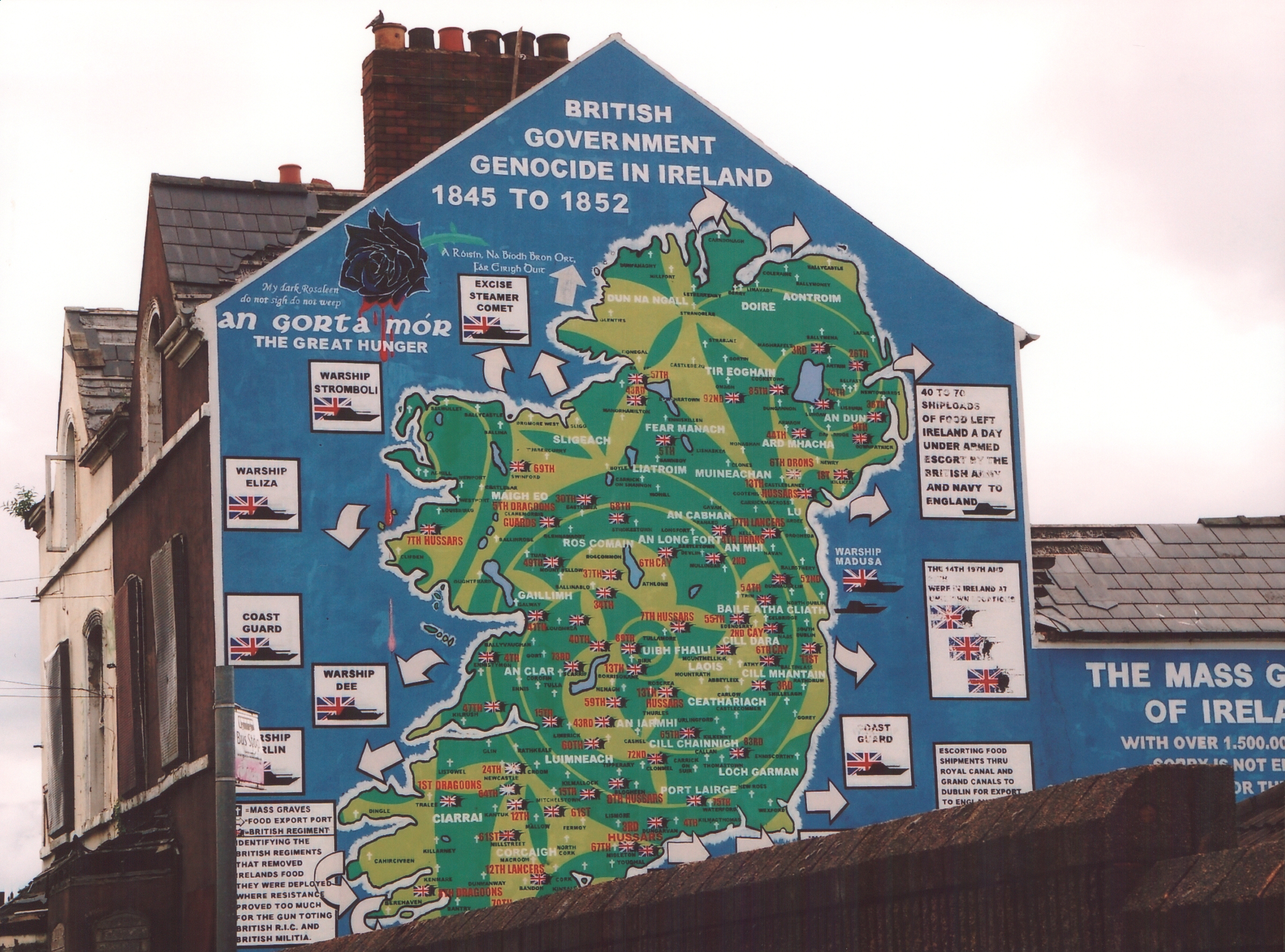
In 1997, the office of then-Prime Minister Tony Blair issued a statement acknowledging that the administration of the time of the Hunger failed to intervene (Guardian | Independent).
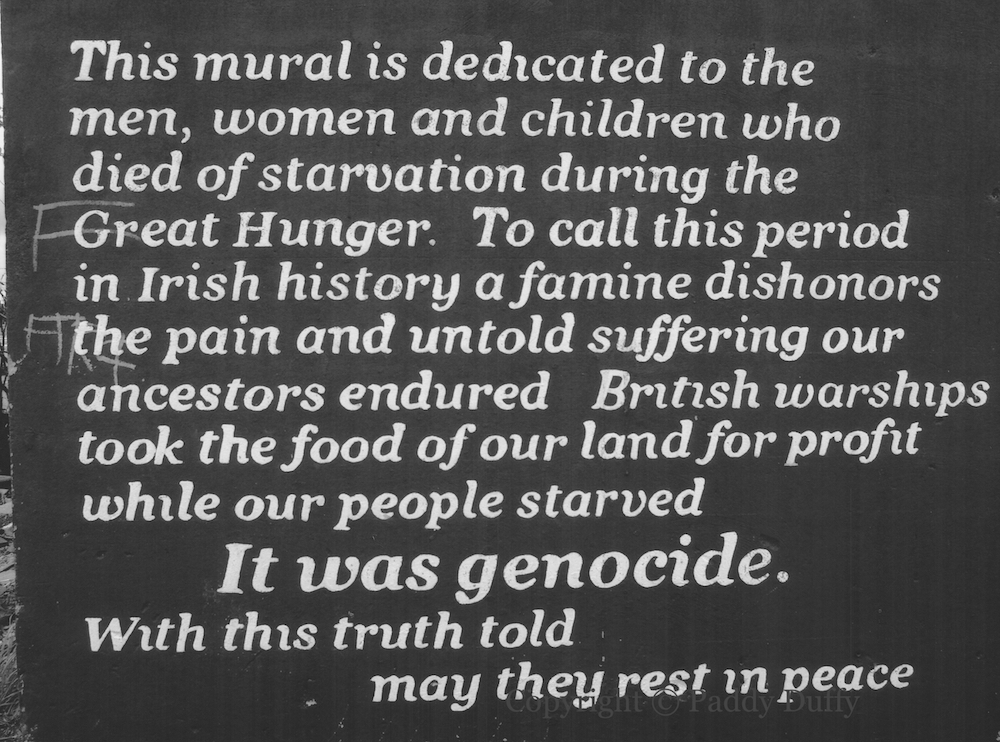
The mural above asserts that government’s inaction was not merely a matter of negligence but of will: “With over 1,500,000 deaths “sorry” is not enough. It is time the British government and its war machine to leave Ireland and her people in peace. During the genocide of 1845 to 1852 the British government seized from Ireland’s producers tens of millions of head of livestock, tens of millions of tons of flour, grain, meat, poultry and dairy products, enough food to sustain 18 million people. 200,000 British troops (100,000 at any given time) and 12,000 RIC removed Ireland’s food at gun point. This mural is dedicated to the men, women and children who died of starvation during the Great Hunger. To call this period in Irish history a famine dishonors the pain and untold suffering our ancestors endured. British warships took the food of our land for profit while our people starved. It was genocide. With this truth told may they rest in peace.”
“A Róısín, na bíodh brón ort, fár [fé’r] éırıgh duıt.” Each white cross on the map represents a mass grave. The map is originally from irishholocaust.org.
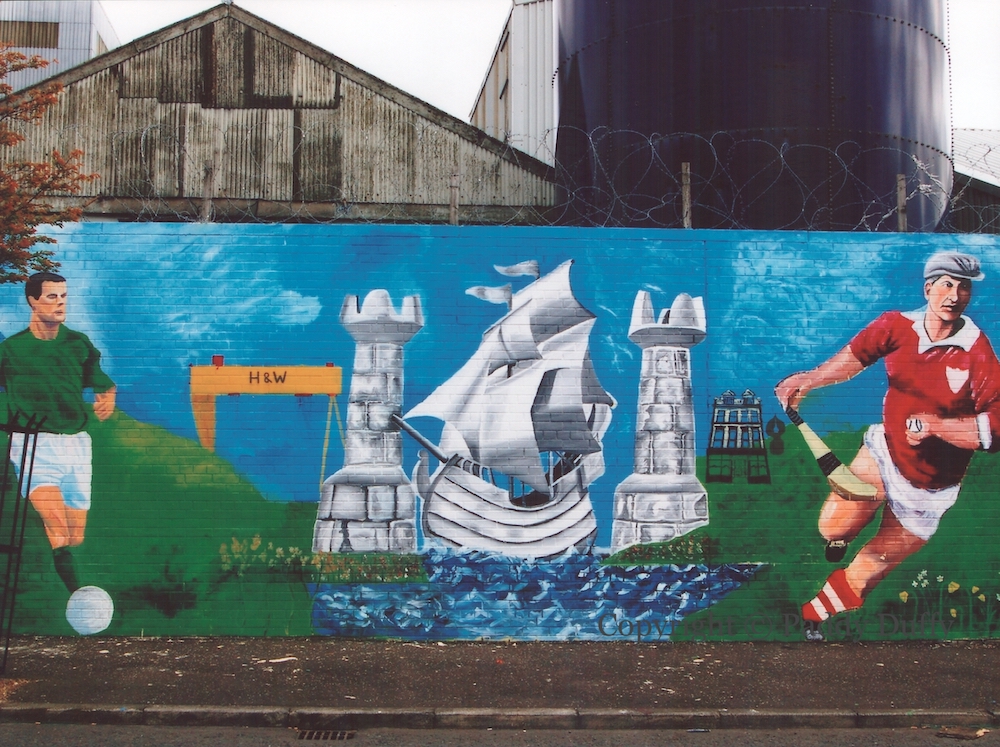
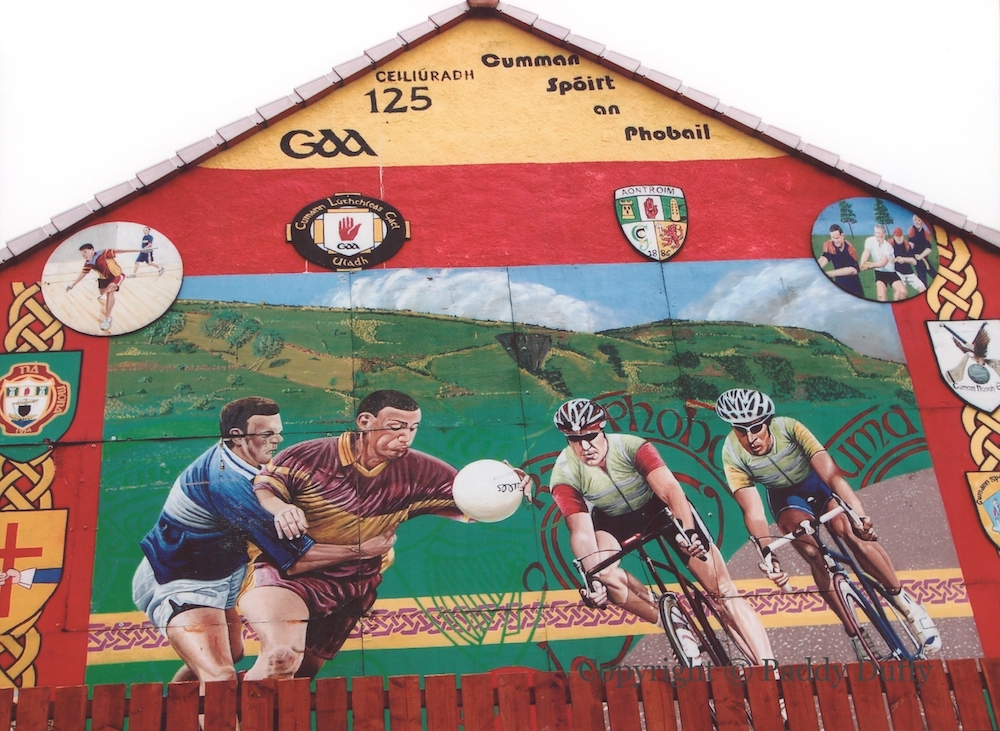
This mural (partly on boards, partly on the wall) celebrates 125 years of the GAA, particularly local teams Cumman [sic] Spóırt An Phobaıl, Cardinal O’Donnell’s, Gort Na Móna, and Cumann Naomh Eoın.