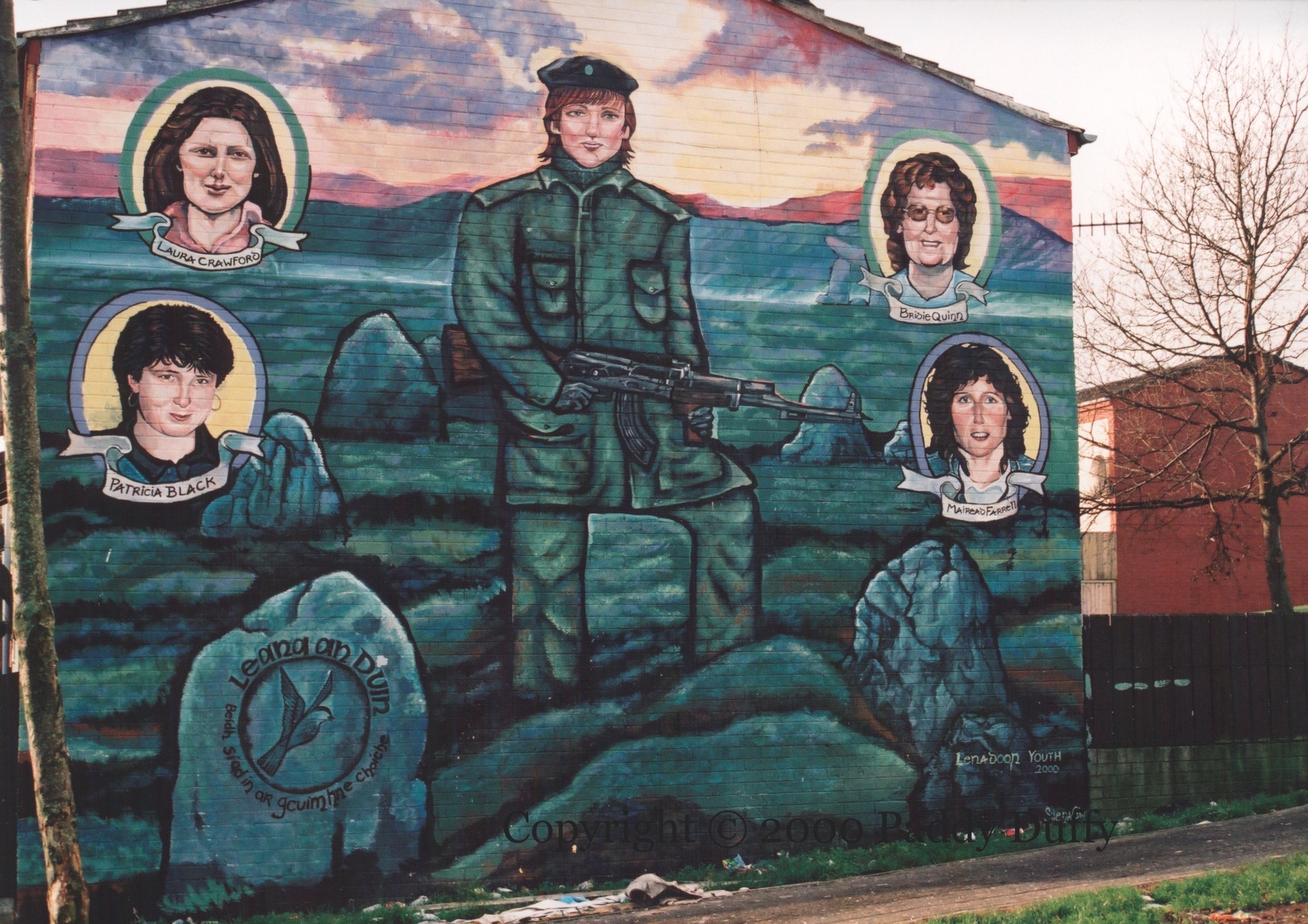
“Leanna An Dúın – Beıdh sıad ın ár gcuımhne choíche.” Local female IRA volunteers Laura Crawford, Patricia Black, Bridie Quinn, Maıréad Farrell and a generic female volunteer with assault rifle on manoeuvres in an Irish landscape strewn with standing stones.
Signed by “Lenadoon Youth 2000”. Glenveagh Drive, Lenadoon, Belfast
The dying Cú Chulaınn and the Blessed Virgin Mary make an odd pairing in this Ligoniel memorial garden to locals who died during the Troubles. Cú Chulaınn is typically used to memorialise paramilitary volunteers (see the Visual History page) but the plaque does not mention volunteers and the statuary suggests prayer rather than a final salute as a fitting form of remembrance.
The plaque in the centre, which was previously at the crux of a Celtic Cross mural, reads “I ndıl chuımhne [in fond memory]. This plaque is dedicated to the memory of all those from Ligoniel who lost their lives as a result of the conflict in our country. A Mhuıre banríon na nGael guıgh orthu [Mary, queen of the Gael, pray for them]”
The other mural in the yard is a greatly re-designed presentation of Éıre, taking up the whole wall, and replacing the Maid Of Erin harp with Érıu, the mythological queen of Ireland/Éıre, as designed by (or at least, in the style of) Richard J King/Rísteard Ó Cíonga. (Also seen in the Short Strand.)
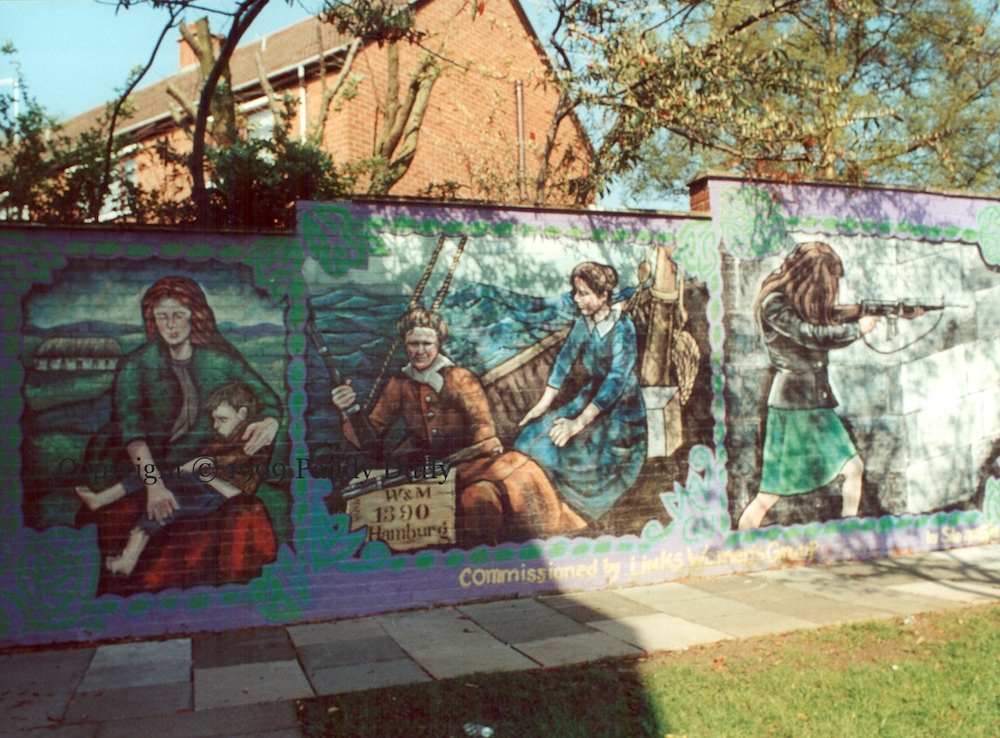
Three panels portraying the importance of women to the republican movement, though the first seems to be a generic ‘mother and son’ image.
The second shows Molly Childers and Mary Spring Rice aboard the yacht, Asgard, with about 900 of the 1,500 rifles that were smuggled into Ireland on two boats. Asgard docked at Howth on July 26th, 1914; the other rifles eventually came ashore two weeks later at Kilcoole. (Here is a tcd.ie collection of images of Asgard’s journey; image #53 is the one reproduced in the mural. Rice kept a diary of the trip; extracts are included in this RTÉ History Show video. See this RTÉ article for an account of their tortured journey.) The off-loading took place during the day but when the police and army met the marching volunteers at Clontarf they were able to capture only 19 rifles. As the army regiment involved returned to barracks it was pelted with stones or fruit by a crowd and killed three (with a fourth dying a week later). The vintage Mauser rifles were received by members of Óglaıgh Na hÉıreann and Na Fıanna Éıreann.
This mural for the 200th anniversary of the 1798 rebellion by “Na hÉıreannaıgh Aontaıthe” (the United Irishmen). The United Irishmen used the Maid Of Erin harp as a symbol. Out of frame to the right is the motto of the French Revolution: “Liberté, égalité, fraternité”.
There are seven names listed on the right, none of which is Andrea Redmond (Fb), who is the painter of record. The list was later painted out – see M02183.
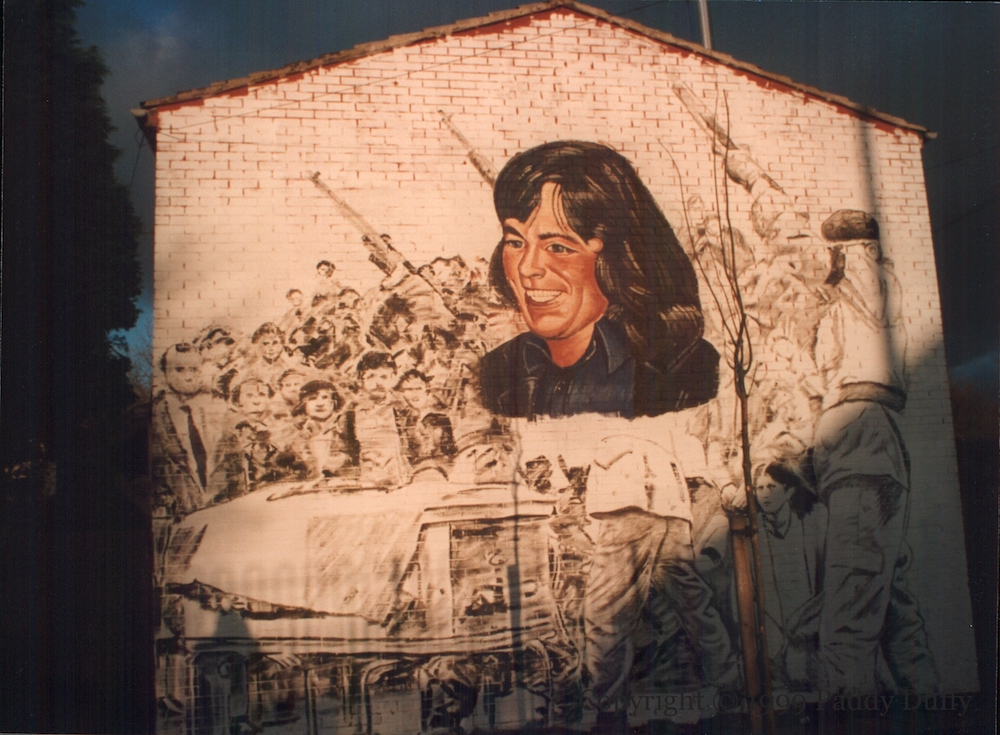
The IRA’s Joe McDonnell was the fifth of the 1981 hunger-strikers to die, on July 8th, after 61 days. McDonnell’s portrait is superimposed upon a sketch of a photograph of the funeral volley fired while his coffin was en route to Milltown cemetery (An Phoblacht).
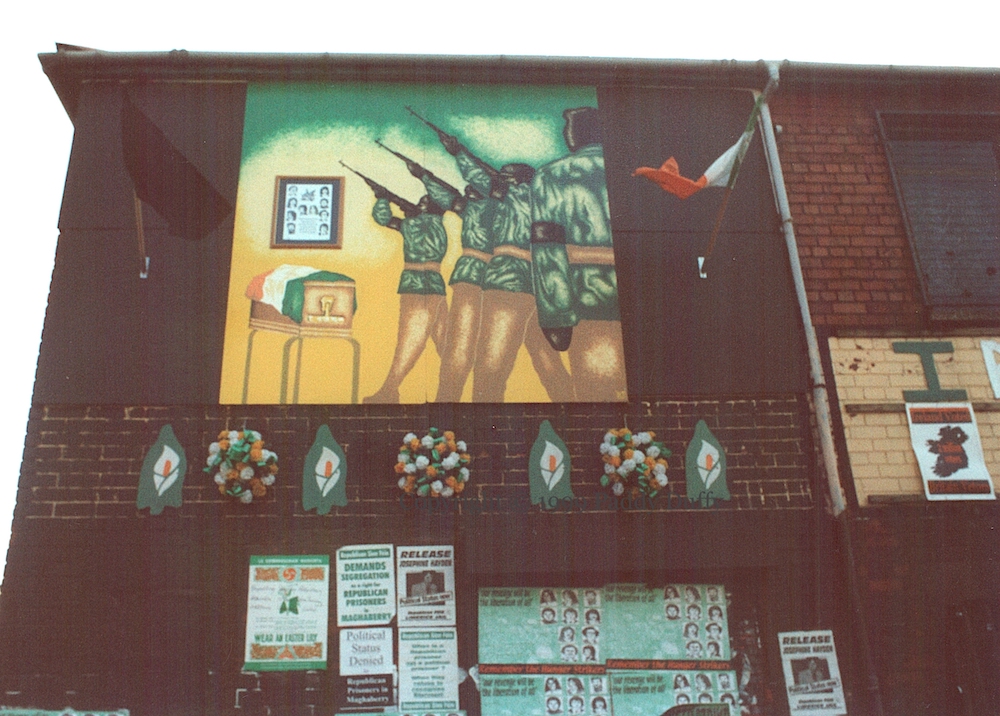
This is a display to republican dead, with a black flag, Easter lilies, and (on the main board) a funeral volley being fired over a coffin draped in a Tricolour, with a printed poster of the ten deceased 1981 hunger-strikers. The board was later moved to Clowney Street.
Among the posters below we see “Release Josephine Hayden”. Hayden was General Secretary of Republican Sınn Féın when she was sentenced to six years in jail in 1996 for weapons’ possession. She would be released in 2000. (Irish Times)
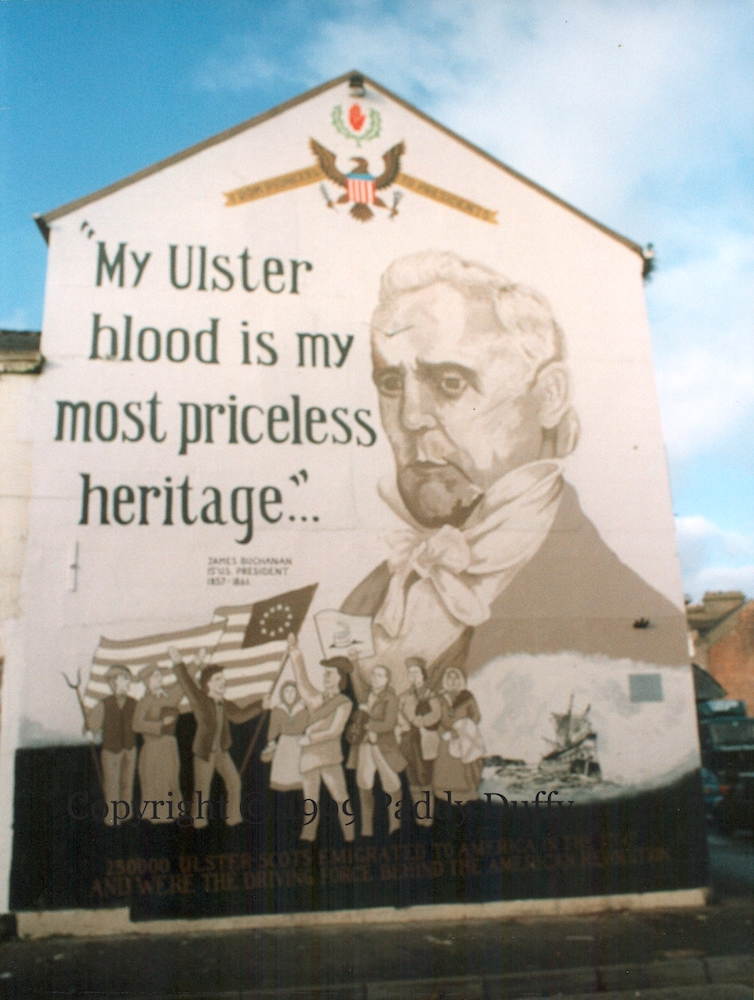
“”My Ulster blood is my most priceless heritage …” – James Buchanan 15th US president 1857-1861″. This is the first of the murals in the “From pioneers to presidents” series to be painted in Belfast, depicting James Buchanan. Three murals had already been painted in Londonderry, to Theodore Roosevelt, James Buchanan (which contains more information about Buchanan and his heritage), and George Washington.
The words along the bottom read, “250,000 Ulster Scots emigrated to America in the 1700s and were the driving force behind the American Revolution.”
The small plaque to the right reads, “Shankill Ulster-Scots Cultural Society. The Buchanan Mural. This mural was dedicated to the memory of those early Ulster-Scots emigrants by Ms Jane Benton Fort, US Consul General, on Thursday November 4th, 1999. Sae monie hairts gaed far frae hame – bot ilka yin oor ain fowk [So many hearts went far from home – but every one [is/remains] our own folk]. This project was funded by Belfast City Council and Making Belfast Work.”
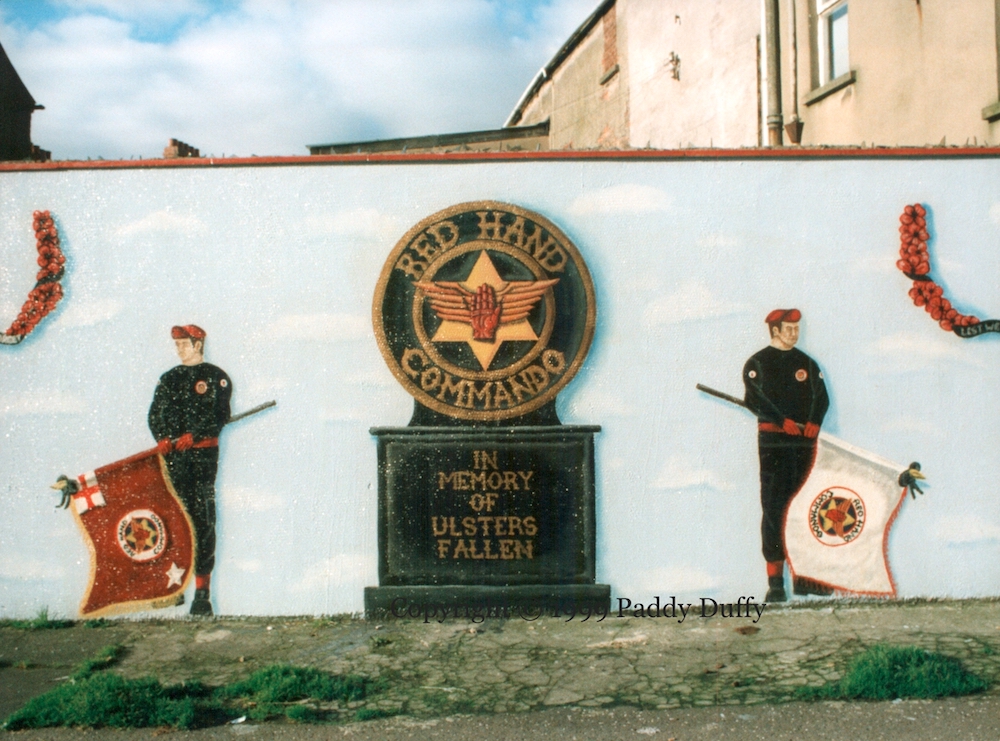
On the left, volunteers from the Red Hand Commando with bare faces stand with lowered flags beside a plinth “in memory of Ulster’s fallen”.
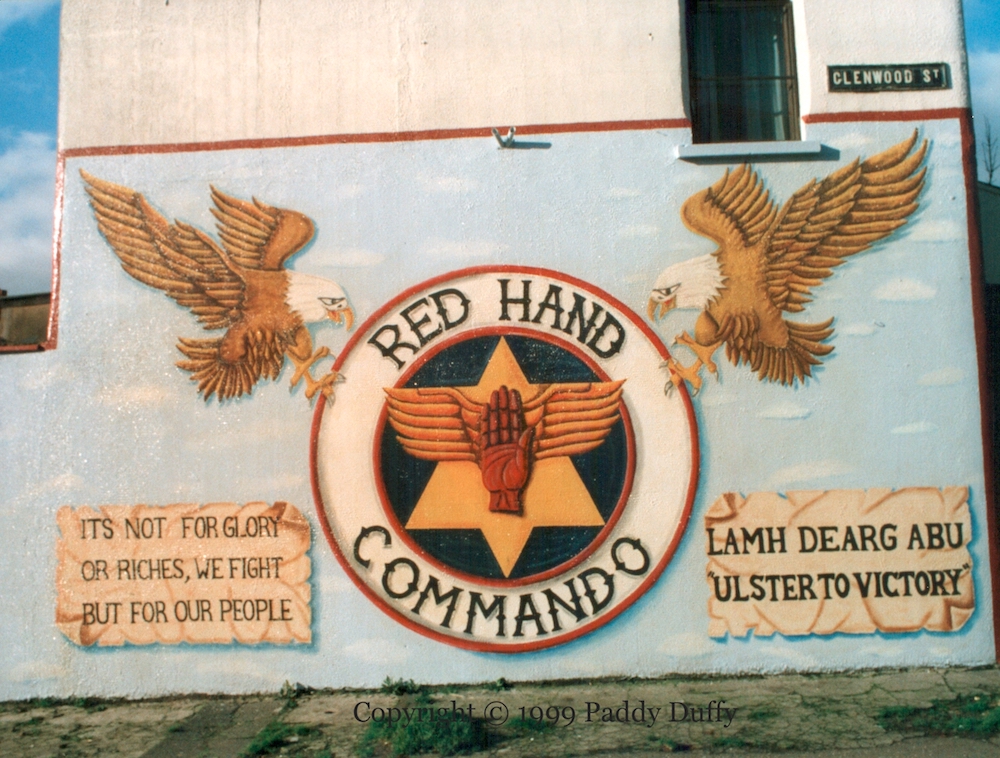
On the right, “In memory of Ulster’s fallen.” “Lamh dearg abu” [= “Lámh dhearg abú”] [= “Red Hand to victory”], “Ulster to victory”, “It is not for glory or riches we fight but for our people” (from the Declaration Of Arbroath). With the insignia of the Red Hand Commando and a pair of bald-headed eagles.
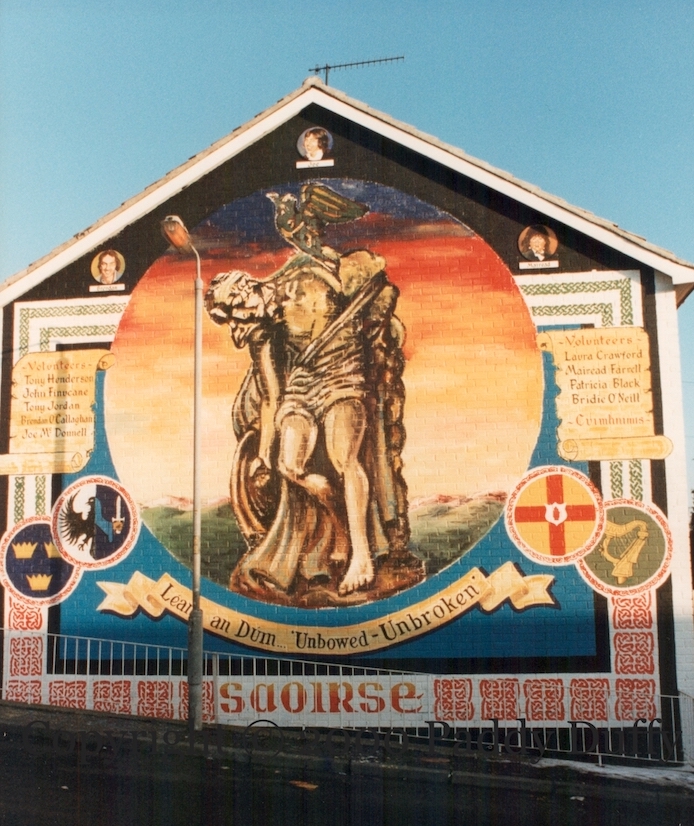
The dying Cú Chulaınn (as portrayed in bronze by Oliver Sheppard, in a statue installed in the GPO in 1935) is used as a symbol for the locals from Lenadoon area of west Belfast who fought for freedom (“saoırse”): Tony Henderson, John Finucane, Brendan O’Callaghan, Joe McDonnell, Laura Crawford, Maıréad Farrell, Patricia Black, Bridie O’Neill (subsequently changed to Bridie Quinn).
There were originally portraits of all nine people in the apex when the mural was launched in 1996, but only three remain.
A dove carries the keys that would unlock the chains that are already being rent asunder by their manacled captive in “Ceıs Fada” [Long Kesh]. Part of the “green ribbon” campaign to release republican POWs under the terms of any peace agreement.





 Paddy Duffy Collection