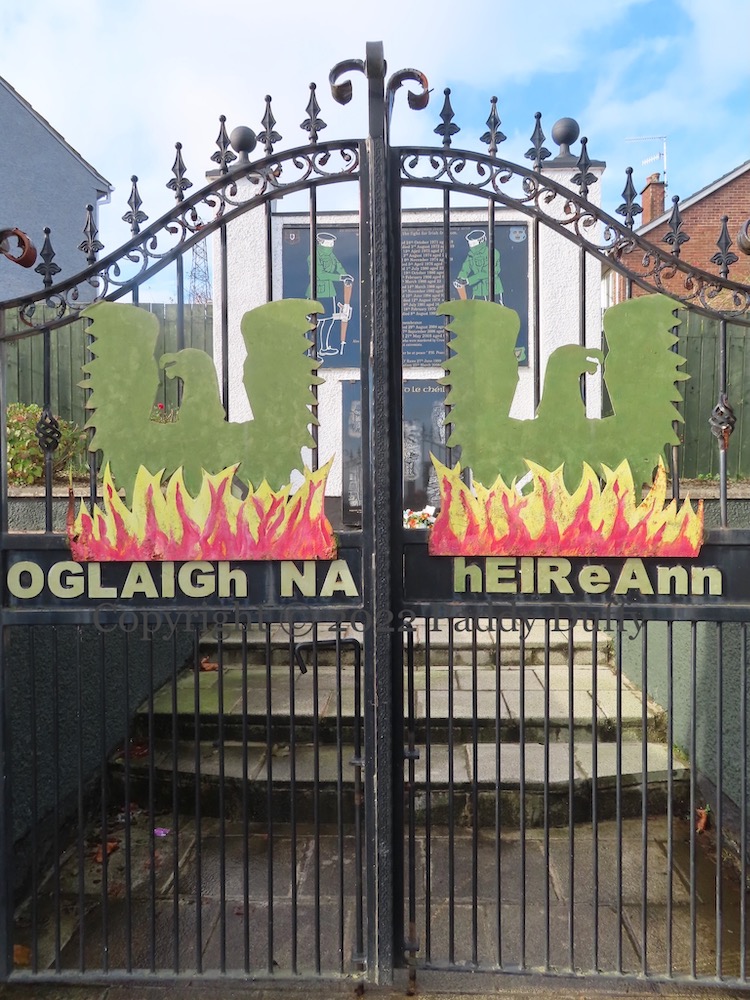
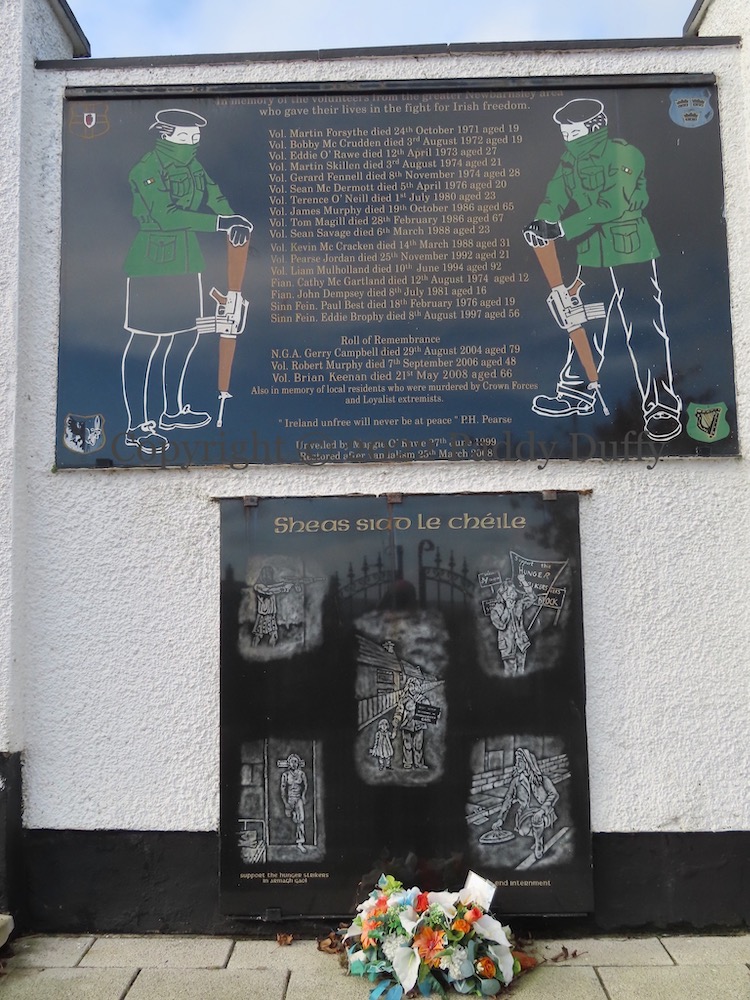
“Sheas sıad le chéıle” [They stood together] – the New Barnsley memorial garden commemorates (on the large plaque) “Volunteers From The Greater New Barnsley Area” and (on the smaller one) commemorating support from the community.
The wrought-iron gates depict a phoenix and “Óglaıgh Na hÉıreann”.
The “Craigavon 2” are Brendan McConville and John-Paul Wootton; they were convicted of the 2009 murder of PSNI constable Stephen Carroll. The “set up by MI5” and/or “appeals sabotaged” on the RNU board shown above is a reference to the claim that MI5 agent Dennis McFadden had infiltrated the campaign for justice for Brendan McConville (Irish News).
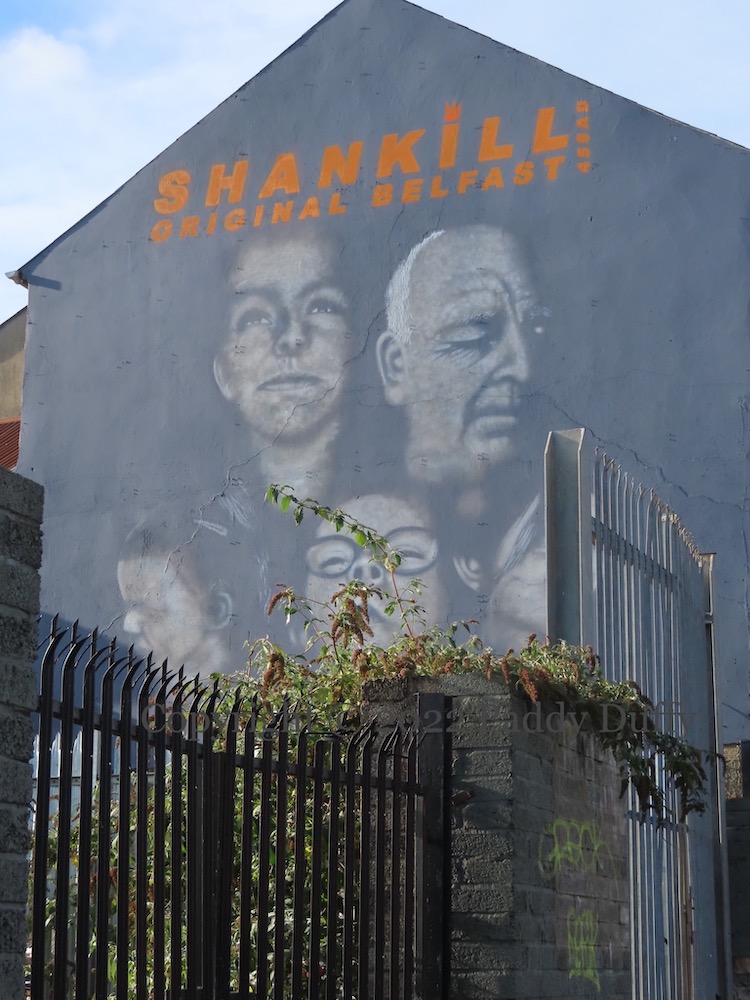
The second version of the “Original Belfast” mural “celebrates the contribution of people across the Greater Shankill who work with children and young people” including Sam Drake from the lower Shankill community centre (GSWF). For the previous version, see The Original Belfast.
Ulster’s defenders, past and present, from Cuchulainn “Ancient defender of Ulster from Gael attacks”, via the 1893 UDU and WWI soldiers memorialised in the towers at Messines and Thiepval, to the modern UDA/UFF: “In memory of the officers and volunteers of A. Coy. UDA/UFF West Belfast Brigade who unselfishly dedicated their lives in defence of their country.”
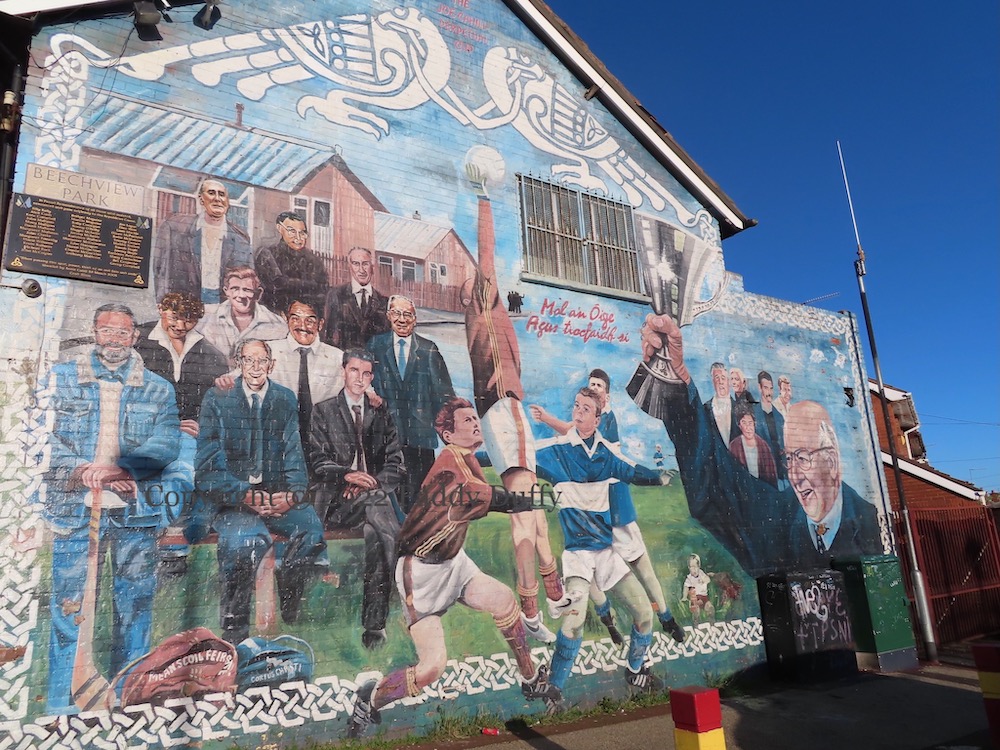
“Mol an óıge agus tıocfaıdh sÍ”. [Praise youth and it will flourish/Youth responds to praise] Above is the Joe Cahill mural in Beechview Park, next to the GAA pitch. The mural was unveiled on September 2nd, 2013. (Images of the unveiling from An Phoblacht.) Joe Cahill (WP) holds the cup aloft. The group in the bottom left corner (see the second image, below) are Pat O’Hare, Frank Cahill, Tom Cahill, (the three Cahills were featured in the previous mural) Ned Maguire, Jr., Ned Maguire, Sr., Alec Crowe, Paddy Meenan, Tommy Crowe, Dal Delaney, and Hugh Elliot. In the crook of Cahill’s arm are Rita McParland, Sean Wallace, Paddy Corrigan, John Pettigrew, and John Stone. None of these adults is still alive; all were from the local area.
The chalet bungalows in the background on the left are gone, but you can see images of them on the Belfast Forum.
The plaque on the left names others in addition: Billy Kelly, Alice Cush, Kate Campbell, John Mulligan, Mary Mulligan, David Mulhern, Margaret Mulhern, John Clarke, Margaret Farrelly, Marie Williams, Kevin Sullivan, Michael Rock, John McColgan, Bridget Maguire, Martin Maguire, Sally Corrigan, Sonny O’Reilly, Maggie McArdle, Jimmy McArdle, Kathleen Wallace, Maragret McGuinness, John Flanagan, Maisie McGuckian, Charlie McGuckian, Anthony Muldoon, Jim Logue, Ellen Weir, Liam Mackie, Oliver McParland, Sadie McMahon, Tommy Crowe, Maddie Holden, Sarah Doyle, Jimmy Doyle, Kathleen Pettigrew, Mary Cushnihan, Bell Cosgrove, Gerry Campbell.
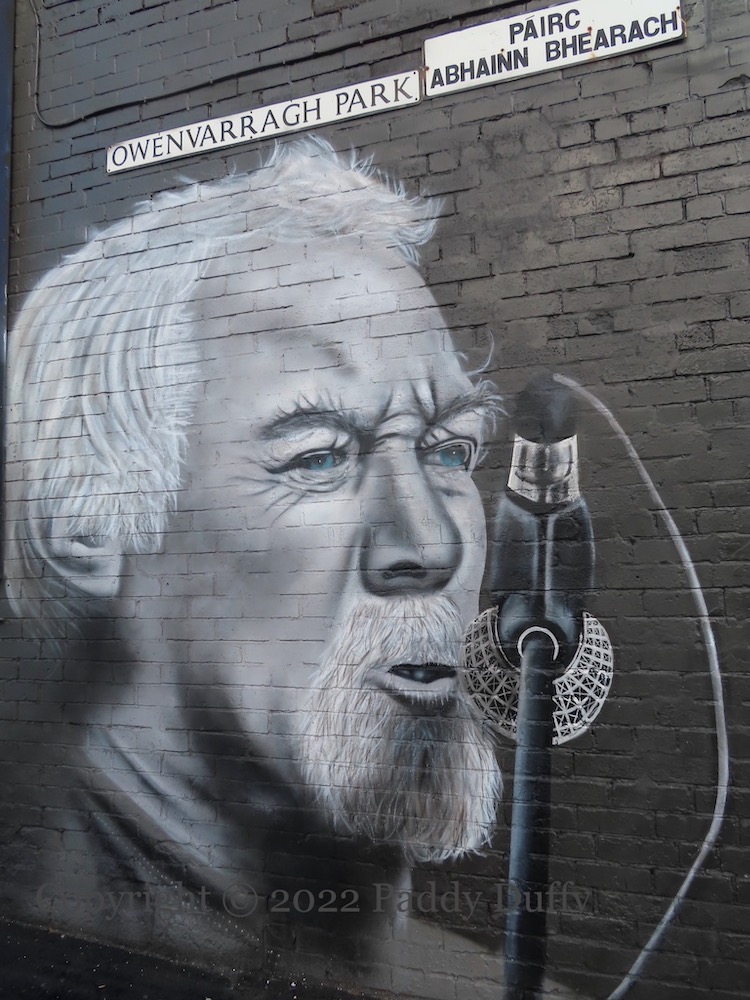
The career of Belfast blues/rock guitarist Rab McCullough spanned more than five decades, beginning with the formation of Baraka back in the 1970s, and included opening for Jimi Hendrix and a 20-year residency in the Empire. McCullough died in May (of 2021) after suffering a heart attack while swimming in Andersonstown leisure centre (BBC | BelTel | Belfast Media | Love Belfast). McCullough’s family is maintaining his Facebook page.
The mural was painted in Owenvarragh Park/Páırc Abhaınn Bhearach near his former home by Glen Molloy (ig). (Belfast Media)
A succession of Irish rebels is shown in this new mural in Andersonstown, west Belfast. It begins (top left) with the rebellion of 1798 and then to the Easter Rising of 1916 at the GPO in Dublin. In the lower left, a pious Padraıg Pearse awaits his execution with rosary beads in hand. There are then shown female figures from Cumann Na mBán and the IRA (see previously: United Irishwomen, Do You Care? and Mothering Sunday In Beechmount), and then Maıréad Farrell in Armagh Women’s Prison (for the original, see Prison Walls). In the bottom right corner there is a blanketman. The busts of Bobby Sands and Joe McDonnell float above the GPO and the last verse of Sands’s The Rhythm Of Timeform the epigraph: “It lights the dark of this prison cell, it thunders forth its might, it is the undauntable thought, my friend, the thought that says, “I’m right”.
On the side wall, “Ag fíorú na poblachta” means “Realising the republic”. It celebrates the centenary (“Céad Blıaın 1916 – 2016”) of the Easter Rising and shows a copy of the proclamation of the republic and an Easter lily. The next wall over (see below) shows portraits of the seven signatories to the Proclamation: Joseph Plunkett, Sean Mac Dıarmada, Thomas Clarke, James Connolly, Patrick Pearse, Eamonn Ceannt, and Thomas McDonagh.
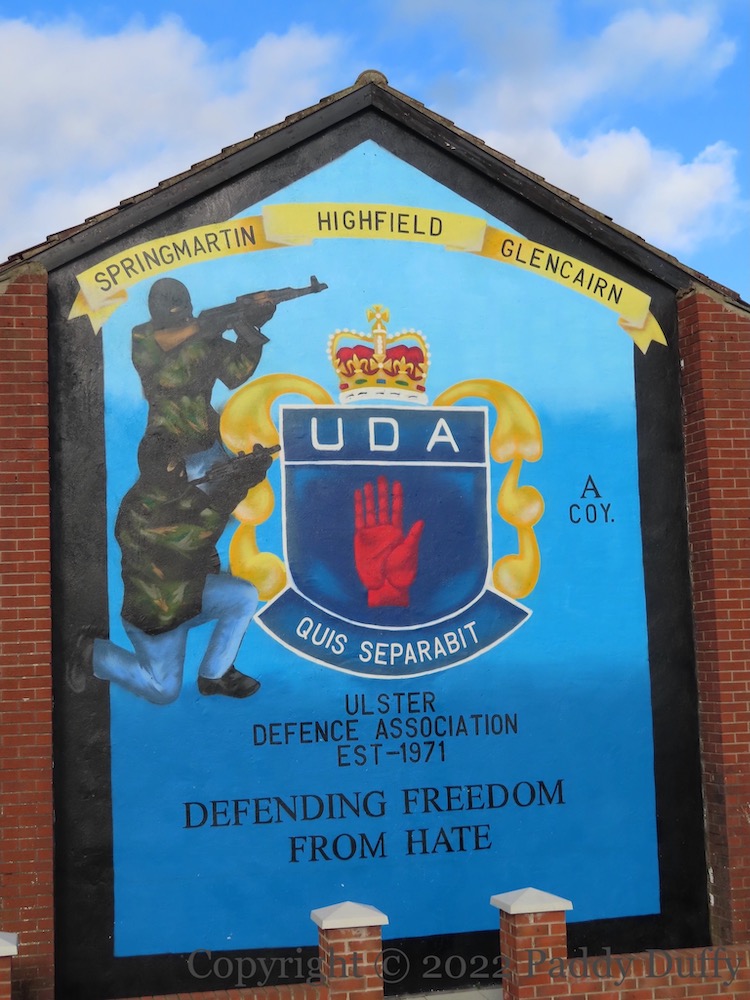
Compared to the UVF, the UDA more strongly detect an existential threat to loyalism and evince a siege mentality that provokes the need for armed resistance. Hence the more frequent presence of armed gunmen in UDA murals (which is also due in part to the UVF being able to “re-image” around the Ulster Volunteers and the Somme). With Brexit and the Protocol, however, armed gunmen have recently been appearing more frequently in UVF murals – see, for example, If Our Shores Are Threatened | Bang Up To Date | Our British Identity.
“Springmartin–Highfield–Glencairn Ulster Defence Association est. 1971. Defending freedom from hate.” As the companion mural (We Will Take Nothing Less) makes clear, the hate is coming from a “fascist republican enemy” (“Sinn Féin/IRA”, presumably) and the government of Ireland. Graphically, this mural is the same as the previous one on this wall: Under The Protection Of The UDA.
An estimated 100,000 people congregated at Craigavon House on the 23rd of September, 1911, to hear Edward Carson’s inaugural speech as Unionist leader (McNeill Ch. 4). In his speech he said “Our demand is a simple one. We ask for no privileges, but we are determined that no one shall have privileges over us. We ask for no special rights, but we claim the same rights from the same government as every other part of the United Kingdom. We ask for nothing more; we will take nothing less”. Ten years later, in 1921, Northern Ireland was created and it has survived to reach its centenary, despite (according to this mural) “100 years of fighting a fascist republican enemy sponsored by the Irish state.”
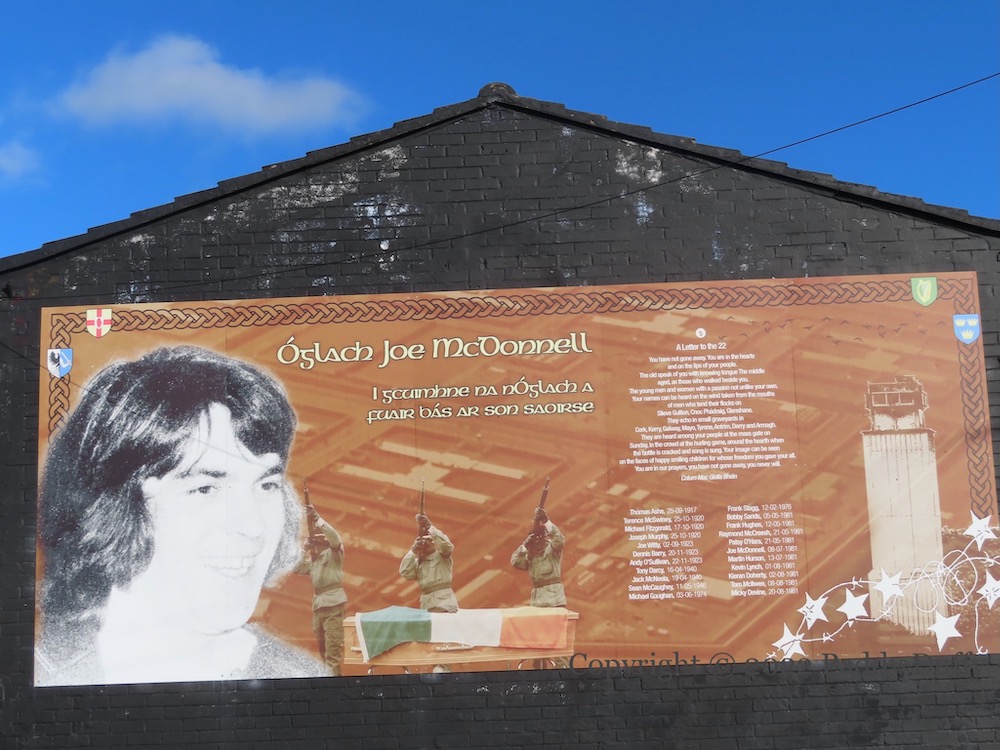
“I gcuımhne na nÓglach a fuaır bás ar son saoırse [in memory of the volunteers who died for freedom].” The “22” are the familiar 12 deceased Troubles-era hunger-strikers, plus 10 from 1917 to 1946: Thomas Ashe, Terence MacSwiney, Michael Fitzgerald, Joseph Murphy, Joe Witty, Dennis Barry, Andy O’Sullivan, Tony Darcy, Jack McNeela, Sean McCaughey.
“‘A Letter To The 22: You have not gone away. You are in the hearts/and on the lips of your people./The old speak of you with knowing tongue. The middle/aged, as those who walked beside you./The young men and women with a passion not unlike your own./Your names can be heard on the wind taken from the mouths/of men who tend their flocks on Slieve Gullion, Cnoc Phádraıg, Glenshane./They echo in small graveyards in/Cork, Kerry, Galway, Mayo, Tyrone, Antrim, Derry and Armagh./They are heard among your people at the mass gate on/Sunday, in the crowd at the hurling game, around the hearth when/the bottle is cracked and song in sung. Your image can be seen/on the faces of happy smiling children for whose freedom you gave your all./You are in our prayers, you have not gone away, you never will’ – Colum Mac Gıolla Bhéın (youtube)“