Joe McCann was IRA/OIRA OC in the Markets area of Belfast. He was famously photographed among burning buildings in Inglis’s bakery, during protests against the introduction on internment, crouched beneath a Starry Plough and holding an M1. (For more, see Battle Of The Markets, which features the same photograph.) For McCann’s death the following year (on April 15th, 1972) see Joe McCann.
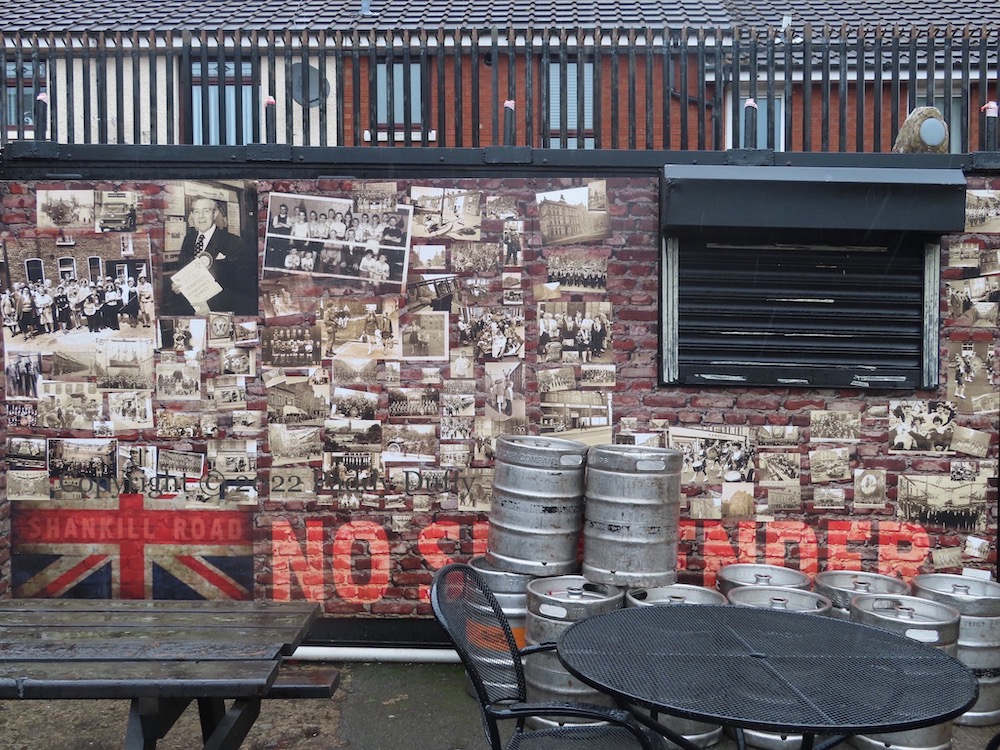
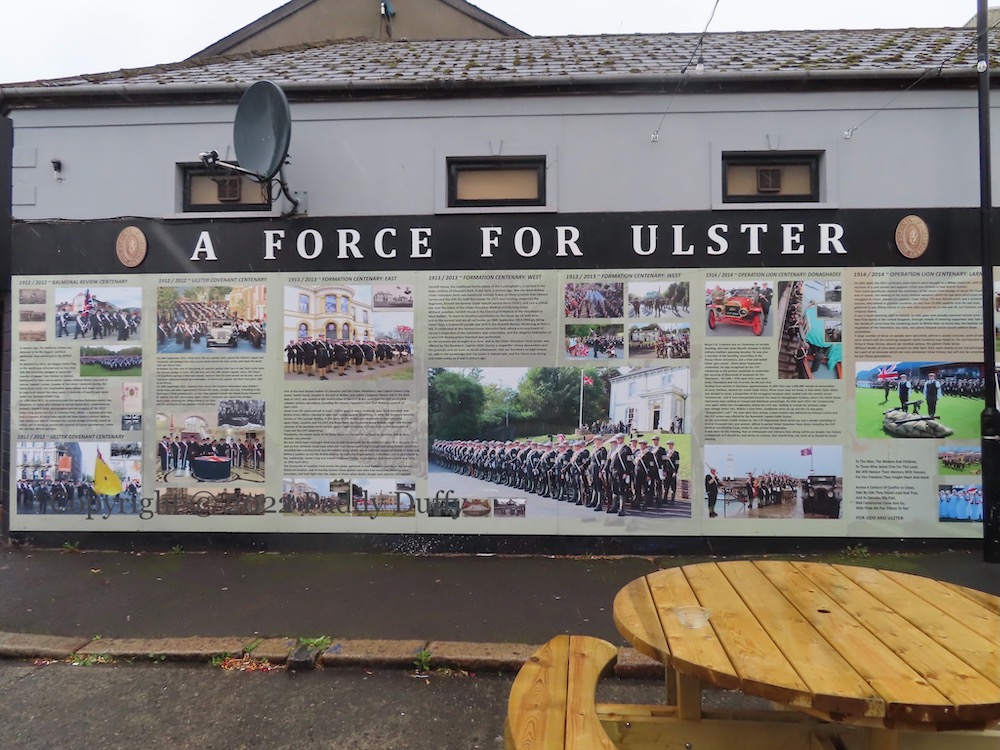
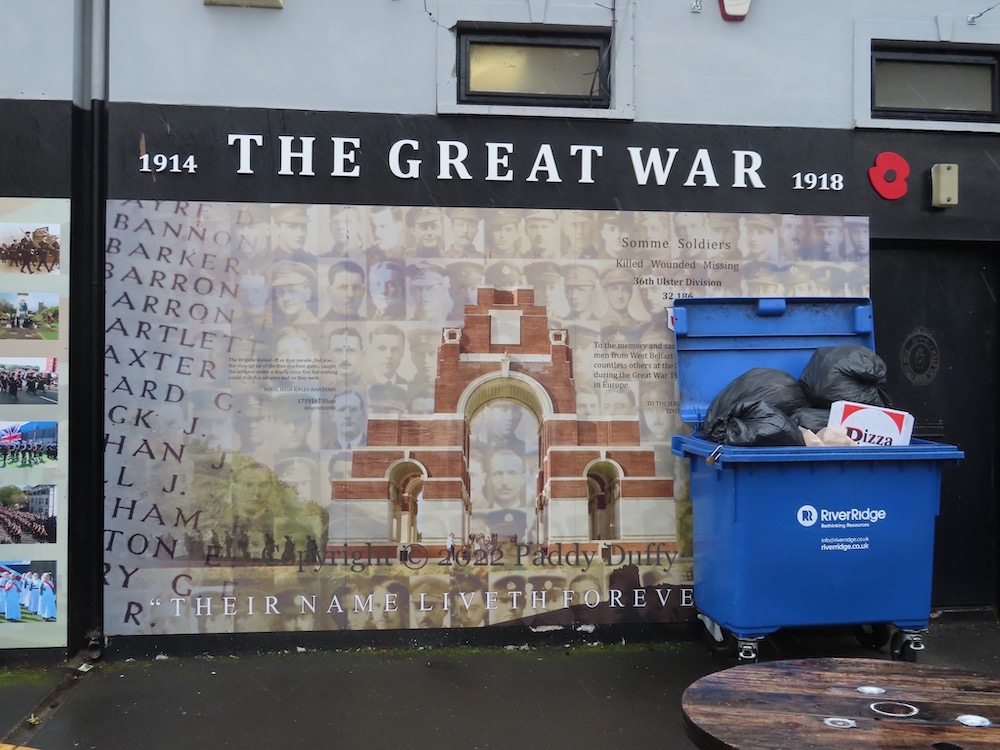
This is the scene at the Rex Bar at (the old) Moscow Street on the Shankill, including, below, three boards describing the formation of the Ulster Volunteers (‘A Force For Ulster’) and using the Thiepval Memorial To The Missing Of The Somme against a background of portraits to commemorate the losses suffered by the 36th (Ulster) Division of the British Army, which the Volunteers became, at the Somme and in other battles, mowed down by “the Hun machine guns” (‘The Great War’). 32,186 men from west Belfast were killed, wounded, or missing. “To them bravery was without limit, to us memory is without end”.
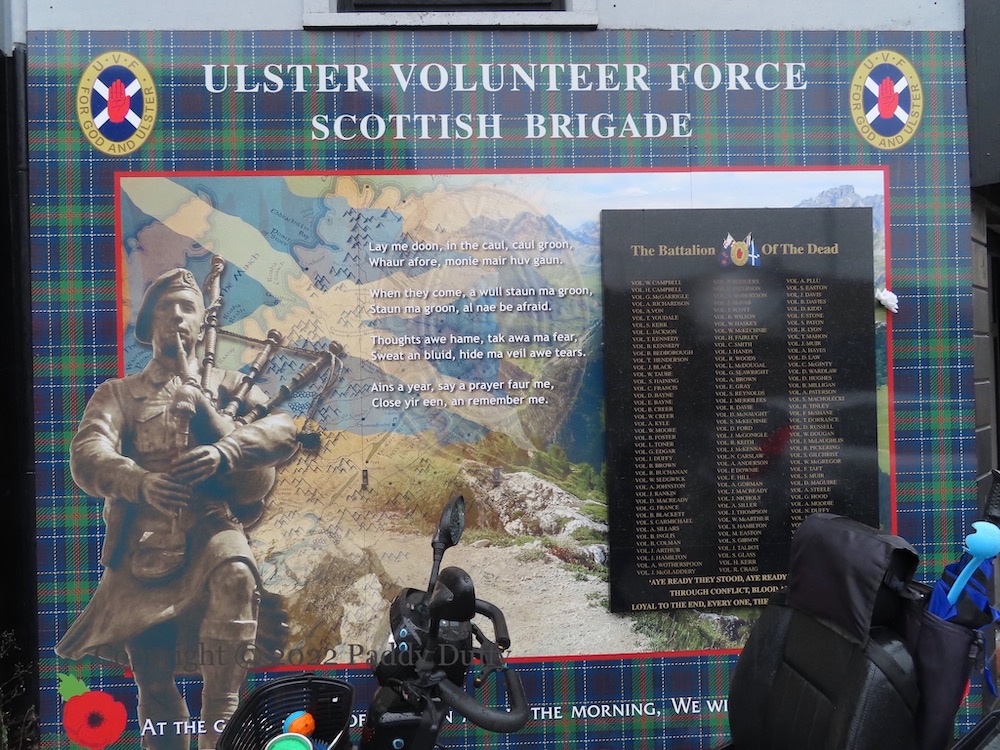
On the Shankill proper (at the newly-christened “Scots Corner”) is a board and plaque to the UVF’s “Scottish Brigade”: “Aye ready they stood, aye ready they fought, through conflict, blood and tears, loyal to the end, every one, the Scottish volunteers.” “Aye ready” was the motto of the 59th Scinde Rifles of the British Indian Army (and later of the Canadian Navy) but is best known from the label of Camp Coffee, in which a Highlander was served a cup of Camp by a Sikh servant (nowadays, they both have a cup of their own).
A Scottish soldier plays the pipes over a list of the “Battalion Of The Dead”, Scottish volunteers from the (modern) UVF. The list is led by William “Big Bill” Campbell, who has had a small plaque in his memory at this spot since (at least) 2014. Preacher and DUP politician George Seawright (see A Crown Of Life) is also included – he was born in Glasgow in 1951.
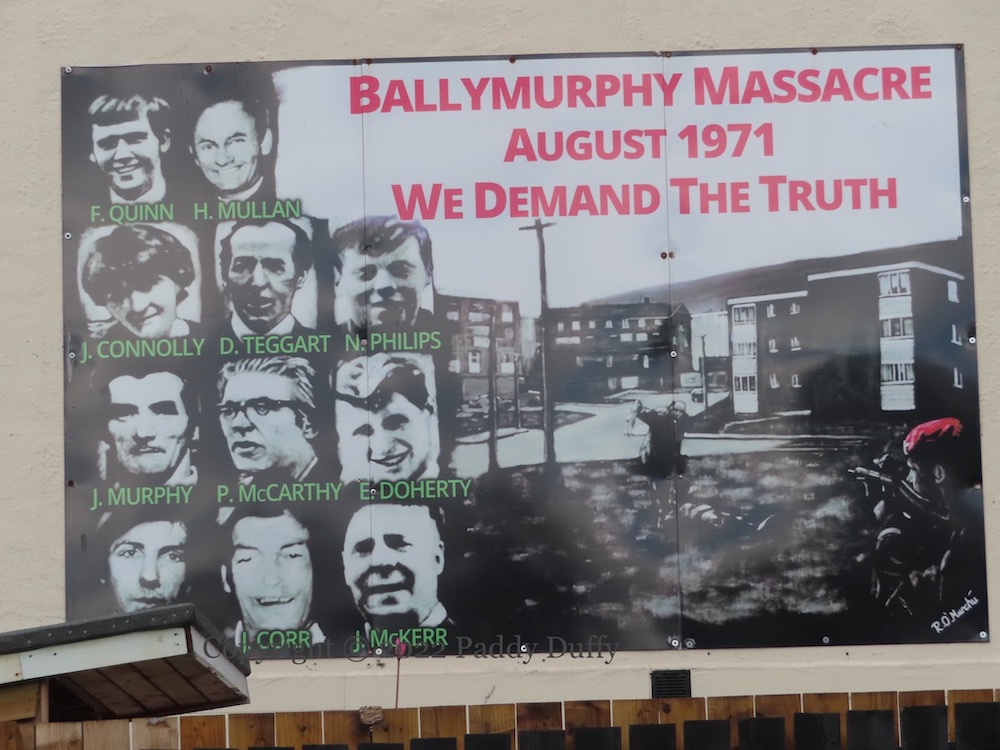
The inquest into the Ballymurphy Massacre – the killings of 11 people from August 9th to 11th, continues, with testimony this past week from former Paratrooper Henry Gow (Irish News | BBC-NI). The image above shows Hugh Mullan being shot from Springmartin while going to the aid of a neigbour, Bobby Clarke; he is waving a white Babygro (BallymurphyMassacre.com). The Paratrooper is distinguished by his red beret.
The mural was originally painted by Rısteard Ó Murchú in 2008 and displayed first on the Whiterock Road then around the corner on the Springfield Road; the location of the repainted board is at the Glenalina Road entrance to the area, in the spot of the former 1916 GPO mural (which had lasted seventeen years before the wall was re-plastered and whitewashed in 2017).
The plaque on the fence reads, “This plaque is dedicated to the 11 innocent civilians murdered by members of the British Parachute regiment in August 1971. Fr Hugh Mullan, Frank Quinn, Noel Phillips, Joan Connolly,
Danny Teggart, Joseph Murphy, Eddie Doherty, John Laverty, Joseph Corr, Paddy McCarthy, John McKerr. Donated by the Frank McCann Cumann, Hamilton [Scotland] (Fb).”
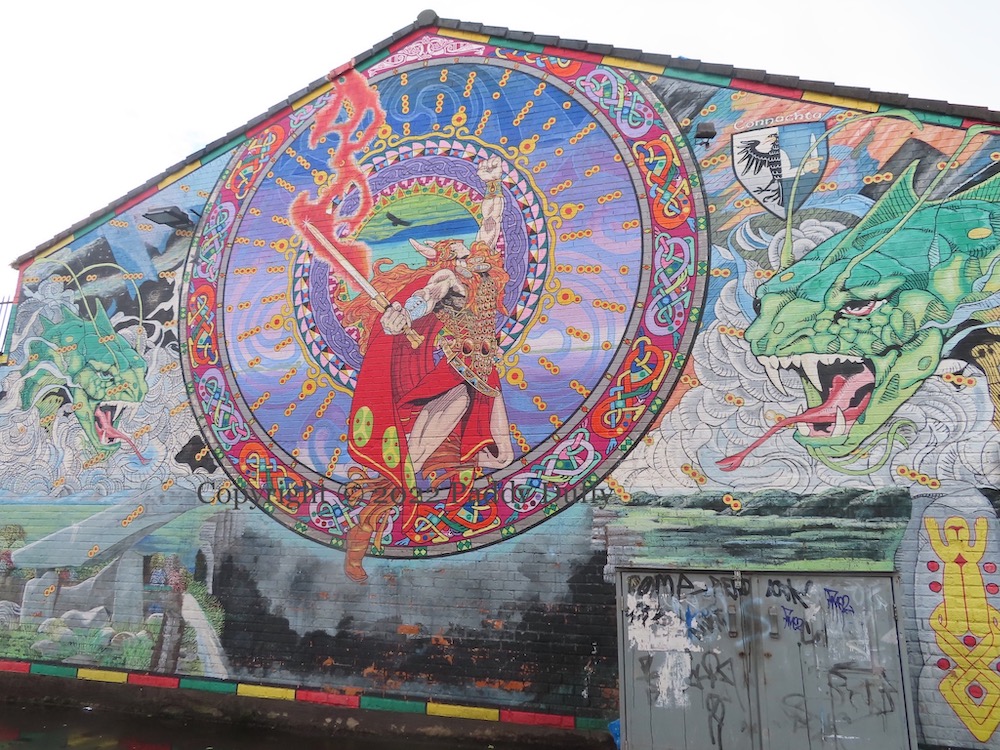
Gerard ‘Mo Chara’ Kelly first painted a mural of King Nuada in 1987, a year after being released from Long Kesh. He reproduced an illustration by Jim Fitzpatrick on a gable wall in Springhill (see images from 1987 | 1988 | 1989). This post-peace version is on the side-wall of the Whiterock Road Spar and was painted as statement of Kelly’s own rebirth after ceasing to work with funding agencies such as the Upper Springfield Development Trust.
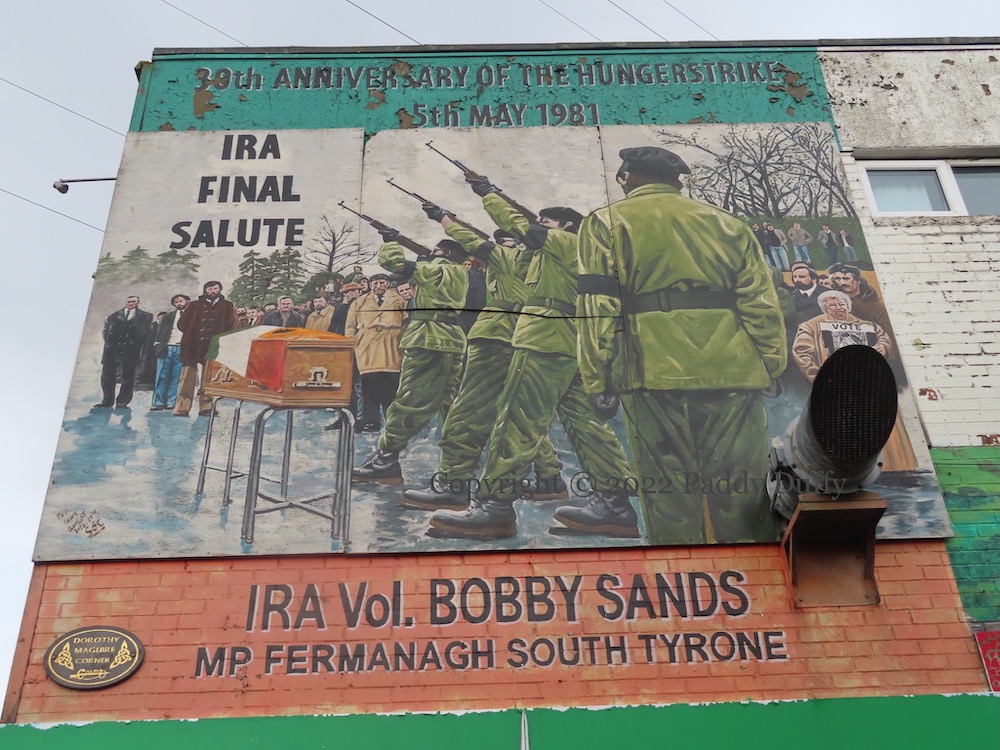
“30th anniversary of the hunger strike. 5th May 1981. IRA final salute. IRA Vol. Bobby Sands, MP Fermanagh South Tyrone.” Gerry Adams watches on as a funeral volley is fired over Sands’s coffin. Whiterock Road, Belfast.
Thomas Ashe was working as an Irish teacher in Dublin when he joined the Irish Volunteers and in 1916 served as a battalion commander in the Easter Rising, for which he was sentenced to penal servitude for life. He went on hunger strike in May 1917 and again in September when he was rearrested by the British authorities for a “seditious” speech. He died on September 25th, one hundred years ago, becoming “an chéad staılceoır ocraıs a maraíodh san 20ú haoıs” (“first hunger striker to die in the 20th century”).
In the five circles around his portrait are Countess Markievicz, Pádraig Pearse, and James Connolly – fellow fighters in the Rising – and (in the bottom left) Máırtín Ó Cadhaın (author of Cré na Cılle and IRA member interned during WWII), and the symbol of Laochra Loch Lao and more generally of An Ceathrú Gaeltachta/Gaeltacht Quarter (see previously The Big Plan and Onwards). In the middle is a march from An Dream Dearg in support of Acht Na Gaeılge (an Irish language Act) past the Bobby Sands mural on Sevastopol Street.
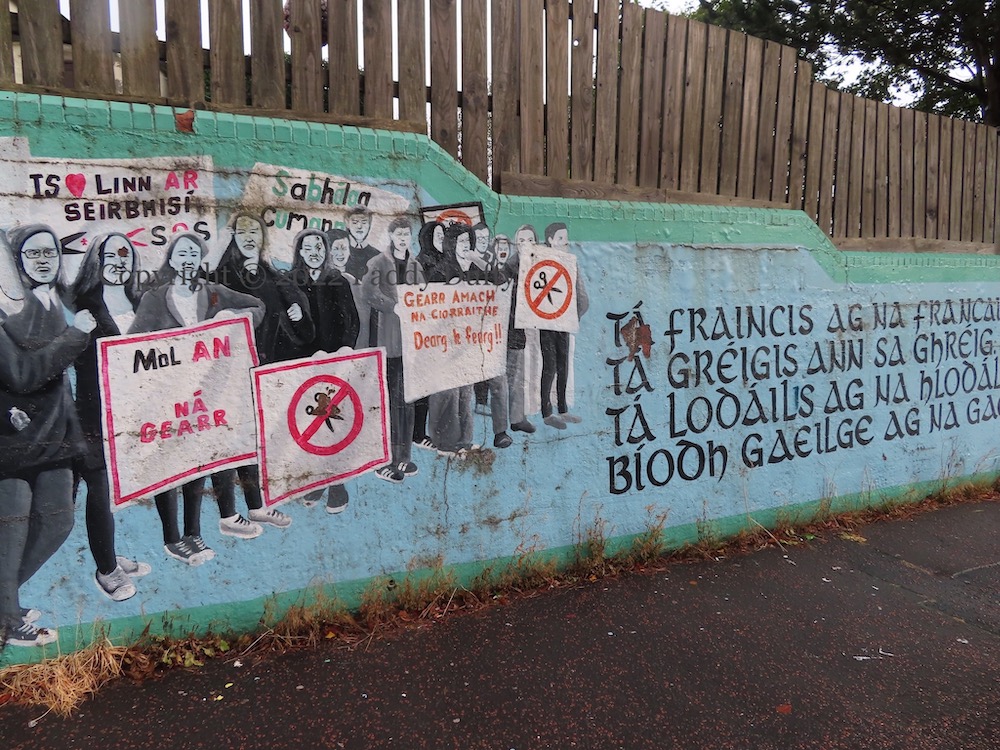
Above is a pro-Gaelic (Irish-language) mural on the Whiterock Road, with signs in Irish being held by young people protesting cuts to social services (on the left) and (on the right) a short poem: “Tá Fraıncıs ag na Francaıgh/Tá Gréıgıs ann sa Ghréıg/Tá Iodáılıs ag na hIodálaıgh/Bíodh Gaeılge ag na Gaeıl.” That is: the French have French, the Greeks Greek, the Italians Italian; let there be Irish for the Irish.
“In memory of our fallen INLA volunteers, upper Springfield area: Hugh Ferguson, Ronnie Bunting, Noel Little, Hugh O’Neill, Micky Kearney, John McColgan, Paddy “Paddybo” Campbell. Comrades: Barry “Baz” McMullan, Sean “Shanto” fleming, Harry O’Hara, Paul Collins, Bernado Brownlee, Emmanuel Kelly, Michael Conlon, Billy Lynch, James “Harpo” Murray, John Kennaway. Saoırse go deo [freedom forever].” Ferguson was the first member of the INLA to die, in 1975 in the feud with the OIRA. Bunting and Little/Lyttle (both Protestants) were shot dead in 1980 in Bunting’s Andersonstown home by masked gunmen from the UDA or SAS with RUC complicity.
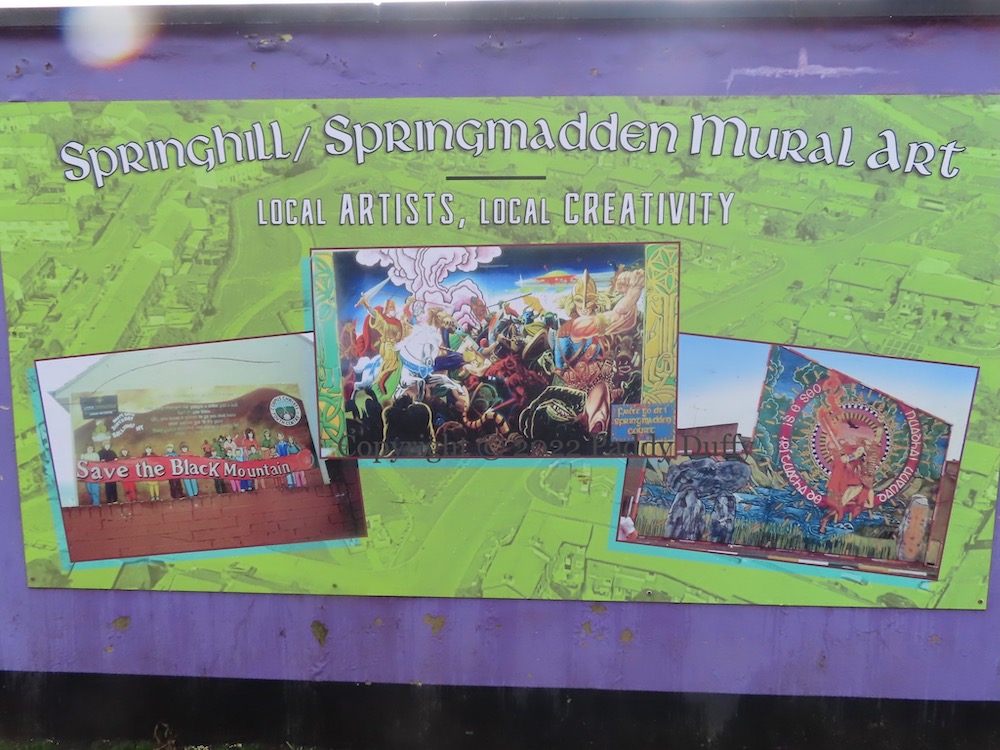
“Fáılte go Cnoc na Foınse – Welcome to Springhill.” There are a dozen boards on either side of the Ballymurphy entrance to Springhill, highlighting positive aspects of the community, such as the work of Mother Teresa and four Missionary Sisters Of Charity from 1971-1973, the Upper Springfield Festival of 1973 (later revived in 1988 and years following as the Springhill Festival), Tara Stores and The Craft Centre, set up as a form of local enterprise in an area of mass unemployment, and the Springhill Community House, still in operation today but going back to Des Wilson and Noelle Ryan. There is no explicit mention of the 1972 Springhill-Westrock Massacre. The murals in the image above were in Divismore, Springmadden, and in the old Springhill.
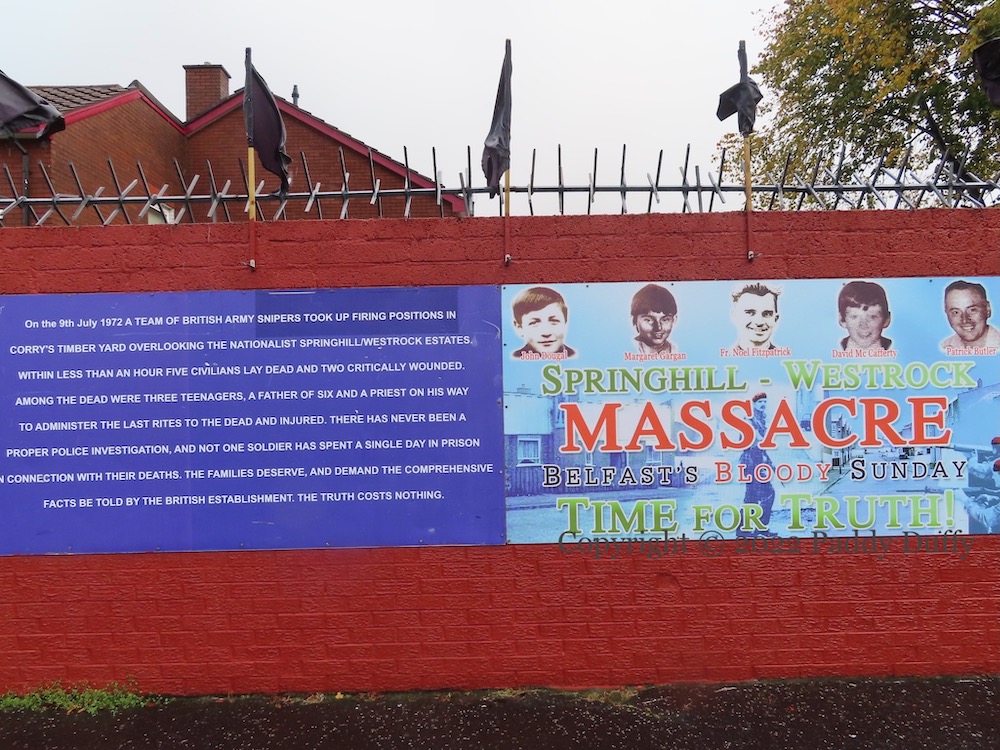
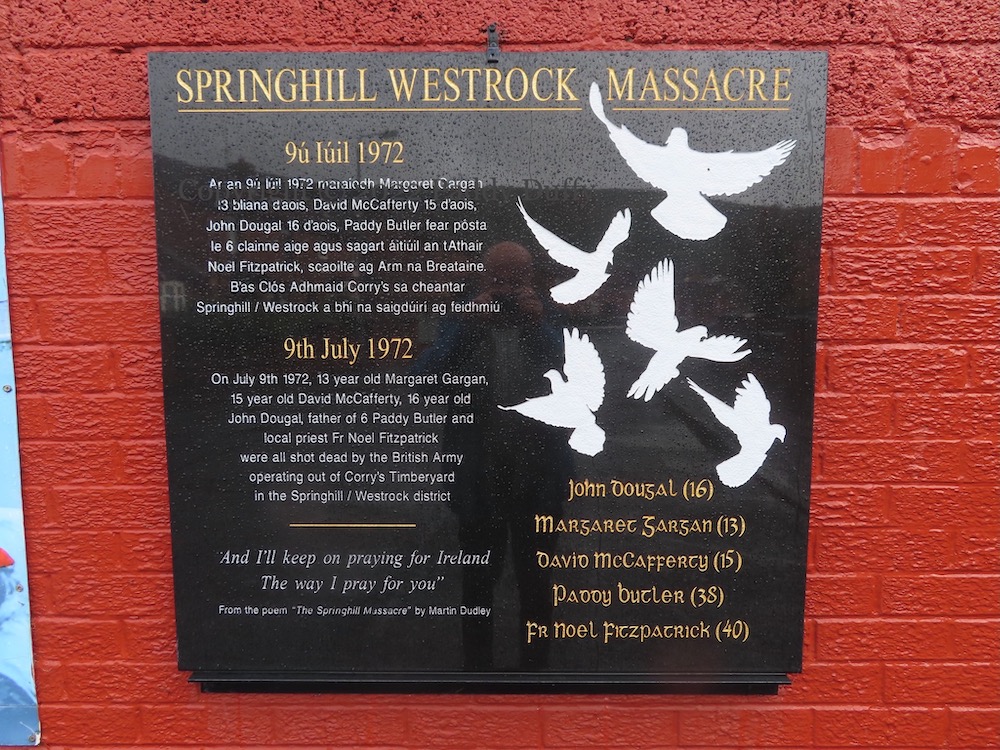
“Springhill-Westock Massacre: Ar an 9ú Iúıl 1972 maraíodh Margaret Gargan 13 blıana d’aoıs, David McCafferty 15 d’aoıs, John Dougal 16 d’aoıs, Paddy Butler fear pósta le 6 claınne aıge agus sagaırt áıtiúıl an tAthaır Noel Fitzpatrick, scaoılt ag Arm na Breataıne. B’as Clós Adhmaıd Corry’s sa cheantar Springhill/Westrock a bhí na saıghdıúrí ag feıdhmıú.”
“‘And I’ll keep on praying for Ireland/The way I pray for you’ – from the poem “The Springhill Massacre” by Martin Dudley”. The new plaque was launched on July 9th, 2019 by Dudley and Brian Pettigrew, both of whom were wounded in the attack. Here is a gallery of images from the launch from Relatives For Justice.
The board, above, was originally in Beechmount Avenue/Ascaıll Ard Na bhFeá, but had to be moved due to the “re-imaging” of the brick wall at the back of St Mary’s University College into a fence by the Department For Communities (web).




 Paddy Duffy Collection