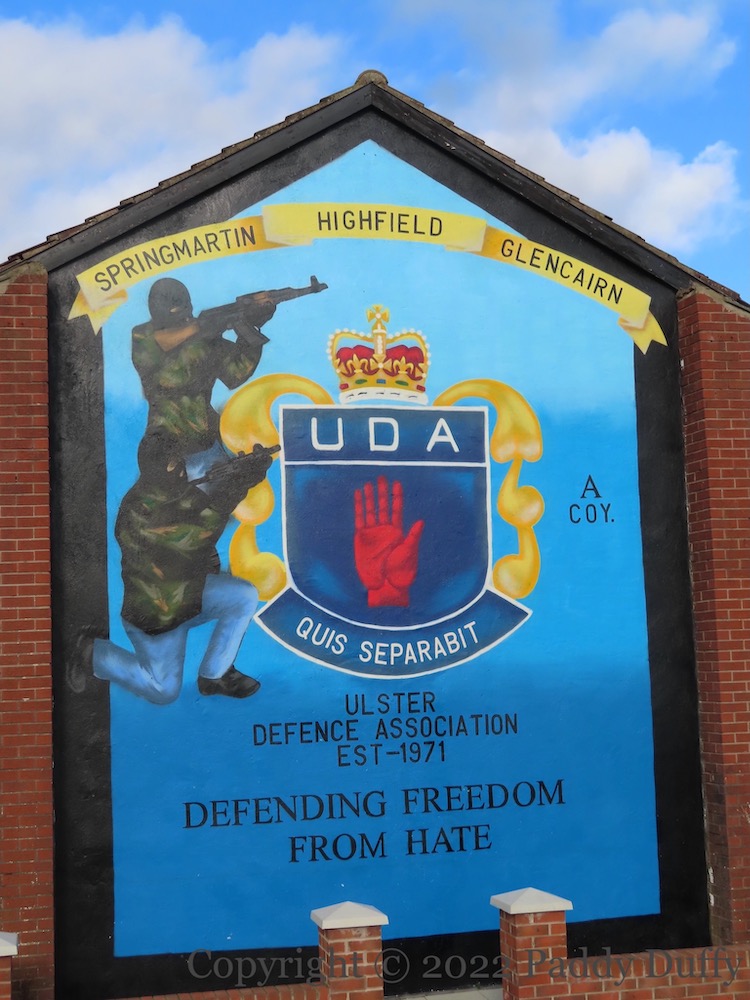
Defending Freedom From Hate

Compared to the UVF, the UDA more strongly detect an existential threat to loyalism and evince a siege mentality that provokes the need for armed resistance. Hence the more frequent presence of armed gunmen in UDA murals (which is also due in part to the UVF being able to “re-image” around the Ulster Volunteers and the Somme). With Brexit and the Protocol, however, armed gunmen have recently been appearing more frequently in UVF murals – see, for example, If Our Shores Are Threatened | Bang Up To Date | Our British Identity.

“Springmartin–Highfield–Glencairn Ulster Defence Association est. 1971. Defending freedom from hate.” As the companion mural (We Will Take Nothing Less) makes clear, the hate is coming from a “fascist republican enemy” (“Sinn Féin/IRA”, presumably) and the government of Ireland. Graphically, this mural is the same as the previous one on this wall: Under The Protection Of The UDA.

Click image to enlarge
Copyright © 2024 Paddy Duffy
T01245

We Will Take Nothing Less

An estimated 100,000 people congregated at Craigavon House on the 23rd of September, 1911, to hear Edward Carson’s inaugural speech as Unionist leader (McNeill Ch. 4). In his speech he said “Our demand is a simple one. We ask for no privileges, but we are determined that no one shall have privileges over us. We ask for no special rights, but we claim the same rights from the same government as every other part of the United Kingdom. We ask for nothing more; we will take nothing less”. Ten years later, in 1921, Northern Ireland was created and it has survived to reach its centenary, despite (according to this mural) “100 years of fighting a fascist republican enemy sponsored by the Irish state.”

Highcairn Drive, Highfield

Click image to enlarge
Copyright © 2024 Paddy Duffy
T01244

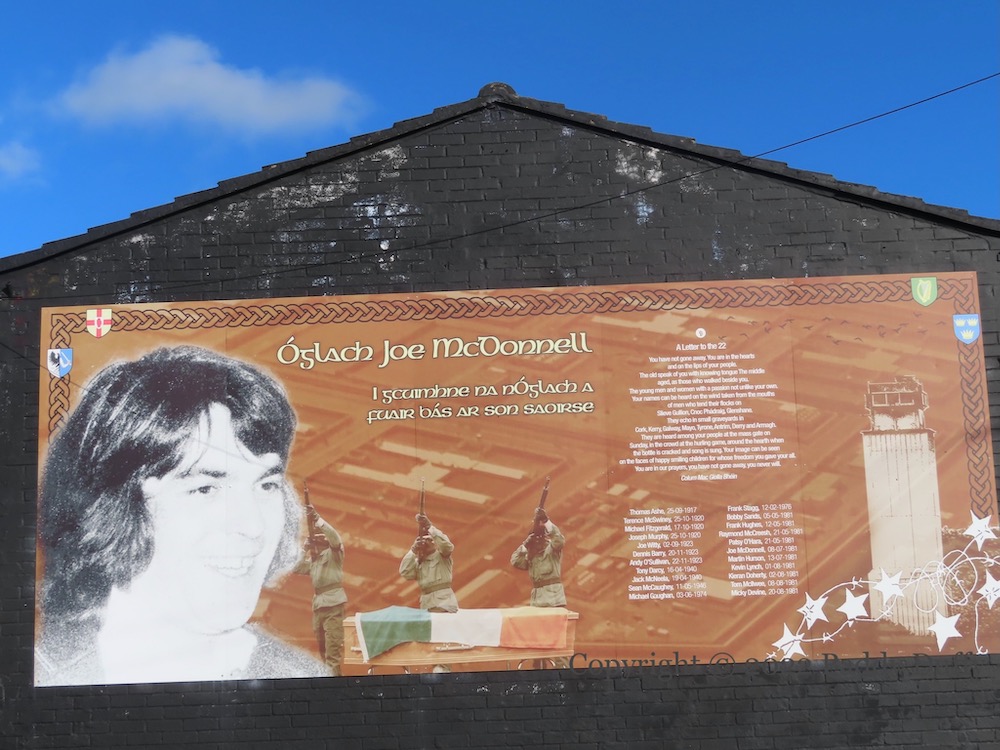
A Letter To The 22

“I gcuımhne na nÓglach a fuaır bás ar son saoırse [in memory of the volunteers who died for freedom].” The “22” are the familiar 12 deceased Troubles-era hunger-strikers, plus 10 from 1917 to 1946: Thomas Ashe, Terence McSwiney, Michael Fitzgerald, Joseph Murphy, Joe Witty, Dennis Barry, Andy O’Sullivan, Tony Darcy, Jack McNeela, Sean McCaughey.

“‘A Letter To The 22: You have not gone away. You are in the hearts/and on the lips of your people./The old speak of you with knowing tongue. The middle/aged, as those who walked beside you./The young men and women with a passion not unlike your own./Your names can be heard on the wind taken from the mouths/of men who tend their flocks on Slieve Gullion, Cnoc Phádraıg, Glenshane./They echo in small graveyards in/Cork, Kerry, Galway, Mayo, Tyrone, Antrim, Derry and Armagh./They are heard among your people at the mass gate on/Sunday, in the crowd at the hurling game, around the hearth when/the bottle is cracked and song in sung. Your image can be seen/on the faces of happy smiling children for whose freedom you gave your all./You are in our prayers, you have not gone away, you never will’ – Colum Mac Gıolla Bhéın

For the same 22, see Staılc Ocraıs. Replaces a painted mural to Joe McDonnell.

Suffolk Road, west Belfast

Click image to enlarge
Copyright © 2024 Paddy Duffy
T01243

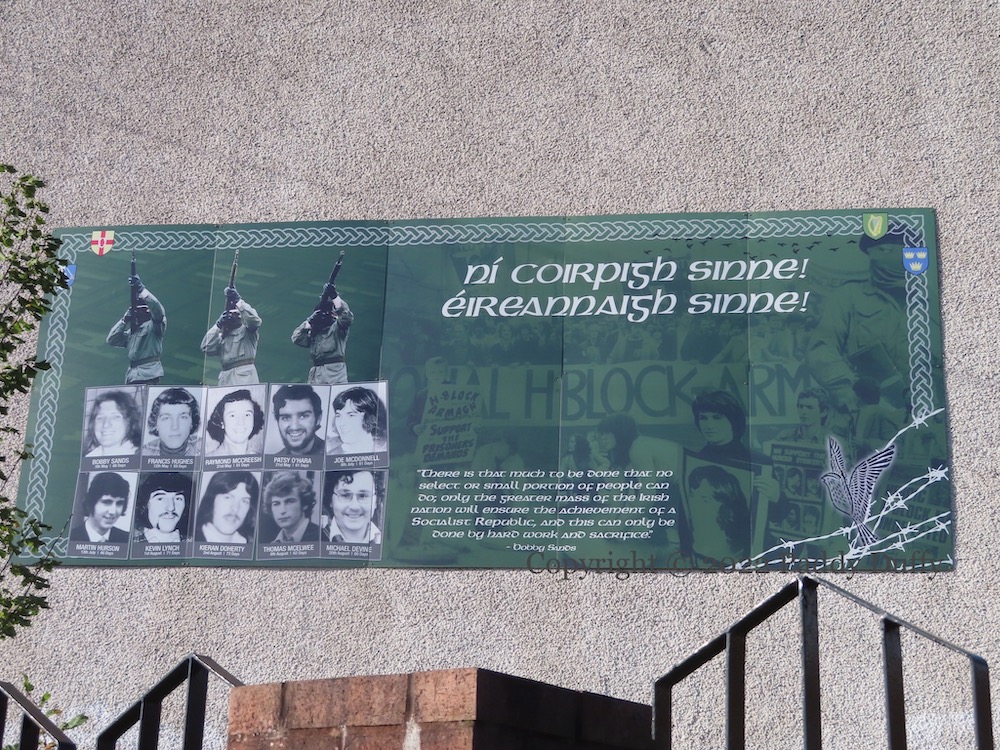
Éıreannaıgh Sınne!

“Ní coırpıgh sınne! Éıreannaıgh sınne! [we are not criminals; we are Irish people] “There is that much to be done that no select or small portion of people can do; only the greater mass of the Irish nation will ensure the achievement of a socialist republic, and this can only be done by hard work and sacrifice.” – Bobby Sands [Hunger strike diary, March 14th, 1981]” With photographs of the ten deceased 1981 hunger strikers.

Falcarragh Drive, Lenadoon, Belfast.

Click image to enlarge
Copyright © 2022 Paddy Duffy
T01241

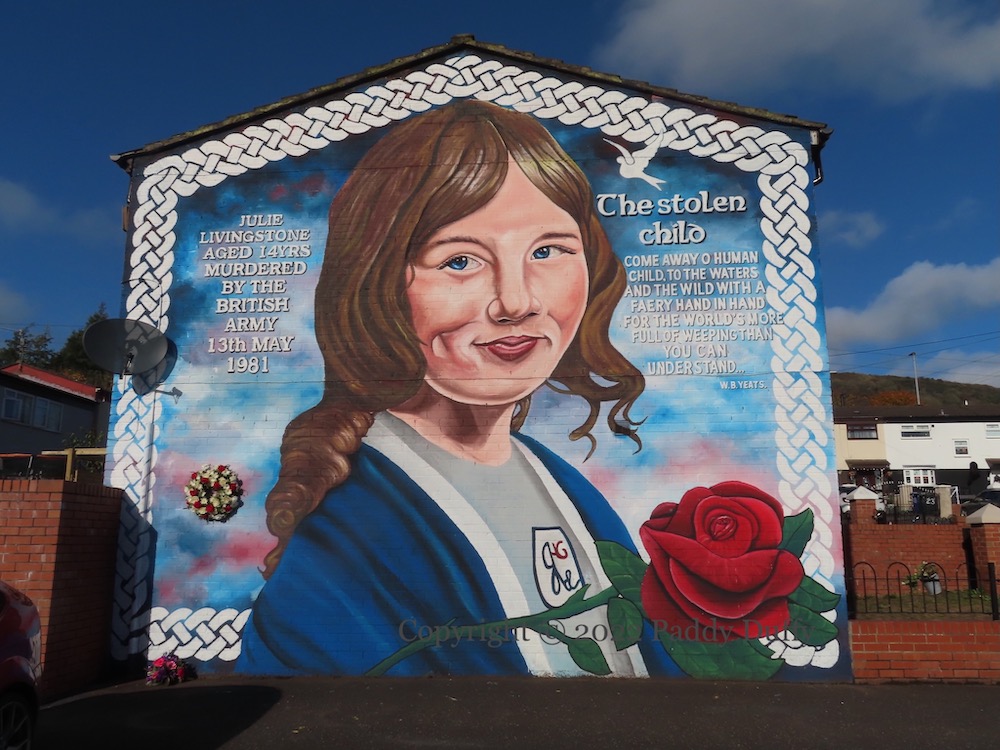
The Stolen Child

The re-painted mural to plastic-bullet victim Julie Livingstone was rededicated on October 15th. For the previous mural, see 2010. “The Stolen Child – Come away, O human child/To the waters and the wild/With a faery hand in hand/For the world’s more full of weeping/Than you can understand… – WB Yeats.”

Click image to enlarge
Copyright © 2024 Paddy Duffy
T01242

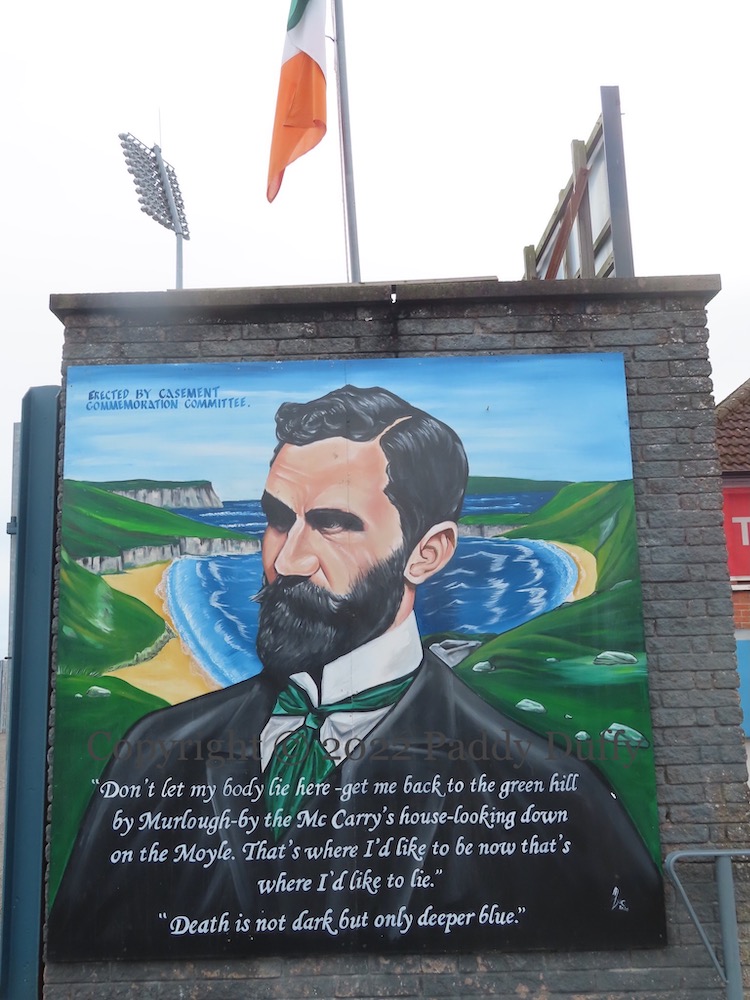
Get Me Back To The Green Hill

“Don’t let me body lie here – get me back to the green hill by Murlough, by the McCarry’s house, looking down on the Moyle. That’s where I’d like to be now, that’s where I’d like to lie. … Death is not dark but only deeper blue.” [Letter to Elizabeth “Eilis” Bannister, July 25th, 1916] Roger Casement was executed in Pentonville prison, in England, in 1916, for his role in gunrunning for the Rising, and his corpse was buried in the prison cemetery. Despite repeated requests for repatriation, it wasn’t until 1965 that the corpse was returned to Ireland – but to his home town of Dublin rather than to his beloved Murlough, where his cousins Eilis and Gertrude lived (in what was by then Northern Ireland): the corpse was released on condition that it not enter Northern Ireland, for fear of stoking political tensions between the sects (WP).

Casement Park, Andersonstown, west Belfast

Click image to enlarge
Copyright © 2022 Paddy Duffy
T01156

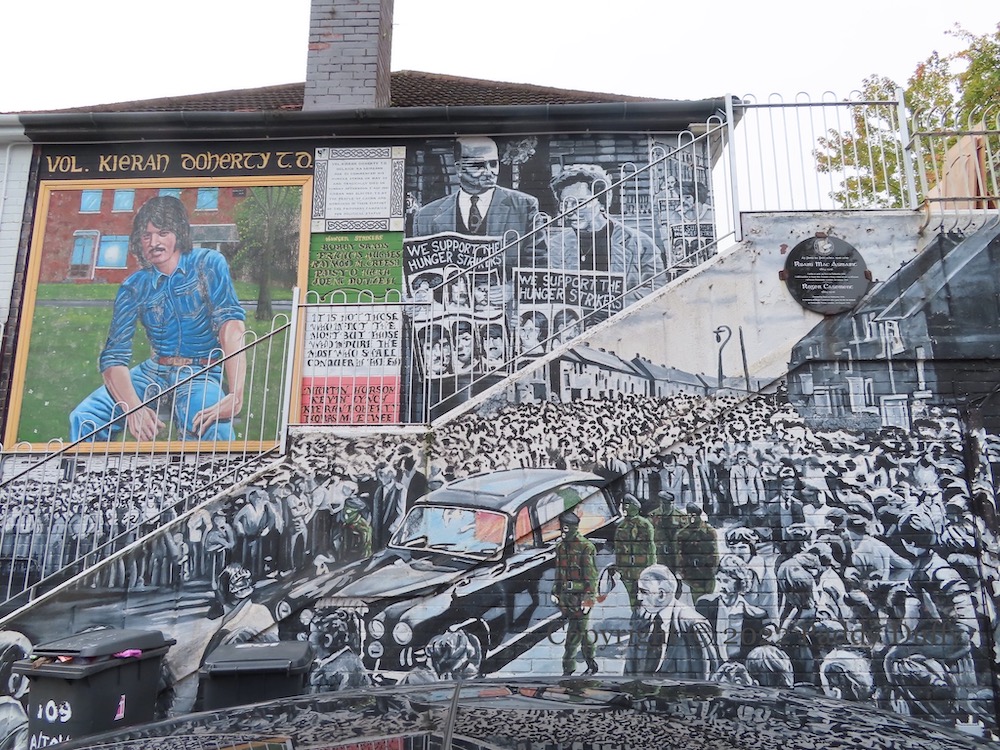
Kieran Doherty

Kieran Doherty died on August 2nd, 1981, after 73 days on hunger-strike. The mural above depicts scenes from his funeral on 1981-08-04. The portrait of Doherty in the top left replaces a similar one in the same location; the plaque at the portrait’s top-right corner remains from before. The angled panel shows Doherty’s parents, Alfie and Margaret.

There is video of the launch on youtube.

The photograph on which the central panel is based is by Derek Spiers; see also this set at hungerstrikes.org. The volley took place outside the Doherty family home in nearby Commedagh Drive (Belfast Media).

Click image to enlarge
Copyright © 2022 Paddy Duffy
T01155 [T01154] T01153

No Justice

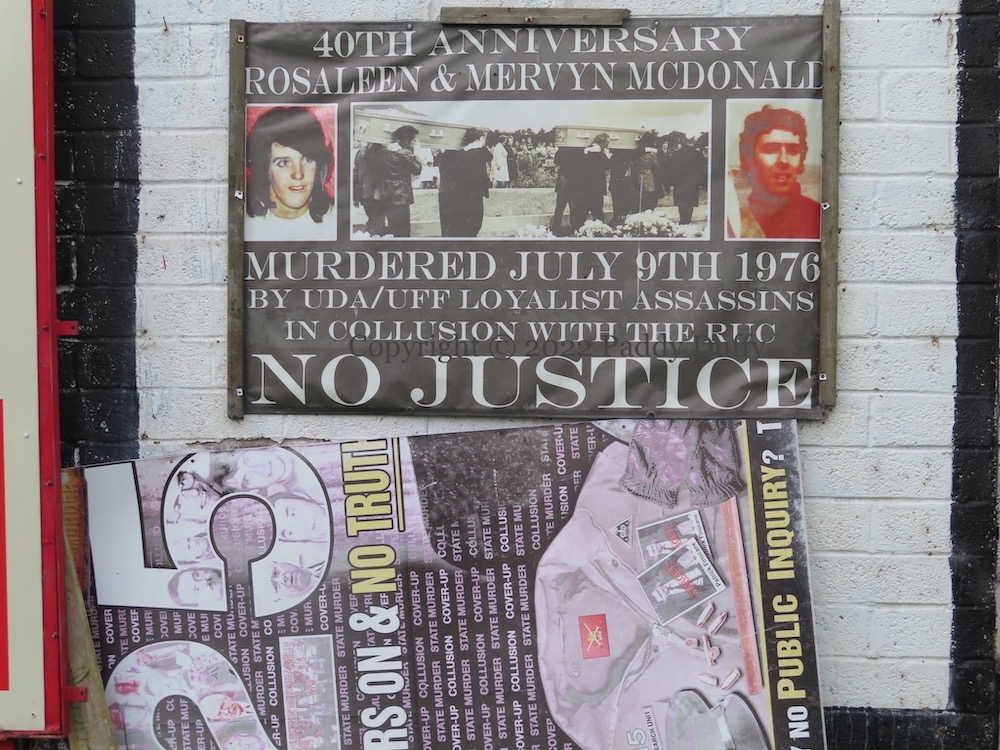
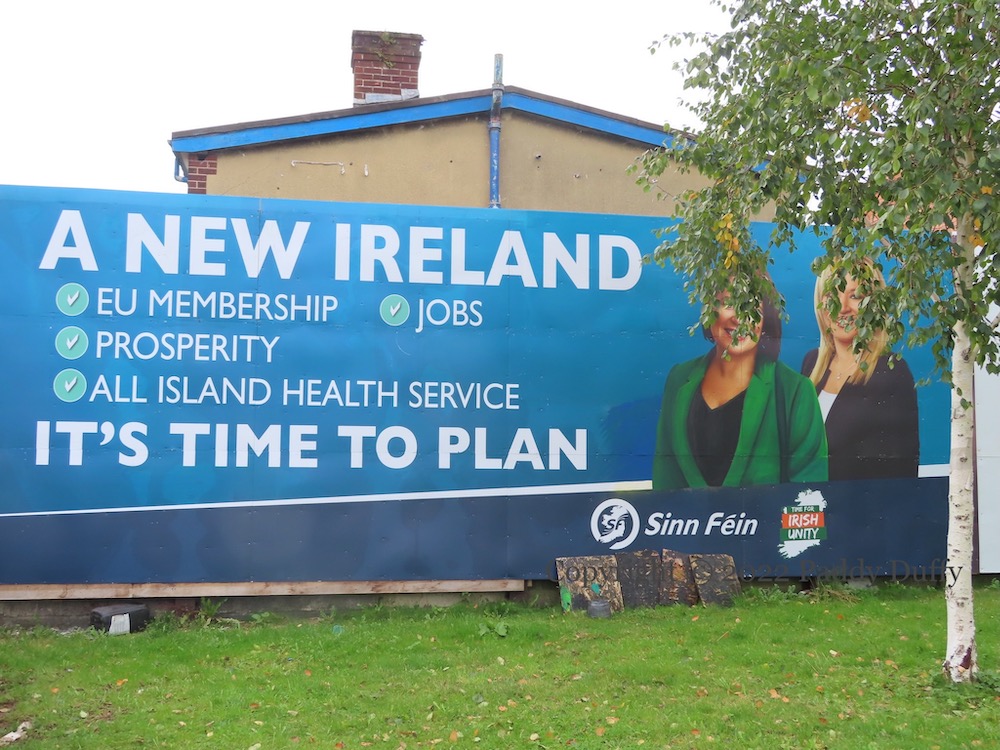
Here is a gallery of images from the Falls Road/Glen Road junction (site of the old Andersonstown RUC barracks). The images top to bottom follow the wall from right (Glen Road) to left (Falls Road).

Above: a call for the release of Basque prisoners.

Below: Mervyn and Rosaleen McDonald were Catholics living in the mixed Longlands area of Newtownabbey when they were visited by “UFF loyalist assassins” and shot dead in front of their two young children. The killings are described in most detail in Jack Holland’s Too Long A Sacrifice, which contains an interview with the gunman and the claim that the unit had access to RUC files (p. 94).

Seamus Costello fought for the IRA during the Border Campaign and was interned in the Curragh for two years. He stayed with the Officials during the split, but was driven out in 1974 and formed the Irish Republican Socialist Party (IRSP) and the INLA. He was shot in 1977. (WP)

A large Fıanna banner.

Metalwork commemorating the deceased 1981 hunger strikers.

A Sınn Féın electoral banner.

Click image to enlarge
Copyright © 2022 Paddy Duffy
T01146 T01147 T01148 [T01149] T01152 T01151 T01150

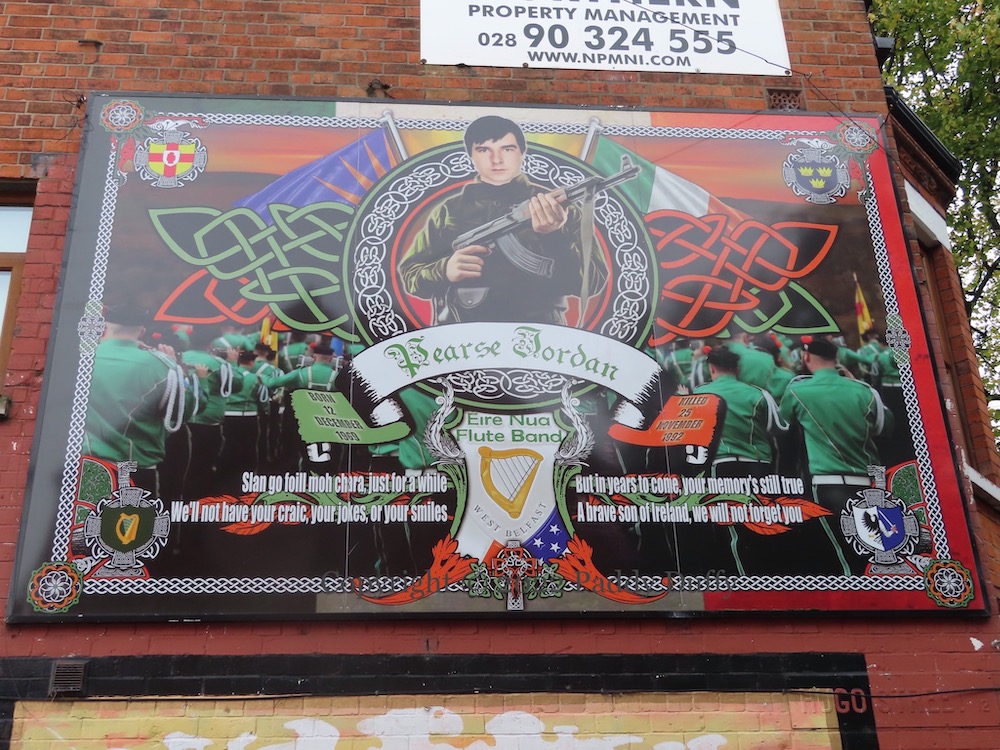
Pearse Jordan

Pearse Jordan was unarmed when he was killed by the RUC on November 25th, 1992 but in this new Éıre Nua Flute Band board he leaves his prints on an assault rifle. (previous Éıre Nua board) His killing was ruled unlawful, and subsequent inquest insufficient, by the European Court Of Human Rights in 2001. The campaign for an inquest continues (An Phoblacht).

The words on the board – “Slan [sic] go foıll [sic] moh [sic] chara, just for a while/We’ll not have your craic, your jokes, or your smiles/But in years to come, your memory’s still true/A brave son of Ireland, we will not forget you” – are the chorus of The Ballad Of Pearse Jordan (words | sung by The Irish Brigade).

The board is in Hugo Street, which is also the site of his memorial plaque, just above the Evolution Of Our Revolution.

Click image to enlarge
Copyright © 2022 Paddy Duffy
T01145

The Evolution Of Our Revolution

A history of nationalism/republicanism from left to right: a pair of Easter lilies, four generations of rifles, and then a switch to a ballot paper with a check in favour of “unity” and a road named “Unity Way”: “From bullet to ballot: the evolution of our revolution. 1916 – 2016”

This mural is on the north side of Hugo Street – the south side remains exclusively éırígí.

Hugo Street, west Belfast

Click image to enlarge
Copyright © 2022 Paddy Duffy
T01144