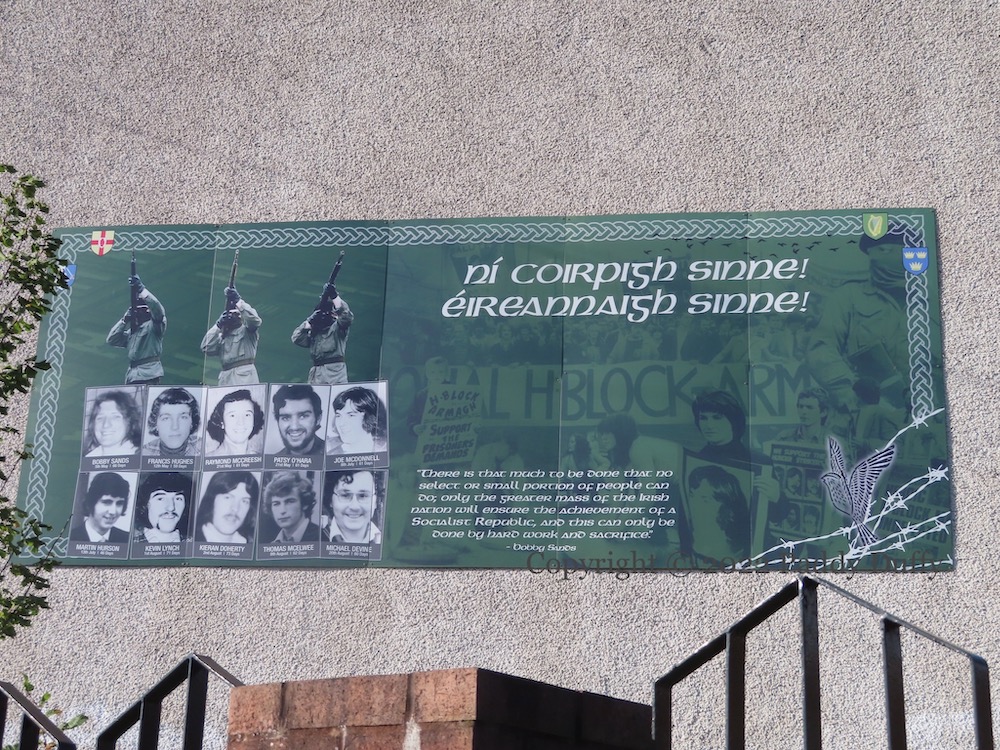
“Ní coırpıgh sınne! Éıreannaıgh sınne! [we are not criminals; we are Irish people] “There is that much to be done that no select or small portion of people can do; only the greater mass of the Irish nation will ensure the achievement of a socialist republic, and this can only be done by hard work and sacrifice.” – Bobby Sands [Hunger strike diary, March 14th, 1981]” With photographs of the ten deceased 1981 hunger strikers.
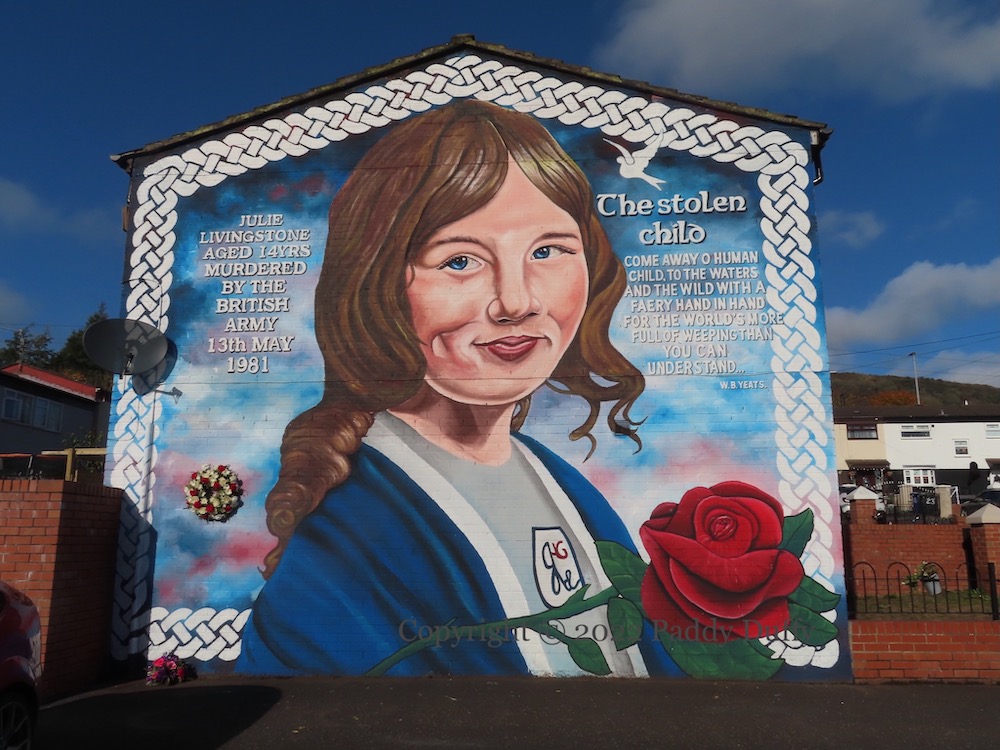
The re-painted mural to plastic-bullet victim Julie Livingstone was rededicated on October 15th. For the previous mural, see 2010. “The Stolen Child – Come away, O human child/To the waters and the wild/With a faery hand in hand/For the world’s more full of weeping/Than you can understand… – WB Yeats.”
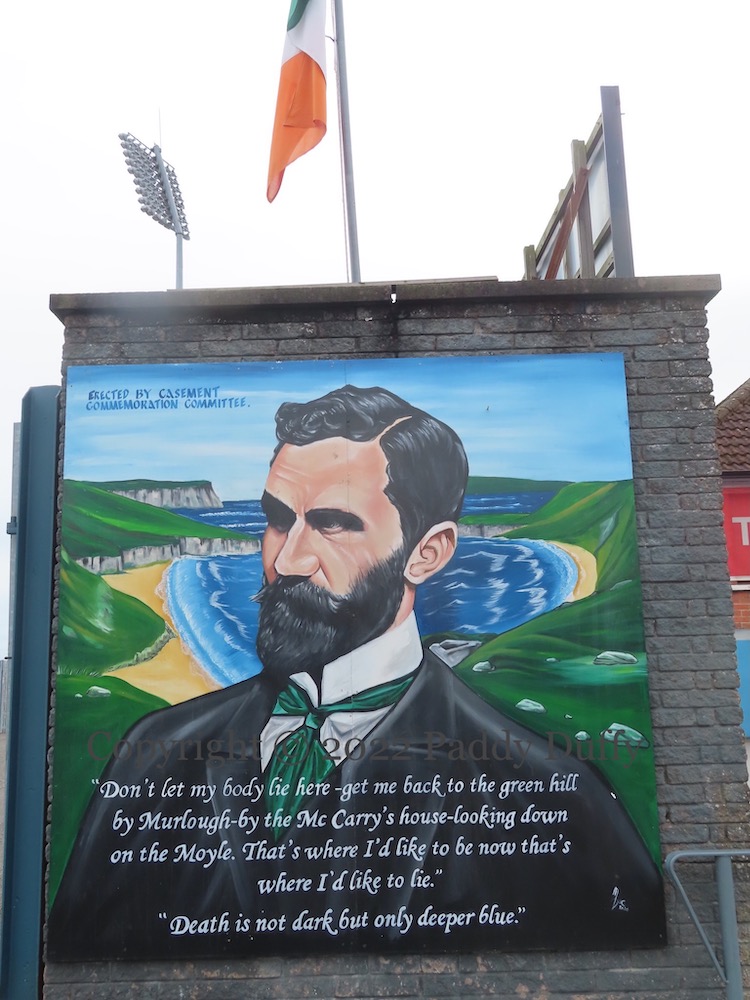
“Don’t let me body lie here – get me back to the green hill by Murlough, by the McCarry’s house, looking down on the Moyle. That’s where I’d like to be now, that’s where I’d like to lie. … Death is not dark but only deeper blue.” [Letter to Elizabeth “Eilis” Bannister, July 25th, 1916] Roger Casement was executed in Pentonville prison, in England, in 1916, for his role in gunrunning for the Rising, and his corpse was buried in the prison cemetery. Despite repeated requests for repatriation, it wasn’t until 1965 that the corpse was returned to Ireland – but to his home town of Dublin rather than to his beloved Murlough, where his cousins Eilis and Gertrude lived (in what was by then Northern Ireland): the corpse was released on condition that it not enter Northern Ireland, for fear of stoking political tensions between the sects (WP).
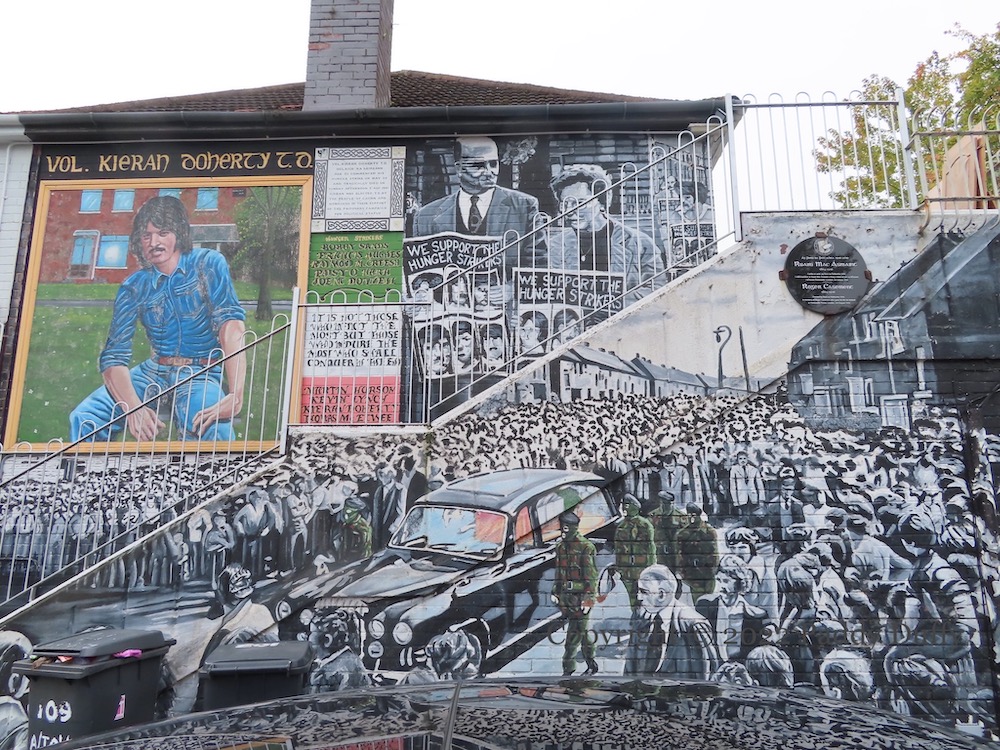
Kieran Doherty died on August 2nd, 1981, after 73 days on hunger-strike. The mural above depicts scenes from his funeral on 1981-08-04. The portrait of Doherty in the top left replaces a similar one in the same location; the plaque at the portrait’s top-right corner remains from before. The angled panel shows Doherty’s parents, Alfie and Margaret.
The photograph on which the central panel is based is by Derek Spiers; see also this set at hungerstrikes.org. The volley took place outside the Doherty family home in nearby Commedagh Drive (Belfast Media).
Here is a gallery of images from the Falls Road/Glen Road junction (site of the old Andersonstown RUC barracks). The images top to bottom follow the wall from right (Glen Road) to left (Falls Road).
Above: a call for the release of Basque prisoners.
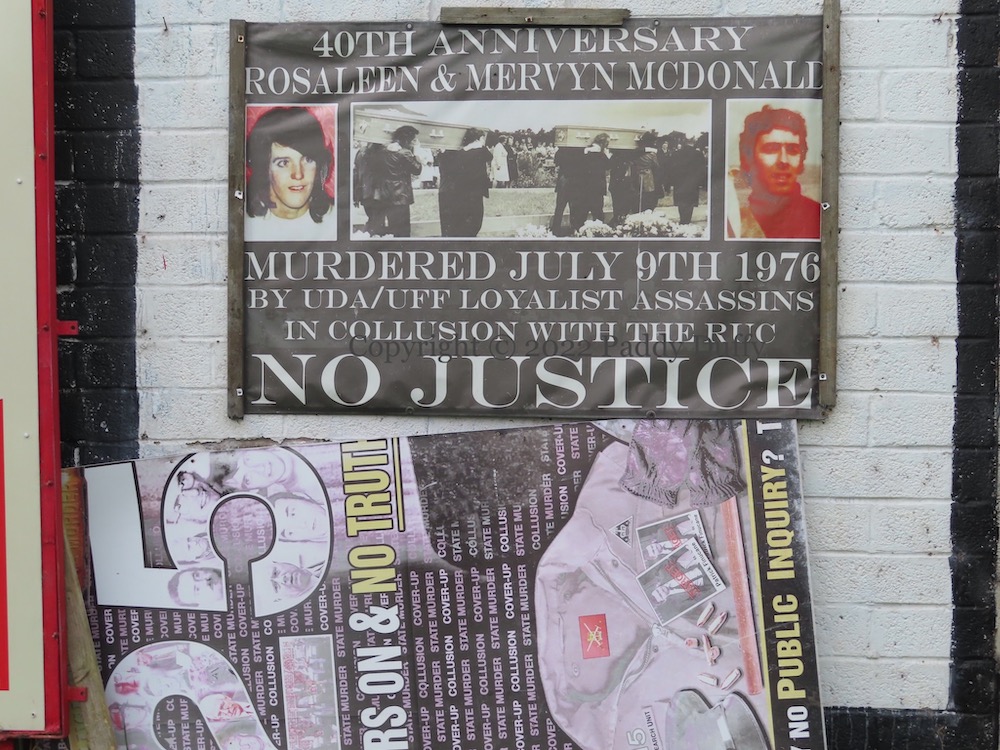
Below: Mervyn and Rosaleen McDonald were Catholics living in the mixed Longlands area of Newtownabbey when they were visited by “UFF loyalist assassins” and shot dead in front of their two young children. The killings are described in most detail in Jack Holland’s Too Long A Sacrifice, which contains an interview with the gunman and the claim that the unit had access to RUC files (p. 94).
Seamus Costello fought for the IRA during the Border Campaign and was interned in the Curragh for two years. He stayed with the Officials during the split, but was driven out in 1974 and formed the Irish Republican Socialist Party (IRSP) and the INLA. He was shot in 1977. (WP)
A large Fıanna banner.
Metalwork commemorating the deceased 1981 hunger strikers.
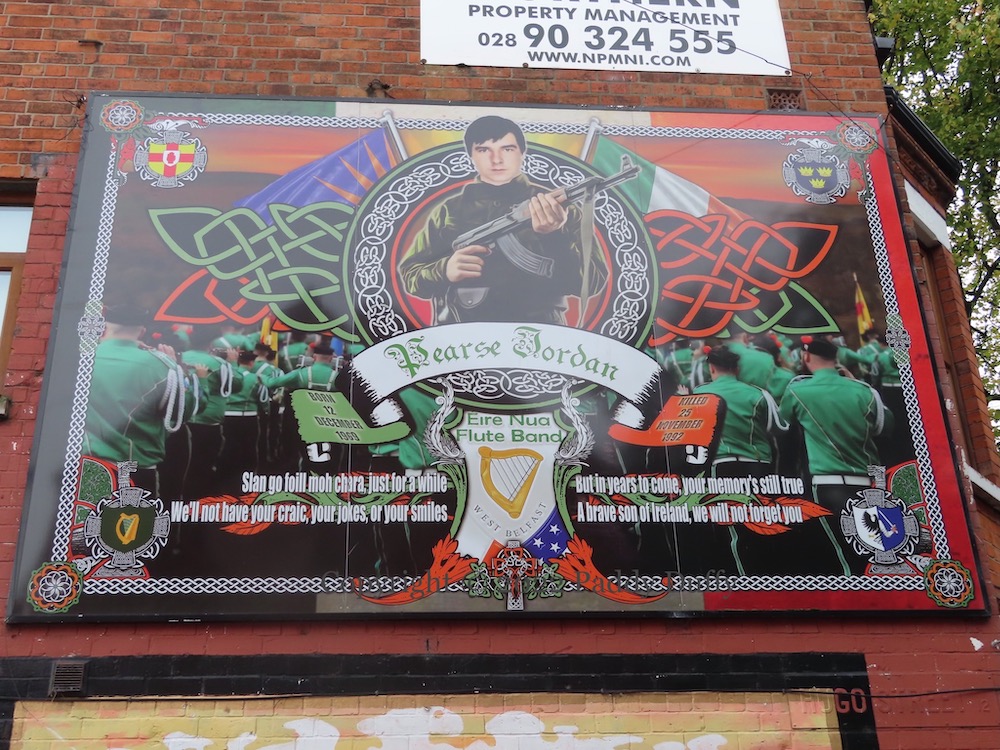
Pearse Jordan was unarmed when he was killed by the RUC on November 25th, 1992 but in this new Éıre Nua Flute Band board he leaves his prints on an assault rifle. (previous Éıre Nua board) His killing was ruled unlawful, and subsequent inquest insufficient, by the European Court Of Human Rights in 2001. The campaign for an inquest continues (An Phoblacht).
The words on the board – “Slan [sic] go foıll [sic] moh [sic] chara, just for a while/We’ll not have your craic, your jokes, or your smiles/But in years to come, your memory’s still true/A brave son of Ireland, we will not forget you” – are the chorus of The Ballad Of Pearse Jordan (words | sung by The Irish Brigade).
The board is in Hugo Street, which is also the site of his memorial plaque, just above the Evolution Of Our Revolution.
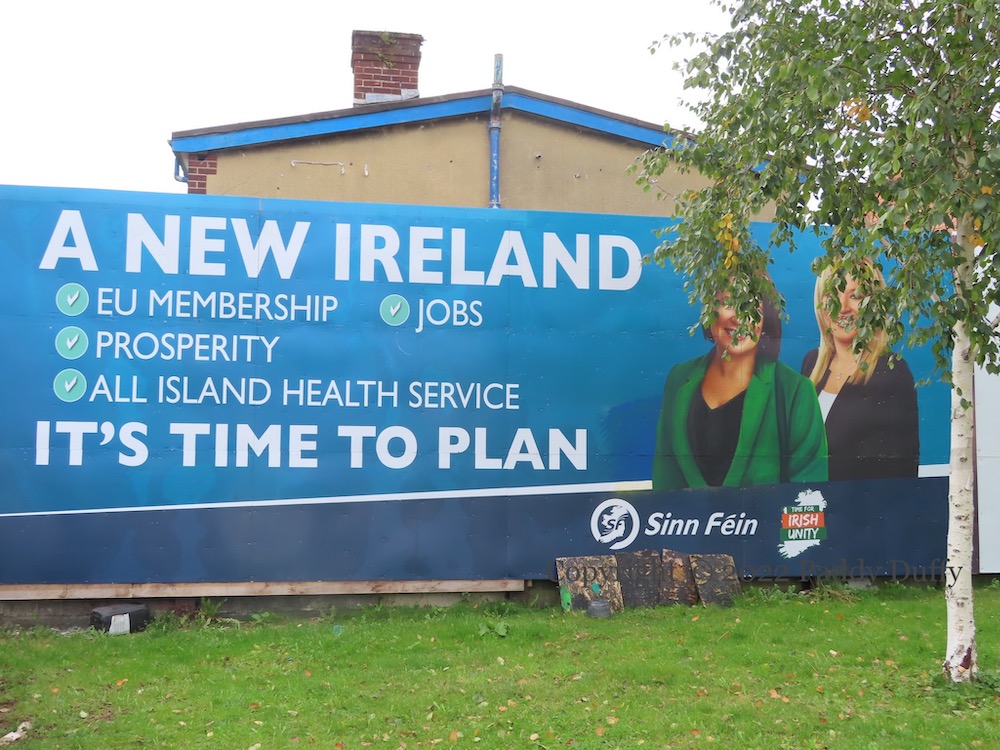
A history of nationalism/republicanism from left to right: a pair of Easter lilies, four generations of rifles, and then a switch to a ballot paper with a check in favour of “unity” and a road named “Unity Way”: “From bullet to ballot: the evolution of our revolution. 1916 – 2016”
This mural is on the north side of Hugo Street – the south side remains exclusively éırígí.
Joe McCann was IRA/OIRA OC in the Markets area of Belfast. He was famously photographed among burning buildings in Inglis’s bakery, during protests against the introduction on internment, crouched beneath a Starry Plough and holding an M1. (For more, see Battle Of The Markets, which features the same photograph.) For McCann’s death the following year (on April 15th, 1972) see Joe McCann.
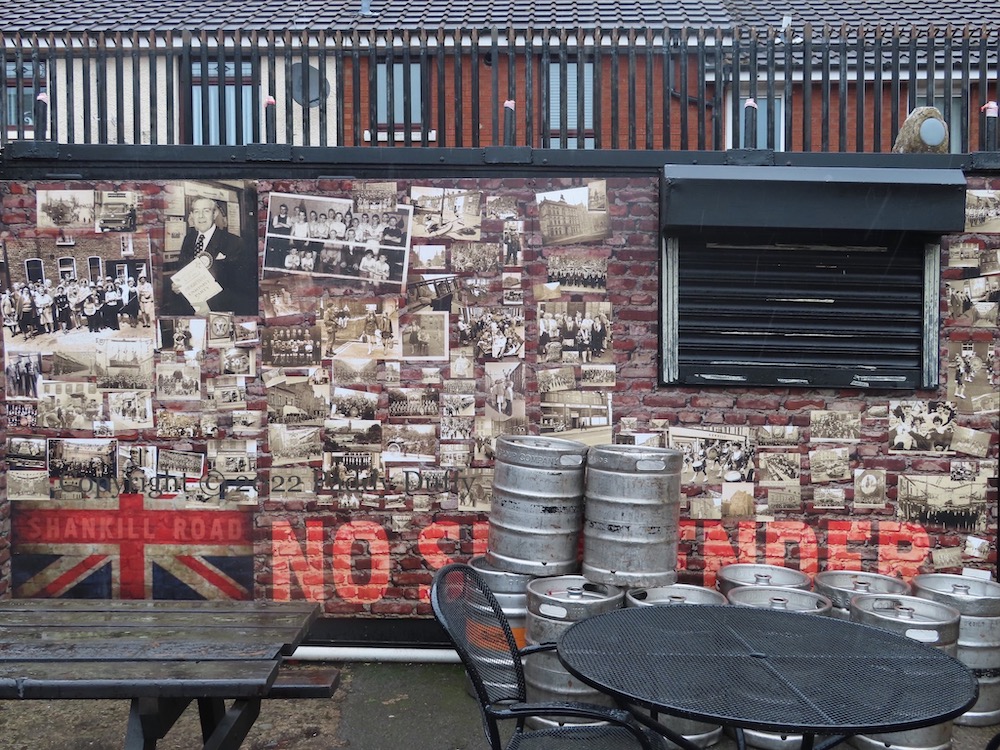
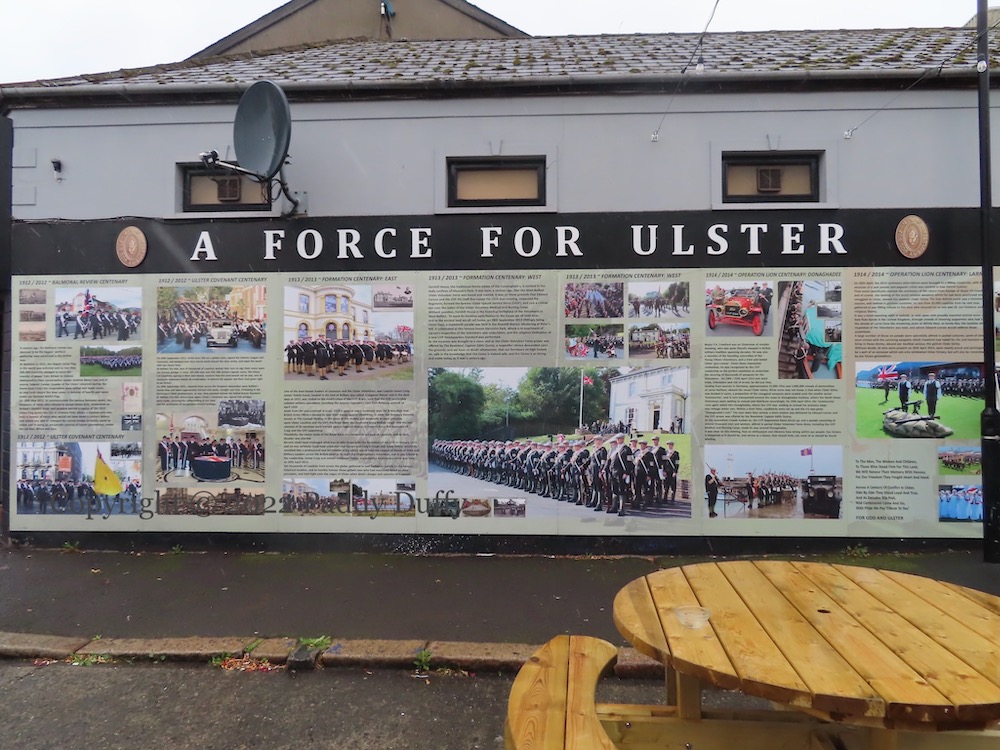
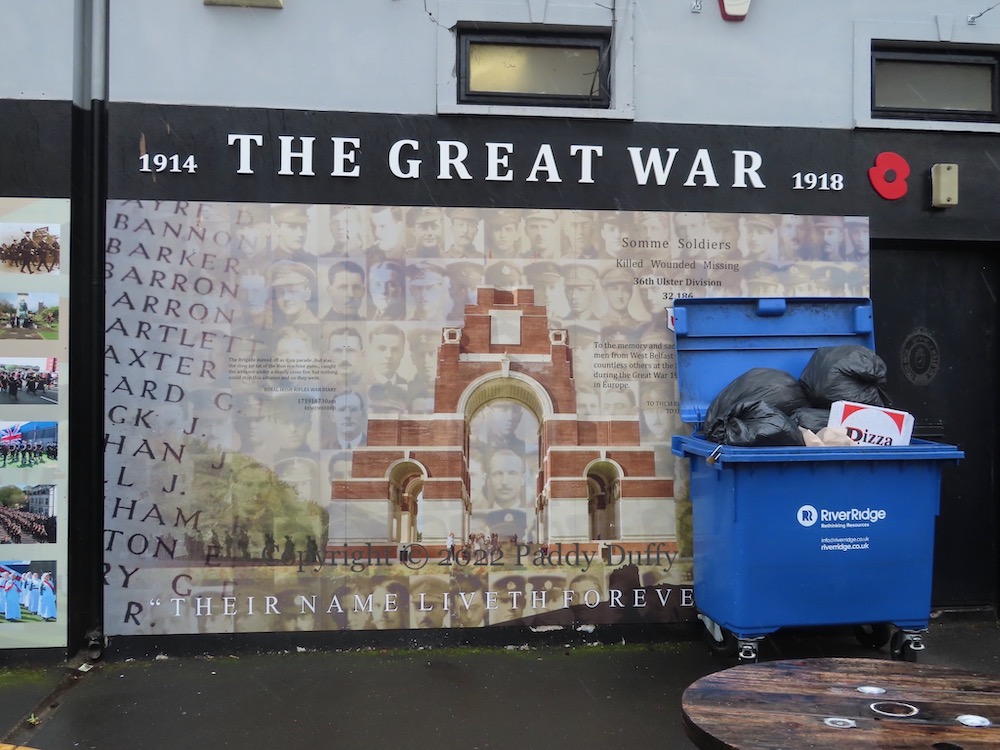
This is the scene at the Rex Bar at (the old) Moscow Street on the Shankill, including, below, three boards describing the formation of the Ulster Volunteers (‘A Force For Ulster’) and using the Thiepval Memorial To The Missing Of The Somme against a background of portraits to commemorate the losses suffered by the 36th (Ulster) Division of the British Army, which the Volunteers became, at the Somme and in other battles, mowed down by “the Hun machine guns” (‘The Great War’). 32,186 men from west Belfast were killed, wounded, or missing. “To them bravery was without limit, to us memory is without end”.
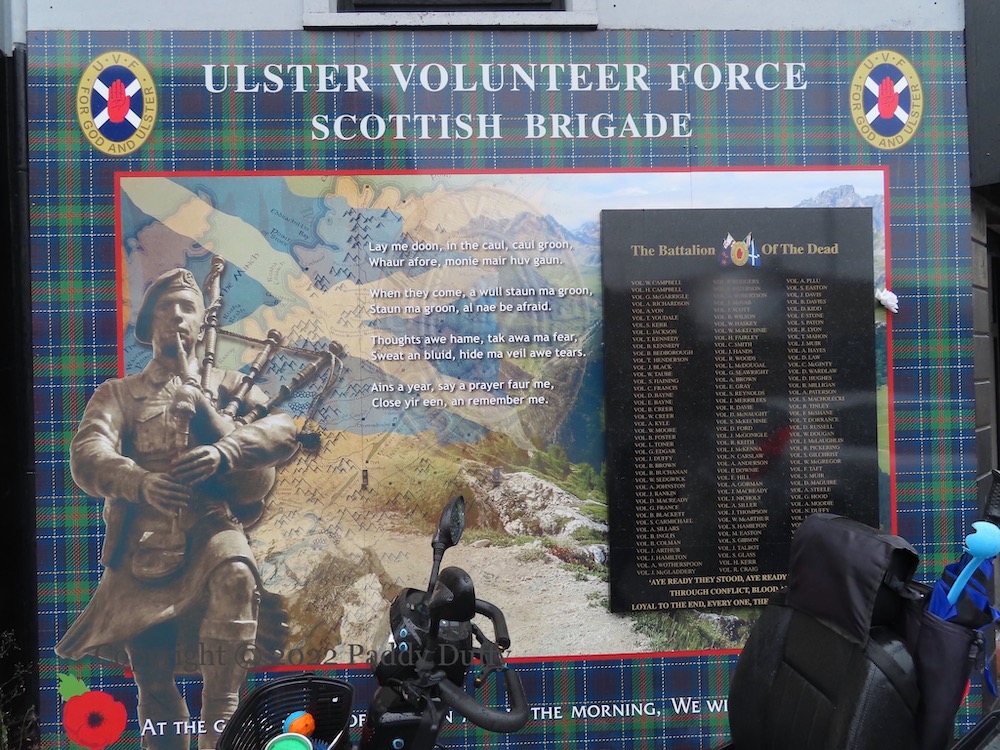
On the Shankill proper (at the newly-christened “Scots Corner”) is a board and plaque to the UVF’s “Scottish Brigade”: “Aye ready they stood, aye ready they fought, through conflict, blood and tears, loyal to the end, every one, the Scottish volunteers.” “Aye ready” was the motto of the 59th Scinde Rifles of the British Indian Army (and later of the Canadian Navy) but is best known from the label of Camp Coffee, in which a Highlander was served a cup of Camp by a Sikh servant (nowadays, they both have a cup of their own).
A Scottish soldier plays the pipes over a list of the “Battalion Of The Dead”, Scottish volunteers from the (modern) UVF. The list is led by William “Big Bill” Campbell, who has had a small plaque in his memory at this spot since (at least) 2014. Preacher and DUP politician George Seawright (see A Crown Of Life) is also included – he was born in Glasgow in 1951.
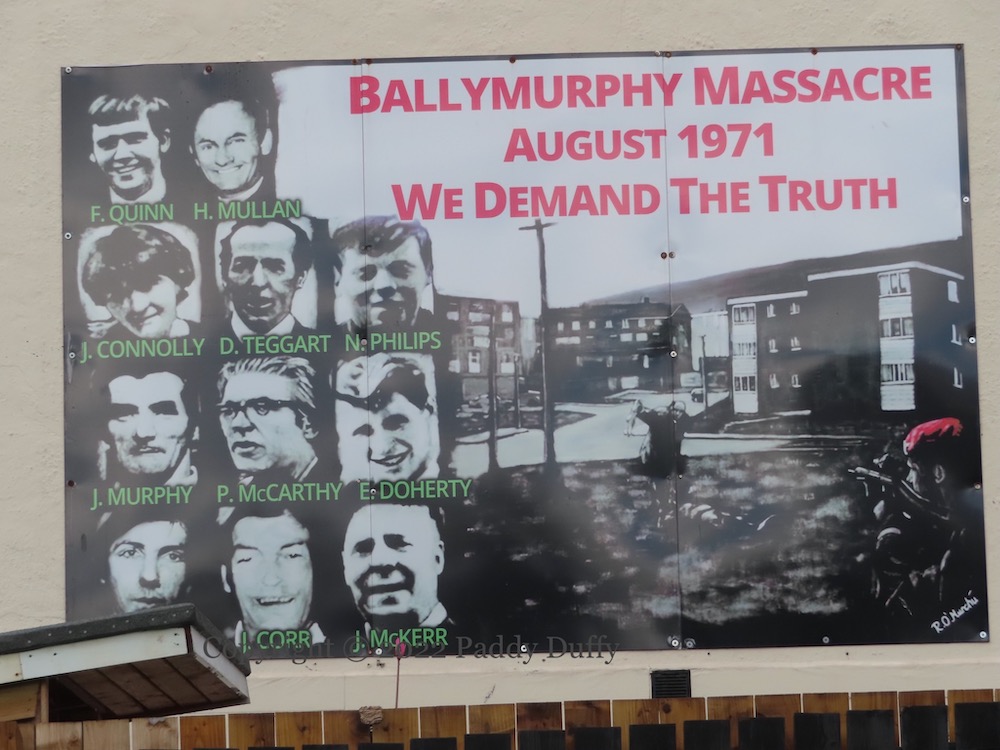
The inquest into the Ballymurphy Massacre – the killings of 11 people from August 9th to 11th, continues, with testimony this past week from former Paratrooper Henry Gow (Irish News | BBC-NI). The image above shows Hugh Mullan being shot from Springmartin while going to the aid of a neigbour, Bobby Clarke; he is waving a white Babygro (BallymurphyMassacre.com). The Paratrooper is distinguished by his red beret.
The mural was originally painted by Rısteard Ó Murchú in 2008 and displayed first on the Whiterock Road then around the corner on the Springfield Road; the location of the repainted board is at the Glenalina Road entrance to the area, in the spot of the former 1916 GPO mural (which had lasted seventeen years before the wall was re-plastered and whitewashed in 2017).
The plaque on the fence reads, “This plaque is dedicated to the 11 innocent civilians murdered by members of the British Parachute regiment in August 1971. Fr Hugh Mullan, Frank Quinn, Noel Phillips, Joan Connolly,
Danny Teggart, Joseph Murphy, Eddie Doherty, John Laverty, Joseph Corr, Paddy McCarthy, John McKerr. Donated by the Frank McCann Cumann, Hamilton [Scotland] (Fb).”