Glencolin estate was built next to Moyard House (which in 1984 became home to the Roddy’s (web)) on the Glen Road in 1979 (Belfast Forums). For the fortieth anniversary of “eastát Ghleann Collaınn” the mural at the entrance to the estate was (belatedly) repainted. The composition of the mural remains as in the previous version, with the Roddy’s and Oliver Plunkett church in the shadow of Dubhaıs and Slıabh Dubh; they are now joined by images of Gaelic games. The Bobby Sands quote has been removed.
The (colour) RNU phoenix and the Craigavon 2 “Free The Innocent” tarp have been joined by a Cogús fist grasping a strand of barbed wire – Cogús (Fb) is (was?) the prisoners’ welfare arm of the RNU.
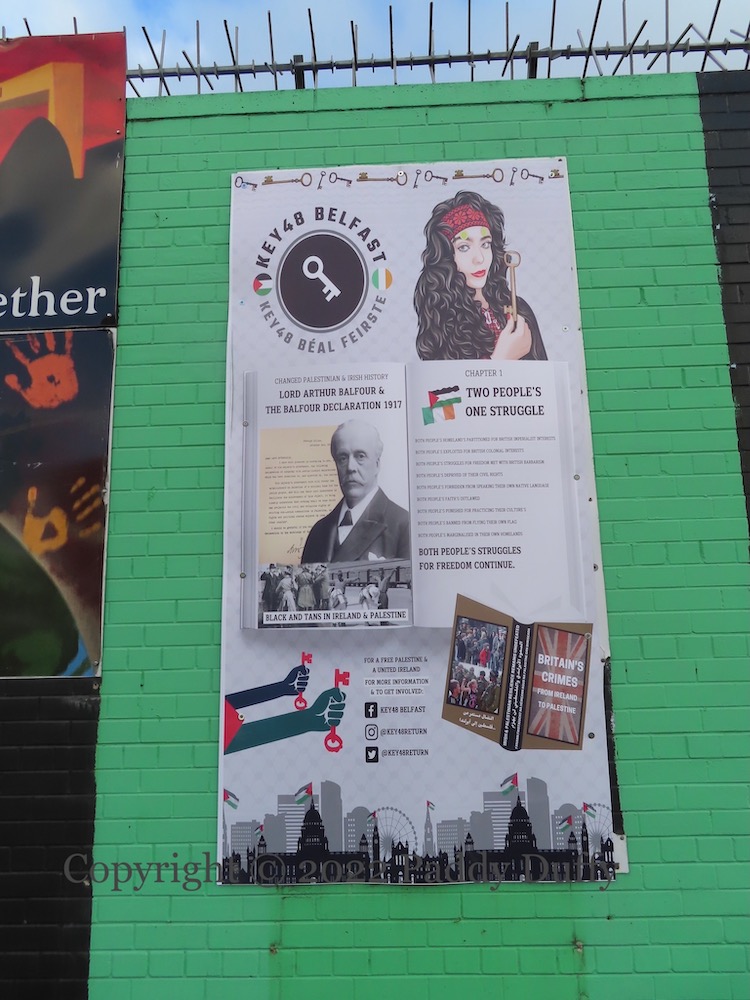
“Britain in Palestine & Ireland” The Balfour Declaration of November 1917 is seen as a pivotal moment in the history leading to the what is formally known as the State Of Israel, as it made the UK the first major government to endorse the idea of a homeland for Jews (WP).
This board on Northumberland Street draws parallels between Ireland and Palestine: homelands partitioned for British imperialist interests, struggles for freedom met with British barbarism … forbidden from speaking their native tongue, faiths outlawed … . About 650 former RIC members were recruited to the “British Gendarmarie” that would police what was called “Mandatory Palestine” (Palestine Studies | Irish History) after WWI.
The League Of Nations mandate putting the UK in change of the Palestinian territory was replaced (in 1947) by a UN plan for partition, which triggered an internal war between Jews and Arabs, and when the UK ended the mandate and evacuated from Palestine in May 1948, Israel declared independence and neighbouring Arab states entered the conflict. About 700,000 Arabs were displaced during the fighting. Key48 (tw) advocates for the right of return and uses as a symbol the keys that householders took with them when they fled.
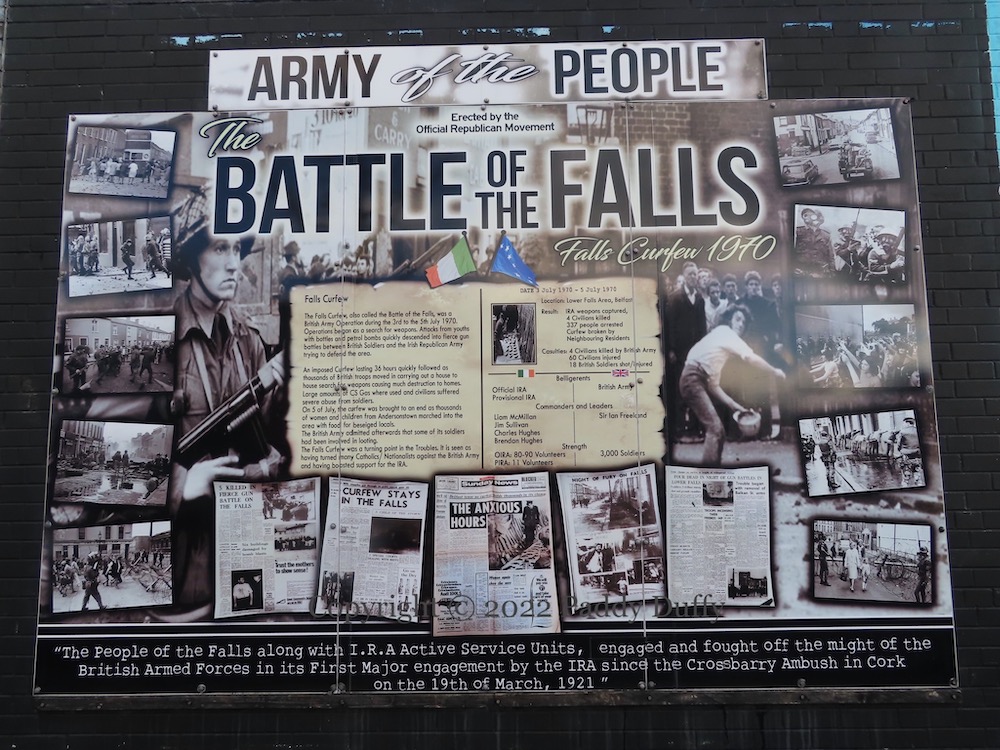
Four people were killed in the course of The Falls Curfew, the 36 hours from July 3rd to 5th in 1970 during which 3,000 houses on the lower Falls were cordoned off after a weapons search of the area devolved into a riot. The curfew ended with a march of women and children from Andersonstown bearing relief (represented in Falls Curfew 1970).
This board has a dual purpose. On the one hand, it was part of celebrations marking the 75th anniversary of the Battle Of Britain, which was waged from July to October in 1940. On the other, it is part of an anti-racism project, celebrating in particular the contributions to the Battle made by roughly 145 Polish aviators (WP) and especially the 303 squadron: “The Polish nation – part of us then, part of us now”. The 303 was later stationed in Northern Ireland for a time. (BBC-NI)
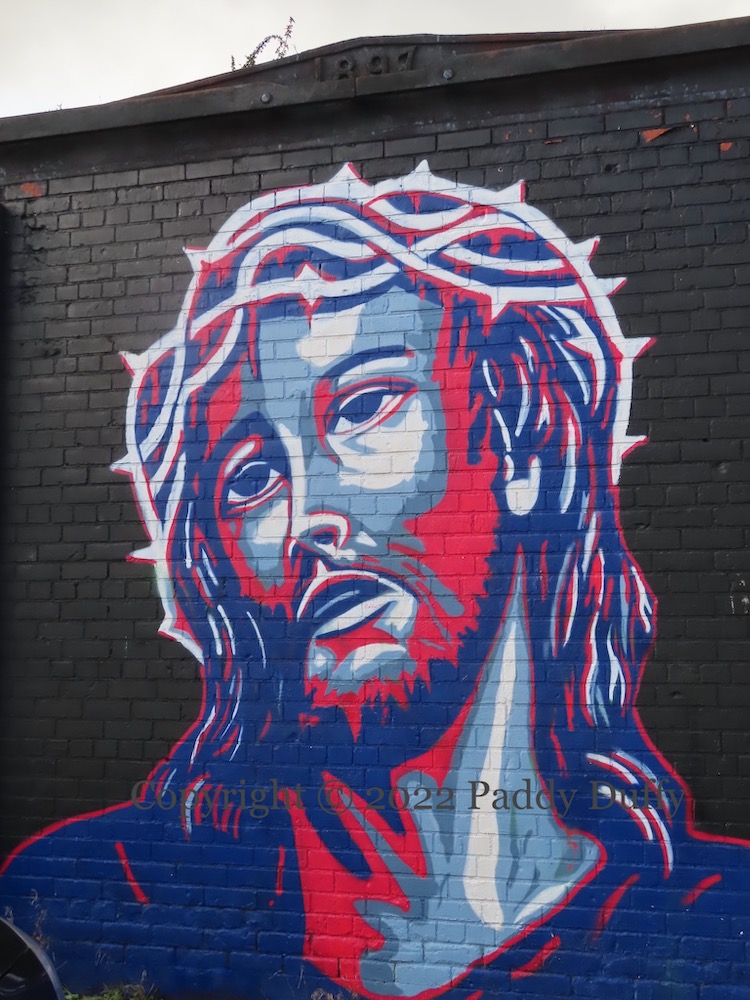
At the height of Covid (April 2020) Artist Glen Molloy (Fb) painted a portrait of Jesus Of Nazareth next to the Cupar Way “peace line” in the style of Shepard Fairey’s Obama ‘Hope’ poster (also the inspiration for De Craig’s Achieve! in east Belfast). Irish News report on the mural.
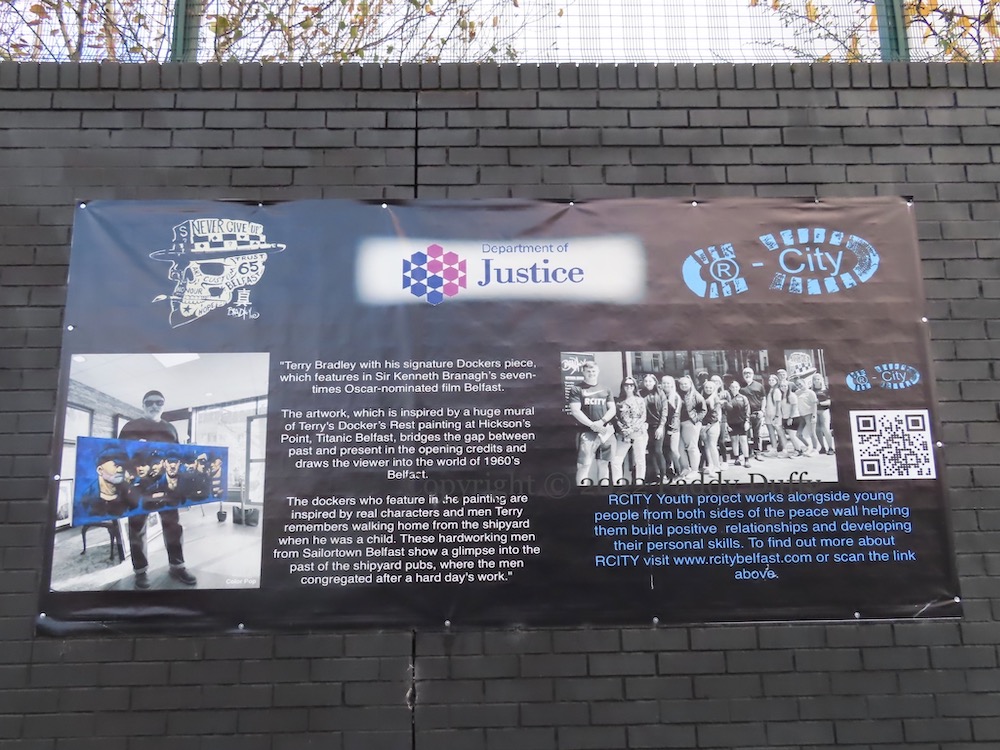
This is a mural of a painting of a mural of a mural. The original is the piece by Terry Bradley (web) and Friz (web) at the Titanic museum’s pub (see Dockers’ Rest), which was then reproduced in a different colour for the opening montage of the Kenneth Branagh film Belfast. The success of the film prompted the Department Of Justice to commission Bradley for a painting that could be turned into a mural and he reproduced the film version (BelTel). The mural that enlarges that painting was painted by DMC on Lanark Way, just above the security gates (Belfast Live).
“The dockers who feature in the painting are inspired by real characters and men Terry remembers walking home from the shipyard when he was a child. These hardworking men from Sailortown, Belfast, show a glimpse into the past of the shipyard pubs, where the men congregated after a hard day’s work.”
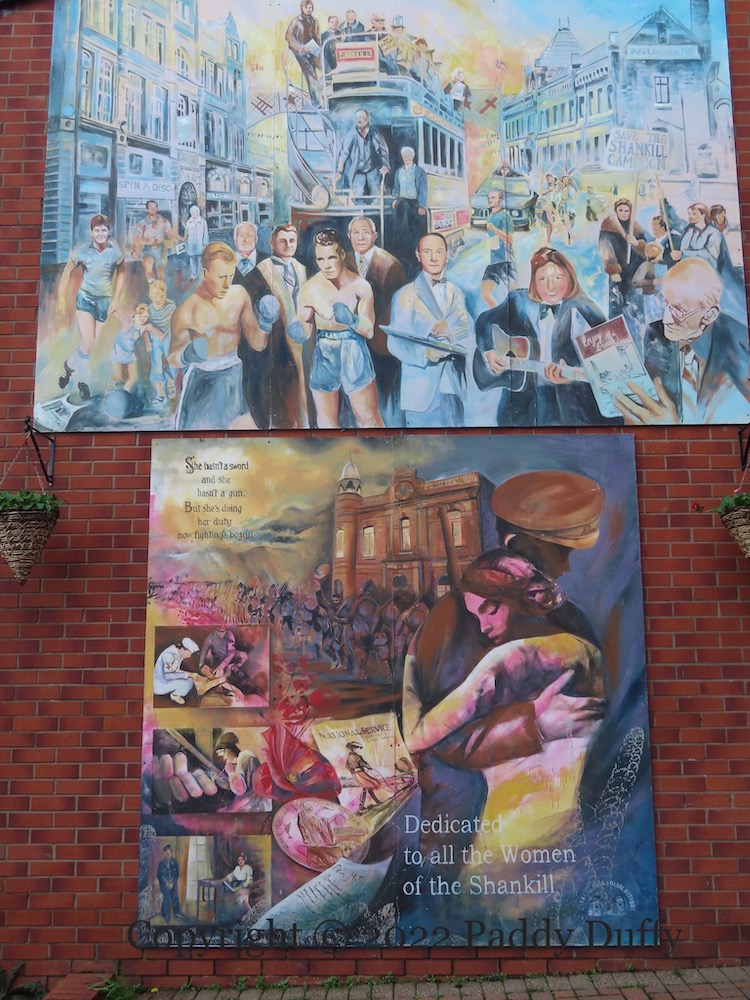
Here are two boards outside the Ulster Rangers Supporters Club (Fb) on the Shankill Road.
The upper one features a tram going under an Orange arch between the public baths on one side an Spin-A-Disc records on the other, surrounded by notable figures from the Shankill area.
Many thanks to Johnny Dougan of Shankill Area Social History (Fb) for the information below! Please e-mail or add a comment with additions or corrections.
Front, from left to right: Manchester United and Northern Ireland Soccer player Norman Whiteside (WP) and behind him boxer Davy Larmour and community worker Saidie Patterson (see WRDA), boxer Sammy (Cisco) Cosgrove, Senator Charlie McCullough (WP), Tommy Henderson, boxer Jimmy Warnock (original photograph here), Hugh Smyth (see previously Third Class Citizens), artist William Conor (see previously Conor’s Corner, Jack Henning (running), musician Belter Bell, writer Albert Haslett (Northern Visions interview).
Atop the tram: on the left is Jackie Redpath of the Save the Shankill Campaign (note other members of the group with placard on right; Northern Visions has a documentary about the Save The Shankill campaign) and Jack Higgins holding his book The Eagle Has Landed (WP). Up there too is Miss Sands, the music teacher in the Girls Model School, and historian Bobby Foster (Northern Visions interview). On the stairs are May Blood MBE and above her D.I. Nixon.
The lower board highlights the roles played by women during WWI as nurses and welders and in the Land Army. “She hasn’t a sword and she hasn’t a gun. But she’s doing her duty now fighting’s begun.” The forces are shown gathered outside the West Belfast Orange Hall, on the Shankill at Brookmount Street.
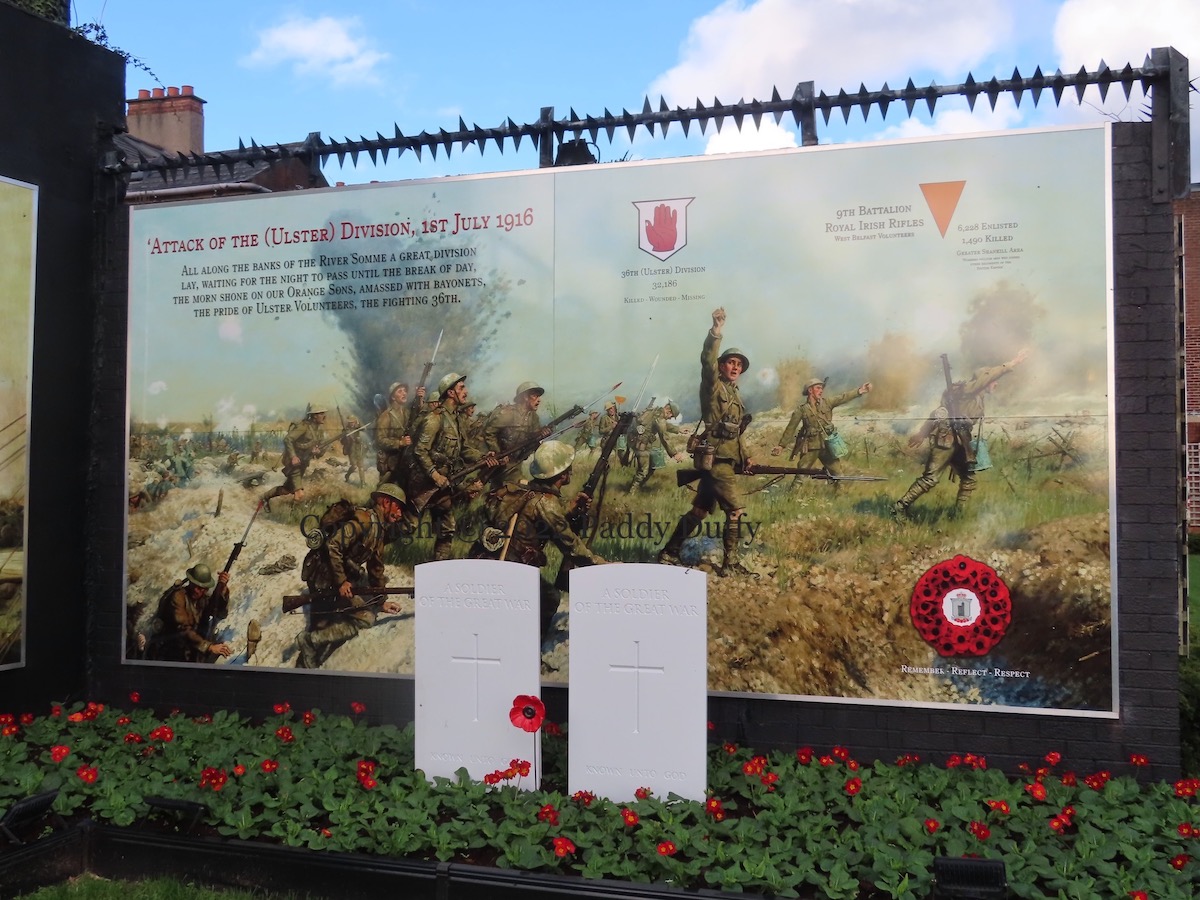
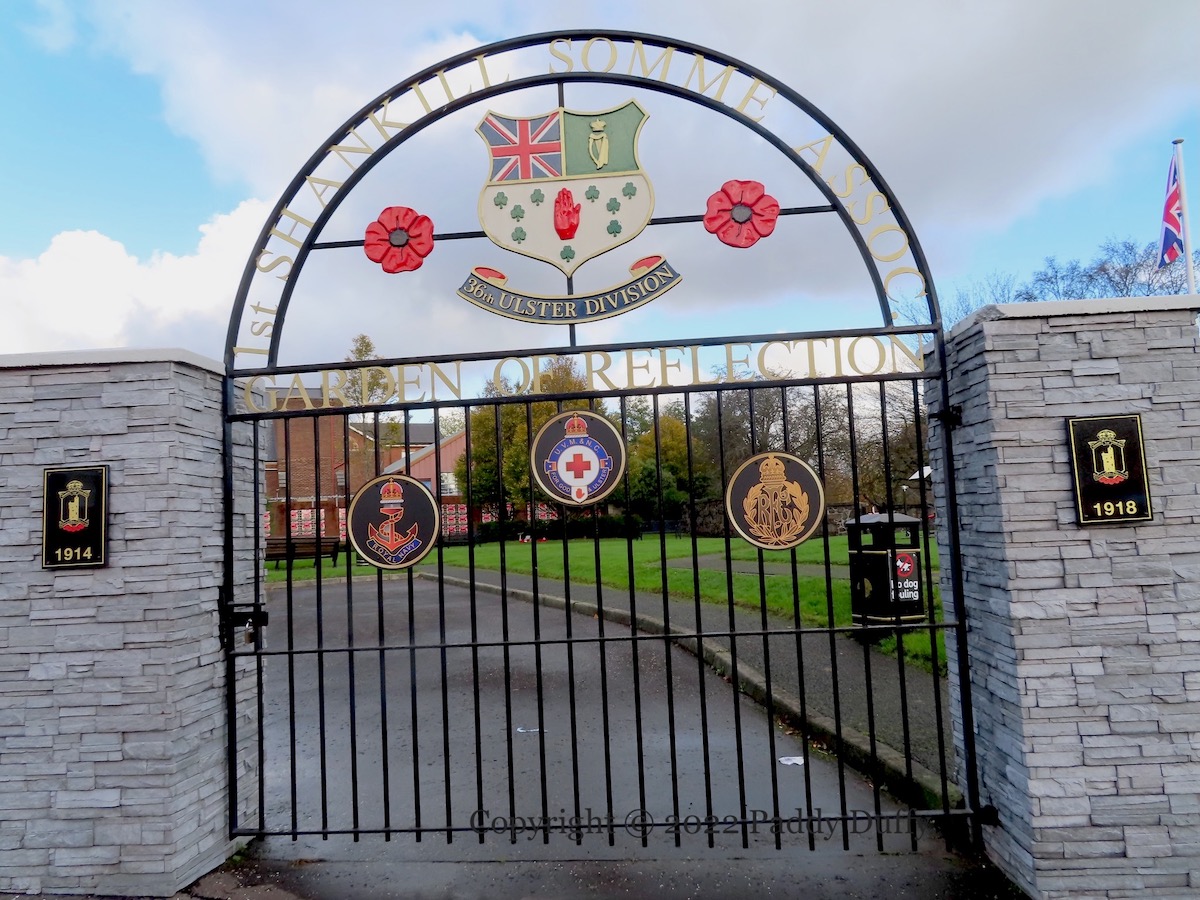
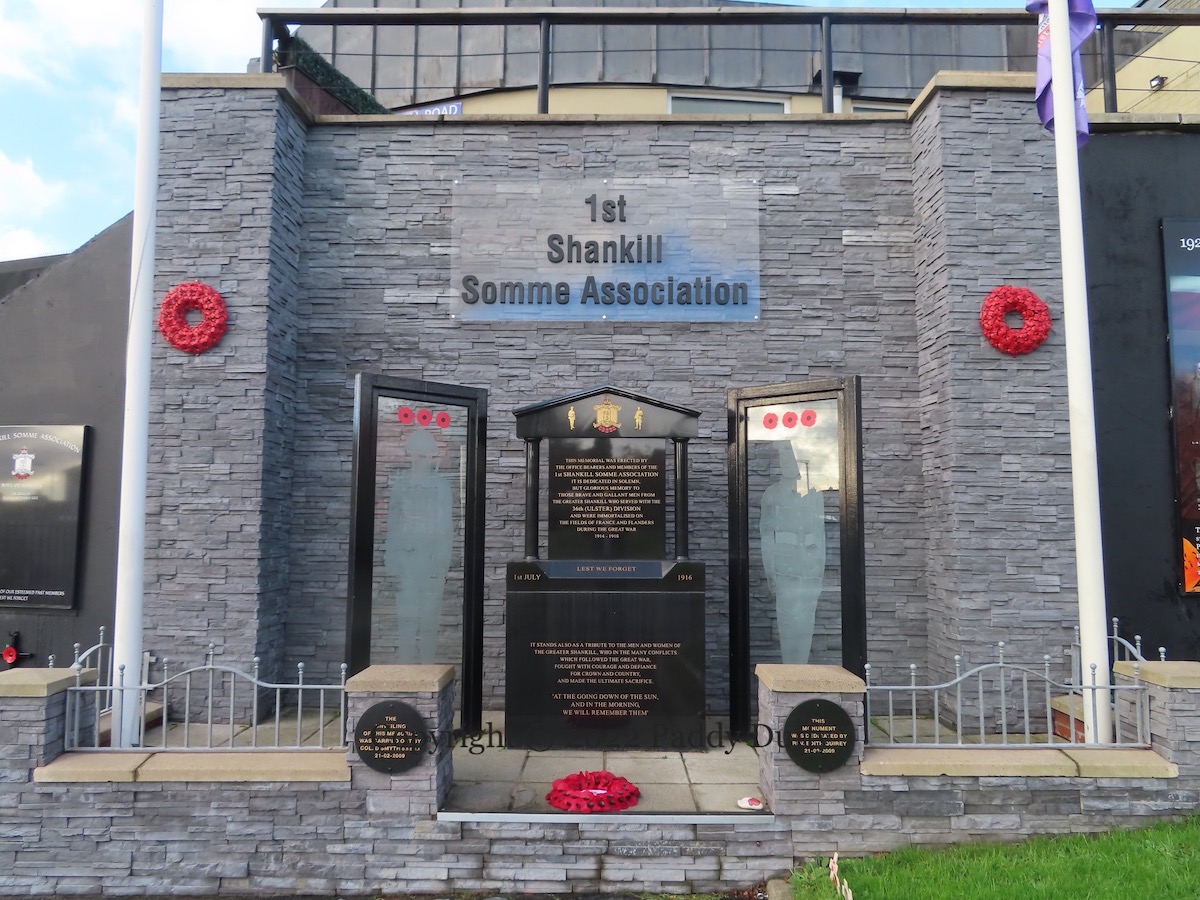
The Shankill Somme Association’s garden of reflection has added a number of new boards.
The board shown above is JP Beadle’s painting “Battle of the Somme: Attack of the Ulster Division”, which hangs in Belfast City Hall (militaryprints.com). It replaces a painting of a soldier in a field of poppies, seen in The Great War.
To its left is John Singer Sargent’s painting “Gassed”, showing the “aftermath of an indiscriminate mustard gas attack on British forces during the Battle of Arras 21st August 1918” (which also forms a part of a memorial in east Belfast) with the GK Chesterton quote “The true soldier fights not because he hates what is front of him, but because he loves what is behind him”.
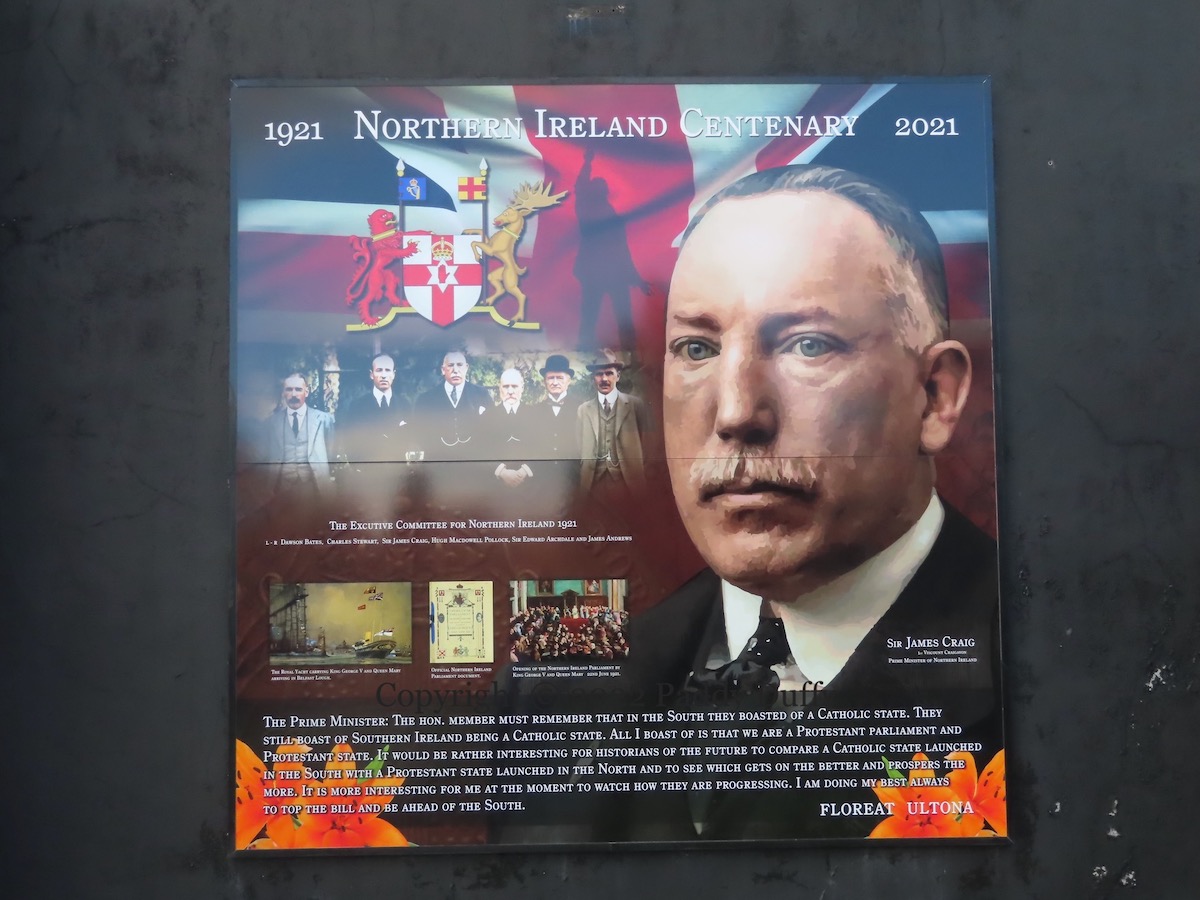
Also new – and somewhat out of place – is the Northern Ireland Centenary board featuring James Craig: “It would be rather interesting for historians of the future to compare a Catholic state launched in the south with a Protestant state launched in the north and to see which gets on the better and prospers the more”. There are other “floreat Ultona” boards/murals in the Village (focusing on the B Specials and UDR) and in Rathcoole (where “Ulster welcomes her King and Queen”).
There are also three insignia on the gates (compare with M05717), to the Royal Navy, the Ulster Volunteer Medical & Nursing Corps, and the Royal Flying Corp.
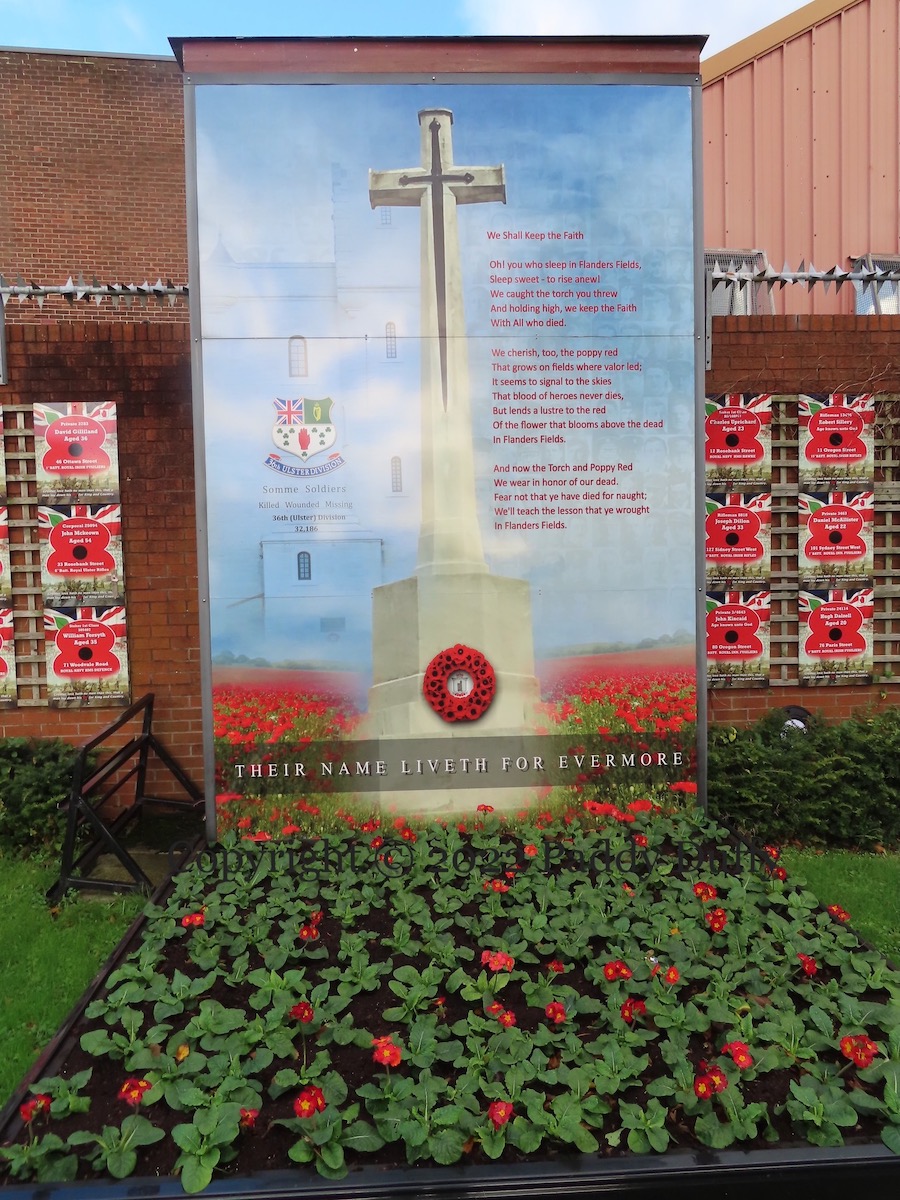
Previously (c. 2017), the undead soldiers of We Shall Not Sleep were replaced with an image of the Cross Of Sacrifice memorial – the original is in Ypres, Belgium but there is also one in the City Cemetery – see One In Design And Intention. At the same time, the poppy plaques for individual local soldiers and the image of the Menin Gate were also added.
The Flanders Field board appears to have survived since 2012 – see Somme Memorial.
The final image below shows the new stone surround for the main memorial. See (again) Somme Memorial.











 Paddy Duffy Collection