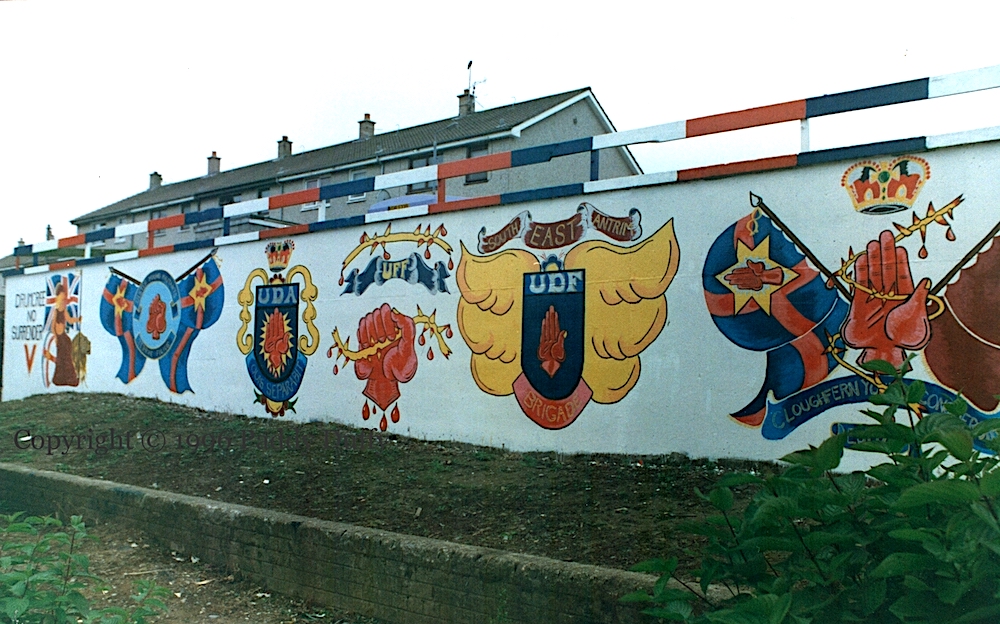
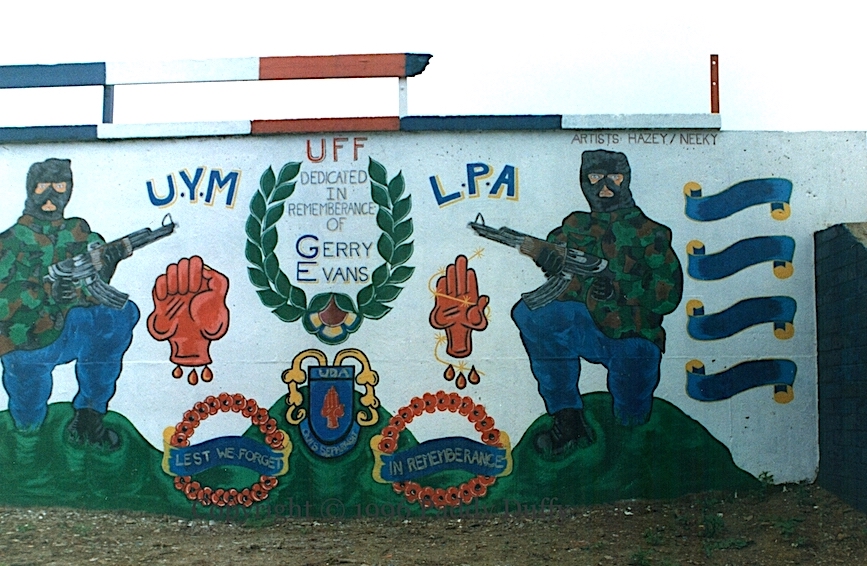
From left to right: “Drumcree – no surrender”, Britannia with a Union Flag and an Ulster Banner shield, Ulster Young Militants, UDA, UFF, “South East Antrim Brigade”, “Cloughfern Young Conquerors [Fb] est. 1973″ with the flag of independent Northern Ireland, and a pair of hooded gunmen flanking a wreath “dedicated in rememberance [sic] of Gerry Evans”. Evans was killed by the INLA on April 27th, 1994, shot at his shop in the Northcott centre. (Lost Lives 3472. Sutton describes Evans as a “civilian”.)
Painted by “Artists Hazey / Neeky” in Knockenagh Avenue, Newtownabbey
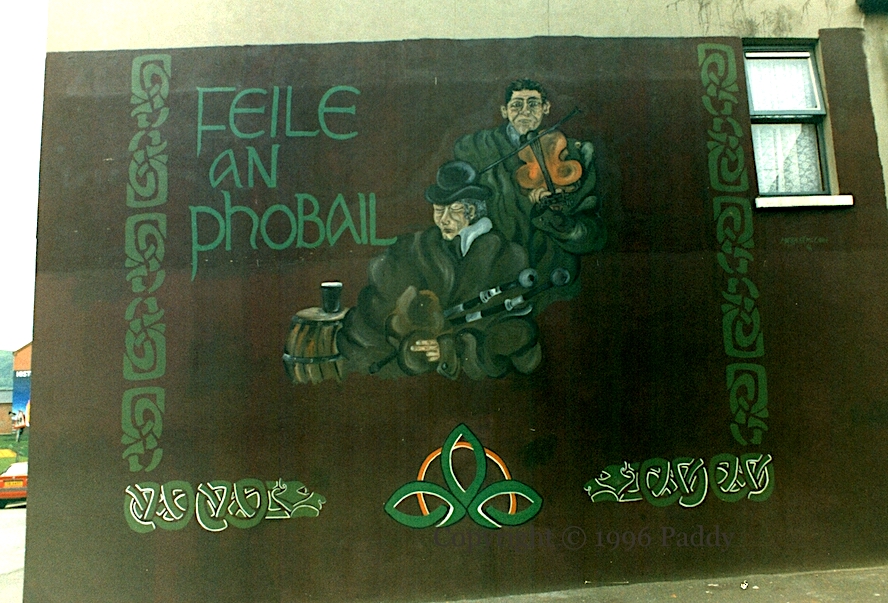
Some of the programme from the 1996 festival is available in the ‘Extraordinary Women’ collection at the Linenhall Library. 1996 was also the first year of Féıle FM (“Triple FM”) (The Can).
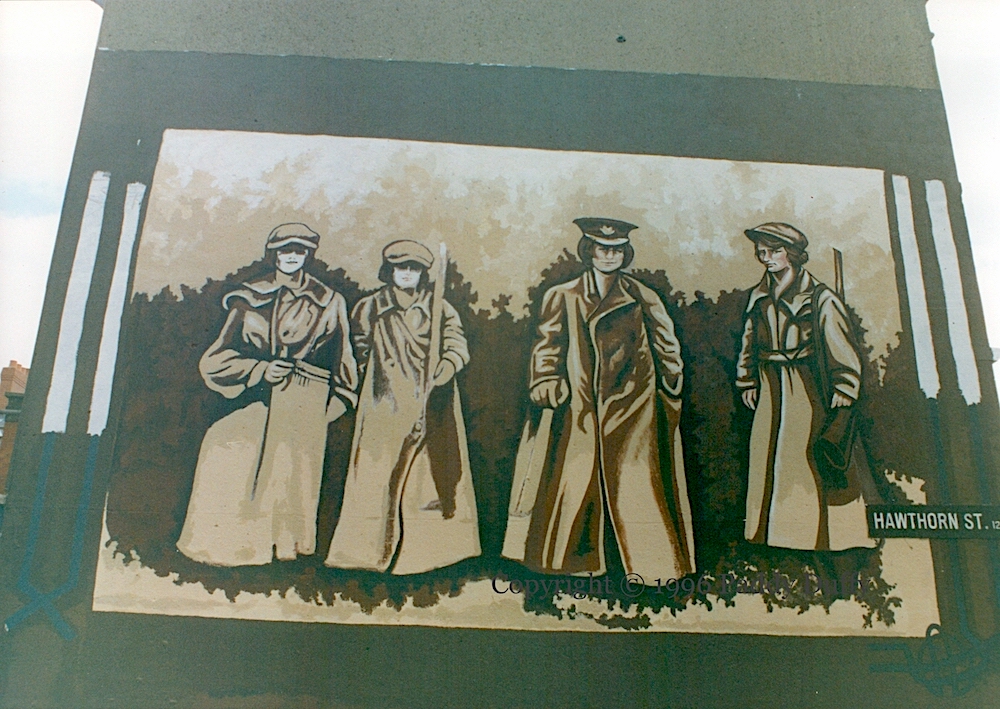
Painted by Margaret McCann in Hawthorn Street, west Belfast
Text would later be added along the bottom reading, “This mural is dedicated to the Women of Cumann Na mBan, Óglaıgh Na hÉıreann & Sınn Féın.” Image “from R[uth] Taillon’s book The Women Of 1916.” Taillon is a Canadian who moved to Belfast in 1980 and has been doing work with the women’s movement in the north and on women’s history – see NVTv.
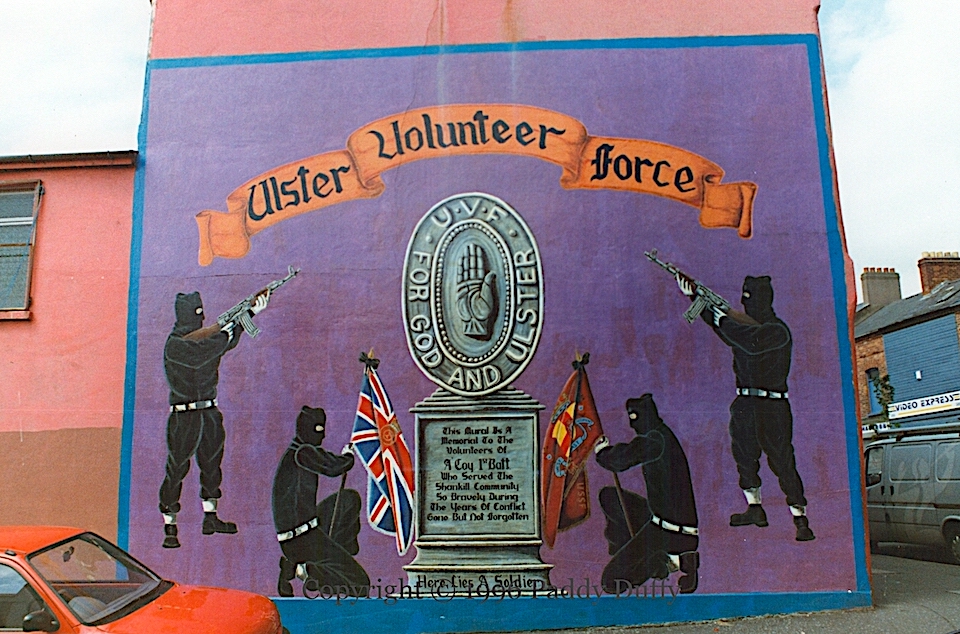
“This mural is a memorial to the volunteers of A Coy 1st Batt who served the Shankill community so bravely during the years of conflict. Gone but not forgotten.” The flags being held on either side are of the Shankill Protestant Boys (1st battalion, Ulster Volunteers) and the USSF.
Canmore Street, Shankill, west Belfast. Paddy Duffy’s British Telecom van is parked on the Shankill, to the right of the image.
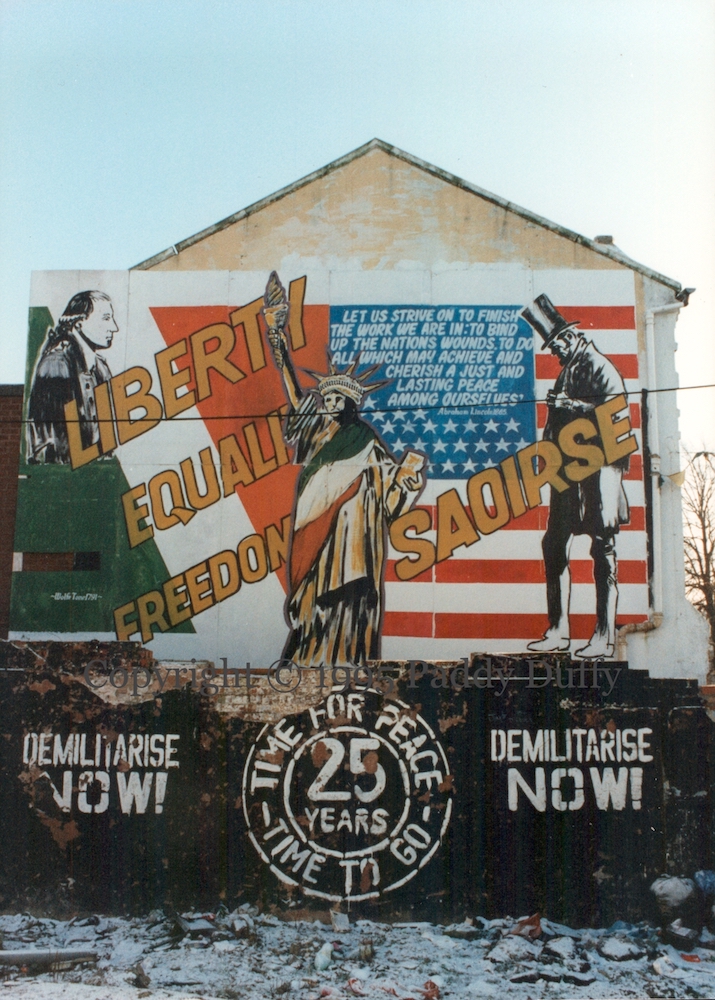
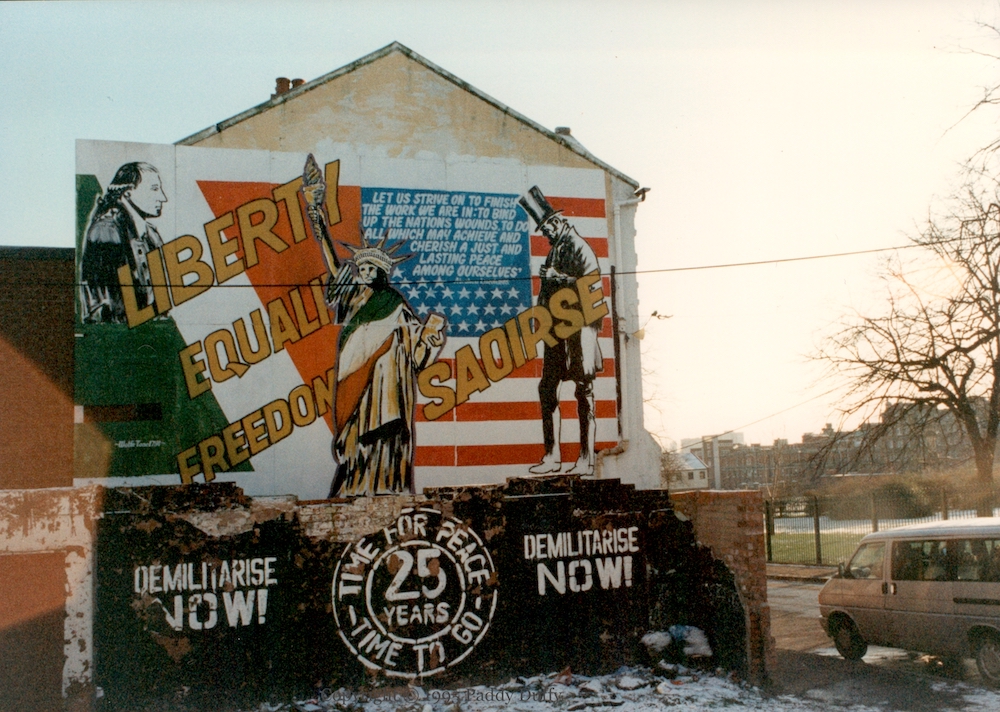
“Liberty, equality, freedom – saoırse”. US President Bill Clinton visited Belfast and Derry on November 30th, 1995, and his visit included brief walk-abouts on the Shankill and the Falls (Clinton Library | BBC).
The stop on the Falls was at Dunville Park, where this painting on boards had been quickly (and briefly) erected on top of a mural (25 Years Of Resistance).
On the left is “Wolfe Tone 1798” and on the right “Abraham Lincoln 1865”: “Let us strive on to finish the work we are in: to bind up the nation’s wounds, to do all which may achieve and cherish a just and lasting peace among ourselves”. (Lincoln’s second inaugural speech concludes, “With malice toward none with charity for all with firmness in the right as God gives us to see the right let us strive on to finish the work we are in to bind up the nation’s wounds, to care for him who shall have borne the battle and for his widow and his orphan ~ to do all which may achieve and cherish a just and lasting peace among ourselves and with all nations.”)
The stencil on the lower wall – “25 years – time for peace, time to go. Demilitarise now!”, designed by Robert Ballagh – belongs to the previous mural.
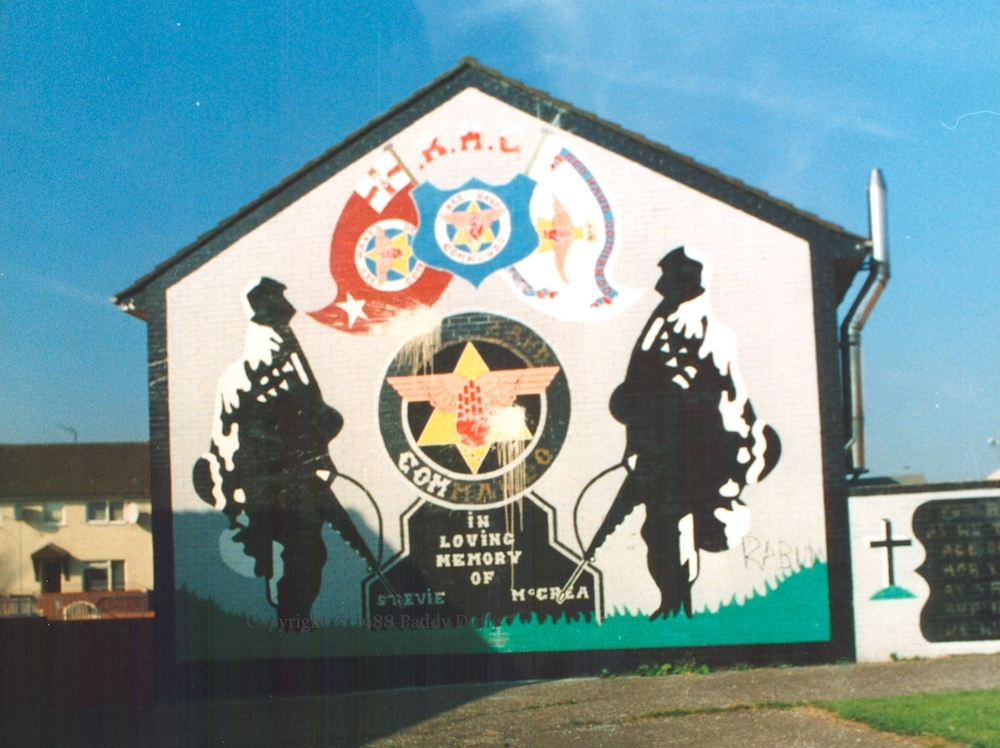
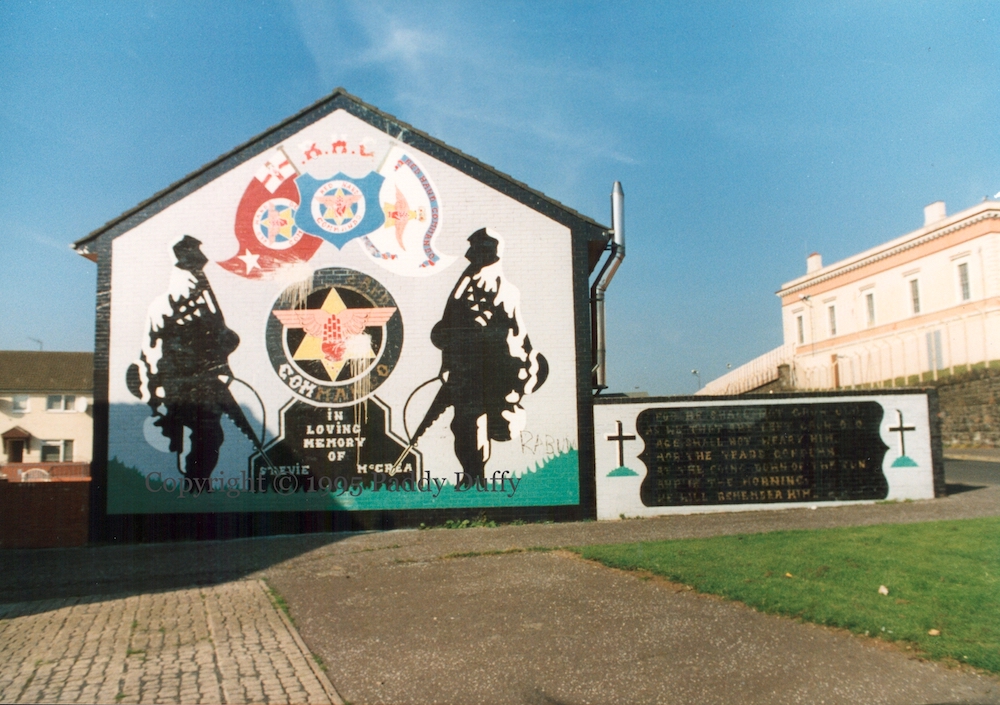
“In loving memory of Stevie McCrea”. Red Hand Commando volunteer Stevie McCrea was sentenced to 16 years for the murder of James Kerr in 1972 (Behind The Mask) and was subsequently “murdered by the enemies of Ulster” on February 18th, 1989 in an IPLO attack on the Orange Cross (WP). (The door of the club can be seen next to the mural in M00560.)
On the side-wall, Binyon’s ‘For The Fallen‘ is modified for the singular “he”: “For he shall not grow old as we that are left grow old. Age shall not weary him nor the years condemn. At the going down of the sun and in the morning, we will remember him.”
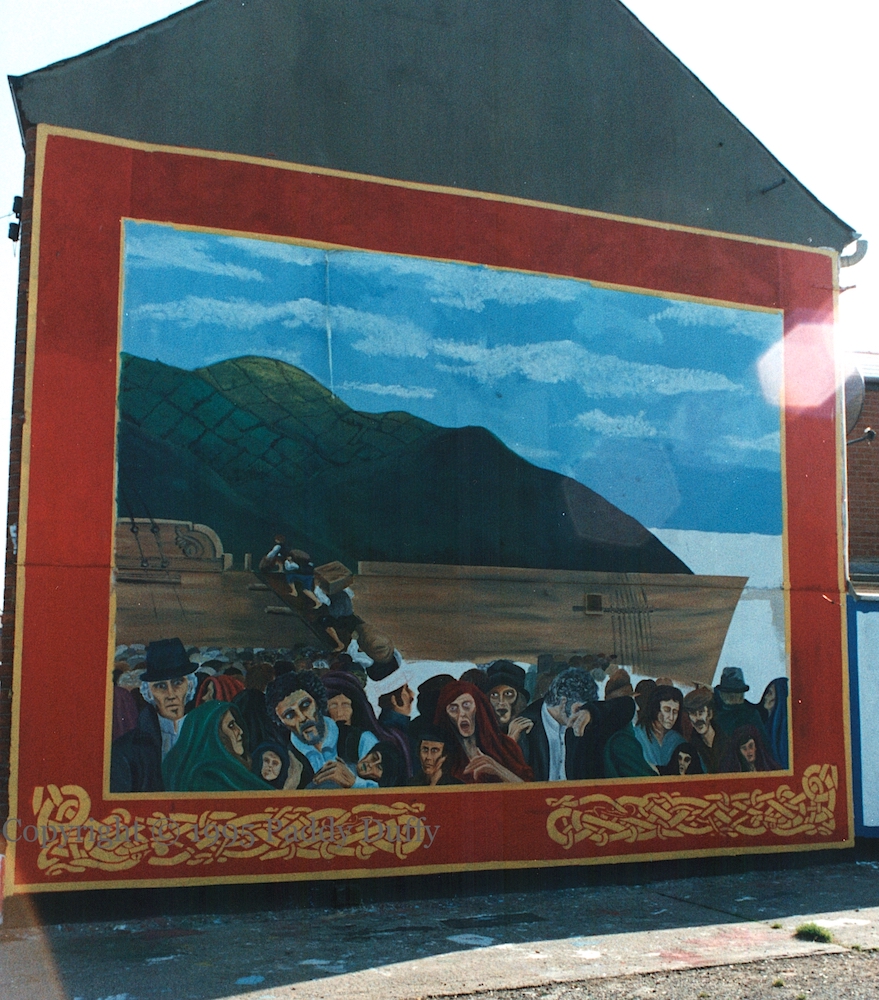
Irish people climb on-board ship in order to escape the Great Hunger. The mural is based on The Embarkation, Waterloo Docks Liverpool in the Illustrated London News. This is one of about nine murals painted in 1995 on the Great Hunger (Visual History).
“When the potato crop failed causing the great hunger, people watched in despair as shiploads of food were escorted away by British troops …”. This mural combines an image from Illustrated London News (Bridget O’Donnel And Children) with five bodies faces drowning in the sea.
This is one of about nine murals painted in 1995 on the Great Hunger (Visual History).
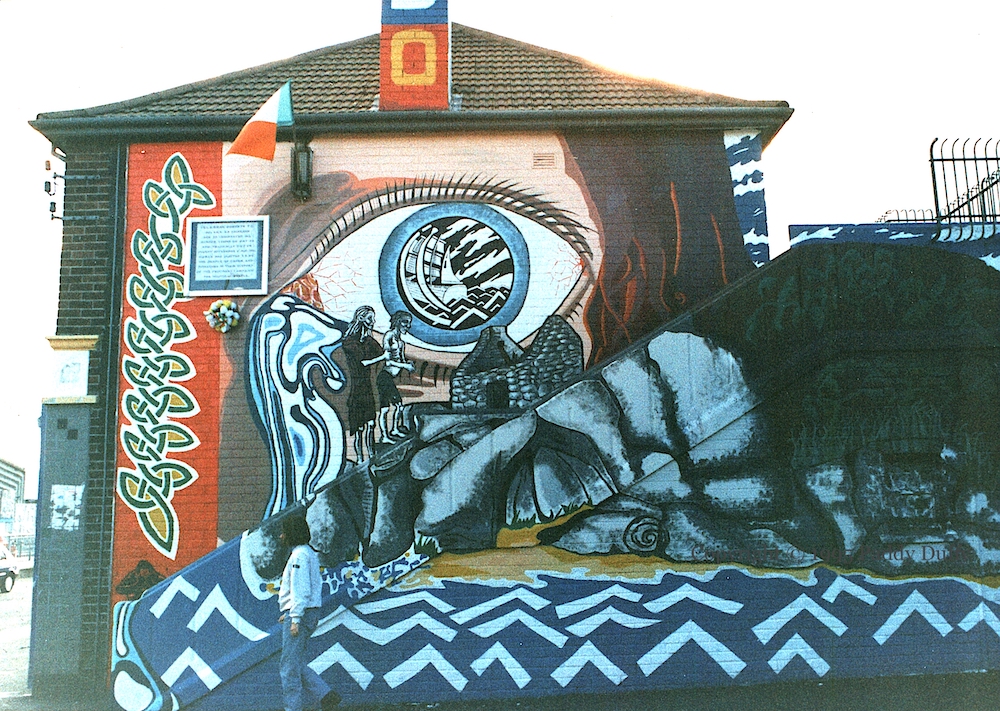
A tearful eye beholds both the Great Hunger, which claimed one million lives, and, within the eye itself, the wave of emigration which took more than a million others away from Ireland.
This is one of about nine murals painted in 1995 on the Great Hunger (Visual History). The number “150” appears on the chimney and would last until 2008 and beyond.
There are two side-walls out of frame to the right, going around a corner. The first gives a list of the artists in Irish (“[Dón]al Ó Dalaıḋ, [Cıa]rán [Mac] Taírnan [sic], Brían Ó Lúaın, […]rán Ó hÉır, […]áın Mac Pháıl, [perhaps one more]” (Donal Daly, Ciaran McKernan, Brian O’Loan, […] O’Hare, […] McFall. Daly, McKernan, and O’Loan would paint the History Is Written By The Winners mural in 1996) and the second reads “Dedicated to those who died in the Great Hunger” with a Celtic cross and some knotwork.
There is also a plaque to local man Kieran Doherty, reading “Vol. Kieran Doherty T.D. Óglaıgh Na hÉıreann. Age 25. Commenced his hunger strike on May 22 and tragically died on Sunday afternoon 2 Aug 1981. Kieran was elected T.D. by the people of Cavan And Monaghan in their support of the prisoners’ campaign for political status.” This plaque would be retained when this wall became a memorial mural to Doherty in 2001.
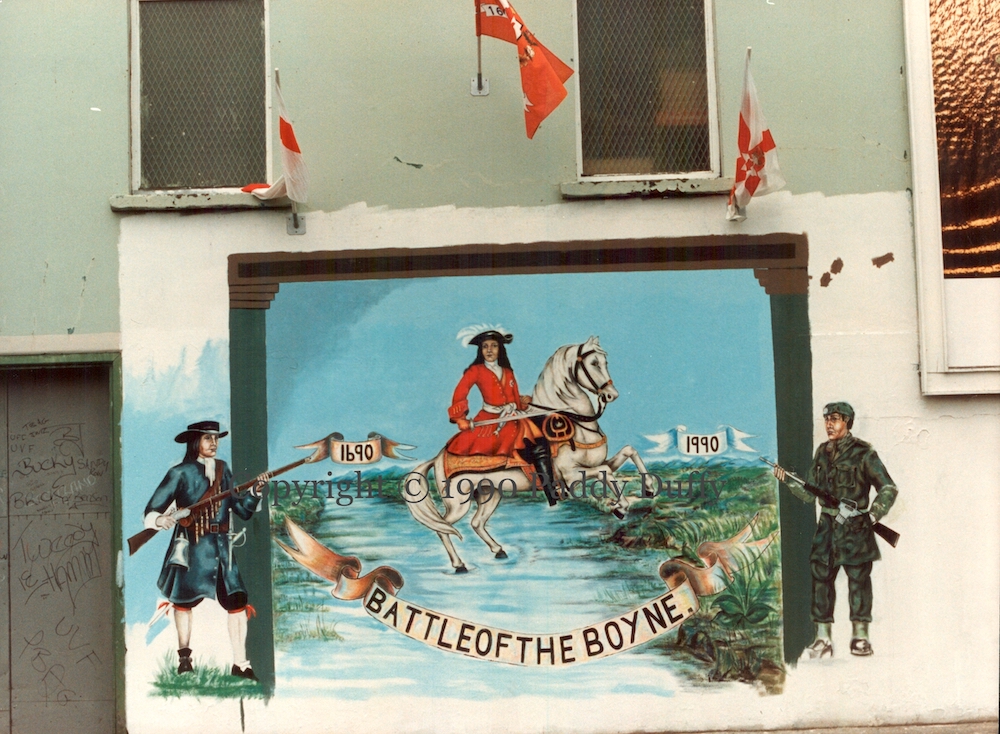
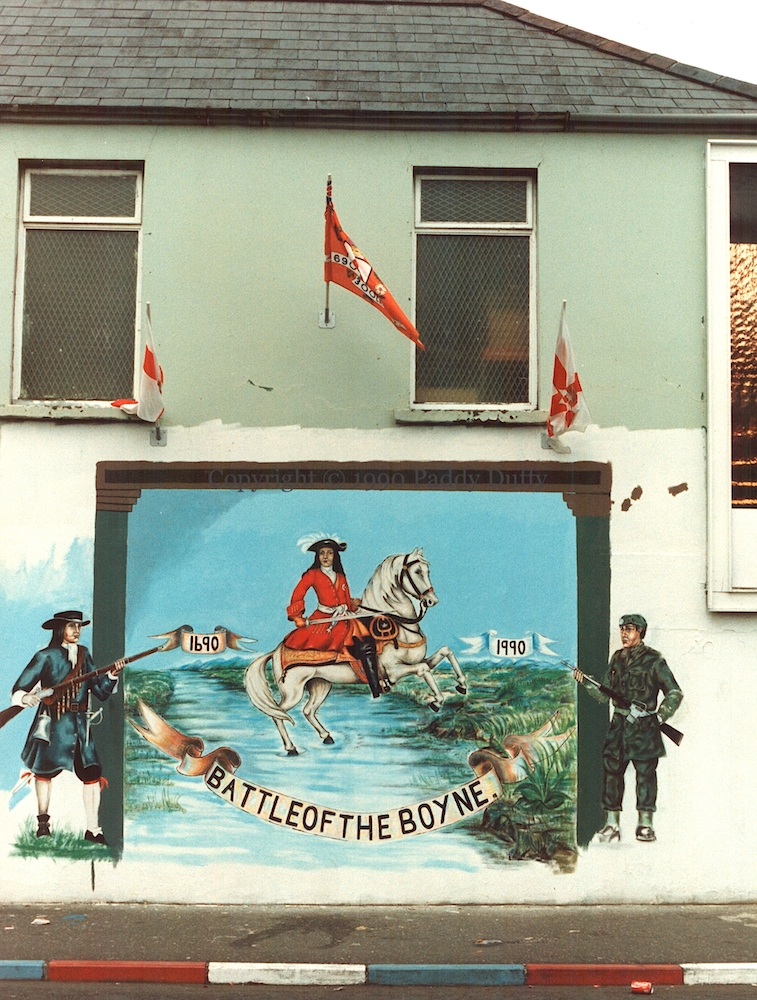
King William III is flanked by foot soldiers from 1690 and 1990. A small painted sign to the right reads, “We the people of Sandy Row remember with pride the 300th anniversary of the Battle of the Boyne. No surrender. Signed, UFF.”
The modern-day gunman on the right would later be replaced by another period soldier – see the Peter Moloney Collection.

 Paddy Duffy Collection