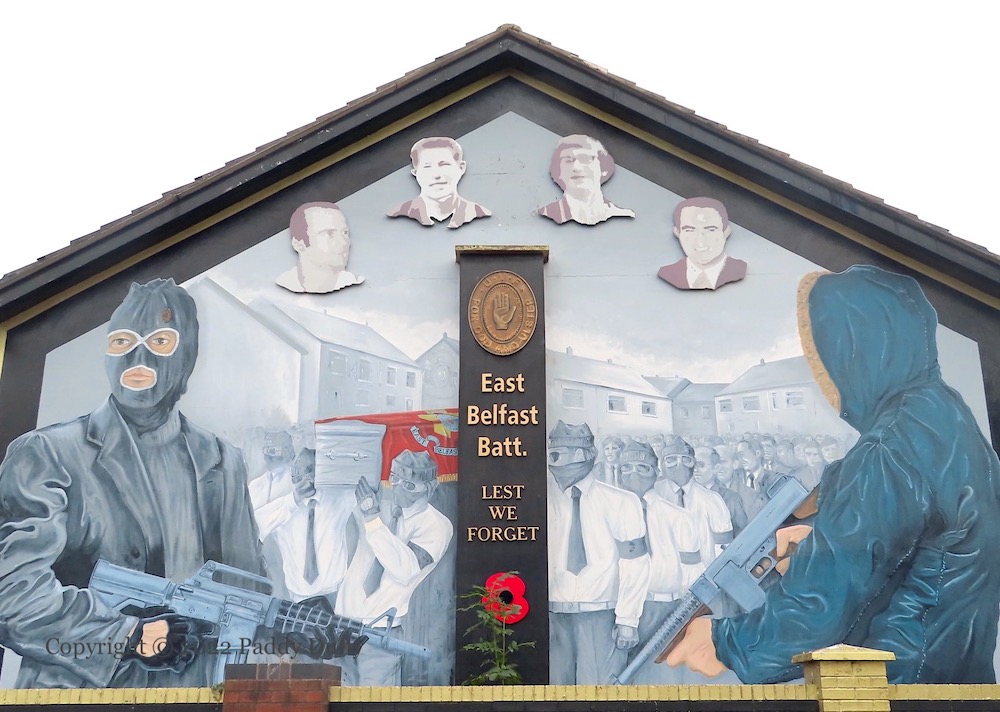
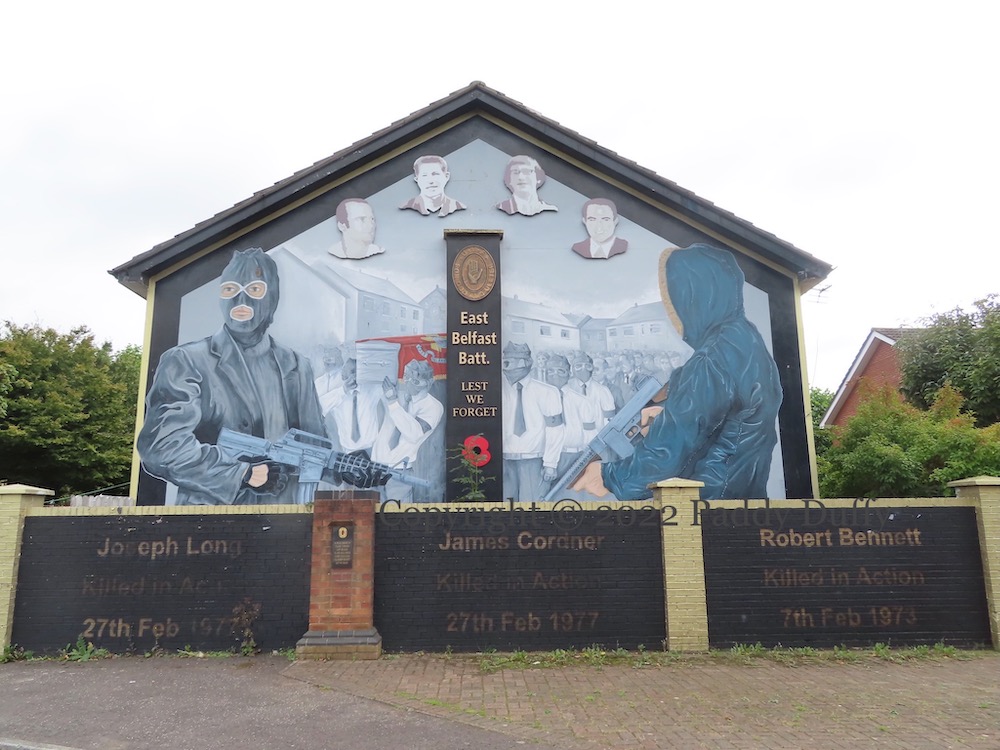
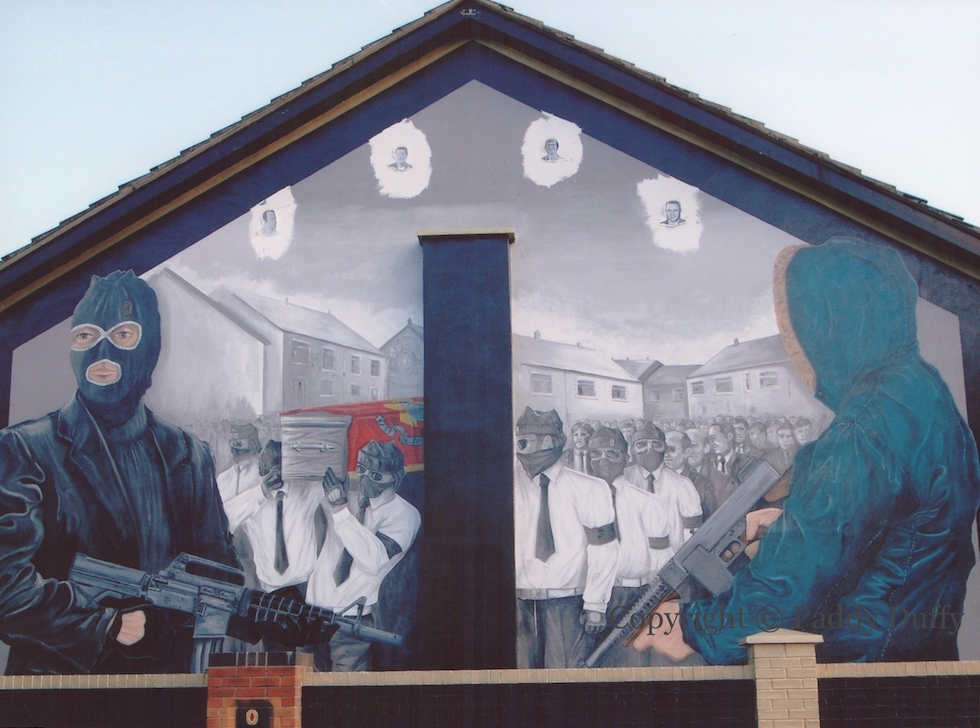
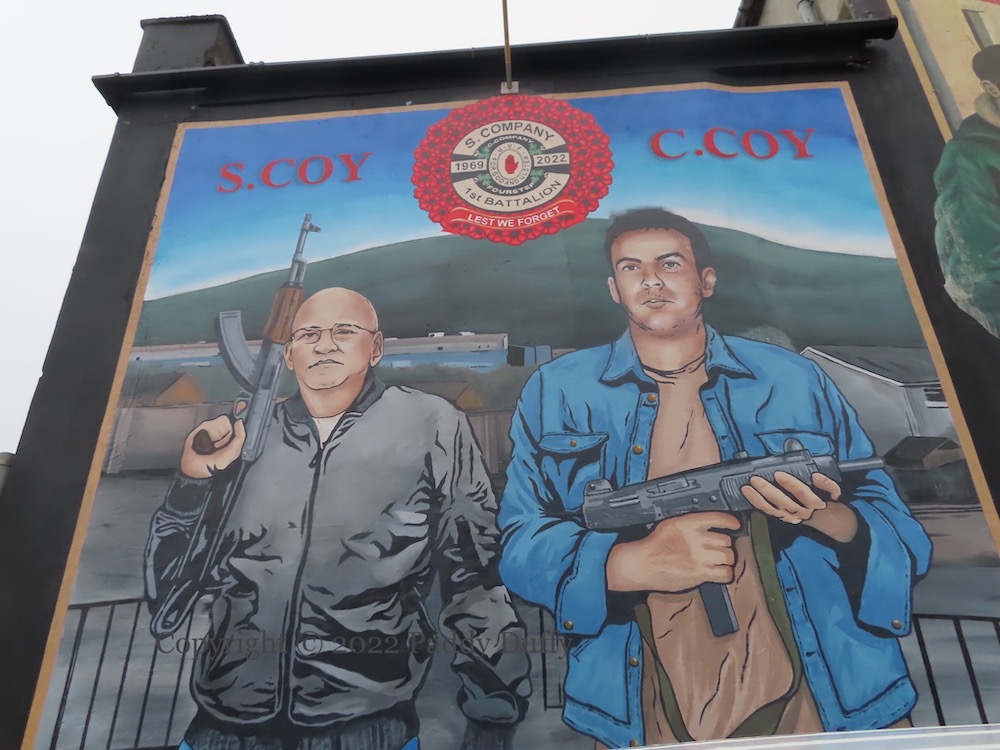
Four members of the East Belfast UVF are commemorated by a new mural in Fraser Pass, Ballymacarrett. The four named are: Robert Seymour, shot dead by the PIRA in 1988; James Cordner and Joseph Long, who were killed in a premature explosion in 1977; Robert Bennett, killed by the British Army during a riot in 1973.
In a previous version of the mural, Seymour and Long were featured alongside Crawford and Craig (of the Home Rule era) – see God, Give Us Men! (which also includes a close-up of the small plaque embedded in the front wall).
These same four are commemorated in the controversial 2013 mural featured in Years Of Sacrifice.
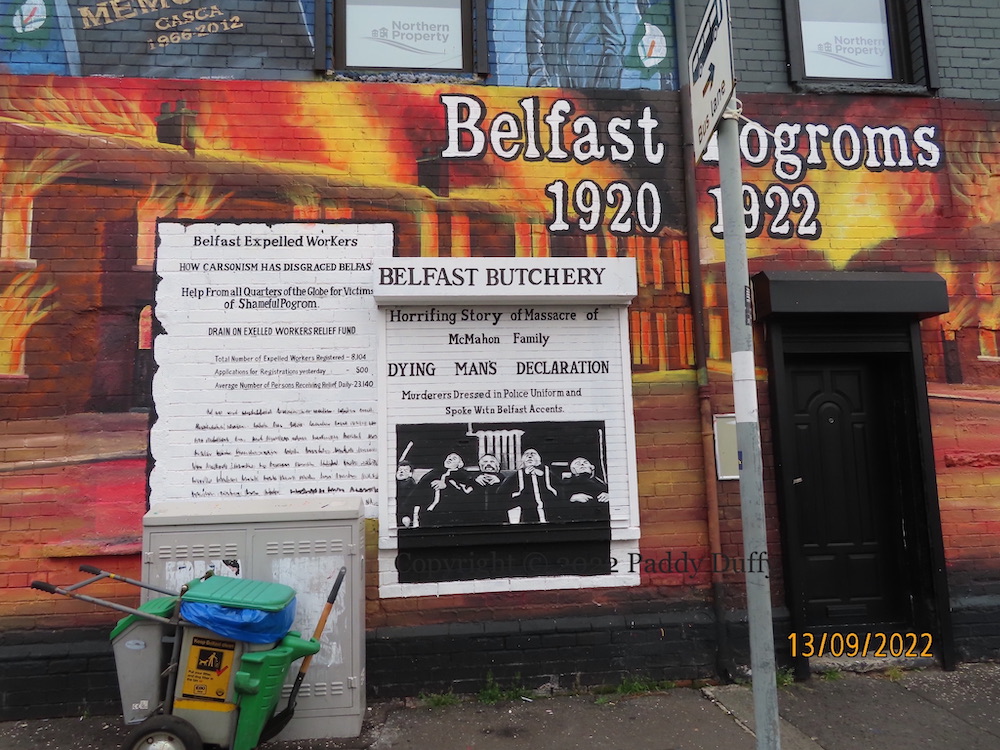
“Belfast Pogroms 1920-1922.” Against the backdrop of the first Dáıl, the War Of Independence, and the debate in Westminster over the fourth Home Rule bill (it would be passed in November 1920), northern Protestants began to assert their de facto independence from the rest of Ireland – both in economic and in military terms.
On July 12th, 1920, Edward Carson spoke to a crowd in Derry and, addressing the government in Westminster, said “if you are yourself unable to protect us from the machinations of Sınn Féın, and you won’t take our help; well, then, we tell you we will take the matter into our own hands.” (Treason Felony). Nine days later, the “clearings” of Catholics from Belfast shipyards and mills began, with about 5,700 Catholics and 1,850 socialists (“rotten Prods“) being expelled from Workman Clark and Harland & Wolff yards, and in total 10,000 workers from yards and mills over the next two weeks (History Ireland). In combination with the straitened economic circumstances of the time (post WWI) thousands (23,140 according to this mural, which reproduces a flyer derived from the Irish News of October 6th, 1920 – via The Irish Story’s account of the start of the “Belfast Pogrom”) were on relief.
Militarily, in October, 1920, the Ulster Special Constabulary was established (drawing on members of the Ulster Volunteers, which had been reconstituted in June 1920, and the 21,000 members of the Ulster Imperial Guards (WP)) as an alternative to the Royal Irish Constabulary in fighting actions by the IRA in Belfast, Derry, and elsewhere in the north. On March 23rd, 1922, two officers of the Specials were killed in Belfast city centre by the IRA. In reprisal, two Catholic civilians were killed in the Short Strand, and in the early hours of March 24th, a party of five men, four dressed in RIC uniforms, burst into the home of Catholic businessman Owen McMahon and shot McMahon, his six sons, and one of his employees – only two of the sons survived. District Inspector John Nixon of the RIC was suspected of leading the attack on the McMahon household – see The RIC Murder Gang and Pat And Dan Duffin. (The headlines are from the Freeman’s Journal of March 25th, 1922 – see Joe Baker’s 80-page account of the murders of summer 1922; the photograph of the McMahon corpses that is reproduced in the mural can be seen at Slugger.)
This is the first half a new mural in Ascaıll Ard Na bhFeá; the “1922” part can be seen in Executed.
“Belfast Expelled Workers – How Carsonism has disgraced Belfast – Help from all quarters of the globe for victims of sh[a]meful pogrom – Drain on Ex[p]elled Workers[‘] Relief Fund. Total number of expelled workers registered – 8,104; Applications for registrations yesterday – 500; Average number of persons receiving relief daily – 23,140.”
“Belfast Butchery – Horrif[y]ing story of massacre of McMahon family – Dying man[‘]s declaration – Murderers dressed in police uniform and spoke with Belfast accents.”
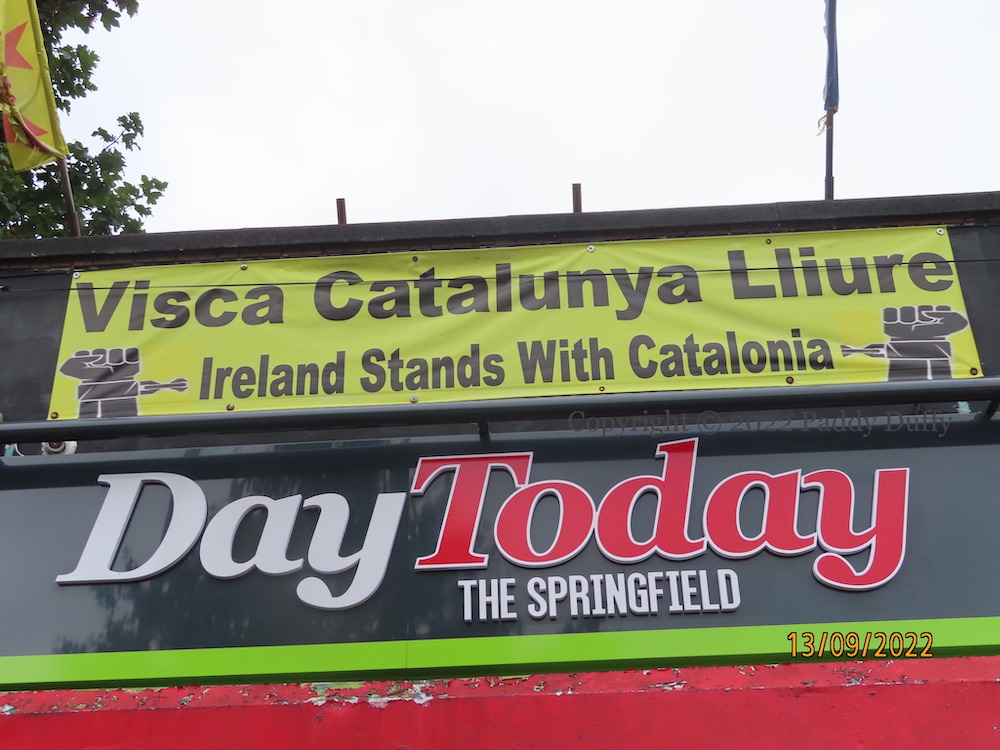
Visca Catalunya Lliure – Ireland stands with Catalonia” – tarp above the newsagents at the junction of Springfield Drive and Springfield Road, west Belfast.
Hooded gunmen from the UDA/UFF/UYM take aim at children going to Woodlawn primary school. There are a few emblems and a quote on the side-walls to the right (out of frame), including the phrase “They rose in dark and evil days to free our native land” which comes from the song ‘The Memory Of The Dead‘, about the 1798 Rebellion, rather than the creation of the UDA in 1971.
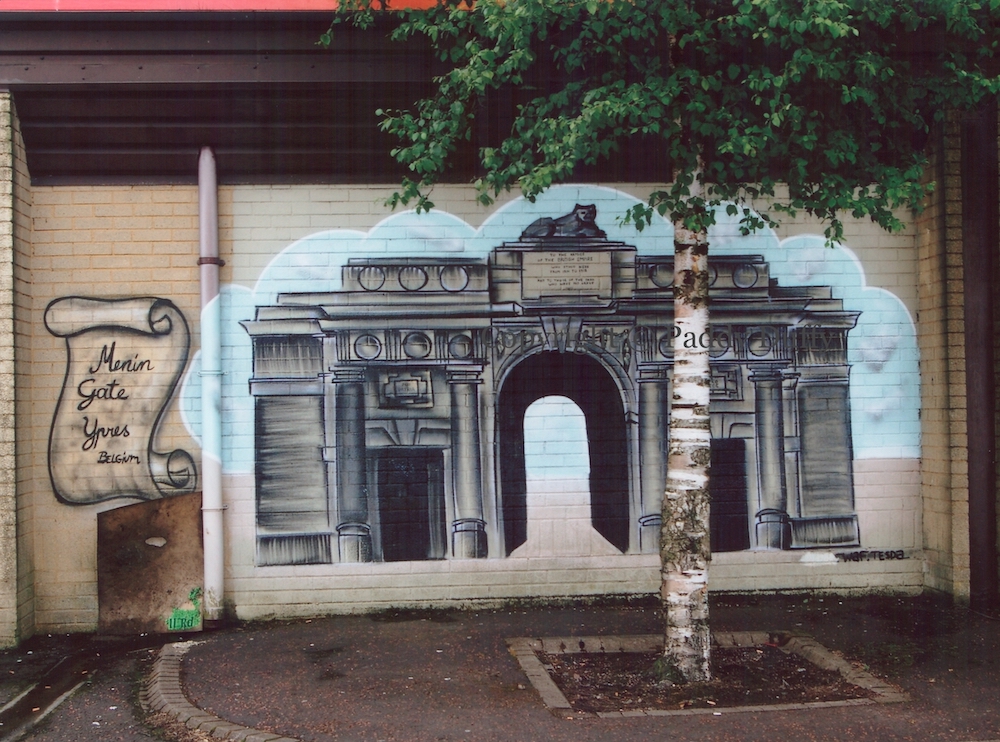
Above: “Menin Gate, Ypres, Belgium.” “To the armies of the British empire who stood here from 1914 to 1918 and to those of the dead who have no grave.” “Pro patria, pro rege.” Almost 55,000 names are inscribed on the memorial.
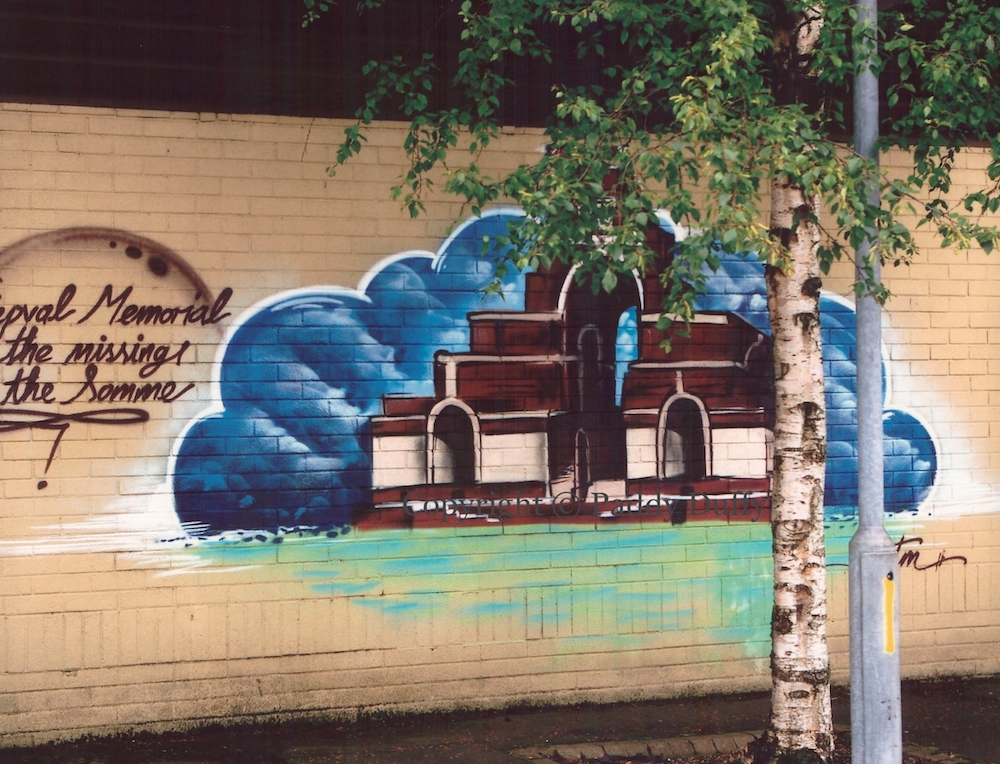
Below: “Thiepval Memorial – to the missing of the Somme”. The names of over 72,000 dead are inscribed on the memorial (WP | travelfranceonline).
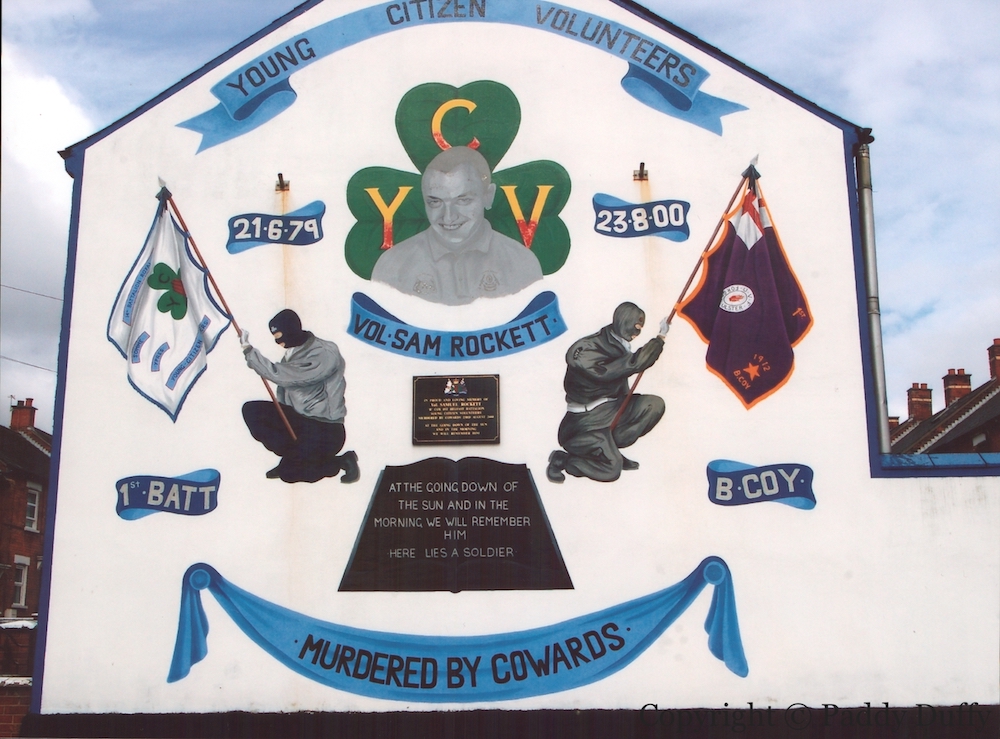
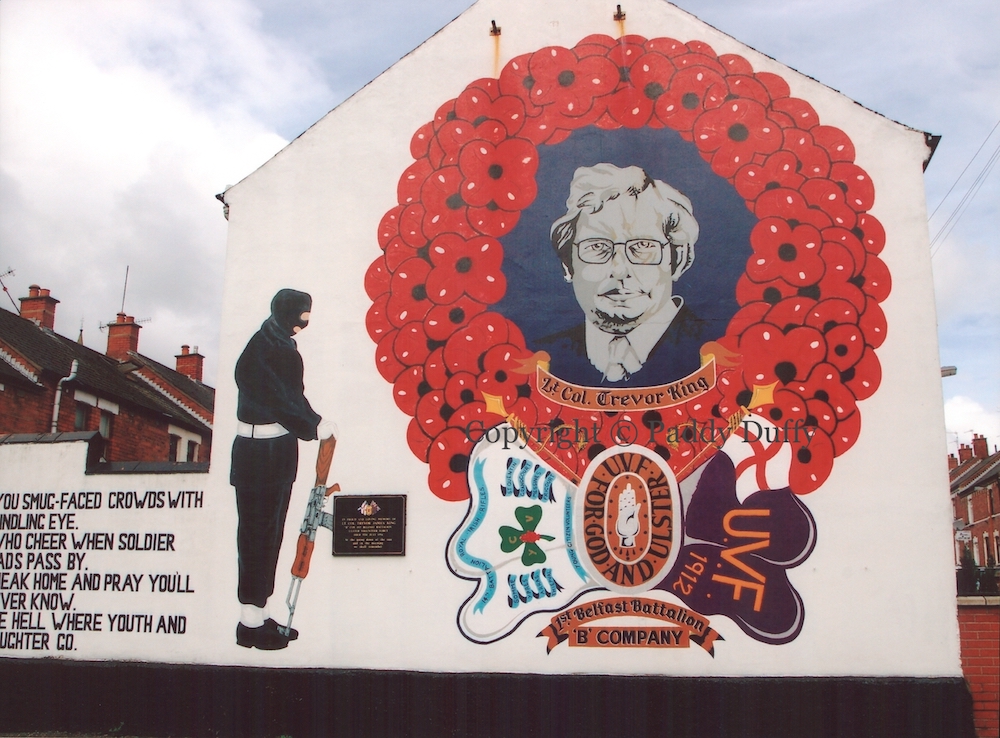
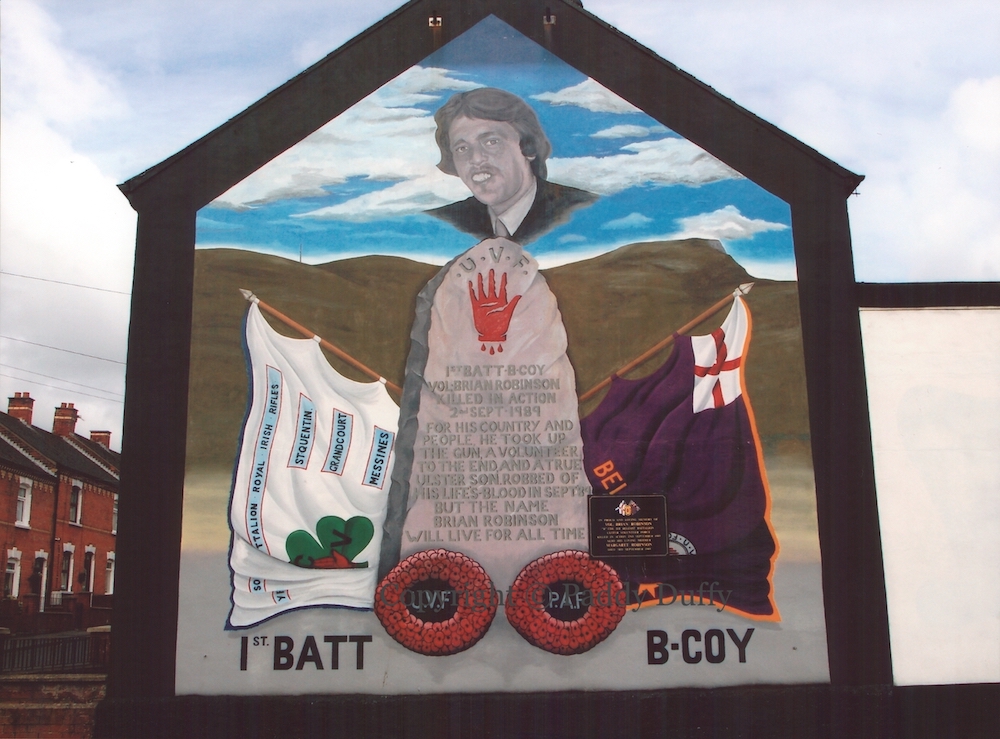
There are three murals (each with a plaque) to UVF volunteers from 1st battalion, B company, on three consecutive gables in Disraeli Street, presented here from south to north (i.e. heading towards Ohio Street).
First: “In proud and loving memory of Vol. Samuel Rockett, ‘B’ Coy 1st Belfast battalion, Young Citizen Volunteers. Murdered by cowards 23rd August 2000. ‘At the going down of the sun and in the morning we will remember them.’ ‘Here lies a soldier’”
The “cowards” in this case are the members of the UDA who killed Rockett (born June 21st, 1979) in front of his girlfriend and 18 month old child in an attack on her house in the lower Oldpark, during the feud between the UVF and UDA, sparked by Johnny Adair’s “loyalist day of culture” and removal of the UVF from the lower Shankill. In response to the purge (and attacks on the Rex bar), the UVF killed Bobby Mahood and Mr Jackie Coulter. Rockett was killed by the UDA in retaliation for their deaths; 1,000 people attended Rockett’s funeral (Irish Times). After Rockett died, the UVF killed David Greer, and the UDA then killed PUP member Bertie Rice in Tiger’s Bay on October 31st.
Second: Lt Col Trevor “Kingso” King served time for his part in the Battle At Springmartin in 1972, in which seven people, including a British soldier, died. In 1994, having been shot by the INLA and paralysed from the neck down, King took the decision to remove his own life-support (WP).
You smug-faced crowds with kindling eye Who cheer when soldier lads pass by Sneak home and pray you’ll never know The hell where youth and laughter go
Third: Brian Robinson was shot by the British Army in 1989 immediately after he had shot and killed a Catholic (Paddy McKenna) walking along Crumlin Road. This is the fifth version of the Brian Robinson mural in Disraeli Street, Belfast.
The plaque reads, “UVF 1st Batt B Coy Vol Brian Robinson killed in action 2nd Sept 1989. For his country and his people he took up the gun, a volunteer to the end and a true Ulster son. Robbed of his life’s blood in Sept ’89 but the name Brian Robinson will live for all time.
The plaque includes “Also his loving mother Margaret Robinson died 3rd September 1989”
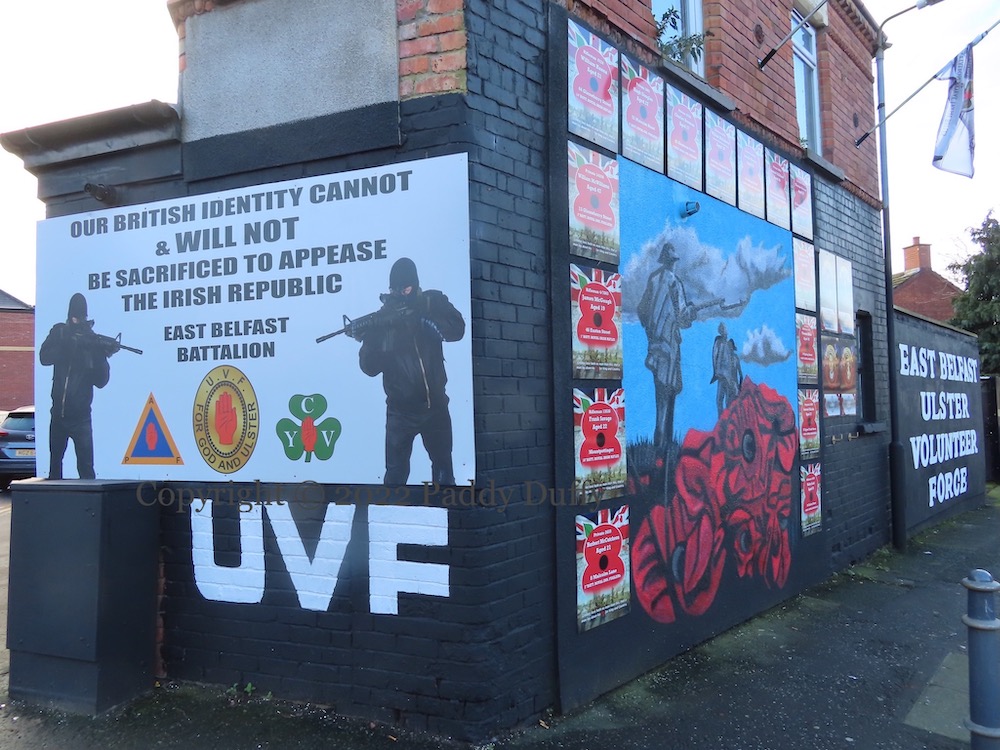
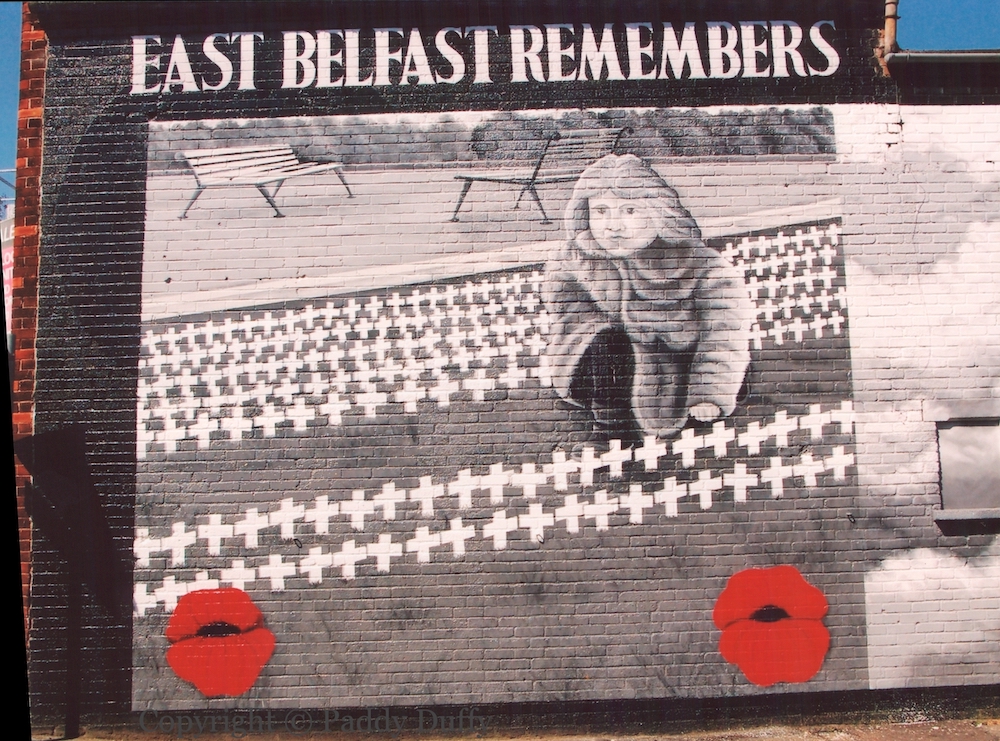
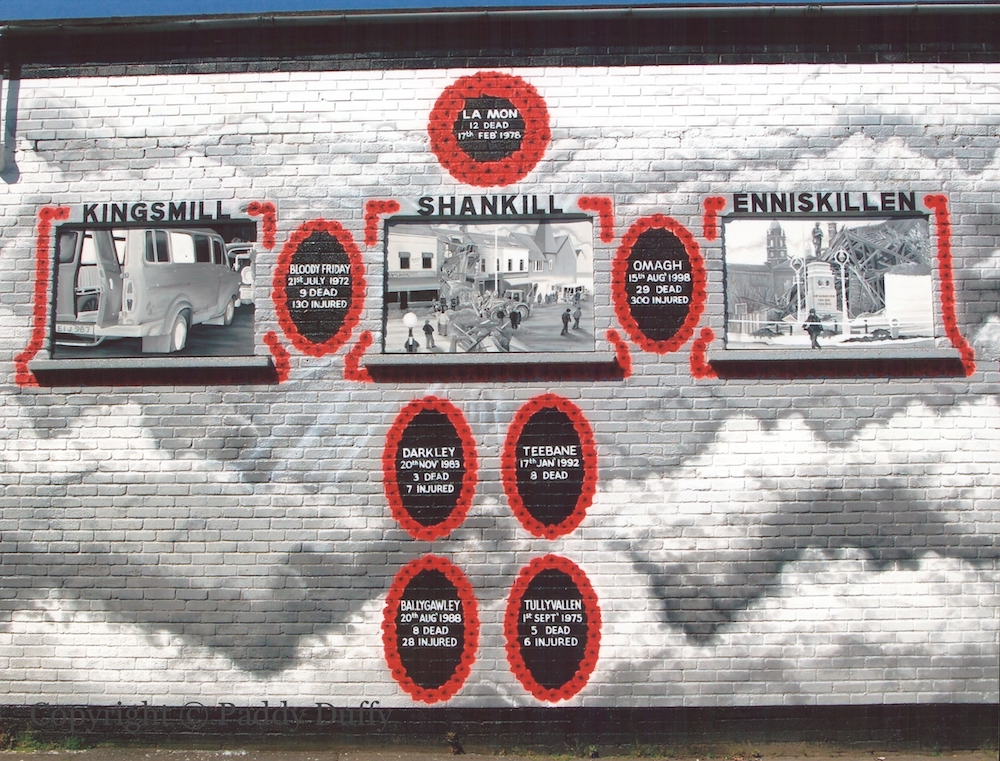
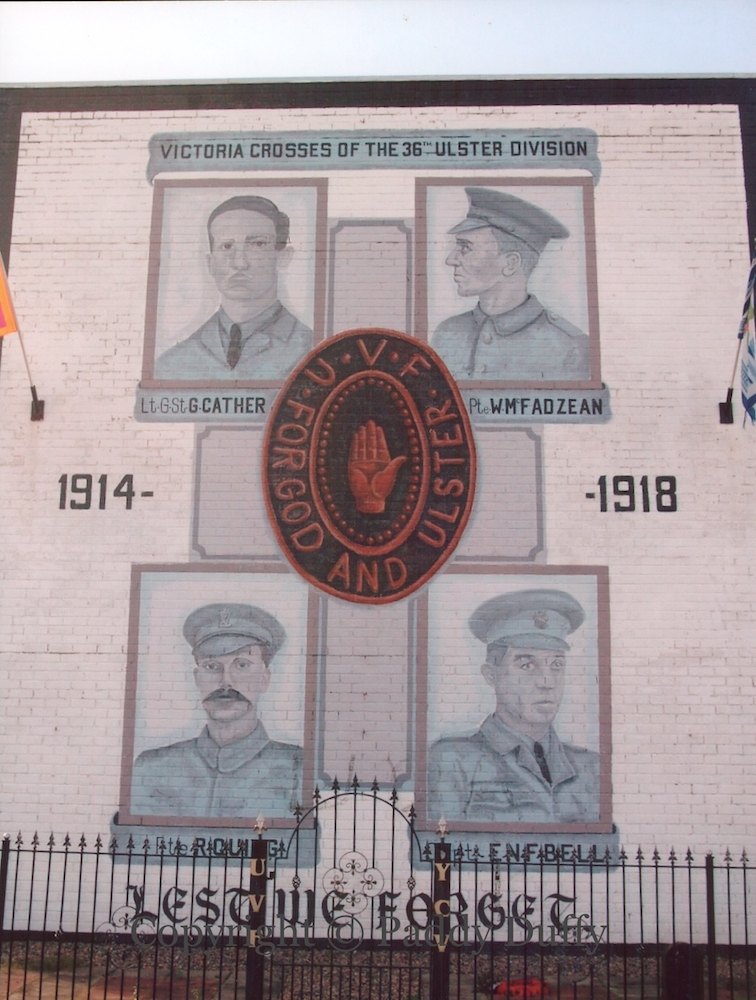
East Belfast remembers both the Great War and the victims of various attacks during the Troubles: in pictures: Kingsmill – Shankill – Enniskillen; in garlands of poppies: La Mon 12 dead 17th Feb 1978, Bloody Friday 21st July 1972 9 dead 130 injured, Omagh 15th Aug 1998 29 dead 300 injured, Darkley 20th Nov 1983 3 dead 7 injured, Teebane 17th Jan 1992 8 dead, Ballygawley 20th Aug 1988 8 dead 28 injured, Tullyvallen 1st Sept 1975 5 dead 6 injured.
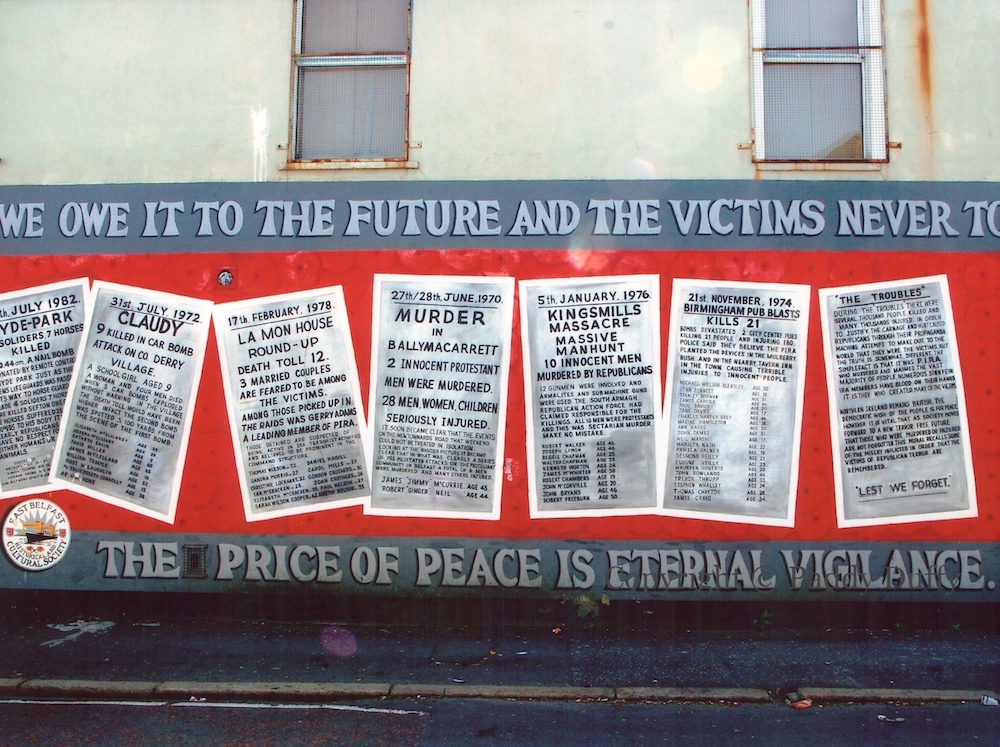
On the facing wall is a similar mural about deaths during the Troubles: “”The Troubles” – During the “Troubles” there were several thousand people killed and many thousands injured. In order to justify the carnage and hurt caused republicans through their propaganda machine attempt to make out to the world that they were the victims, but the truth is somewhat different. The simple fact is that it was PIRA who murdered and maimed the vast majority of people[.] [N]umerous Sinn Fein-IRA members have blood on their hands[.] It is they who created many of the victims. Northern Ireland remains British. The democratic wish of the people is for peace. However[,] it is vital that as society moves forward to a new terror[-]free future that those who were murdered or injured are not forgotten. This mural recalls some of the misery inflicted[,] in order that the victims of republican terror are not forgotten. “Lest we forget.”” “We owe it to the future and the victims never to forget the past – the price of peace is eternal vigilence.”
Individual panels recount the deaths at Hyde Park, Claudy, La Mon House, Ballymacarrett, Kingsmills [Kingsmill], and Birmingham.
Sponsored by the East Belfast Historical And Cultural Society – see Visual History 10.
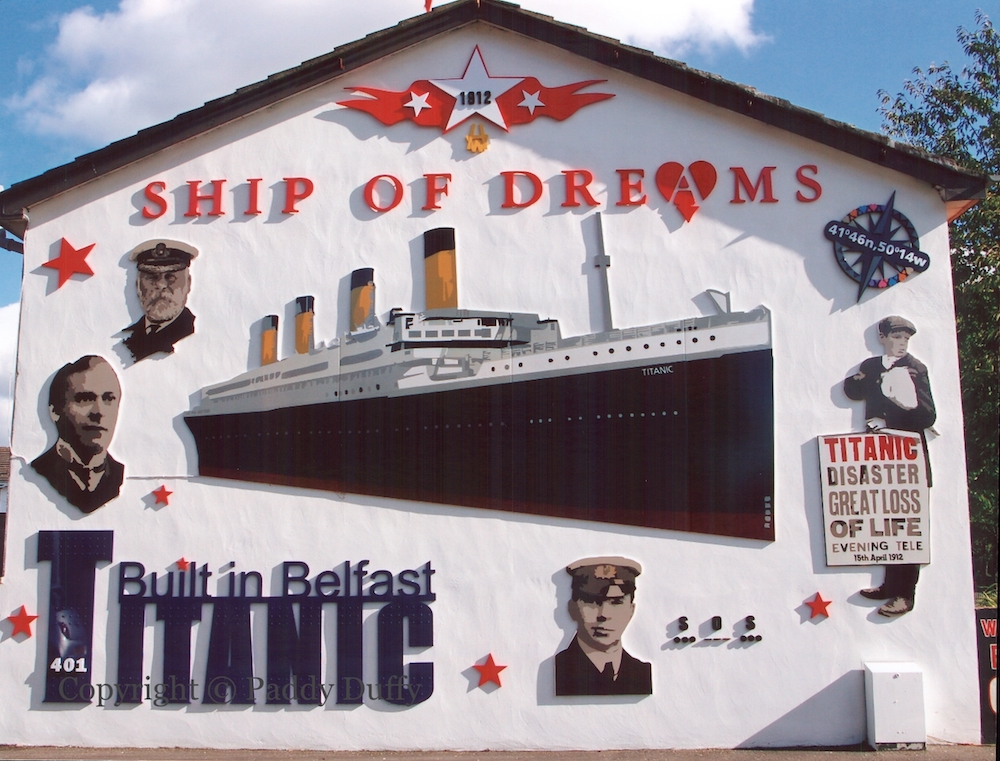
“Built in Belfast.” The White Star Line ship Titanic sank in the Atlantic in the early morning of April 15th, 1912, a thousand miles from New York (the co-ordinates are given in the top right), having been launched from Belfast’s Harland & Wolff shipyard, which is near this mural in east Belfast.
The portraits are of Captain Edward Smith, architect Thomas Andrews, Jack Phillips (wireless officer), and paperboy Ned Parfett.






 Paddy Duffy Collection