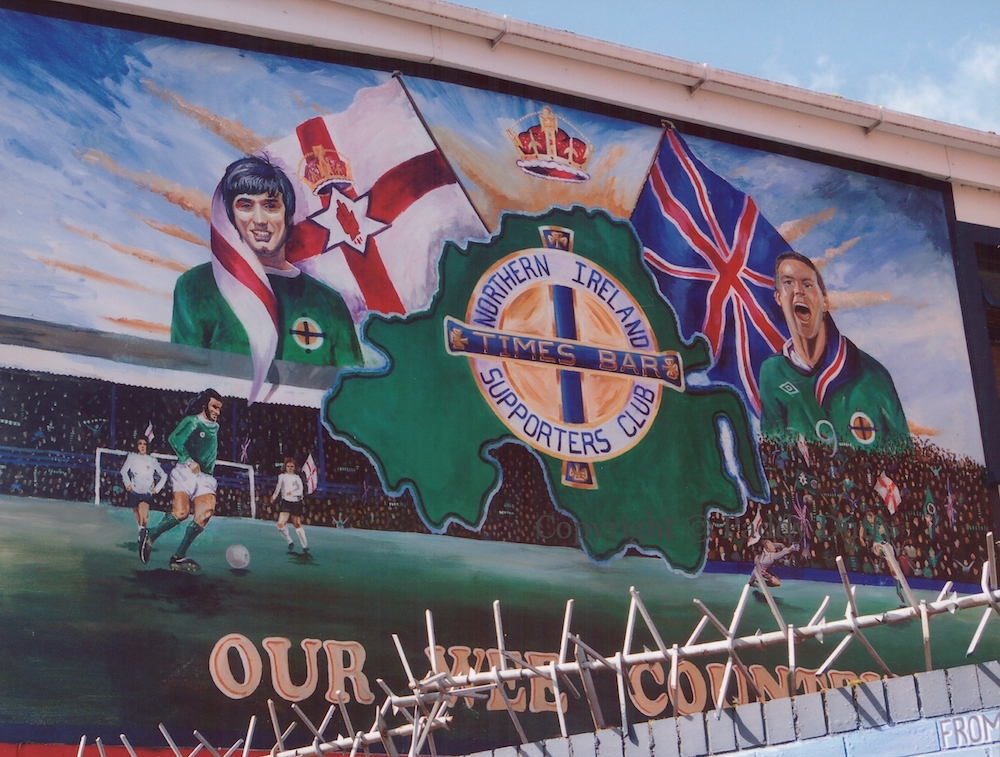
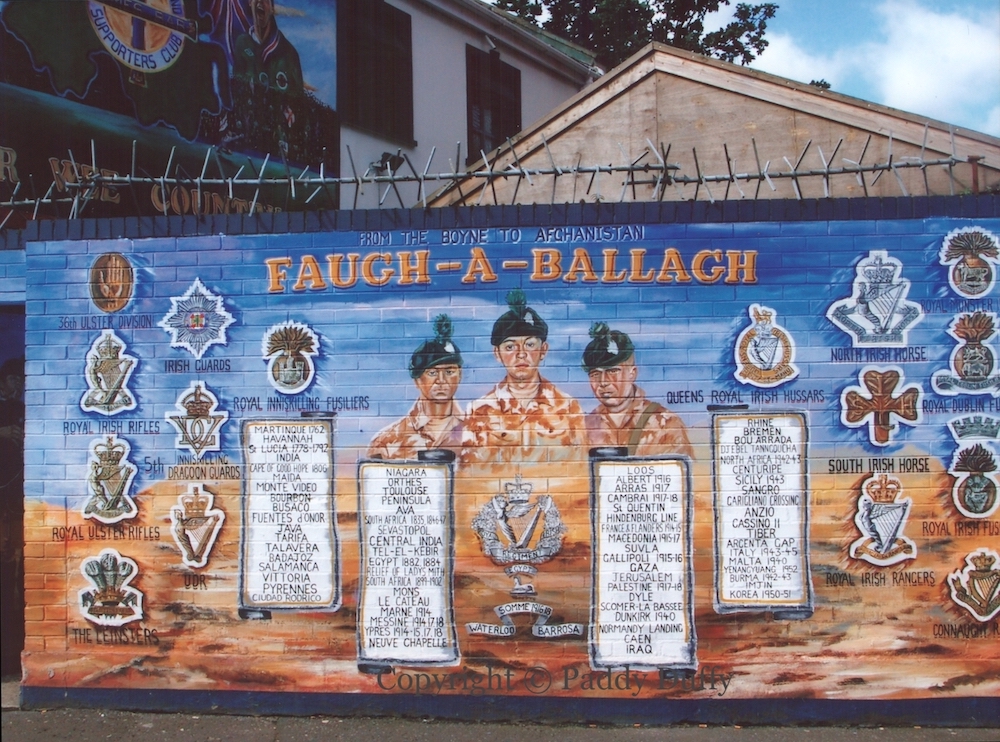
Here are two murals from the Times Bar in York Road, north Belfast.
First (above), a mural celebrating the Northern Ireland football team with the slogan “our wee country”. George Best is on the left and David Healy on the right.
Second, under the title “Faugh-A-Ballagh”, the motto of the Royal Irish Fusiliers (and more recently of the Royal Irish Regiment), a mural commemorating Irish and Northern Irish service in the British military. Robert Blair “Paddy” Mayne is featured on the left (WP). A plaque in the middle reads: In memory of Pte. F.G. Dolloghan, Parachute Regt. Killed at the Nijmegan Bridges, Holland, Sept. 1944. (WWII’s Operation Market Garden (WP))
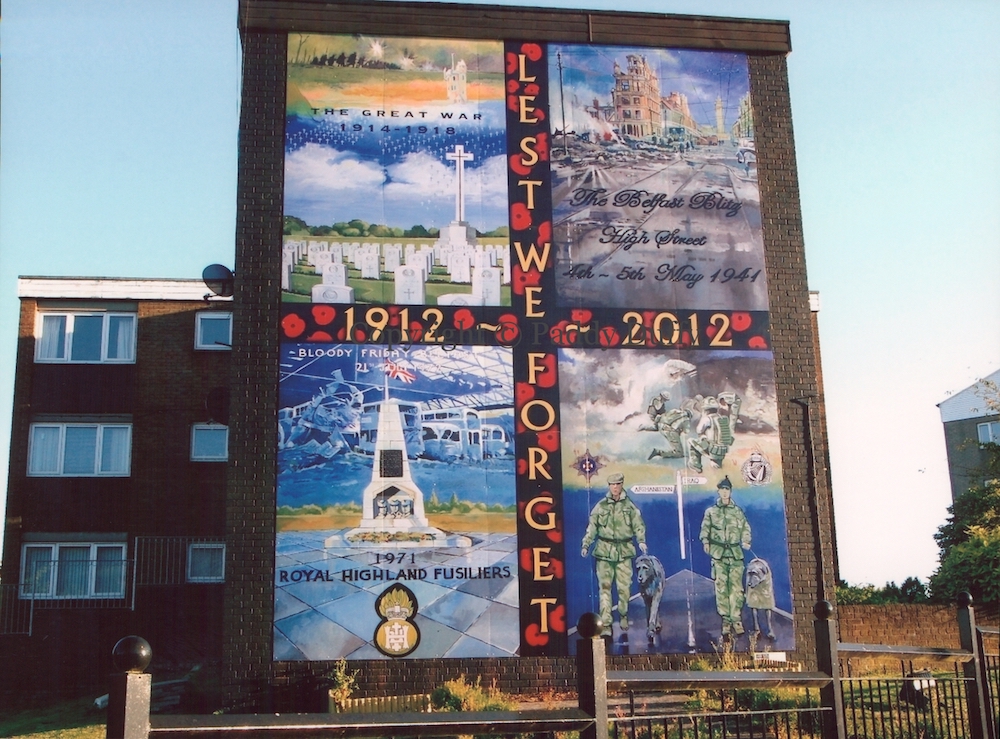
The three-storey mural above is in Ballysillan and replaced a UVF mural when it was added in 2011. The mural is the work of Jim Russell while artist-in-residence at Arts For All. The information below was provided by Arts For All.
The Great War: The first panel commemorates the Great War that ravaged Europe from 1914 to 1918 and shows troops advancing into battle, the Ulster Tower at Thiepval commemorating the sacrifice at the Somme and an image showing one of the war cemeteries and highlighting the true cost of war.
Second World War: The second panel features some of the devastation visited upon Belfast during a series of Luftwaffe raids during the early years of the Second World War. Belfast suffered greatly with over 1,000 people dying in four nights of bombing in April and May of 1941.
The Troubles: In the third panel highlight the dark history known as the Troubles. It features two events from the years of that time – the murder of the three young off-duty Scottish soldiers in 1971 [the monument depicted was featured in The Highland] and the Bloody Friday bombings of July 1972. In the midst of the horror that accompanied the early years of the Troubles these events still caused many to struggle to understand how people could carry out such atrocities.
Present Day Conflict: Panel four brings us up to the present day. Military service is a tradition for many in Northern Ireland and for many their first overseas trip came on the back of an overseas posting whilst serving in one of the Armed Forces. From times past, through the World Wars, the Korean War, to more recent conflicts in Iraq and Afghanistan soldiers and regiments drawn from Norther Ireland continue to play a role.
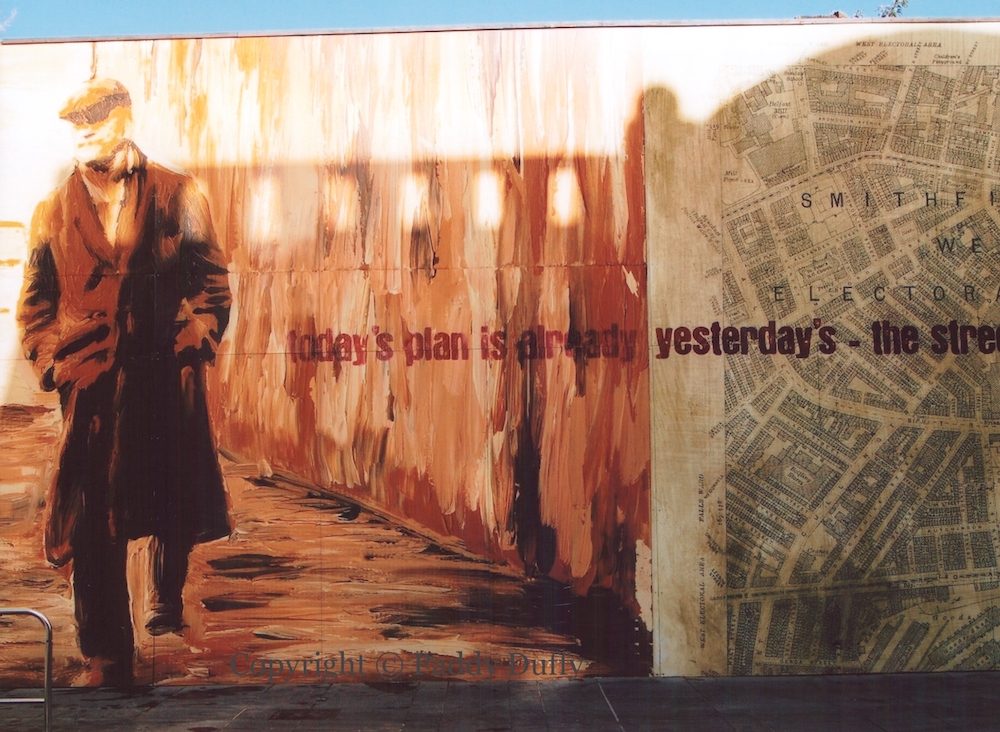
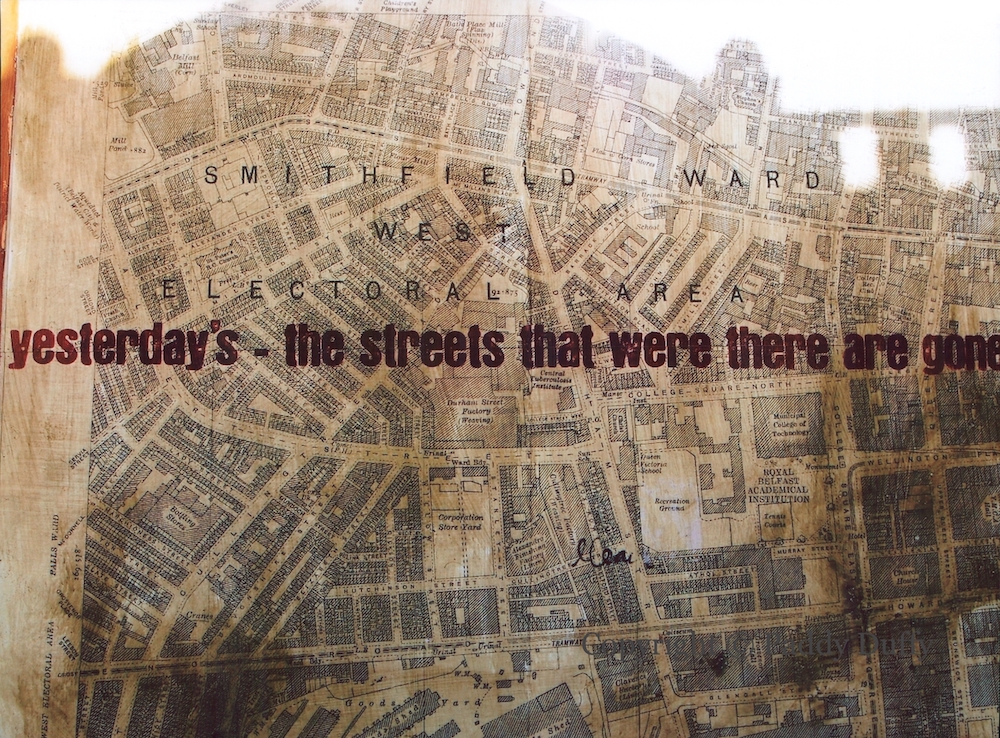
“Today’s plan is already yesterday’s – the streets that were there are gone”. Euphemistic nonsense on a giant hoarding on Castle Street in the city centre, fronting a building site. In keeping with the theme of easy erasure of the past, the words “love joy peace” have been removed from the original 1955 photograph (Belfast Live).
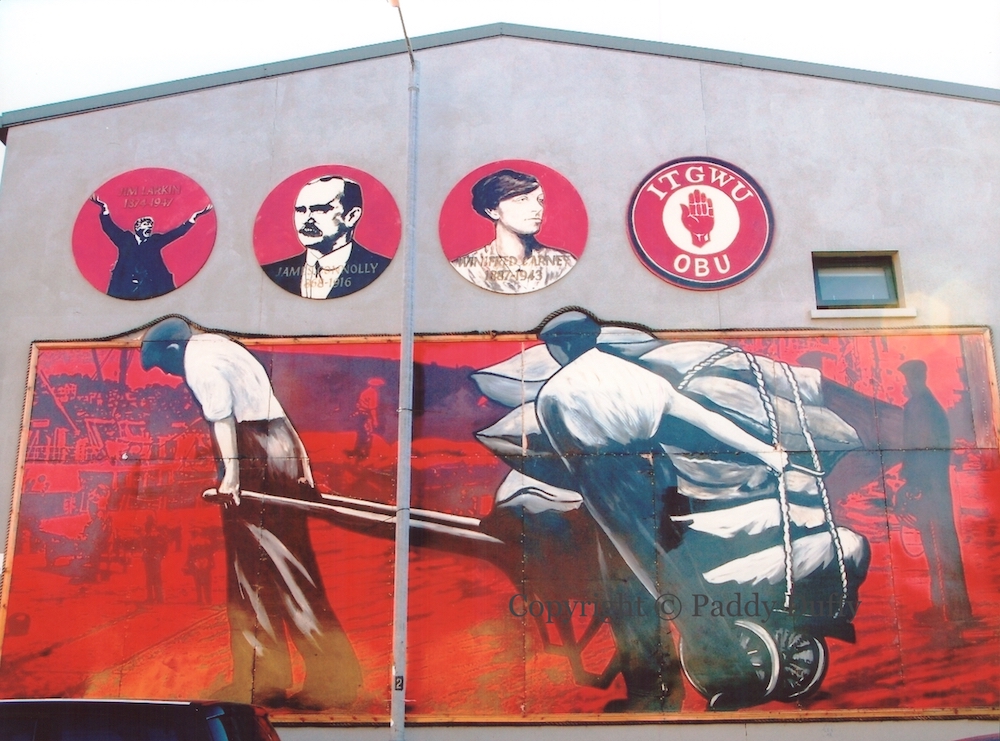
“Remembered with pride and affection our friends and fellow-dockers who were killed at work or suffered pain and premature death from unsafe and unhealthy working conditions in the port of Belfast. ‘On a ship’s dark deck a man is dead/wives, sisters, brothers, parents, shake heads and cry/as they knew not who to blame./An injustice has arrived/pain and anguish begins.’ Memories are everlasting. Ar dheıs Dé go raıbh siad. Erected by the Dockers Club and SHIP [Shared Heritage Interpretive Project] on International Workers Day, April 2007.” The plaque is on an exterior wall of the Dockers Club, adjacent to the mural. Above are portraits of Jim Larkin, James Connolly, Winifred Carney, with the emblem of the IGWU/OBU [One Big Union]. Larkin founded the ITGWU in 1909. It was led by Connolly from 1914 to 1916. Carney, from Bangor, founded the Irish Textile Workers’ Union in Belfast in 1912
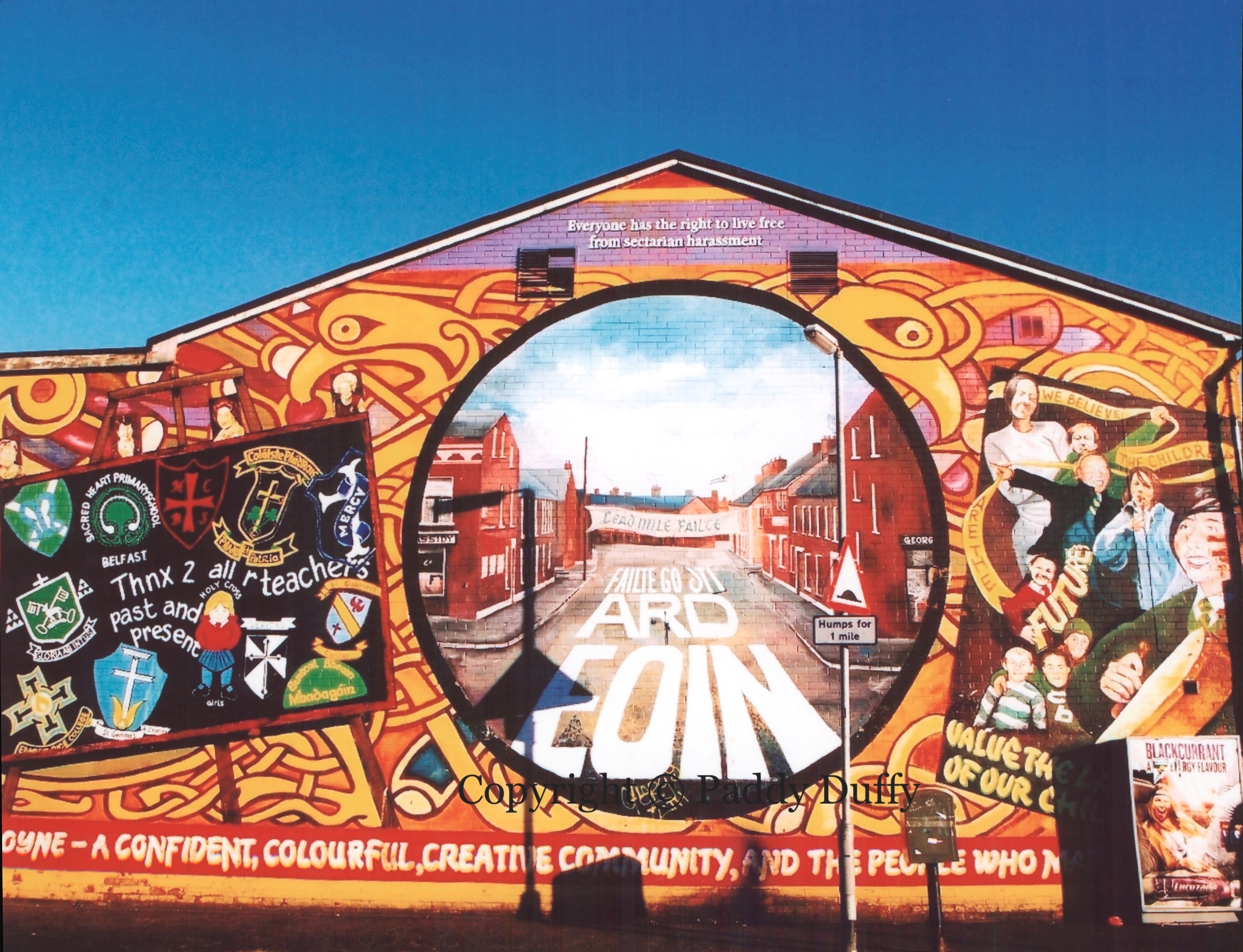
“Fáılte Go Dtí Ard Eoın. Ardoyne – a confident, colourful, creative community, and the people who made it so” particularly the local schools, whose insignia are shown on the left: “Thnx 2 all r teachers past and present.”
The previous mural in this spot (M01783) is invoked by the banner across the top: “Everyone has the right to live free from sectarian harassment” and the inclusion of Holy Cross Girls among the schools.
Whitney Houston and Bobby Sands are invoked on the right “We believe the children are the future – value the laughter of our children“.
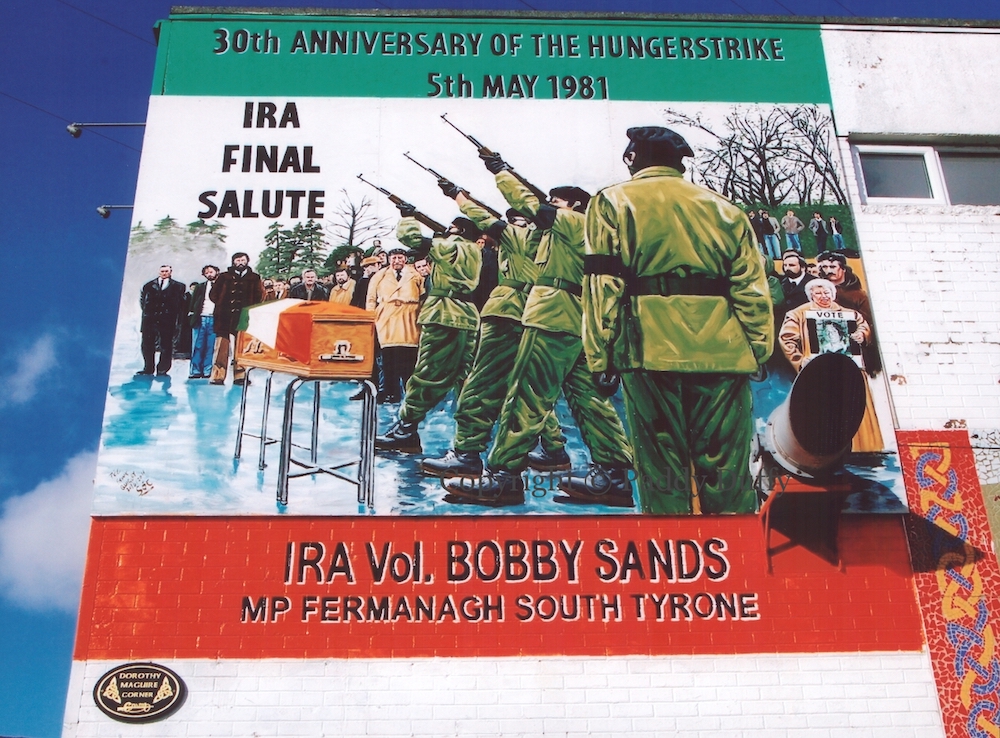
“30th anniversary of the hunger strike. 5th May 1981. IRA final salute. IRA Vol. Bobby Sands, MP Fermanagh South Tyrone.” Gerry Adams watches on as a funeral volley is fired over Sands’s coffin.
Also new is the plaque naming the wall as “Dorothy Maguire Corner”, after the 19-y-o shot in 1971, a member of Cumann Na mBan.
Painted on the Whiterock Road, west Belfast by Lucas Quigley.
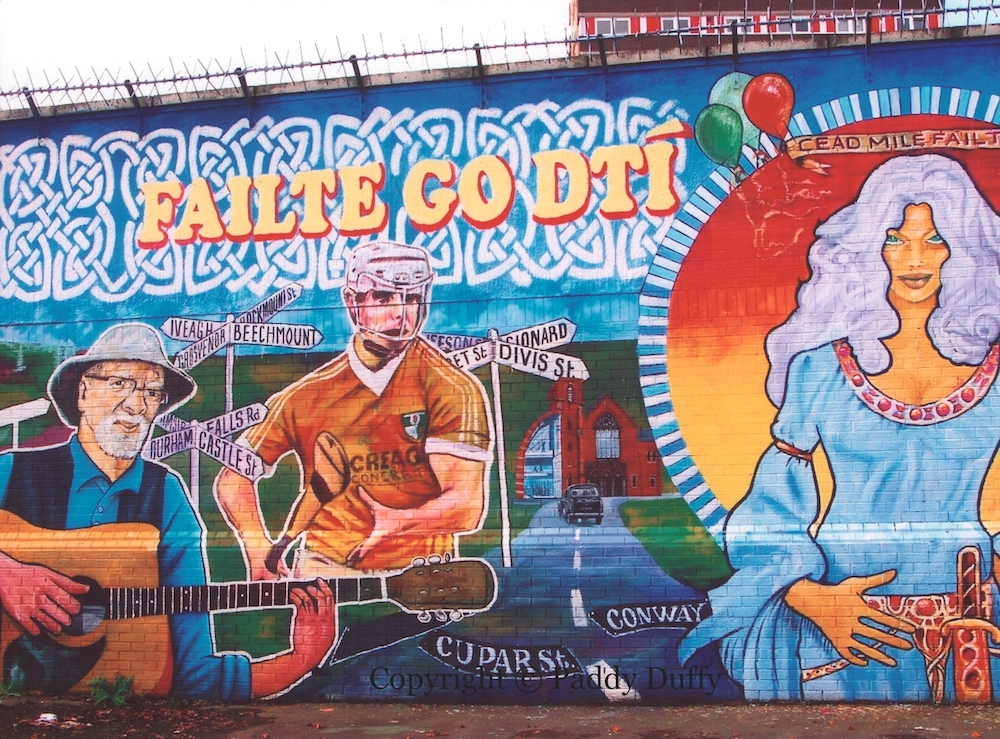
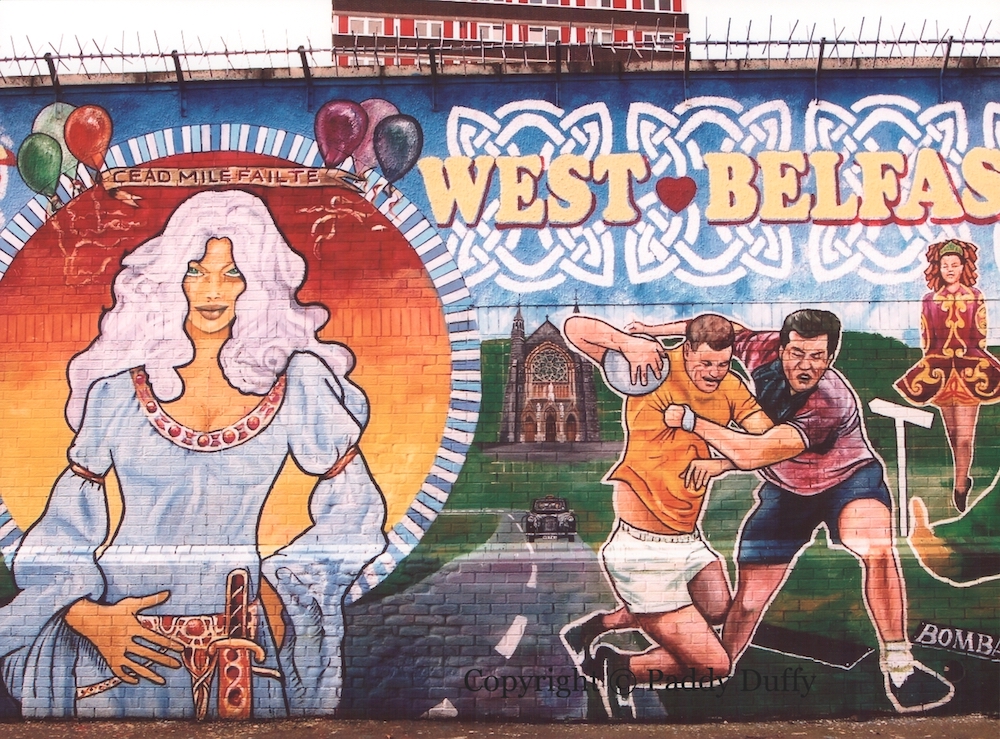
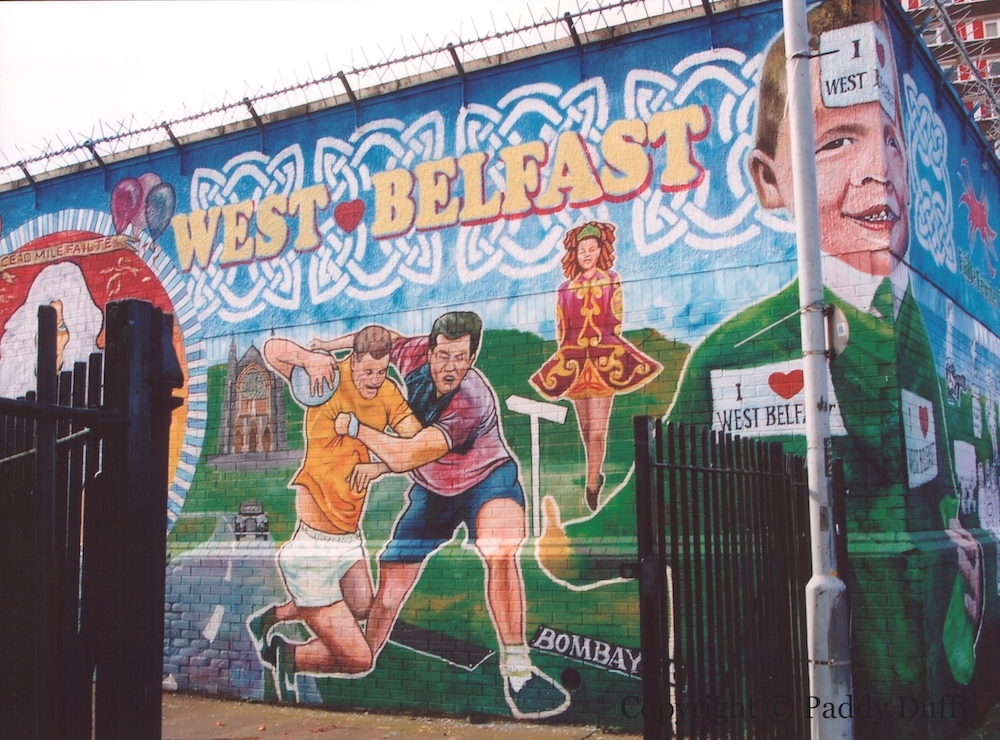
“Welcome to west Belfast”. West Belfast is portrayed as a place of music, sport, and dancing, whose landmark buildings and streets are under the watchful eye (and sword) of the goddess Érıu.
The image of the little boy with the “I [heart] Belfast” stickers and a bag of sweets, standing in the waste ground of Divis flats, is a photograph from the early days of Féıle An Phobaıl/West Belfast Festival.
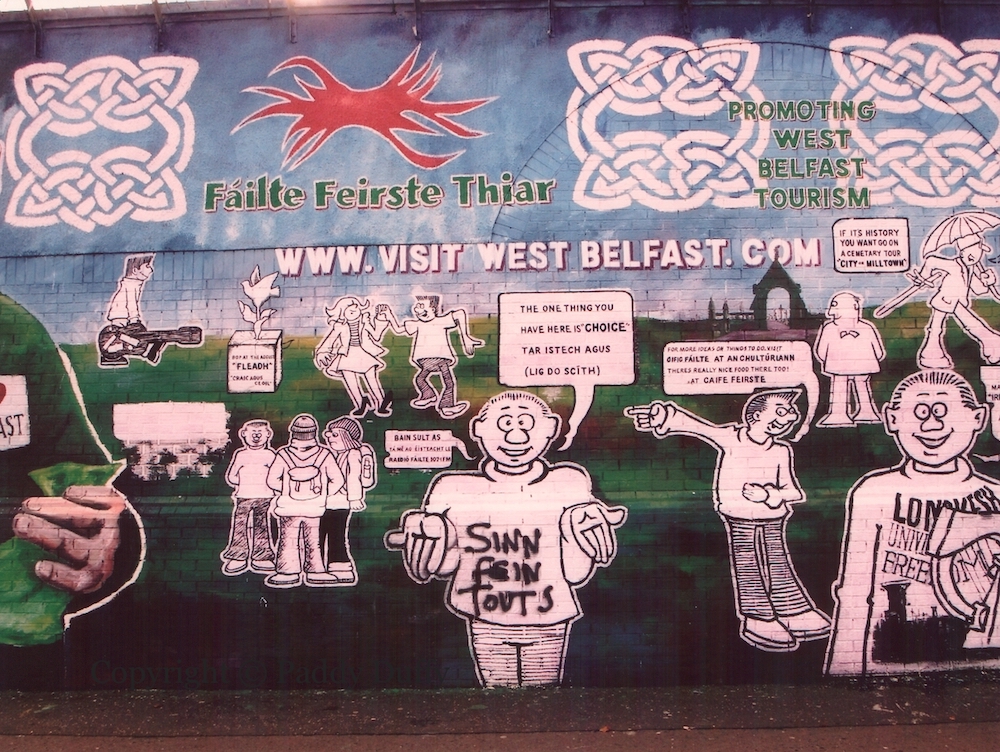
On the Divis Street side, characters in the style of cartoonist Cormac (see e.g. Notes) are “Promoting west Belfast tourism” for “Fáılte Feırste Thıar”, “www.visitwestbelfast.com“. The attractions touted are: “Bop at the August “fleadh”. “Craıc agus ceol” (for Robert Ballagh’s dove coming out of the concrete block, see Féile An Phobail 2008), “The only thing you have here is “choice”. Tar ısteach agus (lıg do scíth)”. “Baın sult as. Tá mé ag éısteacht le Raıdıó Fáilte 107.1 FM”, “For more ideas on things to do, visit Oıfıg Fáılte at An Chultúrlann. There’s really nice food there too! at Caıfe Feırste”, “If it’s history you want go on a cemetery tour “City or Milltown””, “Enjoy a walk on ‘Slıabh Dubh’ (The black … … mountain)”, “Make sure you visit the “Irish republican history museum” at Conway Mill” (with ‘Long Kesh University Of Freedom’ sweater; “Sinn Féin touts” is not a sweater but graffiti.)
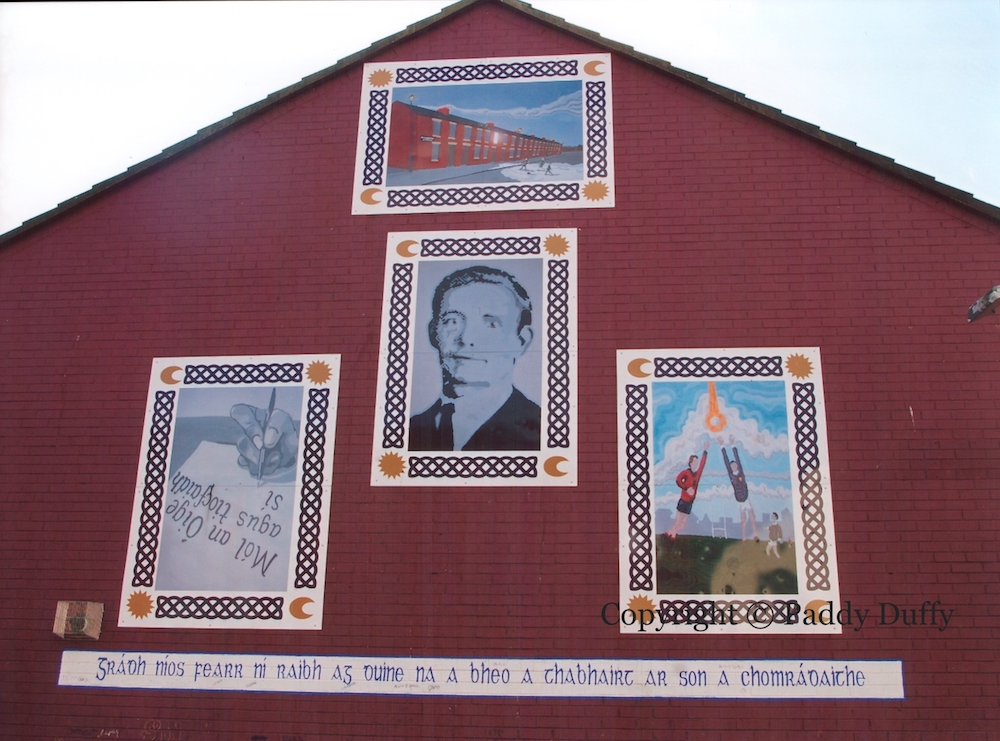
IRA Volunteer Sean Martin is at the centre of these panels in the Short Strand. The image in the apex of the house depicts his death in nearby Anderson Street (which no longer exists; roughly where Arran Street is).
milltowncemetery.com (link now dead) reports that Sean Martin “was killed in April 1940 during a lecture on arms and a Millis hand grenade in a small terrace house in Anderson Street. In the course of the lecture Sean, who was giving the instruction, had dismantled the grenade, and was putting it together again. The detonator which he was using was thought to have been a dud one. In demonstrating how to throw the grenade, he pulled out the pin and released the lever. Hearing the hissing sound of the fuse he realised that the detonator was live and that the grenade was about to explode. He rushed to the window with the intention of throwing it out on to the street, but some children were playing outside. In the few seconds left to him, Sean had to make that terrible choice; shouting to the others to get out of the house – he pulled the grenade into himself with his two hands and leaned over the kitchen table with the grenade covered by his whole body. The device exploded and blew him right across the kitchen, killing him instantly. All the others escaped uninjured.”
The Irish at the bottom reads “Grádh níos fearr ní raıbh ag duıne na a bheo a thabhaırt ar son a chomrádaıthe” – “A greater love no person has than to give his life for his comrades” (John 15:13)
Belfast Forum has some pictures of Anderson Street; according to the accompanying conversation, the Martins (might have) lived at no. 29. Sean Martin’s CLG/GAA club was named after Martin.
“Ceol gan teoraınn” – “unlimited music” or “music without boundaries”. Belfast’s Sean Maguire (also McGuire) (1927-2005) was an All-Ireland fiddle champion and world-wide ambassador for traditional music (WP). The Short Strand artist’s signature can be seen in the bottom corner.
IRA prisoner Kieran Nugent is reputed to have said – upon being imprisoned after the removal of Special Category status in 1976 – “I’m not a criminal – the Brits will have to nail prison clothes to my back.”


 Paddy Duffy Collection