The Ghosts Of The Martyrs

“In proud and loving memory of all local volunteers, prisoners of war, republican activists and the unsung heroes who died of natural causes having served the cause of Irish republicanism [“sean óglach” on the individual plaques]. Together in unity you formed a bond which gave true meaning to the undefeated risen people. Your deeds of bravery and resistance will never be forgotten by the people of greater St. James’s. In your honour the quest for Irish freedom continues.” With the famous “our steps will be onward” quote from Máıre Drumm at an anti-internment rally in Dunville Park on 10th August, 1975 (RN). Coıste Cuımhneacháın Lár Na bhFál/Ard Na bhFeá [Memorial committee of mid-Falls/Beechmount]. For some more of the plaques, see The Unsung Heroes.

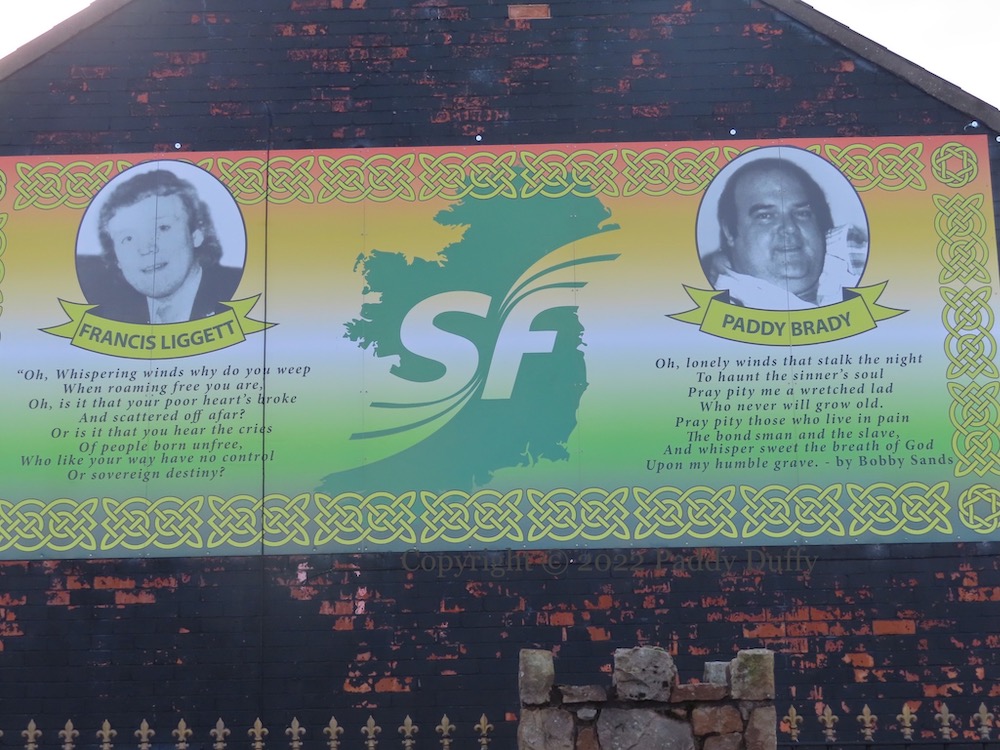
The board on the gable to the side shows Francis Liggett and Paddy Brady. IRA volunteer Francis Liggett was shot dead by the British Army during an attempted armed robbery at Royal Victoria Hospital, Falls Road in 1973 (Sutton) while local Sınn Féın member Paddy Brady was shot by the UFF while at work in 1984 (Sutton | An Phoblacht). They are commemorated in the St James memorial garden with the board shown above, featuring two verses from Bobby Sands’s poem Weeping Winds: Oh, Whispering [Whistling, in the original] winds why do you weep/When roaming free you are,
Oh! Is it that your poor heart’s broke/And scattered off afar?
Or is it that you bear the cries/Of people born unfree,
Who like your way have no control/Or sovereign destiny?
Oh! Lonely winds that stalk [walk] the night/To haunt the sinner’s soul/
Pray pity me a wretched lad/Who never will grow old.
Pray pity those who lie in pain/The bondsman and the slave
And whisper sweet the breath of God/Upon my humble grave.

The board is similar in design to the painted one it replaces, except that Éıre was at the centre rather than the “SF” logo.

Click image to enlarge
Copyright © 2022 Paddy Duffy
T01344 T01345 [T01346] T01347
Remembering The Hunger Strikers

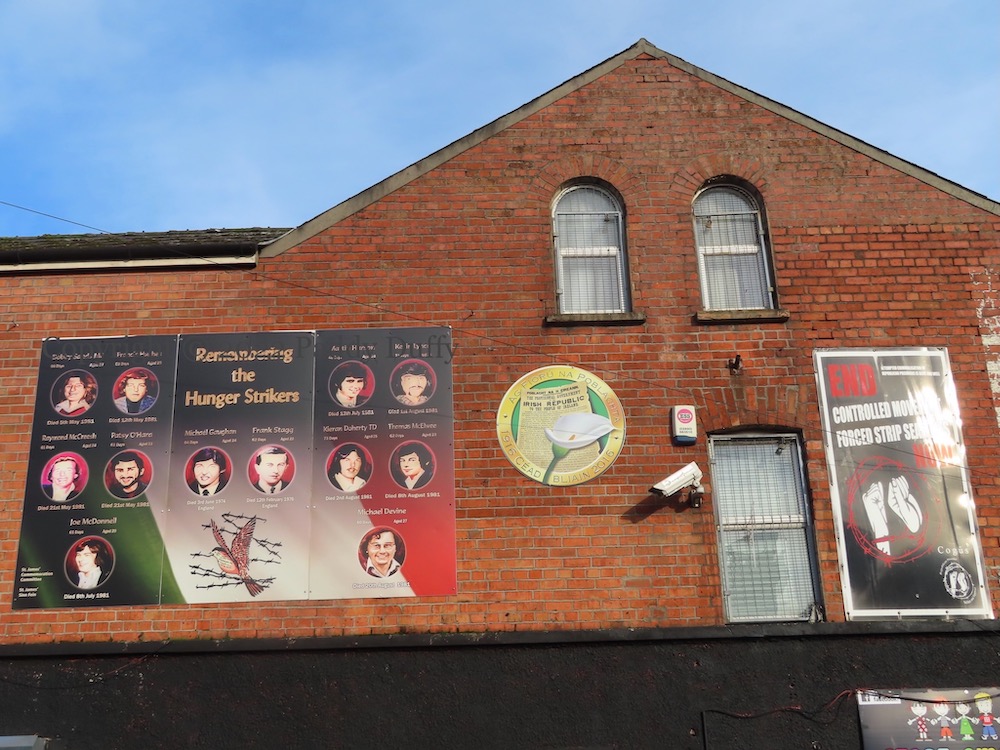
The six weeks from July 8th to August 20th 1981 saw the death of six hunger strikers – McDonnell, Hurson, Lynch, Doherty, McElwee, and Devine – adding to the four who began in March and died in May. All ten, along with Michael Gaughan and Frank Stagg from 1974 and 1976, are remembered in this recent board in Rockmore Road.

To the left is a 1916 centenary board “Ag fíorú na poblachta”/“Realising the republic” – also seen in South Link and in Rockmount Street.

On the far left is a board from Republican Network For Unity (RNU)’s Cogús committee in support of “Attempted criminalisation of republican prisoners is alive and well”, “Republican prisoner welfare and support”: “End controlled movement, forced strip searches. now.”

Click image to enlarge
Copyright © 2022 Paddy Duffy
T01340 [T01338] [T01339]

Mothers, Sisters, Daughters

Érıu/Éıre of the Tuatha Dé Danann, queen of Ireland, (as depicted by Richard J King) is at the centre of various representations of republican women. Along the top are Ann Devlin, Betsy Gray, Mary Ann McCracken, Countess Markievicz, Nora Connolly?, and Winifred Carney. Suffragettes, the modern IRA, and Cumman Na mBan are depicted, as are Máıre Drumm at the Falls Curfew, Tom McElwee’s sisters carrying his coffin, and Molly Childers and Mary Spring Rice running guns on the Asgard. There is also an unusual ‘four provinces’ in the corners.

The wide shot (below) shows the James Connolly mural below and the 1916 centenary board above – also seen in South Link: Ag fíorú na poblachta/“Realising the republic”.

Rockmount Street, west Belfast.

Click image to enlarge
Copyright © 2022 Paddy Duffy
T01336 T01337 [T01335]

Free The Craigavon 2

The “Craigavon 2” are Brendan McConville and John-Paul Wootton; they were convicted of the 2009 murder of PSNI constable Stephen Carroll. The “set up by MI5” and/or “appeals sabotaged” on the RNU board shown above is a reference to the claim that MI5 agent Dennis McFadden had infiltrated the campaign for justice for Brendan McConville (Irish News).

Springfield Road, west Belfast

Click image to enlarge
Copyright © 2022 Paddy Duffy
T01330

Ulster Welcomes Her King & Queen

… to the state opening of the first parliament of Northern Ireland – with new prime minister James Craig – at Belfast City Hall on June 22nd, 1921. The monarchs in question are King George V and Queen Mary. Pathé has video of the royal arrival and travel to City Hall. In his speech, George appealed “to all Irishmen to pause, to stretch out the hand of forbearance and conciliation, to forgive and to forget, and to join in making for the land which they love a new era of peace, contentment, and goodwill.”

For the coat of arms, see previously The Lion And The Elk. It is not clear whom the twelve framed portraits depict. The six gentlemen in the background are the members of the original Executive Committee, which served as a cabinet to the Commons and Senate – for a full list, with offices, and the original photograph, see WP. Carson’s statue at the entrance to Stormont is on the left. The photograph of spectators at the parade (on the far left) can be seen in this News Letter article. The photograph of the royals in their carriage can be seen here and of the King inspecting the guard here.

The project was undertaken by Rathcoole Friends of the Somme (Fb), with support from the Housing Executive’s Community Cohesion unit.

See also Floreat Ultona in south Belfast.

Iniscarn Drive, Rathcoole

Click image to enlarge
Copyright © 2022 Paddy Duffy
T01322 [T01321]

Progression Requires Inclusion

The UVF 1st East Antrim Battalion is “Still ready & willing to defend the people of Ulster against all foes” including the British government that – even as Northern Ireland marks its centenary – has “deserted” it over the NI Protocol that involves checks on goods moving between Britain and Ireland (whether north or south) but no (new) checks on goods moving between north and south (gov.uk). The “still” goes all the way back to 1912, when the British government of the day proposed (for a third time) “Home Rule” for Ireland and the Ulster Volunteers were formed – though the original “deserted” postcard and previous murals show the date as 1914.

The PSNI board was seen previously: In The Pocket Of Sinn Féin.

Below: “Progression Requires Inclusion” – a UVF hooded gunman painted in 2013 is still visible in 2022.

Davy’s Street, Carrickfergus

Click image to enlarge
Copyright © 2022 Paddy Duffy
T01278 T01279 [T01280]

The Great War

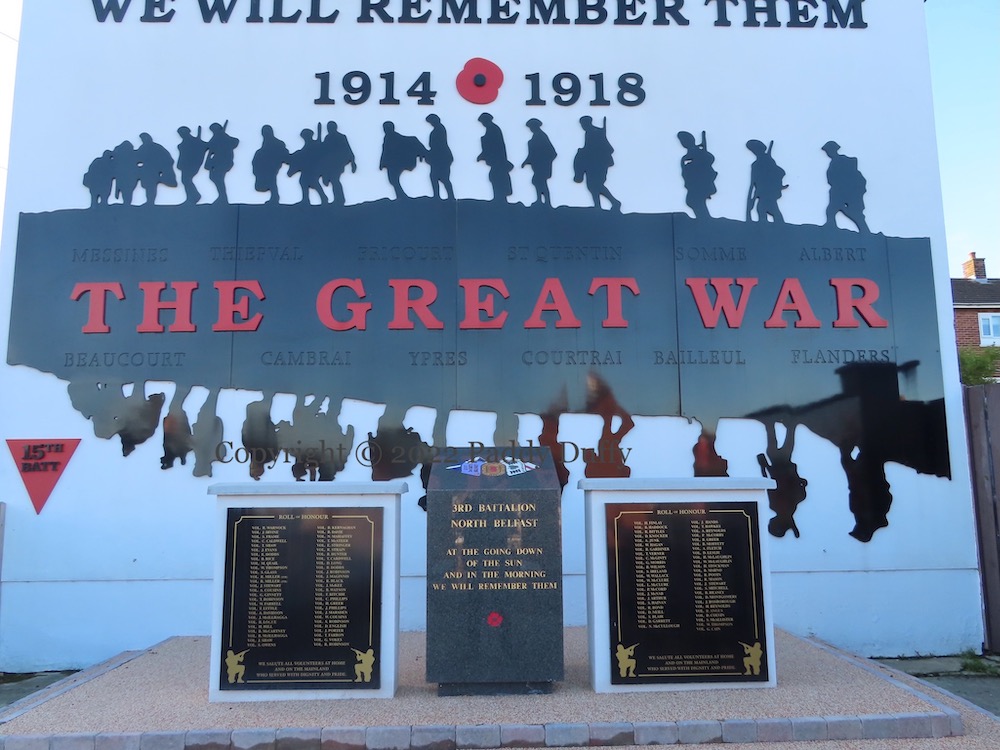
The memorial garden in Mount Vernon, has a “cut-out” mural to the 36th (Ulster) Division and memorial plaques to six UVF members who died between 1974 and 2000, including (lhs of the final image) Joe Shaw, who was shot by the UDA during the 1974-1975 feud. (For details of the killings and its aftermath, see this Balaclava Street article.) The stone in the centre is dedicated to the “3rd battalion North Belfast” Ulster Volunteer Force.

Mount Vernon Gardens, north Belfast

Click image to enlarge
Copyright © 2022 Paddy Duffy
T01293 [T01294] T01297 T01295 T01296

Their Struggle Is A Workers’ One

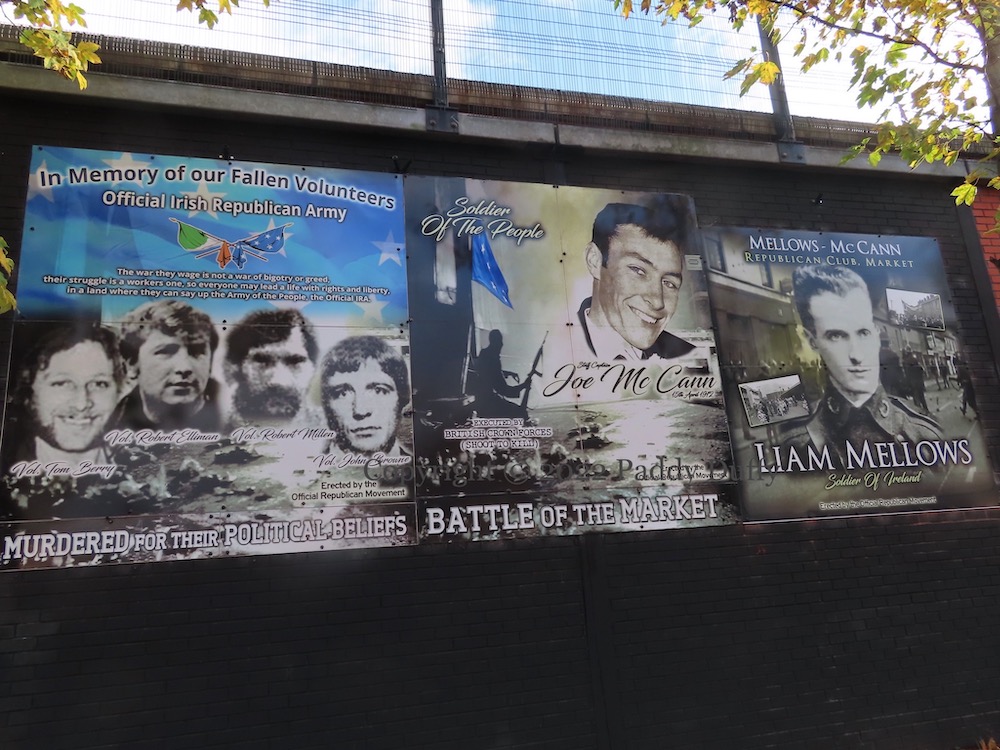
Left: “Murdered for their political beliefs: Tom Berry, Robert Elliman, Robert Millen, John Browne”. All four had a connection Markets or Ormeau area of south Belfast. Millen, from the Ormeau area, was shot in 1973 by the UVF; he played on the same soccer team (Bankmore Star) as Thomas Berry, who was shot in a Short Strand GAA club; Elliman was shot in a Markets pub; John Brown (without the “e”) was shot in his Cooke Street home in front of his family. The first three were all Protestants; the latter three were among 11 people who died in the 1975 feud between the Officials and the Provisionals. (Lost Lives)

“The war they wage is not a war of bigotry or greed, their struggle is a workers one, so everyone may lead a life with rights and liberty, in a land where they can say “Up the Army of the people, the Official IRA”.” “Erected by the Official Republican Movement.”

Centre: Internment (imprisonment without trial) was introduced on August 9th, 1971 by NI Prime Minister Brian Faulkner, with 342 people arrested on the first day. The Bogside was “hysterical with hated”, according to Eamonn McCann (History Ireland) and of Belfast Kevin Myers wrote “Insanity seized the city.” Two dozen people would die in the rioting and gun-battles that followed, leading to the suspension of Stormont rule (WP). In the Markets area, OC Joe McCann and other (Official) IRA volunteers took over the Inglis bakery and reportedly prevented 600 British troops from entering the area – the image to the left of the board above is a Ciaran Donnelly photograph showing McCann during the battle, kneeling beneath a Starry Plough and holding an M1.

Right: After serving in the IRA in the War Of Independence, Liam Mellows was elected to the First Dáil and as a member of the second Dáil voted against the Treaty in January 1922 (his speech is recorded in Oireachtas.ie under the name “Liam Mellowes”). In the Civil War that followed, he served as IRA quartermaster in the force in the Four Courts that surrendered to Free State forces on June 30th, 1922. He was imprisoned in Mountjoy and executed in December, in reprisal for the killing of Seán Hayes (see Executed). (WP | An Phoblacht) His proposals for government were published posthumously as ‘Mellows Testament’ (NLI) and include state ownership of heavy industry, large estates, the transport system, and the banks. The sticker below quotes from that document: “Ireland, if her industries and banks were controlled by foreign capital, would be at the mercy of every breeze that ruffled the surface of the world’s money-markets.”

Stewart Street, the Markets

Click image to enlarge
Copyright © 2022 Paddy Duffy
T01263 [T01264]

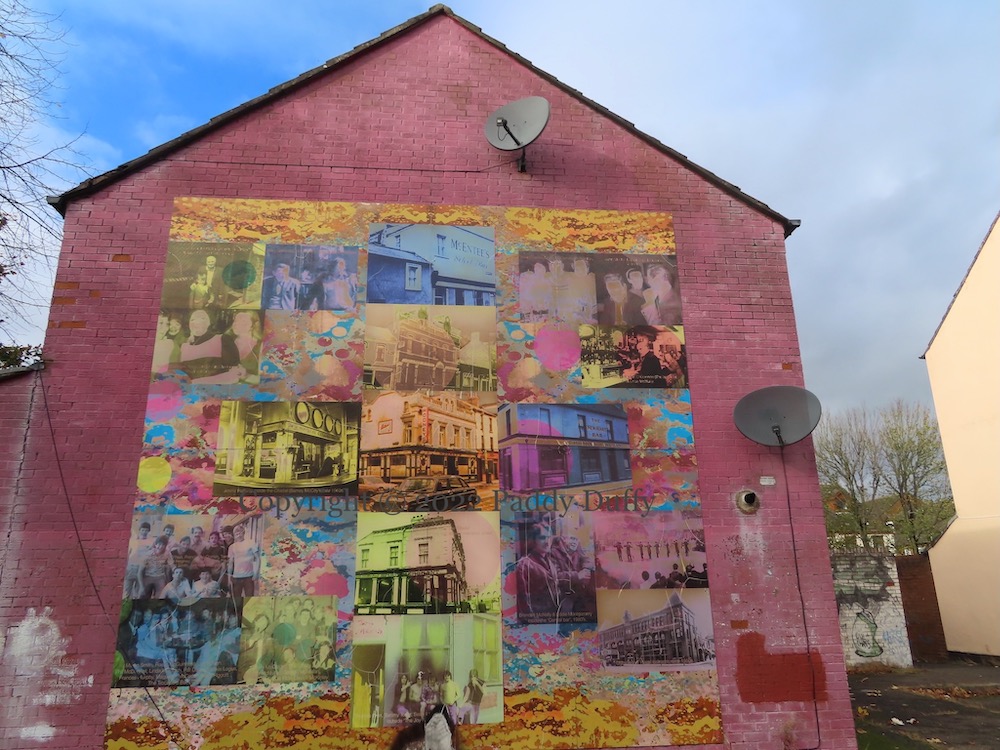
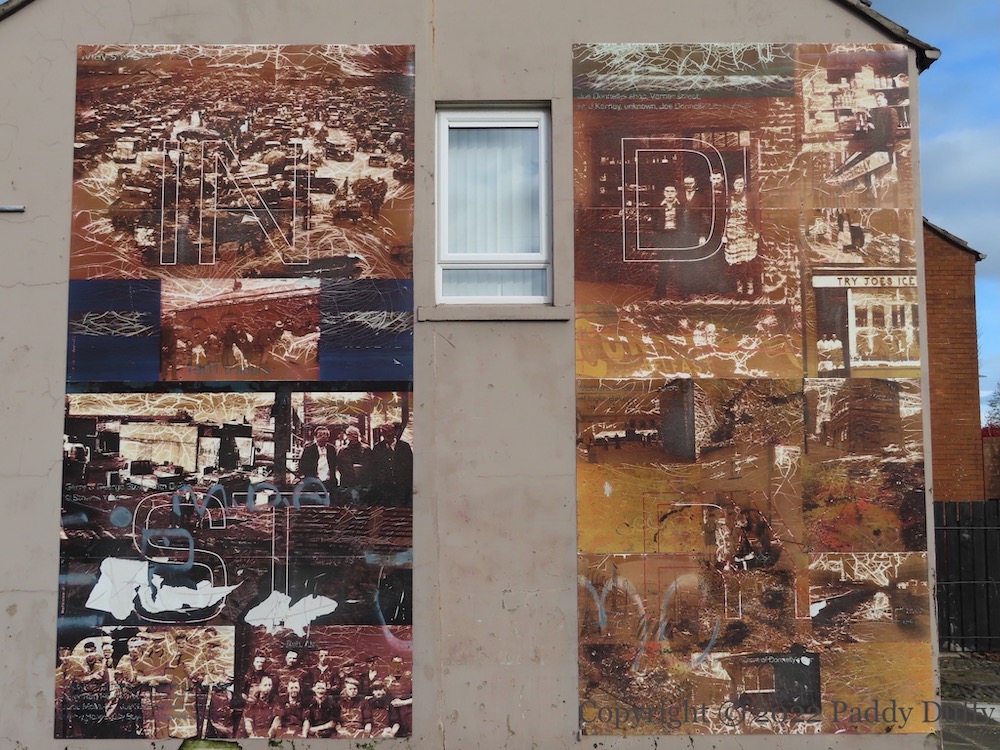
Bars Of The Markets

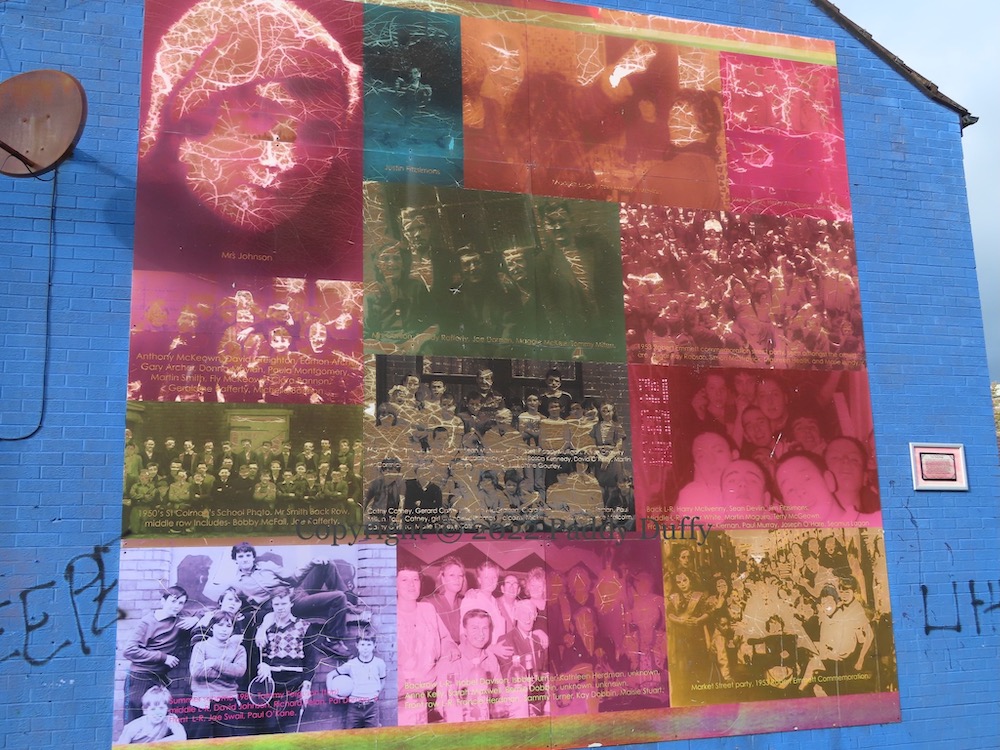
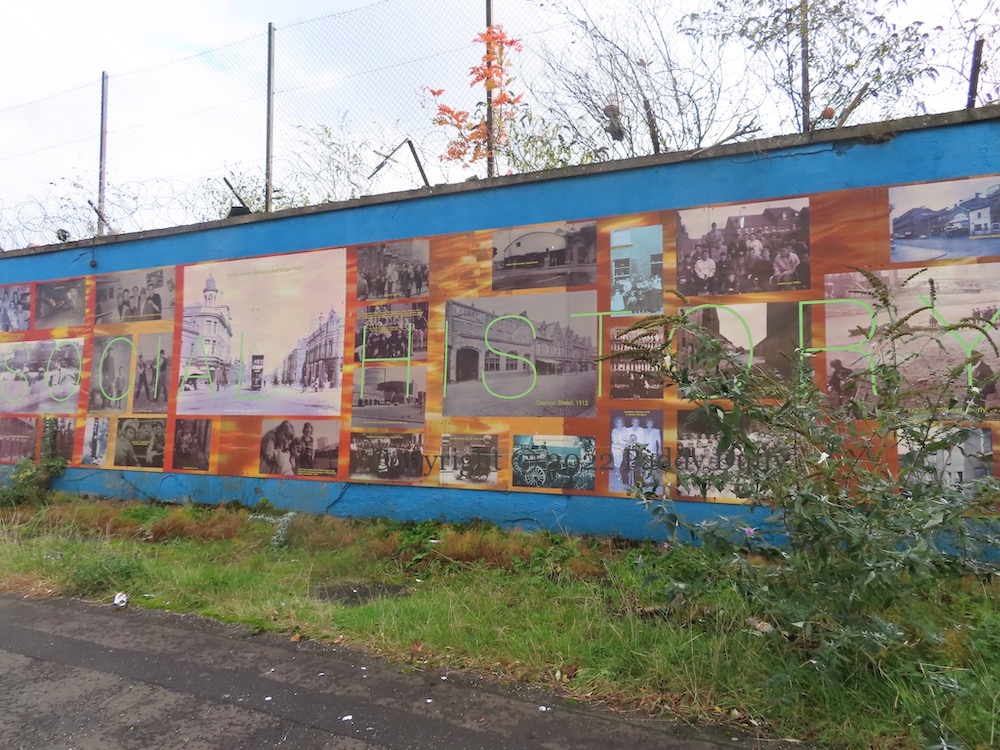
Artist Raymond Henshaw produced a series of boards in 2008 and 2009, with support from the Arts Council, depicting the Markets area in the good old (i.e. pre-Troubles) days. Above are the bars of the Markets and below ‘industry’, ‘social’ and ‘social history.

Stewart St and Stanfield St, Belfast

Click image to enlarge
Copyright © 2022 Paddy Duffy
T01265 T01266 T01269 T01272

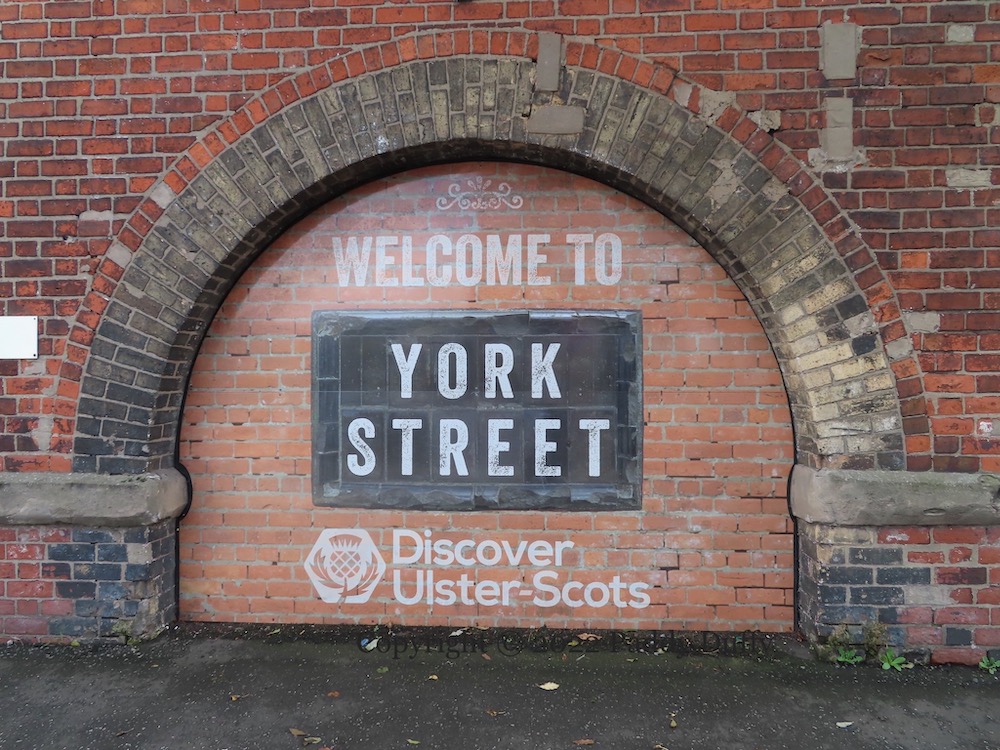
Discover Ulster-Scots

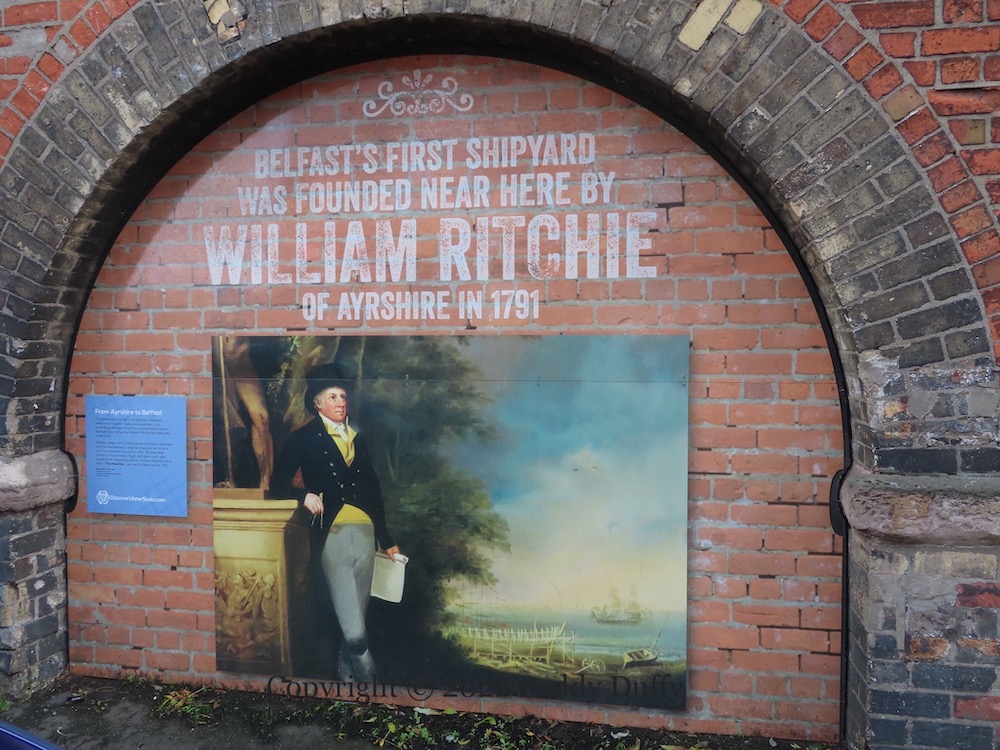
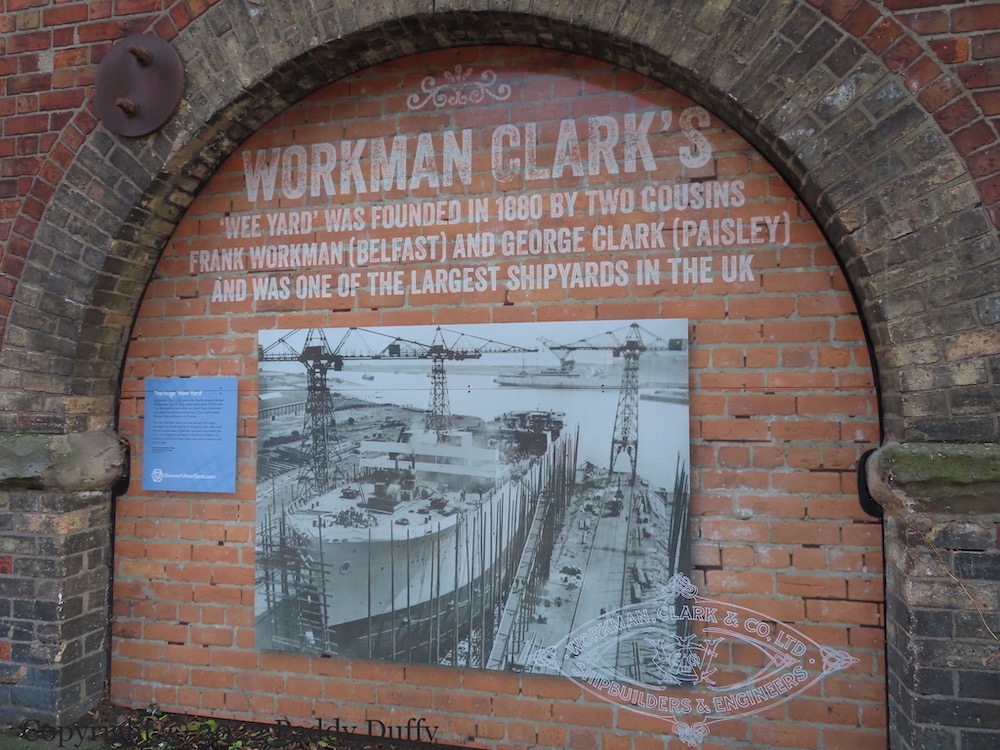
This is a 13-panel installation along York Road from discoverulsterscots.com about York Street businesses and Ulster Scots businessmen. It begins by telling a history of shipbuilding and its role in Belfast’s industrial life (“The harbour made York Street Belfast’s global gateway”) and in particular its connection with Scotland.

Two Scots, William Ritchie (whose 1802 portrait by Thomas Robinson is shown) and Charles Connell (who oversaw the construction of the first wooden steamboat in Belfast – Aurora, pictured below) along with another Scot, Alexander MacLaine, were the leading shipbuilders in Belfast from 1791 until the 1860s, when Englishman Edward Harland (soon joined by German Gustav Wolff, and then in 1874 by William Pirrie and Wilson brothers Walter and Alexander) took over the rival Hickson yard (which included land on Queen’s Island and on the south side of the Lagan) and became dominant. Their connection to York Street is that all of them except Pirrie lived on or near York Street.

Workman & Clark’s was a Belfast shipyard existing from 1880 to 1935. During the first world war it took over the construction of two monitor ships (specifically, M29 and M31) for the Royal Navy that H&W did not have space to build. For more, see Grace’s GuideBBC audio on monitor ships and their construction, including a record for number of rivets hammered in by one John Moore at Workman Clark’s.

Among the Belfast goods “exported around the world from York Street by rail and sea” were Gallaher’s Blues (cigarettes), Irish linens, Davidson & Co (Samuel Davidson, born in County Down to an Ulster-Scots family, was the inventor of the Sirocco centrifugal fan “for mine ventilation, dust removal, induced draft, forge fires”), and linen carpet thread from York Street (Threads) Ltd. Robinson & Cleaver’s department store is now out of business. Gallaher’s is now the multinational Gallaher Group, but its factories in Belfast and Ballymena have closed. And Davidson’s company was bought by Howden UK in 1988.

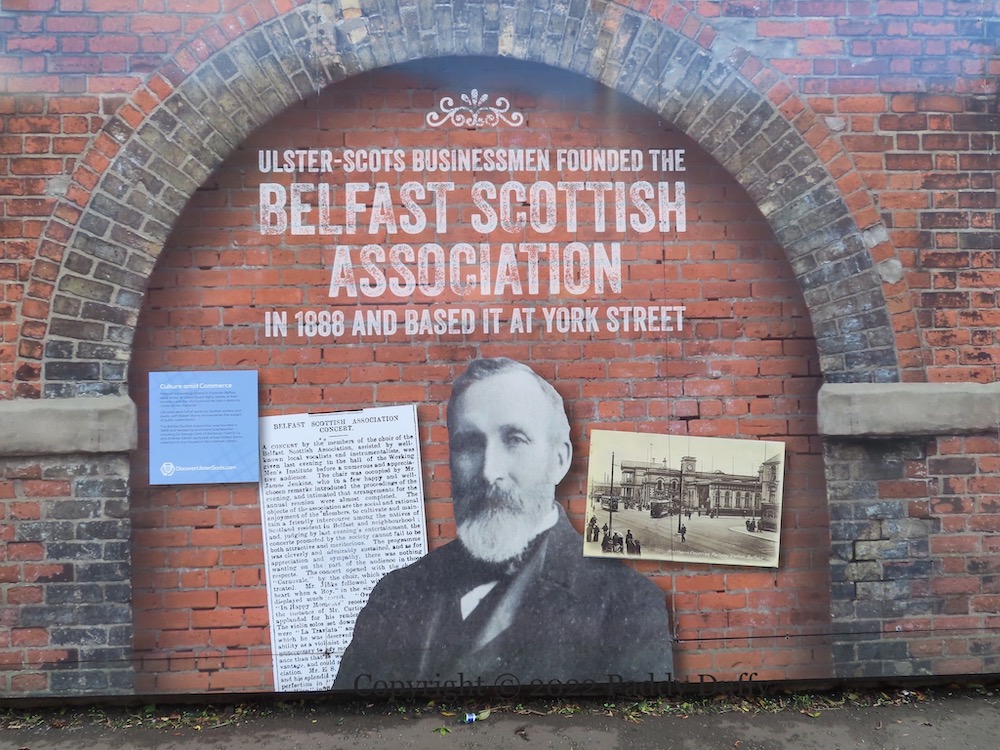
“The Belfast Scottish Association was founded in 1888 and headed by prominent businessmen, including Sir George Clark of Workman Clark and Andrew Gibson (pictured) whose Robert Burns collection is now housed in the Linenhall Library.”

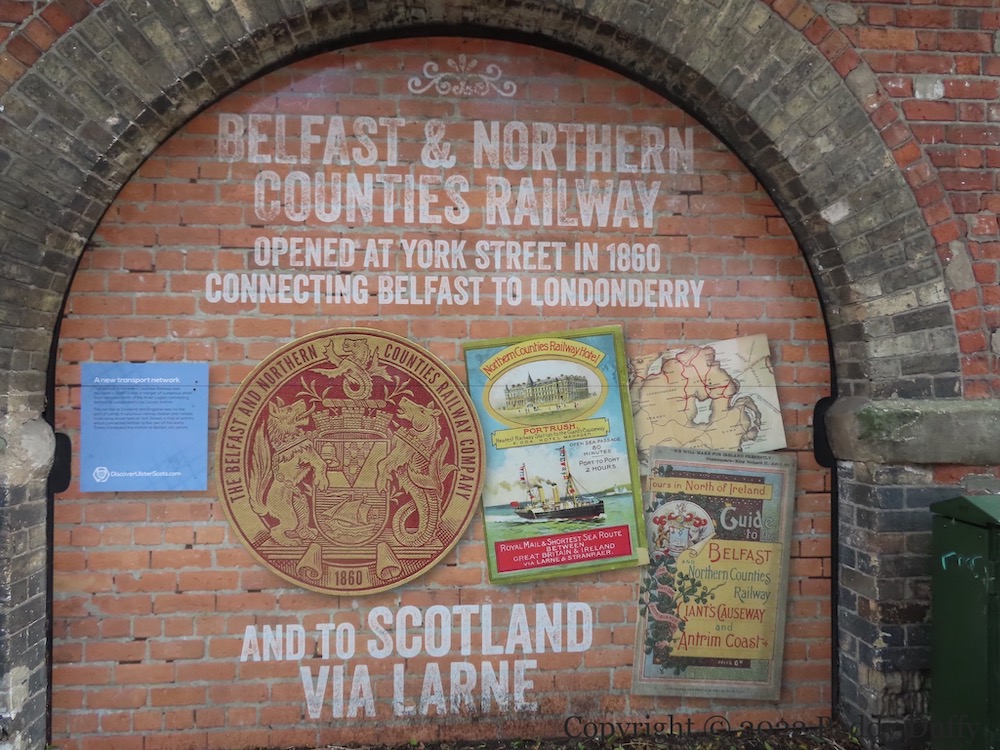
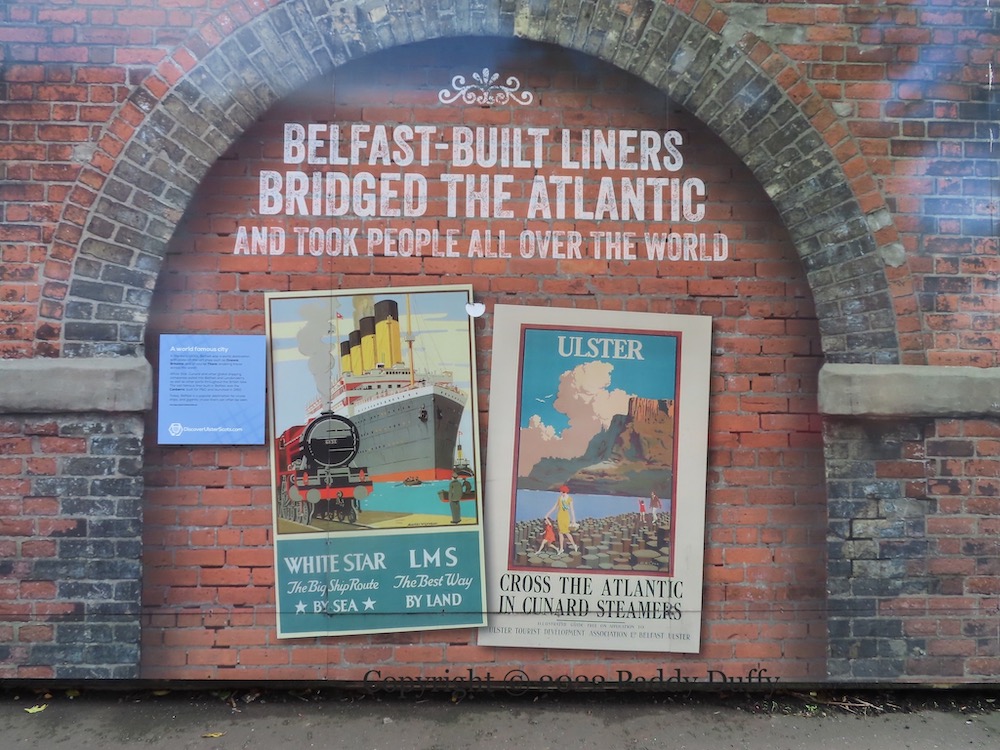
In addition to the famous trans-Atlantic ships (image below), Belfast was part of the travel network in the UK and Ireland (image above). Before there was British Railways, there were the Big 4: the Southern, Great Western, London and Northeastern, and London, Midland, and Scottish (LMS) railways. The latter included the railways in the Northern Counties. In addition to railways, the company owned canals, ships (including the Princess Victoria which sank on the Larne-Stranraer route), and hotels. “Belfast-built liners bridged the Atlantic and took people all over the world.” “Railway-owned ships ensured a seamless journey throughout the British Isles.”

Click image to enlarge
Copyright © 2022 Paddy Duffy
T01246 T01247 T01248 T01249 T01250 T01251 T01252 T01253 T01254 T01255 T01256 T01257 T01258 [T01259]