Pass Not This Spot In Sorrow

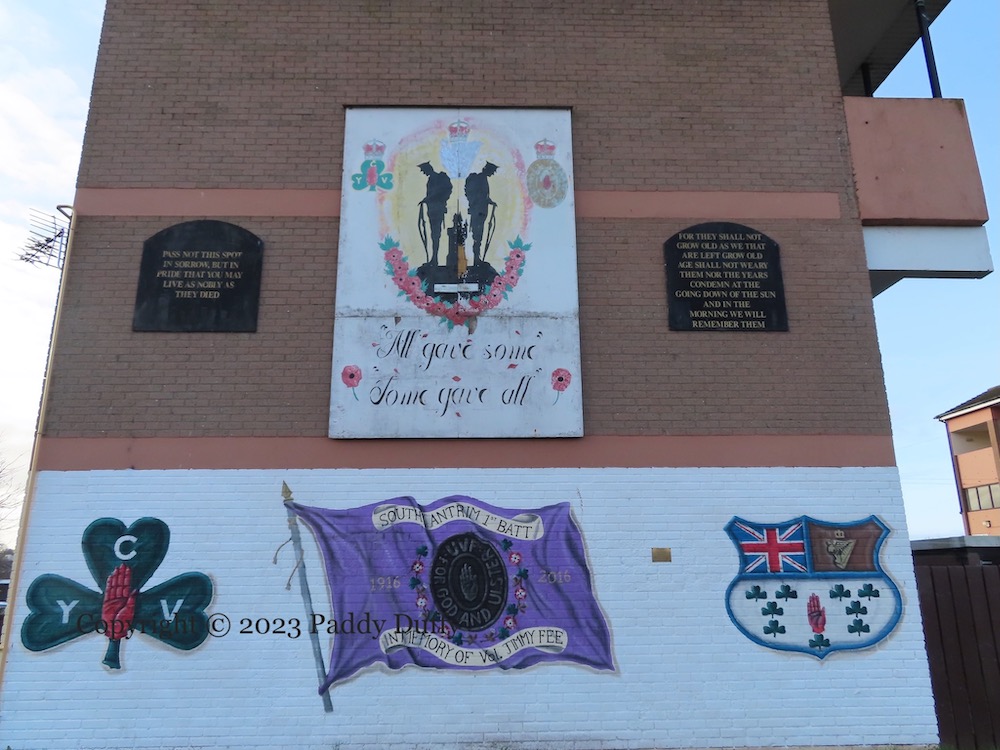
There has been a 36th Division board on this wall since 2003 (see Steeple Defenders) and this second one is now more than a decade old – see the 2013 post on Peter’s site. It is accompanied by two quotations:
“Pass not this spot in sorrow but in pride/That you may live as nobly as they died.” These lines are also used in a WWI memorial mural in Carlingford Street, Belfast.
“They shall not grow old as we that are left grow old./Age shall not weary them nor the years condemn./At the going down of the sun and in the morning, we will remember them.” from Binyon’s For The Fallen.

The mural below, with YCV and 36th Division emblems and a “South Antrim 1st Batt” flag was added in 2016. There’s no mention on-line of “Vol. Jimmy Fee” of the 1st (and only) battalion of the South Antrim brigade.

The board and mural are on the gable next to the Steeple memorial mural to Denver Smith; between the two gables is the UVF flag shown below.

Click image to enlarge
Copyright © 2023 Paddy Duffy
T01978 T01979 Parkhall Road all gave some some gave all thank you nhs

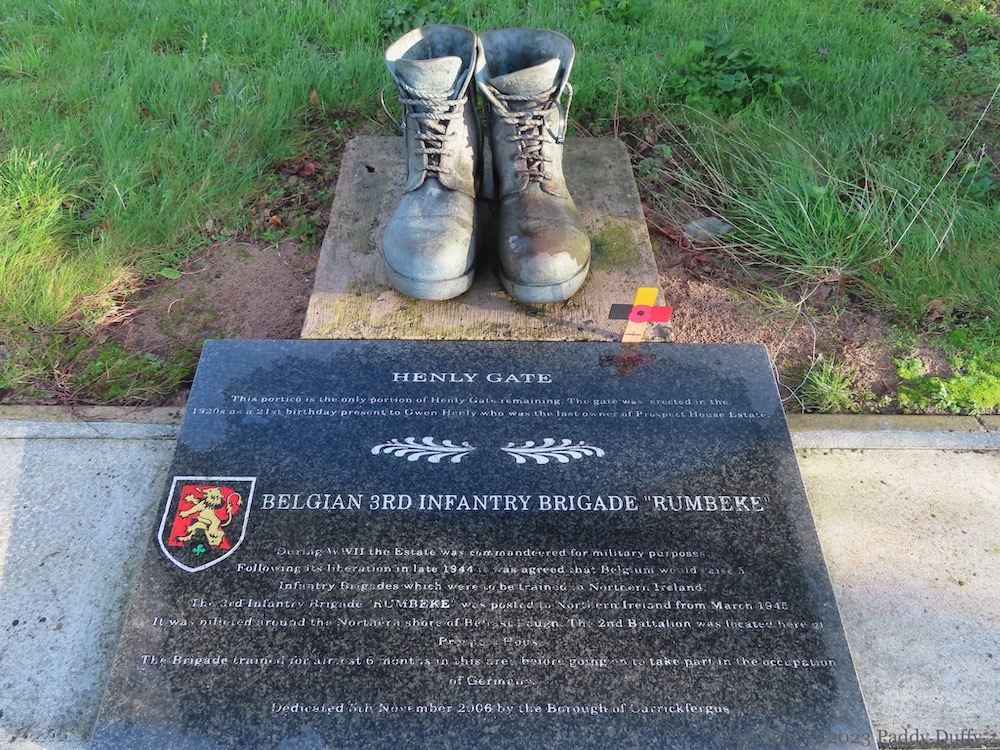
Henly Gate

Five Belgian brigades trained in Northern Ireland towards the end of WWII, as the Belgian Army rebuilt itself after the liberation of Belgium in 1944 (WarTimeNI). The 3rd or ‘Rumbeke’ brigade was raised in March 1945 and trained in six south-east Antrim towns, including Carrickfergus, where they were stationed at Henly House. After training, it took part in the occupation of Germany for about six months (BE Brigades). The boots and plaque are beneath the arch of what was once Prospect House.

The text on the plaque reads in full: “Henly Gate. This portico is the only portion of the Henly Gate remaining. The gate was erected in the 1920s as a 21st birthday present to Gwen Henly who was the last owner of Prospect House Estate. Belgian 3rd Infantry Brigade “Rumbeke”. During WWII the Estate was commandeered for military purposes. Following the liberation in late 1944 it was agreed that Belgium would raise 5 Infantry Brigades which were to be trained in Northern Ireland. The 3rd Infantry Brigade “Rumbeke” was posted to Northern Ireland from March 1945. It was billeted around the Northern shore of Belfast Lough. The 2nd Battalion was located here at Prospect House. The Brigade trained for almost 6 months in this area before going on to take part in the occupation of Germany. Dedicated 5th November 2006 by the Borough of Carrickfergus.”

At the junction of Woodburn Rd and Prospect Rd, Carrickfergus.

Click image to enlarge
Copyright © 2023 Paddy Duffy
T01827 [T01828]

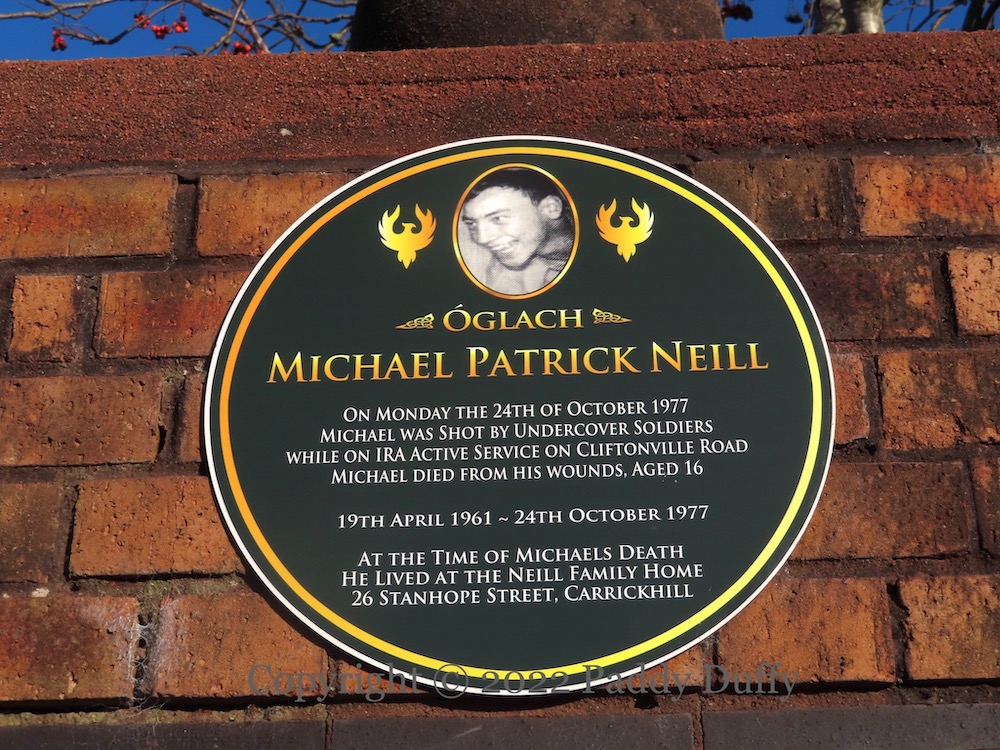
Neill And Scullion

These two plaques are on the “gateposts” at the entrance to Alton Street in Carrick Hill. Neill (above) is on the right; Scullion (below) is on the left.

Neill: “Óglach Michael Patrick Neill. On Monday the 24th of October 1977 Michael was shot by undercover soldiers while on IRA active service on Cliftonville Road. Michael died from his wounds, aged 16. At the time of Michael’s death he lived at the Neill family home 26 Stanhope Street, Carrickhill.”

Scullion: “Óglach Louis Scullion. At 1:45 a.m. on the 14th of July 1972 Louis was shot four times by the British Army as he walked to his home in Unity flats. Louis was unarmed and died as a result of his injuries. 5th June 1945 – 14th July 1972. Louis lived at 51H Unity Walk.”

Click image to enlarge
Copyright © 2022 Paddy Duffy
T01592 T01593

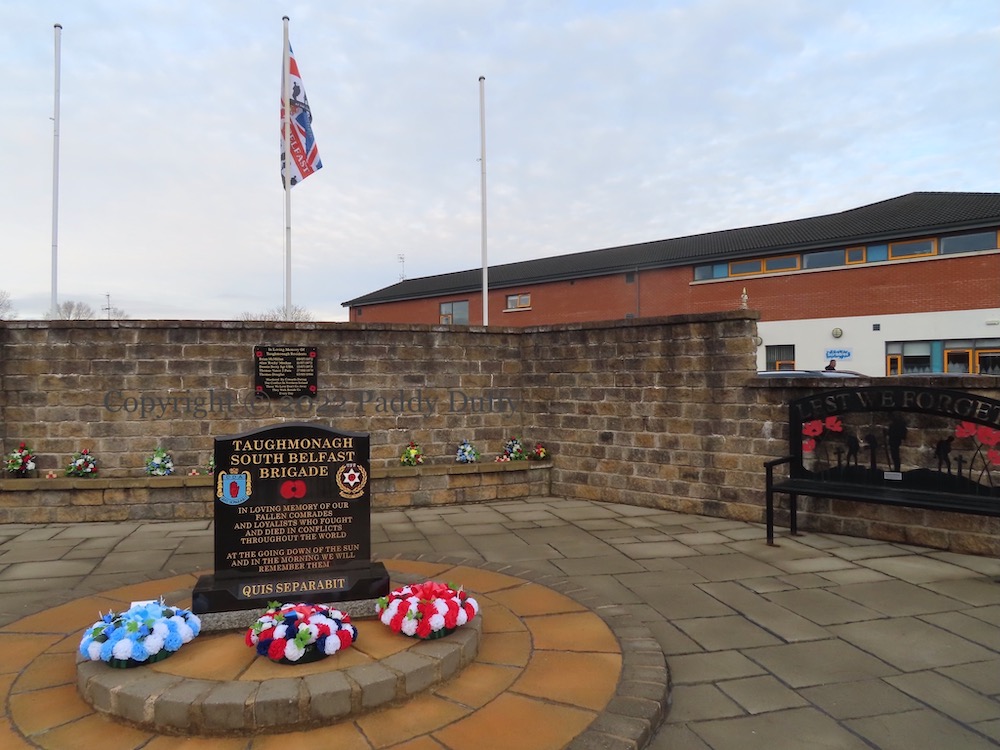
Taughmonagh South Belfast Brigade

“In loving memory of Taughmonagh residents Brian McMillan, Alan ‘Rocky’ Meehan, Dennis Berrty (Sgt UDA), Thomas Vance (2 Para), Thomas Douglas. Murdered by cowards during the conflict in Northern Ireland. Those we love don’t go away, they walk beside us every day.”

McMillan and Meehan were civilians shot along with TA staff sergeant (and English Catholic) Joseph Flemming on July 9th, 1972.

Dennis Berry was shot by the UVF after leaving the UDA social club in Taughmonagh. According to Lost lives, “Reliable loyalist sources said the shooting was the result of a personal row rather than having any political or organisational basis.” (p. 441)

Thomas Vance died in the IRA’s 1979 ambush of the British Army at Narrow Water Castle, near Warrenpoint (WP), on the same day that Louis Mounbatten was killed. (Republican mural)

Thomas Douglas was shot while walking along the street. His family denied he was a leading loyalist and simply a member of the Orange Order (CAIN | Fb).

This plaque is in the UDA memorial garden in Taughmonagh at the corner of Finbank Gardens & Malfin Drive.

Click image to enlarge
Copyright © 2022 Paddy Duffy
T01537 [T01536]

Stag Inn Shooting

A long series of tit-for-tat shootings of pubs and clubs continued into the summer of 1976, with attacks on the Chlorane (June 5th), Walkers (June 25th), the Ramble (July 2nd), the Whitefort (July 29th), and then, on the 30th, The Stag at Shaws Bridge, Belfast, by the Republican Action Force (PIRA) (Sutton). John McCleave, John McKay, and James “Jimmy” Doherty died on the night of the attack, and Thompson McCreight died of his wounds nine days later. The memorial to them – “erected by the local communities” – is on Milltown Road, next to the Dreamscheme (web) mural.

Milltown Road, Belvoir, south Belfast

Click image to enlarge
Copyright © 2022 Paddy Duffy
T01530 [T01531] T01532 [T01533] T01534 T01535

That We May Live In Freedom

The old C Batt mural further up Hornbeam Road has long been painted over. It used the same line – “They gave their lives that we may live in freedom” – to remember Wesley Nicholl and Brian Morton. A plaque to Morton is now included on top of the new mural. “Brian Morton (Morty) killed in action 07/07/1997, a true Ulster patriot who gave his life in defence of his country. Feriens tego.” As with republican memorials, “active service” means that Morton was killed by a premature bomb exploding.

Previously on this wall: Queensway Flute Band.

Hornbeam Drive, Dunmurry

Click image to enlarge
Copyright © 2022 Paddy Duffy
T01523 [T01522]

Loyalist Cluan Place

The mural in Cluan Place goes back to (at least) 2002. It used to include the words “5 people shot, houses burned, houses bombed” but these have been painted out in this repainted version.

For Ian Ogle, see What Fire Does Not Destroy It Hardens.

Click image to enlarge
Copyright © 2022 Paddy Duffy
T01480 T01483

The Joy Of Our Hearts

The Newington tribute to Bobby Sands and the other deceased hunger strikers of the 1970s and 80s (see previously: Mol An Óıge Agus Tıocfaıdh Sí) has been augmented with four plaques to republicans from the area who died in the Troubles: (l-r) Martin McDonagh, Rosemary Bleakley, Colm Mulgrew, and Sean ‘Maxi’ McIvenna.

Unbeknowst to her parents (Lost Lives), Bleakley had joined Cumann Na mBan at 18 and was four days short of her nineteenth birthday when she and McDonagh were killed in a premature bomb explosion in the North Street arcade (Victor Patterson image of the blast), along with civilians Ian Gallagher and Mary Dornan (Sutton); 20 others were injured (Fortnight). Bleakley was not buried in the republican plot (in Milltown) but coincidentally in the plot adjacent to Dornan (BBC).

Bleakley was portrayed in the old New Lodge Volunteers mural.

Newington Avenue, north Belfast

Click image to enlarge
Copyright © 2022 Paddy Duffy
T01458 T01459

Because He Loves What Is Behind Him

The Shankill Somme Association’s garden of reflection has added a number of new boards.

The board shown above is JP Beadle’s painting “Battle of the Somme: Attack of the Ulster Division”, which hangs in Belfast City Hall (militaryprints.com). It replaces a painting of a soldier in a field of poppies, seen in The Great War.

To its left is John Singer Sargent’s painting “Gassed”, showing the “aftermath of an indiscriminate mustard gas attack on British forces during the Battle of Arras 21st August 1918” (which also forms a part of a memorial in east Belfast) with the GK Chesterton quote “The true soldier fights not because he hates what is front of him, but because he loves what is behind him”.

Also new – and somewhat out of place – is the Northern Ireland Centenary board featuring James Craig: “It would be rather interesting for historians of the future to compare a Catholic state launched in the south with a Protestant state launched in the north and to see which gets on the better and prospers the more”. There are other “floreat Ultona” boards/murals in the Village (focusing on the B Specials and UDR) and in Rathcoole (where “Ulster welcomes her King and Queen”).

There are also three insignia on the gates (compare with M05717), to the Royal Navy, the Ulster Volunteer Medical & Nursing Corps, and the Royal Flying Corp.

Previously (c. 2017), the undead soldiers of We Shall Not Sleep were replaced with an image of the Cross Of Sacrifice memorial – the original is in Ypres, Belgium but there is also one in the City Cemetery – see One In Design And Intention. At the same time, the poppy plaques for individual local soldiers and the image of the Menin Gate were also added.

The Flanders Field board appears to have survived since 2012 – see Somme Memorial.

The final image below shows the new stone surround for the main memorial. See (again) Somme Memorial.

For the 20th anniversary electrical box on the footpath outside, see Shankill Somme Association.

Click image to enlarge
Copyright © 2022 Paddy Duffy
T01427 [T01428] T01436 T01438 [T01437] T01435 T01433 [T01434] T01432 [T01431] T01426 [T01429] T01425 T01424 T01423
[T01439] [T01430]