The Pigeon Has Landed

On June 12th 1944, ‘Paddy The Pigeon’ flew from Normandy (where the landings begun on the 6th were ongoing – D-Day Story) back to the English coast. In recognition of his exploits, a plaque was mounted in the harbour of his home town of Carnlough on the Antrim coast in 2009.

Update: The plaque was destroyed in June 2024 – you can it in pieces on the ground in this BBC article.

“During World War II, pigeons were used by the forces as message carriers. Paddy was one of thirty pigeons delivered by RAF Hurn to operational units of the First US Army on June 8th, 1944. They were to be used in connection with a secret task, code named “U2″. Paddy was released in Normandy at around 8.15am on June 12th, carrying coded information on the Allied advance. He returned to his loft in Hampshire in just 4 hours and 50 minutes. This was the fastest time recorded by a message-carrying pigeon during the Normandy landings. For his services Paddy was awarded the Dickin Medal on September 1st, 1944. He had previously served at RAF Ballykelly on Air Sea rescue missions. Andrew Hughes JP, of Carnlough, was the proud owner of Paddy. He handed over several of his pigeons to be trained, along with others for service with the Forces. Paddy lived for eleven years, and to date is the only Irish recipient of the Dickin Medal, which is the animal equivalent of the Victoria Cross. – Larne & District Historical Society MMIX.”

Also in the harbour is a plaque (shown below) to the sailors who died on the Peridot in November, 1905.

Click image to enlarge
Copyright © 2023 Paddy Duffy
T02971 T02970

Scottish Brigade

The hand-painted UVF Scottish Brigade mural (see Boab Kerr) in Beechfield Street/Tower Street has been replaced by this new printed board. The plaque to Kerr has been retained, but four names have been added – David Totten, Brian Milligan, Billy Inglis, and Jim Holt, who is now the most prominent. Holt died in February 2021 (ACT Fb).

Click image to enlarge
Copyright © 2023 Paddy Duffy
T02825 [T02826 ]

Clós Ard An Lao

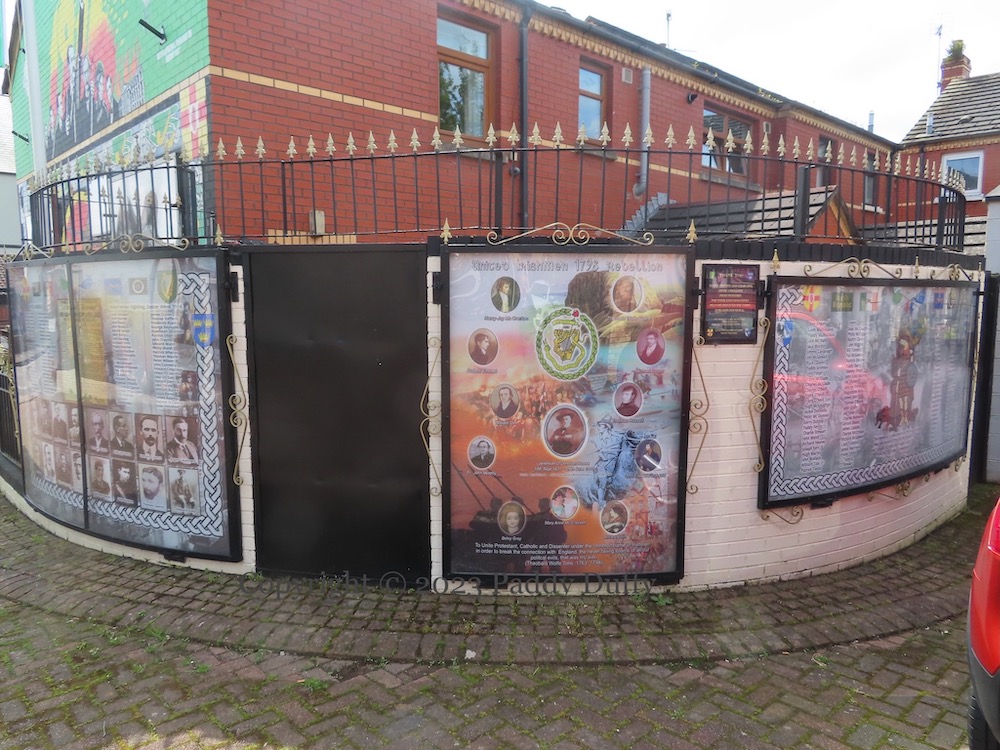
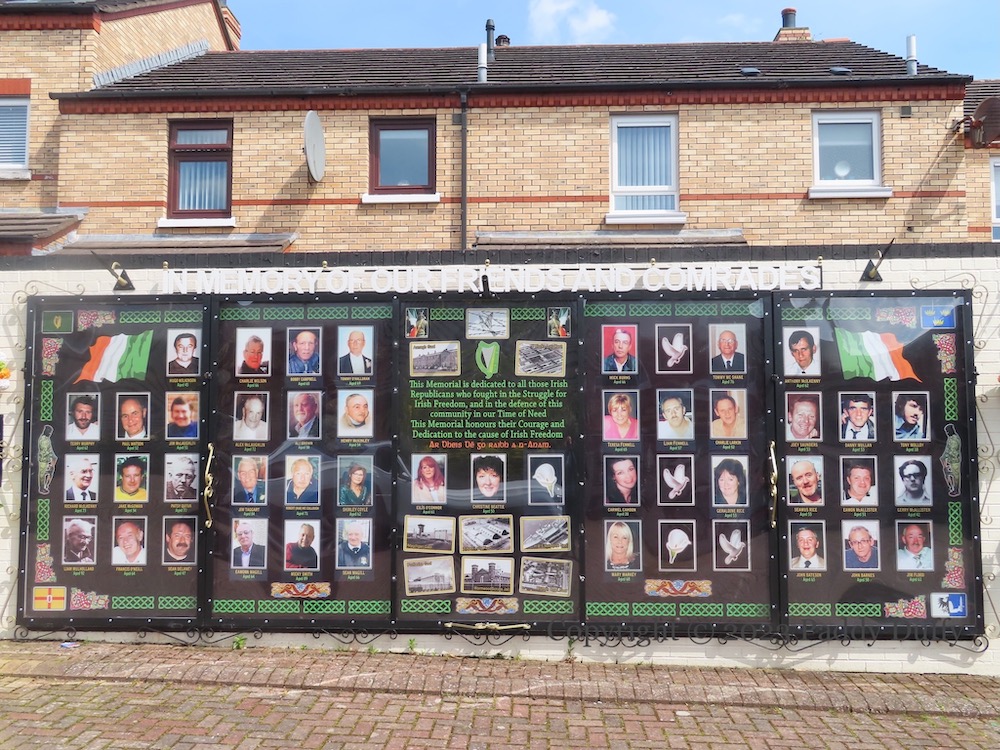
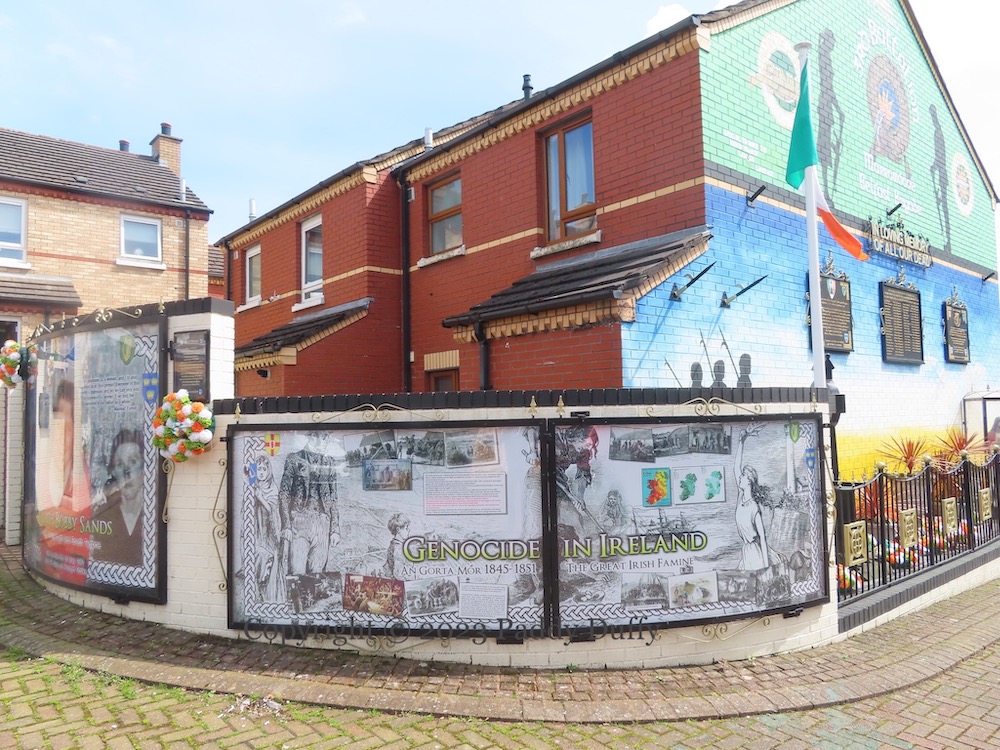
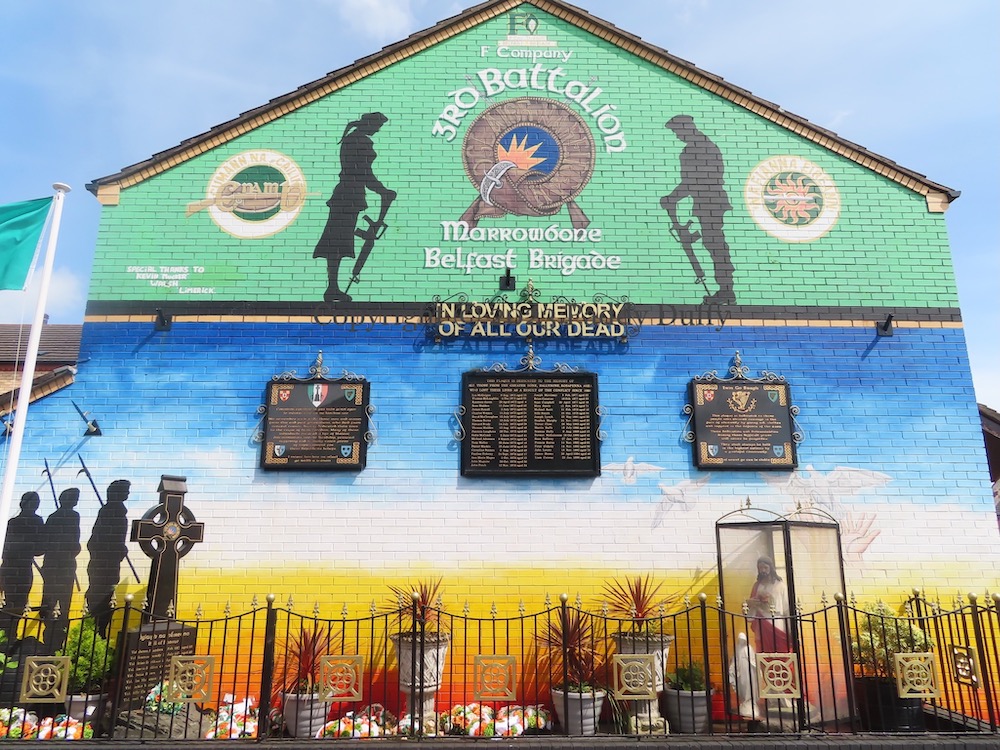
Here is a gallery of the murals and plaques in Clós Ard An Lao/Ardilea Close in the Machaıre Botháın/Marrowbone area of north Belfast. A full repertoire of republican events is commemorated – the United Irishmen, Great Hunger, the Rising, the Troubles, the (modern) hunger strikes. What is most striking is the significant presence of religious icons, such as the Sacred Heart in the glass cases in front of the two main murals (above and last below).

Click image to enlarge
Copyright © 2023 Paddy Duffy
T02709 T02713 T02712 T02716 T02717 T02715 T02714 T02710 [T02711]

Andrew Mason

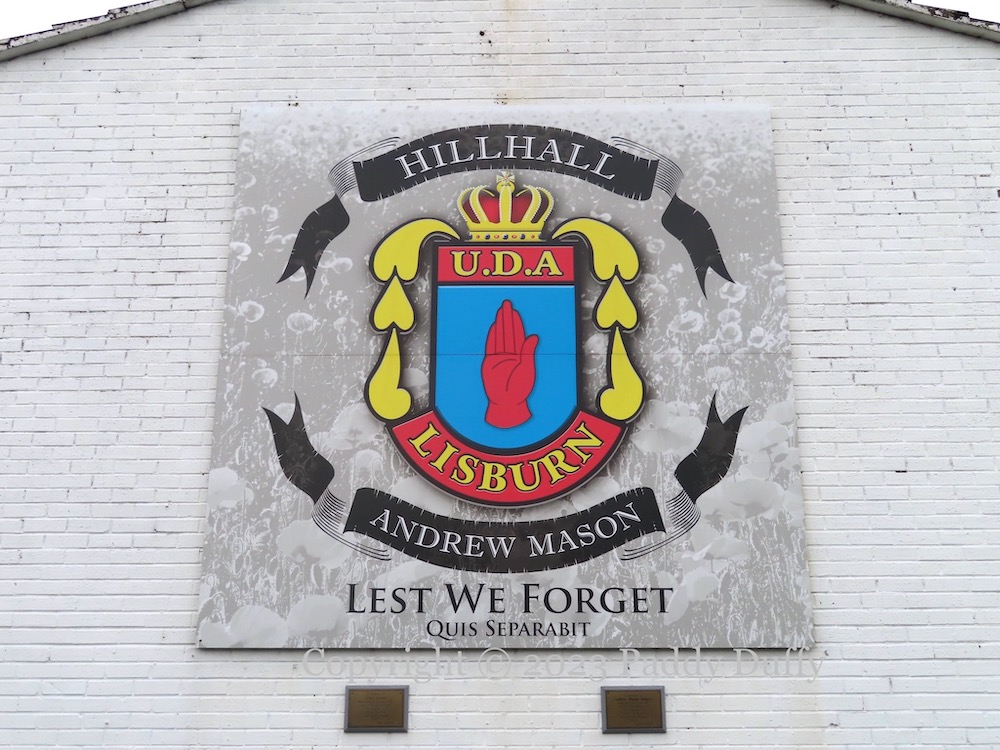
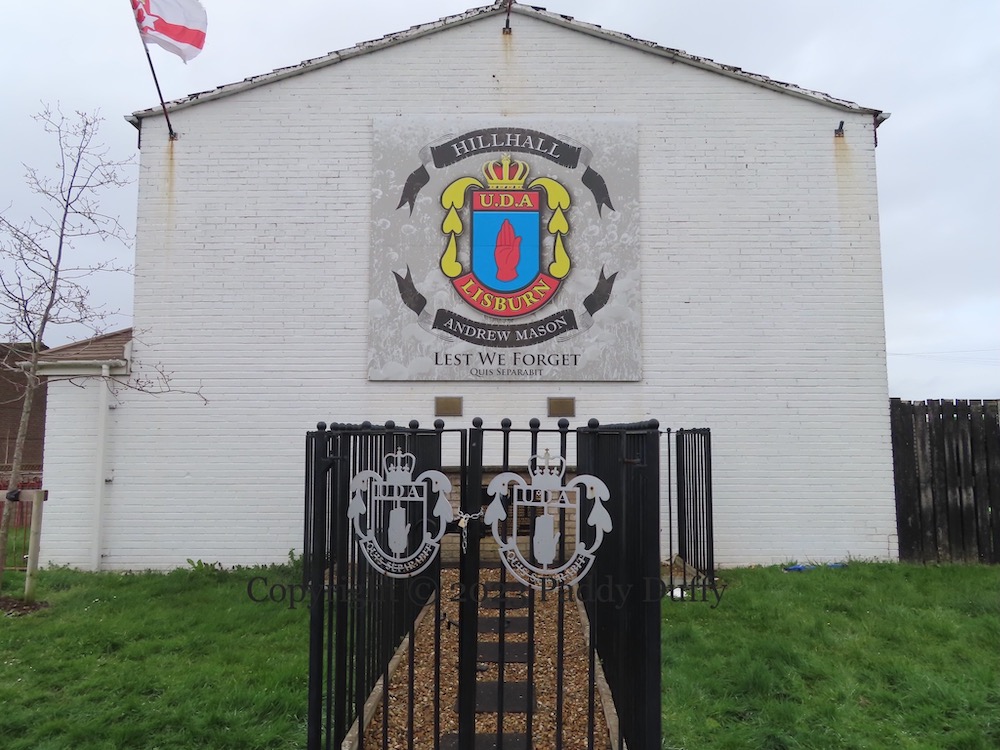
19-year-old Andrew “Macey” Mason was wearing his Hillhall band uniform and a UDA badge while en route to visit his girlfriend on April 19th, 1987, when he was set upon by two men near Carnlough on the Antrim coast. The gruesome details of the beatings and stabbings that followed are given in Lost Lives (#2827).

This is the second (see previously 2010 – M05938) memorial board to Mason in Hillhall. The memorial plaque (below) is a new version of the older plaque to John McMichael, Raymond Smallwood[s], Jim Guiney, and Mason.

Click image to enlarge
Copyright © 2023 Paddy Duffy
T02320 T02321 T02319 Hillhall Gardens “Sons of Ulster do not be anxious for we will never forget you as long as the sun shines and the wind blows and the rain falls and the rivers of Ulster flow to the sea. Always remembered by volunteers from Hillhall C Company.”

The People’s Monument

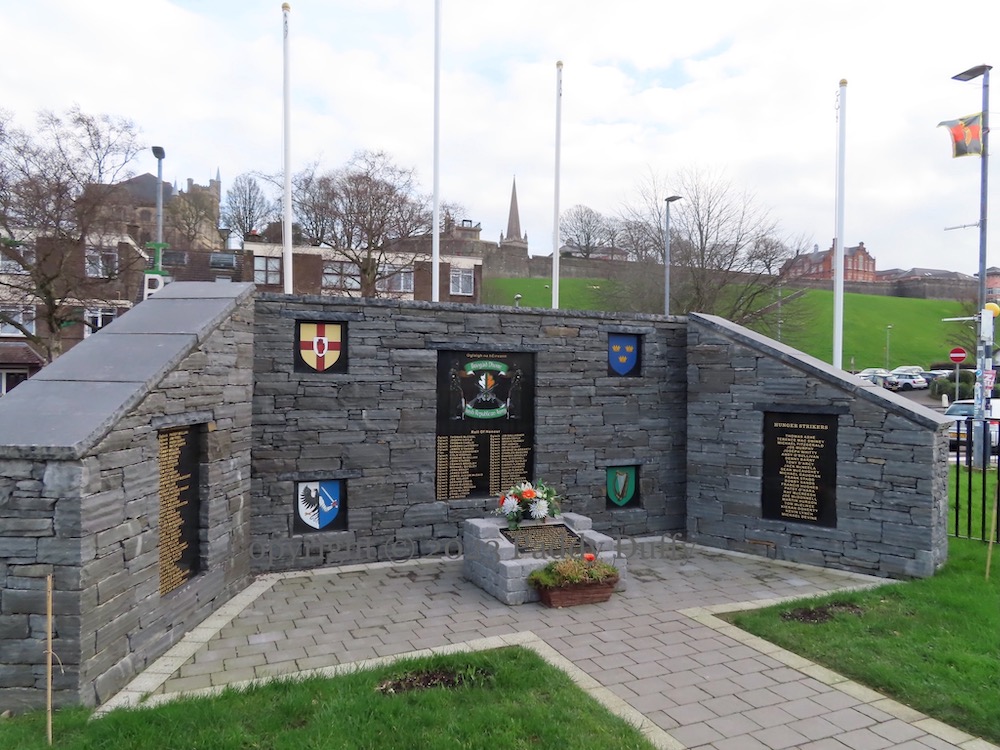
In August (2022), Saoradh Doıre (web) and the Derry IRPWA (web) unveiled a new memorial to the Derry Brigade IRA/Brıogáıd Dhoıre Óglaıgh Na hÉıreann on the green at the Fahan Street turn which it is calling “the people’s monument” (Derry Now) perhaps in parallel with the series of murals by the Bogside Artists called “the people’s gallery” (Visual History page).

In the centre is a Derry Brigade roll of honour with 42 names; on the left is a role of remembrance of naturally-deceased óglaıgh and activists, including Geordie McGilloway who worked on the nearby hunger strike memorial (An Phoblacht); on the right is a list of the deceased twentieth century hunger strikers, beginning with Thomas Ashe.

“This monument is dedicated to the people of Derry City who have resisted & still resist the occupation of our country by Britain. We acknowledge with pride the sacrifices they made throughout every decade. Their names would be too numerous to mention & their deeds of bravery & resistance unequaled in the history of our struggle. The republican movement of Derry City salute you and your families. Your reward will only be a united Ireland.”

Click image to enlarge
Copyright © 2023 Paddy Duffy
T02112 T02111

Pass Not This Spot In Sorrow

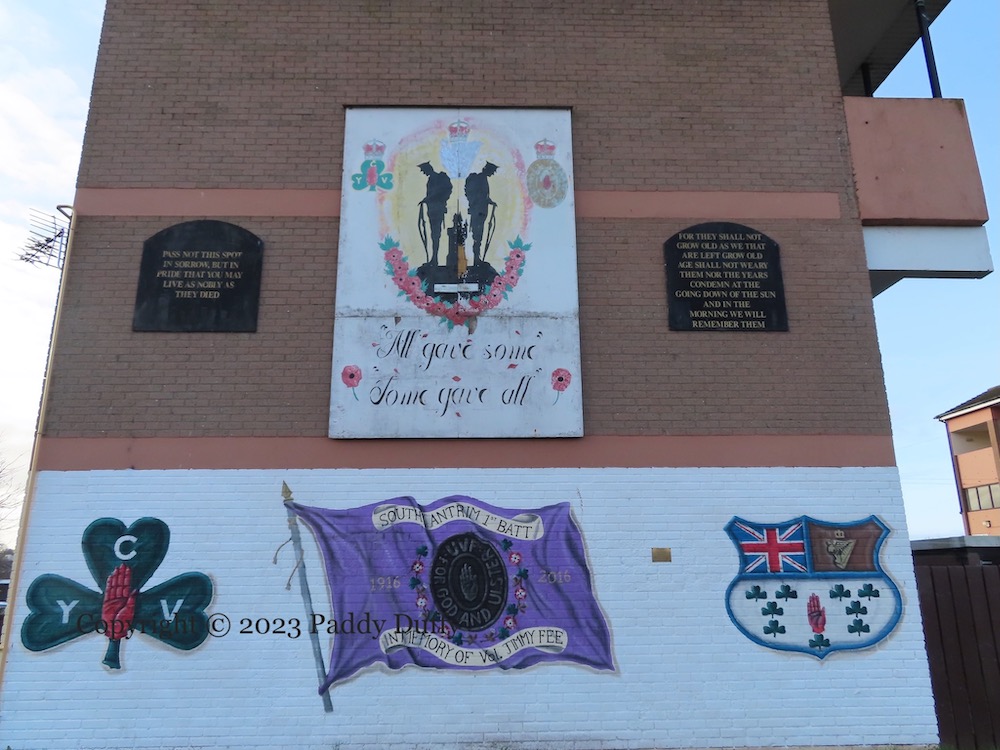
There has been a 36th Division board on this wall since 2003 (see Steeple Defenders) and this second one is now more than a decade old – see the 2013 post on Peter’s site. It is accompanied by two quotations:
“Pass not this spot in sorrow but in pride/That you may live as nobly as they died.” These lines are also used in a WWI memorial mural in Carlingford Street, Belfast.
“They shall not grow old as we that are left grow old./Age shall not weary them nor the years condemn./At the going down of the sun and in the morning, we will remember them.” from Binyon’s For The Fallen.

The mural below, with YCV and 36th Division emblems and a “South Antrim 1st Batt” flag was added in 2016. There’s no mention on-line of “Vol. Jimmy Fee” of the 1st (and only) battalion of the South Antrim brigade.

The board and mural are on the gable next to the Steeple memorial mural to Denver Smith; between the two gables is the UVF flag shown below.

Click image to enlarge
Copyright © 2023 Paddy Duffy
T01978 T01979 Parkhall Road all gave some some gave all thank you nhs

Henly Gate

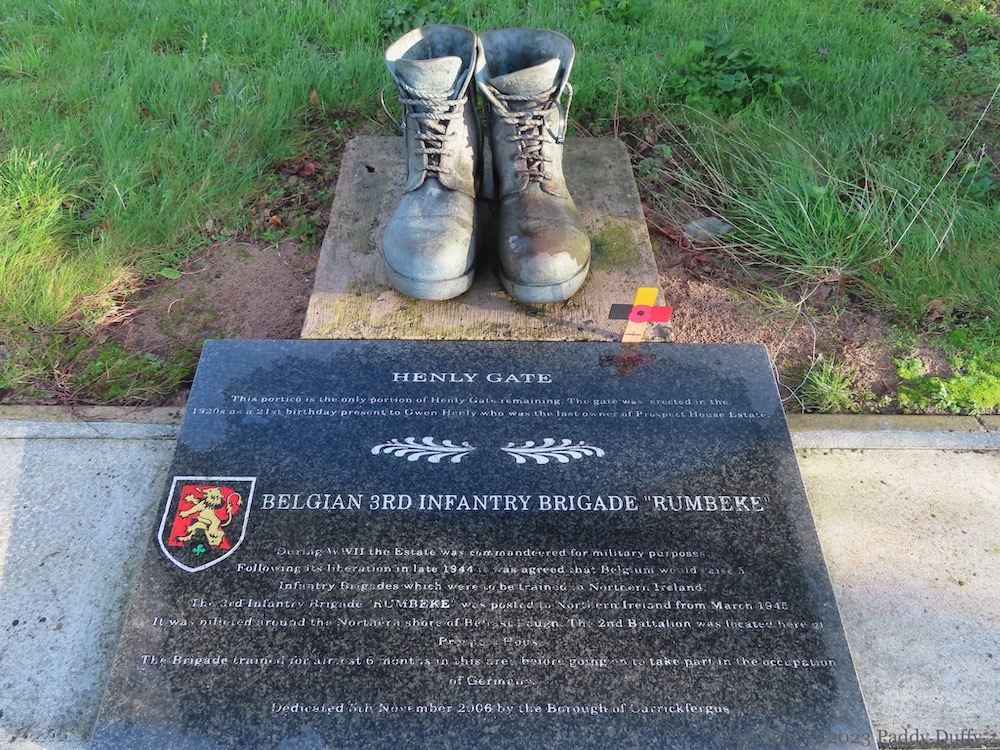
Five Belgian brigades trained in Northern Ireland towards the end of WWII, as the Belgian Army rebuilt itself after the liberation of Belgium in 1944 (WarTimeNI). The 3rd or ‘Rumbeke’ brigade was raised in March 1945 and trained in six south-east Antrim towns, including Carrickfergus, where they were stationed at Henly House. After training, it took part in the occupation of Germany for about six months (BE Brigades). The boots and plaque are beneath the arch of what was once Prospect House.

The text on the plaque reads in full: “Henly Gate. This portico is the only portion of the Henly Gate remaining. The gate was erected in the 1920s as a 21st birthday present to Gwen Henly who was the last owner of Prospect House Estate. Belgian 3rd Infantry Brigade “Rumbeke”. During WWII the Estate was commandeered for military purposes. Following the liberation in late 1944 it was agreed that Belgium would raise 5 Infantry Brigades which were to be trained in Northern Ireland. The 3rd Infantry Brigade “Rumbeke” was posted to Northern Ireland from March 1945. It was billeted around the Northern shore of Belfast Lough. The 2nd Battalion was located here at Prospect House. The Brigade trained for almost 6 months in this area before going on to take part in the occupation of Germany. Dedicated 5th November 2006 by the Borough of Carrickfergus.”

At the junction of Woodburn Rd and Prospect Rd, Carrickfergus.

Click image to enlarge
Copyright © 2023 Paddy Duffy
T01827 [T01828]

Neill And Scullion

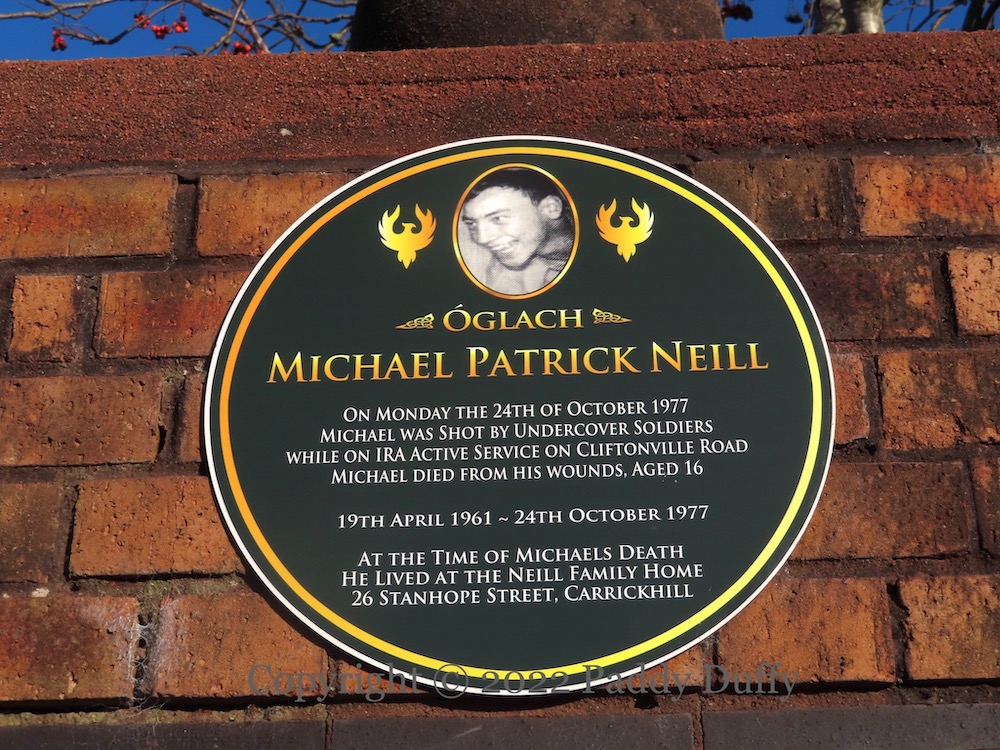
These two plaques are on the “gateposts” at the entrance to Alton Street in Carrick Hill. Neill (above) is on the right; Scullion (below) is on the left.

Neill: “Óglach Michael Patrick Neill. On Monday the 24th of October 1977 Michael was shot by undercover soldiers while on IRA active service on Cliftonville Road. Michael died from his wounds, aged 16. At the time of Michael’s death he lived at the Neill family home 26 Stanhope Street, Carrickhill.”

Scullion: “Óglach Louis Scullion. At 1:45 a.m. on the 14th of July 1972 Louis was shot four times by the British Army as he walked to his home in Unity flats. Louis was unarmed and died as a result of his injuries. 5th June 1945 – 14th July 1972. Louis lived at 51H Unity Walk.”

Click image to enlarge
Copyright © 2022 Paddy Duffy
T01592 T01593

Taughmonagh South Belfast Brigade

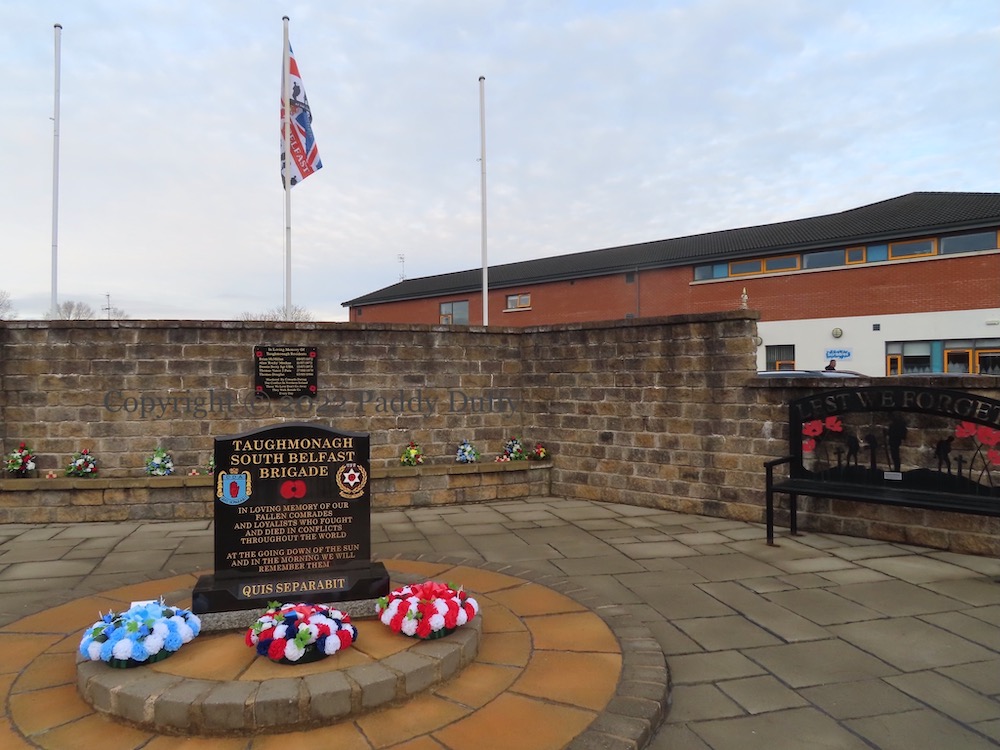
“In loving memory of Taughmonagh residents Brian McMillan, Alan ‘Rocky’ Meehan, Dennis Berrty (Sgt UDA), Thomas Vance (2 Para), Thomas Douglas. Murdered by cowards during the conflict in Northern Ireland. Those we love don’t go away, they walk beside us every day.”

McMillan and Meehan were civilians shot along with TA staff sergeant (and English Catholic) Joseph Flemming on July 9th, 1972.

Dennis Berry was shot by the UVF after leaving the UDA social club in Taughmonagh. According to Lost lives, “Reliable loyalist sources said the shooting was the result of a personal row rather than having any political or organisational basis.” (p. 441)

Thomas Vance died in the IRA’s 1979 ambush of the British Army at Narrow Water Castle, near Warrenpoint (WP), on the same day that Louis Mounbatten was killed. (Republican mural)

Thomas Douglas was shot while walking along the street. His family denied he was a leading loyalist and simply a member of the Orange Order (CAIN | Fb).

This plaque is in the UDA memorial garden in Taughmonagh at the corner of Finbank Gardens & Malfin Drive.

Click image to enlarge
Copyright © 2022 Paddy Duffy
T01537 [T01536]

Stag Inn Shooting

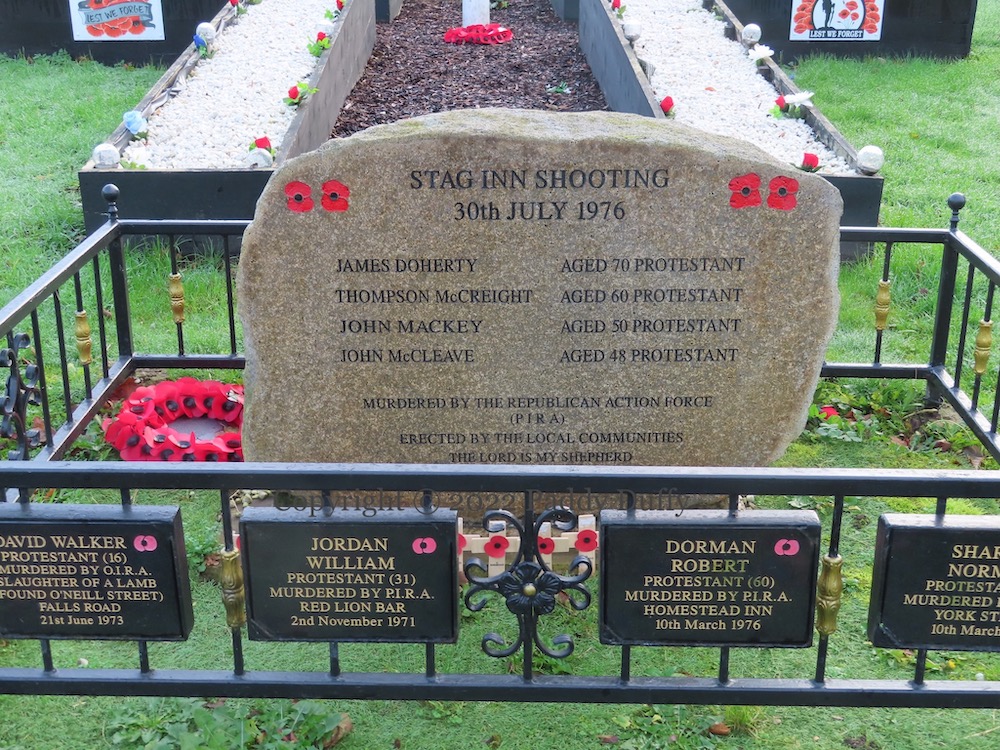
A long series of tit-for-tat shootings of pubs and clubs continued into the summer of 1976, with attacks on the Chlorane (June 5th), Walkers (June 25th), the Ramble (July 2nd), the Whitefort (July 29th), and then, on the 30th, The Stag at Shaws Bridge, Belfast, by the Republican Action Force (PIRA) (Sutton). John McCleave, John McKay, and James “Jimmy” Doherty died on the night of the attack, and Thompson McCreight died of his wounds nine days later. The memorial to them – “erected by the local communities” – is on Milltown Road, next to the Dreamscheme (web) mural.

Milltown Road, Belvoir, south Belfast

Click image to enlarge
Copyright © 2022 Paddy Duffy
T01530 [T01531] T01532 [T01533] T01534 T01535