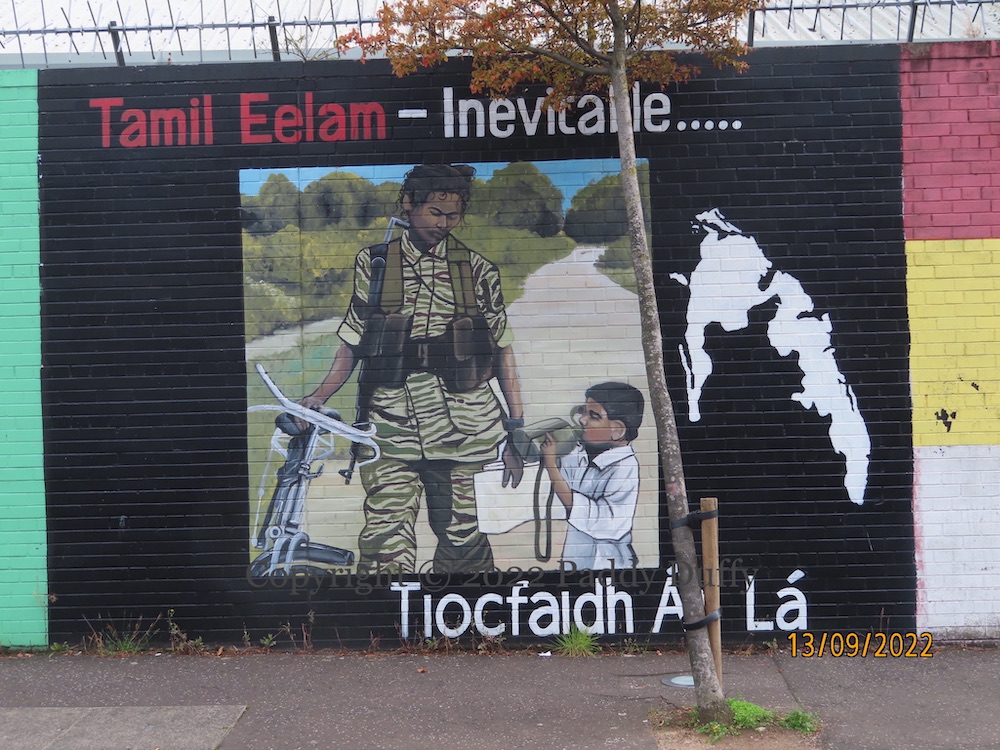
“Eelam” is the ancient Tamil name for Sri Lanka and “Tamil Eelam” is the name of a proposed Tamil state in the north and east of Sri Lanka (shown on the right of the mural) that the Tigers were fighting for. After 26 years of war, the Tamil Tigers were defeated in 2009 but independence (from the majority Sinhalese) is “inevitable” according to this new mural. For an account of commemorations in both Belfast and Derry, see this TamilNet article.
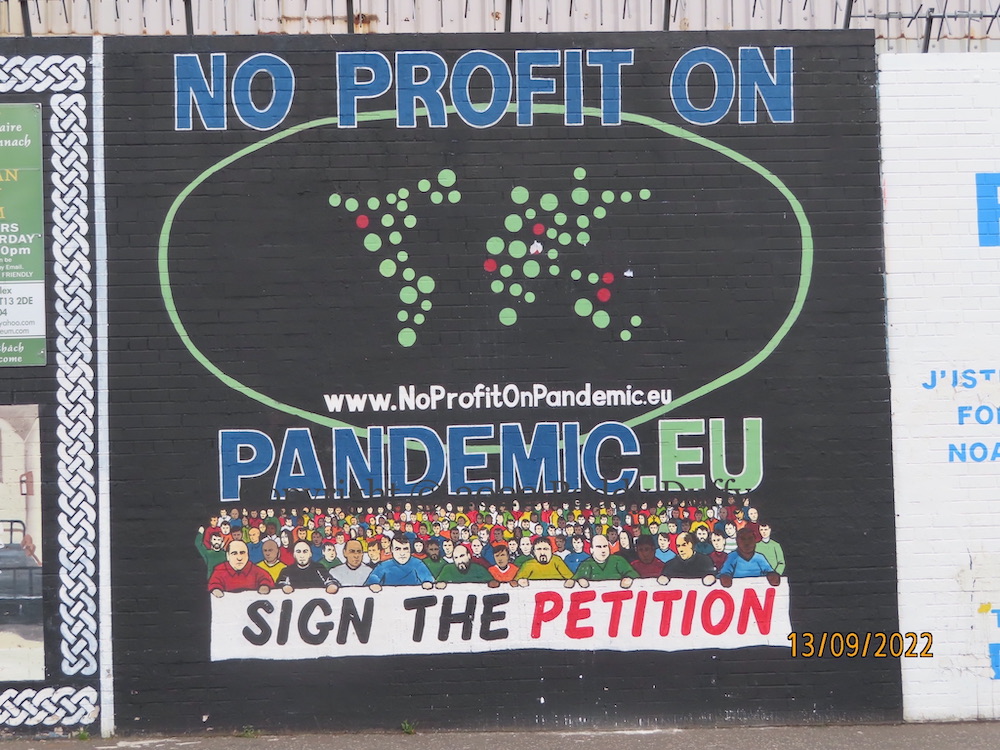
A “European Citizens’ Initiative” allows for legislation to be put before the European Commission if one million signatures are collected supporting it (europa.eu). Signatures are being collected for a petition to ensure that EU-funded work on Covid-19 is shared worldwide by a group calling themselves “No Profit On Pandemic” and “Right2Cure” (web). The mural takes the place of the vandalisedGeorge Floyd mural that was replaced with a place-holder reading “#BLM – back soon”.
Left: Lawyers for the PSNI defended the request for a Public Interest Immunity certificate regarding evidence in the case of Noah Donohoe (PA). This stencil on Divis Street says “not in our name” and asserts that “the public want full disclosure”.
Right: This is the third mural (see 2014 The Maze Ablaze and 2018 The Battle Of Long Kesh) on the International Wall on Divis Street about the ‘Battle Of Long Kesh’, when republican prisoners tried to burn down the cages in protest at living conditions in the camp. CR gas had recently been developed by the British MoD at a lab in Porton Down and is alleged to have been “used against Irish POWs”.
Brady & Faul wrote an 80-page report on the conditions at the camp following the event, entitled The Flames Of Long Kesh. “Telegram to International Red Cross: ‘ … Visited Long Kesh today with others … request immediate investigation into use of “CR gas” … sub-human conditions … SOS … come immed[i]ately’ – 20 Oct 1974, Brian Brady & Fr. Denis Faul”.
“Miguel Díaz-Canel Bermudez … President of the Republic Of Cuba 11.6.2021. ‘Irish friends and Cubans living in Ireland have placed a Cuban flag on a mountain in the city of Belfast. The flag is 46 by 23 metres, the largest in the world. With the flag [is] the giant slogan and it’s [sic] demand to #UnblockCuba. [This is a] Moving and beautiful gesture from the “solidarious” children of an admirable people, [a] dignified and patriotic gesture of Cubans who are far away. Thank you for your unshakable solidarity …”
(Originally in Spanish: “Amigos irlandeses y cubanos residentes, han colocado en una colina visible desde la ciudad de Belfast, una bandera de Cuba, de 46 por 23 metros, la más grande en el mundo. La acompaña un letrero también gigante, demandando #UnblockCuba. Bello y conmovedor gesto de los solidarios hijos de un pueblo admirable, digno y de patriotas que están lejos. Gracias por la solidaridad invariable.” #LetCubaLive
“Serving the community for over fifty years.” BTCIC is the current name for what was previously the West Belfast Taxi Association. Black taxis have been running up and down the Falls since 1970, providing an alternative form of transportation to local people during the Troubles when buses were cancelled or, as in this picture, burnt out and used as barricades. They now, in addition, provide tours of the murals (such as the Bobby Sands mural in Sevastopol Street) and Belfast city. Taxi Trax has a web site but here provides a phone number for those already at the International Wall, where there has been a black taxi mural since 2003.
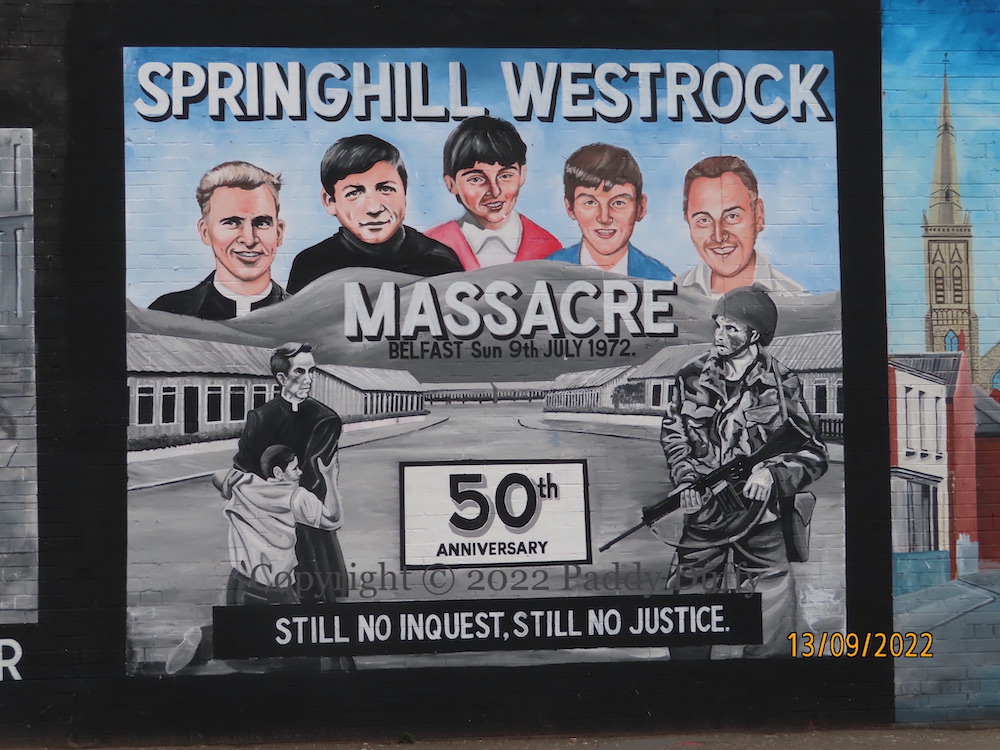
A march took place on July 9th, 2022, to mark the 50th anniversary of the Springhill-Westrock massacre, in which five people were killed by the British Army. A new inquest was directed by the AG in 2014 but has been repeatedly delayed; it is scheduled to begin next year (Belfast Live).
The march was organised by the Springhill-Westrock Campaign (Fb); it began at the memorial plaque in Springhill and ended at the memorial garden in Westrock (Irish News). See also Keep On Praying.
The mural shows the pre-fab aluminium bungalows built in Westrock in 1949.
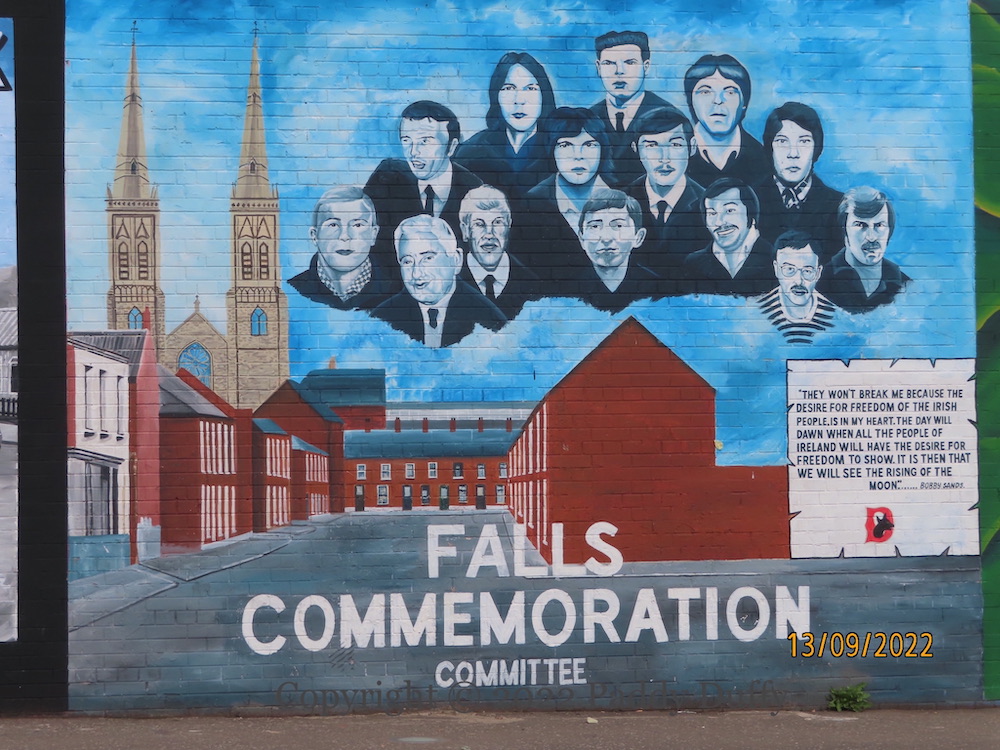
The Falls Commemoration Committee (Fb) organises an annual commemoration for IRA D company volunteers from Divis and the lower Falls (as well as special events for the fiftieth anniversary of the Falls Curfew in 2020). The fourteen local volunteers are portrayed in a group above St Peter’s. They include the five volunteers who died in 1972 and were depicted in a mural previously at this spot.
“‘They won’t break me because the desire for [freedom and the] freedom of the Irish people is in my heart. The day will dawn when all the people of Ireland will have the desire for freedom to show. It is then that we will see the rising of the moon’ – Bobby Sands [March 17th, 1981]” Originally in Irish: “Ní bhrısfıdh sıad mé mar tá an fonn saoırse, agus saoırse mhuıntır na hÉıreann, ı mo chroí. Tıocfaıdh lá éıgın nuaır a bheıdh an fonn saoırse seo le taıspeáınt ag daoıne go léır na hÉıreann. Ansın tchífıdh [chífidh] muıd éırí na gealaí.”
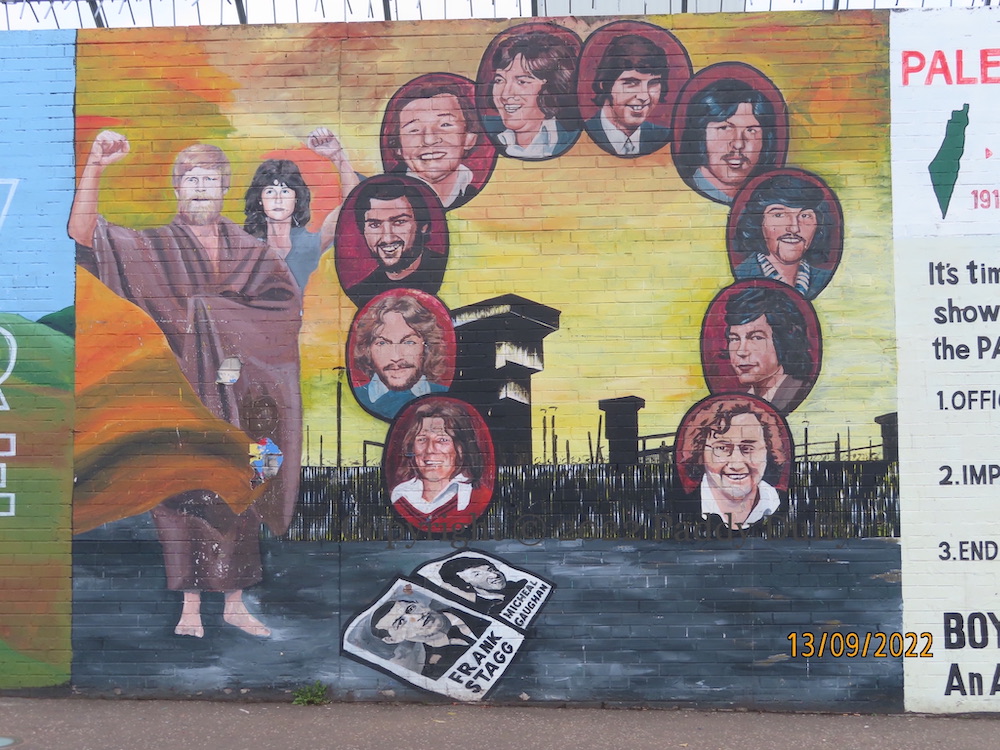
In 2014, after the Nugent/Hughes mural at the corner of Divis and Northumberland Streets (see Belfast’s Infamous Prison) was painted out to make way for a pro-Catalonia vote mural (see Votes About Votes), Kieran Nugent was added to the hunger-strikers mural further down the international wall, along with Mairéad Farrell, who was the second person, after Nugent, to refuse to wear a prison uniform. In 2016, that mural was revised for the Easter Rising centenary, by painting Kilmainham jail in the background. This background was later changed (c. 2019) to the watch-towers of Long Kesh, as shown above.
“Am le haontacht na hÉıreann” [Time for Irish unity]. Between stints in prison in 1976, Bobby Sands carried a green harp flag – symbol of Ireland and in particular of the United Irishmen – in an August march to protest the withdrawal of political status (Gérard Harlay/Bobby Sands Trust). He is shown here marching under the #TimeForUnity message on Slıabh Dubh in the campaign for a border poll and Irish unity “lenár lınn”/”in our time” (Fb).
The Great March Of Return was a six-week protest by Palestinians in Gaza. Most protestors at the border fence with Israel were non-violent but there are reports of some with rocks, burning tyres, Molotov cocktails on a kite, and an AK-47 (WP). It ended (officially – incidents have continued) on May 15th, Nakba Day, the “day of the catastrophe”, meaning the displacement of Palestinians in the 1948 war. The protest demanded that refugees be allowed to return home – there are 1.1 million living in Gaza. During the protest more than 100 Palestinians died, many by live fire by Israeli forces, and more than 13,000 were injured. According to the mural above, “It’s time the Irish Government show some humanity and act for the Palestinian people. 1. Officially recognise the state of Palestine. 2. Impose economic sanctions on Israel. 3. End all diplomatic ties with the apartheid state. Boycott Israel, an apartheid state.”
The wheelchair protester shown on the right is double amputee Saber Al-Ashkar. He has not, however, been reported dead, as the text below the image (and reports on Twitter and elsewhere) suggests: “They took his land, his legs, and finally his life.” The death might refer to another such protestor Fadi Abu Salah, who was killed in May (Alaraby) (or Ibrahim Abu Thuraya, who was shot in December 2017 – Independent obituary). The UN Commissioner for Human Rights called the killing “incomprehensible” (Guardian); an internal IDF investigation found that Abu Thuraya was not shot by Israeli snipers (Times Of Israel).
The mural was was originally painted without the carton of Cookie Dough ice-cream in Al-Ashkar’s sling. Vermont-based ice-cream maker Ben & Jerry’s announced that it would no longer sell its products in the Occupied Palestinian Territory which it says is subject to an “internationally recognised illegal occupation”. In response, Israel threatened parent company Unilever with “extreme consequences” (Reuters).