Incendiary Device

Before playing in the Falls Park as part of Féıle in August, Irish-language rap group Kneecap (web) revealed a mural in Hawthorn Street showing a PSNI land-rover on fire next to the phrase “Níl fáılte roımh an RUC [The RUC is not welcome]”.

Outraged responses to the mural have come from all quarters. The line comes from their song C.E.A.R.T.A. (youtube), about making sure the police don’t find the satirically enormous array of drugs – “cóc, speed, Es, agus moll marıjuana” to name only a few – they hope to take at a party: “Seans ar bıth go bhfaıghıdh sıad mo mhála MD/Mar tá cóısır ann anocht ‘s níl fáılte roımh an RUC”.

The Kneecap party and the middle Falls are the latest in a long line of places where the PSNI is not welcome, not just Ardoyne, Divis, and the Bogside (Derry) but also PUL areas the Village, the Shankill, Carrickfergus, Millbrook (Larne), the Caw (Londonderry), and Tullyally (Londonderry).

Click image to enlarge
Copyright © 2022 Paddy Duffy
T00841 [T00842]
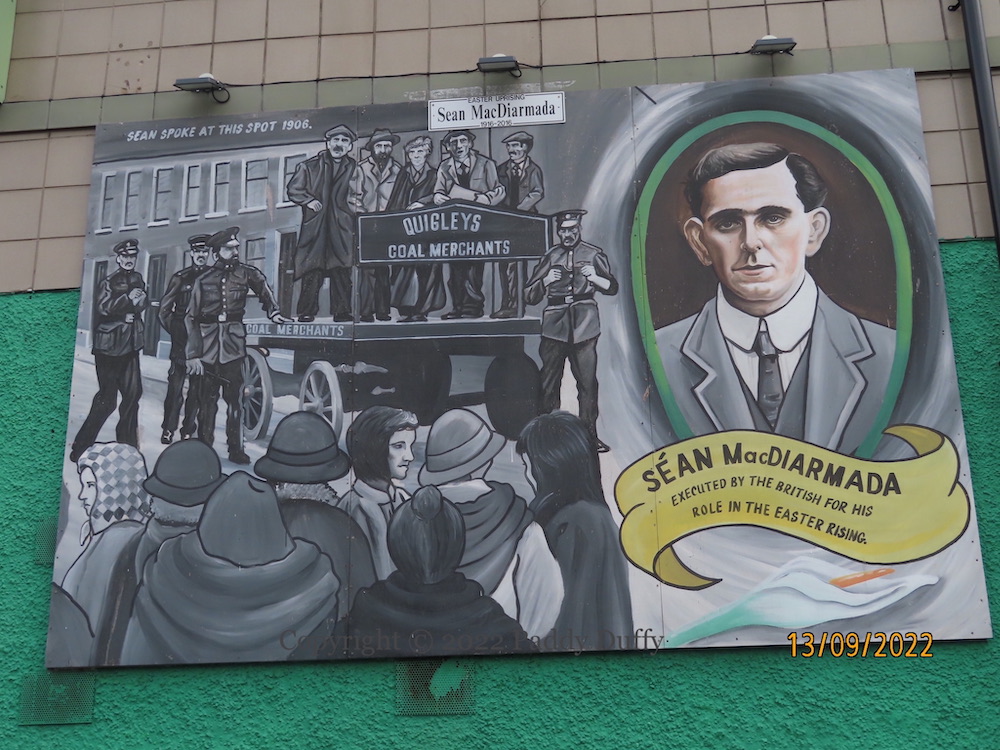
The Mainspring

Seán Mac Dıarmada was born in Leitrim, left for Glasgow at age 15, but after two years returned to Belfast in 1905 (working on the trams) and – according to the new mural above – spoke from the back of a coal lorry in Clonard Street, outside the Clonard branch of the Ancient Order Of Hibernians. Mac Dıarmada was for a short time an AOH member, before moving on to the Irish Republican Brotherhood and Irish Volunteers, which led to his participation in the 1916 Easter Rising and execution on May 12th of that year.

The title of this post is historian F.X. Martin’s assessment of Mac Dıarmada, quoted in a pamphlet on Mac Dıarmada from the National Library Of Ireland, which includes reproductions of letters from and about Mac Dıarmada. The NLI made more letters available today (2016-02-08). (See also this Irish Times write-up).

Previously: A 2013 Mac Dıarmada mural in Ardoyne.

Click image to enlarge
Copyright © 2022 Paddy Duffy
T00826 [T00825]

We Bleed That The Nation May Live

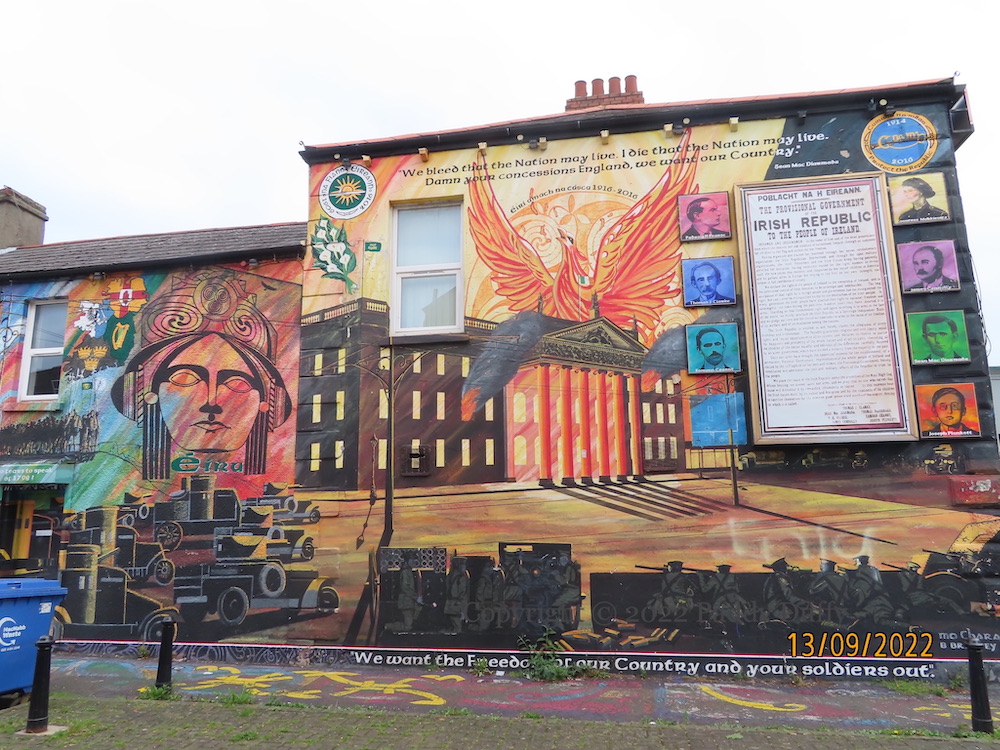
Arrayed against the forces of the British Army (which are shown in armoured cars and in sniping positions in the foreground of the mural, along the whole length of the wall) are various symbols of Irish nationalism: Oliver Sheppard‘s 1911 statue of Cú Chulaınn dying; the pikemen of the 1798 Rebellion (Éırí Amach 1798); the four provinces of Ireland; Érıu the mythological queen of Ireland/Éıre as designed by Richard J King/Rísteard Ó Cíonga; Easter lilies; the emblems of Na Fıanna Éıreann and Cumann Na mBan on either side of a quote from (The Mainspring) Sean MacDiarmada “We bleed that the nation may live; I die that the nation may live. Damn your concessions, England: we want our country”; a phoenix rising from the flames of the burning Dublin GPO (inspired by Norman Teeling’s 1998 painting The GPO Burns In Dublin); the GPO flying an ‘Irish Republic’ flag; portraits of signatories and other rebels — (left) Padraig H. Pearse, Thomas J Clarke, Eamonn Ceannt, Thomas MacDonagh, (right) Countess Markievicz, James Connolly, Sean MacDiarmada, Thomas Plunkett; the declaration of independence, placed over the advertising box of AA Accountants – see the in-progress shot below. For more work-in-progess images, see Éırí Amach 1798. At the very bottom is a quote from the mother of Gerard ‘Mo Chara’ Kelly, Harriet Kelly: “We want the freedom of our country and your soldiers out.”

McQuillan Street, west Belfast

Click image to enlarge
Copyright © 2022 Paddy Duffy
T00821 [T00822] T00823

Executed

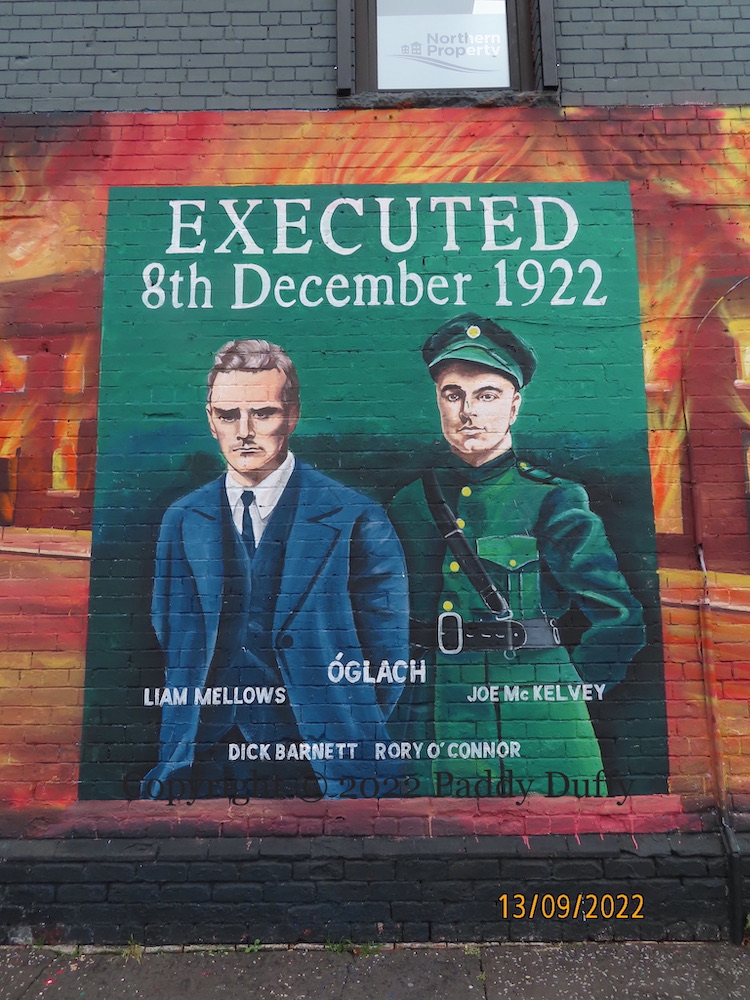
On October 18th, 1922, the third Dáıl/second Provisional Government Of Southern Ireland approved – in the absence of anti-Treaty members – a bill entitled the “Army Emergency Powers Resolution” which introduced martial law, including martial courts with the death penalty for anyone found in possession of an illegal firearm – “illegal” meaning not sanctioned by the nascent pro-Treaty Free State. Under these powers, seven IRA volunteers were executed on November 17th and 19th, followed on the 24th by Erskine Childers (a member of the team that negotiated the Treaty but subsequently against it). In response, the IRA declared that TDs who had voted for the bill were fair game, and on December 7th Seán Hales of Cork was shot and killed. In reprisal, the government ordered the execution of four more volunteers, one from each province: Liam Mellows, Joe McKelvey, Dick Barnett, Rory O’Connor. The four had been arrested five months earlier, on June 30th, 1922, at the start of the Civil War, after surrendering the Four Courts. By the end of the war, 81 executions had taken place. (An Phoblacht | Irish Times | The Irish Story | WP | WP)

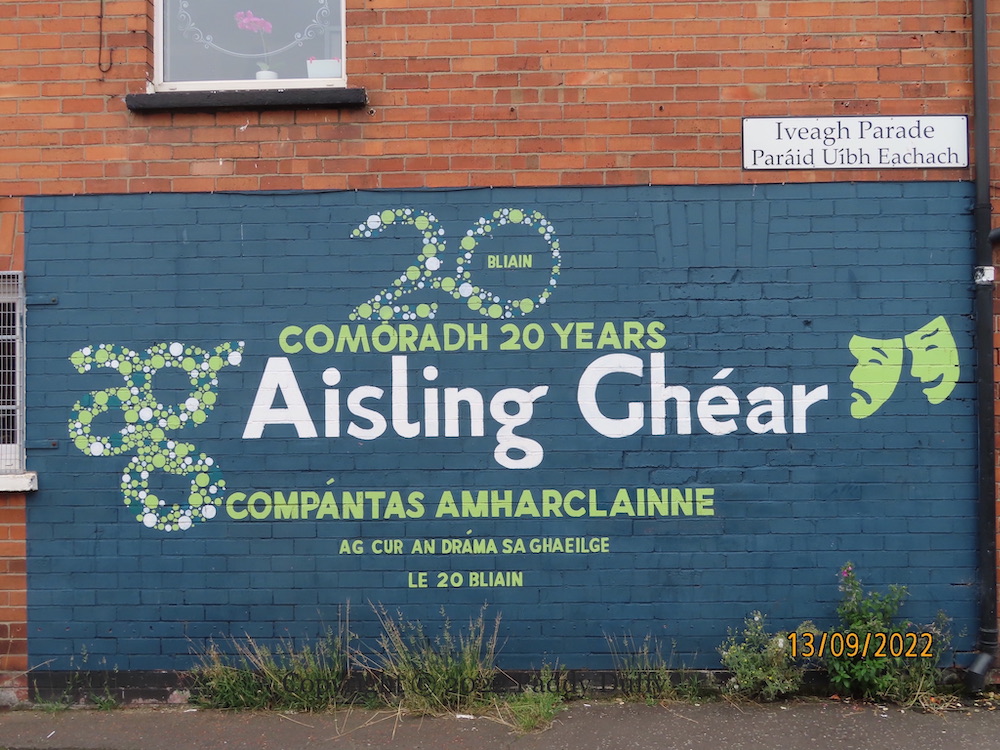
For the left-hand side of the wall, on the shipyard clearings and the McMahon murders, see Belfast Butchery.

Click image to enlarge
Copyright © 2022 Paddy Duffy
T00803 [T00802]

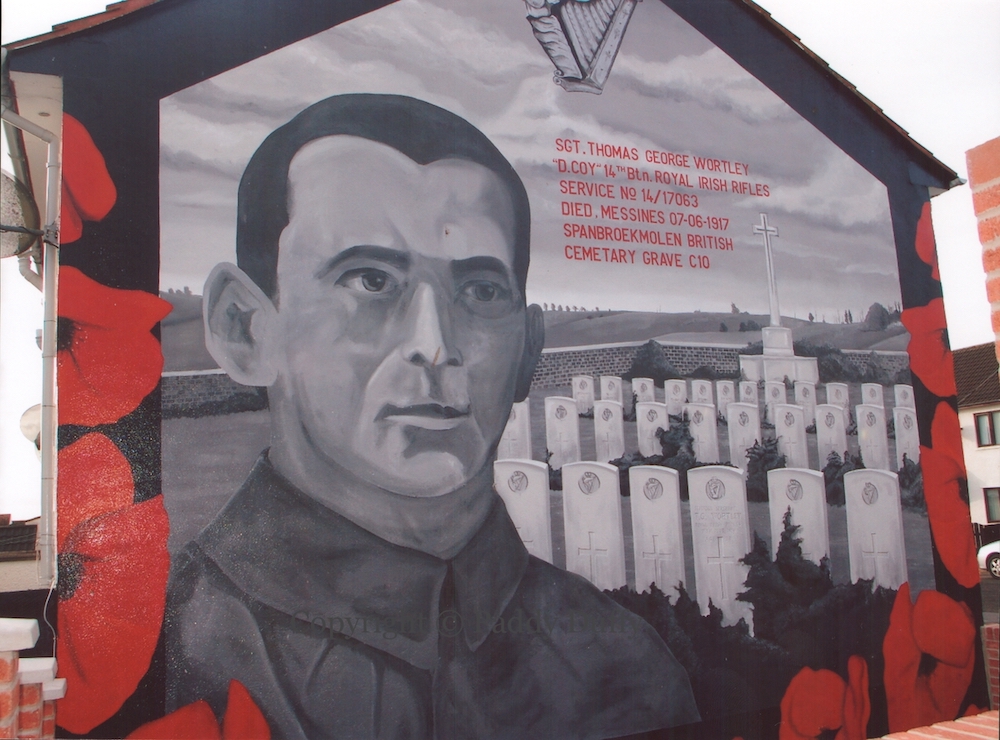
Thomas George Wortley

“Sgt. Thomas George Wortley , “D Coy” 14th Btn. Royal Irish Rifles, Service No. 14/17063, Died Messines 07-06-1917, Spanbroekmolen British Cemetary Grave C10″. Wortley was born in Carrickfergus, lived in Belfast, died on the first day of the battle at Messines (findagrave), buried in a small cemetery of British soldiers, many from the 36th (Ulster) Division, in Spanbroekmolen on the Ypres Salient in Flanders (WP) – shown in the mural – and is remembered in Carrickfergus with a parade each year on the date of his death (carrickfergusrollofhonour).

Maple Gardens, Carrickfergus

Click image to enlarge
Copyright © 2012 Paddy Duffy
T00651

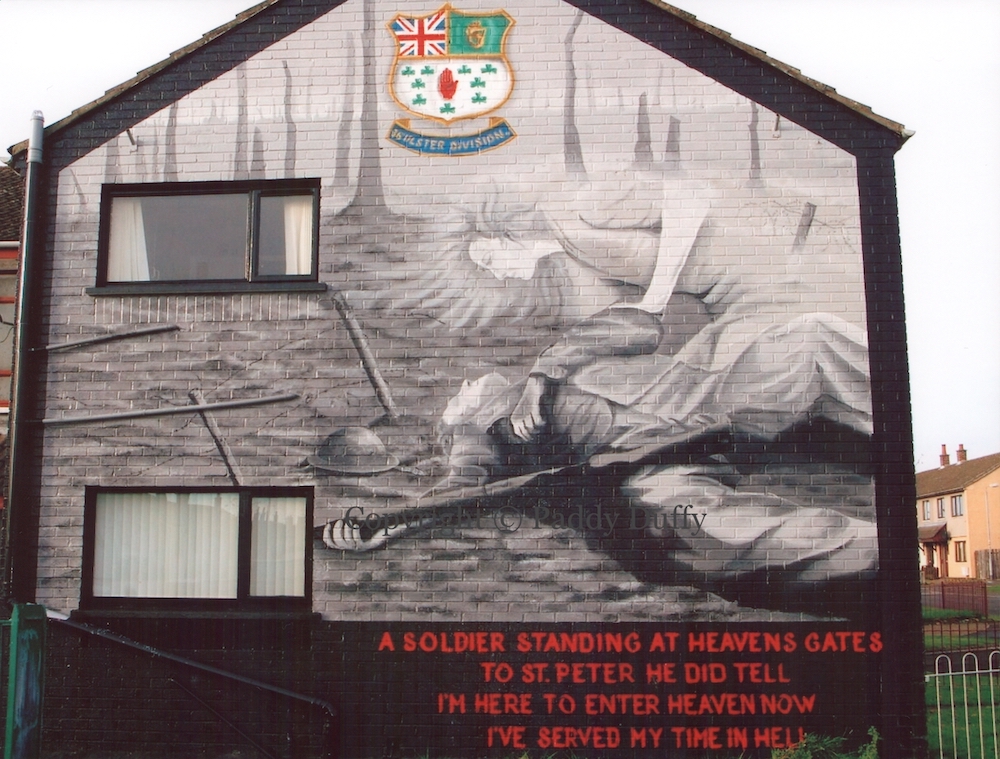
Time In Hell

A dead WWI soldier in the scorched Belgian countryside is comforted by an ethereal figure who will convey him to heaven: A soldier standing at heaven’s gate/To St. Peter he did tell/I’m here to enter heaven now/I’ve served my time in hell – a variation on James Donahue’s WWII Soldier’s Poem (WP). The poem was previously used of Republicans in a 1981 mural in Derry (see I Refuse To Change/M00151).

The Larches, Carrickfergus

Click image to enlarge
Copyright © 2012 Paddy Duffy
T00635

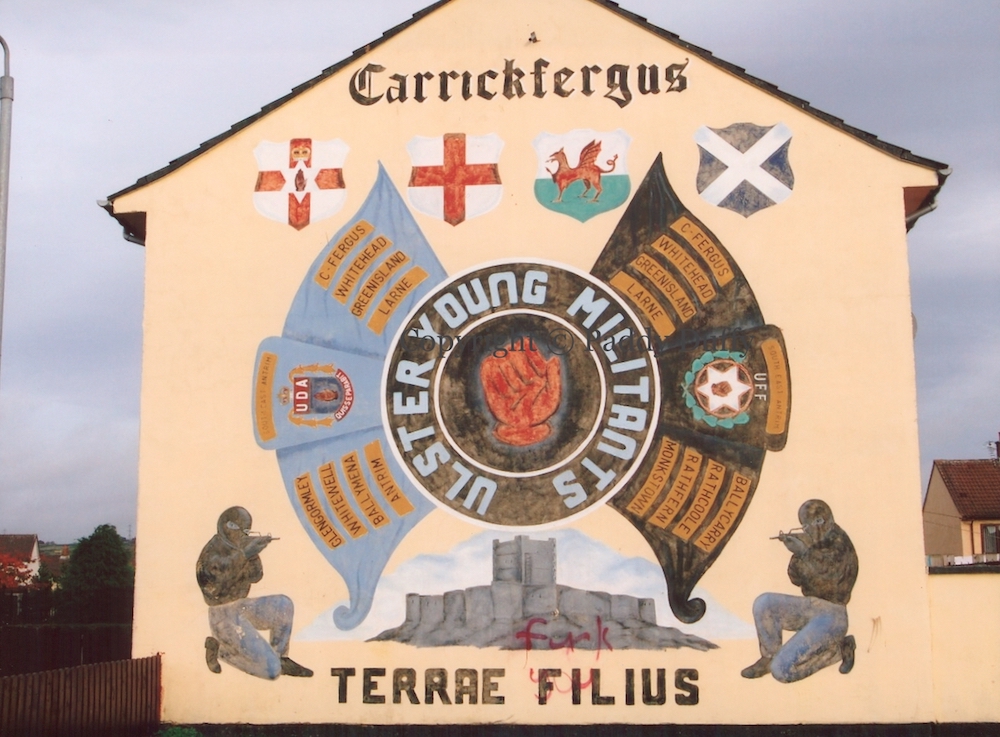
Carrickfergus UYM

Hooded gunmen from the UDA/UFF/UYM take aim at children going to Woodlawn primary school. There are a few emblems and a quote on the side-walls to the right (out of frame), including the phrase “They rose in dark and evil days to free our native land” which comes from the song ‘The Memory Of The Dead‘, about the 1798 Rebellion, rather than the creation of the UDA in 1971.

The Birches, Carrickfergus

Click image to enlarge
Copyright © 2012 Paddy Duffy
T00616 [T00643]