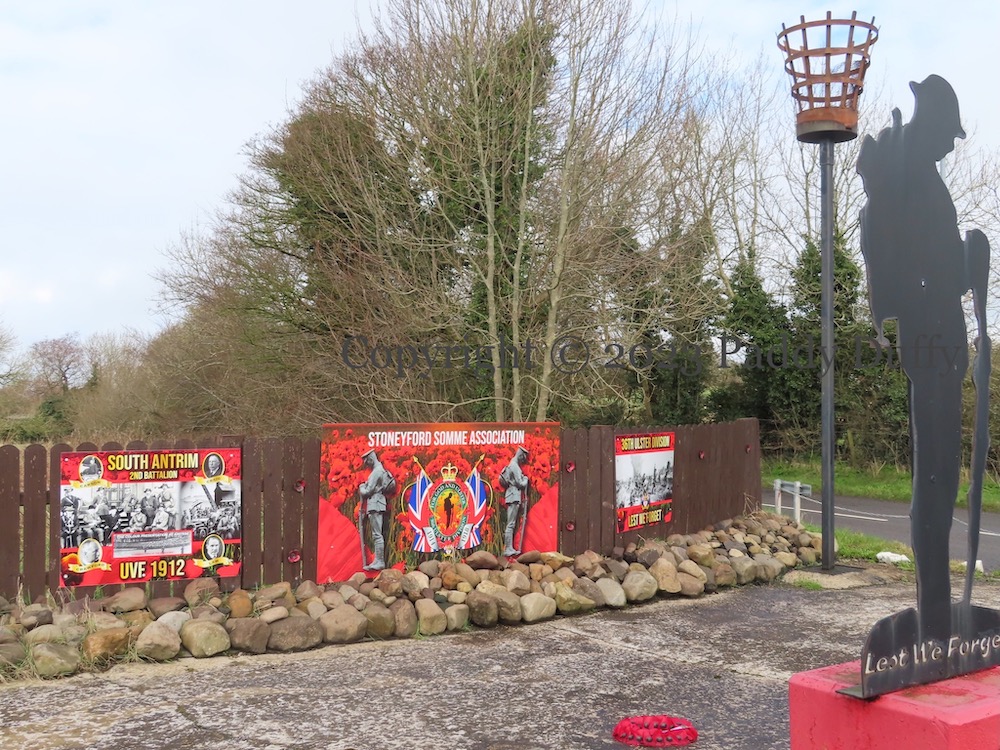
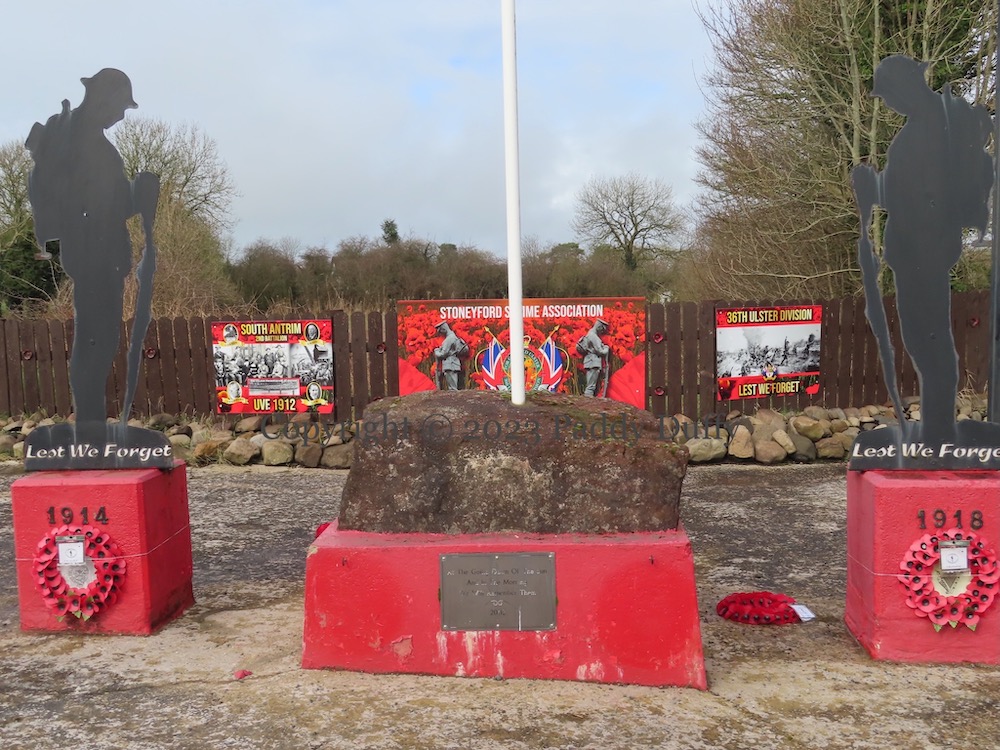
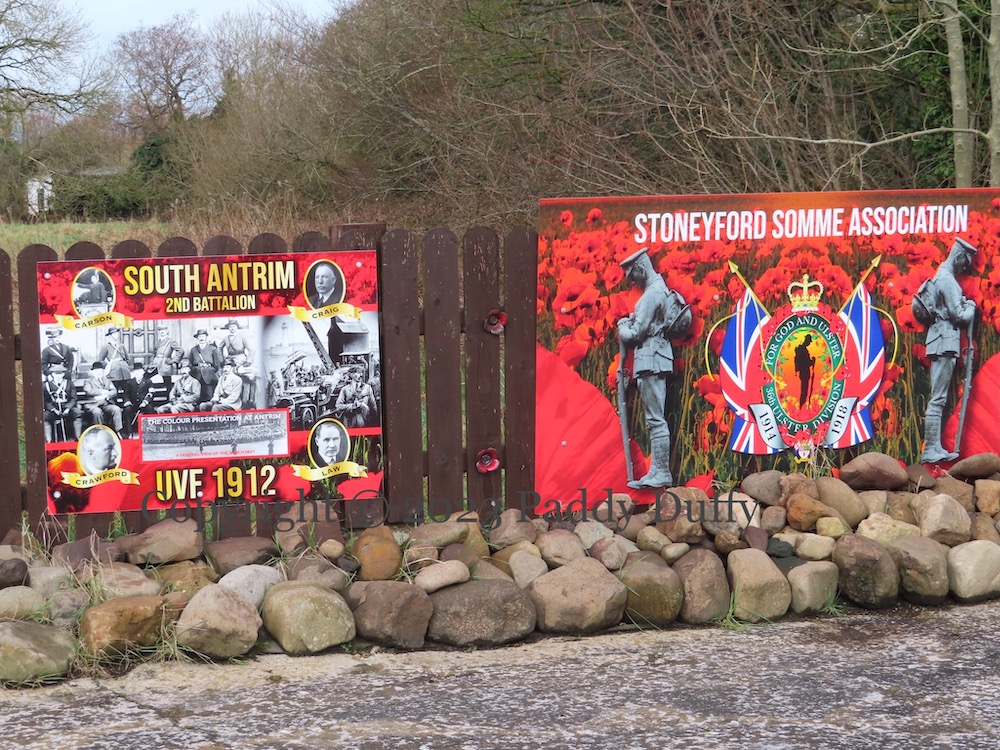
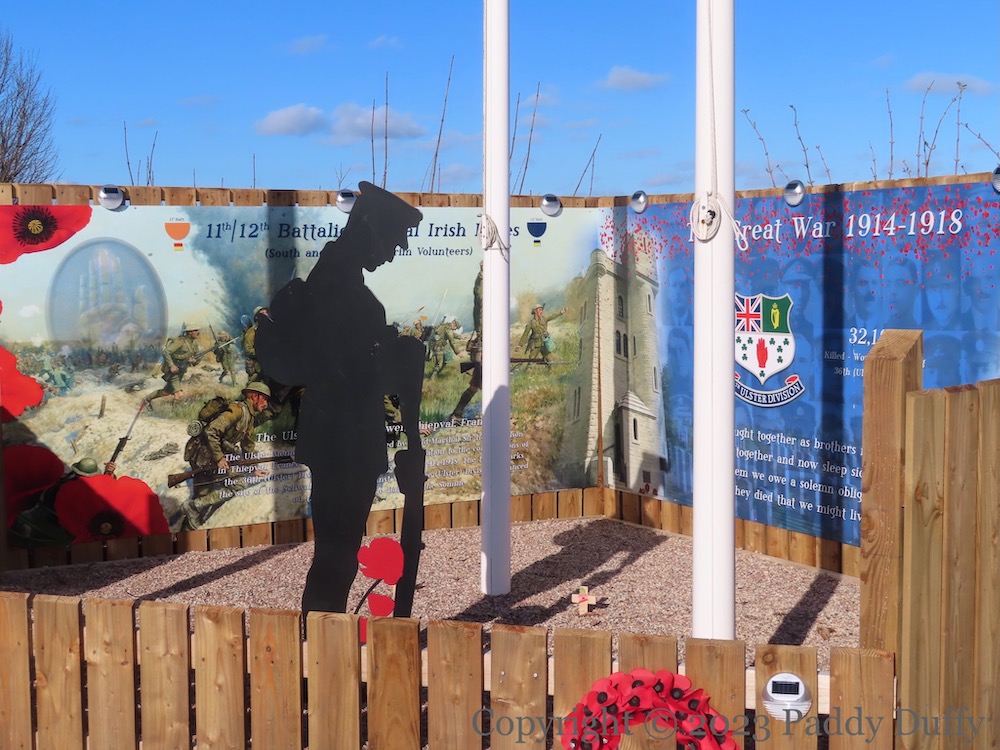
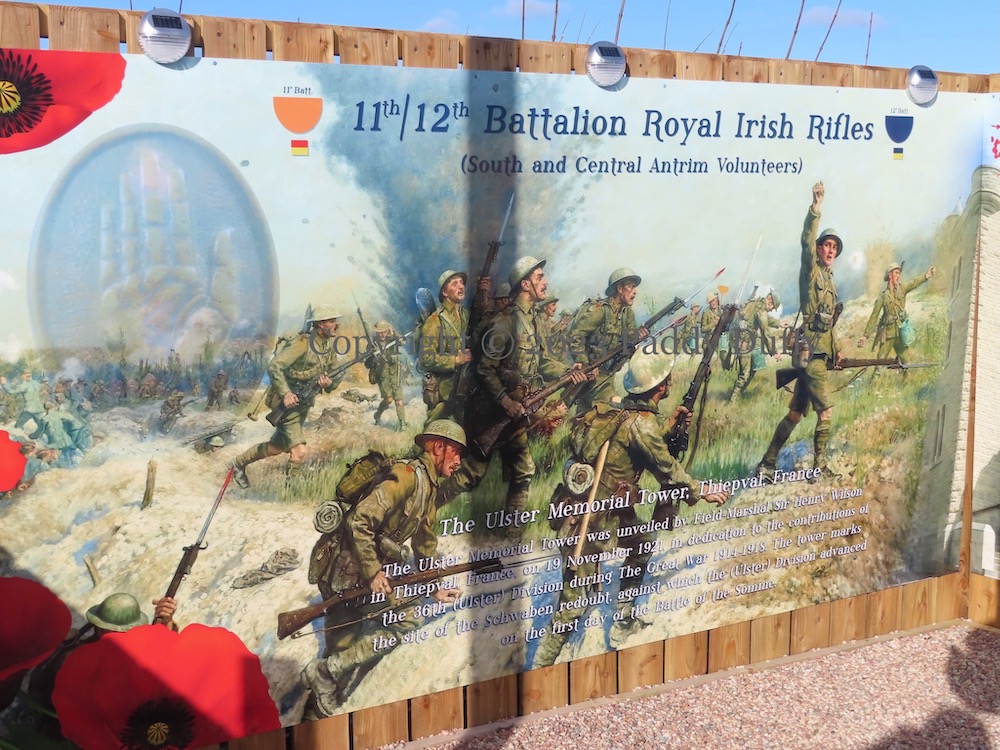
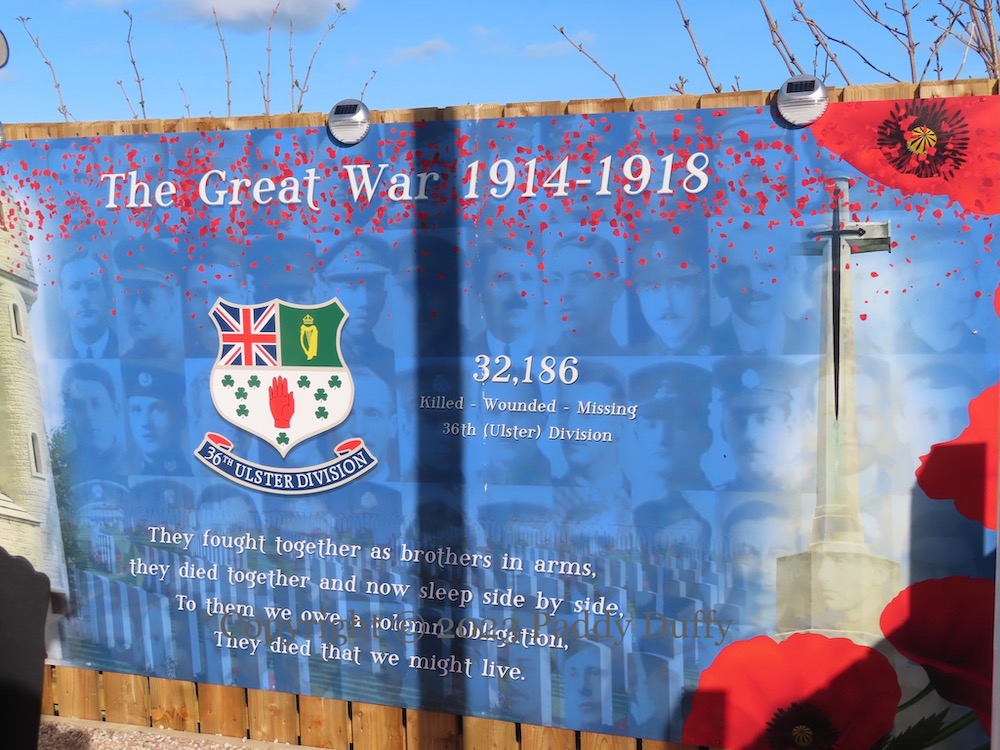
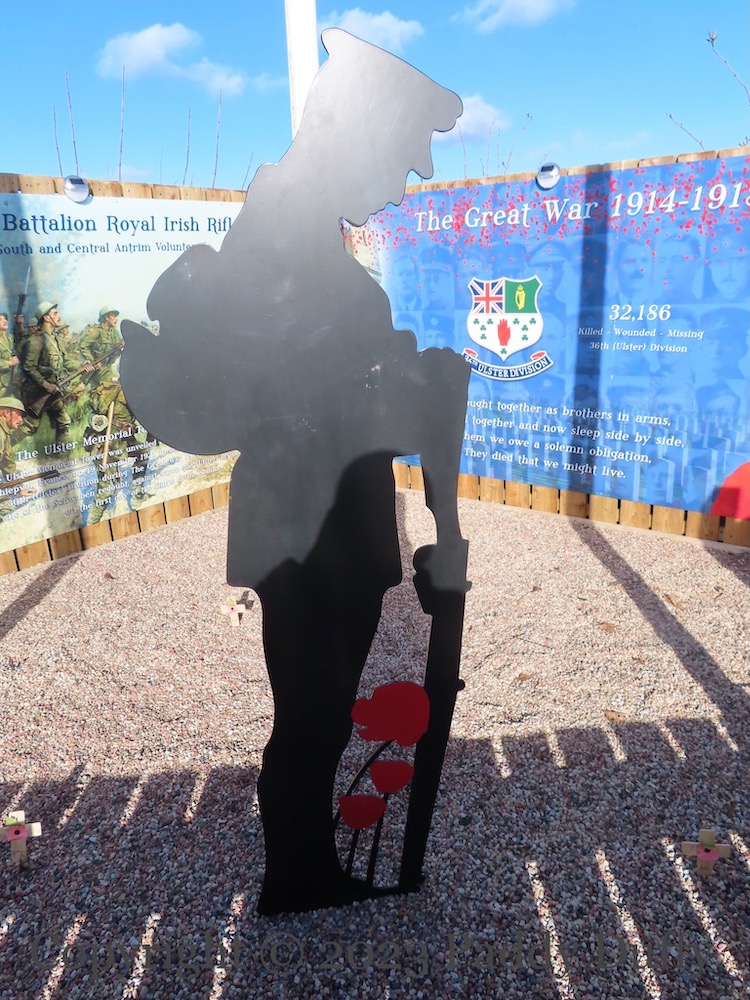
Boards have been added to the WWI memorial plaque in Stoneyford. On the right, the 36th Division go over the top in Beadle’s ‘Attack Of The Ulster Division’ (see Over The Top); the board on left more specifically commemorates the 2nd battalion of the South Antrim Ulster Volunteers, flanked by the leaders of the anti-Home Rule movement – Carson, Craig, Crawford, and Bonar Law.
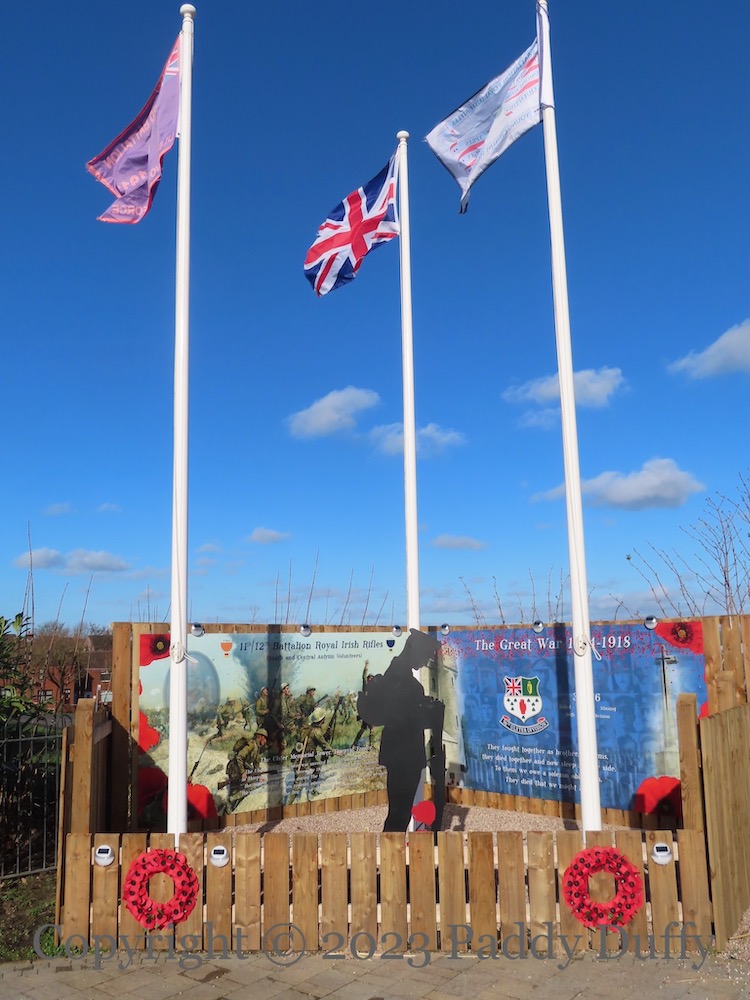
The 11th and 12th battalions of the Royal Irish Rifles were part of the 108th brigade and the 36th (Ulster) Division in WWI.
On July 1st, 1916, the 12th battalion’s objective was to reach the German trenches beyond Beaucourt railway station with the 9th battalion Royal Irish Fusiliers (Armagh, Monaghan & Cavan Volunteers); they were cut down by machine-gun fire and unable to achieve their goal. Robert Quigg of the 12th Rifles and Geoffrey Cather of the 9th Fusiliers were awarded the VC (see previously VCs Of The 36th). The 11th was part of the attack on the Schwaben Redoubt and reached the German second line before being pushed back in the evening. (Royal Irish | Web Matters)
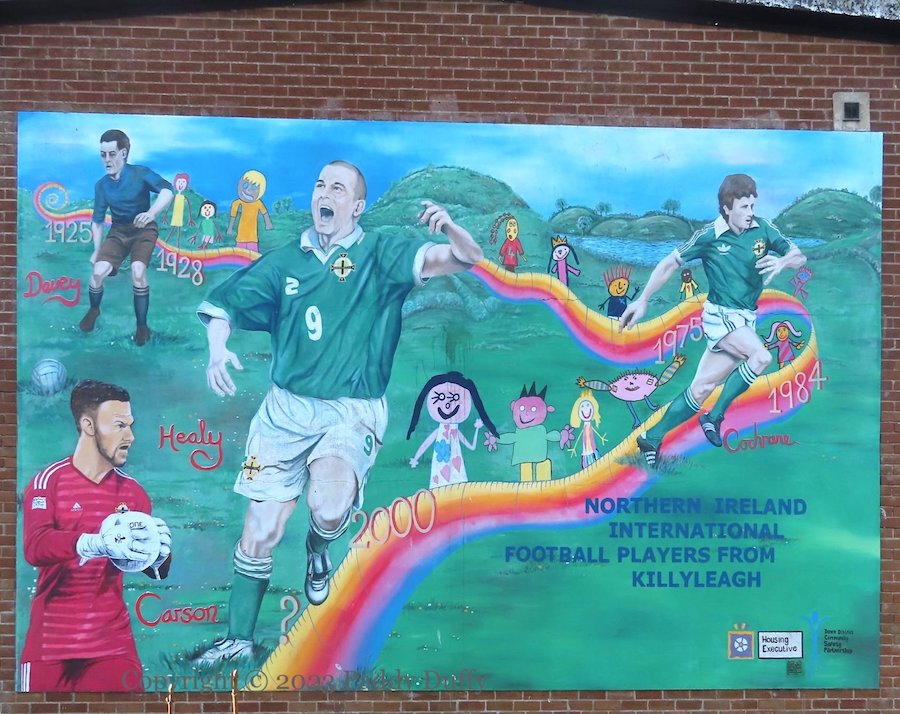
When this mural of Northern Ireland players from Killyleagh was originally painted in 2006 it featured only three players:
– Hugh Davey, from Shrigley, five caps for “Ireland” (that is, for the IFA team) from “1925-1928” (NI Football)
– Terry Cochrane, 26 caps for Nothern Ireland from “1975-1984”; he played in the ’82 World Cup qualifiers but was injured for the tournament itself (NI Football)
A space and a question-mark were left at the bottom of the rainbow for future stars, in particular for then-seventeen-year-old up-and-comer Trevor Carson (Glasgow Times) who indeed went on to win his first (senior) cap in 2018 and currently has eight in total. He was added to the mural in 2021 (tw).
Braeside Gardens/Frederick Street, Killyleagh. Carson’s mother lives in the estate (Sunderland Echo).
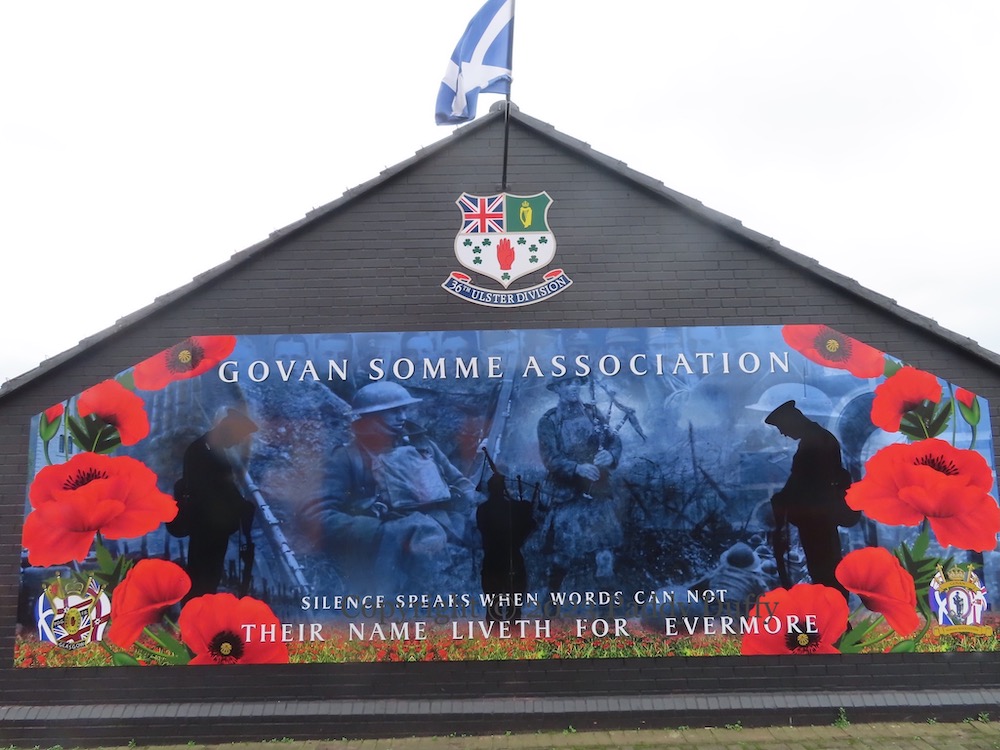
There was previously a (painted) mural on this wall – see Passchendaele Court – but this latest display is a large printed board, with photographs blended together and framed by graveside mourners, poppies, and the emblems of the Pride Of Govan flute band and the Govan Somme Association (Fb), which also supported the previous mural.
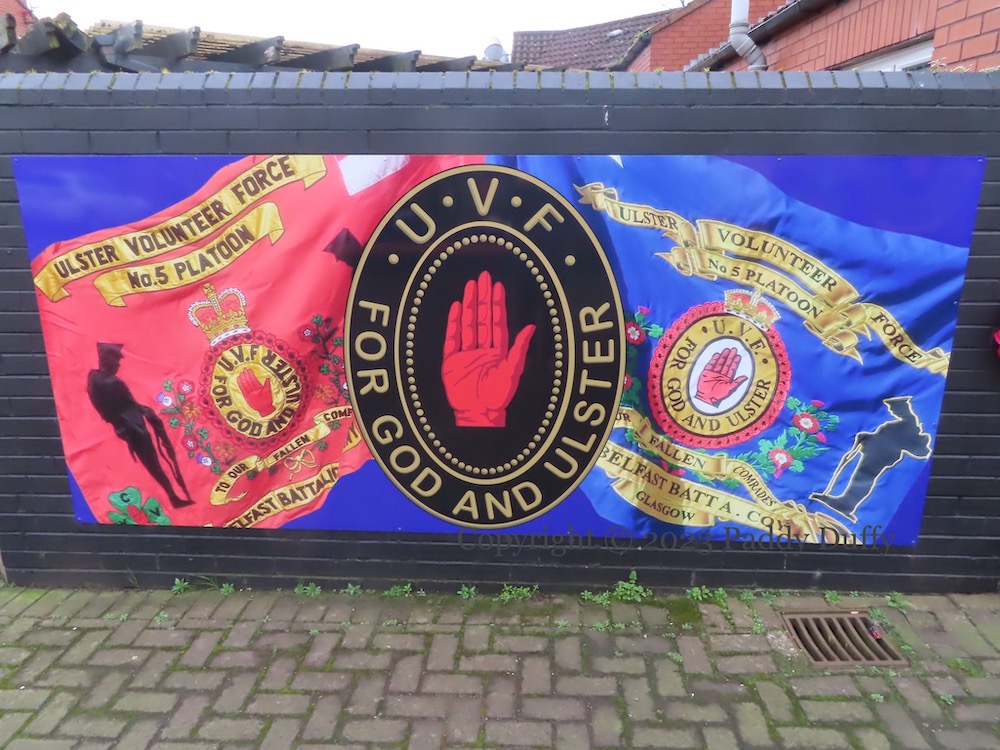
To the left, as seen in the final images, is a smaller UVF (1st Battalion) A Company 5th Platoon board – like the other new board in the street We Will Always Be Ready (and on the other side of Conway Street – see When Needed We Shall Rise Again).
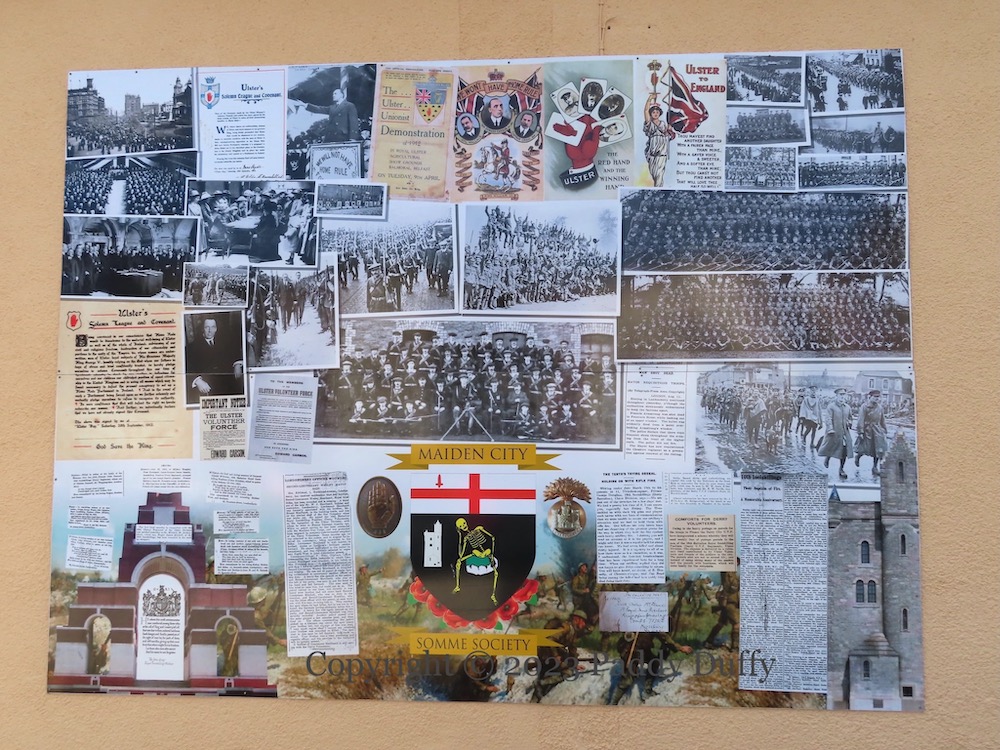
This board from the Maiden City Somme Society (Fb) traces the history of 1912-1918, from the protests against Home Rule and the signing of the Ulster Covenant (both the men’s (middle left) and women’s (top row, second from left) versions of the declaration are shown; also in the top row are postcards seen previously in The Red Hand And The Winning Hand and Ulster Girl), to the formation and training of the Ulster Volunteers (specifically the City of Derry regiment – emblem left of the city crest), to the Ulster Division’s service in WWI (specifically the 10th Battalion Royal Inniskilling Fusiliers or ‘Derry Volunteers’ – emblem right of the city crest) shown in the bottom row by JP Beadle’s painting (see Over The Top) flanked by the Thiepval and Ulster Tower memorials.
The board was launched in August 2016 in the Fountain, Londonderry.
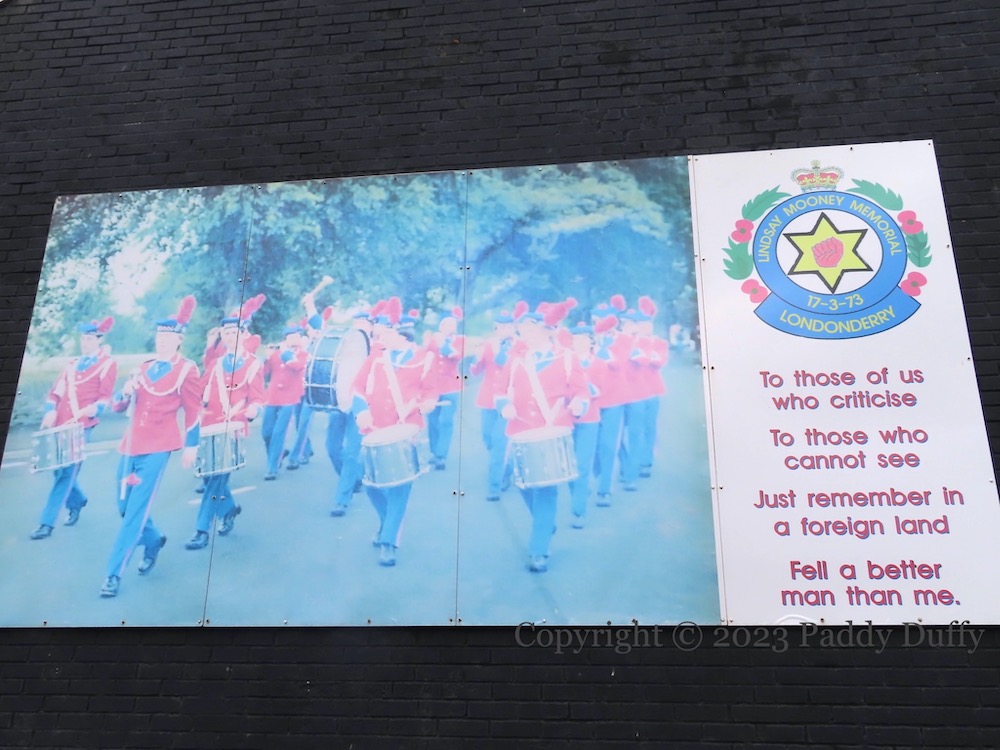
The [Sergeant] Lindsay Mooney Memorial Flute Band was formed in 1973 after the St. Patrick’s day death of Lindsay Mooney, a UDA member killed by the premature explosion of a bomb near Lifford, County Donegal (Sutton). The band dissolved in 1993 but commemorative nights are still held (NI World). It has presumably re-formed, as there are videos on youtube of the band parading in 2021 and in 2022 and they will march for the 50th anniversary of the band later this year (2023) (youtube).
The board above is in the Lincoln Court area of Londonderry, from where Mooney and the band both hailed. “To those of us who criticise, to those who cannot see, just remember in a foreign land fell a better man than me.”
900 people died and half the homes in Belfast were destroyed or damaged in the Belfast Blitz of WWII (WP). in the apex of this mural a Nazi bomber sets buildings alight; in the main panel, people, including a milkman, walk among the bombed-out buildings and play a piano that has been pulled from the rubble.
Painted in 2013 by JMK, in Hogarth Street, Tiger’s Bay, north Belfast
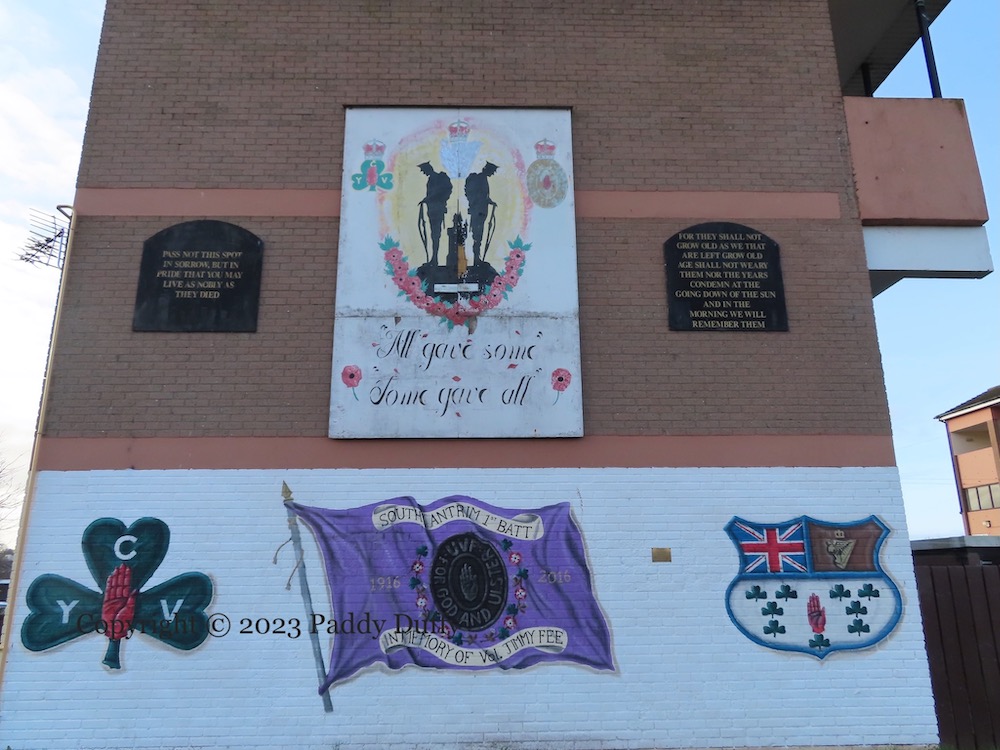
There has been a 36th Division board on this wall since 2003 (see Steeple Defenders) and this second one is now more than a decade old – see the 2013 post on Peter Moloney’s site. It is accompanied by two quotations: “Pass not this spot in sorrow but in pride/That you may live as nobly as they died.” These lines are also used in a WWI memorial mural in Carlingford Street, Belfast. “They shall not grow old as we that are left grow old./Age shall not weary them nor the years condemn./At the going down of the sun and in the morning, we will remember them.” from Binyon’s For The Fallen.
The mural below, with YCV and 36th Division emblems and a “South Antrim 1st Batt” flag was added in 2016. There’s no mention on-line of “Vol. Jimmy Fee” of the 1st (and only) battalion of the South Antrim brigade.
The board and mural are on the gable next to the Steeple memorial mural to Denver Smith; between the two gables is the UVF flag shown below.
Ulster Tower in Thiepval, France, provides a background for 13 jigsaw pieces with partial images relating to the Great War, including a uniform with a Victoria Cross and badge of the 36th (Ulster) Division, the 10th (Irish) Division, the 16th (Irish) Division, and the Royal Irish Fusiliers (and a fourteenth piece for information).
Kilgreel Road, Antrim. The mural is more than a decade old and is bleached from the sun (the pinks were formerly brown); on the former site of The People’s Army (a UVF board).
“This artwork, commemorating the sacrifices made during the Great War and subsequent conflicts, was produced by the young people of Parkhall Youth & Community Club and was completed in 2010. It is part of a larger Re-imaging project undertaken by Parkhall Cultural Awareness Association & Parkhall Community Association. 14 jigsaw pieces are representated as that was the age of the youngest soldier to die on the Somme. The Royal Irish Fusiliers, who recruited in the Antrim area, served with the 10th Irish Division and 36th Ulster Division during World War I. The cap badge is surrounded with poppies. The poppy is an international symbol commemorating the sacrifices of members of the armed forces and of civilians specifically since the Great War. Birds were used extensively during World War I delivering important logistic message from the front line. HMS Antrim served in the Great War and survived. After the war she became the first ship to be fitted with an experimental sonar system in 1920. Her bell can presently be viewed in Antrim Civic Centre. The grounds of Shane’s Castle in Antrim were used as a training ground and a campsite for the 36th Ulster Division prior to their deployment to France. Of all bell tents and parachutes during the Great War 90% were made from Irish Linen. During the Great War a service man’s basic wage was one shilling a day (5 pence). The sound of the bugle was heard throughout each day in the trenches, starting with Reveille to rouse you from slumber. ‘Flowers of the Forest’, a powerful Scottish lament, is often played by a lone piper at services of Remembrance. “I am not an Ulsterman but yesterday, the 1st July, as I followed their amazing attack, I felt that I would rather be an Ulsterman than anything else in the world.” Extract from the speech by Captain Wilfred [Wilfrid] Spencer 2st July 1916. Men from the 36th Ulster Division received 9 Victoria Crosses. Women played a vital role in field hospitals during the Great War caring for the injured, from the front line. The flags of the 16th and 10th Irish Divisions. 36th Ulster division. The Ulster Tower is a memorial to the men of the 36th Ulster Division. It is situated near the entrance to Thiepval Wood, France.
On the front of the wall, soldiers from the 36th (Ulster) Division stop at a grave as they march through Flanders Fields; just around the corner (second image) is a memorial to a (modern) UVF member “Vol. D[avid] Langley, 1969-2018”.