“In memory of Brigadier Billy Wright (King Rat). ‘Greater love hath no man than this: that a man lay down his life for his friends.’ – John Ch15v13. Gone but not forgotten.” Wright became alienated from the UVF due to his opposition to the ceasefire and peace process (in 1994) and was finally kicked out in 1996 during the Drumcree dispute. The Portadown UVF under Wright formed the LVF [Loyalist Volunteer Force]; another LVF unit was formed in Ballycraigy, where this memorial can be found. (BBC | WP) Silhouetted graveside mourners have been added, compared to the 2009 image in the Peter Moloney collection.
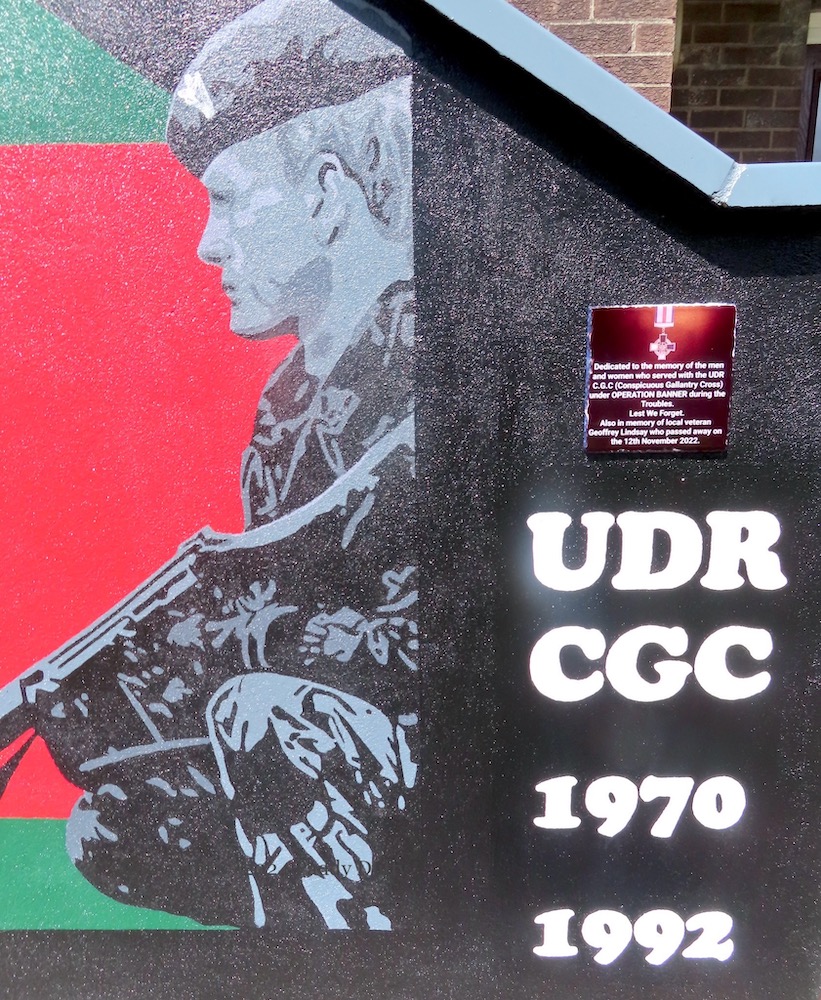
“Dedicated to the memory of the men and women who served with the UDR C.G.C (Conspicuous Gallantry Cross) under OPERATION BANNER during the Troubles. Lest we forget. Also in memory of local veteran Geoffrey Lindsay who passed away on the 12th November 2022.”
The Conspicuous Gallantry Cross is shown (in the close-up below) at the top of the board; it was awarded to the UDR retroactively in 2006 for its role in ‘Operation Banner’, i.e. the deployment of British Army troops to Northern Ireland – the regiment had been folded into the Royal Irish Regiment in 1992. The mural is specifically to the 5th (Co. Londonderry) battalion – here is a list of the 11 battalions (and bases).
There is also a UDR information board (and an Ulster Volunteers board) in the green-space in front of this mural – see Leckagh Remembers The Fallen.
The memorial mural to the 36th (Ulster) Division on the end wall has also been completed since last (2023) year – in-progress images for both murals from last August are included below. For the previous murals on these walls, see C07766.
Two other pieces are included, below: the UVF mural was seen last year in Pause, Reflect, Remember; the ‘Ignite the fire’ board appears to be new.
Leckagh Drive, Magherafelt
August 27th green-washing of previous mural:
August 27th in-progress image of mural immediately above:
Here are three pieces from the Drumcor Hill area of Enniskillen.
Above, “Enniskillen remembers the hunger strikers” – for the fortieth anniversary of the 1981 strike, against a background of sunburst and starry plough, in Loughview Drive.
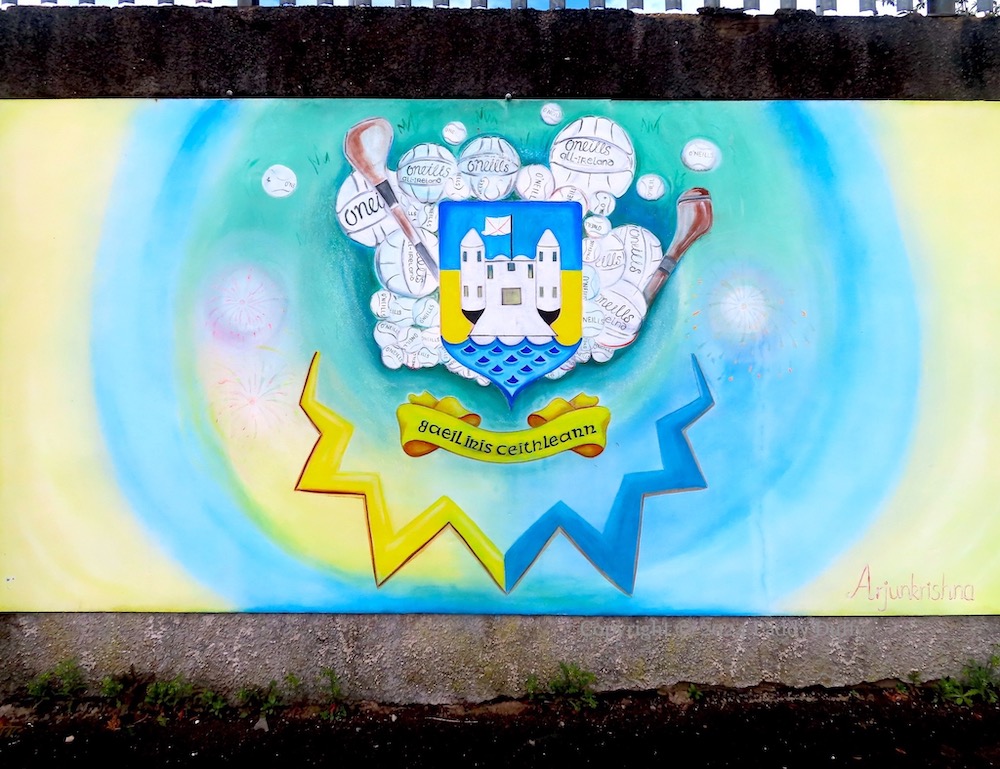
Below, the emblem of Gaeıl Inıs Ceıthleann/Enniskillen Gaels (web) on the wall outside their home field of Brewster Park.
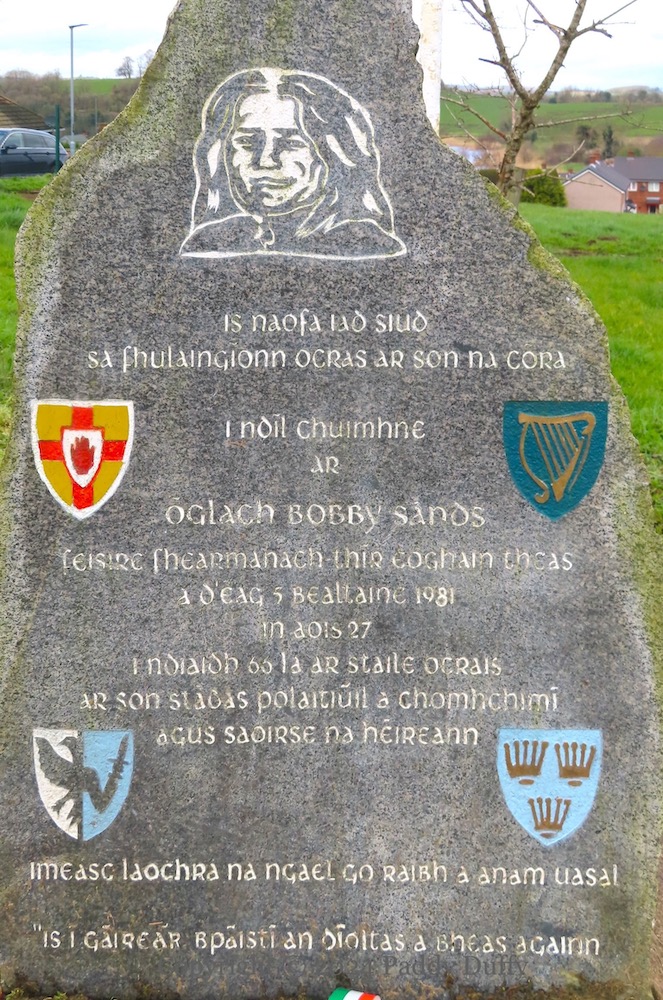
Finally, a memorial stone to Bobby Sands in Erne Drive. The inscription on the stone reads, “‘Is naofa ıad sıud sa fhulaıngíonn ocras ar son na córa.’ [= Holy are those who suffer hunger for the sake of justice/”Blessed are those who hunger for justice”] I ndíl [ndıl] chuımnhe ar Óglach Bobby Sands, feısıre [= M.P.] Fhearmanach-Thír Eoghaın Theas, a d’éag 5 Bealtaıne 1981 ın aoıs 27 ı ndıaıdh 66 lá ar staıle [staılc] ocraıs ar son stádas polaıtıúıl a chomhchımí agus saoırse na hÉıreann. I measc laochra na nGael go raıbh a anam uasal. ‘Is í gáıre ár bpáıstí an díoltas a bheas agaınn'”
For an alternative translation of Sands’s quote “Our revenge will be the laughter of our children”, see The Spirit Of Freedom in the Peter Moloney collection.
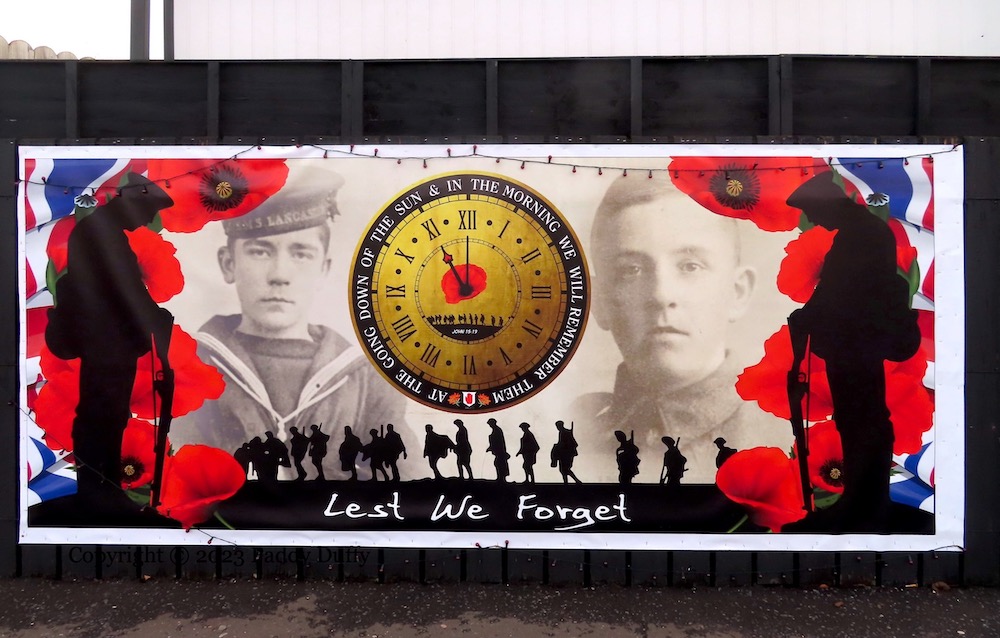
The portrait on the right is probably William McFadzean, familiar from murals such as in the Caw, Londonderry, and in Cregagh, Belfast (though the photo is unknown). The face on the left is John Travers “Jack” Cornwell, “the boy hero of Jutland”, who was awarded the VC for staying at his post as a sight-setter on the HMS Chester (the picture is from an earlier posting, on the HMS Lancaster) when it was hit by German light cruisers on May 31st, 1916. Cornwell died from shrapnel wounds on June 2nd (Mary Evans).
It’s not clear why Cornwell is included here, as he was from, and is buried in, east London, rather than Belfast or Ireland, and does not seem to be associated with the 36th Division. Please get in touch if you can explain his inclusion here. See also: Battle Of Jutland and HMS Caroline.
March 10th was the 52nd anniversary of the killings of three Highland Fusiliers, Dougald McCaughey and teen-aged brothers Joseph and John McCaig, who were drinking in a city centre pub and lured to their deaths in north Belfast at the hands of the (Provisional) IRA. The killings led to the resignation of NI prime minister James Chichester-Clark and an increase, to 18, in the minimum age for service (WP).
“It is not for riches, fame or glory that we remain in the shadows of our community, but for its protection.”
These words are echoed on the central stone in the garden of reflection, with adjacent North Down UDA roll of honour: “‘Who shall separate us?’ Right up to the present day, these words have been the inspiration and motivation of numerous men and women to serve, fight and die for the defence of their homeland, its people and its heritage. This selfless action is not for riches, fame or glory, but is freely given out of a love of freedom, commitment to the faith and culture of our nation, and a desire that all future generation in all communities can live in peace.”
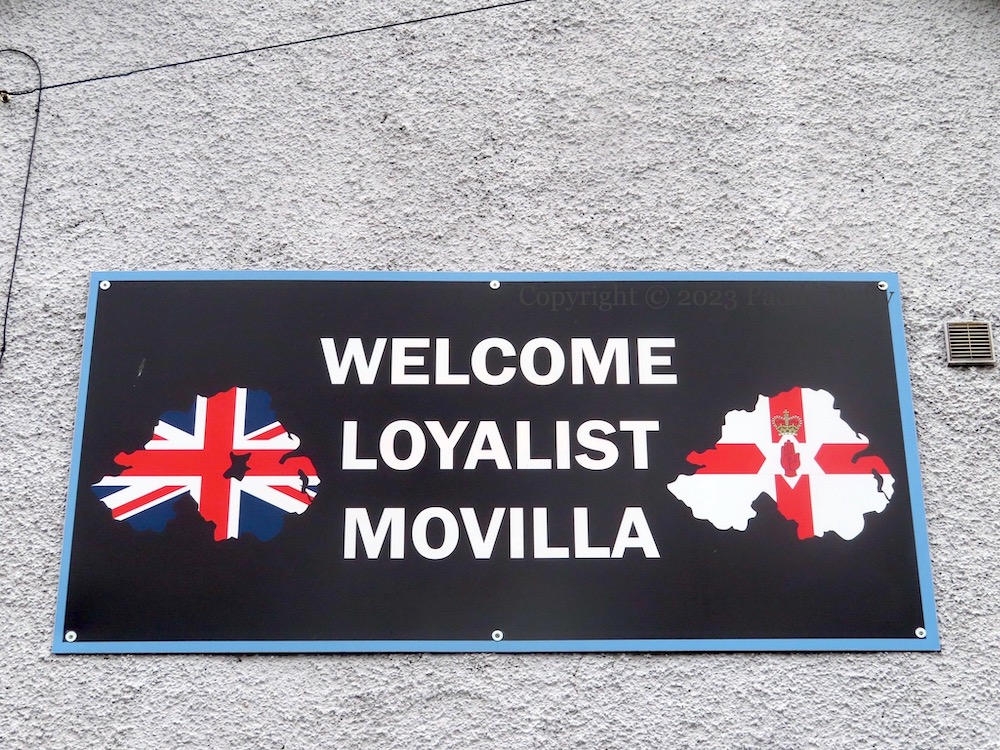
Movilla Street and Wallace’s Street, off Upper Movilla Street. “Loyalist Movilla” in Newtownards.
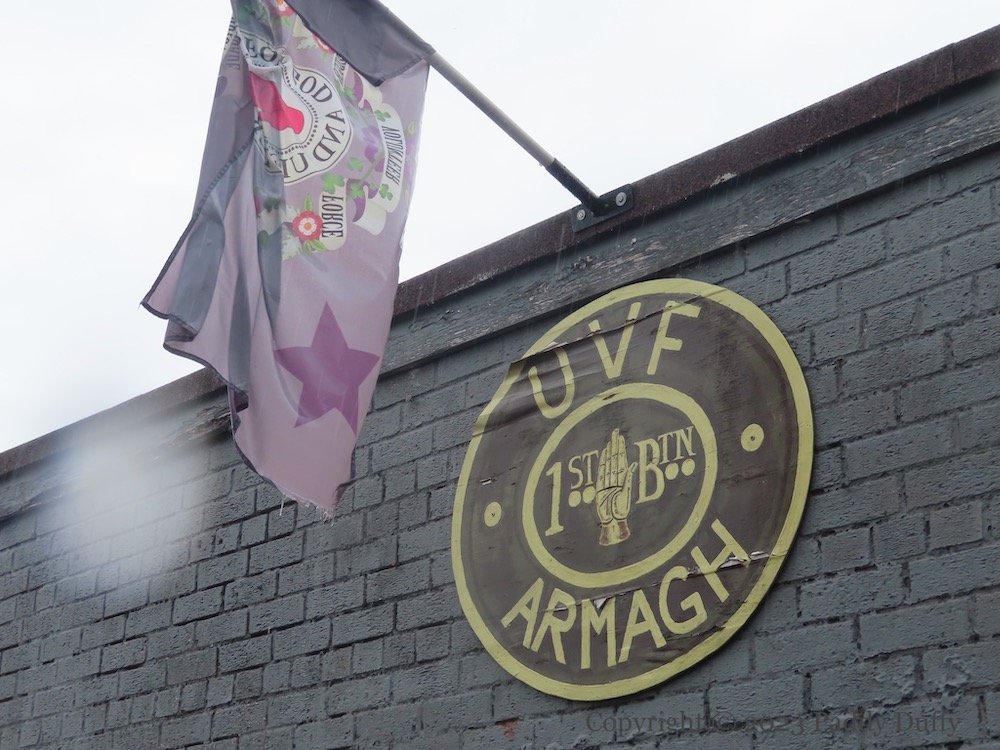
These two boards from the Armagh True Blues flute band (Fb) in Barrack Hill commemorate the Ulster Volunteers of 1912 who went on to join the 9th (County Armagh) battalion of the Royal Irish Fusiliers (Wartime Memories).
The “1st batt” emblem (in the third image) applies to both the Ulster Volunteers of the Home-Rule era and the Troubles-era Mid-Ulster UVF.
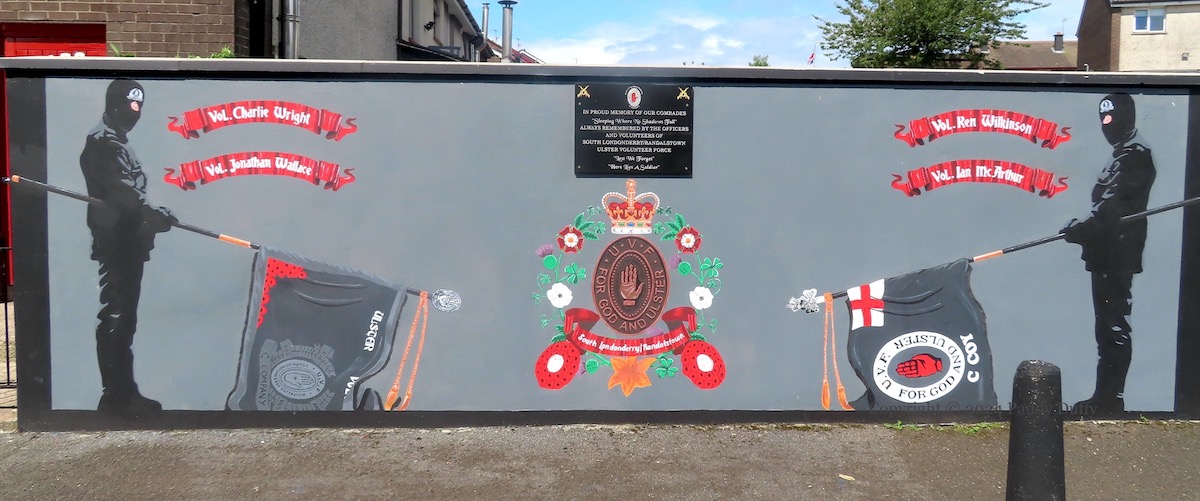
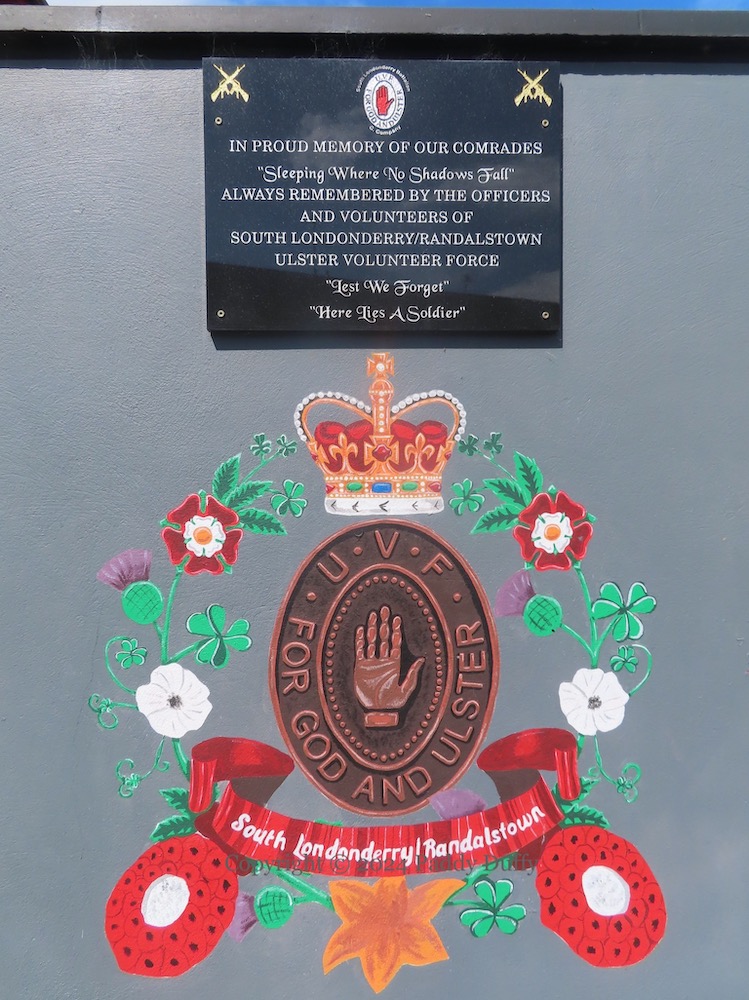
“Always remembered by the officers and volunteers of South Londonderry/Randalstown Ulster Volunteer Force.” This memorial mural and plaque in Magherafelt names Charlie Wright, Jonathan Wallace, Ken Wilkinson, and Ian McArthur.
Of these, Wilkinson seems the most well-known, as he served as a PUP representative for the area. He commented on sectarian tensions in Randalstown in 1999 (An Phoblacht) and in Coleraine in 2009 (Irish Examiner), and spoke against sueprgrass trials in 2011 as a member of FAST (Irish Times | see previously FAST and FASTing For Human Rights And Justice); he was accused of intimidation of Catholics in Antrim in 2003 (An Phoblacht). He stood for a number of elected positions (e.g. 2013) but was unsuccessful.
Ostensibly for his stand against drug-sellers, in 2010 a pipe-bomb (BBC), and in 2011 a make-shift car-bomb (BelTel), were placed against his home and he received death threats in 2013 (politics.ie). He died in 2021 (BelTel | News Letter | Irish News).
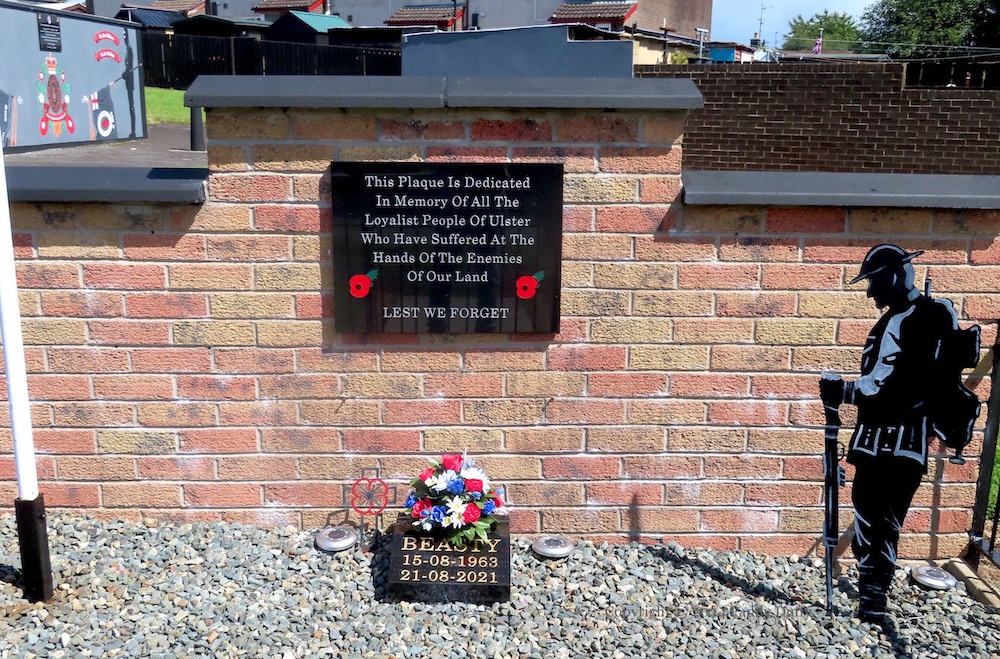
The plaque in the memorial garden (shown below) reads, “This plaque is dedicated in memory of all of the loyalist people of Ulster who have suffered at the hands of the enemies of our land. Lest we forget.”
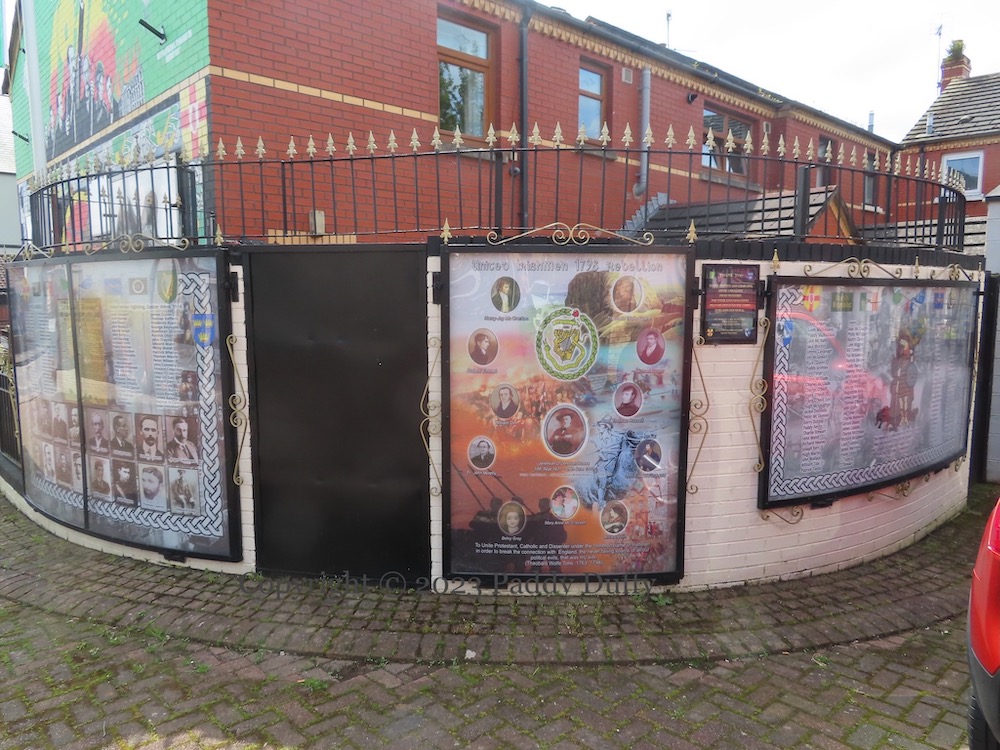
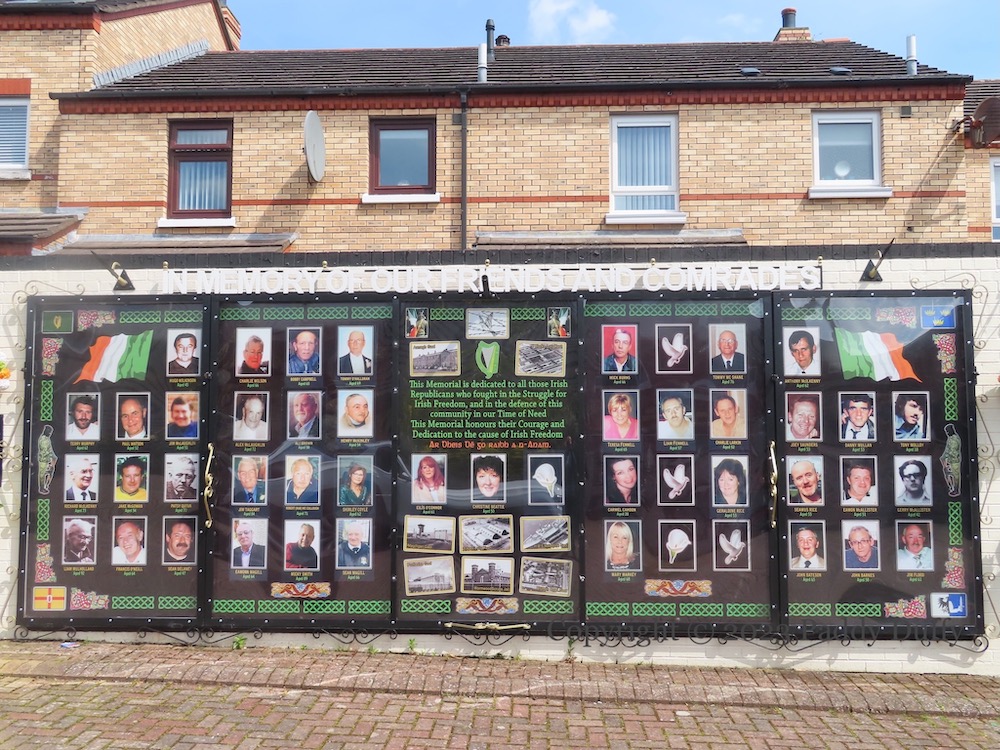
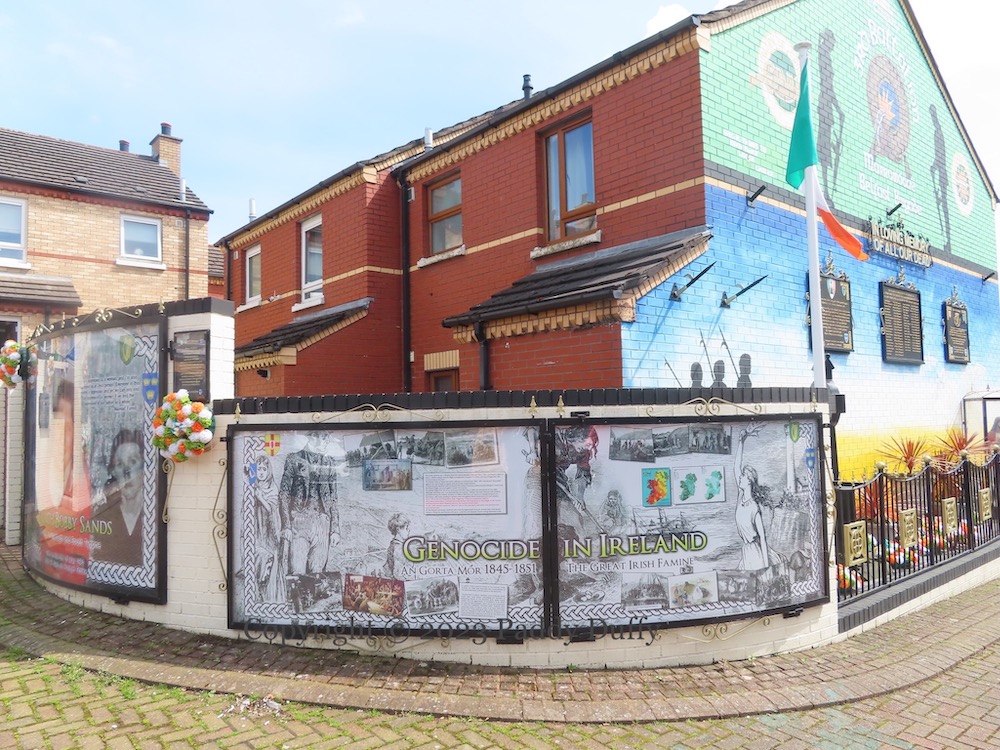
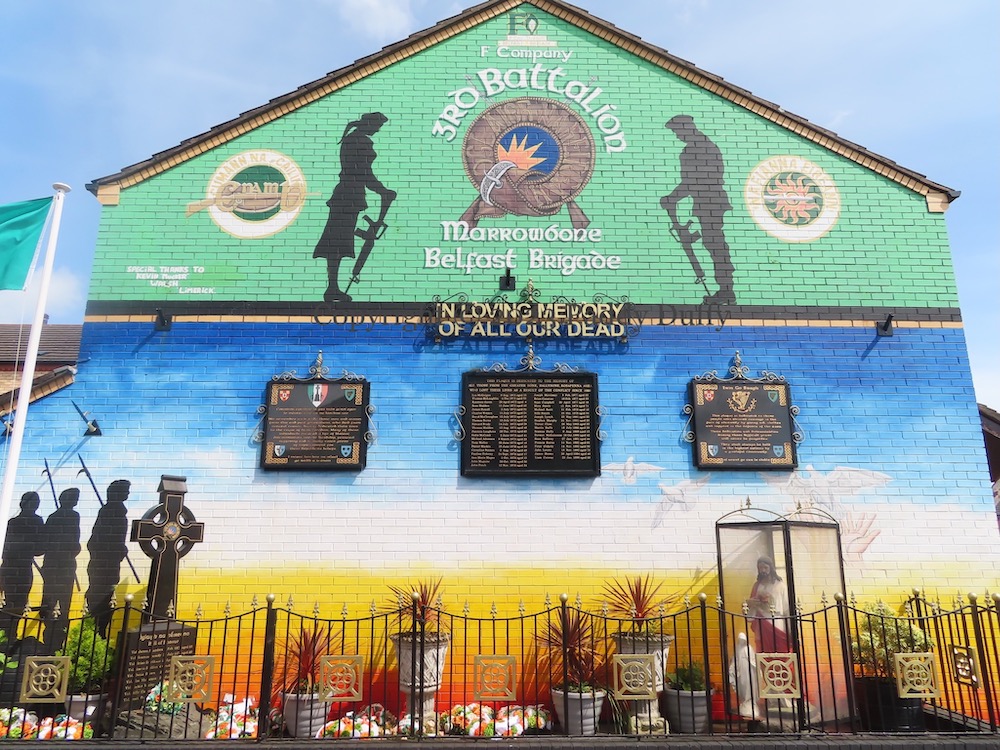
Here is a gallery of the murals and plaques in Clós Ard An Lao/Ardilea Close in the Machaıre Botháın/Marrowbone area of north Belfast. A full repertoire of republican events is commemorated – the United Irishmen, Great Hunger, the Rising, the Troubles, the (modern) hunger strikes. What is most striking is the significant presence of religious icons, such as the Sacred Heart in the glass cases in front of the two main murals (above and last below).
Two poems of WWI in Ballykeel 2, Ballymena: above, “We are the Dead. Short days ago/We lived, felt dawn, saw sunset glow,/Loved and were loved, and now we lie/In Flanders fields.” from ‘In Flanders Fields’ by John McCrae.
Below: “They shall not grow old/As we that are left grow old/Age shall not weary them/Nor the years condemn/At the going down of the sun/And in the morning/We will remember them.” from ‘For The Fallen’ by Laurence Binyon.