
Palestinian flags fly around the 1916 Easter Rising centenary board in Taghnevan Drive, Lurgan, seen previously in 2024.
Click image to enlarge
Copyright © 2025 Paddy Duffy
T08024
Palestinian flags fly around the 1916 Easter Rising centenary board in Taghnevan Drive, Lurgan, seen previously in 2024.
Click image to enlarge
Copyright © 2025 Paddy Duffy
T08024

The 1918 ‘Representation Of The People’ act gave 8.4 million women in the United Kingdom the right to vote (WP). (For the two women on the left holding the ‘Votes For Women’ sign, see Women’s Hall And Cost-Price Restaurant.) In that same year, Countess Constance Markievicz was the first woman elected to Westminster and became Sınn Féın Minister For Labour in the first Dáıl Éıreann that was established as an alternative. Ten years earlier, she had co-founded Na Fıanna Éıreann with Bulmer Hobson. The names of Derry fianna are listed on the right. “Fuaır sıad bás ar son saoırse na hÉıreann.” (This board replaces the former Fianna mural that celebrated the centenary in 2009.)
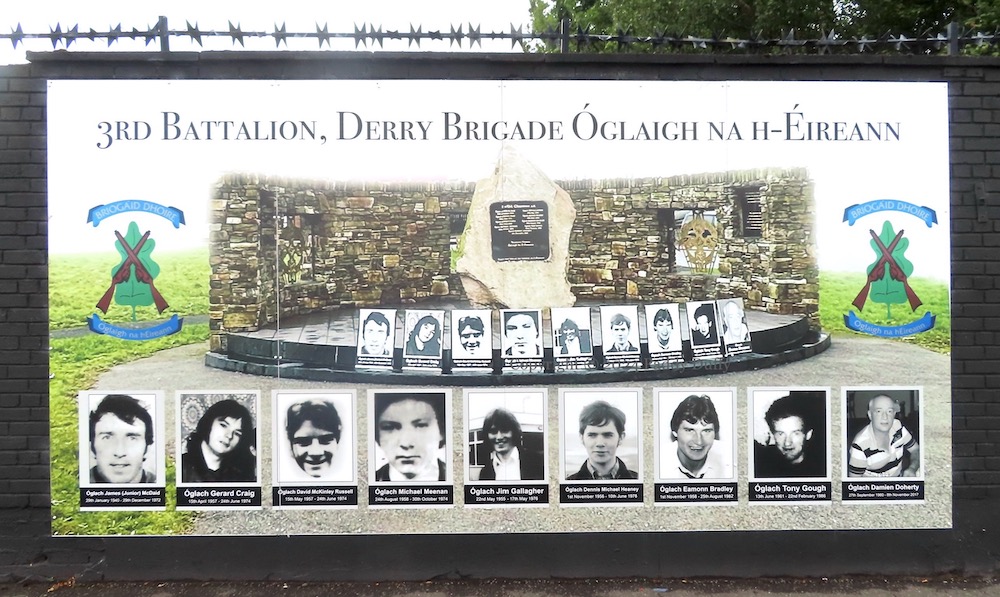
To the left (above) is a “Join RSYM” stencil with the names of the ten deceased 1981 hunger strikers; to the right is a picture of the memorial across the street to the dead of the 3rd battalion of the Doıre Brigade Óglaıgh na hÉıreann.
“But while Ireland is not free I remain a rebel, unconverted and unconvertible. There is no word strong enough for it. I am pledged as a rebel to the one thing – a free and independent republic.”
“Ach a fhad is nach bhfuıl Éıre saor, seasfaıdh mé an fód mar cheannaırceach, gan géılleadh, gan athrú. Níl focal dá bhfuıl atá chumhachtach go leor. Tá gealltanas tugtha agam mar cheannaırceach, cuspóır amháın a chur ı gcrích – poblacht shaor agus neamhspleach.”


Click image to enlarge
Copyright © 2024 Paddy Duffy
T05181 T05180 T05179
T05182

Twenty portraits in circular frames have replaced the twenty-one square portraits seen on the ‘Out Of The Ashes Of 1969’ mural in the New Lodge. From left to right, those portrayed are Michael P Neill, Seamus McCusker, Gerard Crossan, Colm Mulgrew, Francis Liggett, Brian Fox, John Kelly, Robert Allsopp, Louis Scullion, Billy Reid, Danny O’Hagan, Michael Kane, Sean McIlvenna, Jim O’Neill, Rosemary Bleakley, Martin McDonagh, James McCann, James Sloan, Dan McCann. Paddy McManus is no longer included, as compared with the earlier portraits.
For the mural without any portraits, at the time of its launch in 2012, see X00857.
See also the New Lodge IRA memorial garden.
New Lodge Road, north Belfast.

Click image to enlarge
Copyright © 2024 Paddy Duffy
T04307 T04306 [T04305]
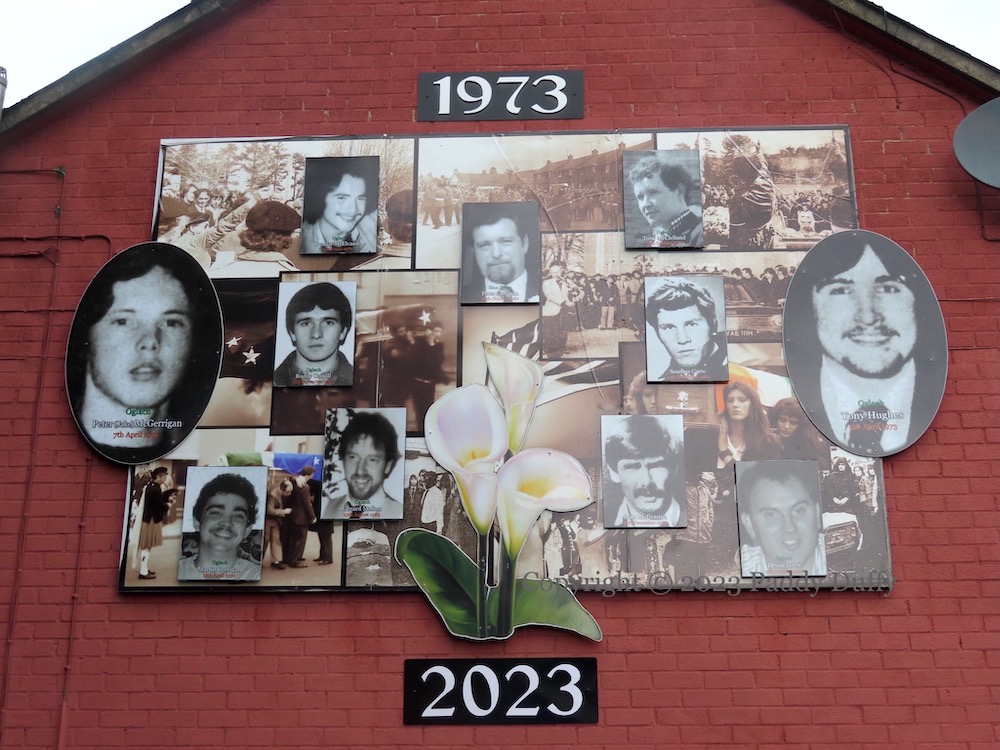
Jake McGerrigan and Tony Hughes of the OIRA were both shot and killed by British forces in the Windmill Hill area of Armagh in a 48-hour period spanning April 7th and 9th, 1973. (Lost Lives #791 incorrectly gives March 7th for McGerrigan.) The board shown above was mounted in Navan Street for the 40th anniversary of their deaths, in 2013, and the lower date has now been updated for the 50th anniversary.
The larger portraits on either side are of McGerrigan and Hughes; between them are (left) Peadar McElvanna, Roddy Carroll, Gerard Mallon, Martin Corrigan, (middle) Peter Corrigan, (right) Tony McClelland, Seamus Grew, Sean McIlvanna [McIlvenna], Dessie Grew.
There is an individual plaque to Hughes (shown immediately below) at the spot where he was shot and a stone (shown below; for text see McGerrigan – Hughes) to both of them in the same alley; there is also a stone (not shown) to McGerrigan in Windmill Avenue. (Video of Jake McGerrigan’s funeral.)


Click image to enlarge
Copyright © 2023 Paddy Duffy
T03376 T03378 [T03379] [T03380] T03381 T03382 T03383 T03384 [T03385]

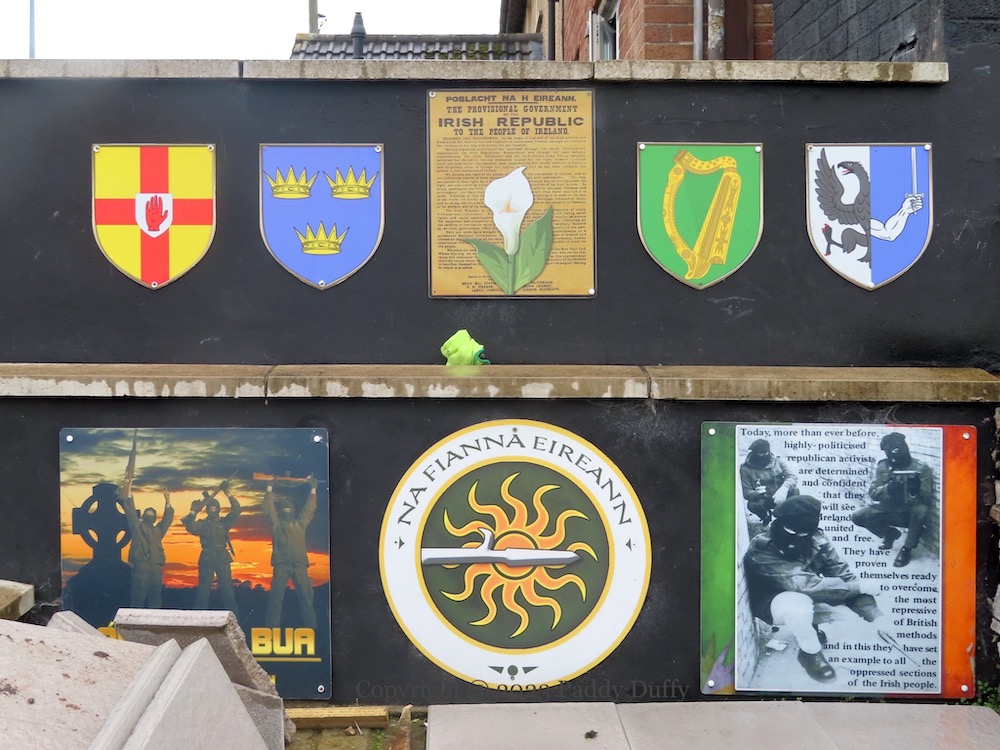
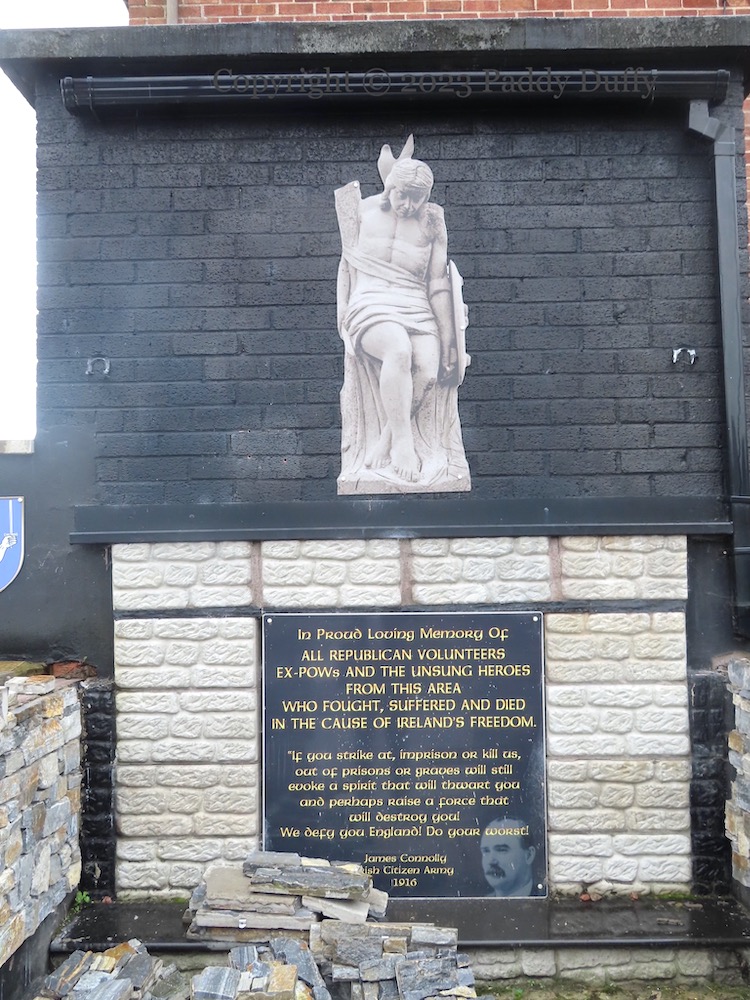
There is a memorial garden to the history of Irish resistance at the entrance to the Athletic Grounds in Armagh. From left to right, the images presented here show:
“More than 800 years of Irish resistence” – a sword for the Norman invasion under Strongbow, a pike for the 1798 and 1803 rebellions, a bolt-action rifle for the Easter Rising of 1916, and an assault rifle for the Troubles;
Cumann Na mBan, Mairéad Farrell and republican women who made “the supreme sacrifice”;
The Proclamation, Provisional IRA and Na Fianna;
The dying Cú Chulainn and a plaque “in proud and loving memory of all republican volunteers, ex-POWs and the unsung heroes from this area who fought, suffered and died in the cause of Ireland’s freedom, with a quote from James Connolly: ‘If you strike at, imprison or kill us, out of prisons or graves will still evoke a spirit that will thwart you and perhaps raise a force that will destroy you! We defy you England! Do your worst!”;
“Remember Ireland’s hunger strikers – 22 men” – the ten 1981 hunger strikers and Thomas Ashe, Terence MacSwiney, Michael Fitzgerald, Joe Murphy, Joseph Whitty, Andy O’Sullivan, Denny Barry, Tony D’Arcy, Jack McNeela, Seán McCaughey, Michael Gaughan, Frank Stagg;
A stone “in loving memory of men, women and children murdered by British forces in Ireland.”

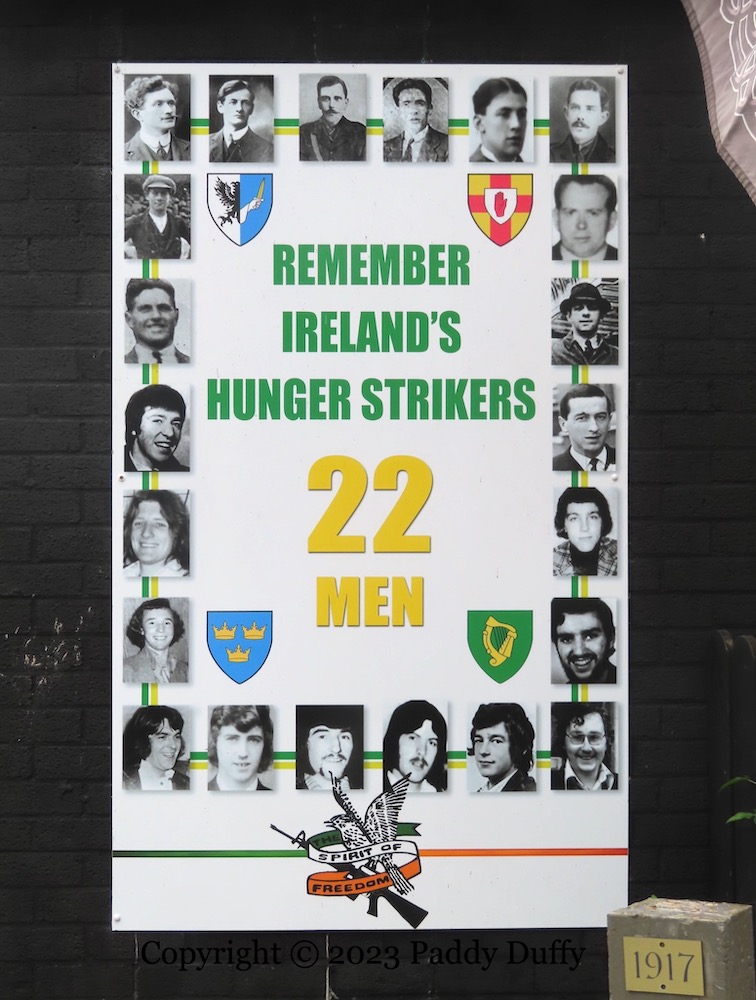

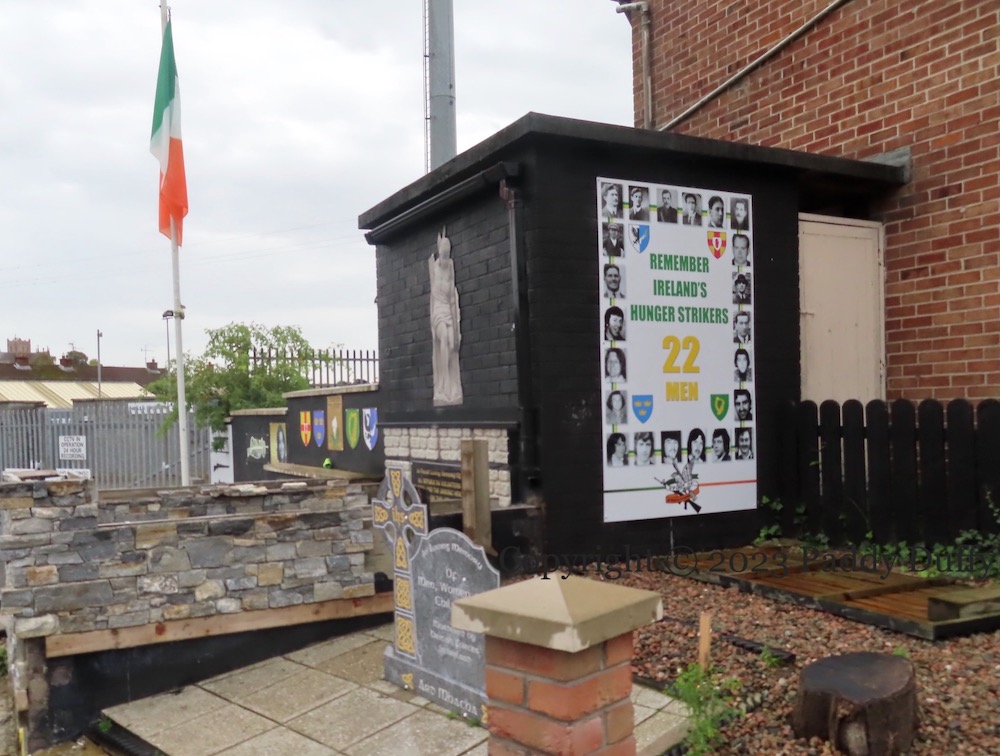
Click image to enlarge
Copyright © 2023 Paddy Duffy
T03367 T03368 T03369 [T03370] T03371 [T03372] T03373 T03375 T03374

Here is a gallery of the murals and plaques in Clós Ard An Lao/Ardilea Close in the Machaıre Botháın/Marrowbone area of north Belfast. A full repertoire of republican events is commemorated – the United Irishmen, Great Hunger, the Rising, the Troubles, the (modern) hunger strikes. What is most striking is the significant presence of religious icons, such as the Sacred Heart in the glass cases in front of the two main murals (above and last below).
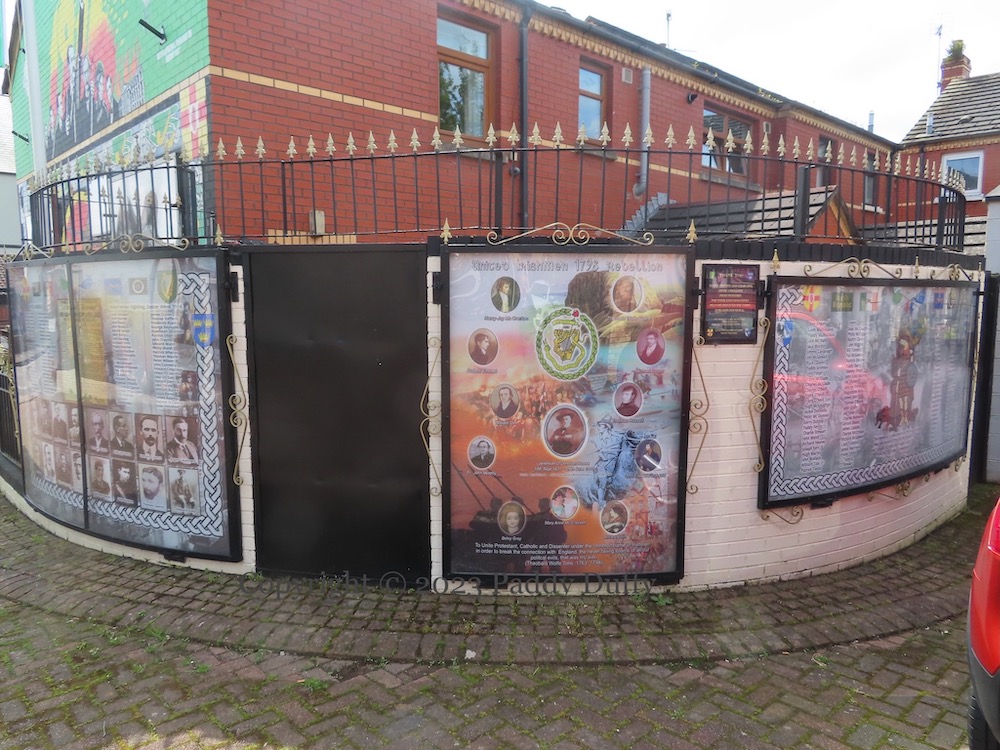


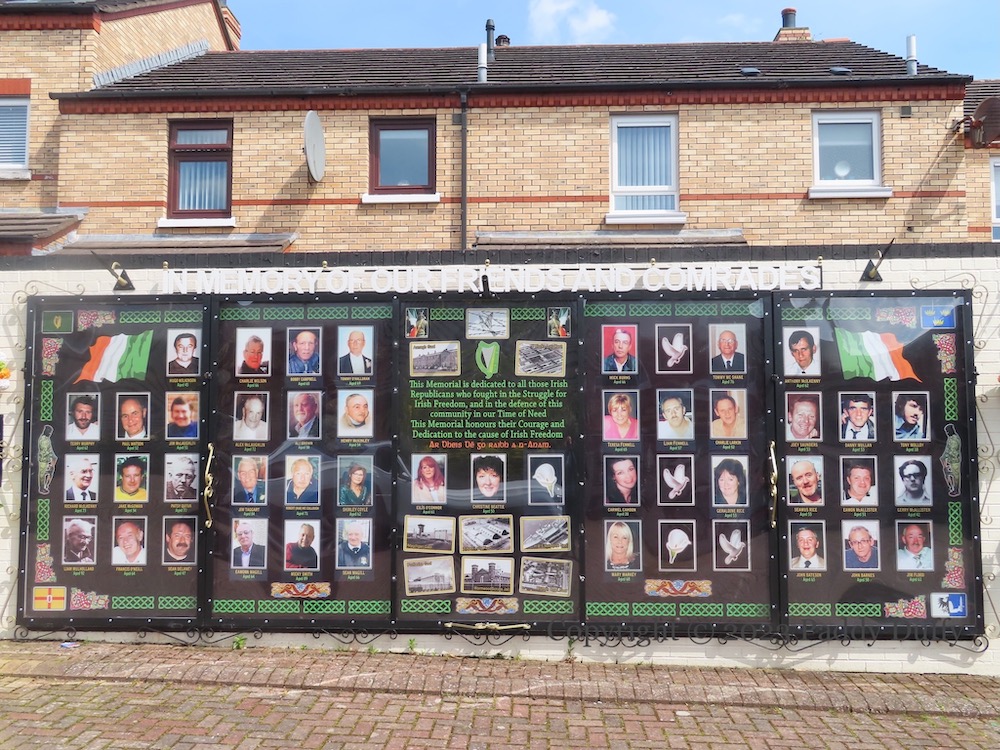
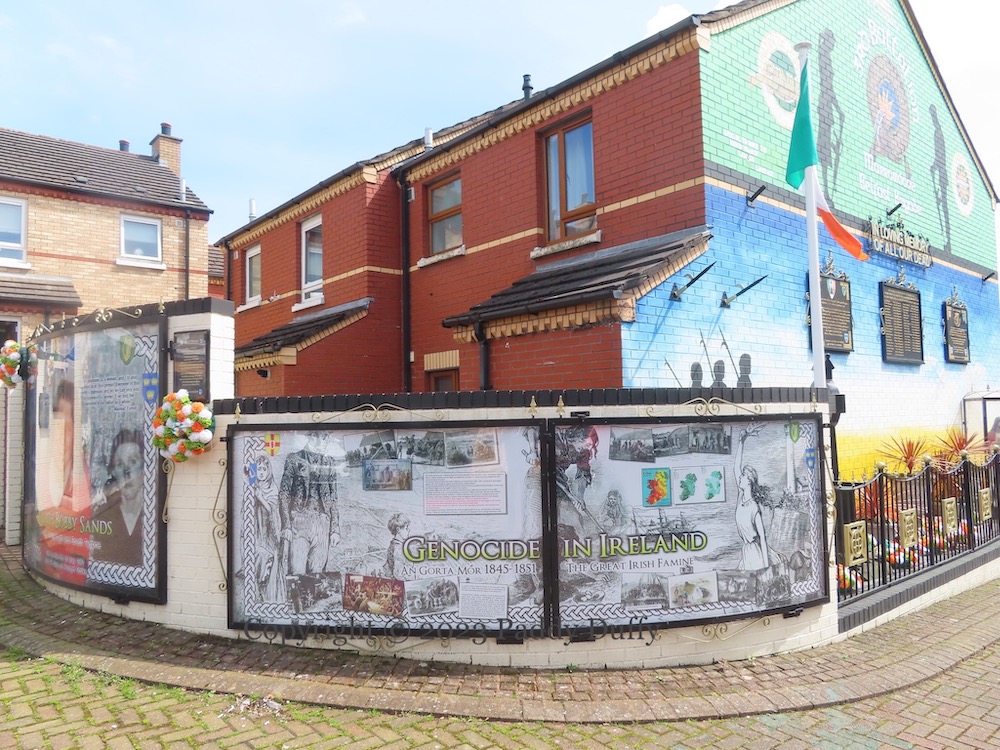
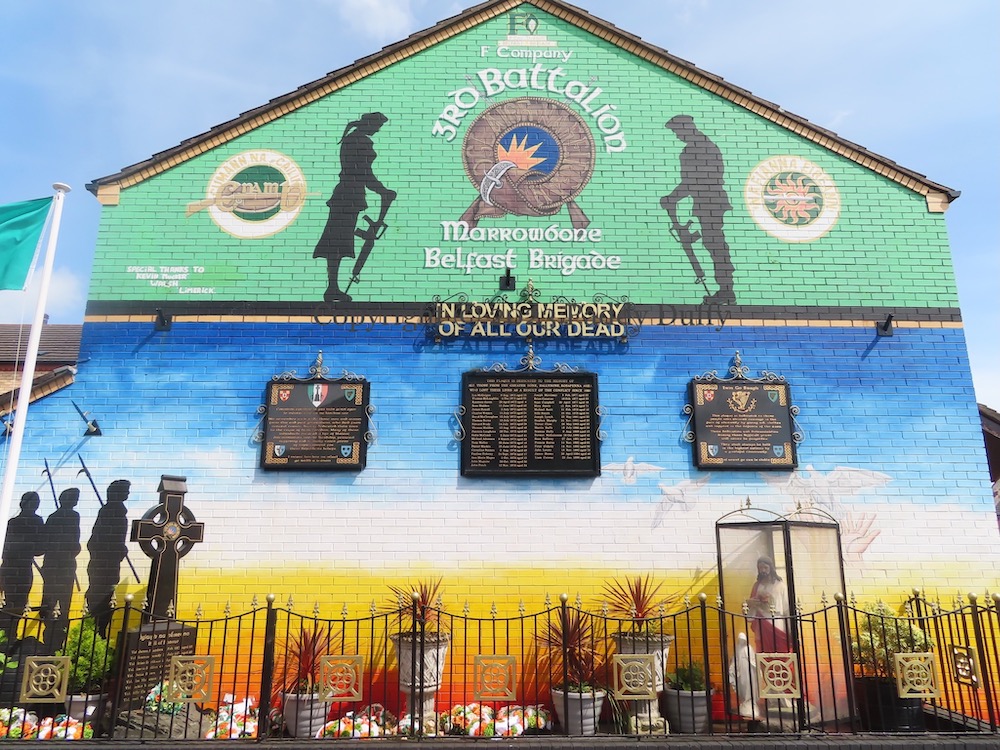
Click image to enlarge
Copyright © 2023 Paddy Duffy
T02709 T02713 T02712 T02716 T02717 T02715 T02714 T02710 [T02711]
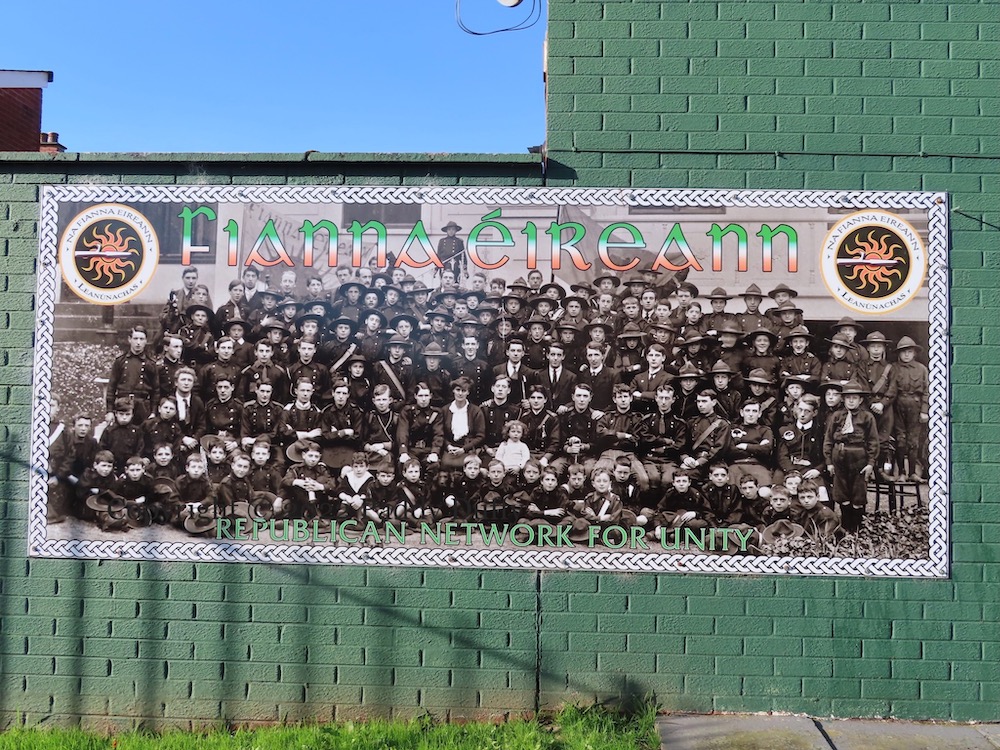
The emblems in the corners read “Na Fıanna Éıreann Leanúnachas” or “The Continuity Fıanna”. The Irish National Boy Scouts or “junior IRA” were founded in 1909 by Bulmer Hobson and Countess Markievicz, who is at the centre of the photograph above. The Fıanna followed the Provisionals in 1969 and Republican Sınn Féın (and the Continuity IRA) in 1986 (Fianna History blog | Irish Examiner), while Provisional Fianna became Ógra Shınn Féın and then Sınn Féın Republican Youth (An Sionnach Fionn).
For the previous stencilling in this spot, see In The Cause Of Irish Freedom.
The tarp commemorates four teenaged members of Na Fıanna Éıreann who died in 1972 – Davy McAuley, Josh Campbell, Josie McComiskey and Bernard Fox – all four from Ardoyne/Ard Eoın. “Purity in our hearts, Strength in our arms, Truth in our lips.”
The painted emblem is on the other side of the Berwick Road.


Click image to enlarge
Copyright © 2022 Paddy Duffy
T01158 T01159 T01160

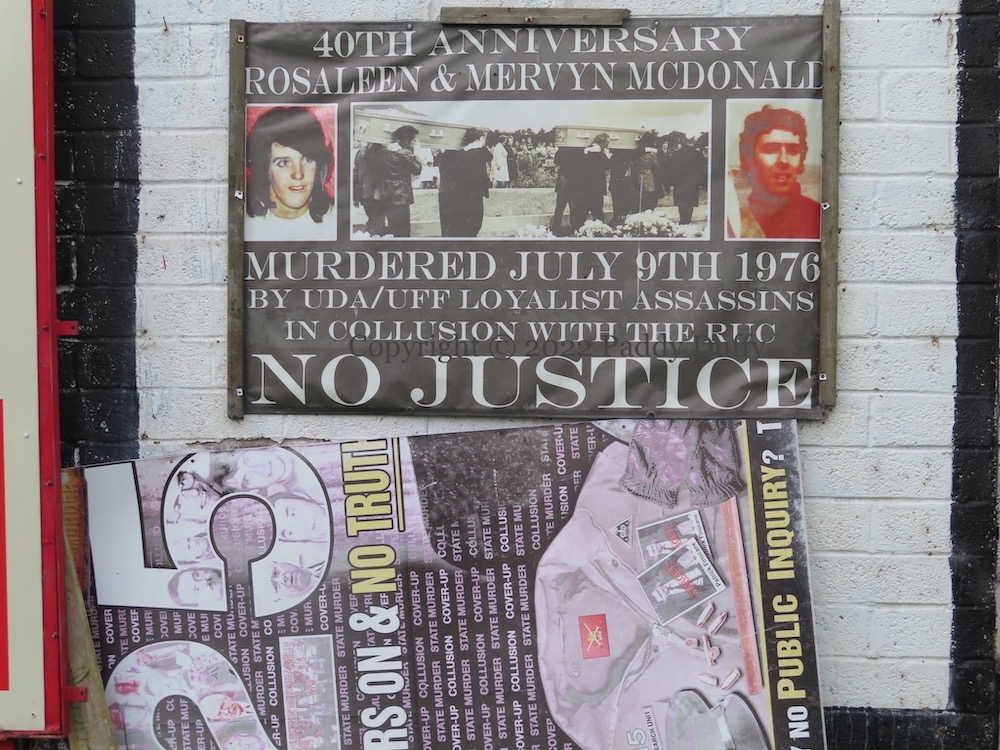
Here is a gallery of images from the Falls Road/Glen Road junction (site of the old Andersonstown RUC barracks). The images top to bottom follow the wall from right (Glen Road) to left (Falls Road).
Above: a call for the release of Basque prisoners.
Below: Mervyn and Rosaleen McDonald were Catholics living in the mixed Longlands area of Newtownabbey when they were visited by “UFF loyalist assassins” and shot dead in front of their two young children. The killings are described in most detail in Jack Holland’s Too Long A Sacrifice, which contains an interview with the gunman and the claim that the unit had access to RUC files (p. 94).
Seamus Costello fought for the IRA during the Border Campaign and was interned in the Curragh for two years. He stayed with the Officials during the split, but was driven out in 1974 and formed the Irish Republican Socialist Party (IRSP) and the INLA. He was shot in 1977. (WP)
A large Fıanna banner.
Metalwork commemorating the deceased 1981 hunger strikers.
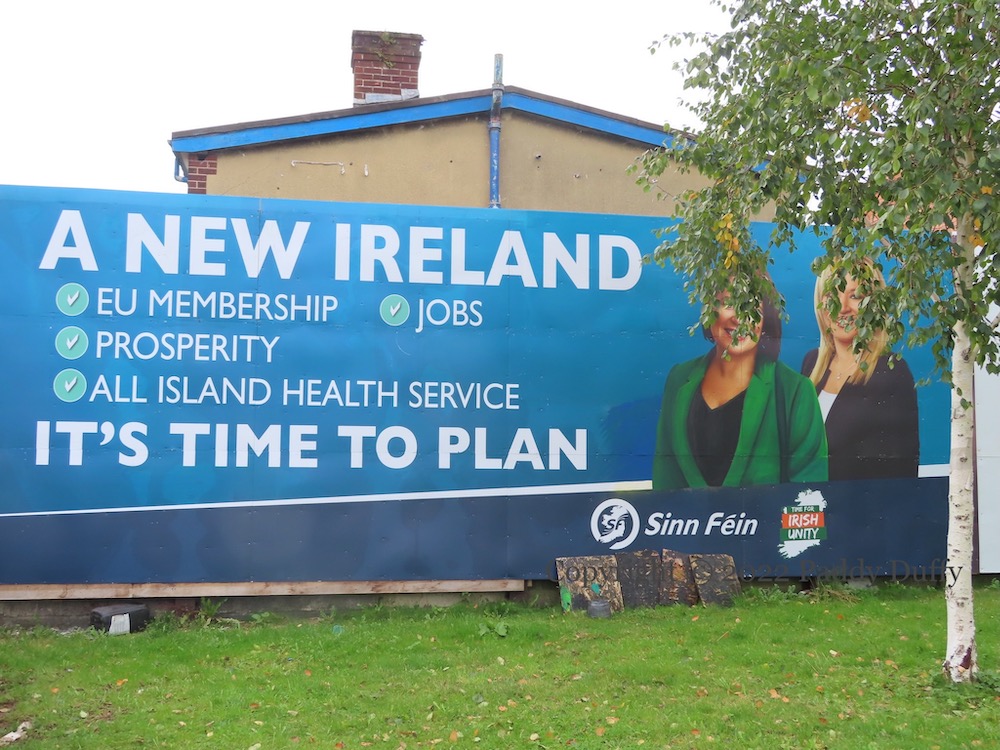
A Sınn Féın electoral banner.


Click image to enlarge
Copyright © 2022 Paddy Duffy
T01146 T01147 T01148 [T01149] T01152 T01151 T01150
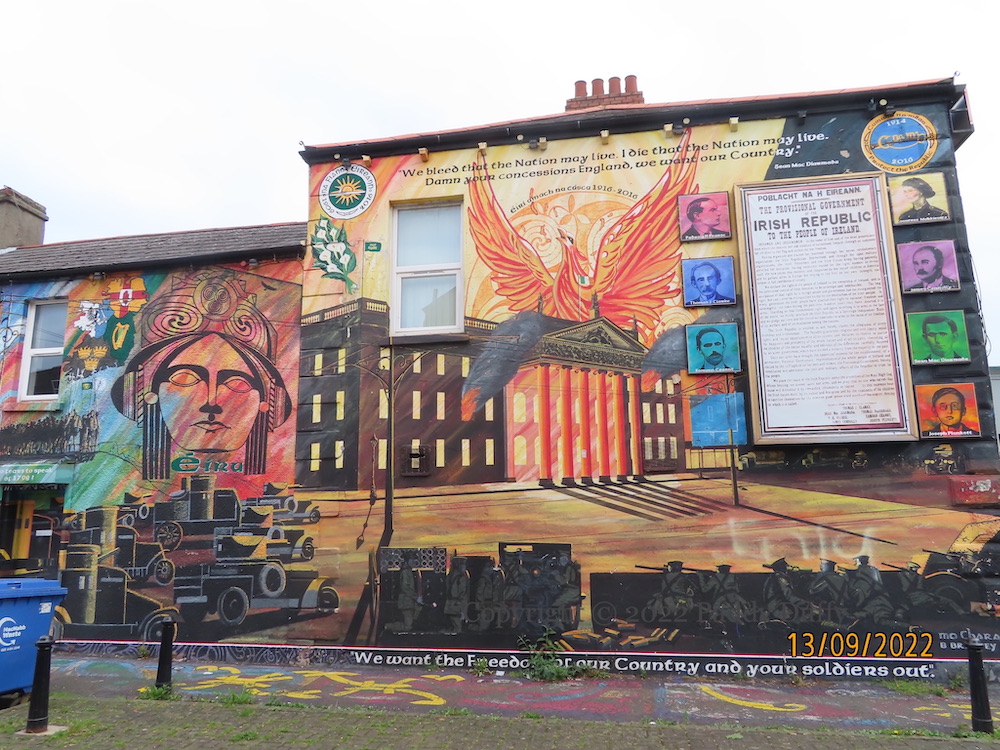
Arrayed against the forces of the British Army (which are shown in armoured cars and in sniping positions in the foreground of the mural, along the whole length of the wall) are various symbols of Irish nationalism: Oliver Sheppard‘s 1911 statue of Cú Chulaınn dying; the pikemen of the 1798 Rebellion (featured yesterday: Éırí Amach 1798); the four provinces of Ireland; Érıu the mythological queen of Ireland/Éıre as designed by Richard J King/Rísteard Ó Cíonga; Easter lilies; the emblems of Na Fıanna Éıreann and Cumann Na mBan on either side of a quote from (The Mainspring) Sean MacDiarmada “We bleed that the nation may live; I die that the nation may live. Damn your concessions, England: we want our country”; a phoenix rising from the flames of the burning Dublin GPO (inspired by Norman Teeling’s 1998 painting The GPO Burns In Dublin); the GPO flying an ‘Irish Republic’ flag; portraits of signatories and other rebels — (left) Padraig H. Pearse, Thomas J Clarke, Eamonn Ceannt, Thomas MacDonagh, (right) Countess Markievicz, James Connolly, Sean MacDiarmada, Thomas Plunkett; the declaration of independence, placed over the advertising box of AA Accountants – see the in-progress shot below. For more work-in-progess images, see yesterday’s post, Éırí Amach 1798. At the very bottom is a quote from the mother of Gerard ‘Mo Chara’ Kelly, Harriet Kelly: “We want the freedom of our country and your soldiers out.”
McQuillan Street, west Belfast

Click image to enlarge
Copyright © 2022 Paddy Duffy
T00821 [T00822] T00823
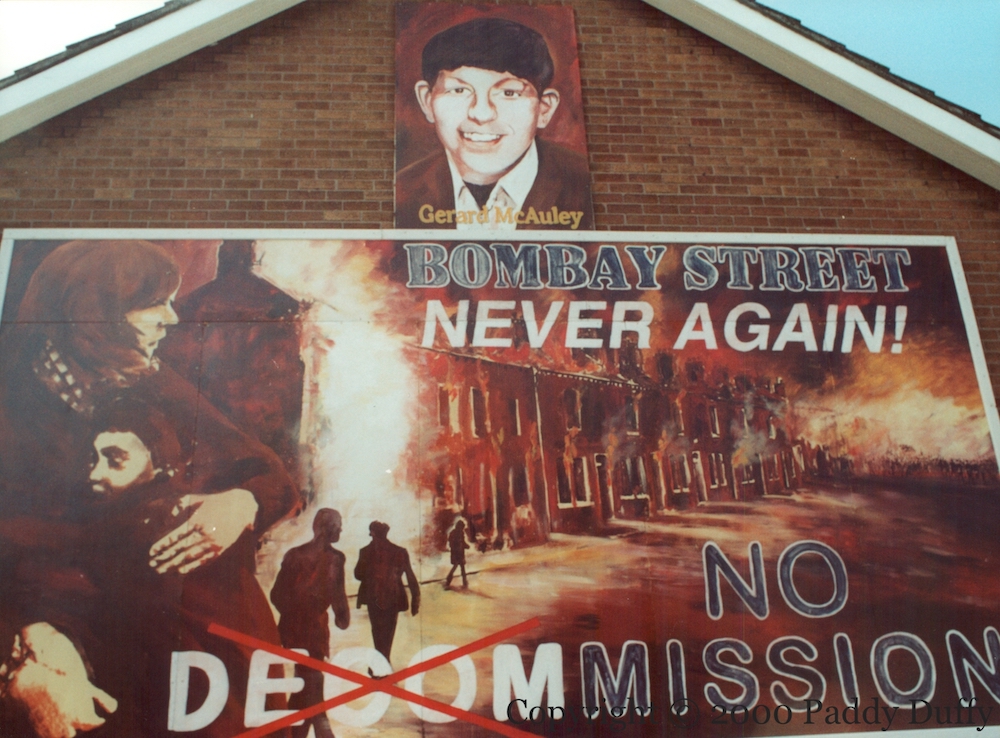
In August, 1969, families, mostly Catholic, were driven out and their homes burned in Bombay Street (and surrounding streets), between the Falls and Shankill (RTÉ news report). The defenselessness of the community then is reflected in the urging for “No decommission” in the present. Fıan Gerard McAuley (aged 15) was shot in nearby Waterville Street.
Bombay Street, Clonard, west Belfast
Click image to enlarge
Copyright © 2000 Paddy Duffy
T00342
 Paddy Duffy Collection