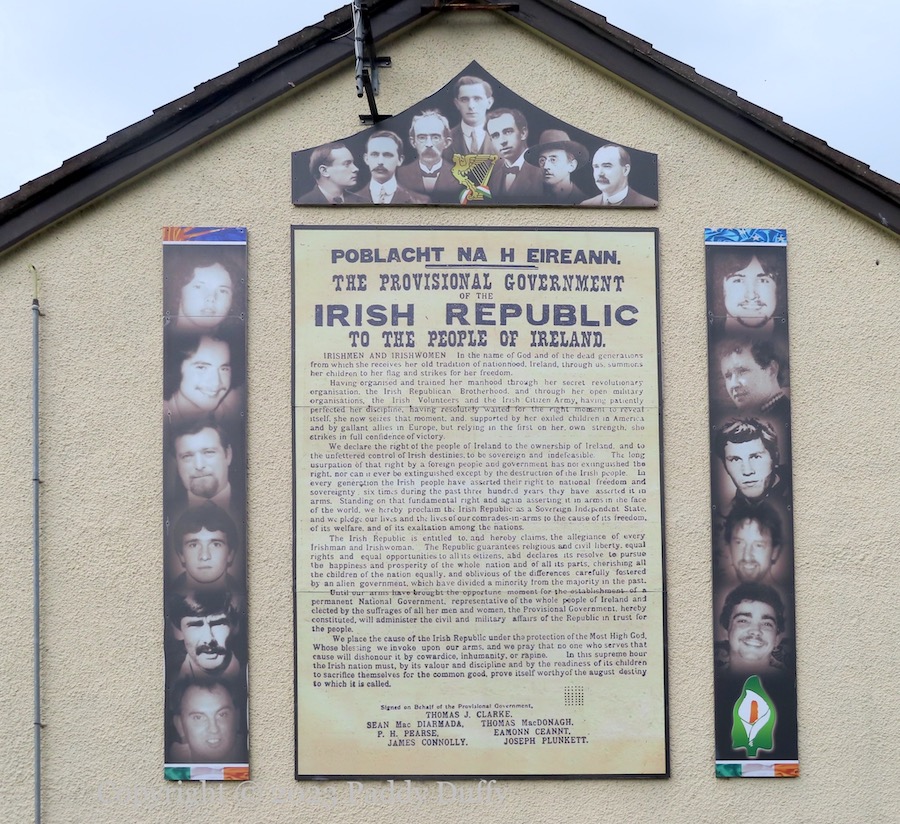
In the apex of the gable are the seven signatories to the 1916 Proclamation — all of whom were executed after the rising — and to the left and right of the text of the Proclamation are IRA dead from 1973 to 1990.
Left, top to bottom: Jake McGerrigan, Peadar McElvanna, Peter Corrigan, Roddy Carroll, Sean McIlvanna [McIlvenna], and Dessie Grew.
Right: Tony Hughes, Tony McClelland, Seamus Grew, Martin Corrigan, and Gerard Mallon.
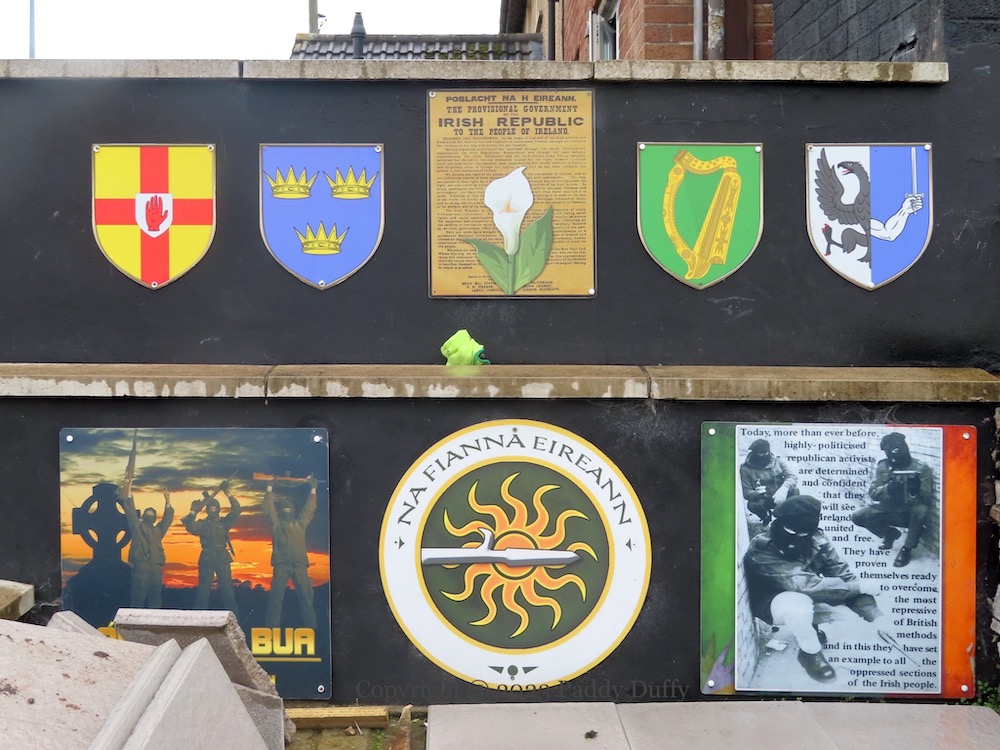
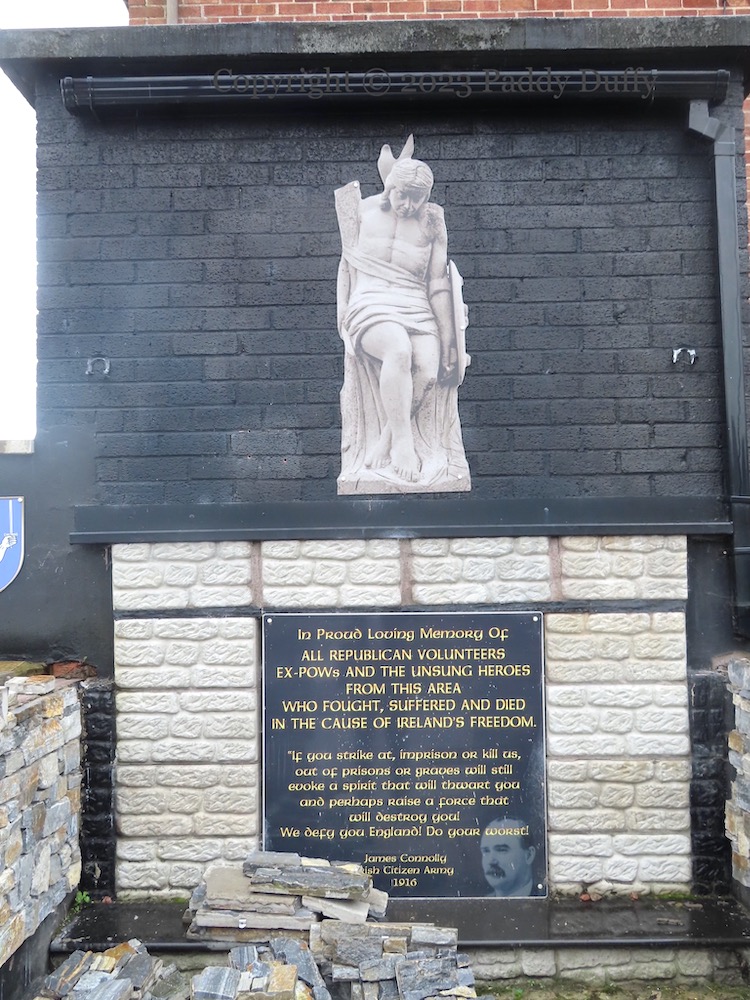
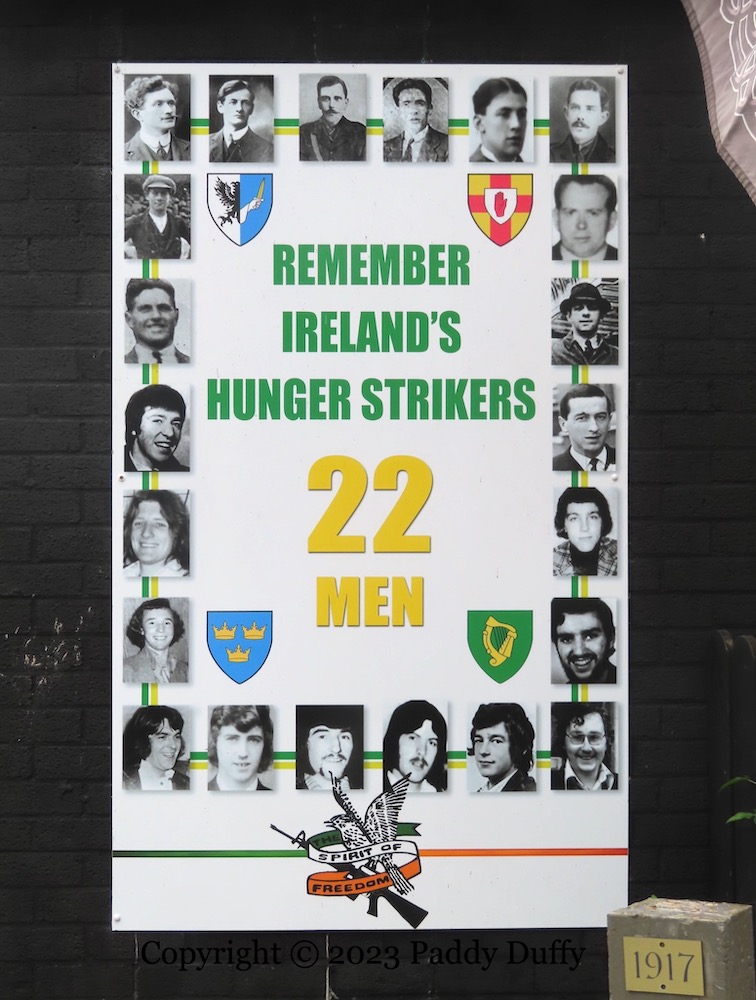
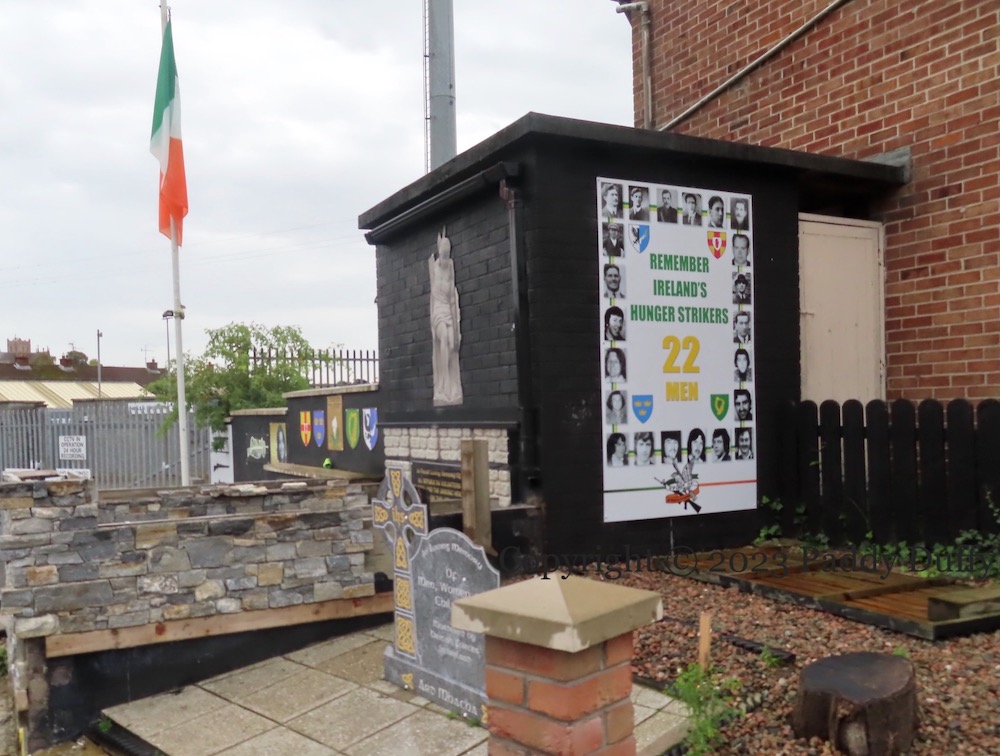
There is a memorial garden to the history of Irish resistance at the entrance to the Athletic Grounds in Armagh. From left to right, the images presented here show:
“More than 800 years of Irish resistence” – a sword for the Norman invasion under Strongbow, a pike for the 1798 and 1803 rebellions, a bolt-action rifle for the Easter Rising of 1916, and an assault rifle for the Troubles;
Cumann Na mBan, Mairéad Farrell and republican women who made “the supreme sacrifice”;
The Proclamation, Provisional IRA and Na Fianna;
The dying Cú Chulainn and a plaque “in proud and loving memory of all republican volunteers, ex-POWs and the unsung heroes from this area who fought, suffered and died in the cause of Ireland’s freedom, with a quote from James Connolly: ‘If you strike at, imprison or kill us, out of prisons or graves will still evoke a spirit that will thwart you and perhaps raise a force that will destroy you! We defy you England! Do your worst!”;
“Remember Ireland’s hunger strikers – 22 men” – the ten 1981 hunger strikers and Thomas Ashe, Terence MacSwiney, Michael Fitzgerald, Joe Murphy, Joseph Whitty, Andy O’Sullivan, Denny Barry, Tony D’Arcy, Jack McNeela, Seán McCaughey, Michael Gaughan, Frank Stagg;
A stone “in loving memory of men, women and children murdered by British forces in Ireland.”
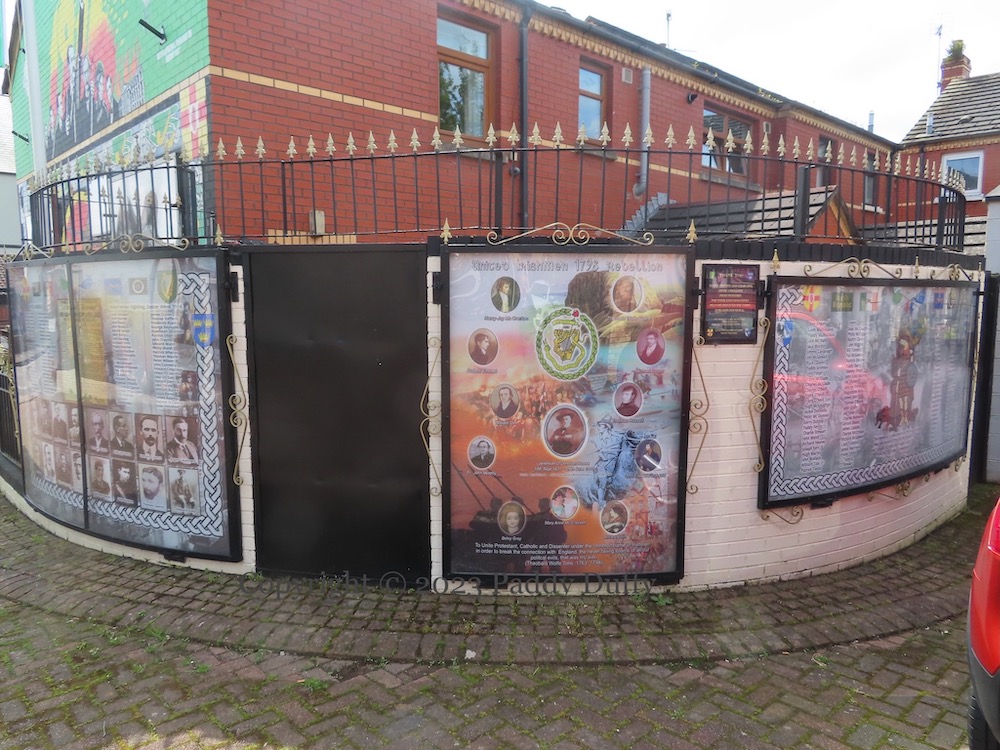
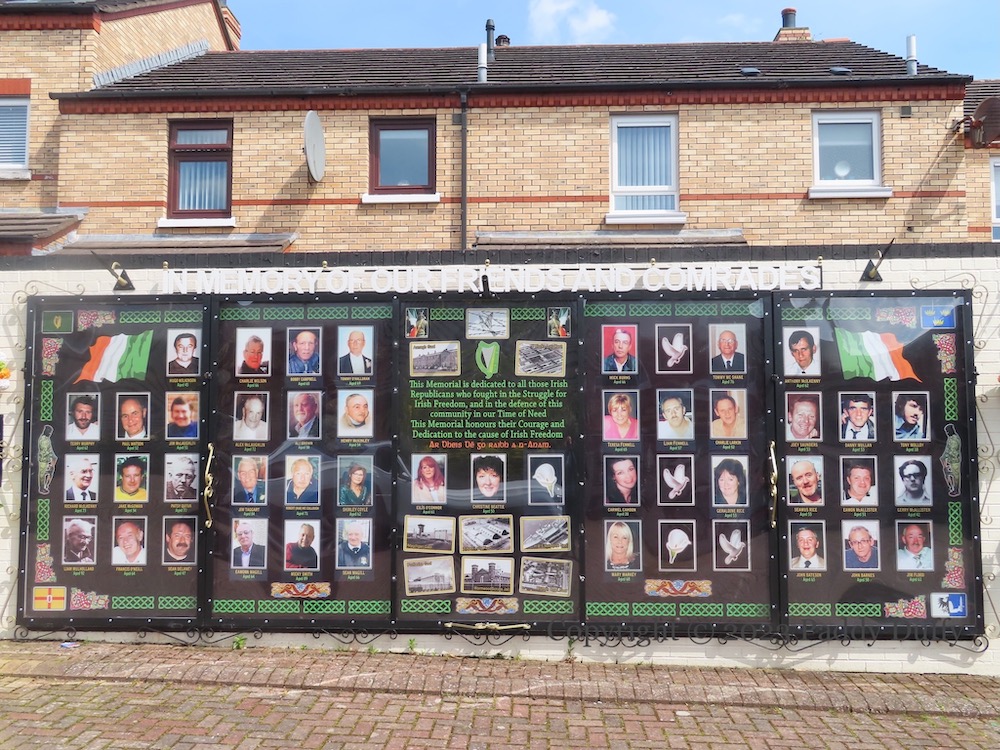
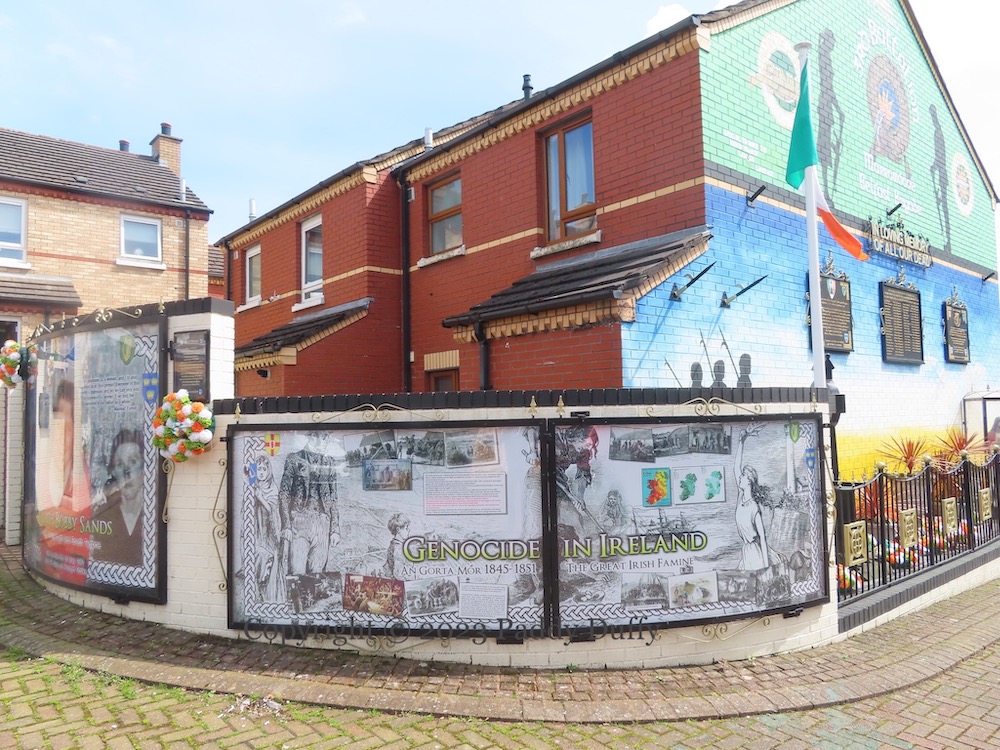
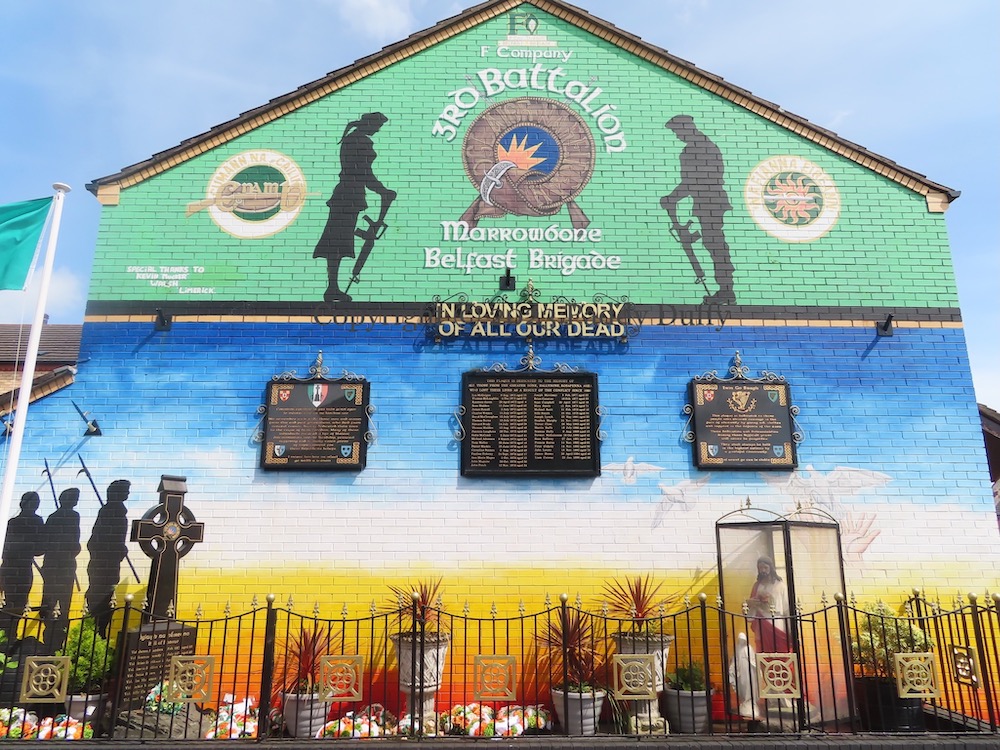
Here is a gallery of the murals and plaques in Clós Ard An Lao/Ardilea Close in the Machaıre Botháın/Marrowbone area of north Belfast. A full repertoire of republican events is commemorated – the United Irishmen, Great Hunger, the Rising, the Troubles, the (modern) hunger strikes. What is most striking is the significant presence of religious icons, such as the Sacred Heart in the glass cases in front of the two main murals (above and last below).
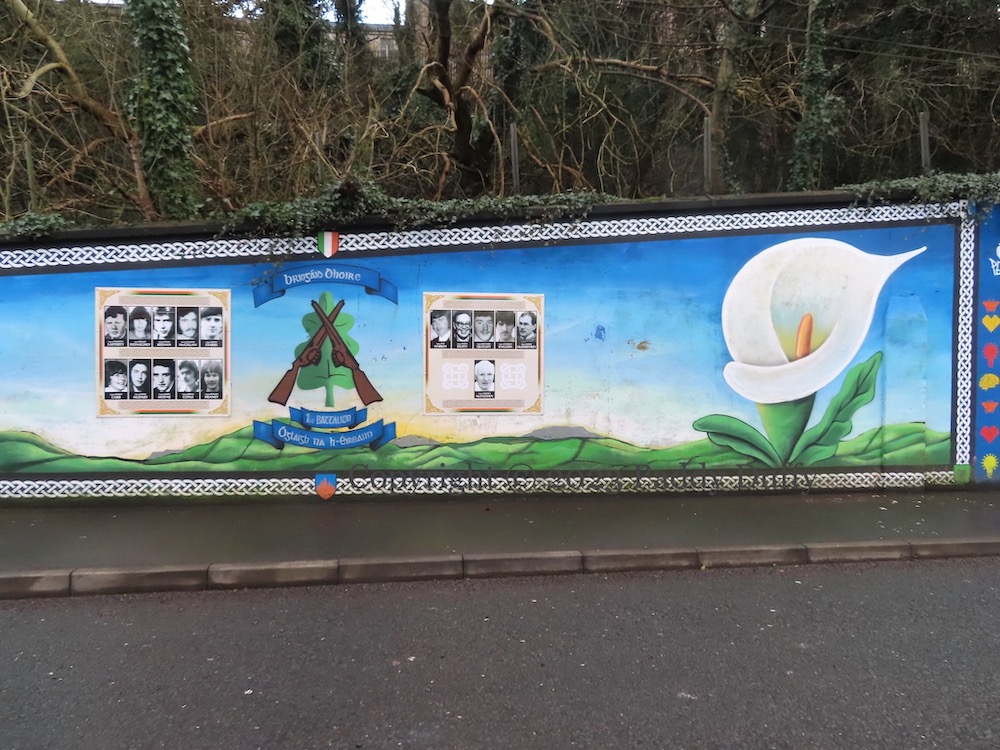
The Provisional IRA emerged from a split in the IRA in the wake of sectarian unrest in 1969. The Derry battalion became the Derry Brigade (An Brıogáıd Dhoıre) in 1972 when the number of people wishing to become volunteers swelled in the aftermath of Bloody Sunday. It is estimated that 1,000 Derry Catholics (2% of the population) were imprisoned for IRA activities in the 70s and 80s. (WP)
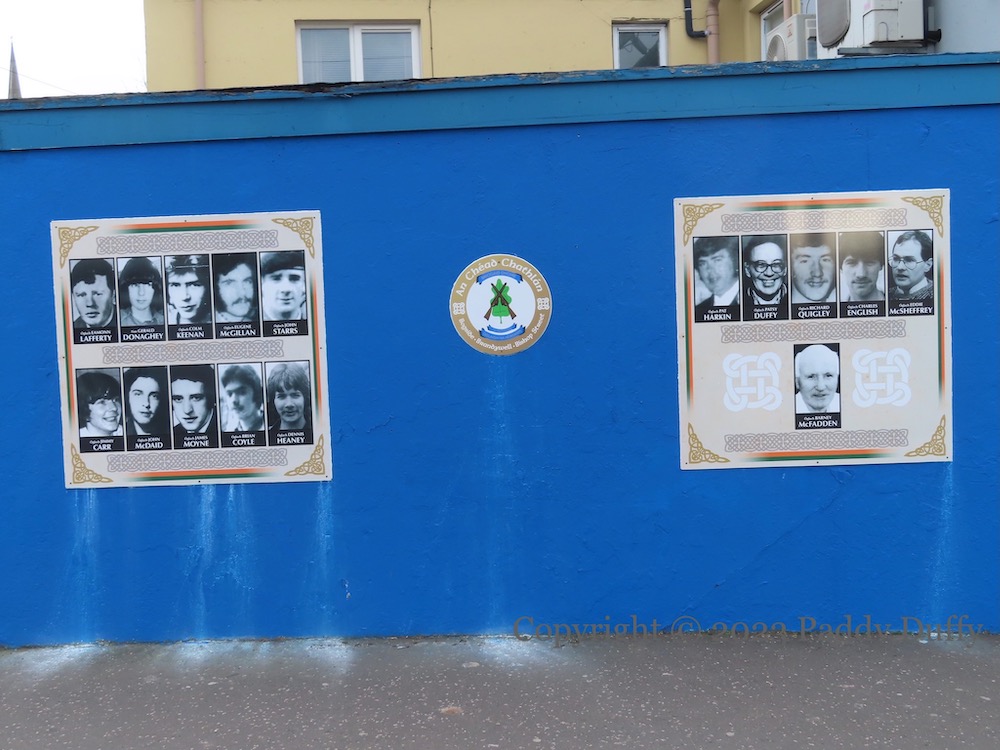
The image above shows a mural with Cú Chulaınn (Visual History), an oak leaf with crossed rifles, and a lily. Two boards commemorate volunteers from the 1st battalion. The sixteen portraits are of Lafferty, Donaghey, Keenan, McGillan, Starrs, / Carr, McDaid, Moyne, Coyle, Heaney, // Harkin, Duffy, Quigley, English, McSheffrey, / McFadden.
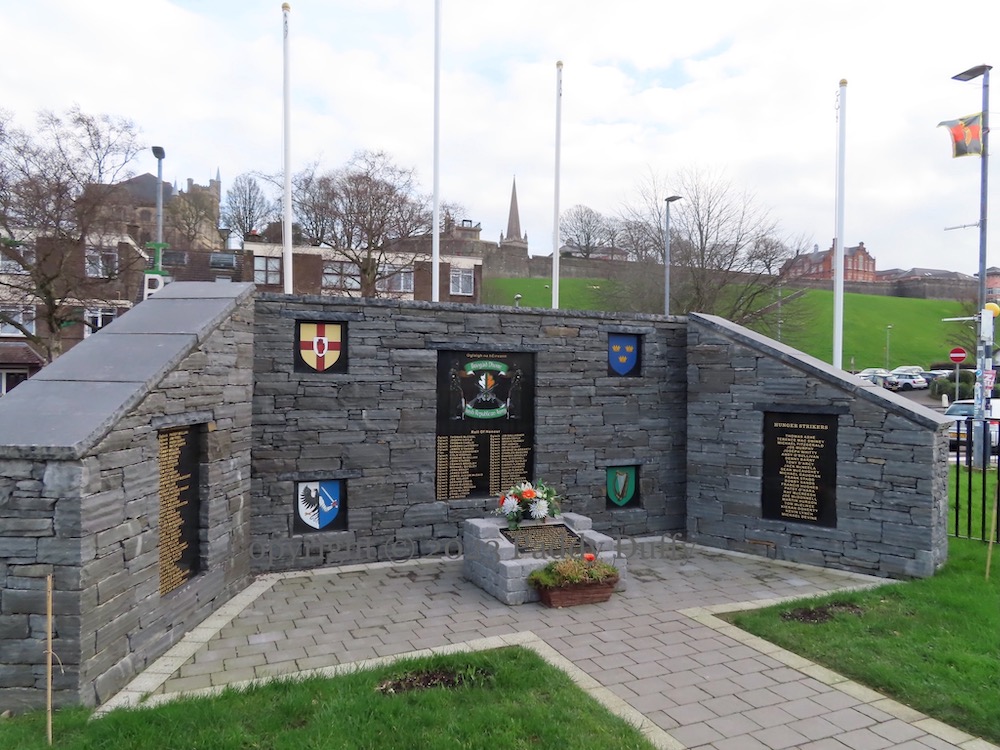
In August (2022), Saoradh Doıre (web) and the Derry IRPWA (web) unveiled a new memorial to the Derry Brigade IRA/Brıogáıd Dhoıre Óglaıgh Na hÉıreann on the green at the Fahan Street turn which it is calling “the people’s monument” (Derry Now) perhaps in parallel with the series of murals by the Bogside Artists called “the people’s gallery” (Visual History page).
In the centre is a Derry Brigade roll of honour with 42 names; on the left is a role of remembrance of naturally-deceased óglaıgh and activists, including Geordie McGilloway who worked on the nearby hunger strike memorial (An Phoblacht); on the right is a list of the deceased twentieth century hunger strikers, beginning with Thomas Ashe.
“This monument is dedicated to the people of Derry City who have resisted & still resist the occupation of our country by Britain. We acknowledge with pride the sacrifices they made throughout every decade. Their names would be too numerous to mention & their deeds of bravery & resistance unequaled in the history of our struggle. The republican movement of Derry City salute you and your families. Your reward will only be a united Ireland.”
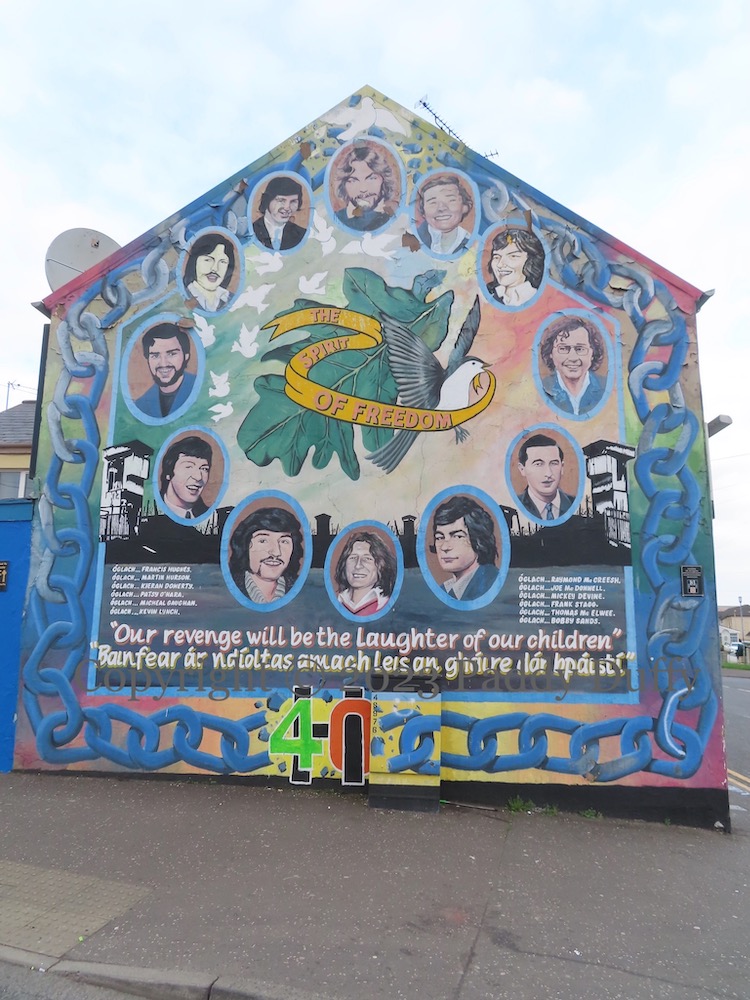
The plaque to the left reads, “This mural is dedicated to all those who tragically died on the streets of Derry during the hunger strike era. Suaımhneas Dé da nanamacha. 3rd October 2006.” The mural referred to is in fact the ‘crumbling cell’ mural (see M03350); the ‘Spirit Of Freedom’ mural was first painted in 2011 for the 30th anniversary (see X00999) – the 30th anniversary plaque remains, on the right of the mural but for the 40th anniversary of the 1981 hunger strike “40” replaced the “30” in the bottom border.
The mural features both the lark and the dove (Visual History).
On the side wall, two new panels remember members of the IRA’s Derry brigade, replacing the single board seen in M07635.
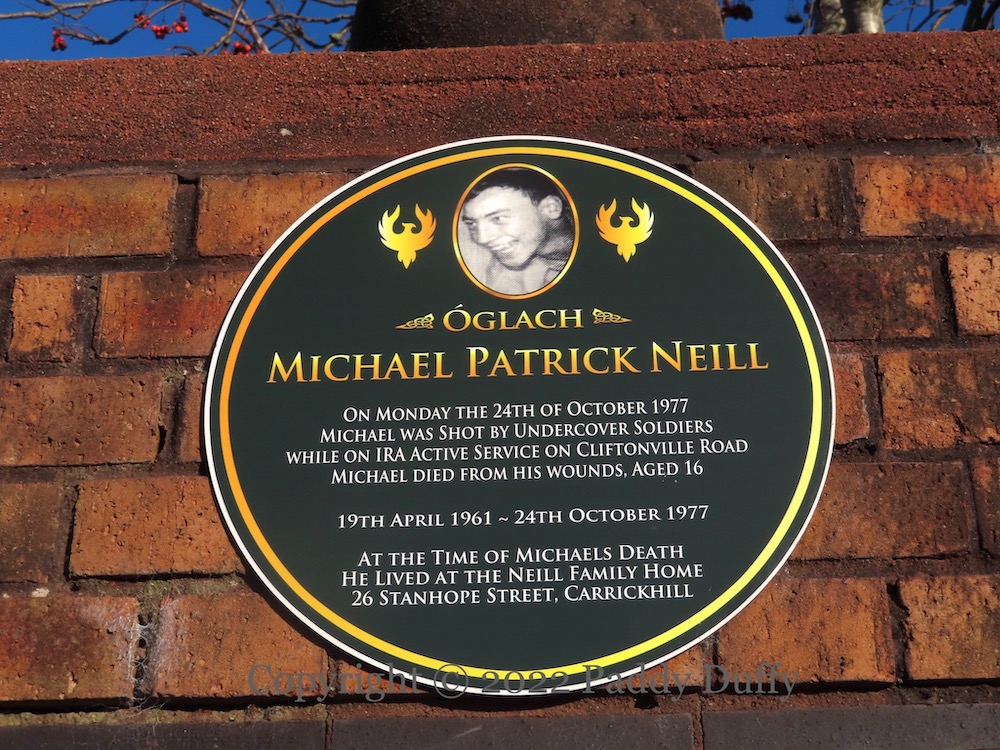
These two plaques are on the “gateposts” at the entrance to Alton Street in Carrick Hill. Neill (above) is on the right; Scullion (below) is on the left.
Neill: “Óglach Michael Patrick Neill. On Monday the 24th of October 1977 Michael was shot by undercover soldiers while on IRA active service on Cliftonville Road. Michael died from his wounds, aged 16. At the time of Michael’s death he lived at the Neill family home 26 Stanhope Street, Carrickhill.”
Scullion: “Óglach Louis Scullion. At 1:45 a.m. on the 14th of July 1972 Louis was shot four times by the British Army as he walked to his home in Unity flats. Louis was unarmed and died as a result of his injuries. 5th June 1945 – 14th July 1972. Louis lived at 51H Unity Walk.”
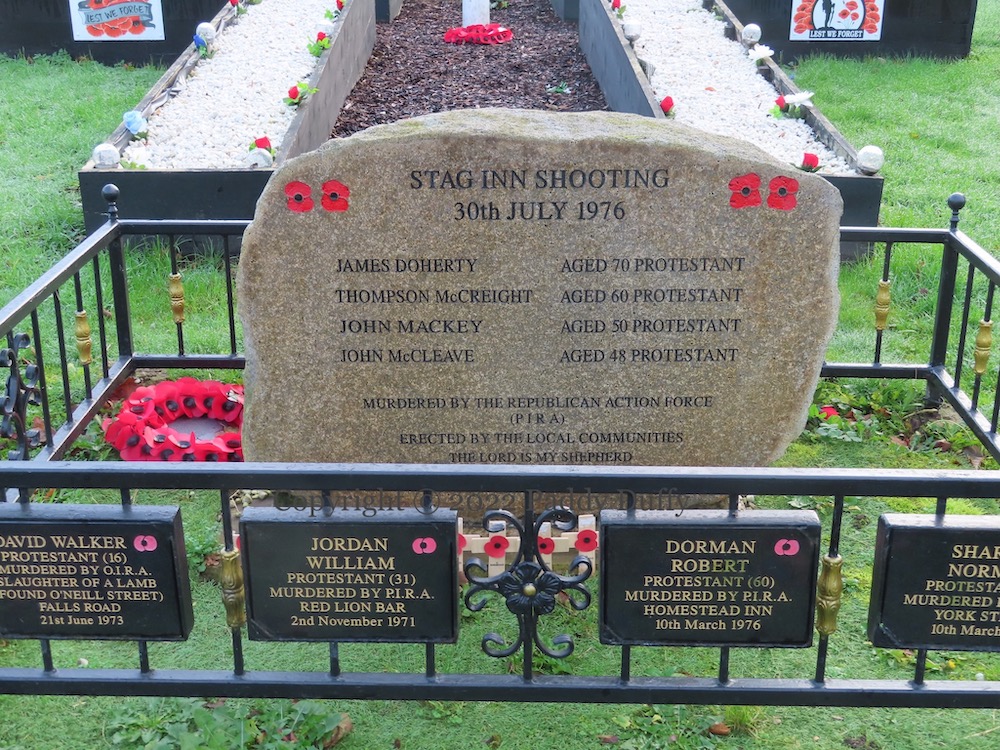
A long series of tit-for-tat shootings of pubs and clubs continued into the summer of 1976, with attacks on the Chlorane (June 5th), Walkers (June 25th), the Ramble (July 2nd), the Whitefort (July 29th), and then, on the 30th, The Stag at Shaws Bridge, Belfast, by the Republican Action Force (PIRA) (Sutton). John McCleave, John McKay, and James “Jimmy” Doherty died on the night of the attack, and Thompson McCreight died of his wounds nine days later. The memorial to them – “erected by the local communities” – is on Milltown Road, next to the Dreamscheme (web) mural.
Photographs of a dozen atrocities are included on the right of this Derwent Street mural, ranging in time from the 1970 gun-battle around the nearby St Matthew’s church in 1970, in which Jimmy McCurrie and Bobby Neill were killed, to the October 1993 IRA bombing of Frizzell’s fish shop on the Shankill Road, in which Leanne Murray (shown on the left) was one of ten people, two of them children, to die. The others incidents portrayed are Bloody Friday, Darkley, Coleraine, Abercorn, Balmoral, Claudy, La Mon, Kingsmill, and Teebane.
This new computer-generated mural replaces the painted East Belfast Remembers, which had peeled away to a great extent.
“The slaughter of the innocent by the blood soaked hands of Sinn Fein/IRA never to be forgotten. The dead cannot cry out for justice. It is a duty of the living to do so for them. Is this the equality Sinn Fein/IRA asks for? No economic targets, no legitimate targets, no enquiries, no truth, no justice. Hold dear the memory of all the innocents murdered in our country in support of the Sinn Fein electorate. This memory extends to those not mentioned here who were murdered going about their daily lives at work, at prayer and in remembrance. Nothing was sacred in the futile question for a united Ireland.”
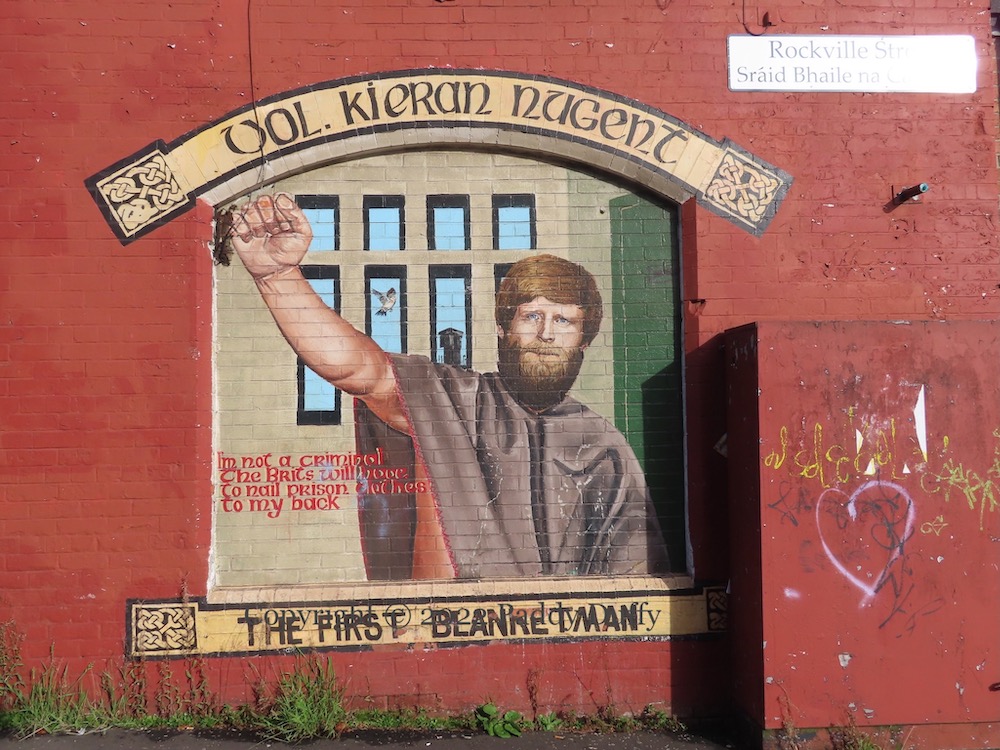
“The first blanketman”. IRA prisoner Kieran Nugent is reputed to have said – upon being imprisoned after the removal of Special Category status in 1976 – “I’m not a criminal – the Brits will have to nail prison clothes to my back.”











 Paddy Duffy Collection