The memorial wall in Erskine Park, Ballyclare, marked the 80th anniversary of VE Day – May 8th, 2025 – with a pair of printed boards wrapping around the corner of the low wall.
For views of the gable and the low wall with armed-forces emblems and plaques to Girvan and Erskine, see The Men From Ballyclare.
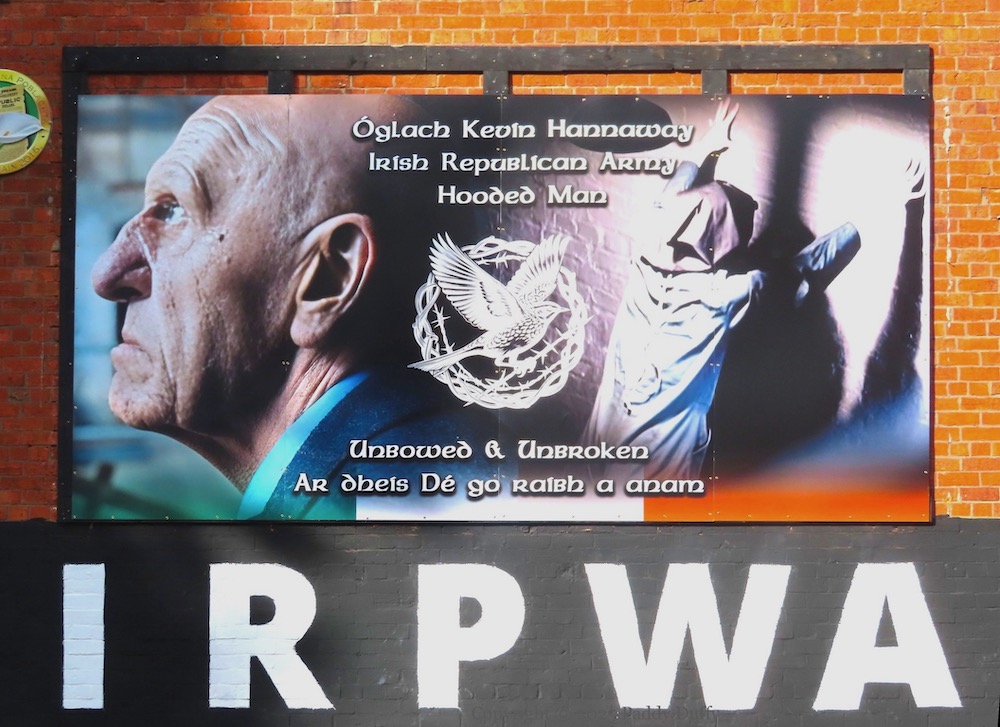
“Óglach Kevin Hannaway, Irish Republican Army, hooded man. Unbowed & unbroken. Ar dheıs Dé go raıbh a anam.”
Kevin Hannaway died in January (2025), aged 77. In 1971 he was interned (Belfast Media) and subjected, along with thirteen others, to the “five techniques” – deprivation of food/drink and of sleep, subjection to noise, prolonged stress positions, and hooding (WP) – as well as being beaten and dropped out of a helicopter (Irish Times). The ‘five techniques’ were found to constitute torture in 2021 (RTÉ) and the PSNI apologised to the victims in 2023 (BBC | Irish Legal News).
Hannaway remained a republican throughout his life and was anti-Agreement in recent years (BBC). The board in Hannaway’s honour was launched on Sunday July 13th (Fb video). The panels of the board were siezed by the PSNI during a drug raid on a home in St James’s on the 11th but returned the next day (BelTel).
“IRPWA [web]. Republican prisoners still exist! Unfinished revolution. Unbowed, unbroken.”
Hugo Street, west Belfast. For a close-up of the Pearse Jordan plaque on the left, see the Peter Moloney Collection.
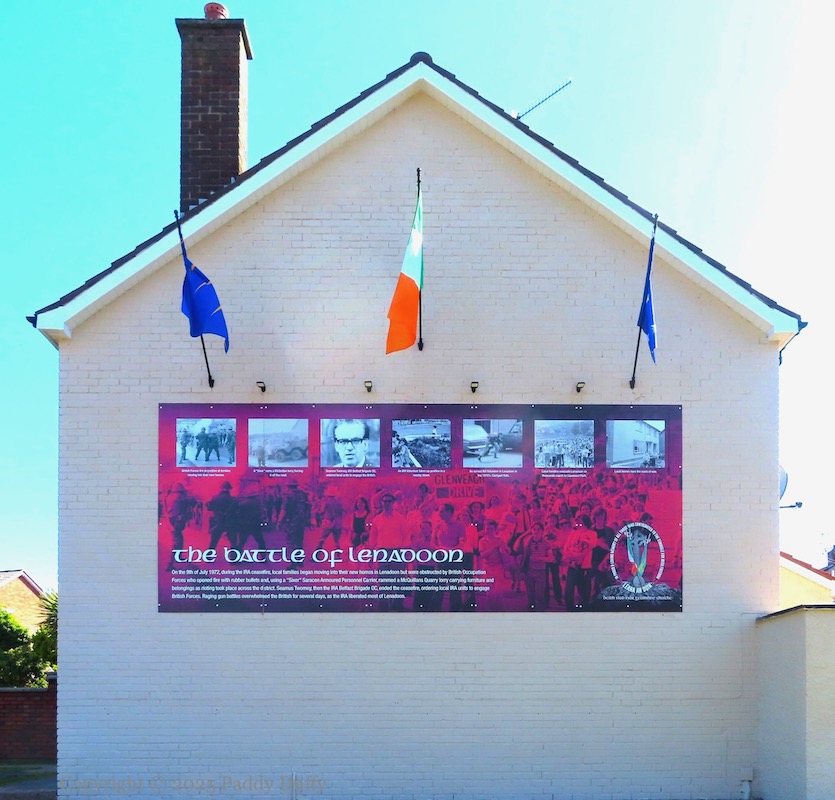
“On the 9th of July 1972, during the IRA ceasefire, local families began moving into their new homes in Lenadoon but were obstructed by British Occupation Forces who opened fire with rubber bullets and, using a “Sixer” Saracen Armoured Personnel Carrier, rammed a McQuillan’s Quarry lorry carrying furniture and belongings as rioting took place across the district. Seamus Twomey, then the IRA Belfast Brigade OC, ended the ceasefire, ordering local IRA units to engage British Forces. Raging gun battles overwhelmed the British for several days, as the IRA liberated most of Lenadoon.”
The captions to the photographs along the top read (l-r): “British Forces fire projectiles at families moving into their new homes”, “A “Sixer” rams a McQuillan lorry, forcing it off the road”, “Seamus Twomey, IRA Belfast Brigade OC, ordered local units to engage the British”, “An IRA Volunteer takes up position in a nearby street”, “An armed IRA volunteer in Lenadoon in the 1970s, Carrigart flats”, “Local families evacuate Lenadoon as thousands march to Casement Park”, “Local homes bare [bear] the scars of war”.
For background, see this 24 minute Thames TV report (on youtube) about the dispute over houses in Lenadoon; RTÉ also has footage (one | two) of the evacuation.
“In proud & loving memory of all those who contributed to the struggle for Irish freedom – Léana An Dúın – Beıdh sıad ınár gcuımhne choíche”
Lenadoon Avenue, west Belfast, replacing the 1995 Gorta Mór mural. Launched Sunday July 12th.
British Army forces were deployed to Northern Ireland On August 14th, 1969, under the operational name “Operation Banner”. It began as peace-keeping, in co-operation with the RUC, but soon became a counter-insurgency operation, which lasted until the Agreement in 1994 and officially ended, under a provision in the Agreement, on July 31st, 2007.
These plaques are beside the front door of the Royal British Legion in Hamilton Road, Bangor. The social club associated with the branch closed in May (Co Down Spectator).
“This plaque is to celebrate the platinum jubilee reign of Her Majesty Queen Elizabeth II 1952-2022. This plaque was presented by the Ulster Defence Regiment CGC Bangor Branch and the Royal British Legion Bangor Branch.”
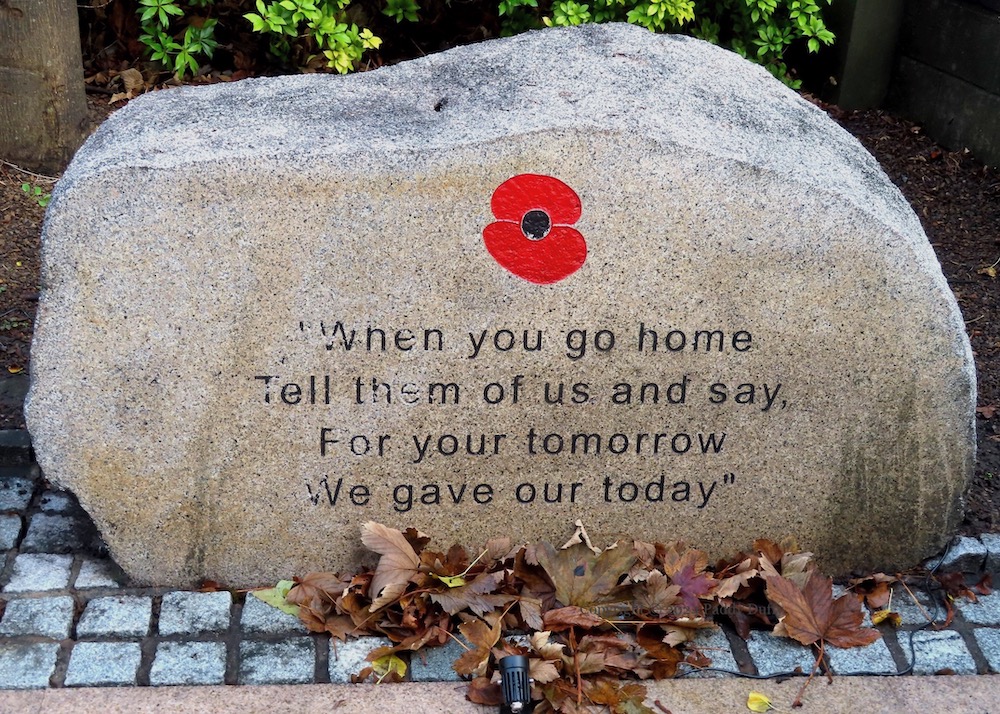
“Operation Banner (14th August 1969 – 31st July 2007) This stone is dedicated to all members of Her Majesty’s Armed Forces and Civilian Emergency Services who served during Operation Banner from Bangor and the surrounding District. ‘As Poppy Petals gently fall, remember us who gave our all/not in the mud of foreign lands nor buried in the desert sands/in Ulster field and farms and town/Fermanagh’s lanes and drumlin’d Down/we died that violent death should cease/and Ulstermen might live in peace.'”
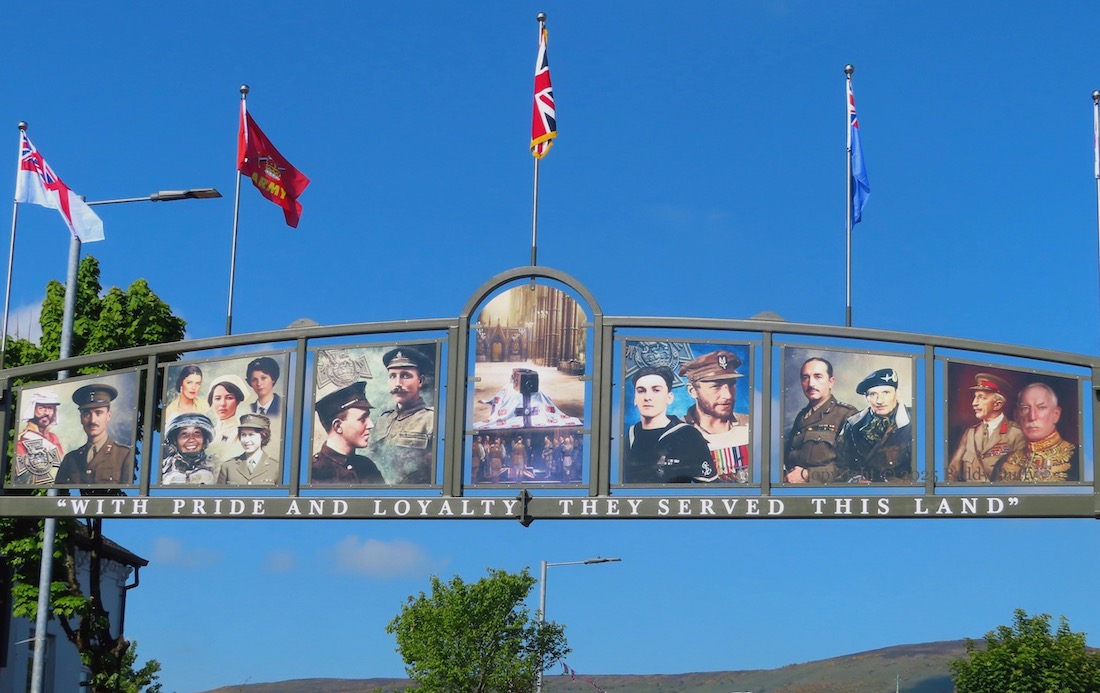
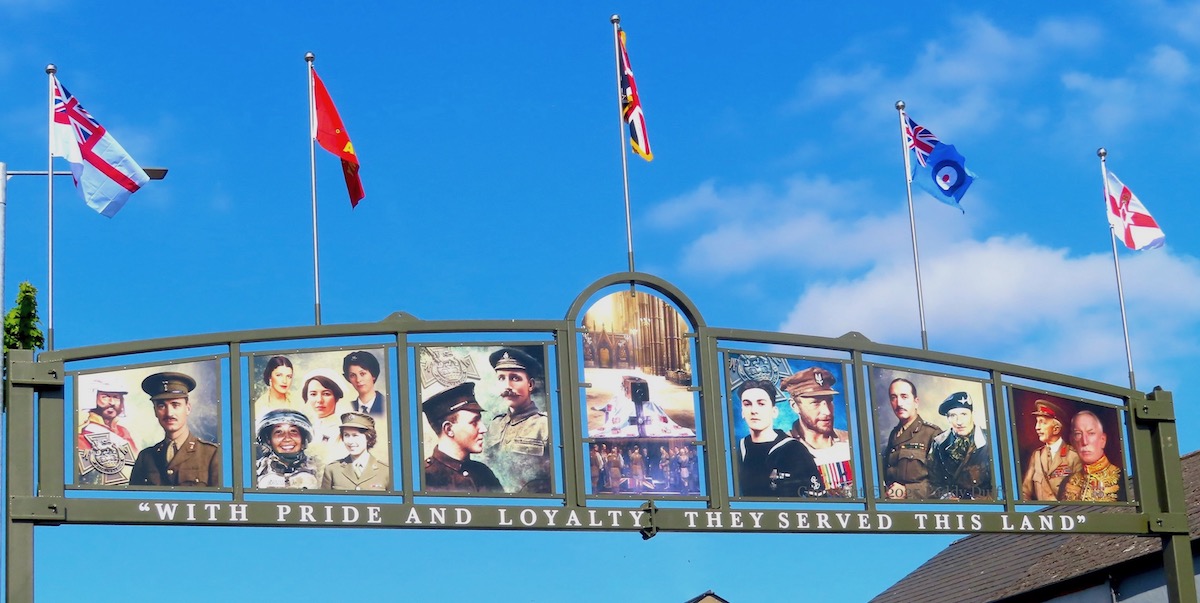
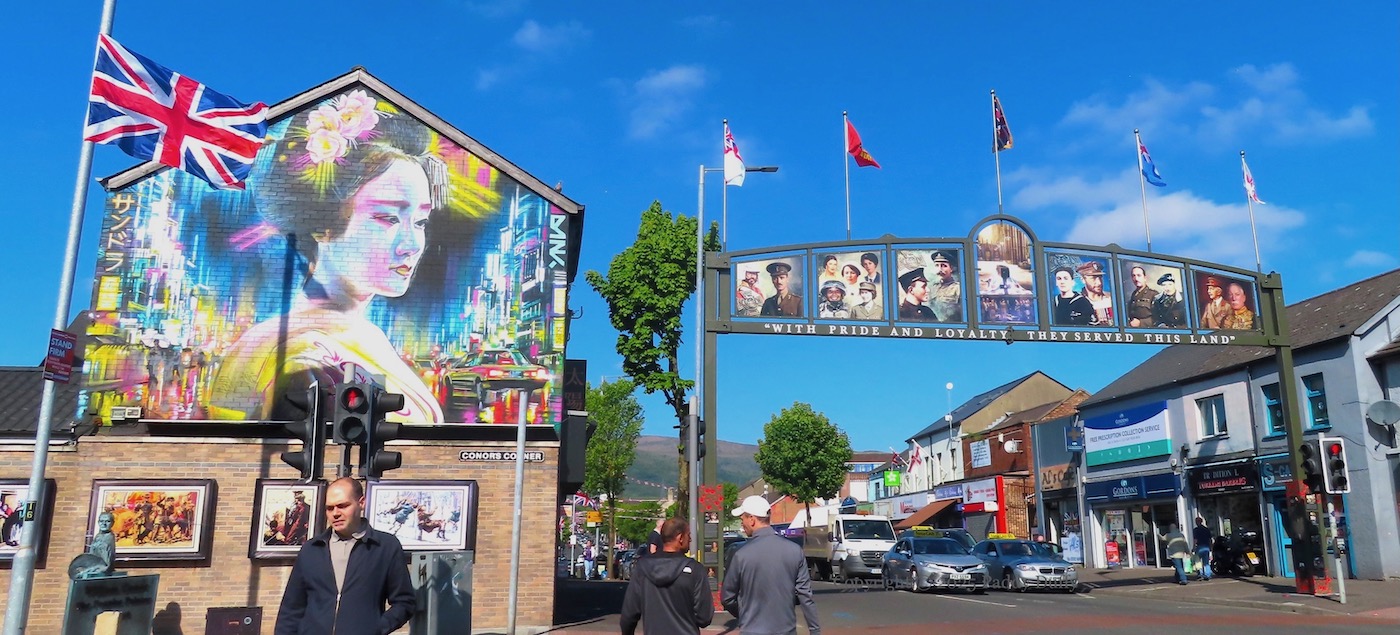
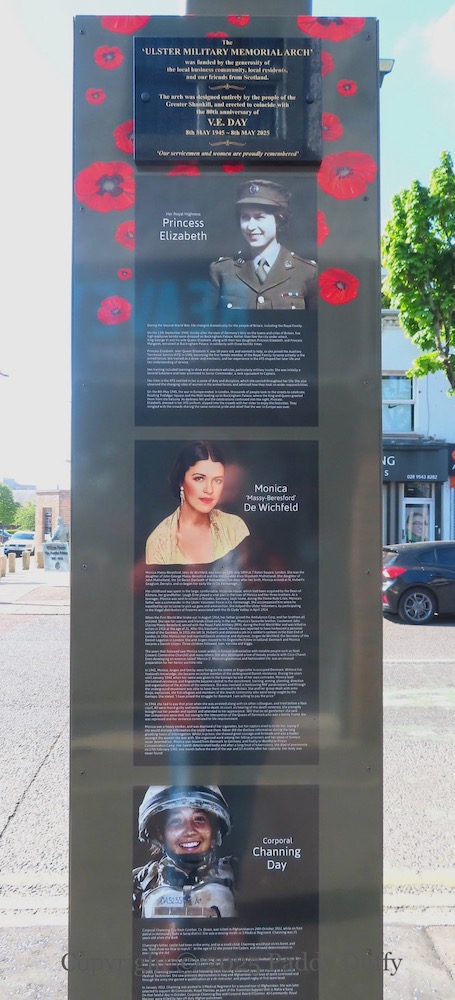
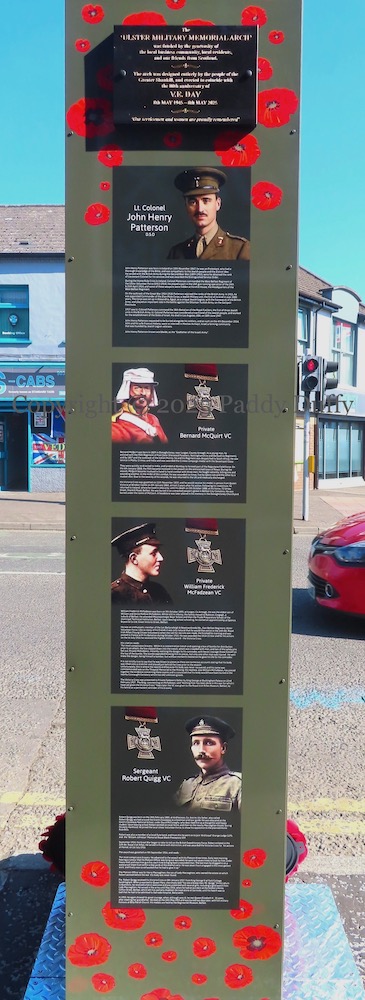
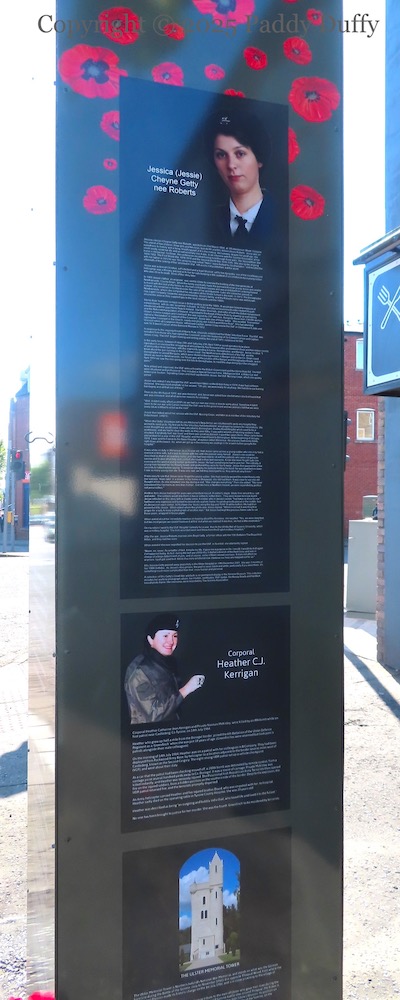
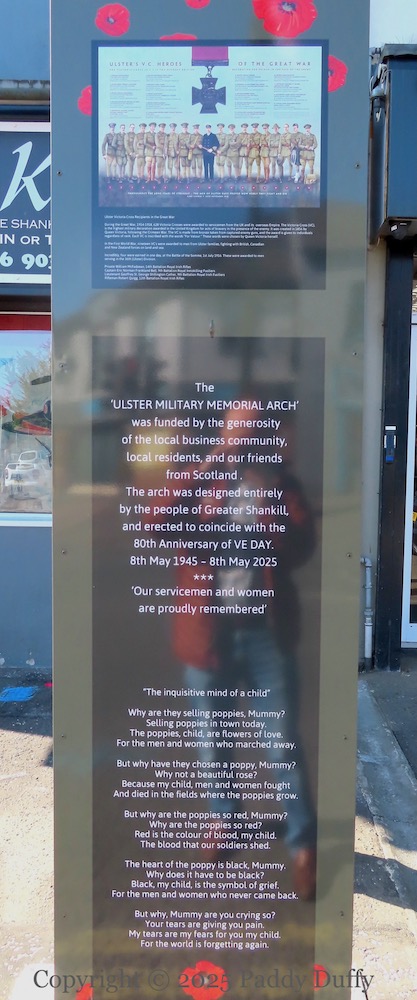
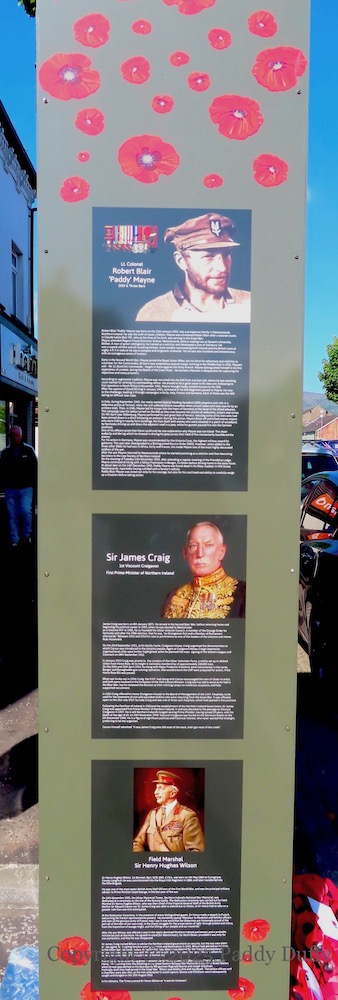
“The ‘Ulster Military Memorial Arch’ was funded by the generosity of the local business community, local residents, and our friends from Scotland. The arch was designed entirely by the people of the Greater Shankill, and erected to coincide with the 80th anniversary of VE Day 8th May 1945 – 8th May 2025. Our servicemen and women are proudly remembered.” For images of the VE Day launch, see the BelTel.
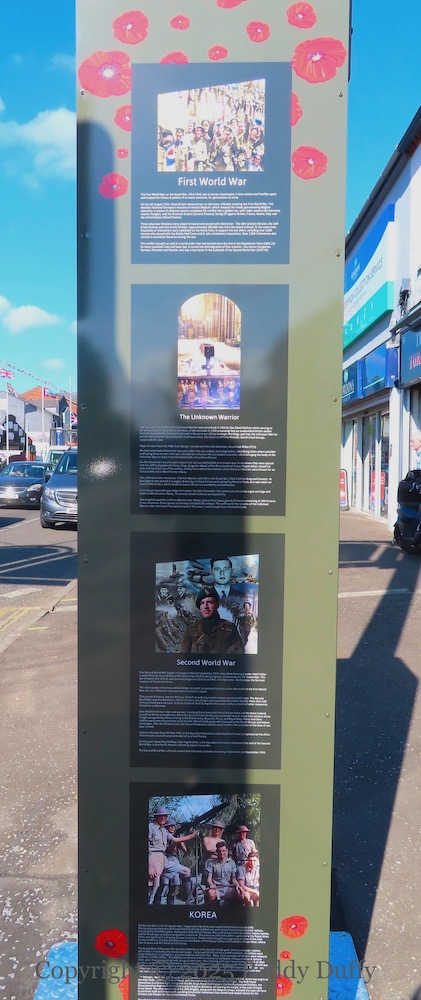
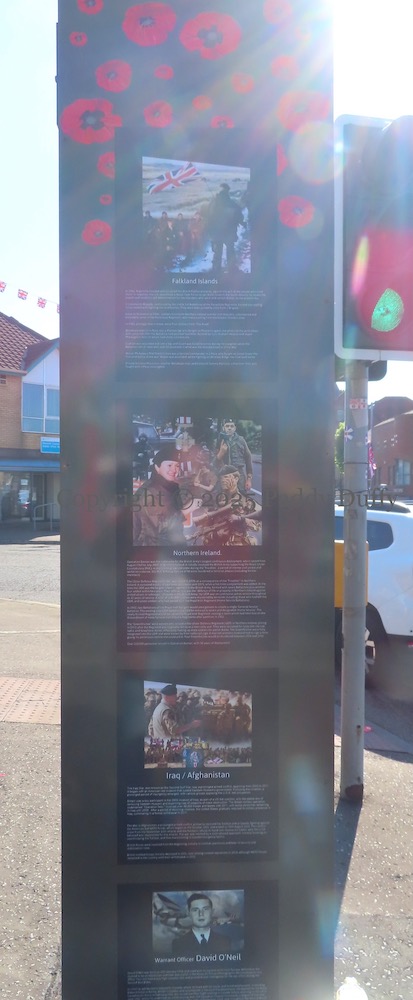
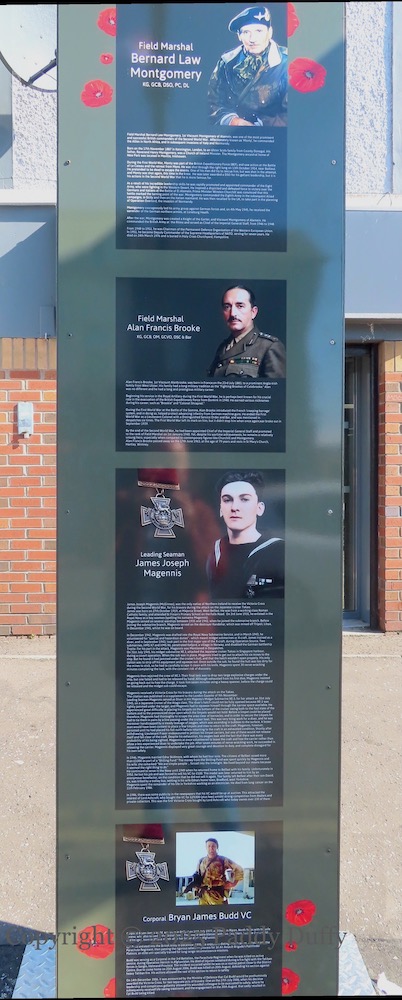
Pictured on Peter’s Hill side of the arch (bearing the quote “With pride and loyalty they served this land”) are (left to right) … Private Bernard McQuirt (a VC winner in 1858 during the Indian Rebellion) and Lt Colonel John Henry Patterson Monica De Wichfeld (raised in Fermanagh and Danish resistance member), Jessie Roberts (a nurse for the Ulster Volunteers and (in WWI) for the Volunteer Aid Detachment, serving in Birmingham and in Wimereux, France; she gets a very long entry on the info panels (see below), as her biography is not available on-line), a (unidentified) nurse, Corporal Channing Day (a medic killed in Afghanistan, 2012), Princess Elizabeth Private William Frederick McFadzean and Sergeant Robert Quigg the tomb of “the unknown warrior” (central panel) Leading Seaman James Joseph Magennis and Lt Colonel Robert Blair ‘Paddy’ Mayne Field Marshal Alan Francis Brooke and Field Marshal Bernard Law Montgomery Field Marshal Sir Henry Hughes Wilson and Sir James Craig
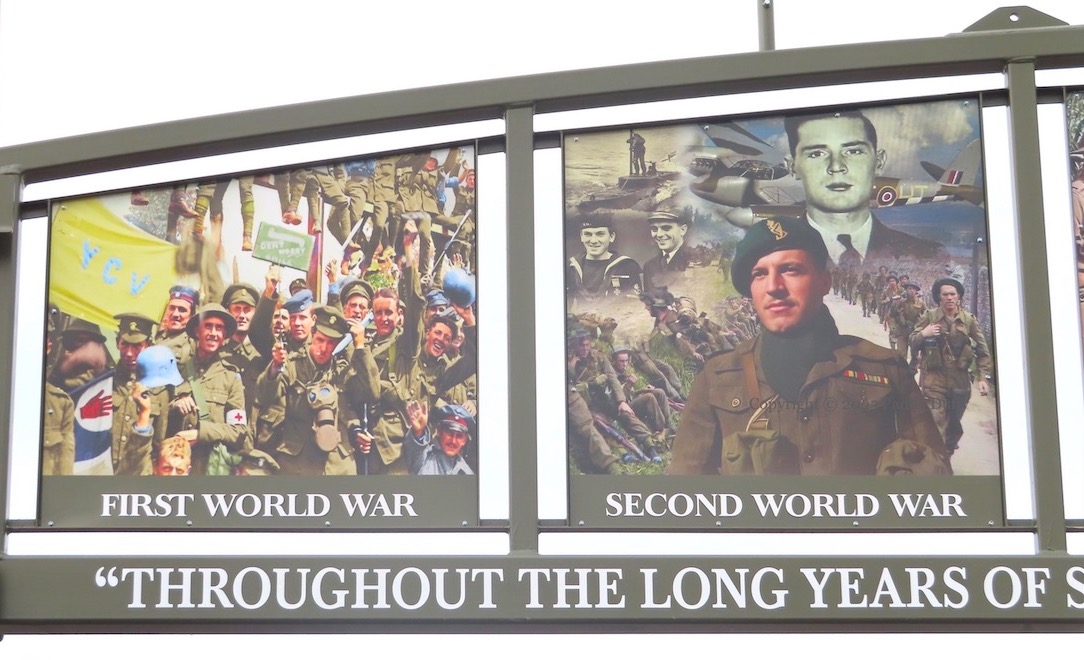
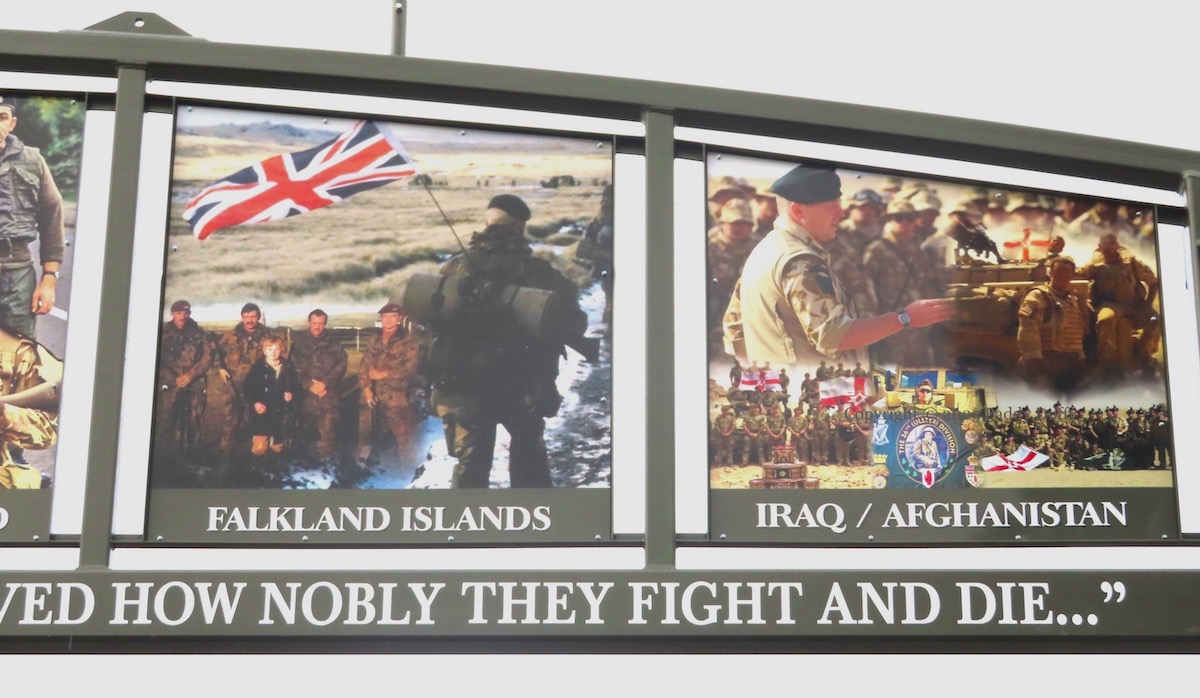
On the other/Shankill side of the arch, bearing the quote “Throughout the long years of struggle … the men and women of Ulster have proved how nobly they fight and die”, the ‘WWII’ panel includes (top right) Warrant Officer David O’Neill, a Canadian Air Force pilot hailing from Ballymena, lost in 1943, and the ‘Northern Ireland’ panel features (left) Corporal Heather CJ Kerrigan, a UDR Greenfinch killed by the IRA in 1984. These two are also profiled in the info panels around the legs of the arch, along with Corporal Bryan James Budd, a 3rd Para soldier killed by friendly fire in Afghanistan, 2006.
Also included is JF Willcocks’s poem Poppies (sometimes called The Inquisitive Mind Of A Child): Why are they selling poppies, Mummy? Selling poppies in town today./The poppies, child, are flowers of love. For the men who marched away./But why have they chosen a poppy, Mummy? Why not a beautiful rose?/Because my child, men fought and died in the fields where the poppies grow./But why are the poppies so red, Mummy? Why are the poppies so red?/Red is the colour of blood, my child. The blood that our soldiers shed./The heart of the poppy is black, Mummy. Why does it have to be black?/Black, my child, is the symbol of grief. For the men who never came back./But why, Mummy are you crying so? Your tears are giving you pain./My tears are my fears for you my child. For the world is forgetting again.”
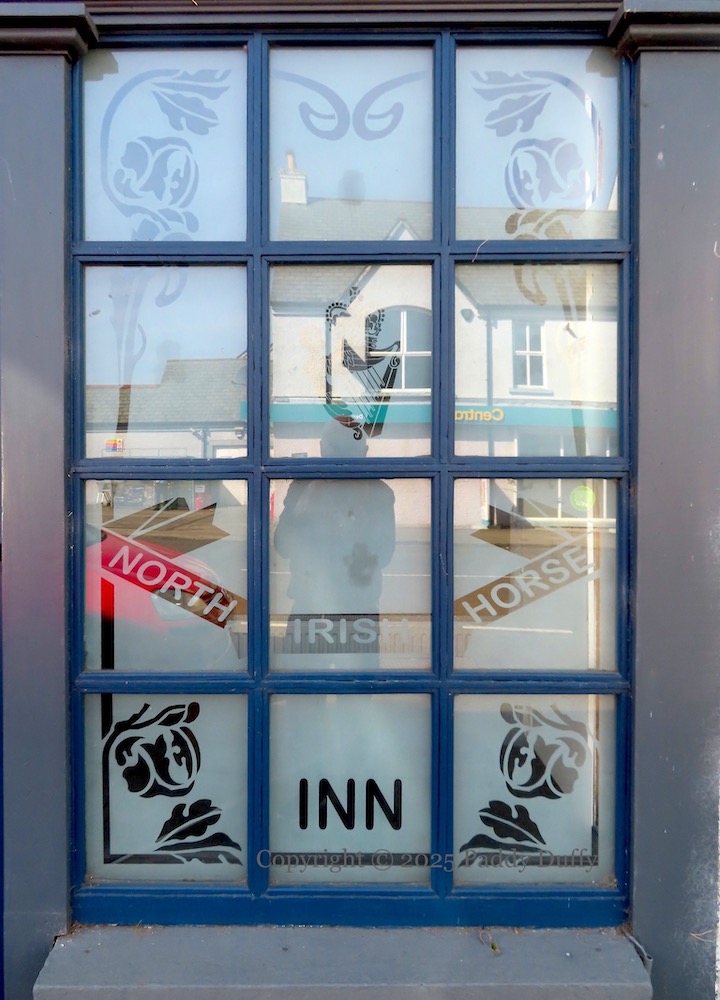
Frosted glass window in the North Irish Horse Inn, Dervock. This Fb page suggests a connection with the 1798 Rebellion; the current North Irish Horse is a light cavalry reconnaissance unit of the British Army, which has a base in nearby Coleraine (web).
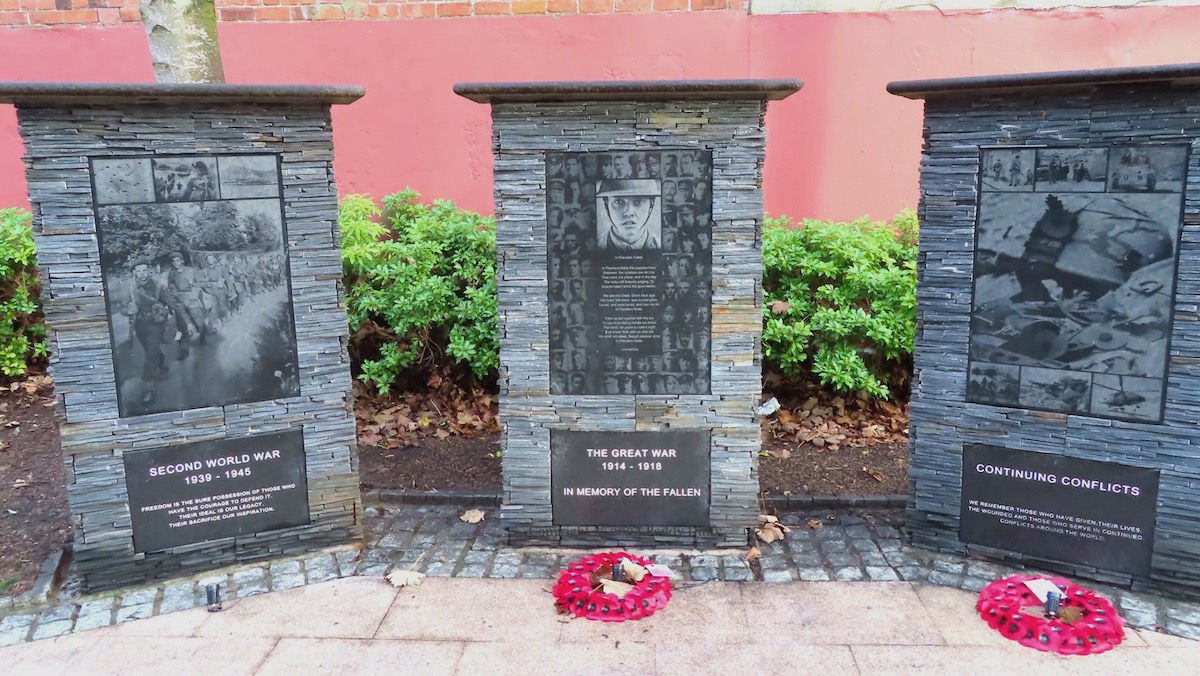
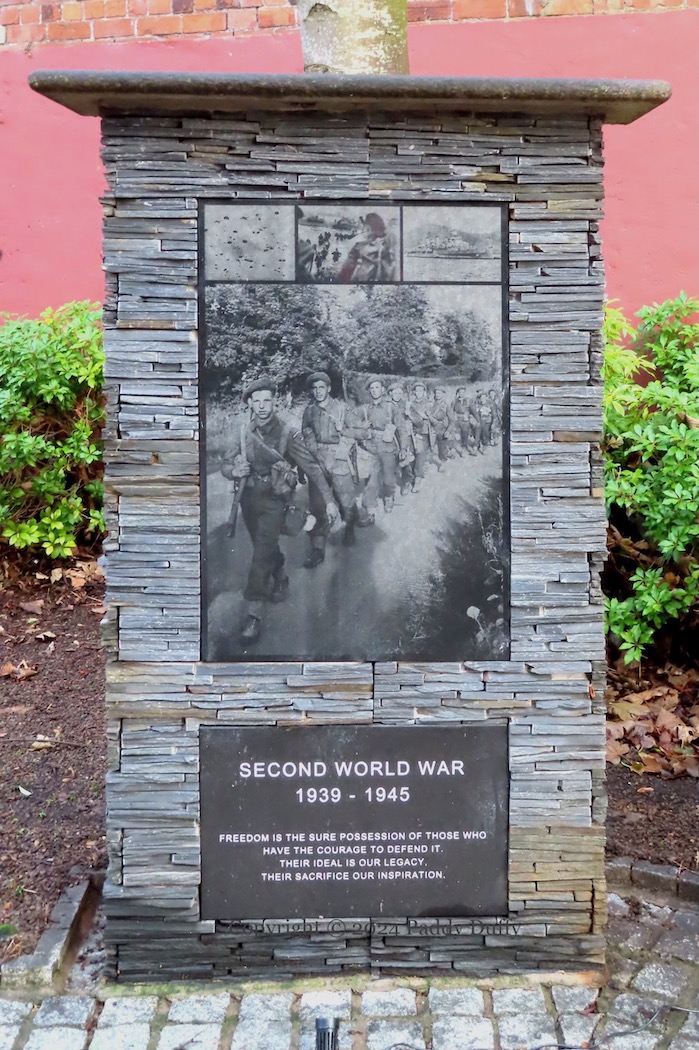
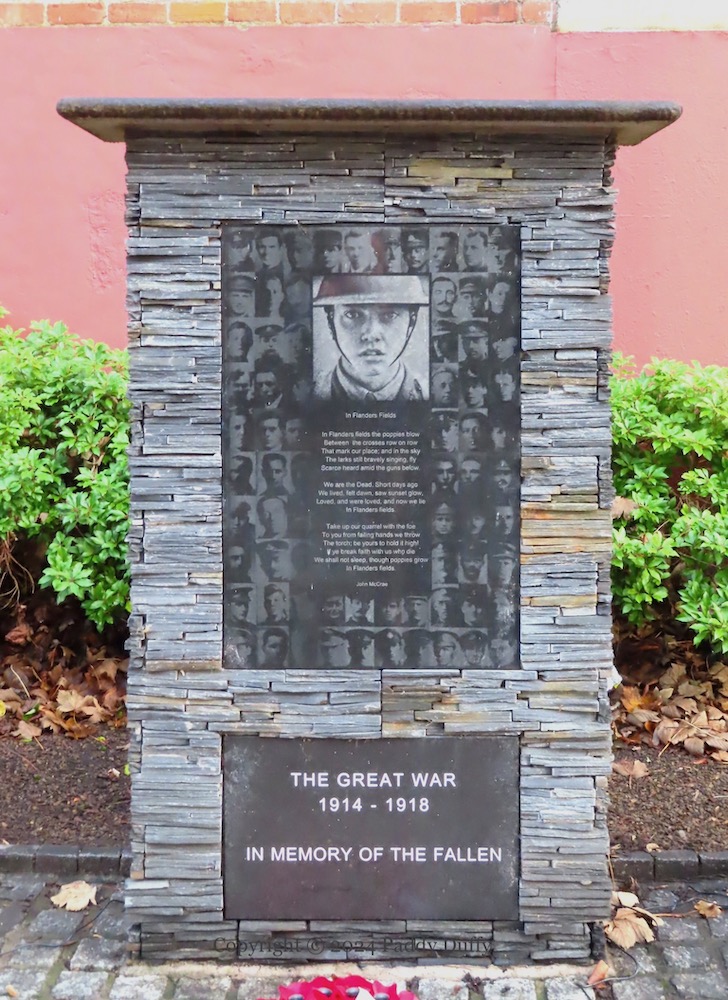
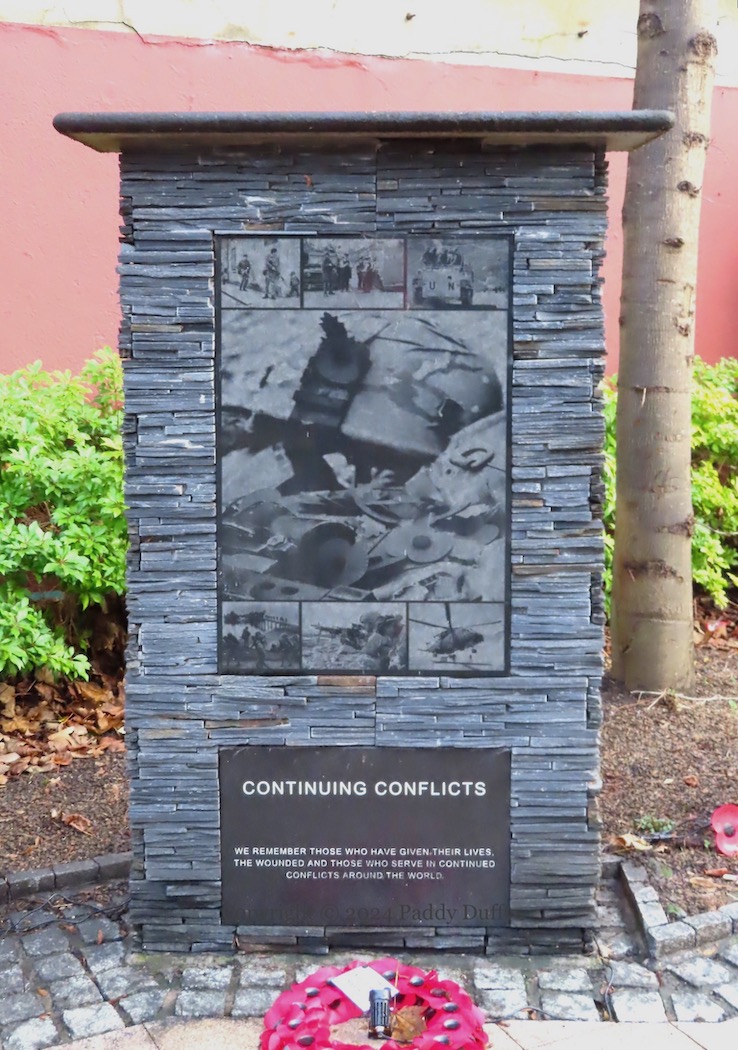
The war memorial garden in City Way (Sandy Row) commemorates those from the Great War, World War II, and “Continuing Conflicts” which includes the “Troubles”. There is also a fourth, smaller, stone, with John Maxwell Edmonds’s memorial epitaph.
“The Great War 1914-1918: In memory of the fallen”, with John McCrae’s poem ‘In Flanders Fields‘. “Second World War 1939-1945: Freedom is the sure possession of those have the courage to defend it. Their ideal is our legacy. Their sacrifice is our inspiration.” “Continuing Conflicts: We remember those who have given their lives. The wounded and those who serve in continued conflicts around the world.”
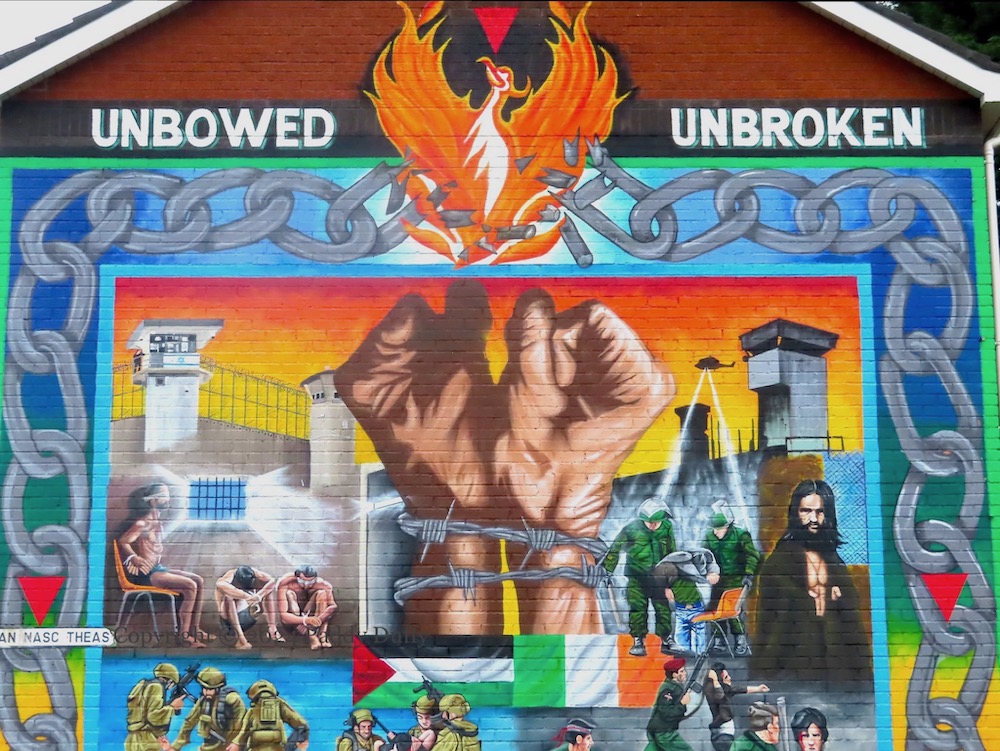
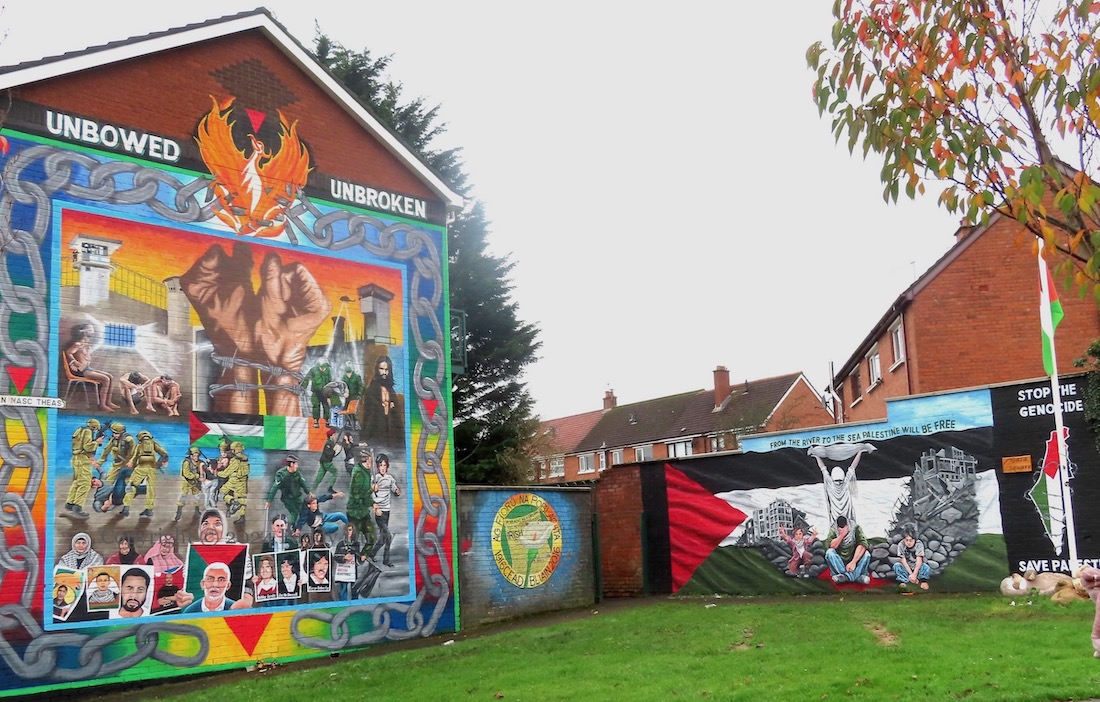
The 1916 centenary mural in Andersonstown has been repurposed and repainted to express solidarity with the people of Palestine.
From the frame of the previous mural – see Unbowed, Unbroken – the title, phoenix, and chains have been preserved but two instances of the inverted red triangle have been added at the top and bottom – see Resist! (and My Kite You Made).
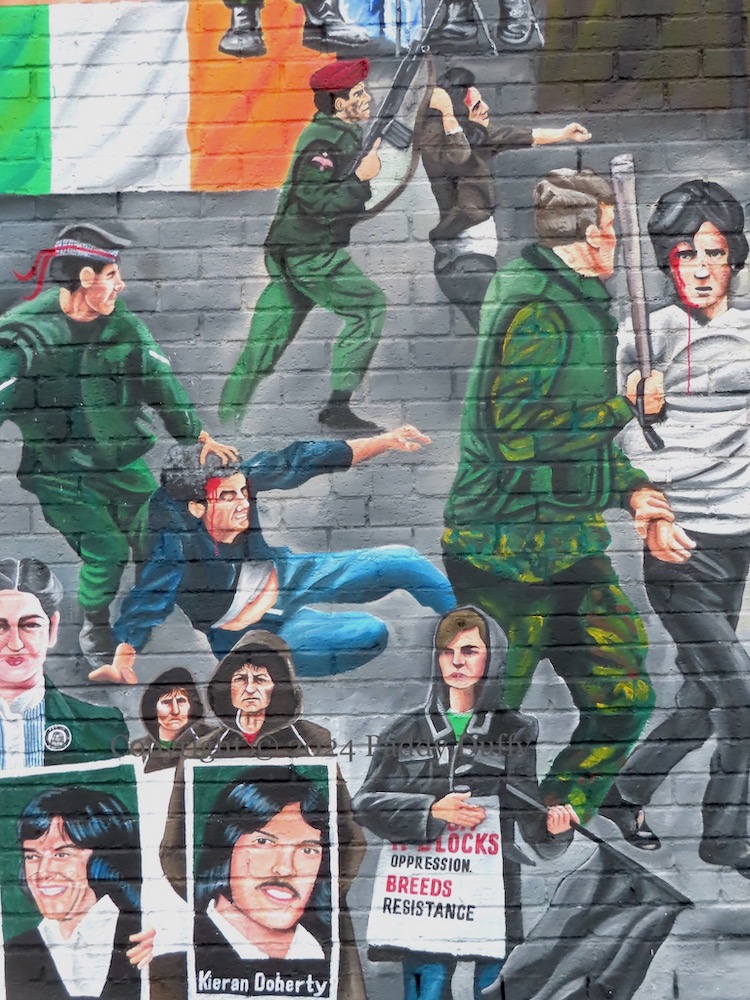
The main panel puts the struggles in Palestine and Northern Ireland in parallel, showing (from top to bottom on each side) political prisoners, violence against protesters, and relatives carrying portraits.
On the left, Palestinian prisoners languish in Israeli jails (based on a photo of Hamza Abu Halima and on this Reuters photograph of prisoners sitting in the street, both from December 2023) and IDF soldiers make violent arrests – the one on the left is from 2016 (CCUN) and the one on the right is perhaps based on this Reuters photograph.
On the right: British soldiers restore order after the Burning Of Long Kesh (see Operation Pagoda), next to blanket-man Hugh Rooney, above three arrests made by British Army soldiers – their caps indicates that they are from the Argyll & Sutherland Highlanders (left) and the Paratroop regiment (centre). (For two of the original photos, see BBC | Getty.)
Along the bottom of both sides, marchers hold portraits of the dead, including the recently-killed leader of Hamas Yahya Sinwar (BBC).
Benjamin West painted The Battle Of The Boyne in 1778 and his composition – with William moving from left to right on a white horse and Marshal Schomberg dying in the bottom-right corner – has become the standard representation in loyalist culture, perhaps due to versions of it appearing on the covers of songbooks for the Orange Order and the Apprentice Boys soon after (Belinda Loftus 1982 Images In Conflict). It appears here on the wall of Whitehead Orange Hall, along with a board connecting service by Irish soldiers in British forces in WWI and Afghanistan (see previously: The Sacrifice Remains the Same in east Belfast).
Compared to the image (from 2021) seen in The Sacrifice Remains The Same, a blue background and a new wall of Poppy Trail plaques (for the Poppy Trail see this 2017 entry on the board) have been added to the Cosy Somme Association’s tribute to British Army soldiers from the 36th (Ulster) Division in WWI and the modern-day Royal Irish Regiment. (See also the image in Alain Miossec’s collection from earlier this year.)
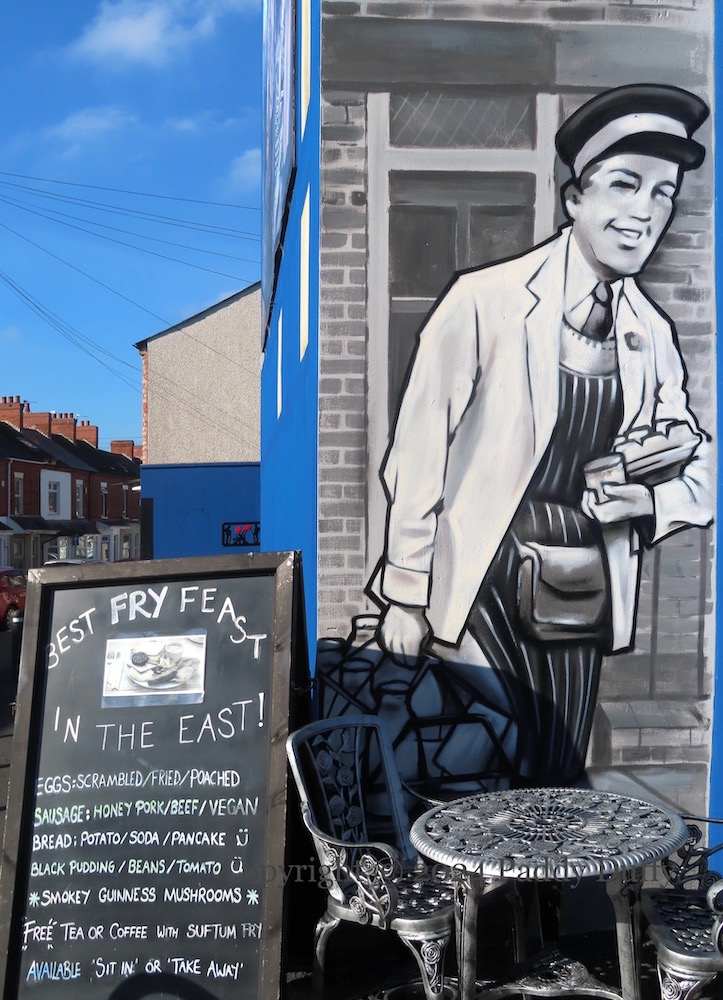
Ogilvie Street, east Belfast, with a bonus image below of the milkman just around the corner, next to Piccola Parma.


















 Paddy Duffy Collection