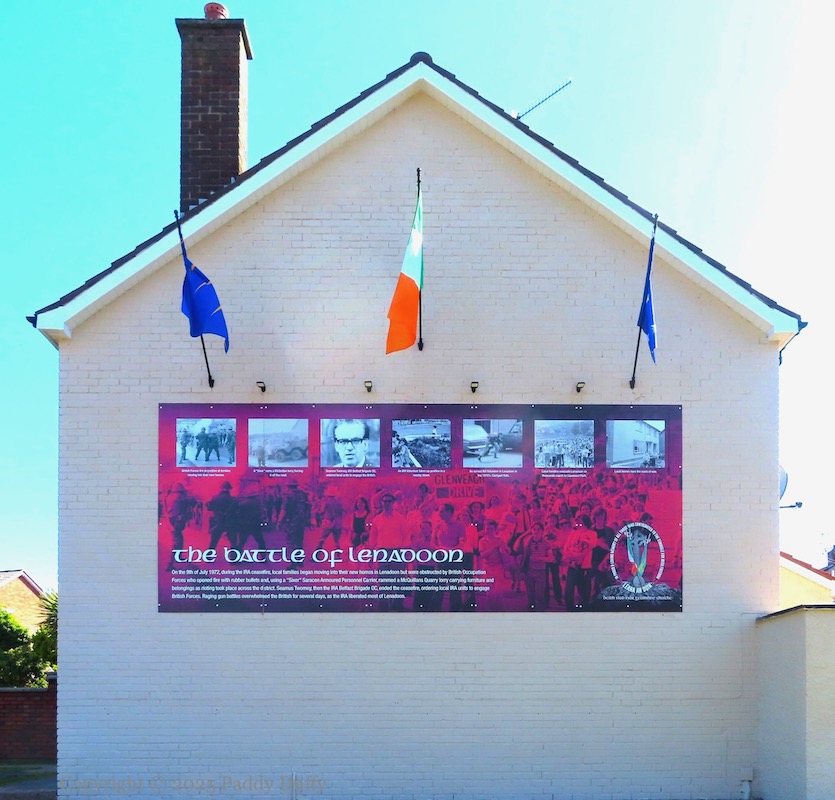
The Battle Of Lenadoon

“On the 9th of July 1972, during the IRA ceasefire, local families began moving into their new homes in Lenadoon but were obstructed by British Occupation Forces who opened fire with rubber bullets and, using a “Sixer” Saracen Armoured Personnel Carrier, rammed a McQuillan’s Quarry lorry carrying furniture and belongings as rioting took place across the district. Seamus Twomey, then the IRA Belfast Brigade OC, ended the ceasefire, ordering local IRA units to engage British Forces. Raging gun battles overwhelmed the British for several days, as the IRA liberated most of Lenadoon.”

The captions to the photographs along the top read (l-r): “British Forces fire projectiles at families moving into their new homes”, “A “Sixer” rams a McQuillan lorry, forcing it off the road”, “Seamus Twomey, IRA Belfast Brigade OC, ordered local units to engage the British”, “An IRA Volunteer takes up position in a nearby street”, “An armed IRA volunteer in Lenadoon in the 1970s, Carrigart flats”, “Local families evacuate Lenadoon as thousands march to Casement Park”, “Local homes bare [bear] the scars of war”.

For background, see this 24 minute Thames TV report (on youtube) about the dispute over houses in Lenadoon; RTÉ also has footage (one | two) of the evacuation.

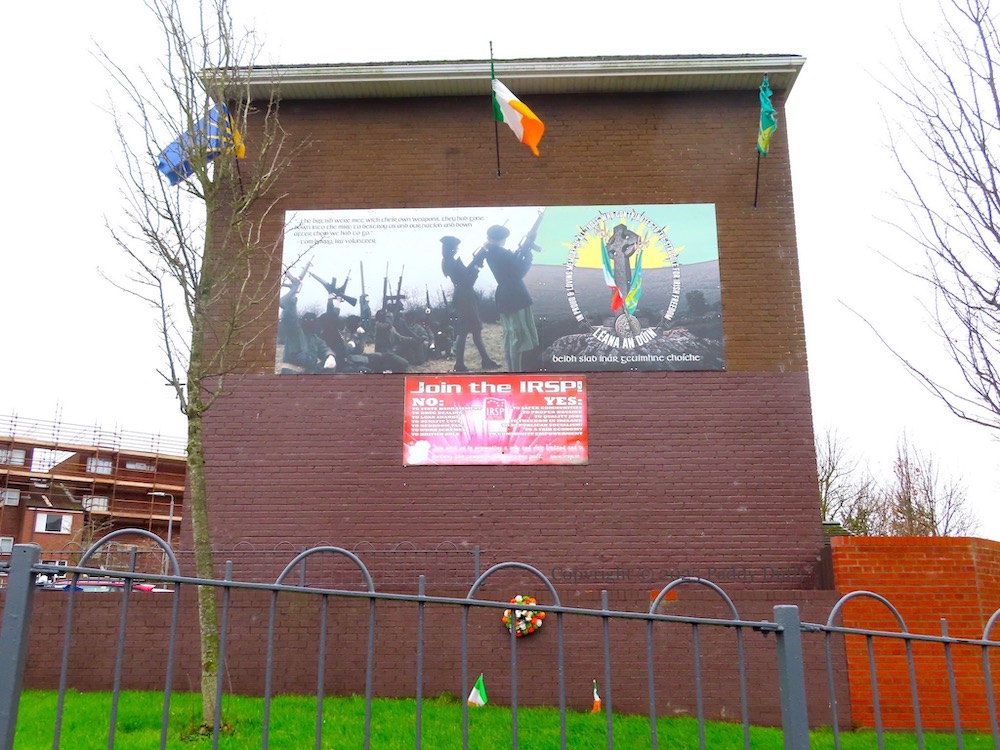
“In proud & loving memory of all those who contributed to the struggle for Irish freedom – Léana An Dúın – Beıdh sıad ınár gcuımhne choíche”

Lenadoon Avenue, west Belfast, replacing the 1995 Gorta Mór mural. Launched Sunday July 12th.

Click image to enlarge
Copyright © 2025 Paddy Duffy
T07225 T07226 T07224 T07227

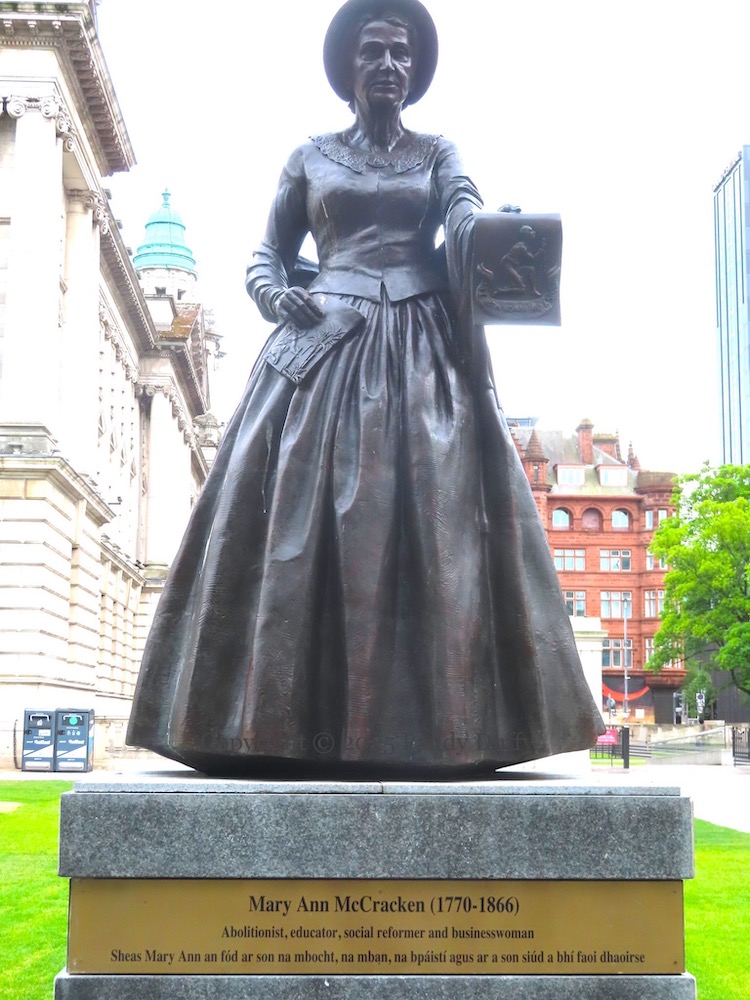
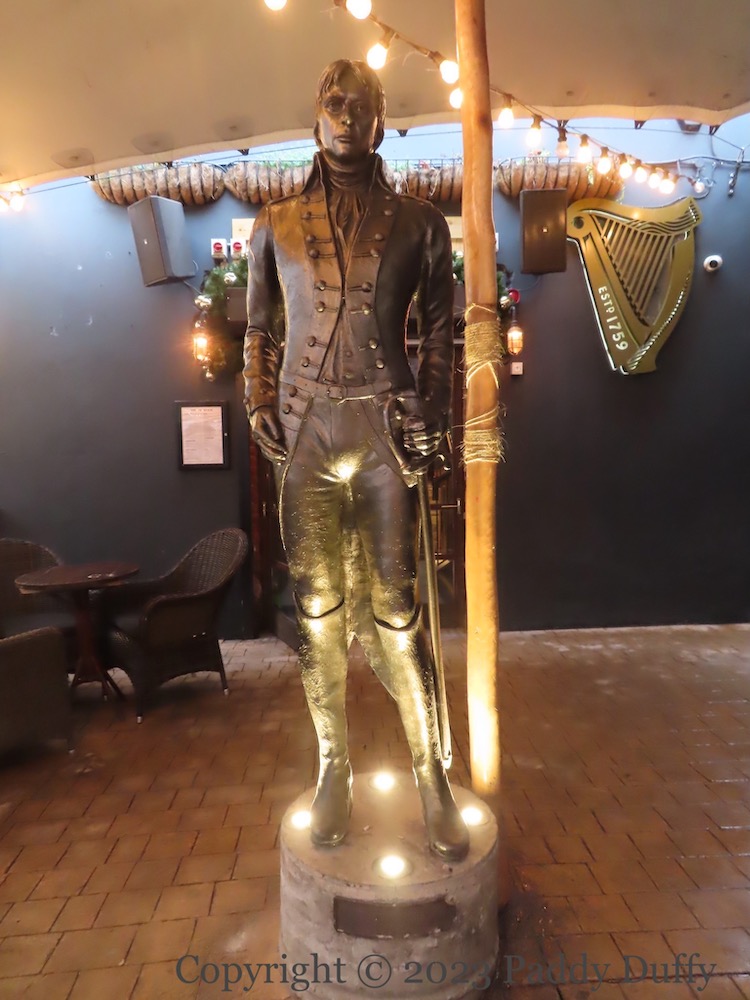
Mary Ann McCracken

“Mary Ann McCracken (1770-1866) Abolitionist, educator, social reformer and businesswoman. Sheas Mary Ann an fód ar son na mbocht, na mban, na bpáıstí agus ar son sıúd a bhí faoı dhaoırse. [Mary Ann stood up for the poor, women, children, and for those who were enslaved.]”

“Mary Ann McCracken’s feminist ideals and commitment to the principles of Equality, Liberty, Fraternity applying equally to the Rights of Woman defined her participation in the United Irish Movement.” For McCracken’s connection to the 1798 Rebellion, see These Are Times That Try Men’s Souls.

McCracken is shown handing out abolitionist leaflets that picture a pleading enslaved woman above the words “Am I not a woman and a sister?” The same supplicant image is on the medallion (perhaps made by Wedgwood for the Society For The Abolition Of The Slave Trade – WP) worn at her throat. See also: The Blots On The Page Are So Black and The World Affords No Enjoyment Equal To That Of Promoting The Happiness Of Others.

The statue was unveiled in the grounds of Belfast City hall together with a statue to Winifred Carney on International Women’s Day (March 8th) 2024; both statues were produced by Ralf and Naomi Sander (BCC).

Click image to enlarge
Copyright © 2025 Paddy Duffy
T06933c T06934

New Lodge Volunteers

Twenty portraits in circular frames have replaced the twenty-one square portraits seen on the ‘Out Of The Ashes Of 1969’ mural in the New Lodge. From left to right, those portrayed are Michael P Neill, Seamus McCusker, Gerard Crossan, Colm Mulgrew, Francis Liggett, Brian Fox, John Kelly, Robert Allsopp, Louis Scullion, Billy Reid, Danny O’Hagan, Michael Kane, Sean McIlvenna, Jim O’Neill, Rosemary Bleakley, Martin McDonagh, James McCann, James Sloan, Dan McCann. Paddy McManus is no longer included, as compared with the earlier portraits.

For the mural without any portraits, at the time of its launch in 2012, see X00857.

See also the New Lodge IRA memorial garden.

New Lodge Road, north Belfast.

Click image to enlarge
Copyright © 2024 Paddy Duffy
T04307 T04306 [T04305]

800 Years Of Irish Resistance

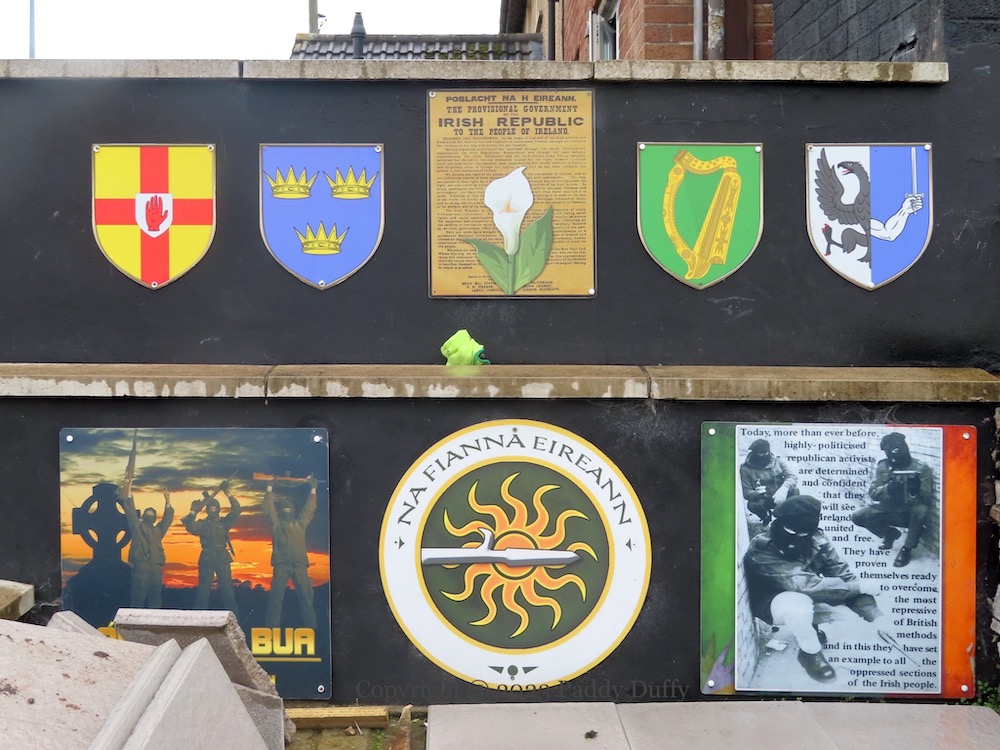
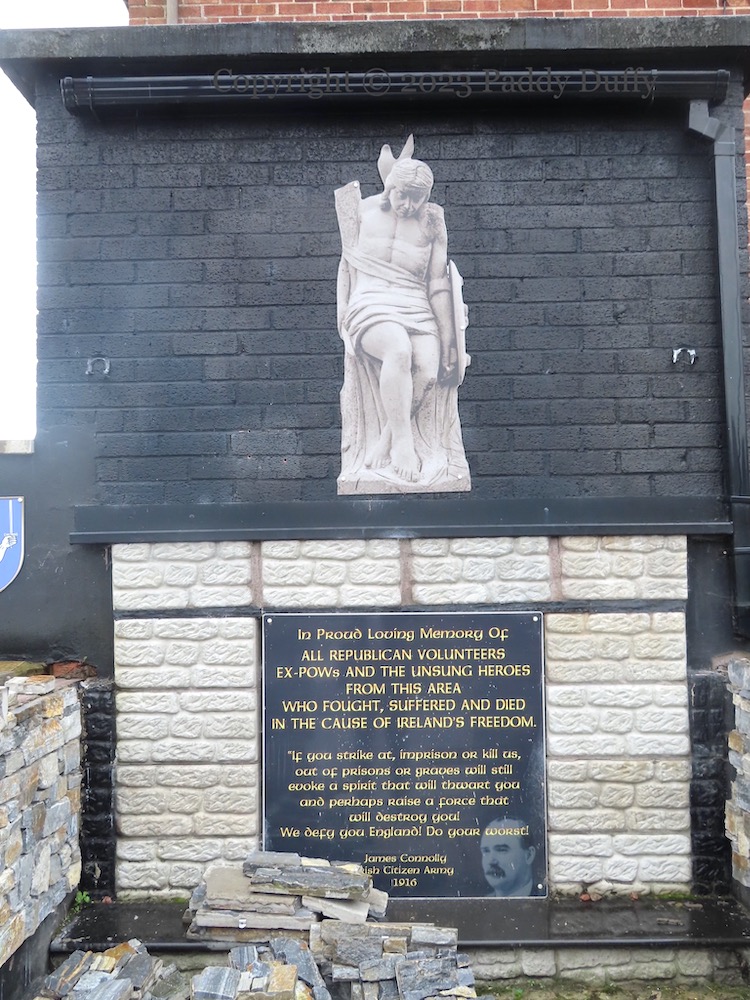
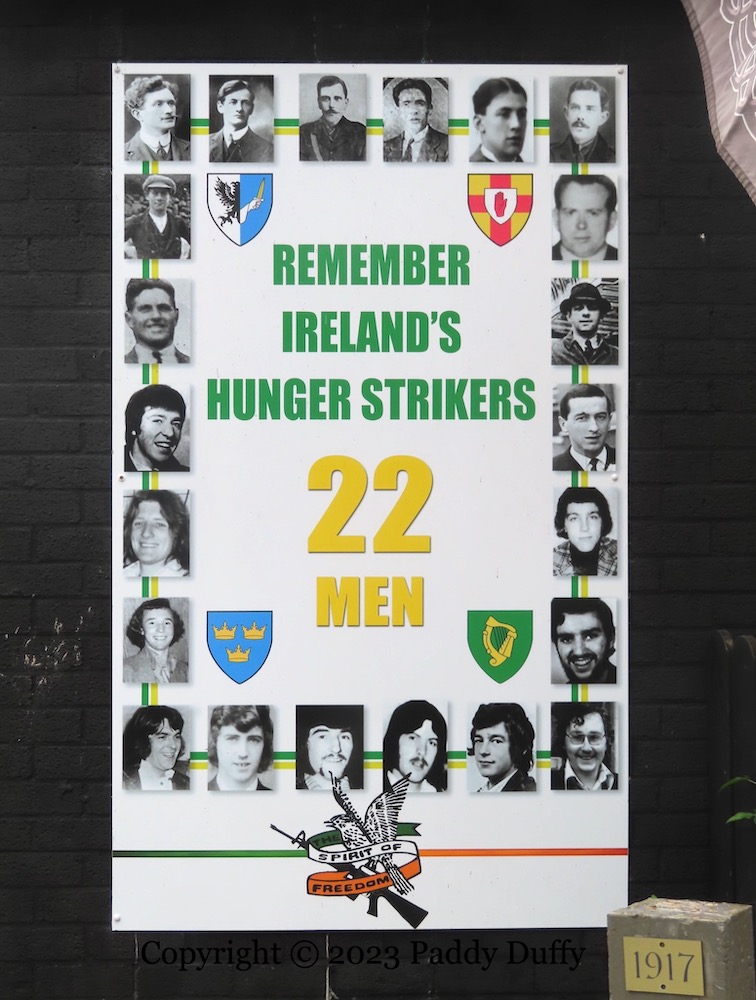
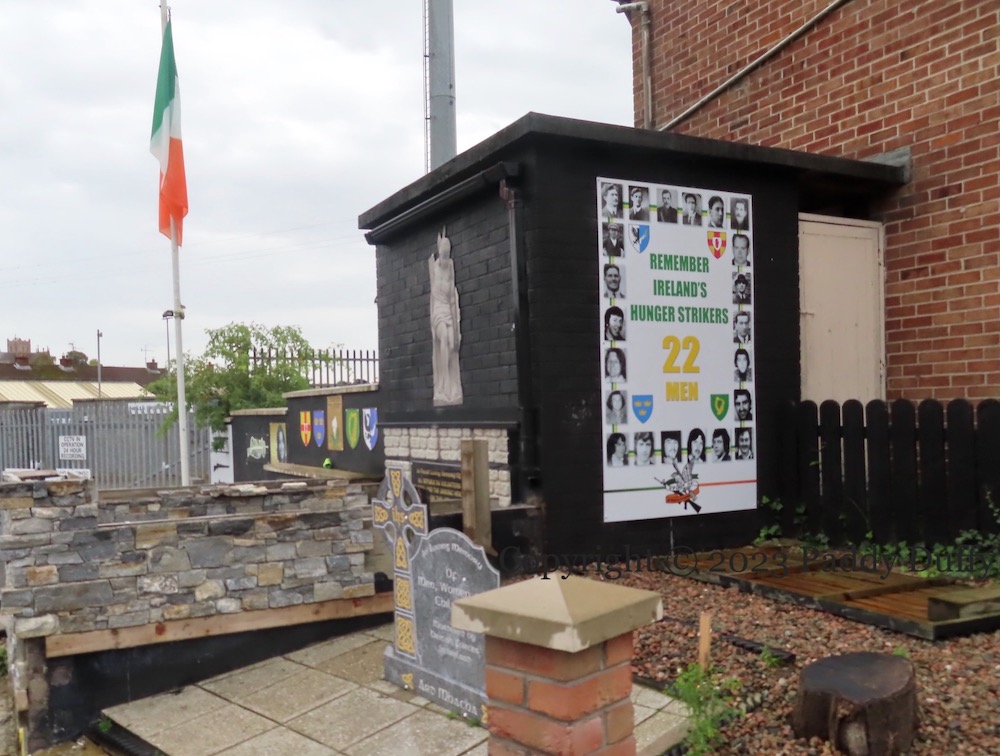
There is a memorial garden to the history of Irish resistance at the entrance to the Athletic Grounds in Armagh. From left to right, the images presented here show:

“More than 800 years of Irish resistence” – a sword for the Norman invasion under Strongbow, a pike for the 1798 and 1803 rebellions, a bolt-action rifle for the Easter Rising of 1916, and an assault rifle for the Troubles;

Cumann Na mBan, Mairéad Farrell and republican women who made “the supreme sacrifice”;

The Proclamation, Provisional IRA and Na Fianna;

The dying Cú Chulainn and a plaque “in proud and loving memory of all republican volunteers, ex-POWs and the unsung heroes from this area who fought, suffered and died in the cause of Ireland’s freedom, with a quote from James Connolly: ‘If you strike at, imprison or kill us, out of prisons or graves will still evoke a spirit that will thwart you and perhaps raise a force that will destroy you! We defy you England! Do your worst!”;

“Remember Ireland’s hunger strikers – 22 men” – the ten 1981 hunger strikers and Thomas Ashe, Terence MacSwiney, Michael Fitzgerald, Joe Murphy, Joseph Whitty, Andy O’Sullivan, Denny Barry, Tony D’Arcy, Jack McNeela, Seán McCaughey, Michael Gaughan, Frank Stagg;

A stone “in loving memory of men, women and children murdered by British forces in Ireland.”

Click image to enlarge
Copyright © 2023 Paddy Duffy
T03367 T03368 T03369 [T03370] T03371 [T03372] T03373 T03375 T03374

Aontacht Lenár Lınn

“Am le haontacht na hÉıreann” [Time for Irish unity]. Between stints in prison in 1976, Bobby Sands carried a green harp flag – symbol of Ireland and in particular of the United Irishmen – in an August march to protest the withdrawal of political status (Gérard Harlay/Bobby Sands Trust). He is shown here marching under the #TimeForUnity message on Slıabh Dubh in the campaign for a border poll and Irish unity “lenár lınn”/”in our time” (Fb | tw).

See also: Reıfreann Anois | Time For Irish Unity

Click image to enlarge
Copyright © 2022 Paddy Duffy
T00865 [T00864]

It Is New Strung And Shall Be Heard

This mural for the 200th anniversary of the 1798 rebellion by “Na hÉıreannaıgh Aontaıthe” (the United Irishmen). The United Irishmen used the Maid Of Erin harp as a symbol. Out of frame to the right is the motto of the French Revolution: “Liberté, égalité, fraternité”.

There are seven names listed on the right, none of which is Andrea Redmond (Fb), who is the painter of record. The list was later painted out – see M02183.

South Link, Andersonstown, west Belfast

Click image to enlarge
Copyright © 1999 Paddy Duffy
T00351 [T00328] [T00419]

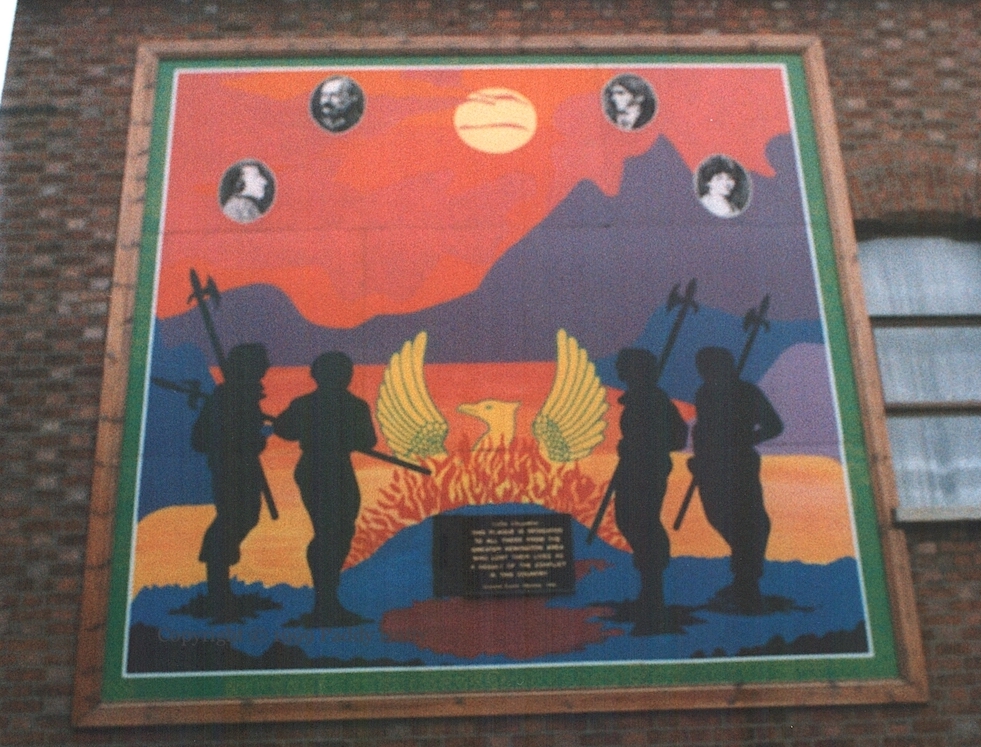
Out Of The Ashes Of 1798

“I ndıl chuımhne – this plaque is dedicated to all those from the greater Newington area who lost their lives as a result of the conflict in this country.” Pikemen from the 1798 uprising stand on either side of a phoenix, with portraits above of Wolfe Tone, James Connolly, Henry Joy McCracken, and Mary Ann McCracken.

Newington Avenue, north Belfast

Click image to enlarge
Copyright © 1999 Paddy Duffy
T00354c

Society Of United Irishmen

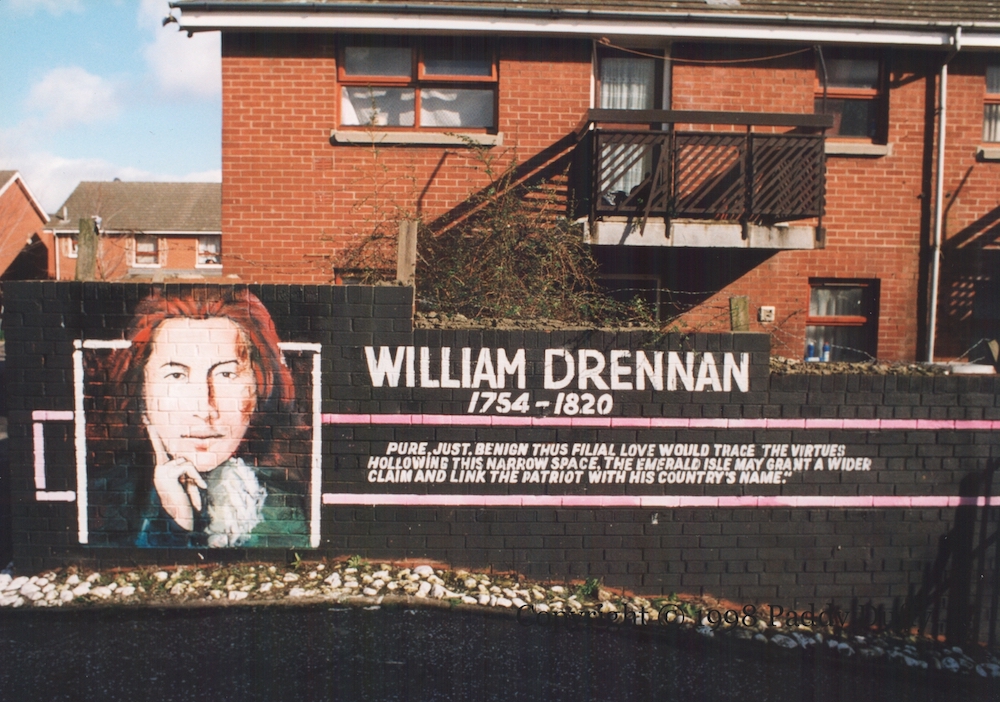
This is a trio of murals along the New Lodge Road to William Steel Dickson, William Drennan, and Mary Ann and Henry Joy McCracken. What the three have in common is that they were all Presbyterians and Irish republicans, and members of the Society Of United Irishmen.

William Steel Dickson was adjutant-general of the County Down Irishmen (see the blue plaque in Portaferry M08948) and was arrested a few days before the insurrection (WP). Like the McCrackens, he is buried in Clifton Street Cemetery.

William Drennan, 1754-1820, was a doctor, poet, a founder of the Society of United Irishmen, and the first person to refer to Ireland as “the Emerald Isle”, in his poem When Erin First Rose. The words in the mural are the epitaph on his stone in Clifton Street Cemetery: “Pure, just, benign. Thus filial love would trace the virtues, hollowing [sic] this narrow space. The Emerald Isle may grant a wider claim and link the patriot with his country’s name.”

Mary Ann McCracken (“What a wonderful clamour is now raised at the name of union, when in reality there has always been such a union between England and this country, as there is between husband and wife by which the former has the power to oppress the latter.”) and her older brother Henry Joy McCracken (“These are the times that try men’s souls … the rich always betray the poor.”) are the best-known of the figures. Henry led the Antrim uprising of the United Irishmen in 1798 and was executed for it; Mary Ann was an abolitionist and social reformer.

Ludlow Square/New Lodge Road, north Belfast

Click image to enlarge
Copyright © 1998 Paddy Duffy
T00282 T00283 T00284 [T00305]

Robert Emmet Commemoration

A Robert Emmet mural was painted by Robbie Kane in 1953 (for the 150th anniversary of the 1803 rebellion and his execution) in Crumlin Street. This was one of a very few CNR murals painted prior to the Troubles, and nationalist symbols were formerly outlawed in the Flags And Emblems Act of 1954. (See Visual History 02.) As can be seen below, the original was accompanied by a Christian cross and the words “Hail Christ our king”. This version reproduces only the two medallions, showing a Celtic harp (left) and a dramatic portrait of Emmet waving his hat, from the mid-1800s (WP/LoC).

Click image to enlarge
Copyright © 1997 Paddy Duffy
T00298

Ireland First, Ireland Last, And Ireland Over All

A revolutionary soldier raises the Irish Tricolour while trampling on a Union Flag on a broken mast that was perhaps attached to the poorly drawn GPO in the background. The card on which the image is based can be seen below.

On the right hand side are the Easter lily and halberds/pikes and an assault rifle, indicating the historical roots and present-day inheritors of the 1916 revolt.

Click image to enlarge
Copyright © 1990 Paddy Duffy
T00094