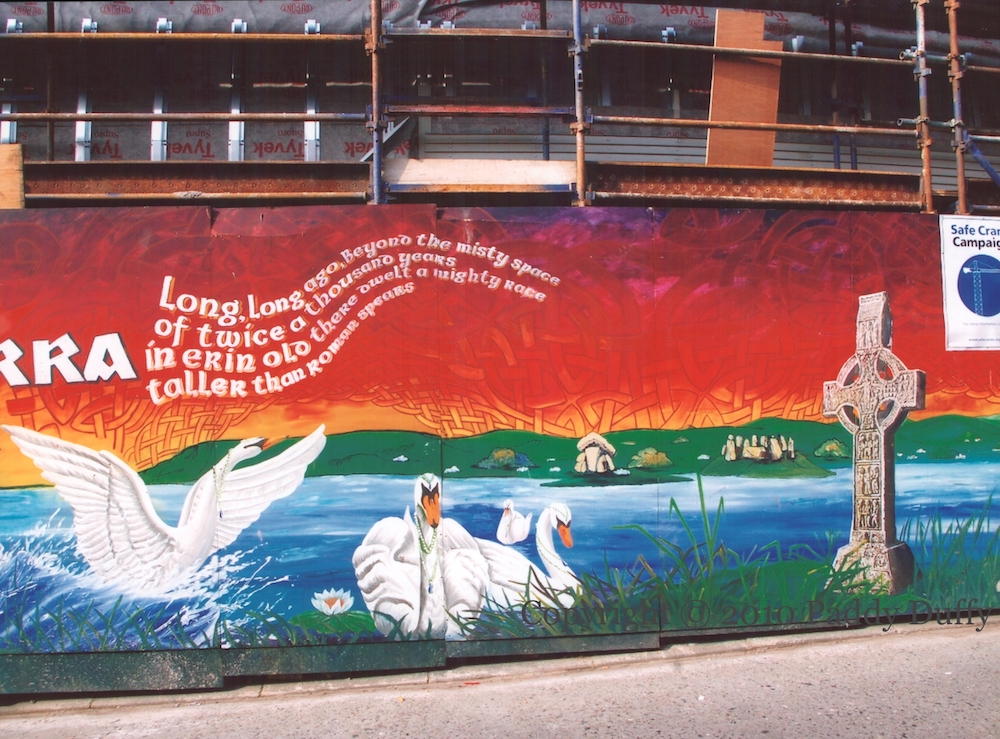
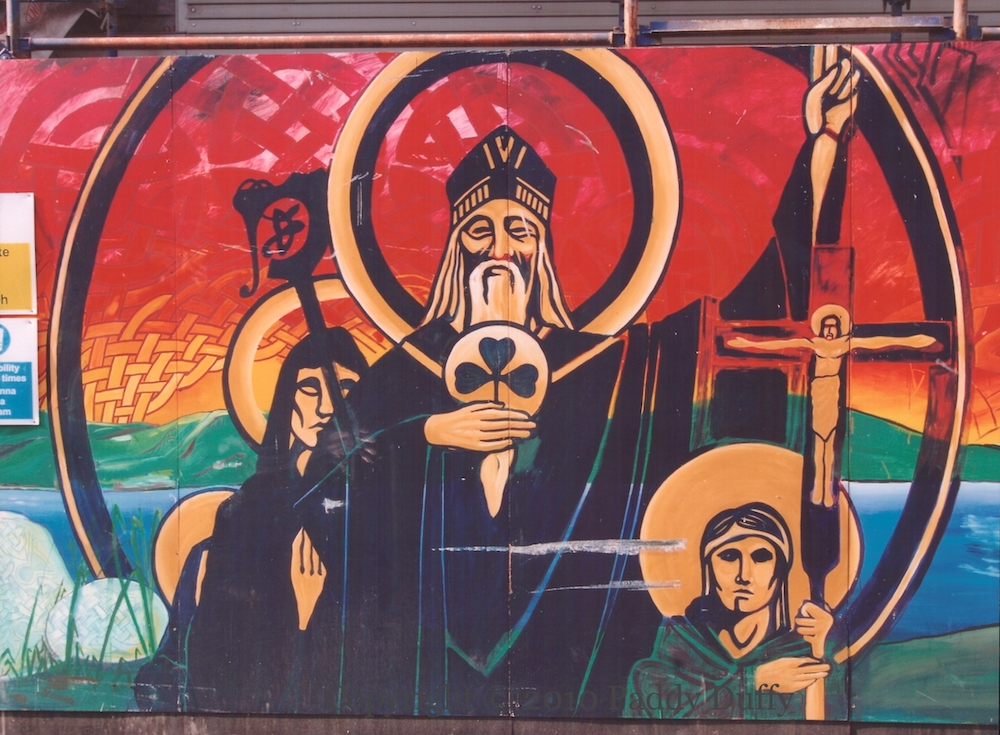
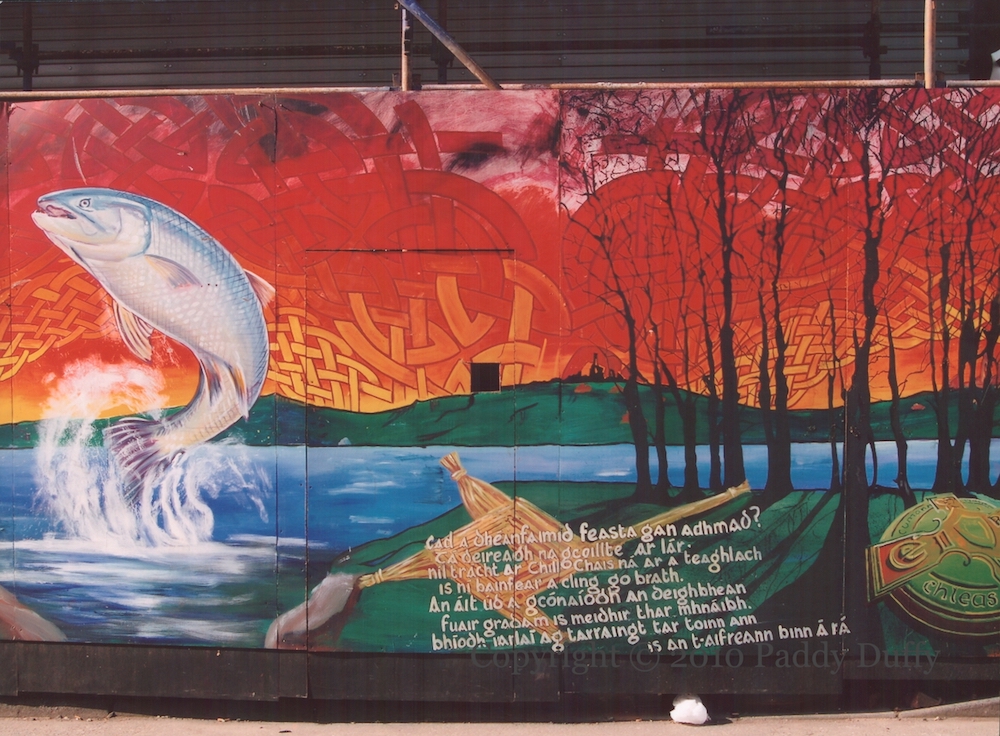
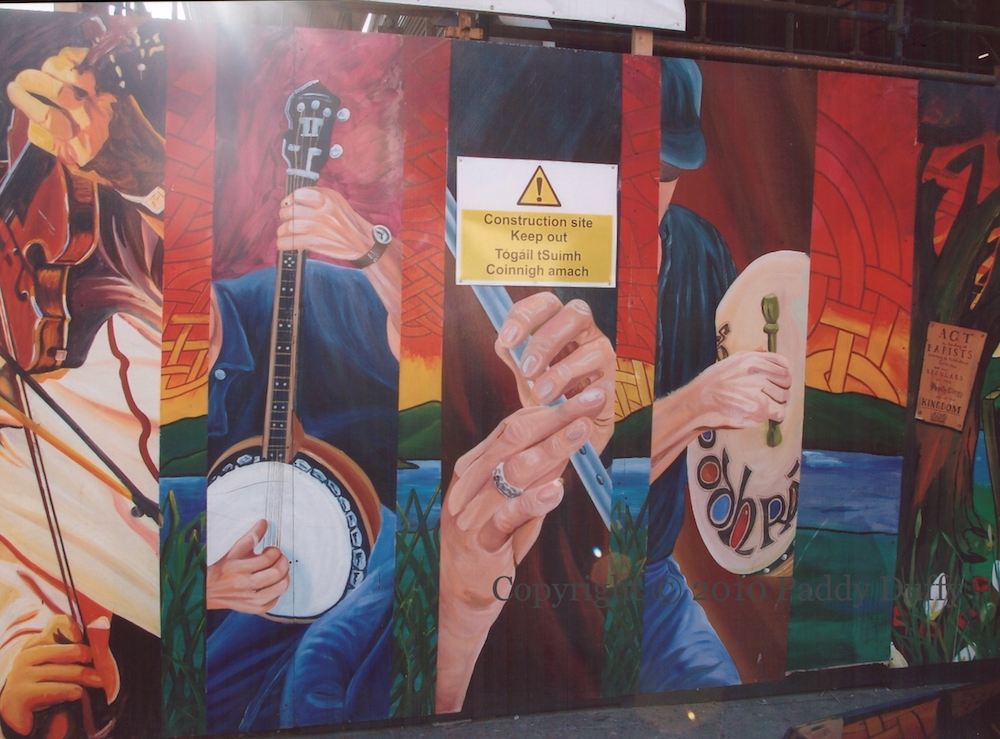
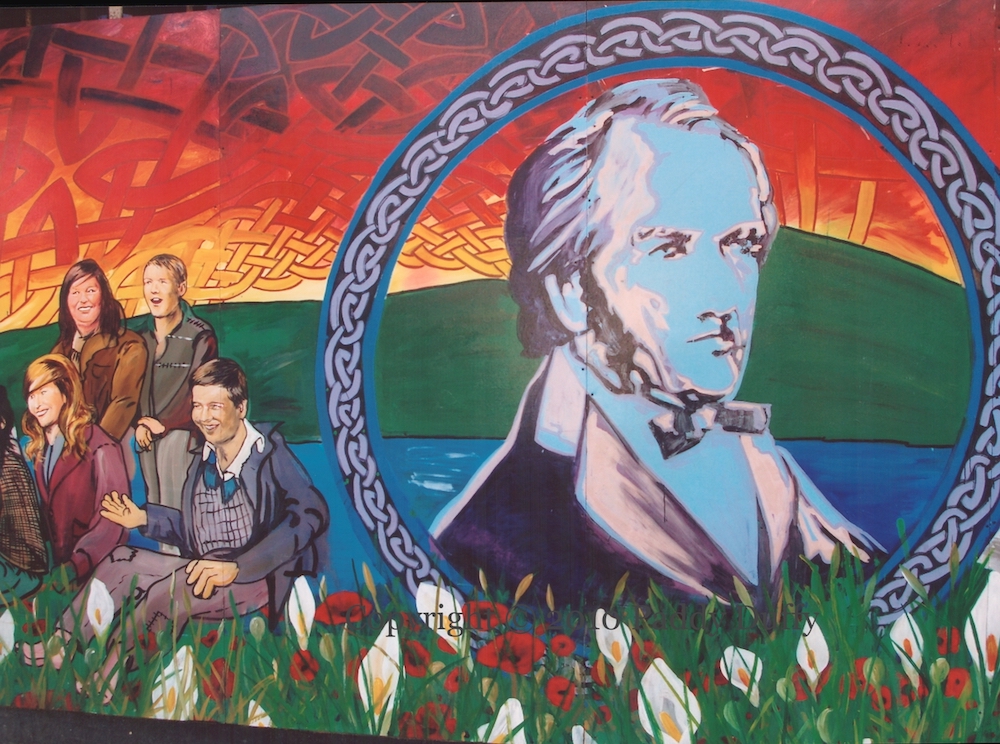
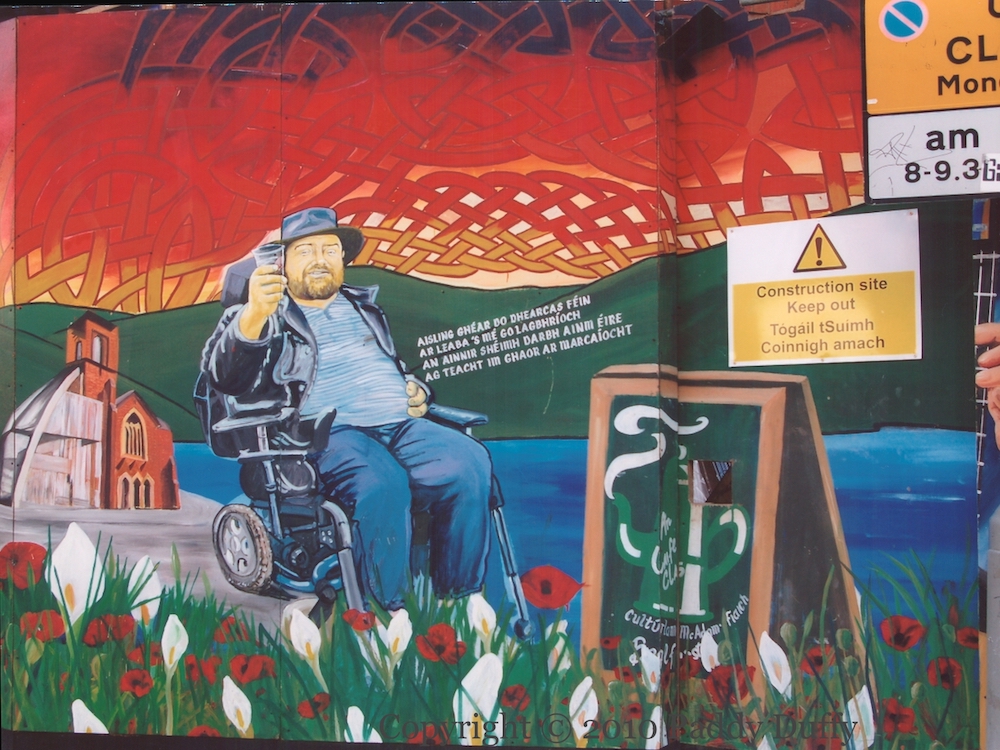
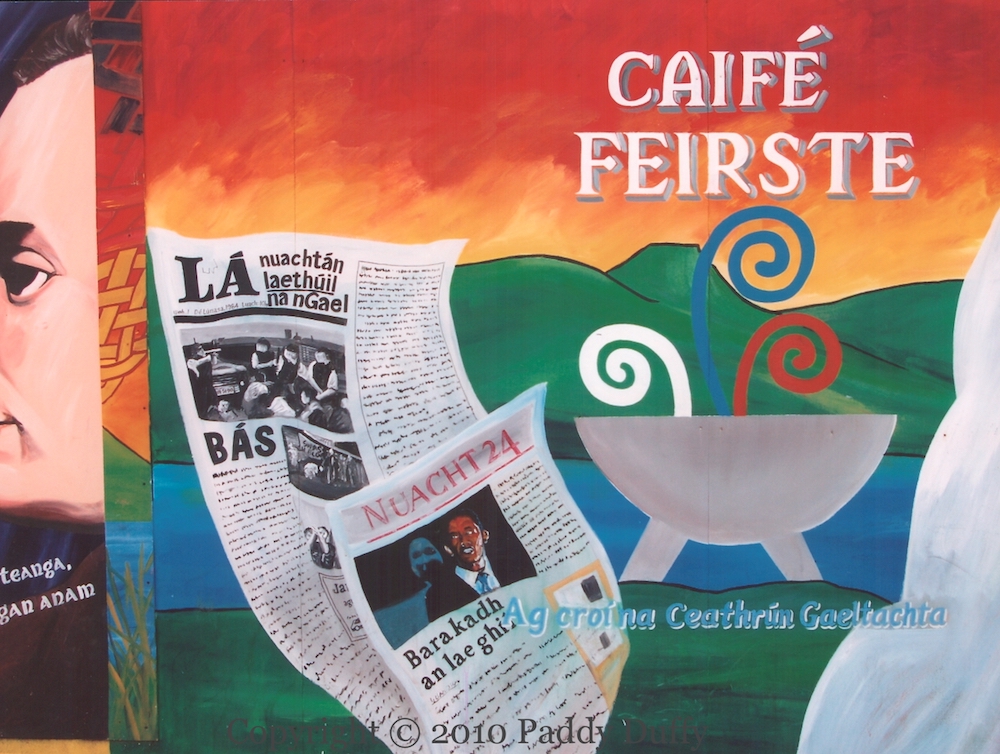
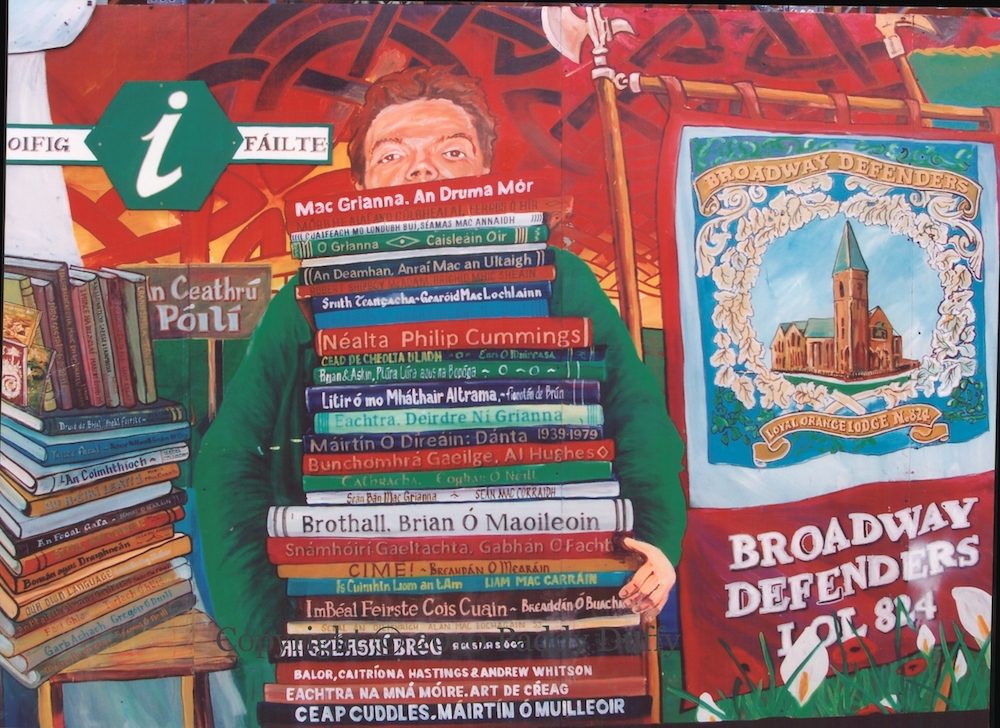
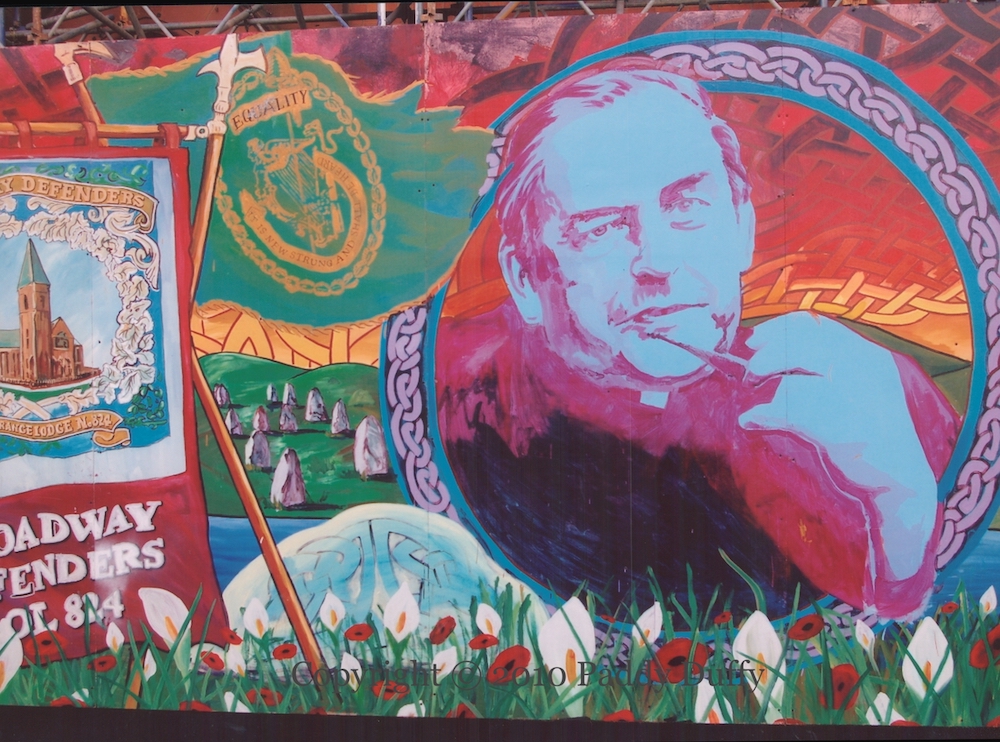
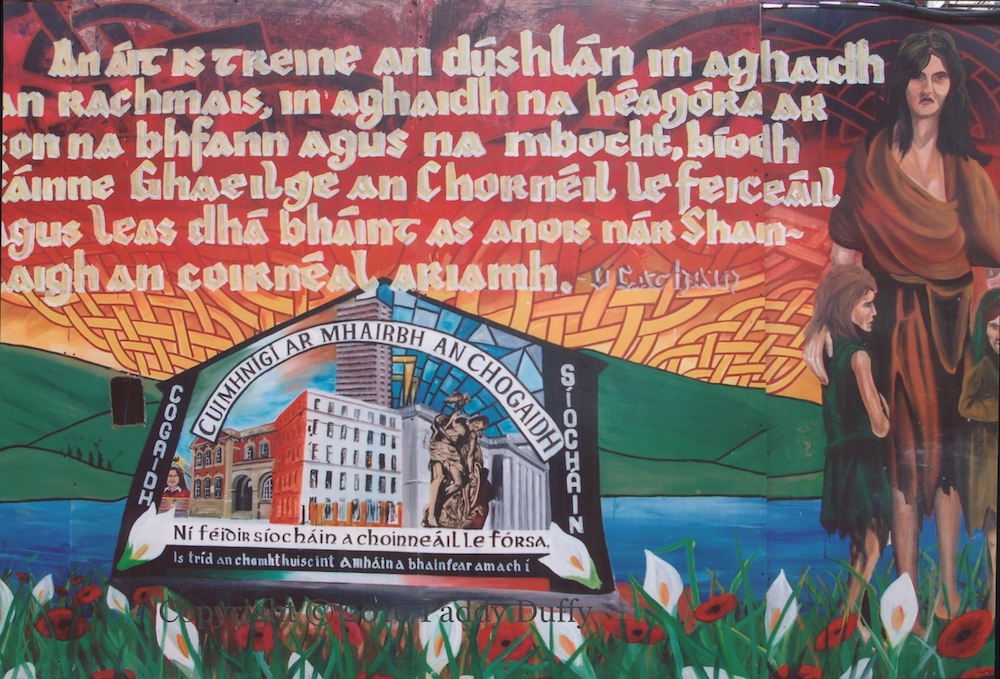
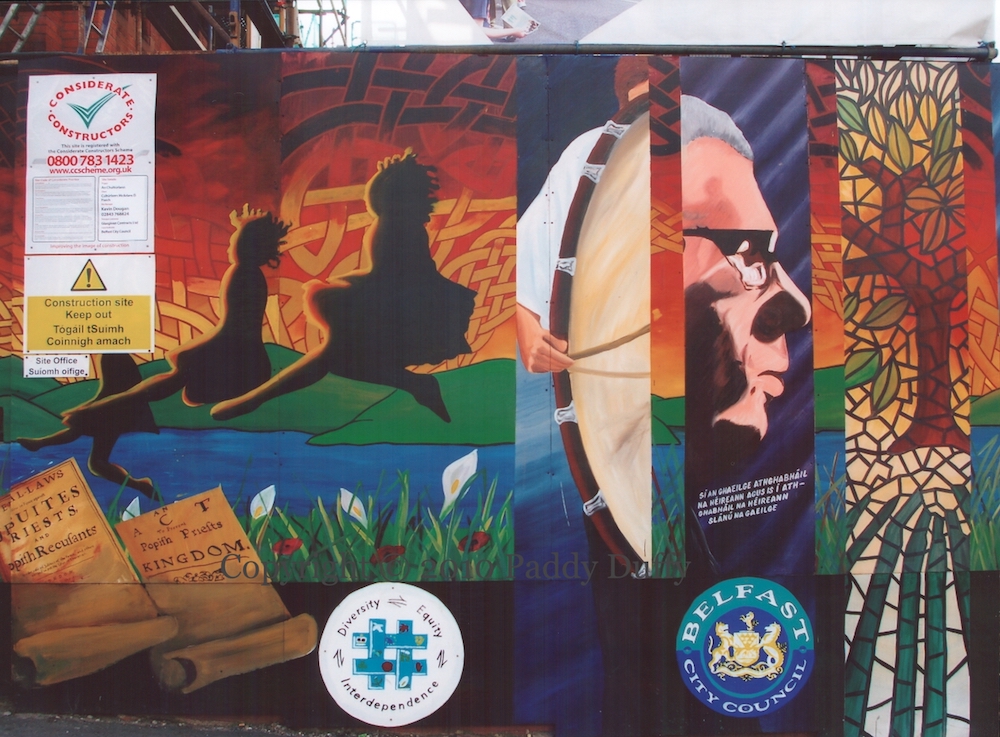
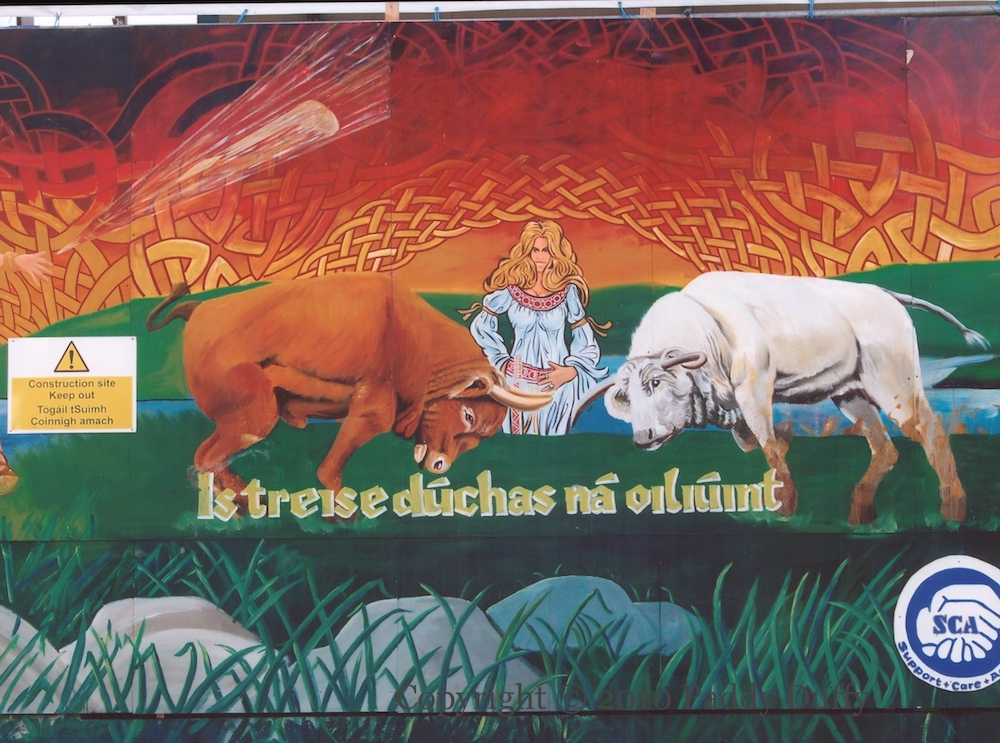
Cultúrlann McAdam – Ó Fıaıch was renovated in 2010-2011 at a cost of 1.9 million pounds, with the addition of the Dillon Gallery. It would be reopened on September 19th by President Mary McAleese (WP). The images here show some of the paintings on the construction hoardings from left (Nansen St) to front (Falls Road) to right (Fallswater St).
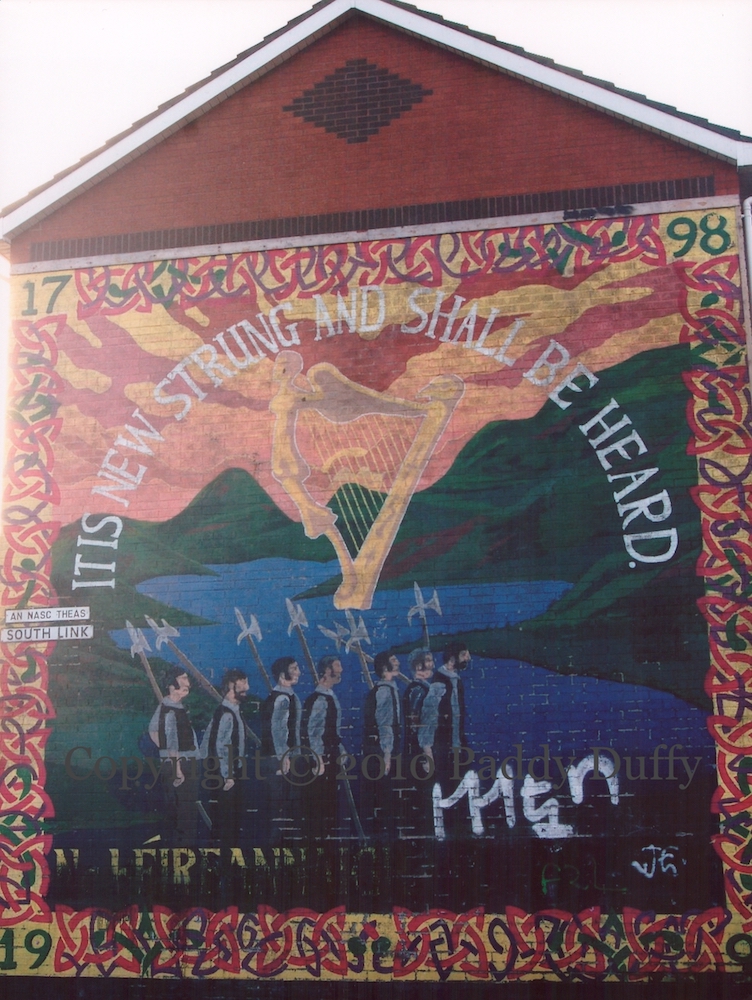
Andrea Redmond painted this mural in Andersonstown for the 200th anniversary of the 1798 rebellion by Na hÉıreannaıgh Aontaıthe (the United Irishmen), who used a harp – specifically a Maid Of Erin harp – as their emblem. To the right, out of shot, are the words Liberté, Égalité, Fraternité.
The mural is in decent shape despite being twelve years old, except for the graffiti at the bottom. The graffiti on the two boards to the side is more obscuring.
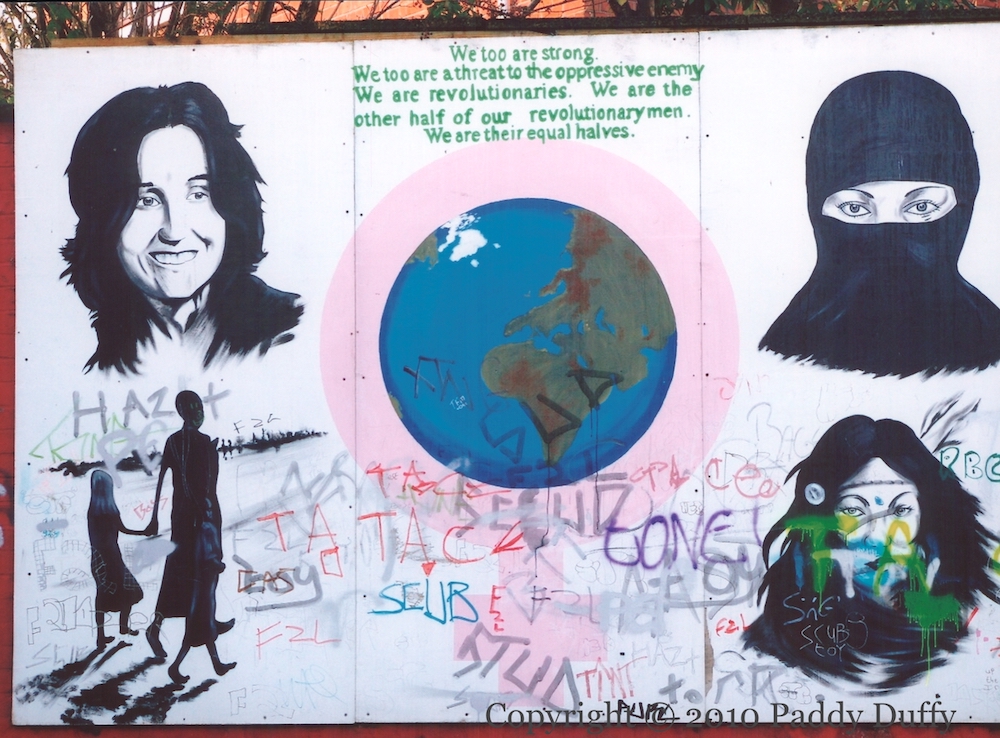
The first is devoted to the role of women in global struggles: “We too are strong. We too are a threat to the oppressive enemy. We are revolutionaries. We are the other half of our revolutionary men. We are their equal halves.” The IRA’s Maıréad Farrell is in the top left.
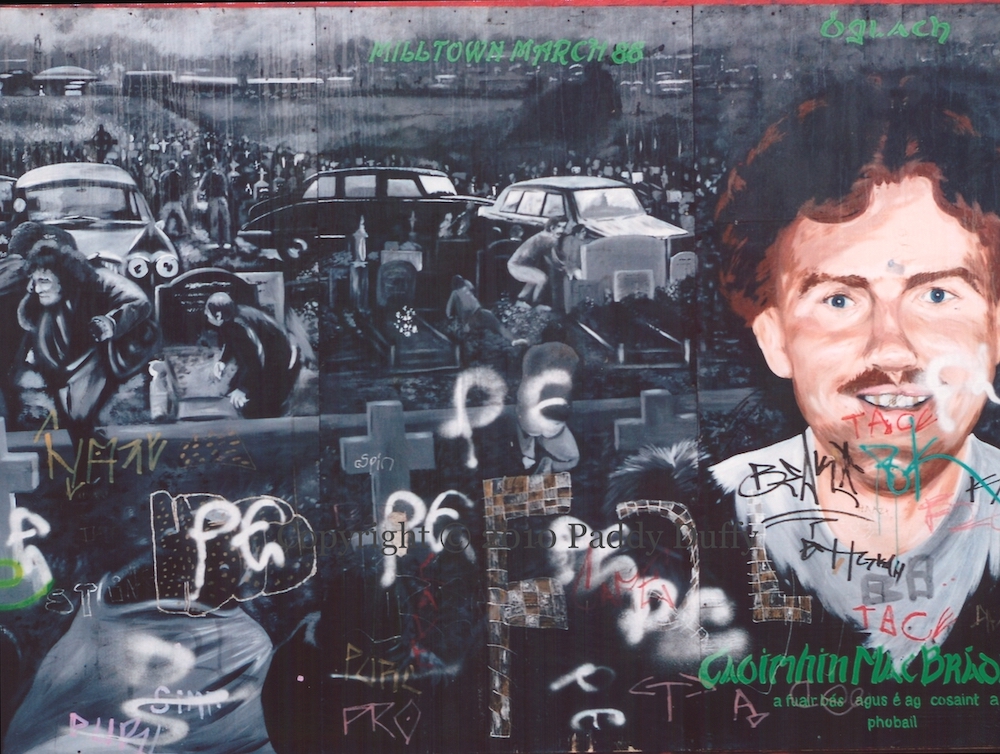
The second commemorates “Óglach Coımhín Mac Brádaıgh a fuaır bás agus é ag cosaınt a phobaıl.” [Volunteer Coımhín Mac Brádaıgh, who died while defending his people.] Mac Brádaıgh was killed pursuing loyalist gunman Michael Stone, who was attacking the funeral of the Gibraltar 3 (including Farrel), in Milltown Cemetery, on March 16th, 1988.
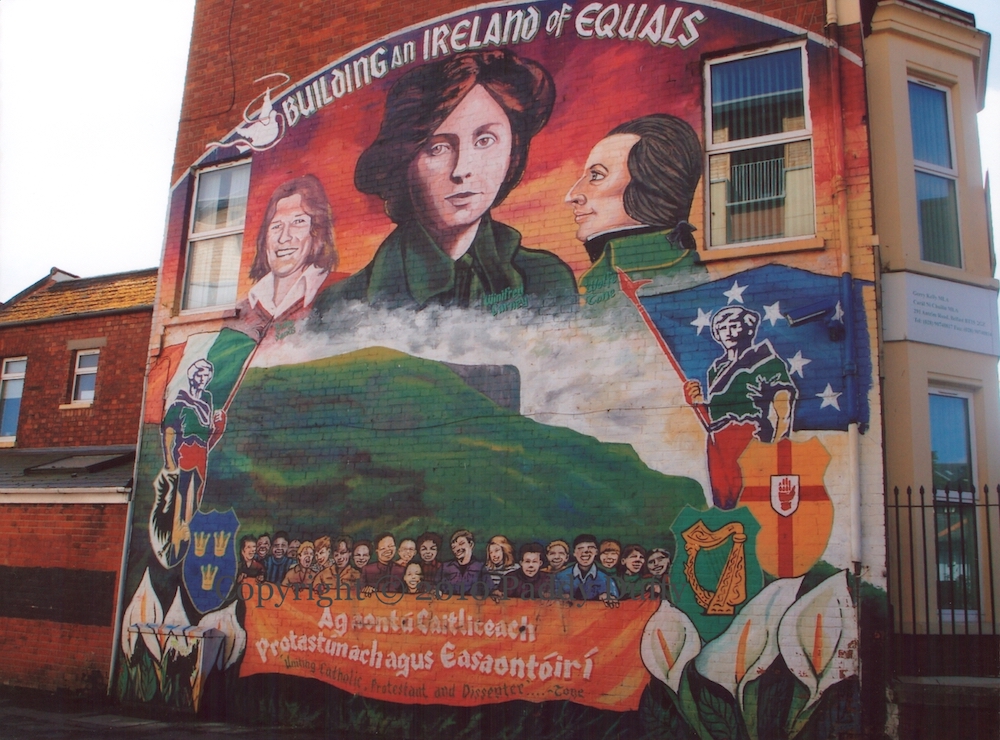
The aspect of Cave Hill commonly known as Napoleon’s Nose is shown sheltering the people of Newington, surrounded by heroes and emblems of the past – Bobby Sands, Wolfe Tone, and in the centre, Winifred Carney. This republican mural is both internally directed (at Newington and the New Lodge) and externally, being on the main Antrim Road (Oceanic avenue, on the side of the Sinn Féin office) which is a main artery between the city and points north.
“Ag aontú Caıtlıceach, Protastúnach agus Easaontóırí.” – “Uniting Catholic, Protestant, and Dissenter.” In An Argument On Behalf Of The Catholics Of Ireland (1791), Wolfe Tone of the United Irishmen wrote, “To subvert the tyranny of our execrable government, to break the connection with England, the never-failing source of all our political evils, and to assert the independence of my country, these were my objects. To unite the whole people of Ireland, to abolish the memory of past dissensions, and to substitute the common name of Irishman, in place of the denominations of Protestant, Catholic and Dissenter, these were my means.”
This mural for the 200th anniversary of the 1798 rebellion by “Na hÉıreannaıgh Aontaıthe” (the United Irishmen). The United Irishmen used the Maid Of Erin harp as a symbol. Out of frame to the right is the motto of the French Revolution: “Liberté, égalité, fraternité”.
There are seven names listed on the right, none of which is Andrea Redmond (Fb), who is the painter of record. The list was later painted out – see M02183.
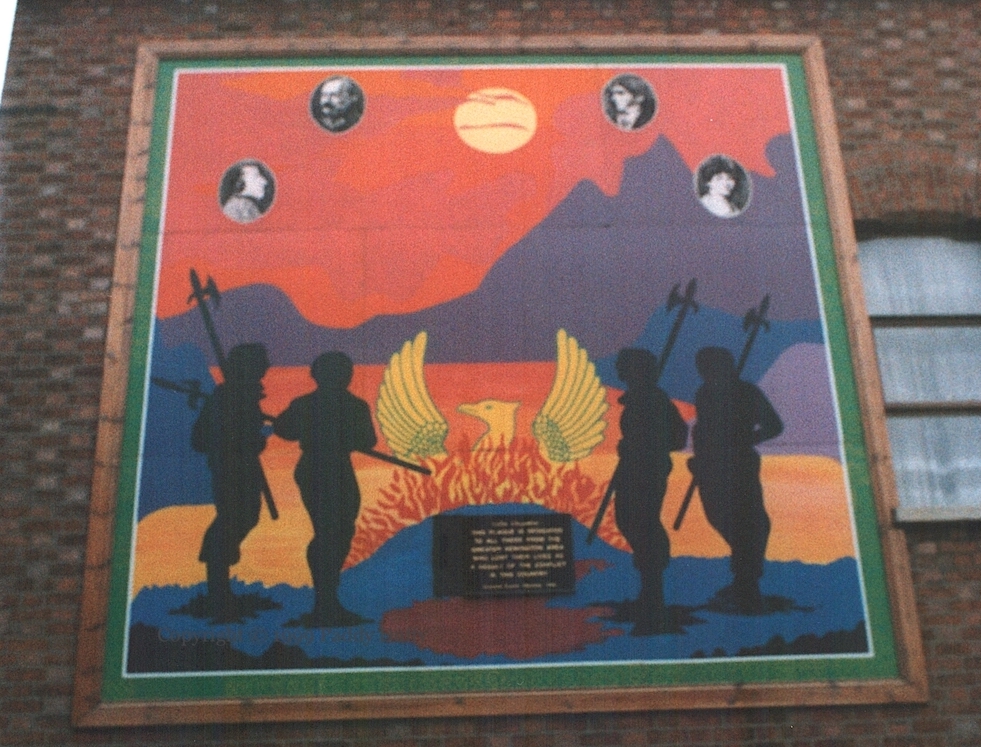
“I ndıl chuımhne – this plaque is dedicated to all those from the greater Newington area who lost their lives as a result of the conflict in this country.” Pikemen from the 1798 uprising stand on either side of a phoenix, with portraits above of Wolfe Tone, James Connolly, Henry Joy McCracken, and Mary Ann McCracken.
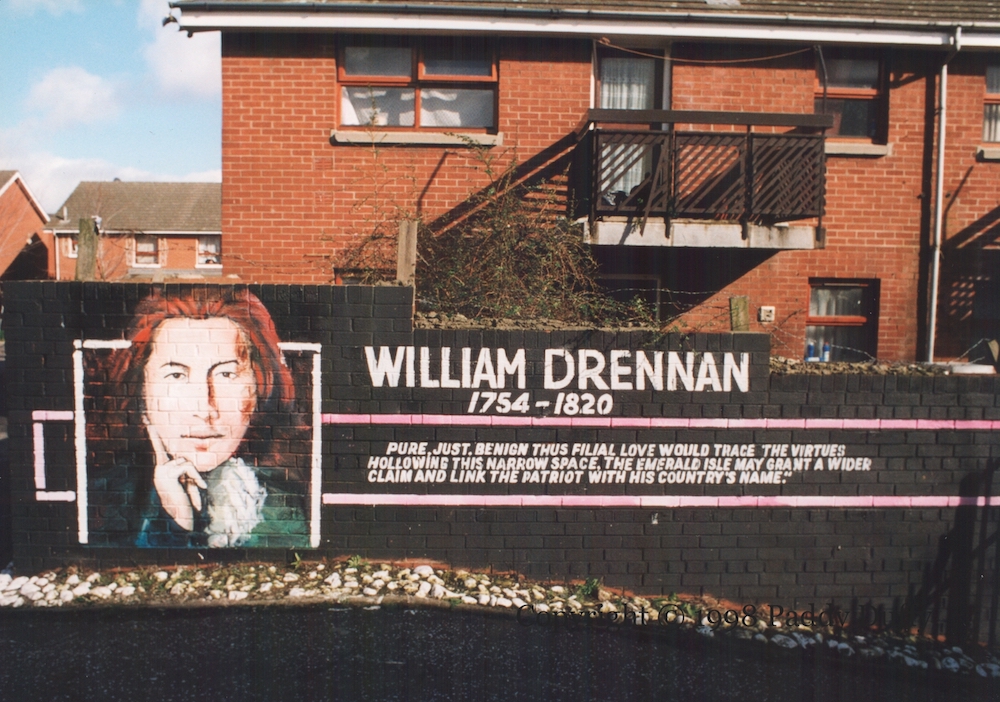
This is a trio of murals along the New Lodge Road to William Steel Dickson, William Drennan, and Mary Ann and Henry Joy McCracken. What the three have in common is that they were all Presbyterians and Irish republicans, and members of the Society Of United Irishmen.
William Steel Dickson was adjutant-general of the County Down Irishmen (see the blue plaque in Portaferry M08948) and was arrested a few days before the insurrection (WP). Like the McCrackens, he is buried in Clifton Street Cemetery.
William Drennan, 1754-1820, was a doctor, poet, a founder of the Society of United Irishmen, and the first person to refer to Ireland as “the Emerald Isle”, in his poem When Erin First Rose. The words in the mural are the epitaph on his stone in Clifton Street Cemetery: “Pure, just, benign. Thus filial love would trace the virtues, hollowing [sic] this narrow space. The Emerald Isle may grant a wider claim and link the patriot with his country’s name.”
Mary Ann McCracken (“What a wonderful clamour is now raised at the name of union, when in reality there has always been such a union between England and this country, as there is between husband and wife by which the former has the power to oppress the latter.”) and her older brother Henry Joy McCracken (“These are the times that try men’s souls … the rich always betray the poor.”) are the best-known of the figures. Henry led the Antrim uprising of the United Irishmen in 1798 and was executed for it; Mary Ann was an abolitionist and social reformer.
A Robert Emmet mural was painted by Robbie Kane in 1953 (for the 150th anniversary of the 1803 rebellion and his execution) in Crumlin Street. This was one of a very few CNR murals painted prior to the Troubles, and nationalist symbols were formerly outlawed in the Flags And Emblems Act of 1954. (See Visual History 02.)
The original (which can be seen at Laochra Uladh) was accompanied by a Christian cross and the words “Hail Christ our king”. This 1997 version reproduces only the two medallions, showing a Celtic harp (left) and a dramatic portrait of Emmet waving his hat, from the mid-1800s (WP/LoC).
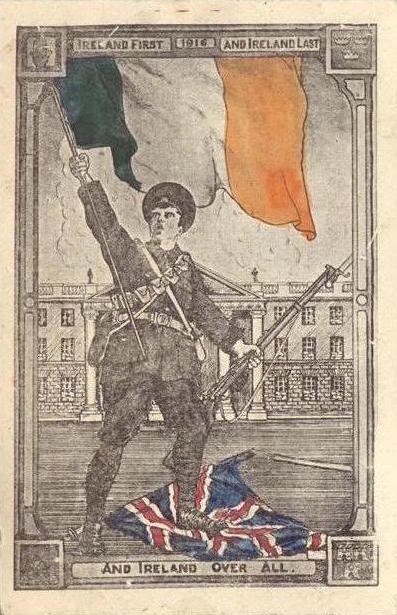
A revolutionary soldier raises the Irish Tricolour while trampling on a Union Flag on a broken mast that was perhaps attached to the poorly drawn GPO in the background. The card on which the image is based can be seen below.
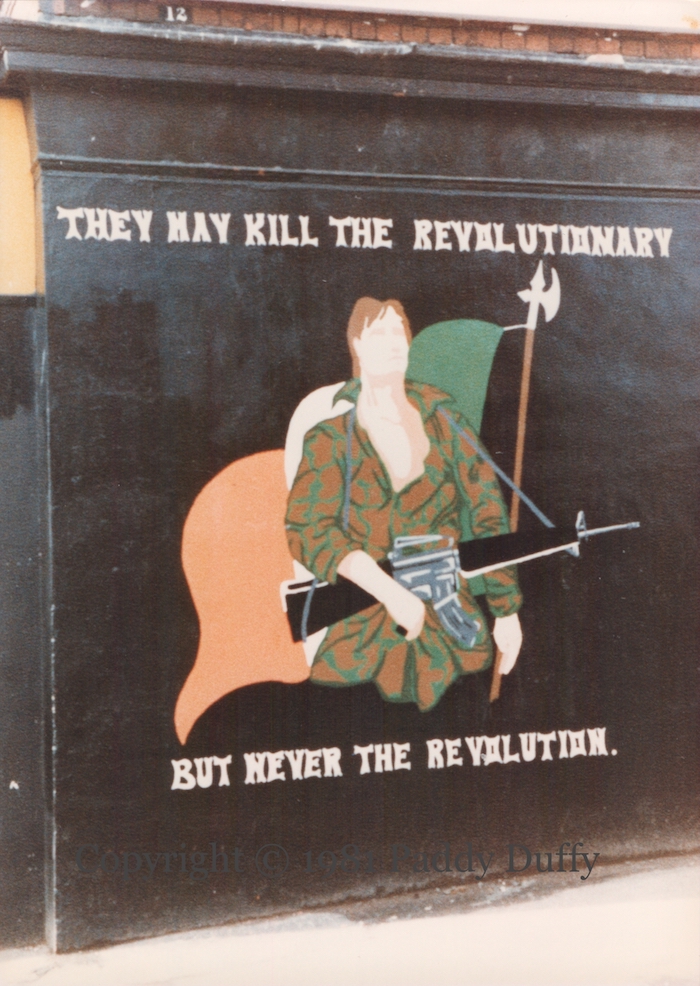
On the right hand side are the Easter lily and halberds/pikes and an assault rifle, indicating the historical roots and present-day inheritors of the 1916 revolt.
“Freedom.” On the left, a Starry Plough (of the INLA) is attached a spear of ancient Ireland, next to two pikes (of the 1798 Rebellion), behind an ancient shield filled in with the Gal Gréıne of the Fıanna; on the right, a volunteer from the modern “Óglaıgh Na hÉıreann” aims an assault rifle, all against a large Irish Tricolour.