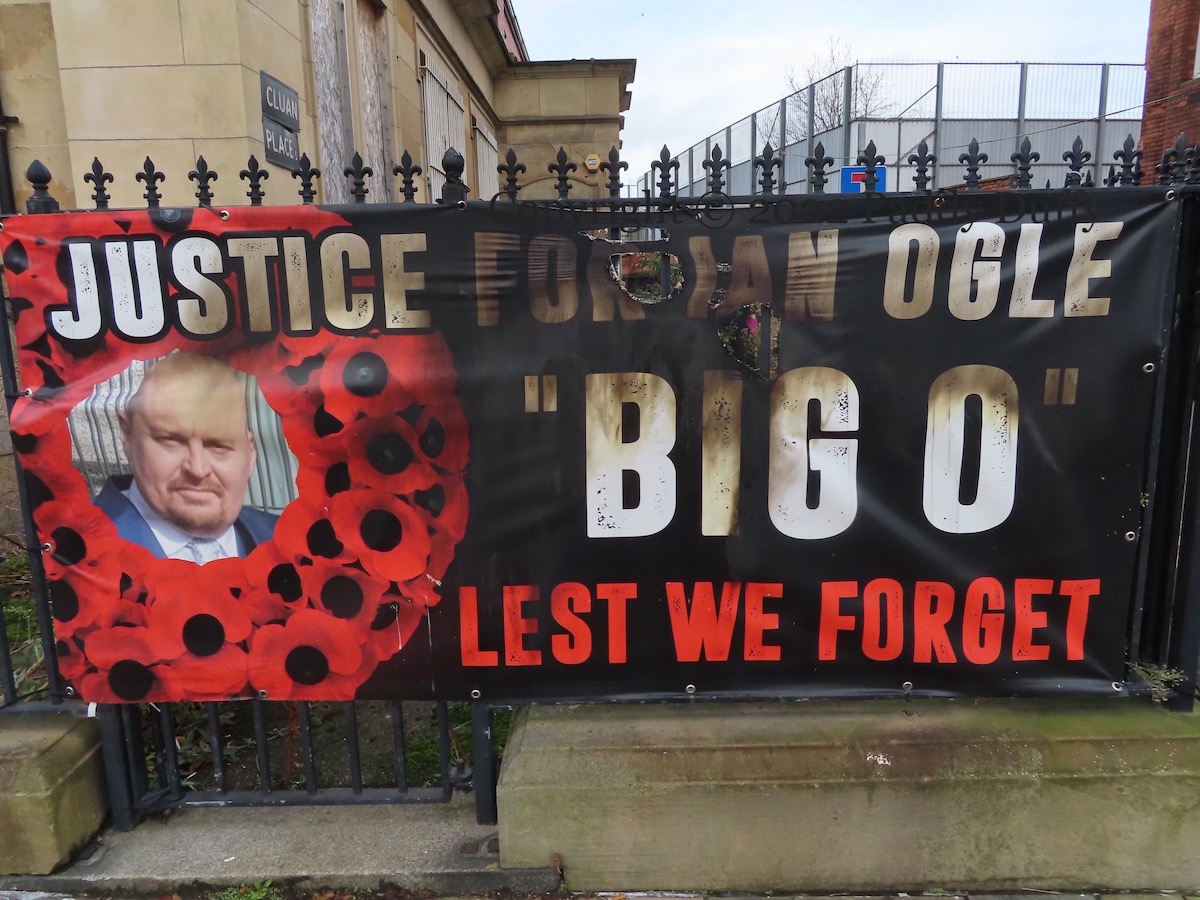
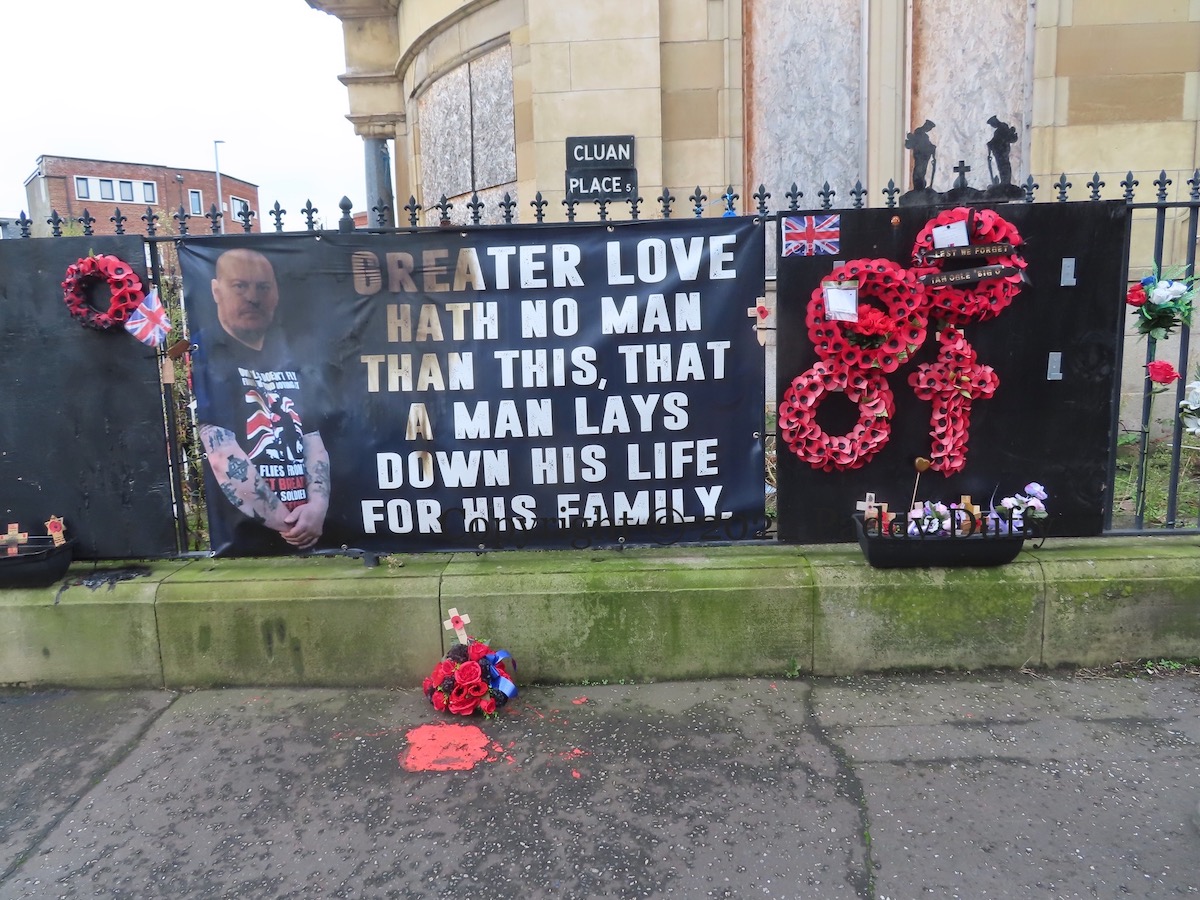
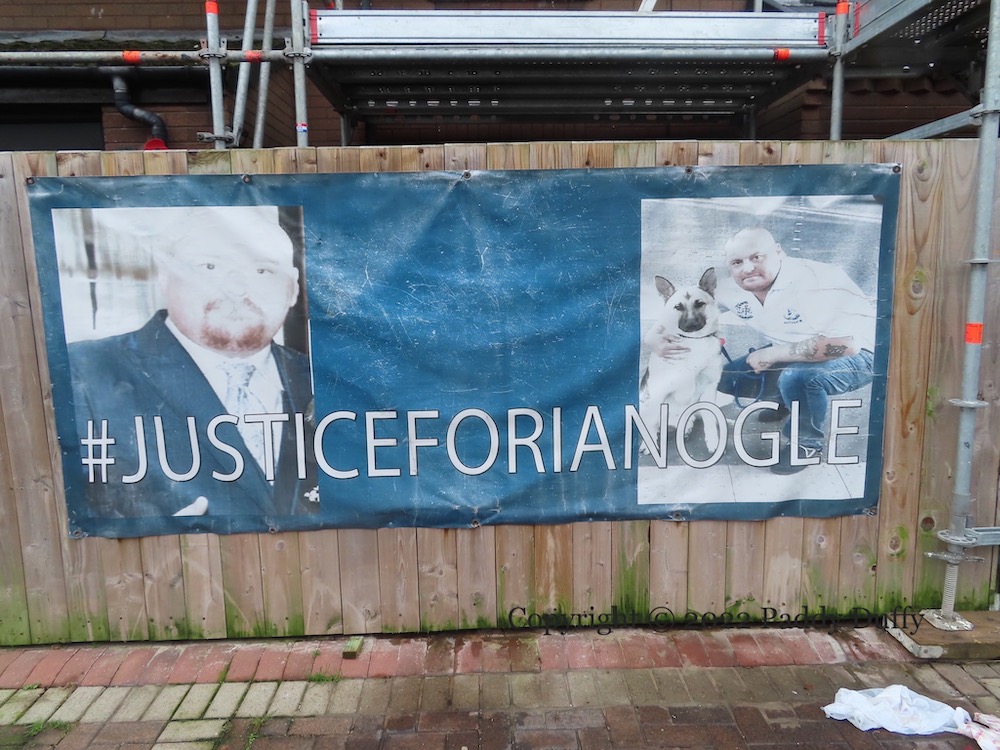
The memorial tarps to Ian Ogle at the entrance to Cluan Place were photographed on October 5th and appeared – unmolested – in For His Family. On about the 18th of November they were subject to an arson attack. Belfast Live has reaction from the family.
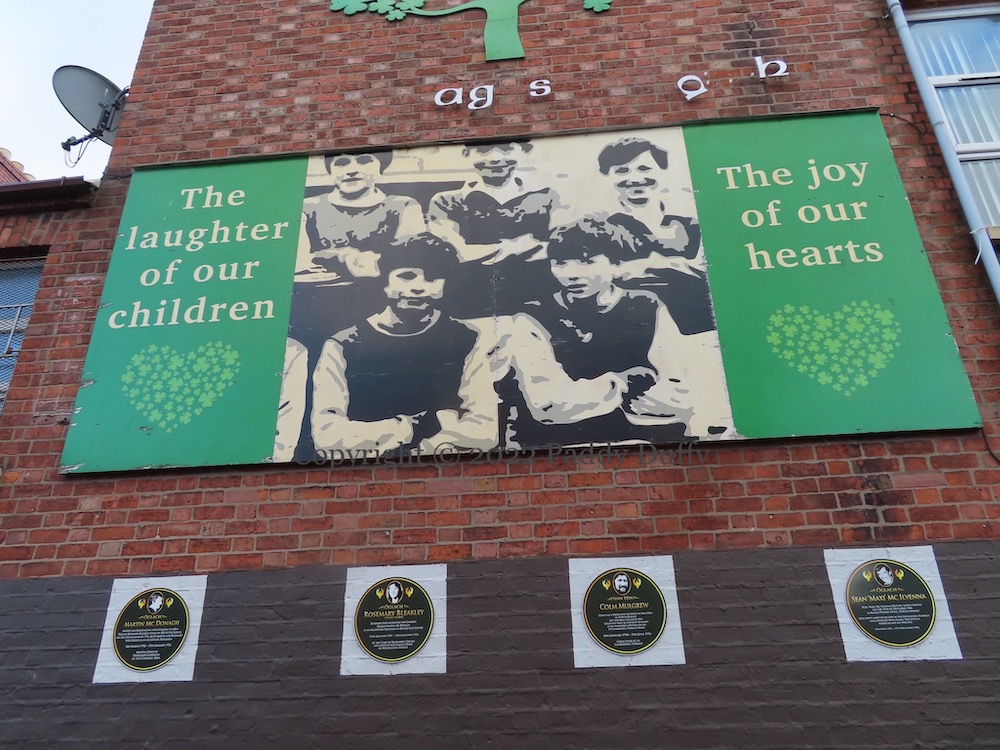
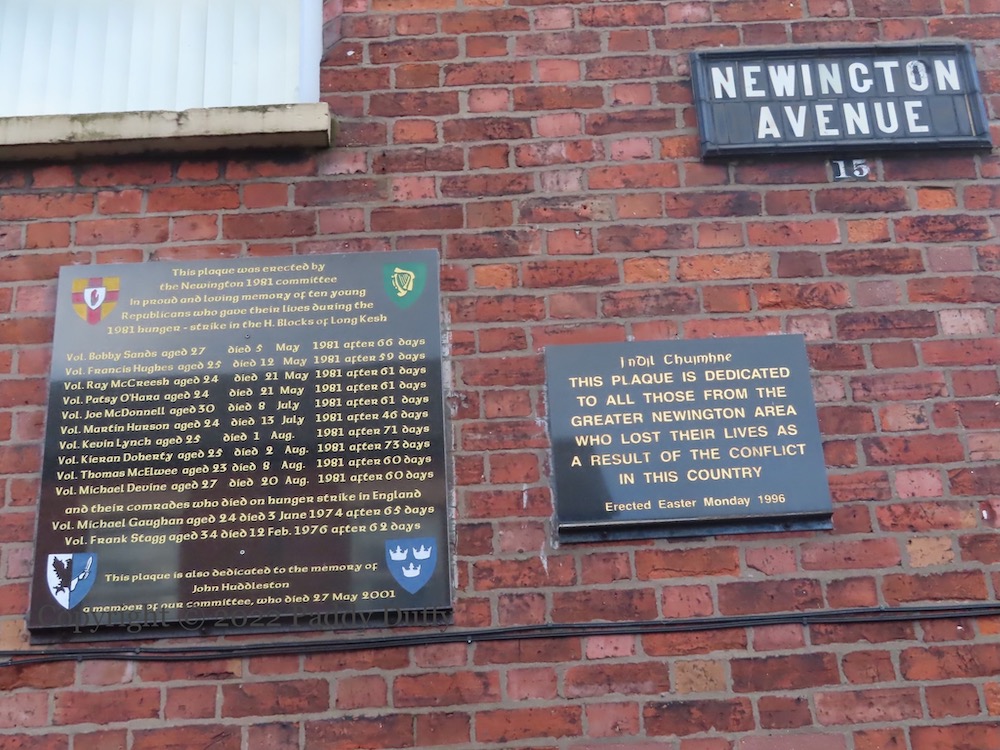
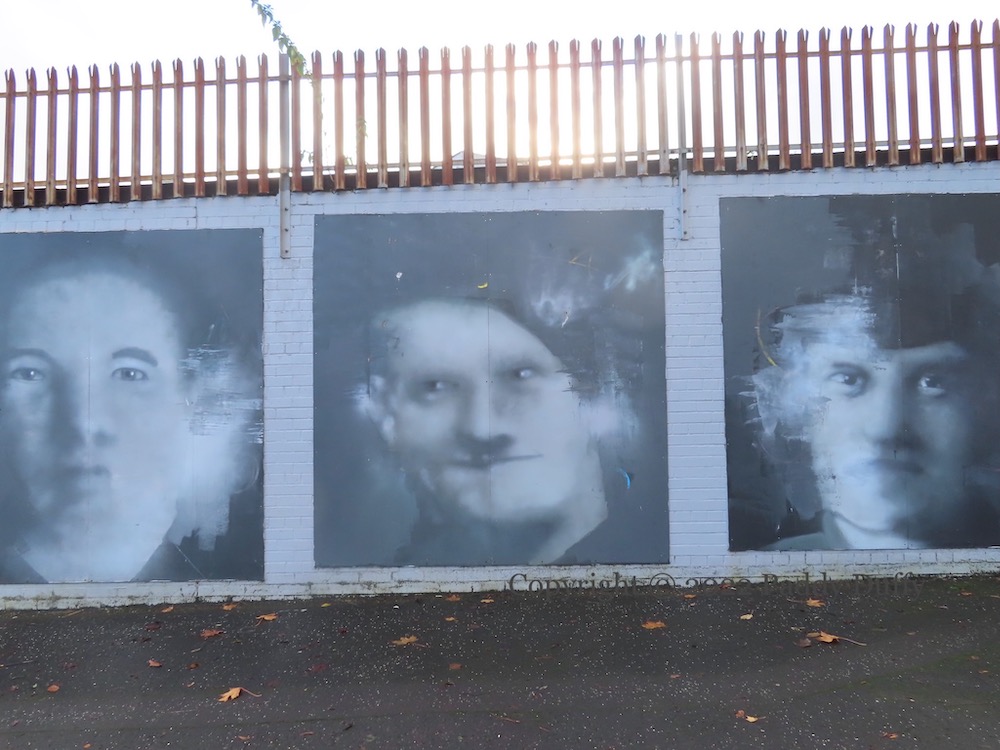
The Newington tribute to Bobby Sands and the other deceased hunger strikers of the 1970s and 80s (see previously: Mol An Óıge Agus Tıocfaıdh Sí) has been augmented with four plaques to republicans from the area who died in the Troubles: (l-r) Martin McDonagh, Rosemary Bleakley, Colm Mulgrew, and Sean ‘Maxi’ McIvenna.
Unbeknowst to her parents (Lost Lives), Bleakley had joined Cumann Na mBan at 18 and was four days short of her nineteenth birthday when she and McDonagh were killed in a premature bomb explosion in the North Street arcade (Victor Patterson image of the blast), along with civilians Ian Gallagher and Mary Dornan (Sutton); 20 others were injured (Fortnight). Bleakley was not buried in the republican plot (in Milltown) but coincidentally in the plot adjacent to Dornan (BBC).
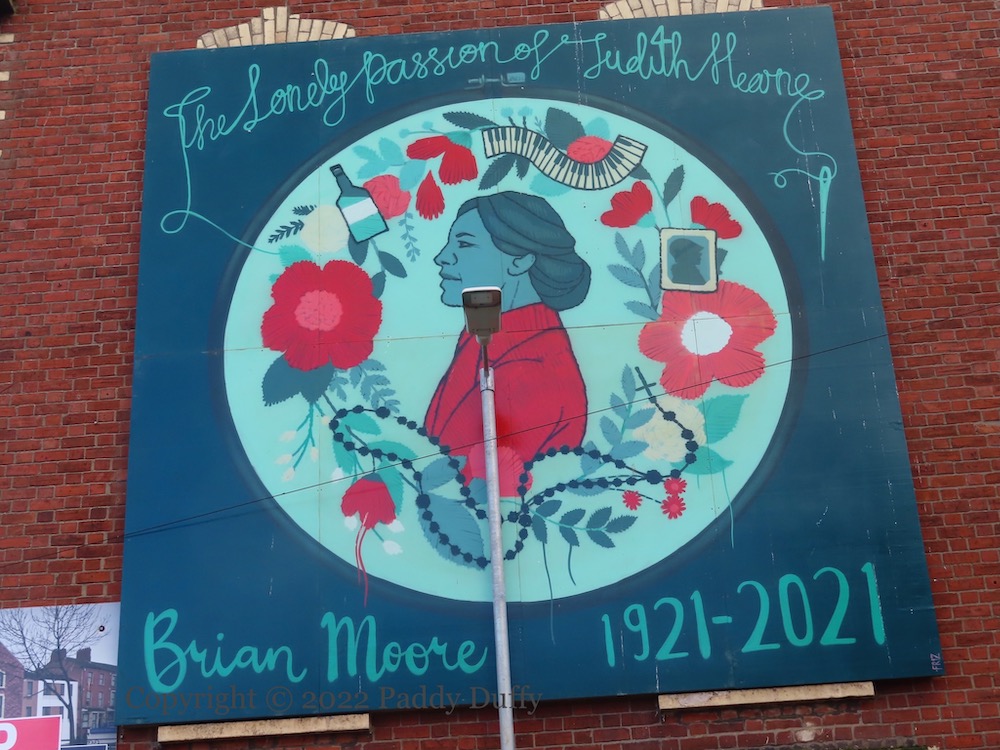
Novelist Brian Moore grew up on the Antrim Road and went to St Malachy’s, before emigrating to Canada in 1948. For the centenary of his birth in 1921, Paradosso Theatre adapted Moore’s best-known novel, (The Lonely Passion Of) Judith Hearne, for the stage and mounted this board in Duncairn Avenue, showing the elements of Judith’s life: the bottle, the beads, the aunt who raised her, the piano used for lessons, and her red coat.
The board by Friz (ig) replaces the anti-joy-riding mural “Where’s The Joy?”, the last to go of the three, the others having been in CNR west Belfast and PUL west Belfast.
The (colour) RNU phoenix and the Craigavon 2 “Free The Innocent” tarp have been joined by a Cogús fist grasping a strand of barbed wire – Cogús (Fb) is (was?) the prisoners’ welfare arm of the RNU.
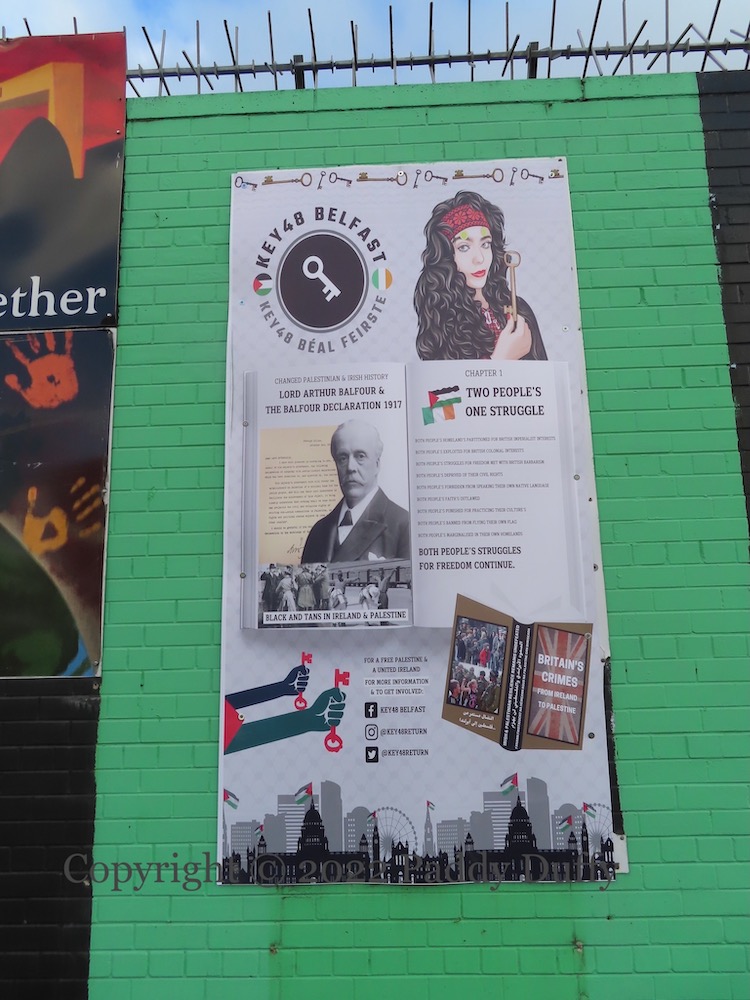
“Britain in Palestine & Ireland” The Balfour Declaration of November 1917 is seen as a pivotal moment in the history leading to the what is formally known as the State Of Israel, as it made the UK the first major government to endorse the idea of a homeland for Jews (WP).
This board on Northumberland Street draws parallels between Ireland and Palestine: homelands partitioned for British imperialist interests, struggles for freedom met with British barbarism … forbidden from speaking their native tongue, faiths outlawed … . About 650 former RIC members were recruited to the “British Gendarmarie” that would police what was called “Mandatory Palestine” (Palestine Studies | Irish History) after WWI.
The League Of Nations mandate putting the UK in change of the Palestinian territory was replaced (in 1947) by a UN plan for partition, which triggered an internal war between Jews and Arabs, and when the UK ended the mandate and evacuated from Palestine in May 1948, Israel declared independence and neighbouring Arab states entered the conflict. About 700,000 Arabs were displaced during the fighting. Key48 (tw) advocates for the right of return and uses as a symbol the keys that householders took with them when they fled.
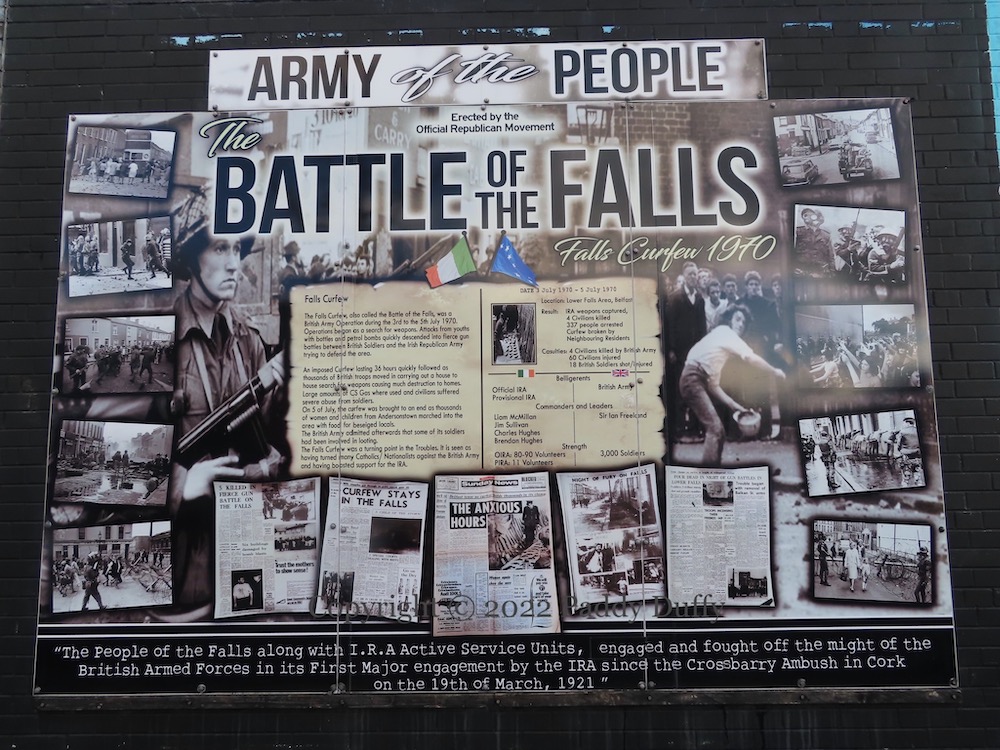
Four people were killed in the course of The Falls Curfew, the 36 hours from July 3rd to 5th in 1970 during which 3,000 houses on the lower Falls were cordoned off after a weapons search of the area devolved into a riot. The curfew ended with a march of women and children from Andersonstown bearing relief (represented in Falls Curfew 1970).
This board has a dual purpose. On the one hand, it was part of celebrations marking the 75th anniversary of the Battle Of Britain, which was waged from July to October in 1940. On the other, it is part of an anti-racism project, celebrating in particular the contributions to the Battle made by roughly 145 Polish aviators (WP) and especially the 303 squadron: “The Polish nation – part of us then, part of us now”. The 303 was later stationed in Northern Ireland for a time. (BBC-NI)
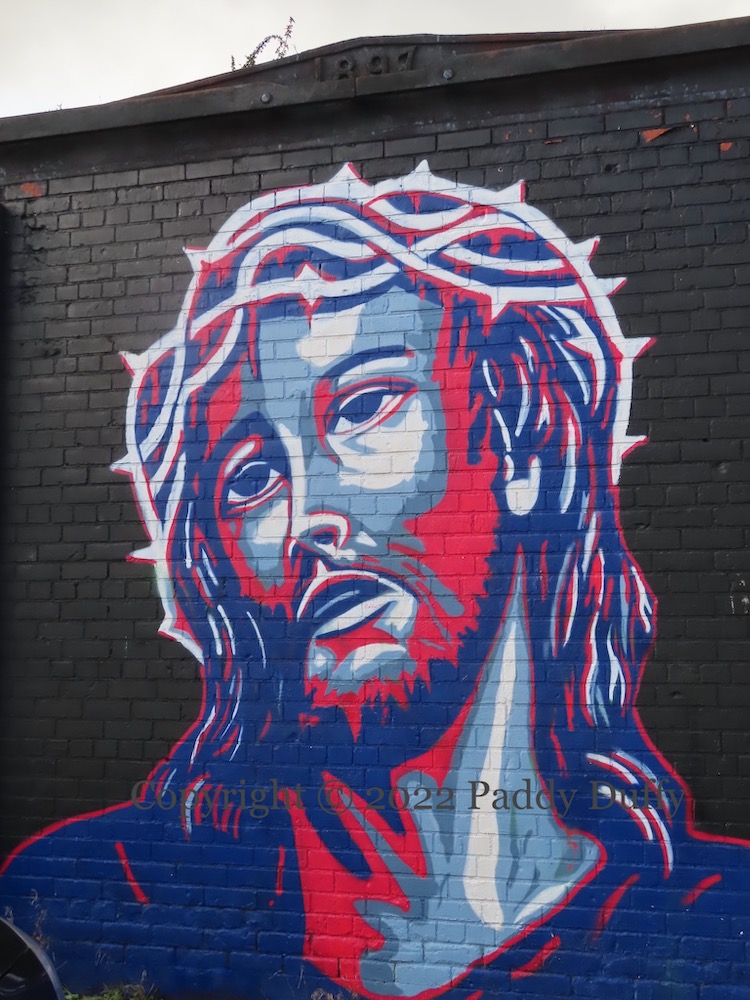
At the height of Covid (April 2020) Artist Glen Molloy (Fb) painted a portrait of Jesus Of Nazareth next to the Cupar Way “peace line” in the style of Shepard Fairey’s Obama ‘Hope’ poster (also the inspiration for De Craig’s Achieve! in east Belfast). Irish News report on the mural.
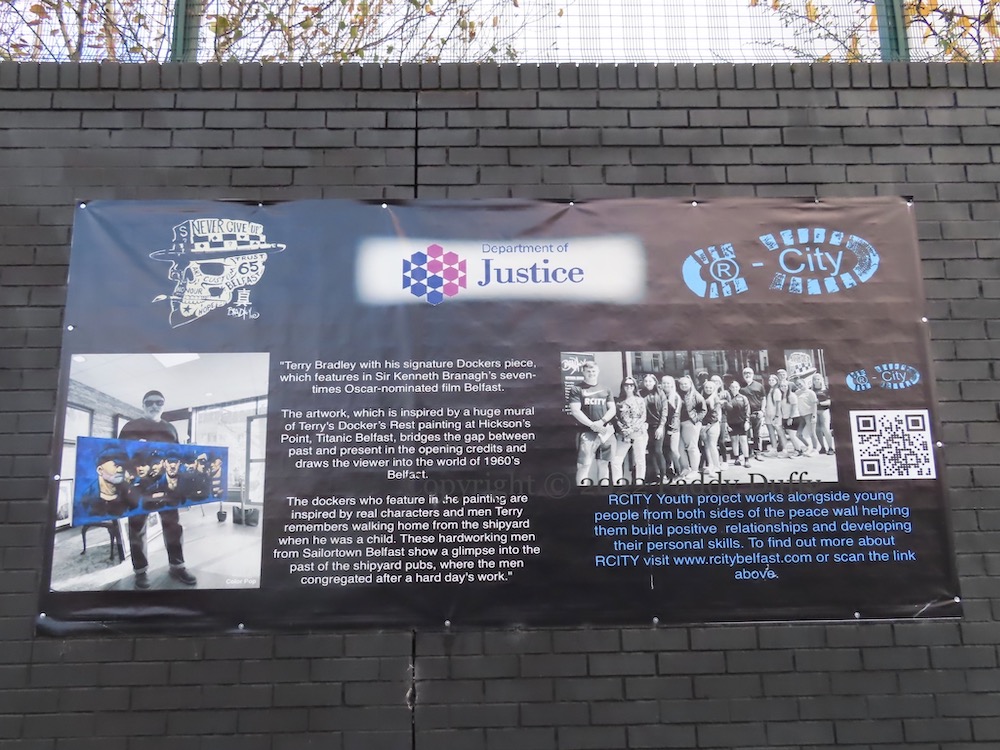
This is a mural of a painting of a mural of a mural. The original is the piece by Terry Bradley (web) and Friz (web) at the Titanic museum’s pub (see Dockers’ Rest), which was then reproduced in a different colour for the opening montage of the Kenneth Branagh film Belfast. The success of the film prompted the Department Of Justice to commission Bradley for a painting that could be turned into a mural and he reproduced the film version (BelTel). The mural that enlarges that painting was painted by DMC on Lanark Way, just above the security gates (Belfast Live).
“The dockers who feature in the painting are inspired by real characters and men Terry remembers walking home from the shipyard when he was a child. These hardworking men from Sailortown, Belfast, show a glimpse into the past of the shipyard pubs, where the men congregated after a hard day’s work.”





 Paddy Duffy Collection