Rí Nuadha ⁊ Loch gCál

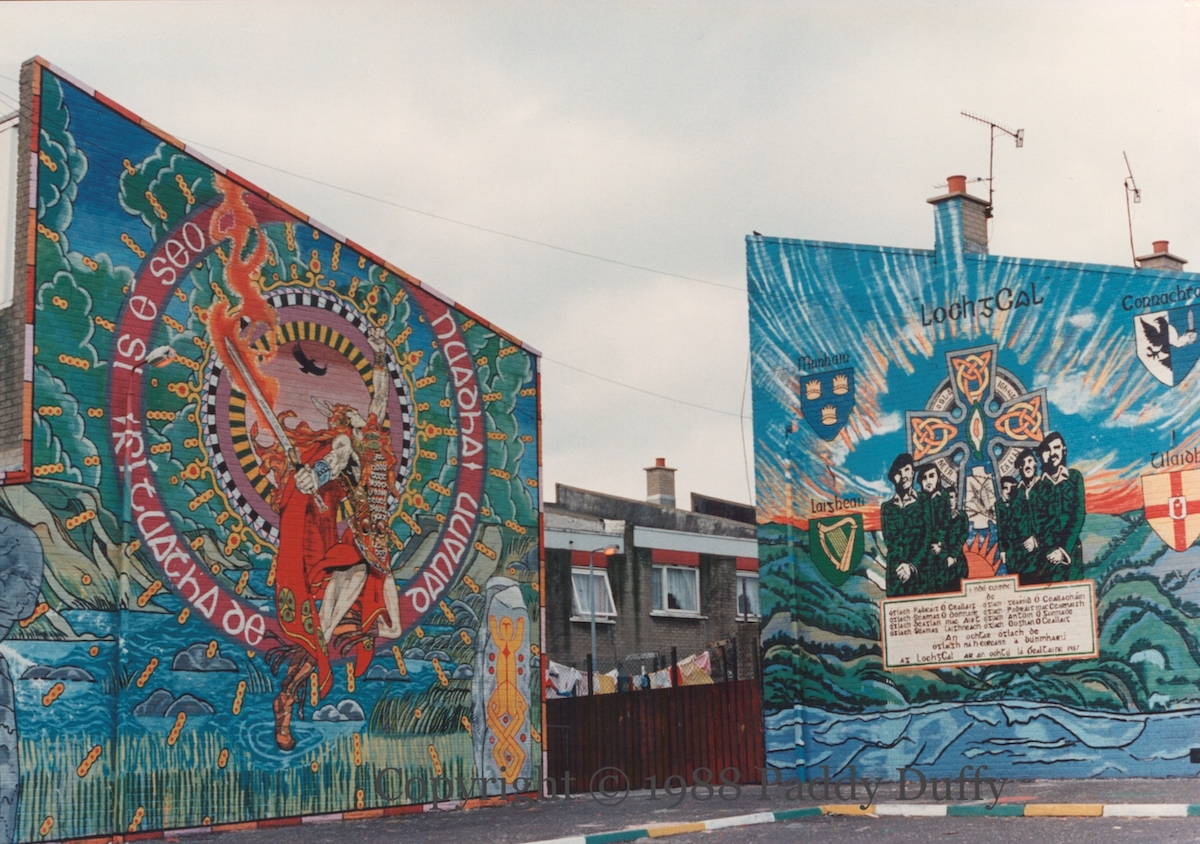
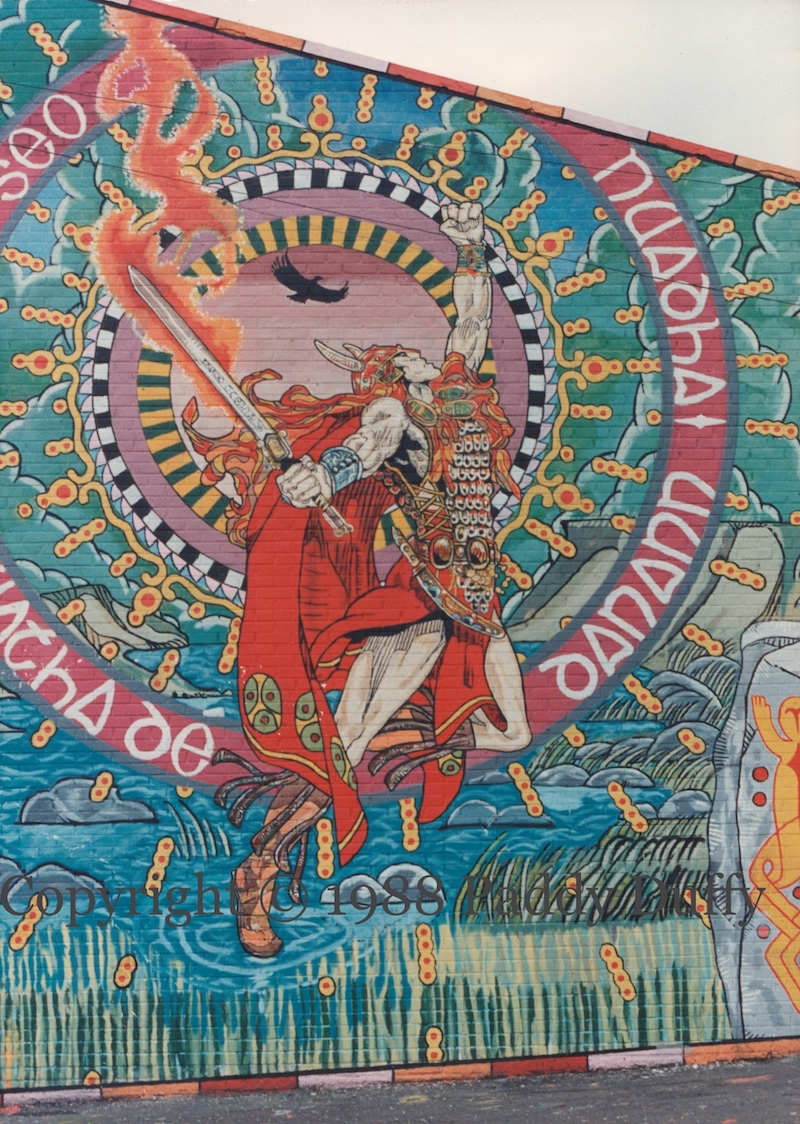
This pair of murals was painted by Mo Chara Kelly at the top of Springhill in 1987 after his release from prison. Both are inspired by the work of Jim Fitzpatrick. The central figure of the Rí Nuadha [King Nuada] mural above and immediately below comes from a painting of Fitzpatrick‘s called ‘Nuada Journeys To The Underworld’ while the background has a Fitzpatrick style and colour-scheme.

Of the myth of Nuada, Mo Chara said, “I had never heard the story of King Nuada before. Then I read the story. Wow! What a yarn! Nuada Of The Silver Arm is one of my favourite stories. As one of the Tuatha Dé Danann you had to be whole and physically perfect to hold the kingship. Nuada lost an arm in the first battle of Moy Tura and so he lost his kingship. He went into the other world, to middle earth, fought through trials and tribulations until Dıan Cécht made a silver arm for Nuada and he was restored to the kingship for another twenty years. But the moral of the story to me was that, no matter what happens, get up again and fight back. No matter how bad the situation you are in, you get back up and fight again. Do not let people isolate you. Get up and fight again. It was very inspiring!” (Painting My Community/An Pobal A Phéınteáıl – English-language version available for free.)

The Loch gCál/Loughgall mural likewise draws on Fitzpatrick for the landscape behind the Celtic cross and funeral guard in memory of the eight IRA volunteers from the East Tyrone brigade who were killed in an SAS ambush during an attack on an RUC base in May, 1987 (WP).

The names of the eight volunteers are given here in Irish and (partially) in the old script:

“I ndıl cuimh[n]e de [= ar]
Óglach Pádraıg Ó Ceallaıġ [Patrick Kelly],
Óglach Séamus Ó Donn[ġ]aıle [Seamus Donnelly],
Óglach Deaglán Mac Aırt [Declan Arthurs],
Óglach Séamus Laıghneach [Jim Lynagh],
Óglach Gearóıd Ó Ceallacháın [Gerry O’Callaghan],
Óglach Pádraıg Mac Cearnaıgh [Pádraıg McKearney],
Óglach Antóın Ó Garmaıle [Ó Gormghaıle | Tony Gormley],
Óglach Eoghan Ó Ceallaıġ [Eugene Kelly]

an ochtar óglach de óglaigh na hÉireann a dúnmharú ag Loch gCál ar an ochtú lá Bealtaine 1987.”
[the eight volunteers from the Irish Volunteers [IRA] who were murdered at Loughgall on the eighth day of May, 1987]

The town (Loughgall) and the four provinces are also named in Irish. An Easter lily is at the centre of the Celtic cross in the middle of the image, above a lark in barbed wire and a gal gréıne/sunburst.

Click image to enlarge
Copyright © 1988 Paddy Duffy
T00073 T00066 [T00074] T00075 T00065

Táın Bó Cúaılnge

This is an interesting mural from North Queen Street, if only because of its psychedelic colour-scheme and composite style.

The two bulls (presumably from the Táın though they are not the classic brown and white bulls) provide a centre, on either side of which we find Cú Chulaınn dying (and Tuan the eagle) and a dolmen. The horse on the right is perhaps Galloper. There are four faces superimposed on flying geese. The cranes Samson and Goliath are on the left (which suggests a cross-community sponsorship) and a Pride rainbow is on the right.

A wide shot of the whole can be seen in the Peter Moloney Collection. If you have any information about the piece, please get in touch.

North Queen Street, presumably at the bottom of the New Lodge (either where the playing pitch opposite (what was then) Artillery House (now Teach Ghráınne) is, or on a wall of Gallagher’s factory, where the car park for the shopping centre now is?).

Click image to enlarge
Copyright © 1988 Paddy Duffy
T00171 T00172

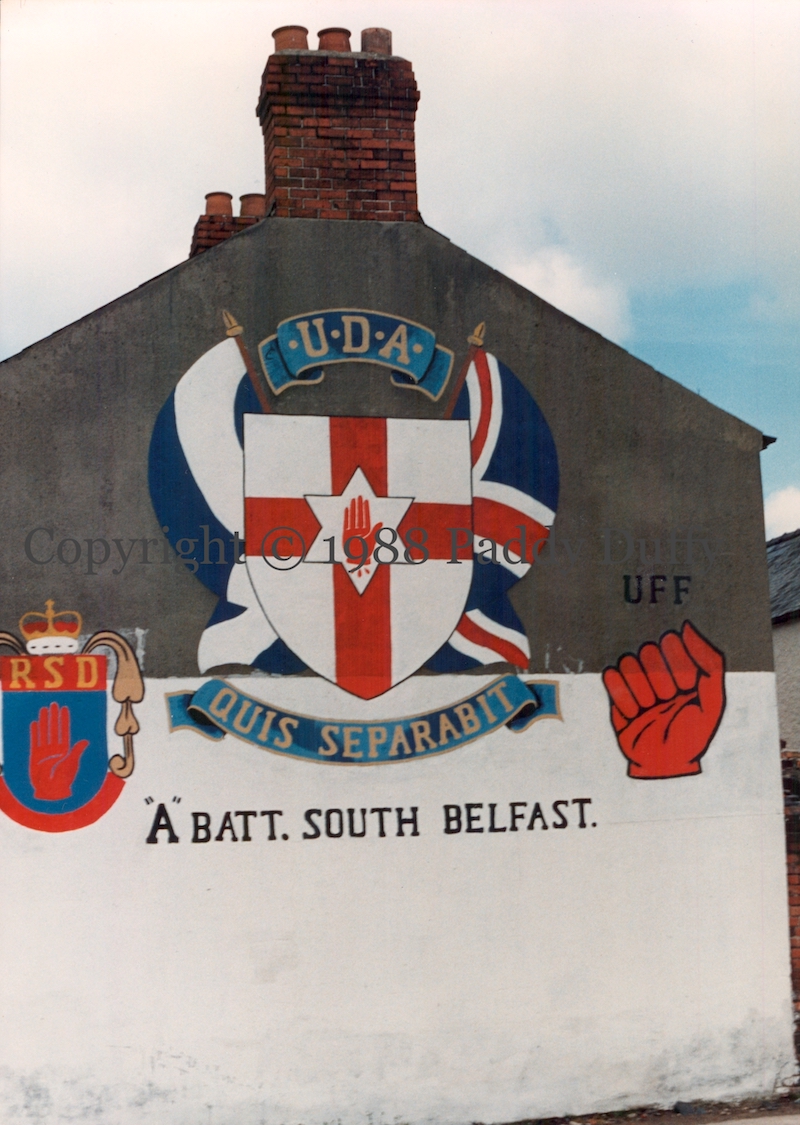
UDA A Battalion South Belfast

“UDA “A” batt. South Belfast. RSD [Roden Street Defenders (private Fb)] UFF”

This is the mural that greets travellers moving west along Donegall Road to the Village. The houses in Beit Street have been knocked down and their replacements, which face directly onto Roden Street, no longer reach all the way to Donegall Road, leaving this gable as a prime painting space.

Click image to enlarge
Copyright © 1988 Paddy Duffy
T00239

UVF And UDA

These are murals from completing organisations, the UVF (above) represented by an Uzi above various flags and the emblem of the UVF, and the UDA (below) represented additionally by hooded volunteers on manoeuvres. They were together on the Crumlin Road, on waste-ground at the top of Queensland Street and at the top of Tasmania Street. On the gable next to the UVF flags large YCV and 36th Division emblems would be added – see the Peter Moloney Collection.

Click image to enlarge
Copyright © 1988 Paddy Duffy
T00143 [T00238]
T00142

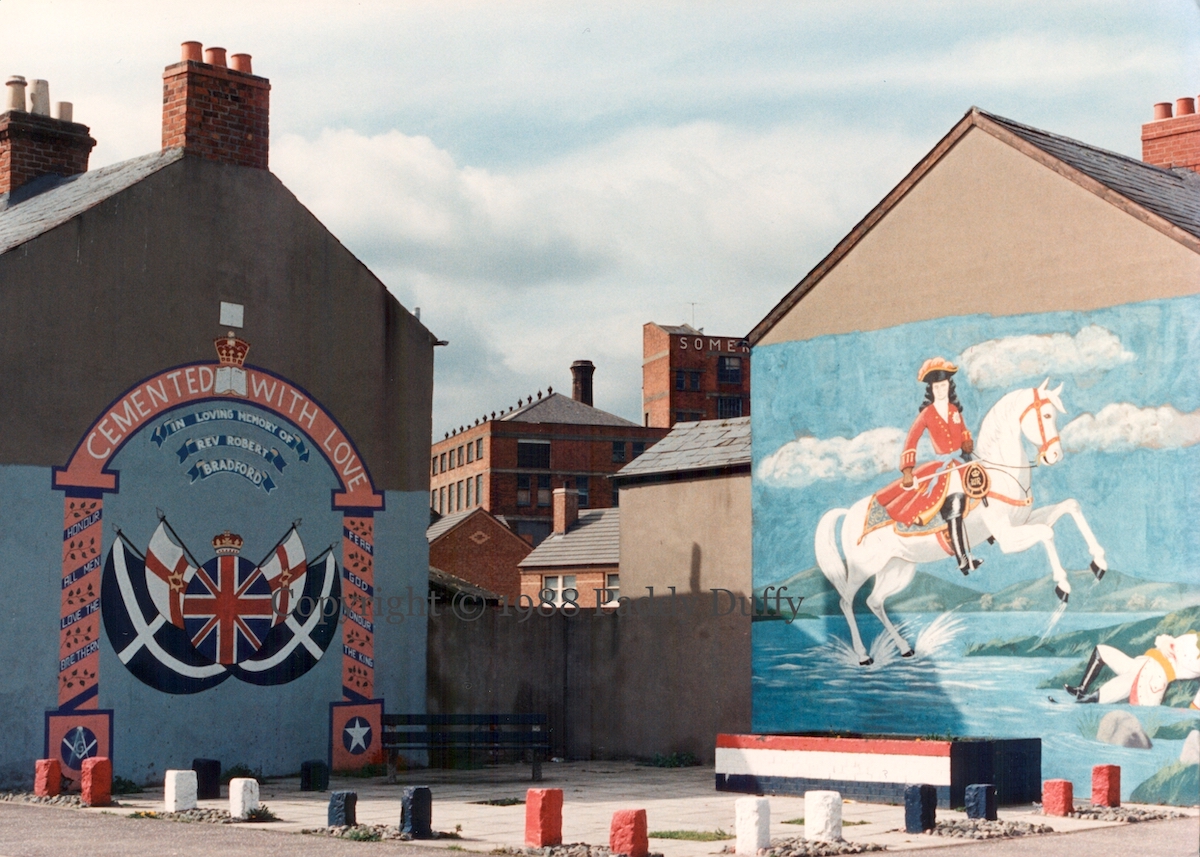
Cemented With Love

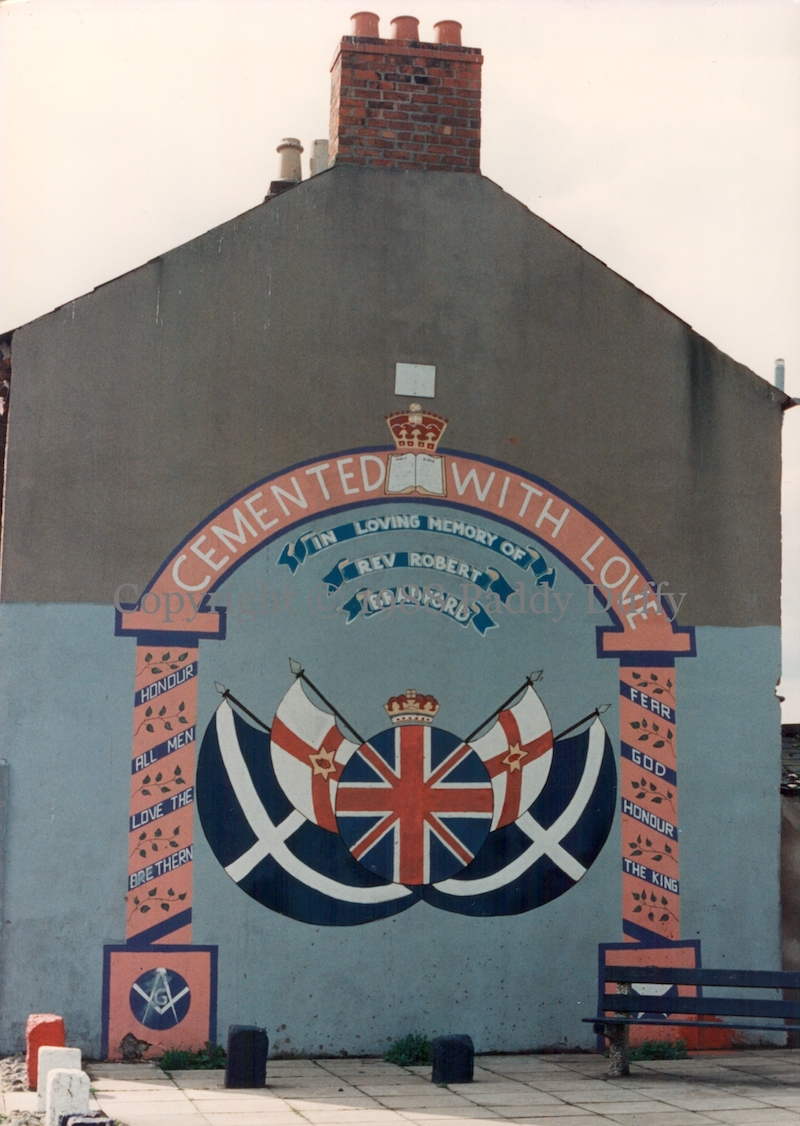
“In loving memory of Rev Robert Bradford.” Bradford was killed in 1981 (see To Bathe The Sharp Sword Of My Word In Heaven) and the mural dates back to (at least) 1983. It perhaps shows the Lindsay Street arch, which was first mounted in 1964. On either side of the arch are written “Honour all men, love the brethren” and “Fear God, honour the King”.

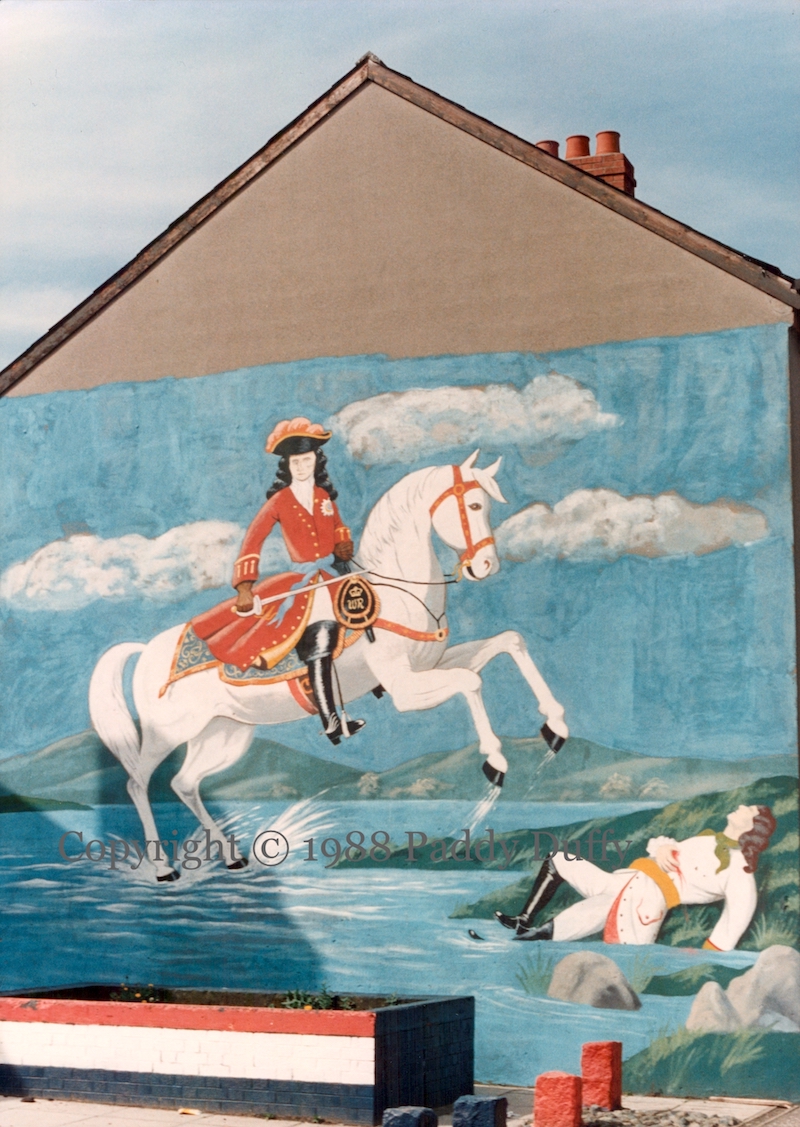
The King Billy mural survived until 1988 and was reproduced on the other side of Donegall Pass in 1989 – see the Peter Moloney Collection. King Billy is subtly coloured red-white-and-blue, while the dying Jacobite is in green-white-and-gold.

At the junction of Apsley Street and Howard Street South, at what is now the entrance to Reverend Robert Bradford Memorial Park.

Click image to enlarge
Copyright © 1988 Paddy Duffy
T00145 T00144 T00140

A Legitimate Right To Take Up Arms

“”I have always believed we had a legitimate right to take up arms …” from an interview by IRA volunteer Maıréad Farrell, executed with her gallant comrades Seán Savage & Dan McCann.”

Yann Goulet’s Ballyseedy Memorial sculpture was rendered in paint for the funeral procession of the Gibraltar Three on March 16th, 1988. The sculpture is a reflection on the killing of eight anti-Treaty prisoners at Ballyseedy Cross (Baıle Ó Síoda), Kerry, during the Irish Civil War. From left to right, we see the dead victim, the grieving widow and orphaned child, and a person (in the painted version wearing the same clothes as the victim) defiantly striding off to take his place and seek revenge.

In the wake of the killings in Gibraltar, six more people were killed in one of the most tense weeks in Troubles history – the IRA’s Kevin McCracken on the 14th, Thomas McErlean, John Murray, and IRA-member Caoımhín Mac Brádaıgh by Michael Stone in the graveyard on the 16th, and British Army corporals Wood and Howes at Mac Brádaıgh’s funeral on the 19th.

Falls Road at Fallswater Street, west Belfast

Click image to enlarge
Copyright © 1988 Paddy Duffy
T00064 [T00076] [T00027]

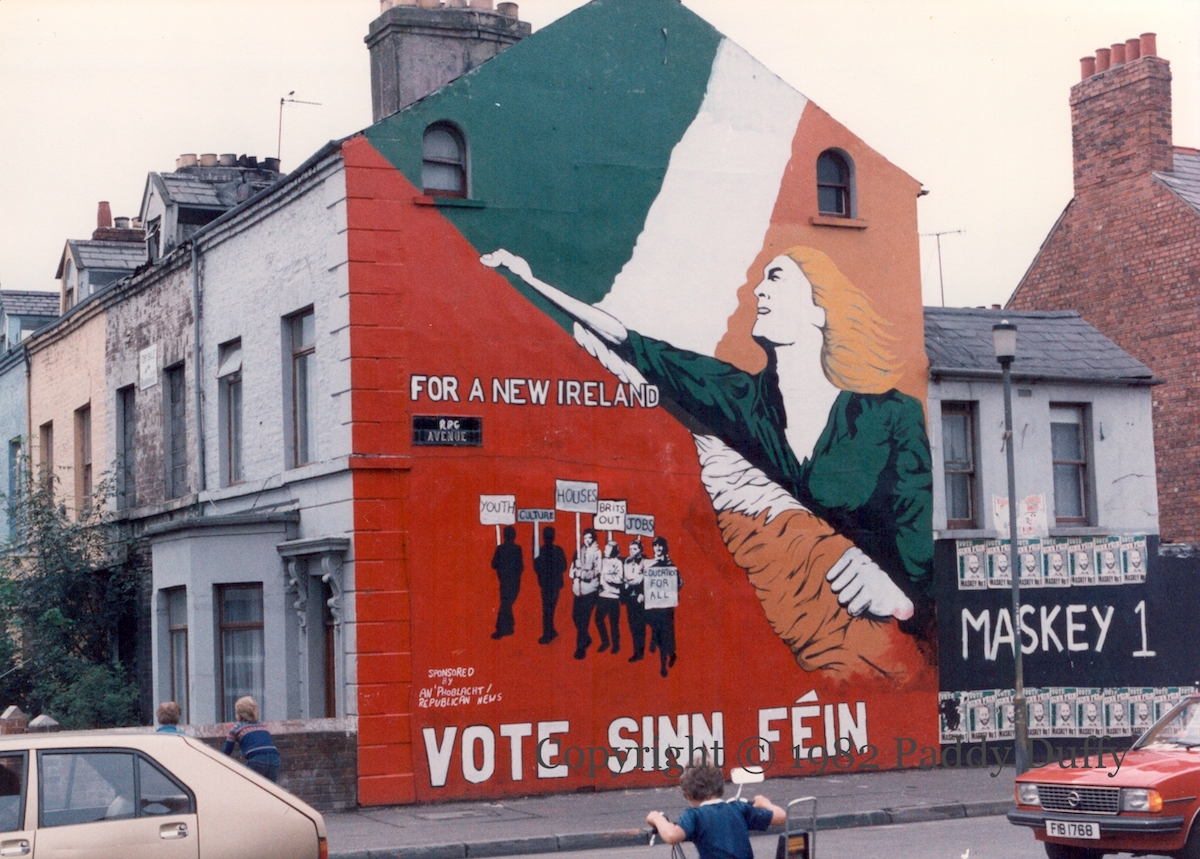
For A New Ireland

Voting for Sınn Féın is seen as the way to address the social issues named on placards carried by protestors – culture, houses, Brits Out, jobs – in order to bring about “a new Ireland”.

Sınn Féın’s electoral strategy emerged from the 1981 hunger strike, during which Bobby Sands was elected as an MP and Paddy Agnew and Kieran Doherty were elected as TDs. In October of that year, Danny Morrison famously asked at the Ard Fheıs, “Will anyone here object if, with a ballot paper in this hand and an Armalite in the other, we take power in Ireland?”

In 1983, Alex Maskey stood for Belfast City Council in a by-election [after the resignation of … whom? – please get in touch] and was successful (WP) – there are a campaign graffito and posters to the right. Shortly afterward, Gerry Adams stood in the Westminster election and was successful (ARK).

Beechmount/RPG Avenue, Beechmount, west Belfast, replacing James Connolly in Let Us Rise and Cormac’s Notes.

Click image to enlarge
Copyright © 1983 Paddy Duffy
T00062 [T00005]

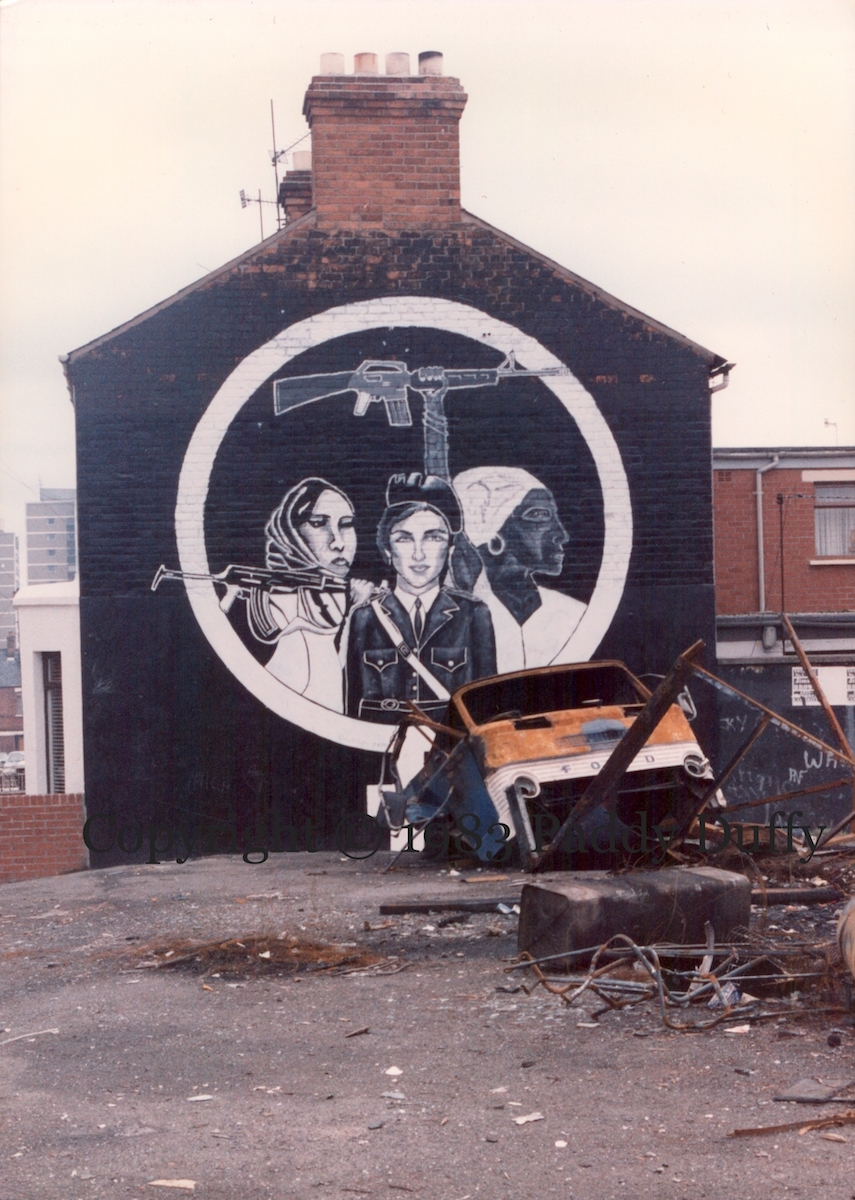
Women In Armed Struggle

“Solidarity between women in armed struggle” would be added in the bottom right (or is perhaps obscured by the burnt-out lorry. The imagery shows female members of the Palestine Liberation Organisation (PLO), Cumann Na mBan, and the Southwest African People’s Organisation (from Namibia) drawn within the symbol for woman (also the planet Venus in astrology).

Painted by Kes and “Improved by Sınn Féın Youth” (added to the bottom left) at the top of Fallswater Street. (Compare with the Peter Moloney Collection’s image from 1985.)

Click image to enlarge
Copyright © 1983 Paddy Duffy
T00056 [T00003]

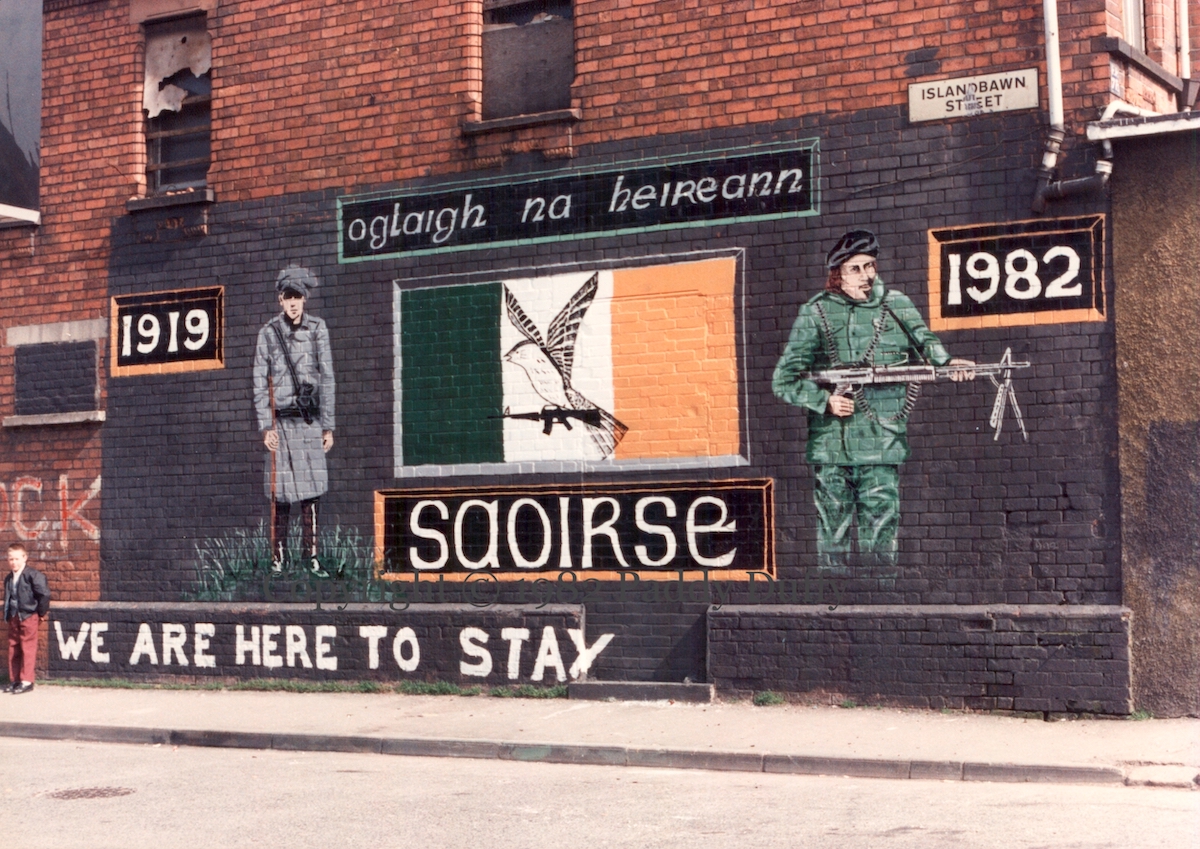
We Are Here To Stay

This mural celebrates the IRA (“Óglaigh Na hÉıreann” at the top) from 1919 (the army of the independent Dáıl Éıreann) to the “present” day of 1982. In the centre, a lark flies against a Tricolour, with the word “Saoırse” (“freedom”) beneath.

This is a repainted version of the original, which was one of several murals in Beechmount and the Rock streets that were paint-bombed by “marauding Coldstream Guards” (according to AP/RN of 1982-04-29) – for the damaged mural, see the Peter Moloney Collection. The “1919” date would be changed to “1916”.

Islandbawn Street, west Belfast, replacing The Right Hon. Bobby Sands.

Click image to enlarge
Copyright © 1982 Paddy Duffy
T00063 [T00009]

An Phoblacht/Republican News

“An Phoblacht/Republican News – official organ of the republican movement. Contents include war news, features, IRA statements, prison news from Ireland & England, news from throughout the 32 counties, solidarity news from abroad.”

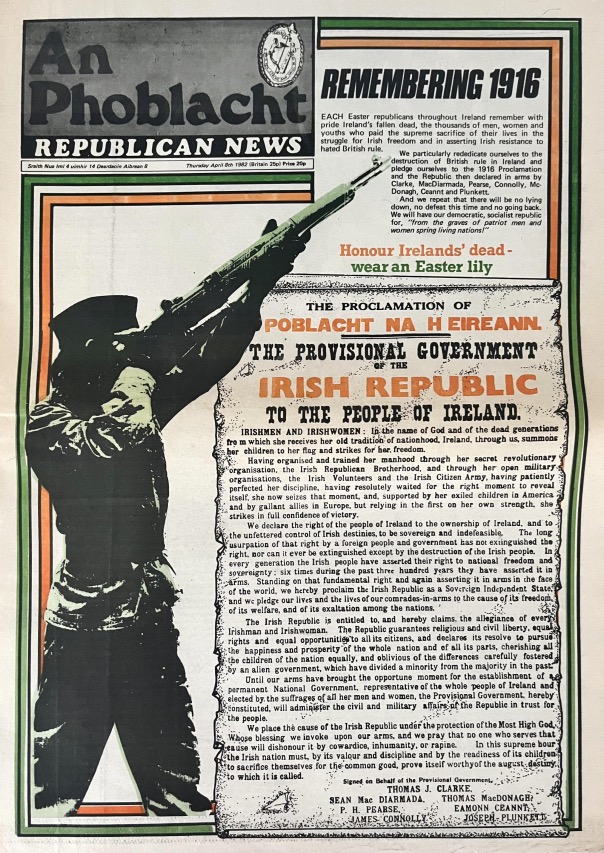
Workers read the 1982-04-08 edition of the paper, the cover of which is reproduced behind them (and included below): a masked volunteer fires a funeral volley next to the 1916 Proclamation.

The Maid Of Erin harp, with a “cap of liberty” rather than a crown (WP), together the slogan “It is new strung and it shall be heard” is the emblem of the Society of United Irishmen (WP).

“Painted by Beechmount & Iveagh Sınn Féın youth.”

Sevastopol Street, west Belfast

Click image to enlarge
Copyright © 1982 Paddy Duffy
T00004 [T00057]