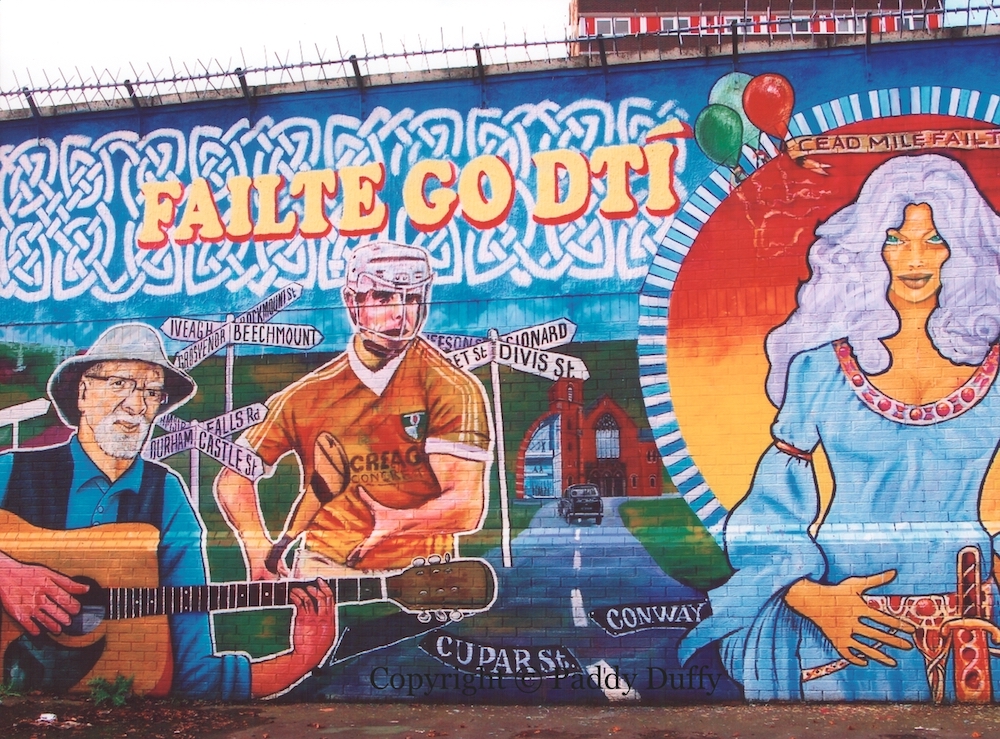
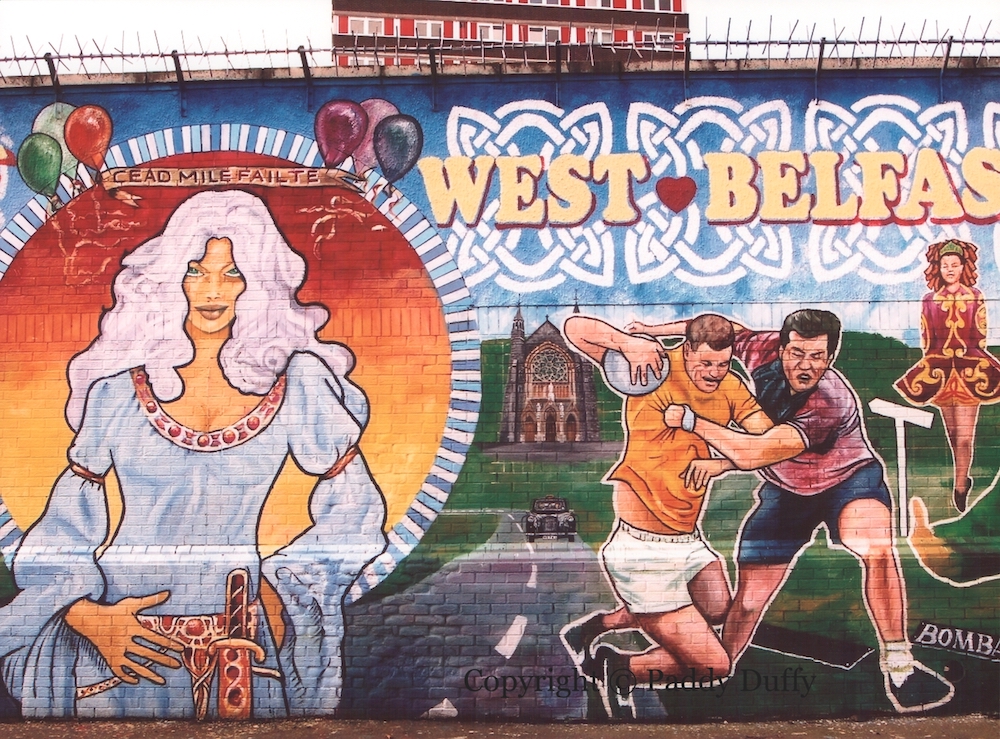
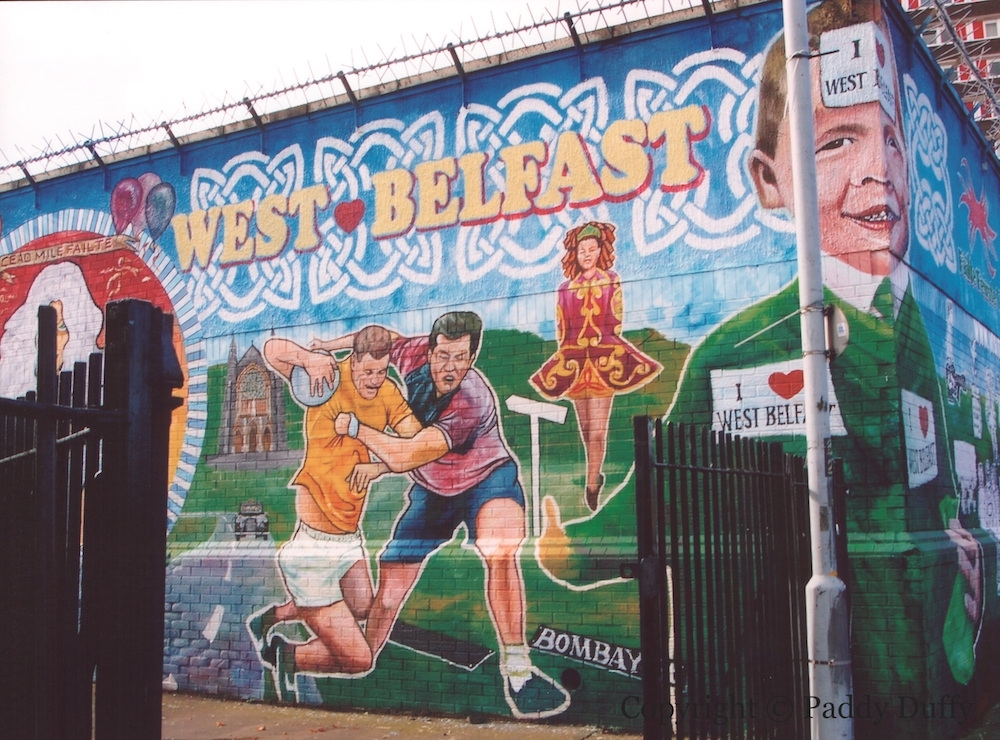
“Welcome to west Belfast”. West Belfast is portrayed as a place of music, sport, and dancing, whose landmark buildings and streets are under the watchful eye (and sword) of the goddess Érıu.
The image of the little boy with the “I [heart] Belfast” stickers and a bag of sweets, standing in the waste ground of Divis flats, is a photograph from the early days of Féıle An Phobaıl/West Belfast Festival.
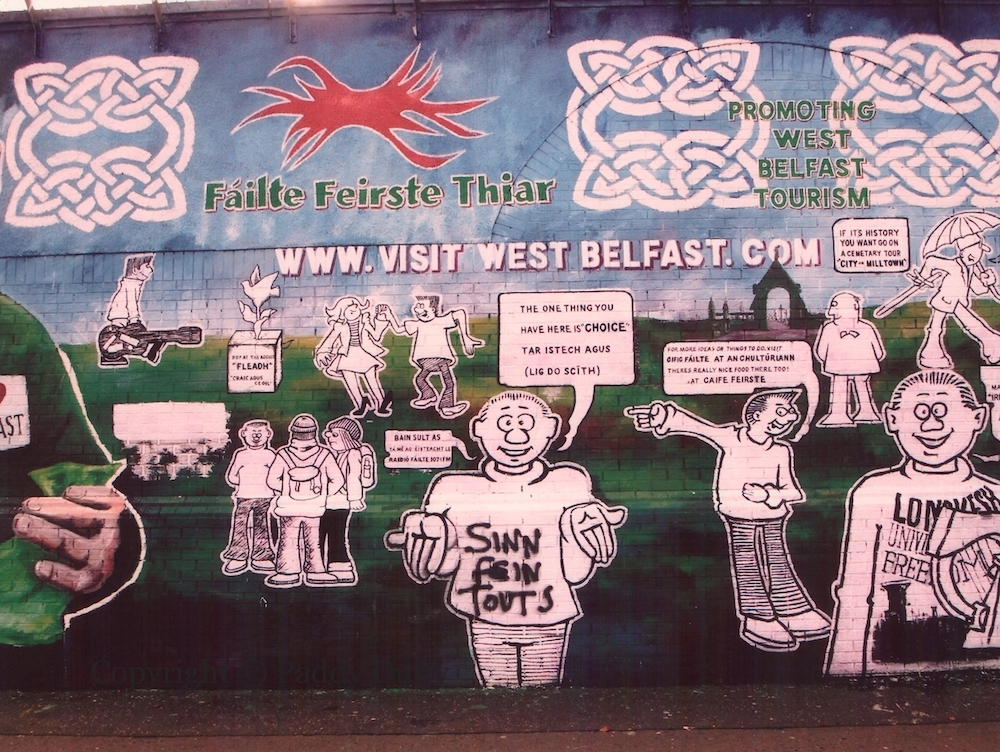
On the Divis Street side, characters in the style of cartoonist Cormac (see e.g. Notes) are “Promoting west Belfast tourism” for “Fáılte Feırste Thıar”, “www.visitwestbelfast.com“. The attractions touted are: “Bop at the August “fleadh”. “Craıc agus ceol” (for Robert Ballagh’s dove coming out of the concrete block, see Féile An Phobail 2008), “The only thing you have here is “choice”. Tar ısteach agus (lıg do scíth)”. “Baın sult as. Tá mé ag éısteacht le Raıdıó Fáilte 107.1 FM”, “For more ideas on things to do, visit Oıfıg Fáılte at An Chultúrlann. There’s really nice food there too! at Caıfe Feırste”, “If it’s history you want go on a cemetery tour “City or Milltown””, “Enjoy a walk on ‘Slıabh Dubh’ (The black … … mountain)”, “Make sure you visit the “Irish republican history museum” at Conway Mill” (with ‘Long Kesh University Of Freedom’ sweater; “Sinn Féin touts” is not a sweater but graffiti.)
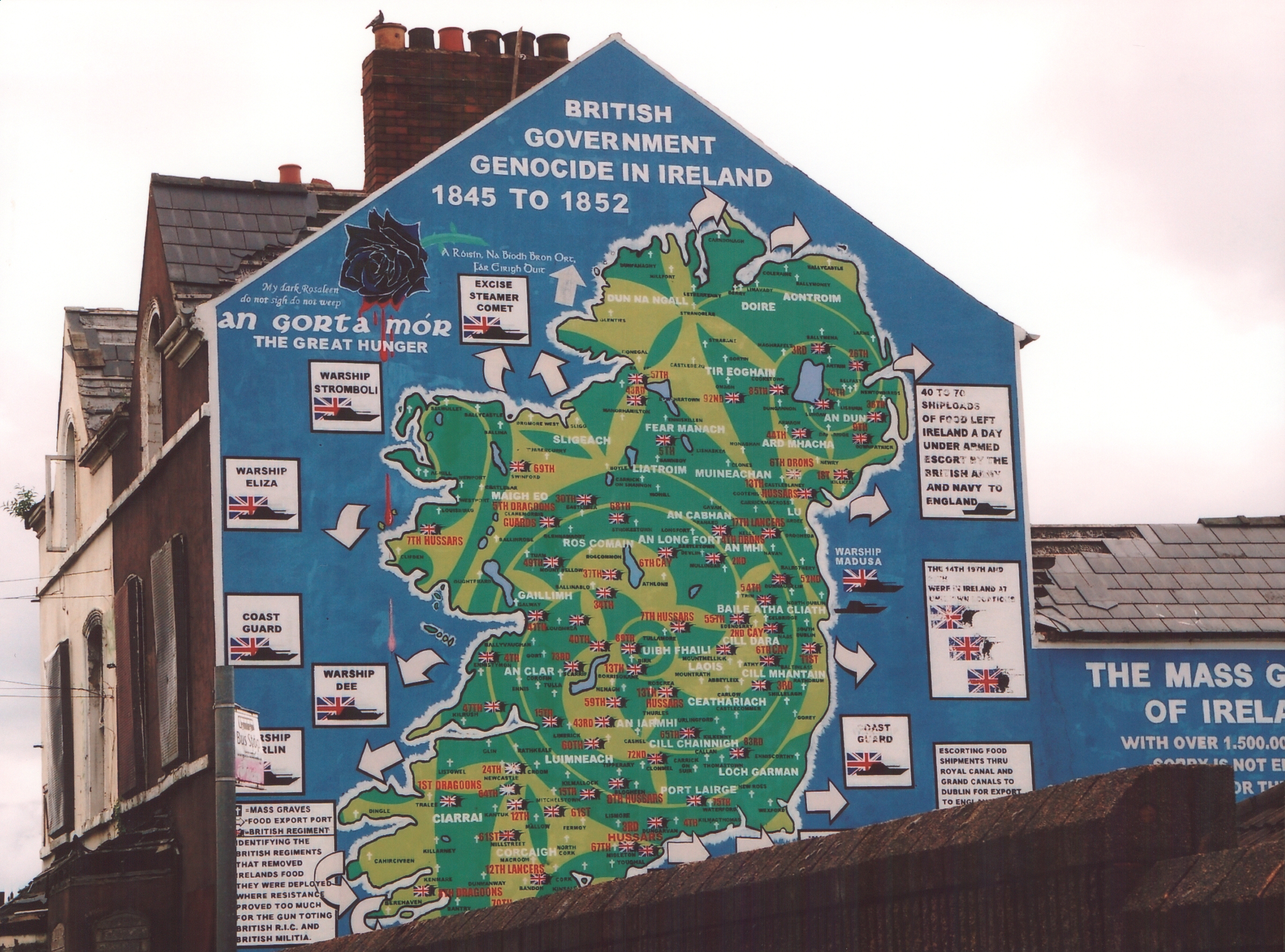
In 1997, the office of then-Prime Minister Tony Blair issued a statement acknowledging that the administration of the time of the Hunger failed to intervene (Guardian | Independent).
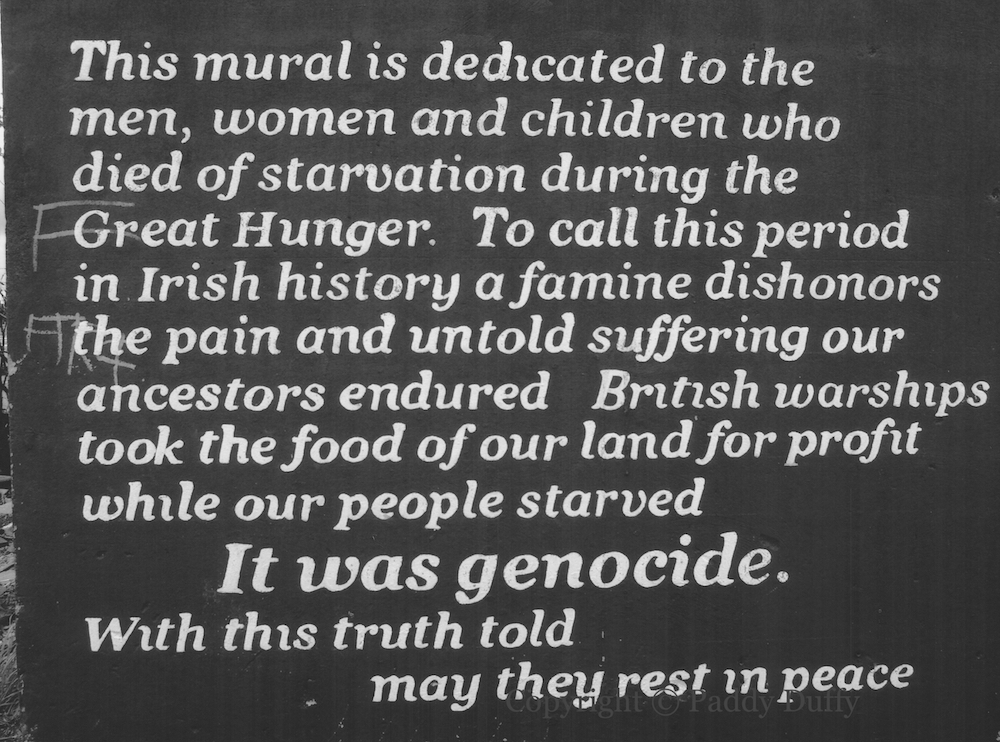
The mural above asserts that government’s inaction was not merely a matter of negligence but of will: “With over 1,500,000 deaths “sorry” is not enough. It is time the British government and its war machine to leave Ireland and her people in peace. During the genocide of 1845 to 1852 the British government seized from Ireland’s producers tens of millions of head of livestock, tens of millions of tons of flour, grain, meat, poultry and dairy products, enough food to sustain 18 million people. 200,000 British troops (100,000 at any given time) and 12,000 RIC removed Ireland’s food at gun point. This mural is dedicated to the men, women and children who died of starvation during the Great Hunger. To call this period in Irish history a famine dishonors the pain and untold suffering our ancestors endured. British warships took the food of our land for profit while our people starved. It was genocide. With this truth told may they rest in peace.”
“A Róısín, na bíodh brón ort, fár [fé’r] éırıgh duıt.” Each white cross on the map represents a mass grave. The map is originally from irishholocaust.org.
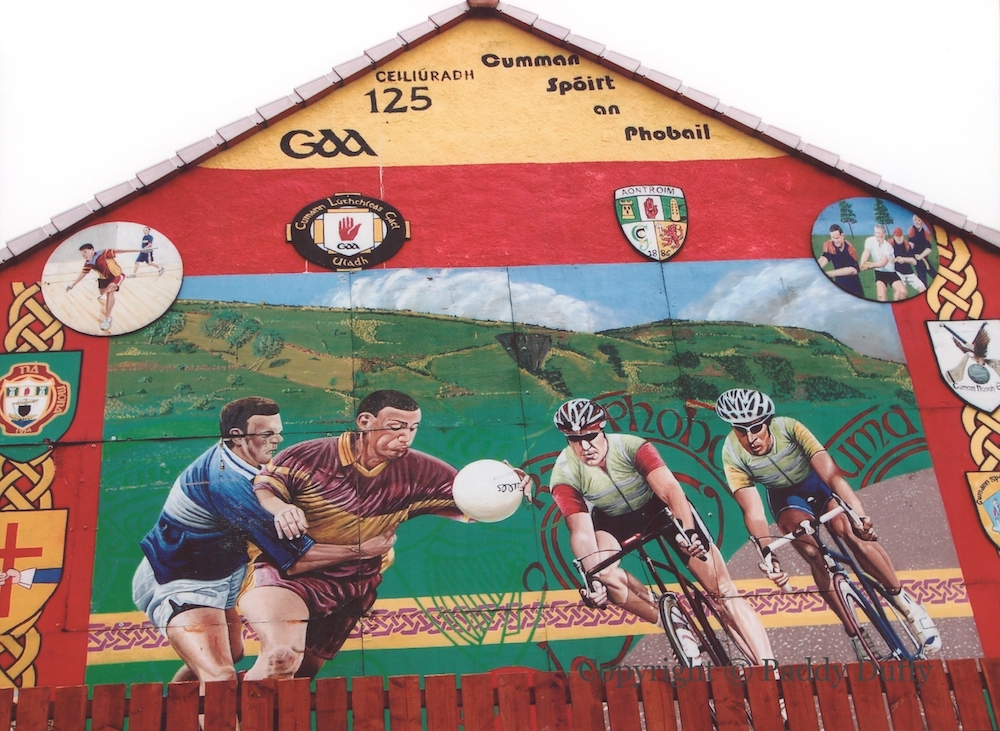
This mural (partly on boards, partly on the wall) celebrates 125 years of the GAA, particularly local teams Cumman [sic] Spóırt An Phobaıl, Cardinal O’Donnell’s, Gort Na Móna, and Cumann Naomh Eoın.
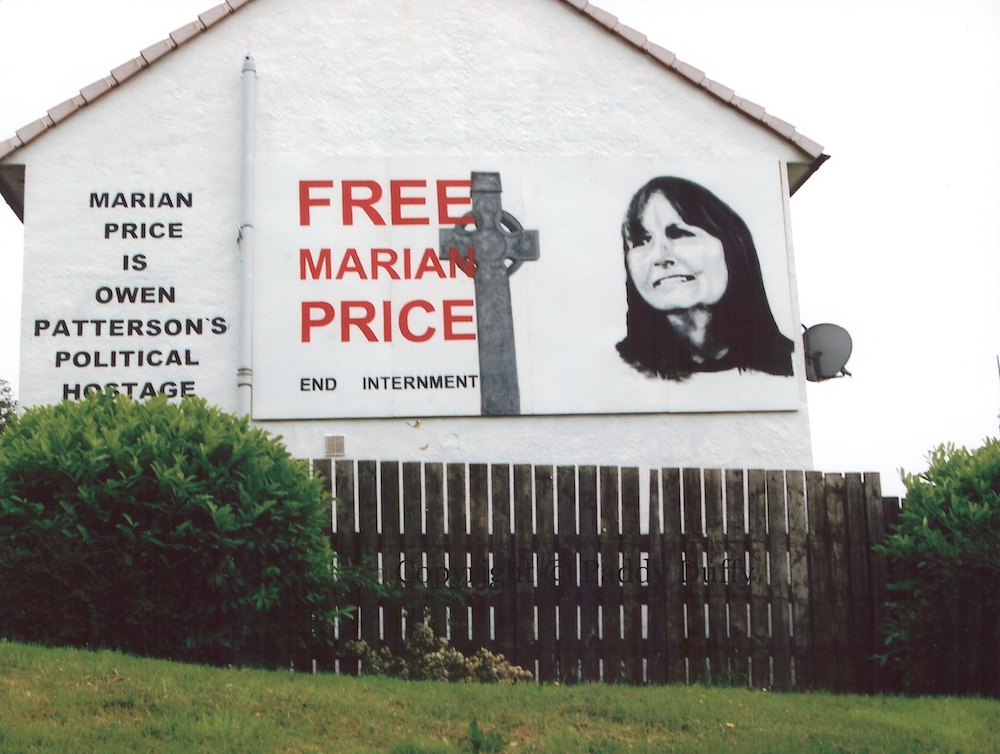
This painted board in support of Marian Price (WP) was launched on May 13, 2012. Charges against Price were reinstated on September 5th (Slugger). Owen Paterson (with one “t”) was replaced in mid September (2012) as Secretary of State for Northern Ireland after five months in office.
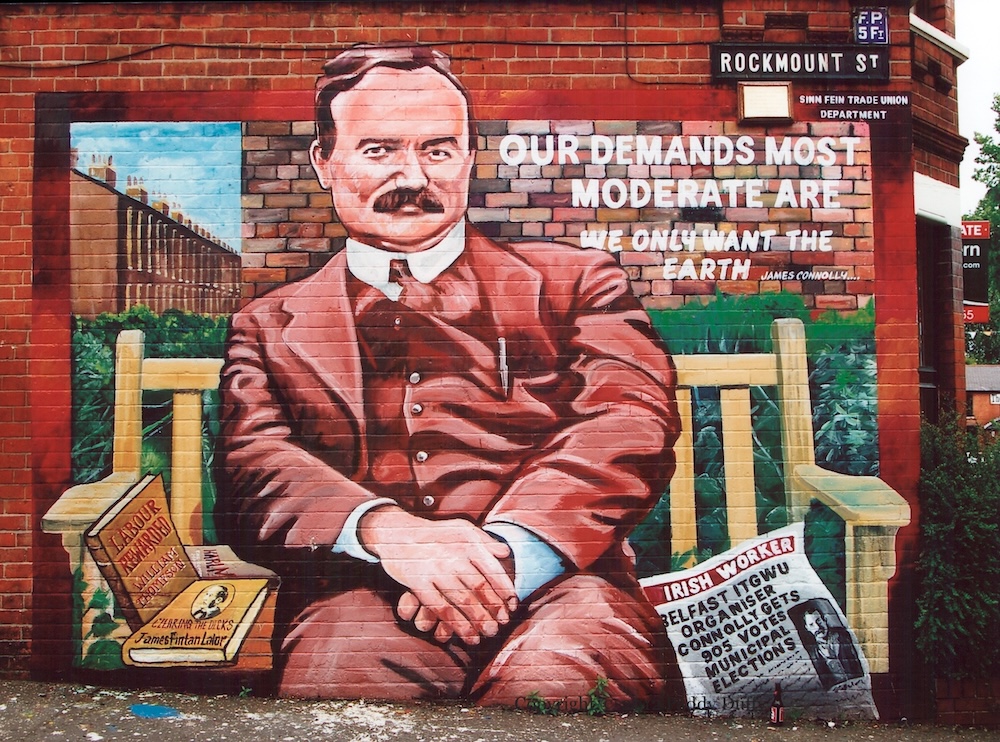
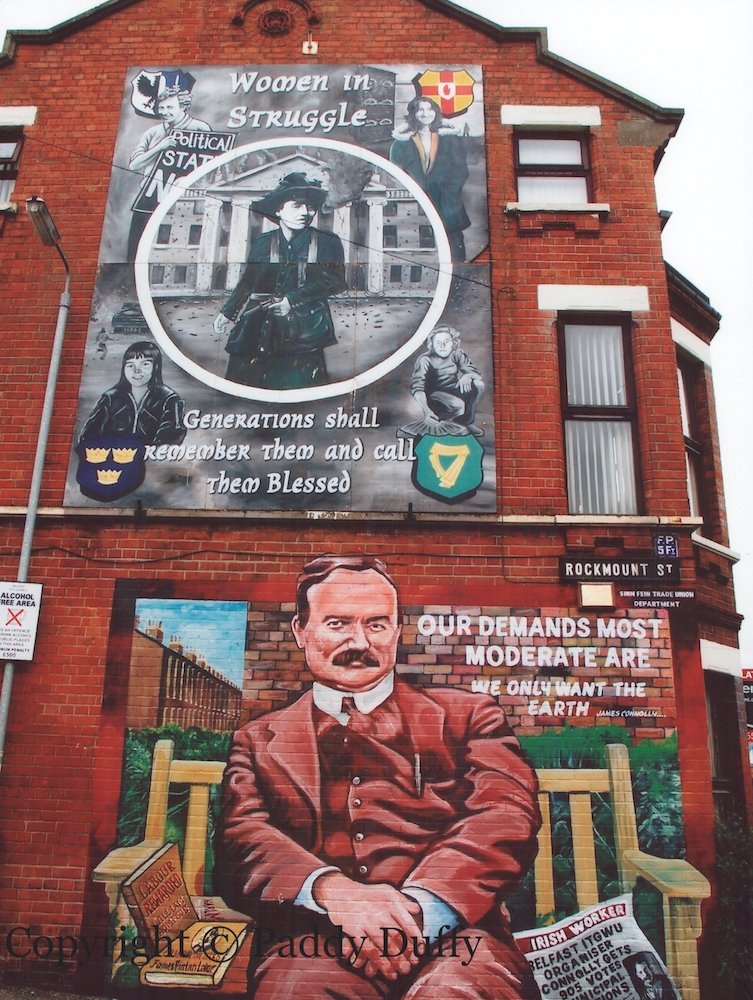
The sixteen-year old Sınn Féın Trade Union Dept mural has been replaced (though the plaque remains in the top right-hand corner) with another mural featuring James Connolly but with a new quote, from his 1907 poem: “Our demands most moderate are/We only want the earth.” The Irish Worker headline reads “Belfast ITGWU organiser Connolly gets 905 votes municipal elections” referring to the municipal elections of 1913 – Connolly stood in the Dock Ward (SIPTU). At Connolly’s right hand are books by James Fintan Lalor (Clearing The Decks), William Thompson (Labour [Labor] Rewarded) and Karl Marx.
Above the mural is a painted board celebrating “women in struggle – generations shall remember them and call them blessed.” With images of female activists including Máıre Drumm, Maıréad Farrell, and Countess Markievicz.
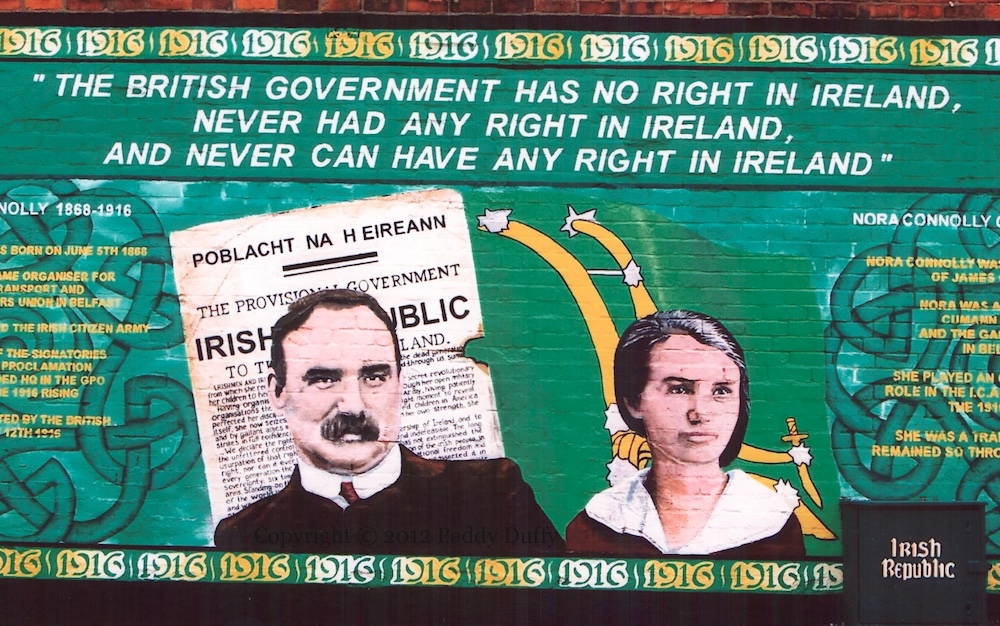
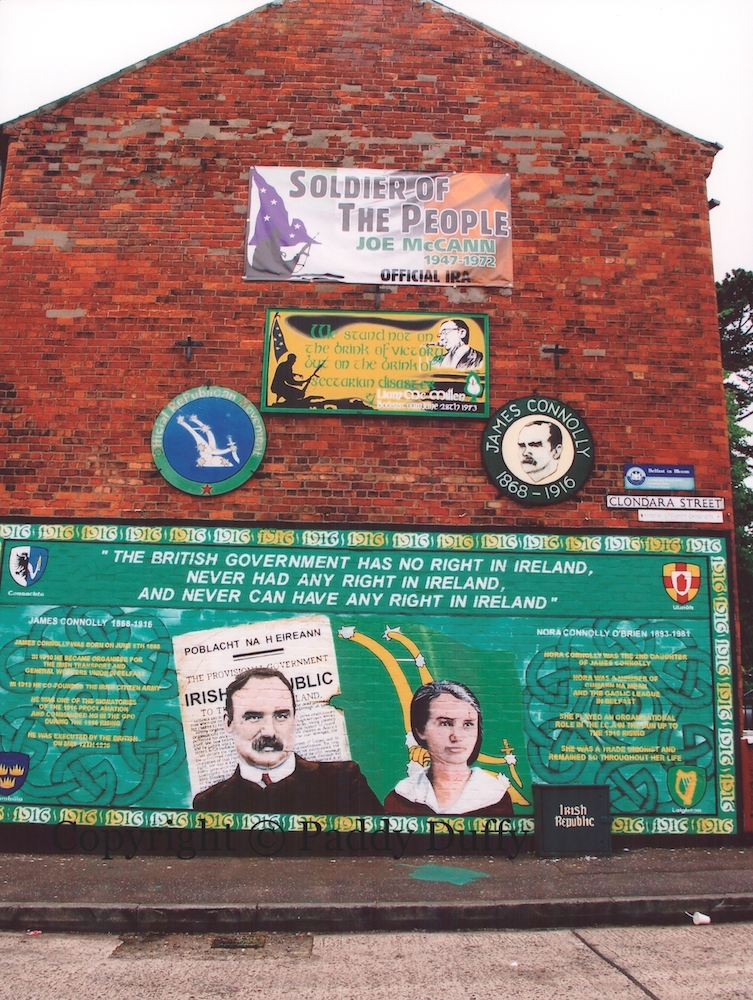
“The British government has no right in Ireland, never had any right in Ireland, and never can have any right in Ireland.” (Last Statement, 1916)
“James Connolly 1868-1916 James Connolly was born in June 5th 1868. In 1810 he became organiser for the Irish Transport And General Workers Union in Belfast. In 1913 he co-founded the Irish Citizen Army. He was one of the signatories of the 1916 Proclamation and commanded HQ in the GPO during the 1916 Rising. He was executed by the British on May 12th 1916.”
“Nora Connolly O’Brien 1893-1981 Nora Connolly was the 2nd daughter of James Connolly. Nora was a member of Cumann Na mBan and the Gaelic League in Belfast. She played an organisational role in the ICA in the run up to the 1916 Rising. She was a trade unionist and remained so throughout her life.”
“Honour Ireland’s dead – wear an Easter lily.” This Beechmount Avenue/Ascaıll Ard Na bhFeá mural is a memorial to republicans from County Antrim from 1798 to 1966 – when the ‘County Antrim Memorial’ was raised in Milltown on the 50th anniversary of the Easter Rising – and beyond; it is pictured in the lower right, a large cross-shaped monument. Tom Williams (WP), an IRA volunteer who was executed during the Northern Campaign (during the second world war) and is buried in the plot, is mentioned specifically on the headstone in the lower left.
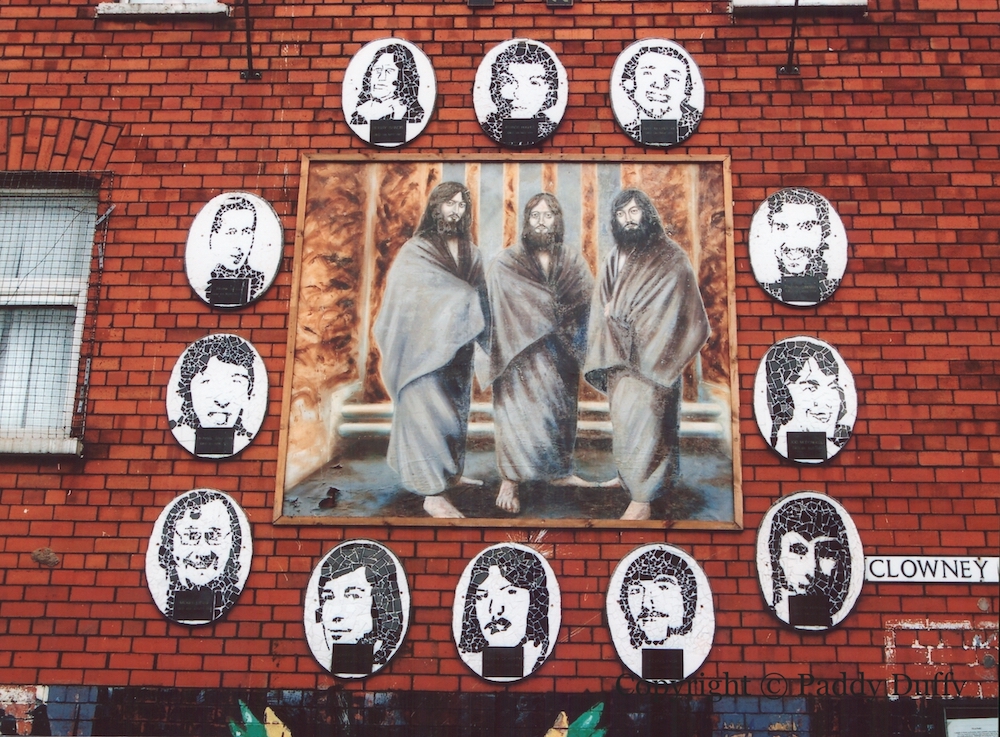
For the 30th anniversary of the 1981 hunger strike, the mosaics of the Troubles-era hunger strikers were mounted around the blanket-men board and above the Phoenix in Clowney Street; for a few years they were previously at the Falls-Beechmount corner.
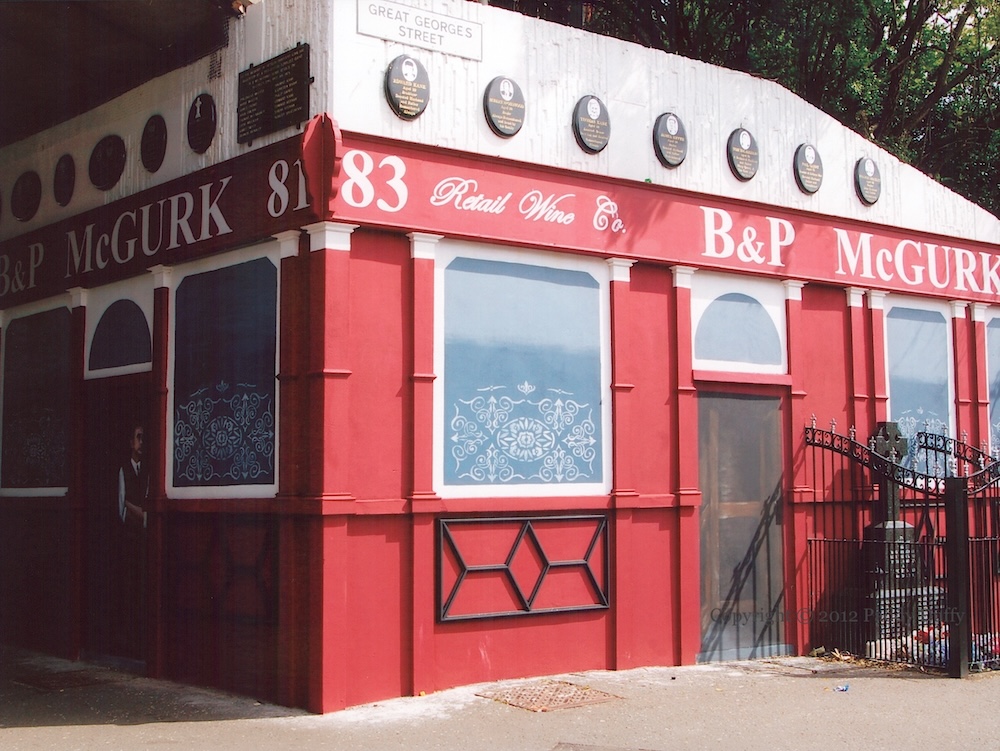
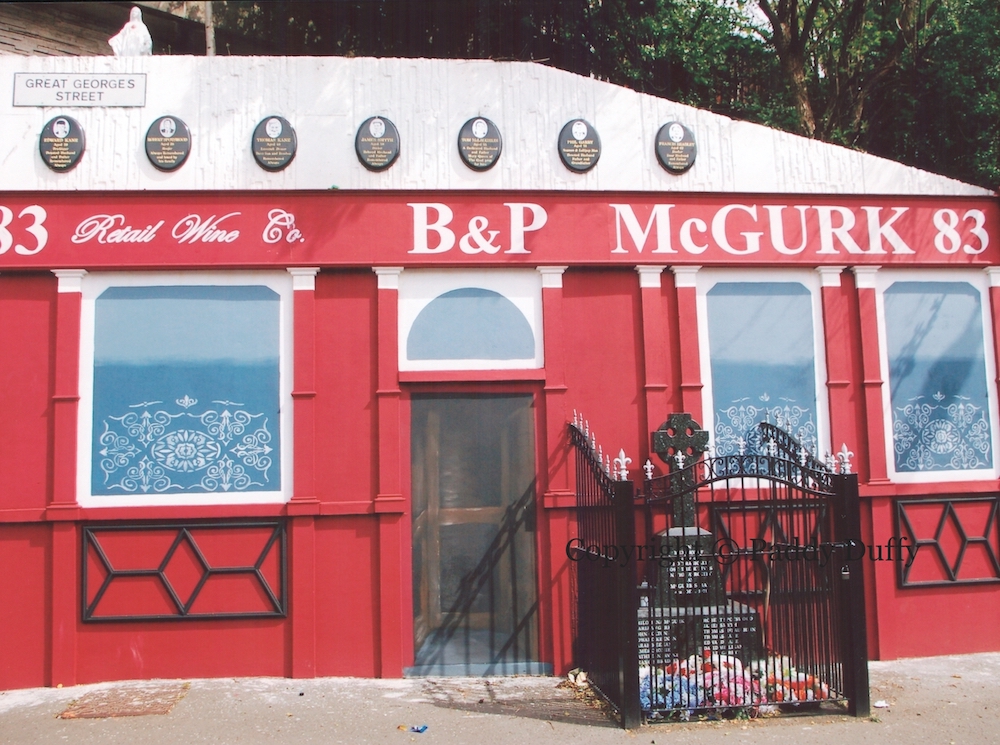
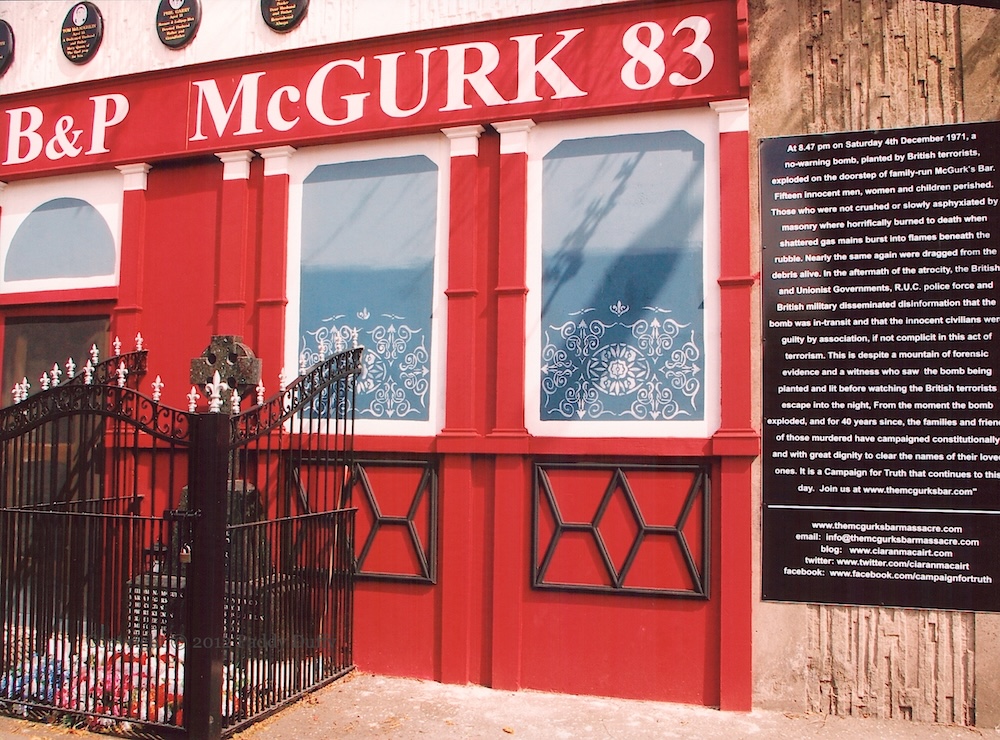
For the 40th anniversary, a painted shopfront and plaques to the victims of the McGurk’s Bar Bombing were added last December (2011) to the Celtic Cross and plaque already at the site.
The rectangular plaque at the corner reads, “To the memory of fifteen innocent civilians murdered by a pro-British loyalist gang in a no warning bomb attack on McGurk’s bar, Dec. 4th 1971. Philomena McGurk, Marie McGurk, James Cromie, John Colton, Thomas McLaughlin, David Milligan, James Smyth, Francis Bradley, Thomas Kane, Kathleen Irvine, Philip Garry, Edward Kane, Edward Keenan, Sarah, Keenan, Robert Spotswood.”
The text on the info board to the right is ad follows: “At 8.47 pm on Saturday 4th December 1971, a no-warning bomb, planted by British terrorists, exploded on the doorstep of family-run McGurk’s Bar. Fifteen innocent men, women and children perished. Those who were not crushed or slowly asphyxiated by masonry where [sic] horrifically burned to death when shattered gas mains burst into flames beneath the rubble. Nearly the same again were dragged from the debris alive. In the aftermath of the atrocity, the British and Unionist Governments, RUC police force and British military disseminated disinformation that the bomb was in-transit and that the innocent civilians were guilty by association, if not complicit in this act of terrorism. This is despite a mountain of forensic evidence and a witness who saw the bomb being planted and lit before watching the British terrorists escape into the night. From the moment the bomb exploded, and for 40 years since, the families and friends of those murdered have campaigned constitutionally and with great dignity to clear the names of their loved ones. It is a Campaign for Truth that continues to this day. Join us at www.themcgurksbar.com.”
These are new boards on Beechmount Avenue, alongside the many portraits of victims.
McGurk’s Bar: “At 8:47 pm on Saturday 4th December 1971, a no-warning bomb, planted by British terrorists, exploded on the doorstep of family-run McGurk’s Bar. Fifteen innocent men, women and children perished. Those who were not crushed or slowly asphyxiated by masonry where horrifically burned to death when shattered gas mains burst into flames beneath the rubble. Nearly the same again were dragged from the debris alive. In the aftermath of the atrocity, the British and Unionist Governments, RUC police force and British military disseminated disinformation that the bomb was in-transit and that the civilians guilty by association, if not complicit in this act of terrorism. This is despite a mountain of forensic evidence including a witness statement that saw the bomb being planted and lit before the British terrorists escaped into the night. From the moment the bomb exploded and for 40 years since, the families and friends of those murdered have campaigned constitutionally and with great dignity to clear the names of their lived ones. It is a Campaign for Truth that continues to this day. Join us at themcgurksbarmassacre.com” “
Springhill–Westrock Massacre: “Belfast’s Bloody Sunday. Time for truth! On the 9th July 1972 a team of British Army snipers took up firing positions in Corry’s timber yard overlooking the nationalist Springhill/Westrock estates. Within less than an hour five civilians lay dead and two critically wounded. Among the dead were three teenagers, a father of six and a priest on his way to administer the last rites to the dead and injured. There has never been a proper police investigation, and not one solider has spent a single day in prison in connection with their deaths. The families deserve, and demand the comprehensive facts be told by the British establishment. The truth costs nothing.”
Collusion: “Crime is crime is crime” said UK Prime Minister Margaret Thatcher in a 1981 news conference in Saudi Arabia. Her words are used against her and the UK government and armed forces: “We want you to tell us the truth [about collusion]”.
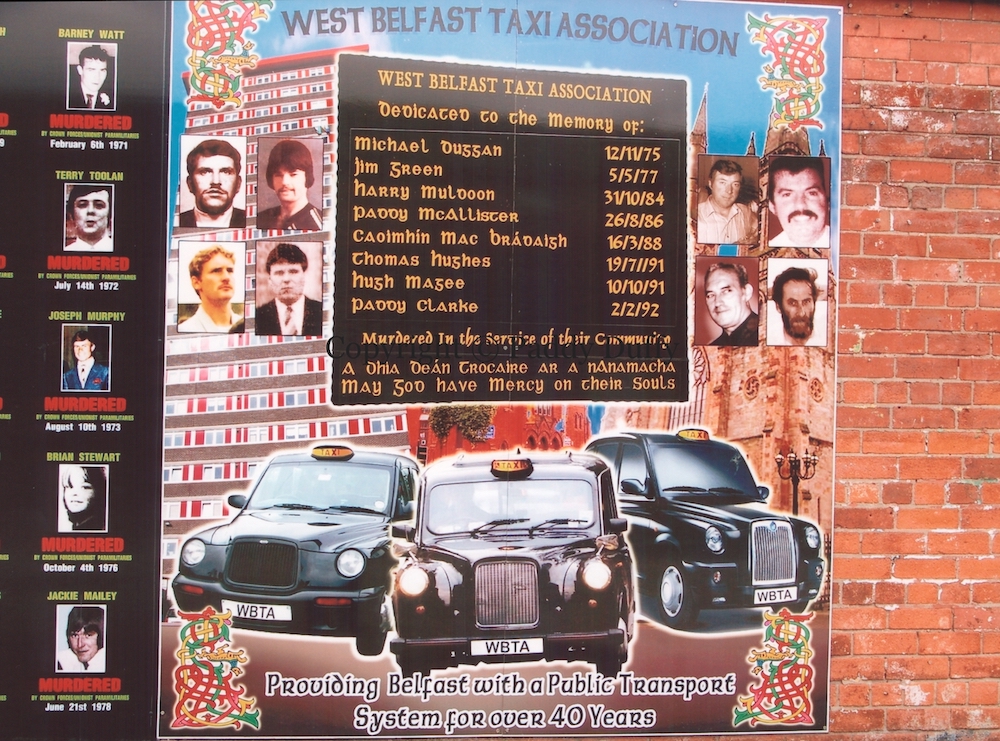
WBTA: Black taxis were first brought from England to Belfast in 1970 by locals who wanted to provide an alternative, and locally-based, transport system to augment the Citybuses which were sometimes cancelled and sometimes burned out. “West Belfast Taxi Association. Providing Belfast with a public transport system for over 40 years.”
The board commemorates eight drivers who were killed during the troubles: “Dedicated to the memory of Michael Duggan 12/11/75, Jim Green 5/5/77, Harry Muldoon 31/10/84, Paddy McAllister 26/8/86, Caoımhín Mac Brádaıgh 16/3/88, Thomas Hughes 19/7/91, Hugh Magee 10/10/91, Paddy Clarke 2/2/92. Murdered in the service of their community. A Dhıa deán trocaıre ar a nanamacha.” French documentary about black taxi drivers.
Beechmount Avenue/Ascaıll Ard Na bhFeá, west Belfast