12 Men Dead

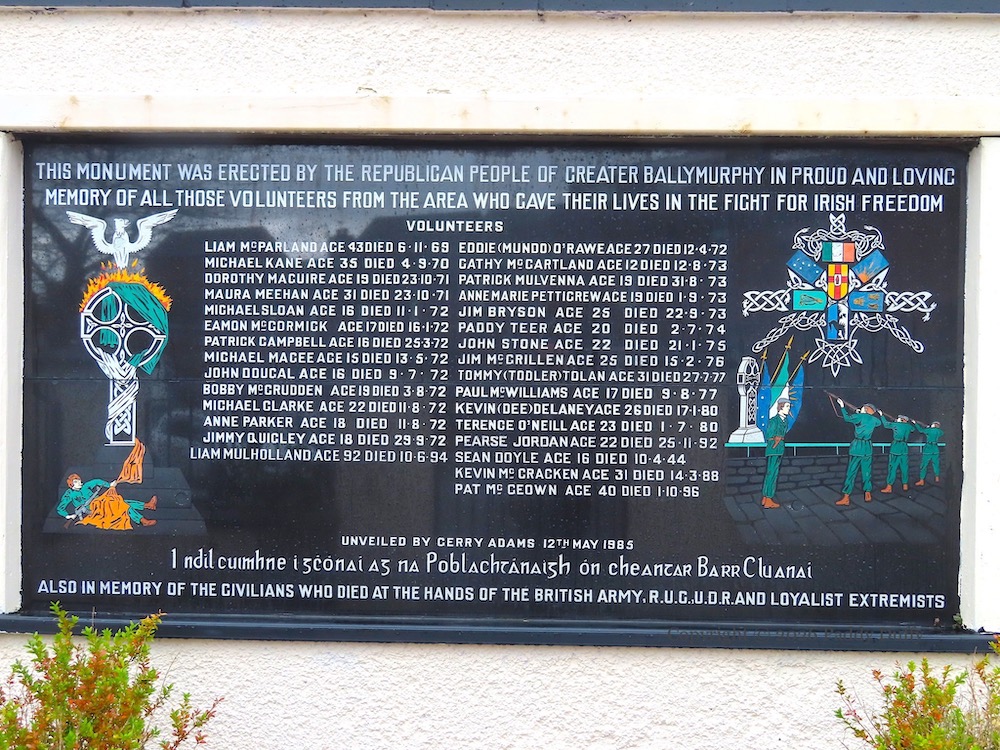
Michael Gaughan and Frank Stagg are presented along with the ten deceased 1981 hunger strikers on the cross-beam of a large wooden “H” at the top of Turf Lodge.

IRA volunteer Michael Gaughan died in Parkhurst prison in 1974 after 64 days on hunger strike. Gaughan’s coffin was draped with the Tricolour used to bury Terence McSwiney in 1920. He was force-fed seventeen times during the strike and his family alleged that he died from food stuck in a punctured lung. The practice was ended after Gaughan’s death.

Frank Stagg was on the Parkhurst hunger strike with Gaughan, and another in Long Lartin prison, and a third in Wakefield in December 1975. He died after 62 days on February 12th, 1976.

Click image to enlarge
Copyright © 2025 Paddy Duffy
T07413 T07412

Saoırse

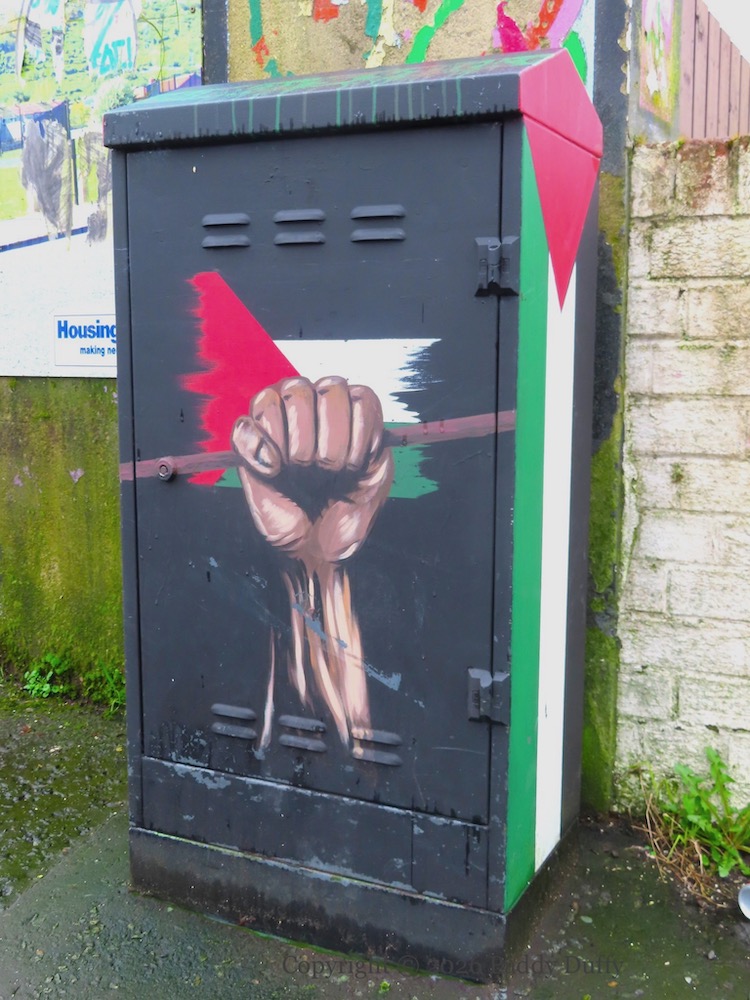
“RNU [Fb] stands with Palestine” – the board has been augmented by some knotwork corner-borders in the colours of the Palestinian and Irish flags, along with “freedom” in Irish (saoırse) and Arabic (الحرية).

For the board as originally presented in April 2024, see X14944.

Northumberland Street, west Belfast

Click image to enlarge
Copyright © 2025 Paddy Duffy
T08103rc [T08102]

LWF

For Remembrance Sunday, rows of hand-painted wooden medallions were attached to the railings at West Kirk Presbyterian to pay homage to the dead of the British armed forces, including Bernard McQuirt, whose plaque is shown below. McQuirt was a VC winner for actions taken during the Indian Rebellion in 1858. Originally from Donaghcloney, he survived his injuries and died in 1888 at 72 Urney Street (HistoryHub | News Letter | WP) – Urney Street used to be where the plaque and the memorial garden now are, along the side of the West Kirk.

Click image to enlarge
Copyright © 2025 Paddy Duffy
T08076 T08077 T08078 T08079

The Typist With The Webley

Winifred Carney was a qualified secretary and typist, and became secretary of the Irish Textile Workers’ Union in 1912, in which position she met James Connolly, who was secretary of the Belfast branch of the ITGWU. She was a member of Cumann Na mBan and participated in the Easter Rising of 1916. Carney was in the GPO when it was taken over and was among those who surrendered at the end; during the occupation she typed up dispatches from the Moore Street headquarters – this is how she was portrayed in the the 1916 Centenary mural.

(DIB | Ulster Biography | A Century Of Women | BBC | WP)

Stencil from Lasaır Dhearg (web) in Glenveagh Drive, Lenadoon, west Belfast, replacing the simple graffiti Ní Saoırse Go Saoırse Na mBan.

Click image to enlarge
Copyright © 2025 Paddy Duffy
T08083 T08069 [T08070]

Saoırse Go Deo

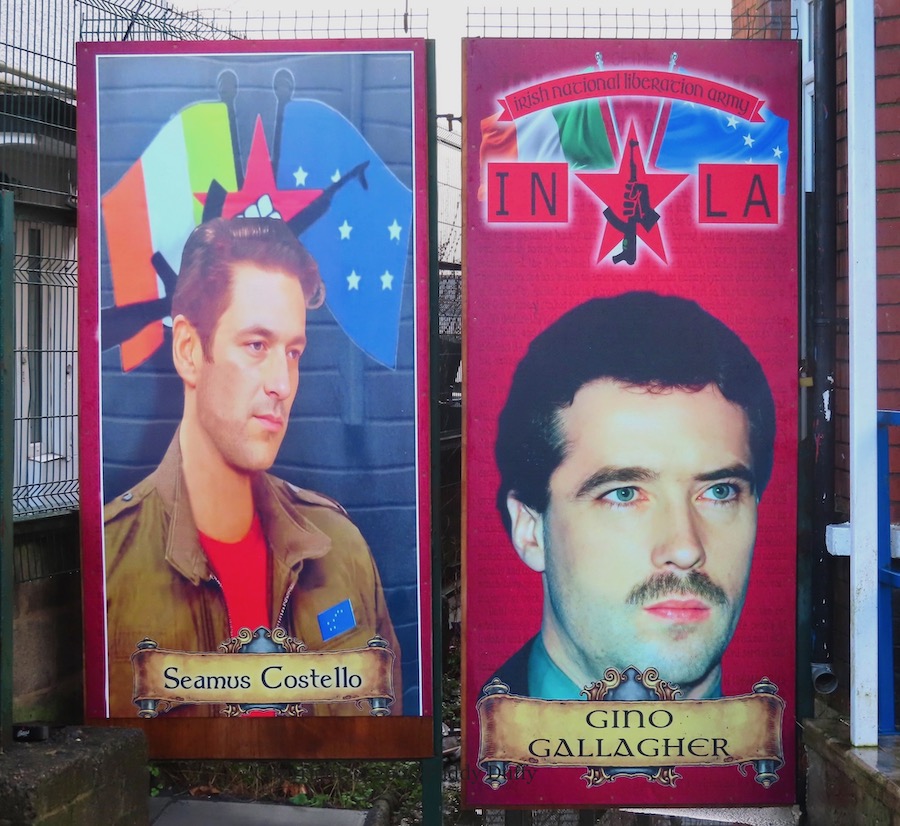
The gallery of socialist heroes at the top of the Rock, first painted in 2006, has been repainted in blue (rather than yellow). The faces remain the same as before: (l-r) Seamus Costello (INLA/IRSP founder), Gino Gallagher (INLA chief of staff), Che (in the Guerillero Heroico pose), Patsy O’HaraMiriam Daly, James Connolly.

Click image to enlarge
Copyright © 2025 Paddy Duffy
T07880 T07879 T07878 T07877

On The Shoulders Of Giants

Matt Talbot Youth Centre (Fb) provides activities and services for young people from New Barnsley and Moyard, including an afternoon club, trips during the summer months, and Halloween and Christmas parties.

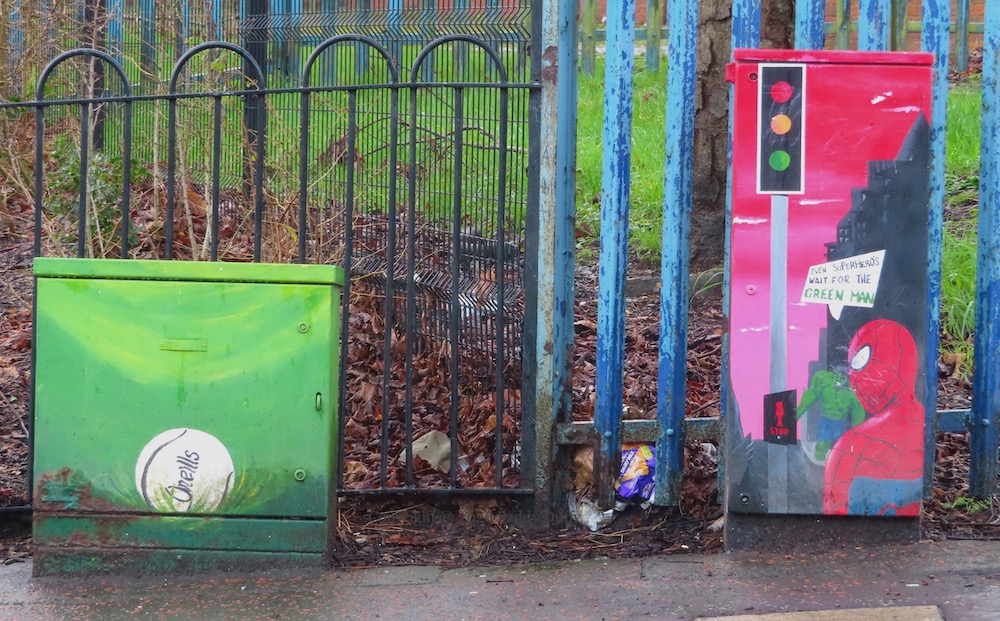
The two murals are face-to-face in New Barnsley Gardens. Also included are some painted utility boxes in the area, including a hurler/camogie-player from Michael Davitt’s GAC (web).

Click image to enlarge
Copyright © 2025 Paddy Duffy
T07886 T07885 T07883 T07884
T07882 T07881 T07887 T07888

Where The Troubles Began

A new visitor exhibition will open on Thursday November 6th at Ionad Eileen Howell with images, video, and audio recordings covering the period from the start of the Troubles in 1969 to the Falls Curfew in 1970 (Belfast Media). The new exhibition is hosted by the Falls Community Council (Fb); tickets via Visit Belfast.

The Troubles are generally said to have started in August, 1969, rather than (e.g.) October, 1968, because the Battle Of The Bogside in Derry (beginning on August 12th) and the rioting in Belfast (beginning on the 13th) led to the deployment of British troops (on August 14th and 15th).

The Falls Curfew, in July 1970, was a pivotal event in the souring of relations between the CNR population and the British Army. About 3,000 homes were cordoned off, the area was saturated with CS gas, and thousands of bullets were fired by the Officials and Army soldiers, the latter killing Charles O’Neill, William Burns, Zbigniew Uglik, and Patrick Elliman; there is a plaque commemorating the four a little further up the road – see The Falls Curfew.

St Comgall’s, Divis Street, west Belfast

Click image to enlarge
Copyright © 2025 Paddy Duffy
T07889 T07890 [T07891] [T07892]

In The Service Of Our Country

The upper Woodvale plaque “in memory of all those Protestants and members of the security forces who lost their lives in the greater Shankill area as a result of conflict” has sat unadorned since at least 2008 but now has a pair of boards to accompany it.

On the left, a reproduction of the “Faithful Unto Death” stained-glass window in the Museum of Orange Heritage in Schomberg House on the Cregagh Road (also reproduced in Newbuildings in 2022), along with the emblem of the Country Grand Orange Lodge Of Belfast (Fb).

On the right, a memorial to “all local residents whose lives were cruelly taken by Republican terrorists. Also those who selflessly gave their lives in the service of our country, and those who continue to do so.” (LOL “423” appears to be Banbridge Bible And Crown Defenders.)

Bray Street/Bray Close, Woodvale, west Belfast

Click image to enlarge
Copyright © 2025 Paddy Duffy
T07863 T07864 T07865 T07866 T07867 [T07868]

Mythical Andersonstown

Here are five mythological figures placed against a backdrop of Celtic Ireland, including standing stones, a dolmen, a stone circle, and the Janus figure on Boa Island (WP), from the wall of the PD/Cumann Sóısıalta Bhaıle Andarsan.

At least four of the five are copies of Jim Fitzpatrick paintings. From top to bottom (right to left on the wall) we see the figures from Breas ⁊ Cú Brea (which was long ago a mural in Derry), Medb Of Connacht, Nuada Journeys To The Underworld (seen in Nuada, Nuada Reborn, and elsewhere), a warrior-woman with spear (get in touch if you know the source), and The Coming Of Lugh (previously a mural in Ardoyne).

See also the Visual History page on The Influence Of Jim Fitzpatrick.

South Link, Andersonstown, west Belfast

Click image to enlarge
Copyright © 2025 Paddy Duffy
T07775 T07776 T07777 T07778 T07779 T07780 T07781 T07782