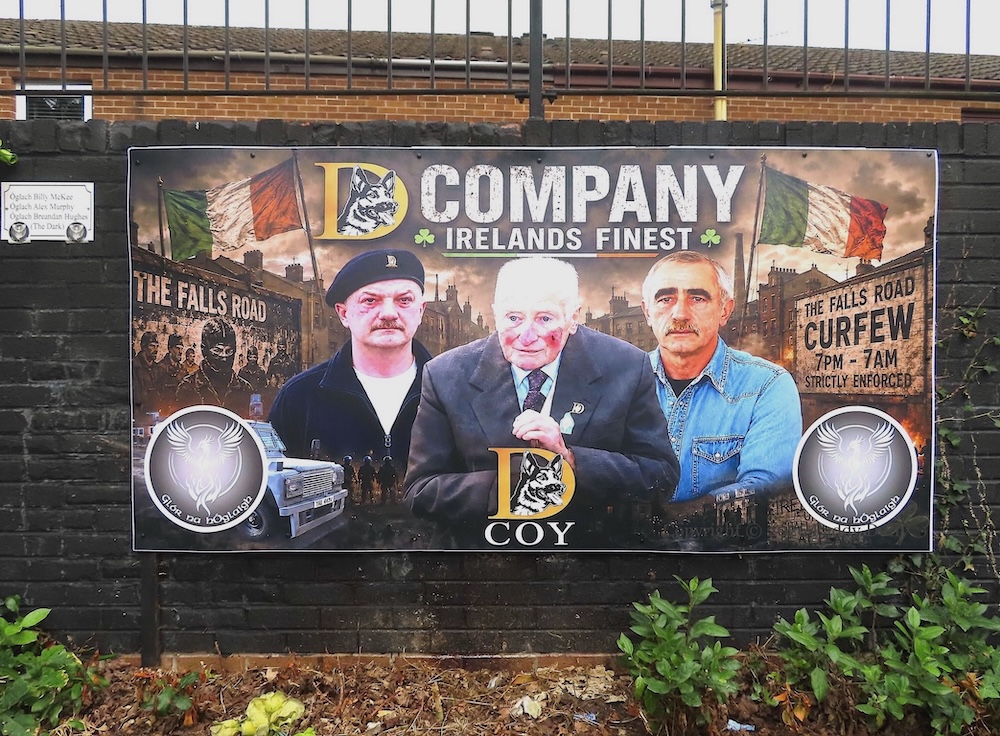
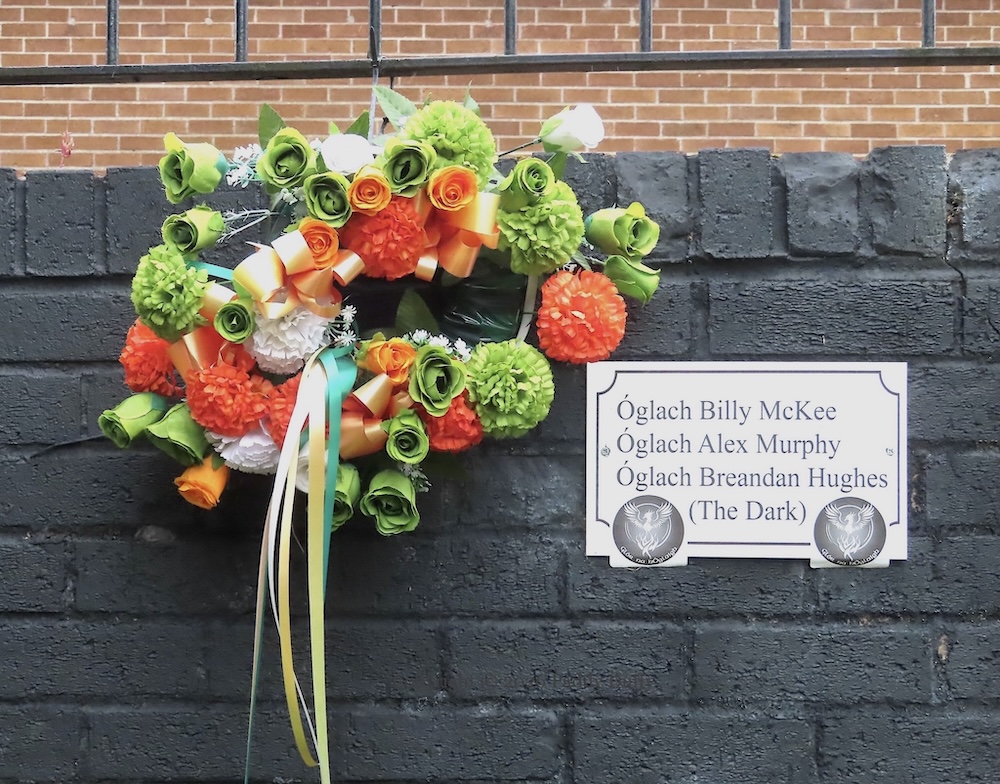
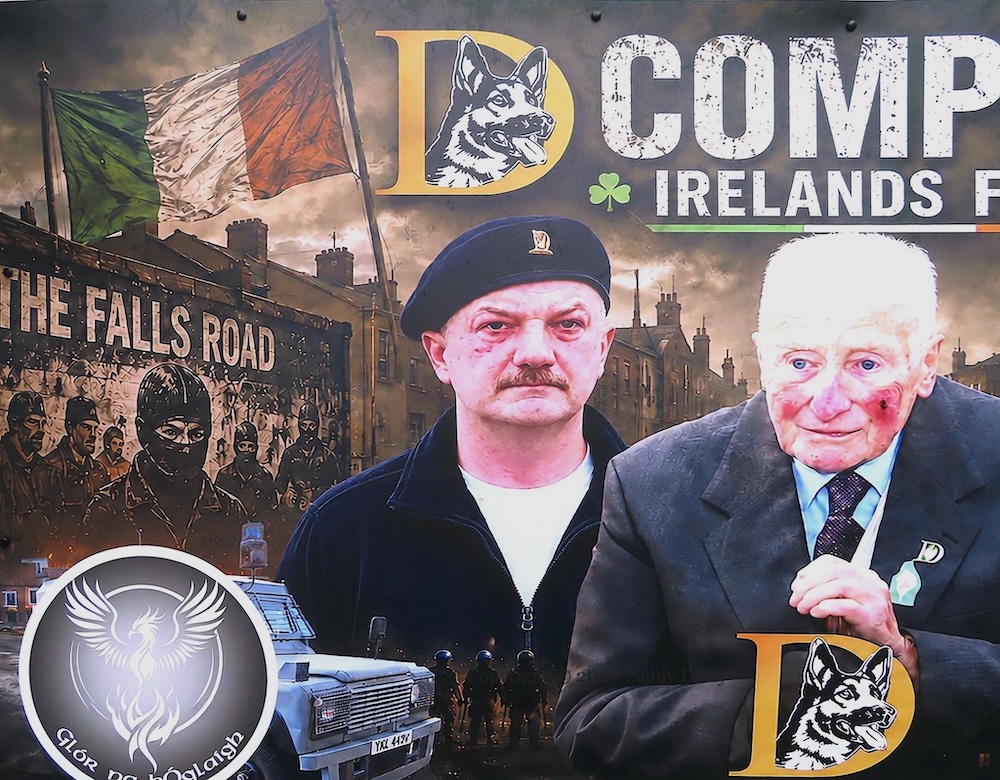
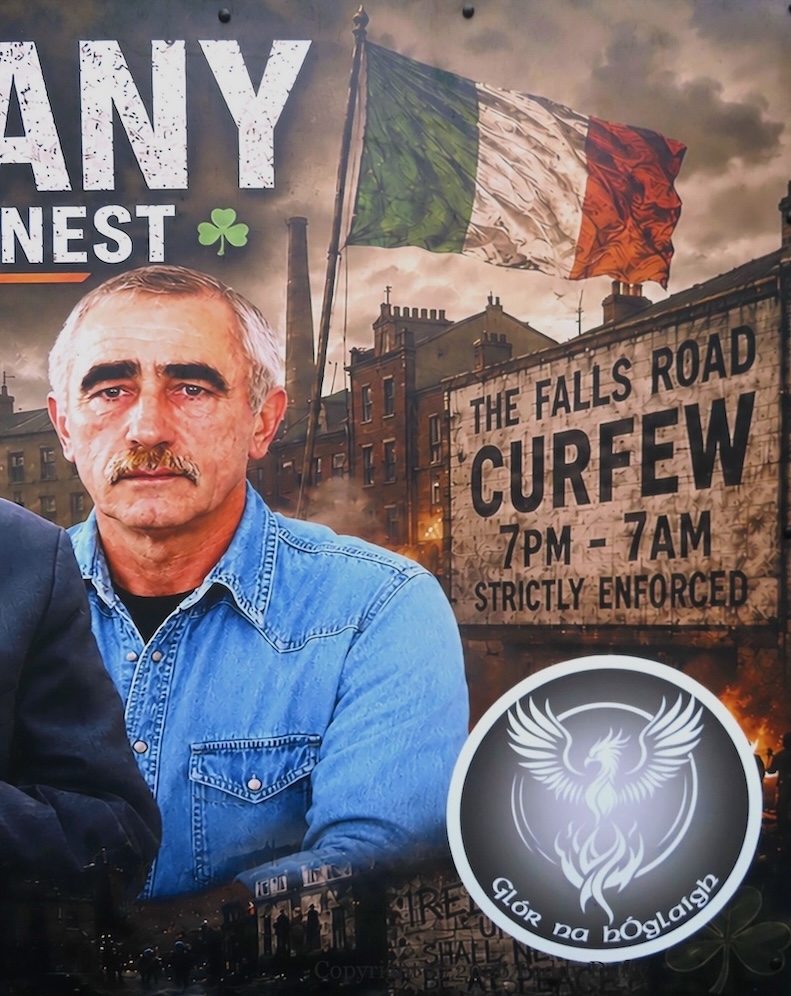
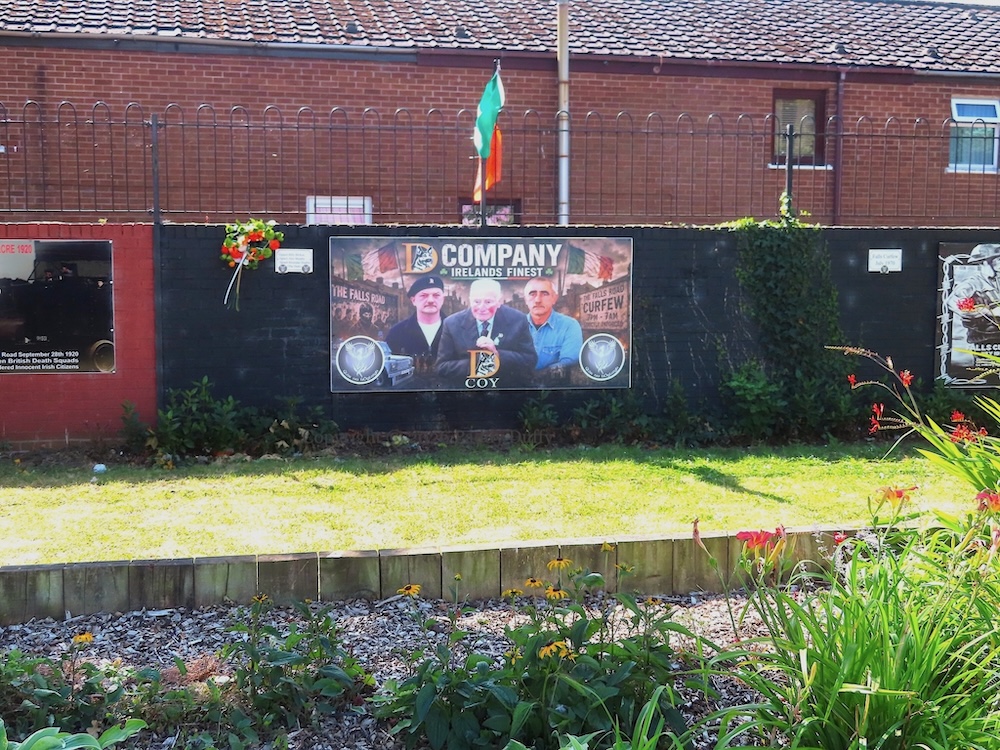
“Óglach Billy McKee, Óglach Alex Murphy, Óglach Breandan [Brendan/Breandán] Hughes (The Dark)” are featured in a new D Company board on the anti-Agreement wall below the Falls Garden Of Remembrance.
In the bottom corners is the emblem of Glór Na hÓglaıgh (Fb), a new (March 2026) “revolutionary republican socialist political party”, associated with Óglaıgh Na hÉıreann and feuding with the RNU.
As in the previous board, Alex Murphy is included (on the left); Murphy was sentenced to life imprisonment for his role in the killing of the two Signals corporals (Wood and Howes) in 1988 (UPI). He was released in 1998 under the provisions of the Agreement and died in 2019 (Pensive Quill). (The D Company board on the International Wall (Visual History) features Kieran Nugent rather than Murphy.)
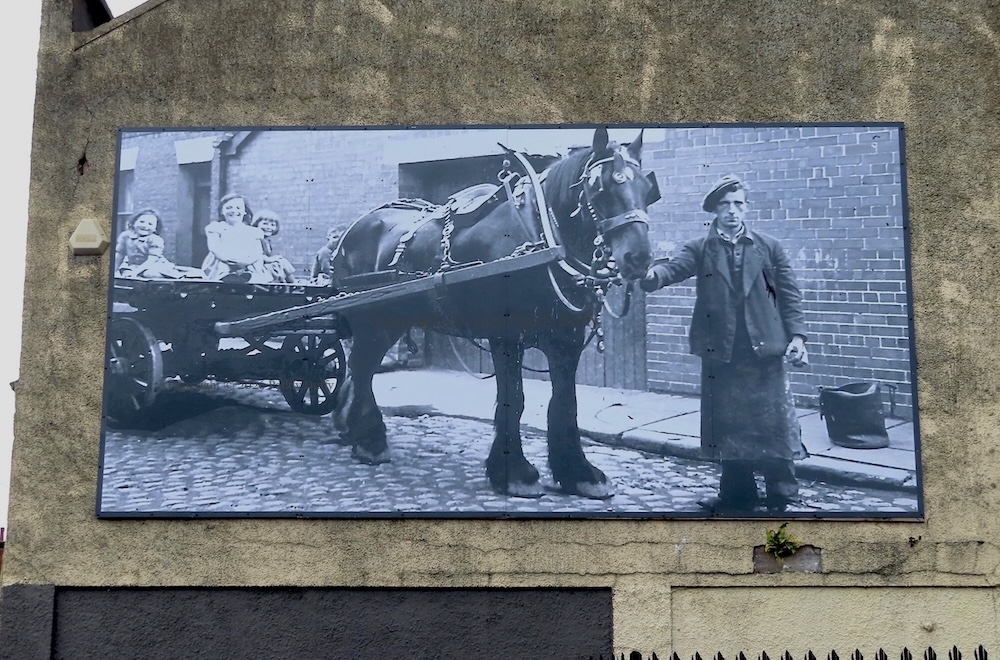
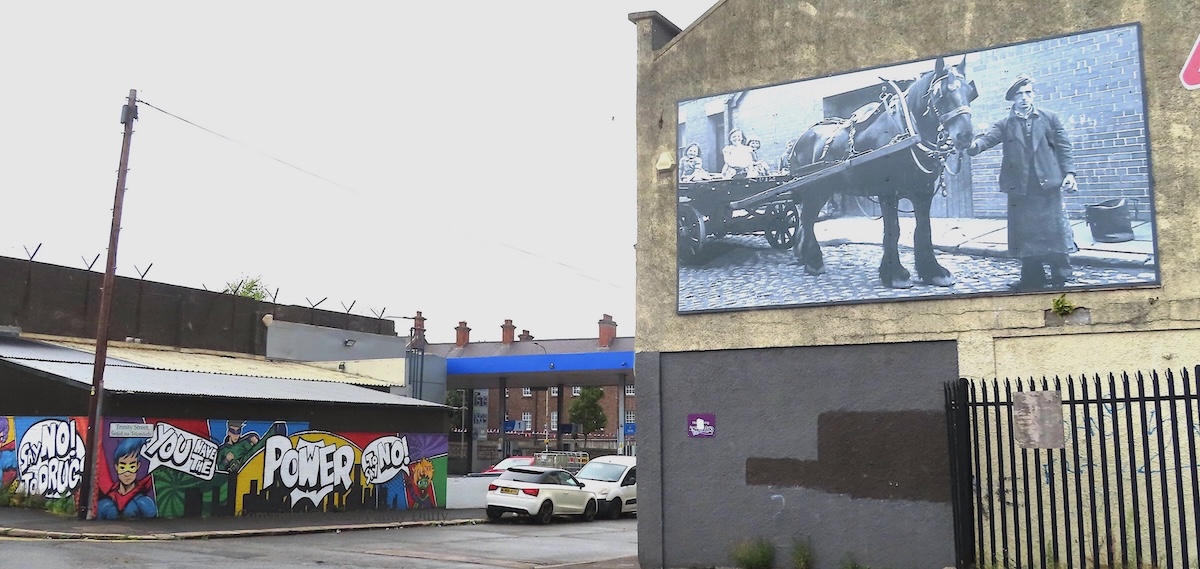
This photo of children taking a ride on a coal cart joins more than a dozen others depicting life during the 20th century in Carrick Hill – see Old Carrick Hill and The Tea Bar. Here is a Belfast Forum thread of people reminiscing about the various items that used to be delivered by horse-drawn cart.
For the anti-drugs art on the left of the wide shot below, see You Have The Power.
(lower) Regent Street, Carrick Hill, west Belfast. A new archive featuring recordings of local people opened earlier this month in the Carrick Hill Community Centre (Belfast City Council).
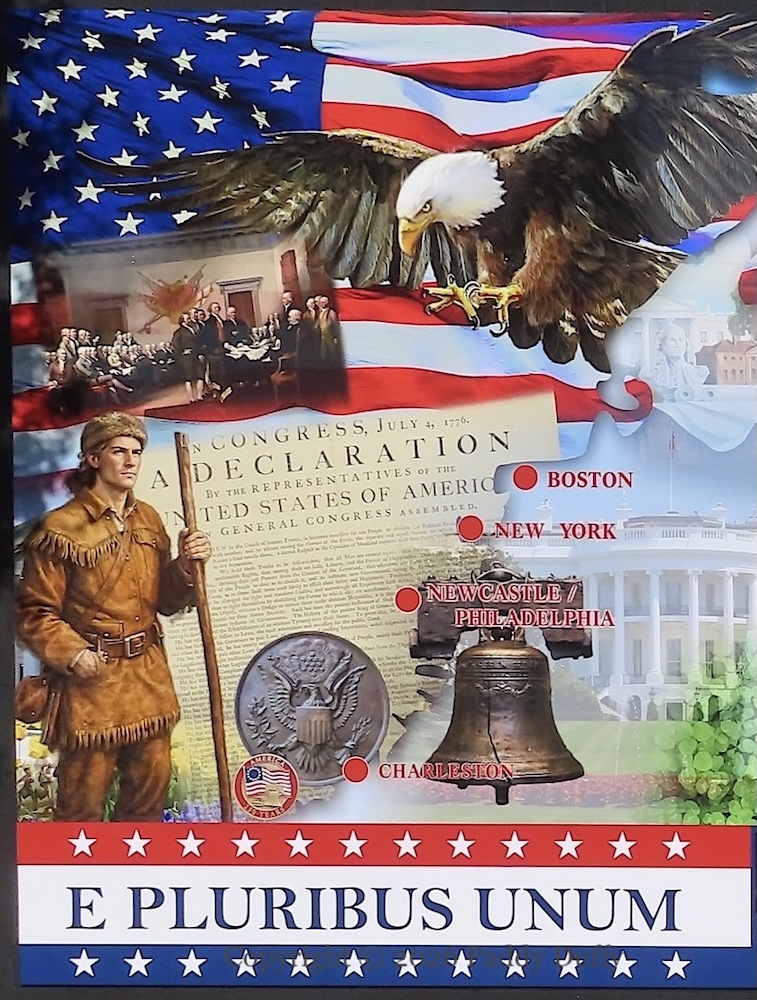
The United States Of America celebrates the 250th anniversary of its adoption of the Declaration Of Independence today, July 4th, 2026. In the Declaration, delegates from the thirteen (former) colonies set out their reasons for voting to overthrow British rule on July 2nd, noting twenty-seven grievances against the reigning monarch, George III of Great Britain And Ireland. At the time, the American Revolution was ongoing, and the Continental Congress meeting this time in Philadelphia was soon compelled to move to Baltimore, Maryland; the permanent Congress was not established until 1781.
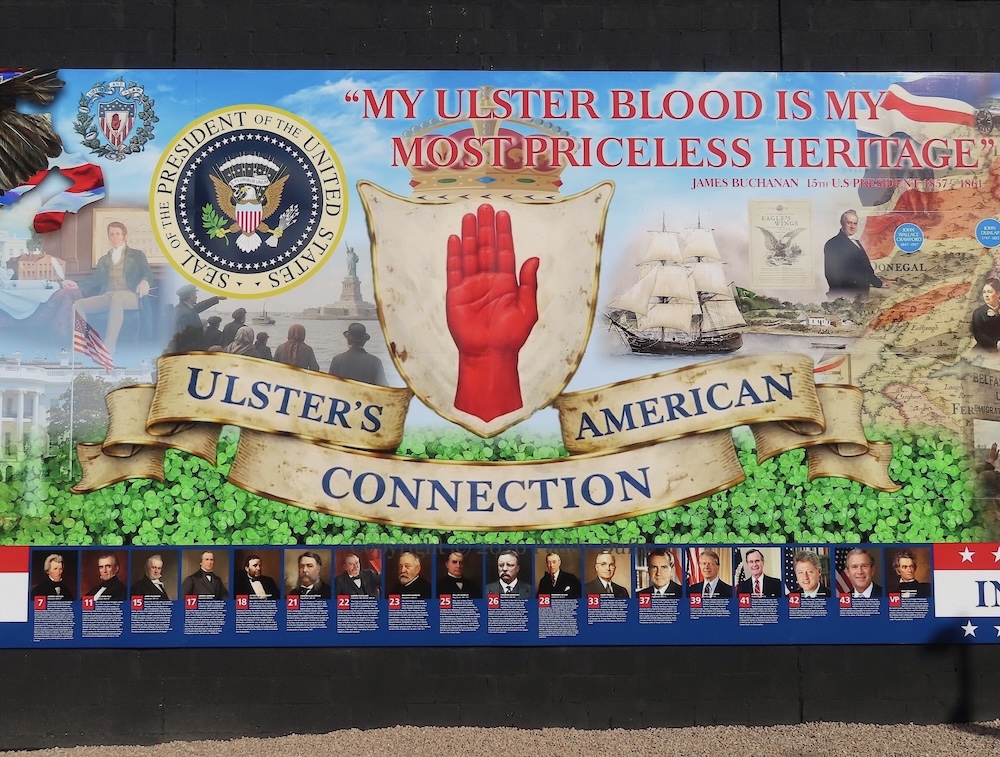
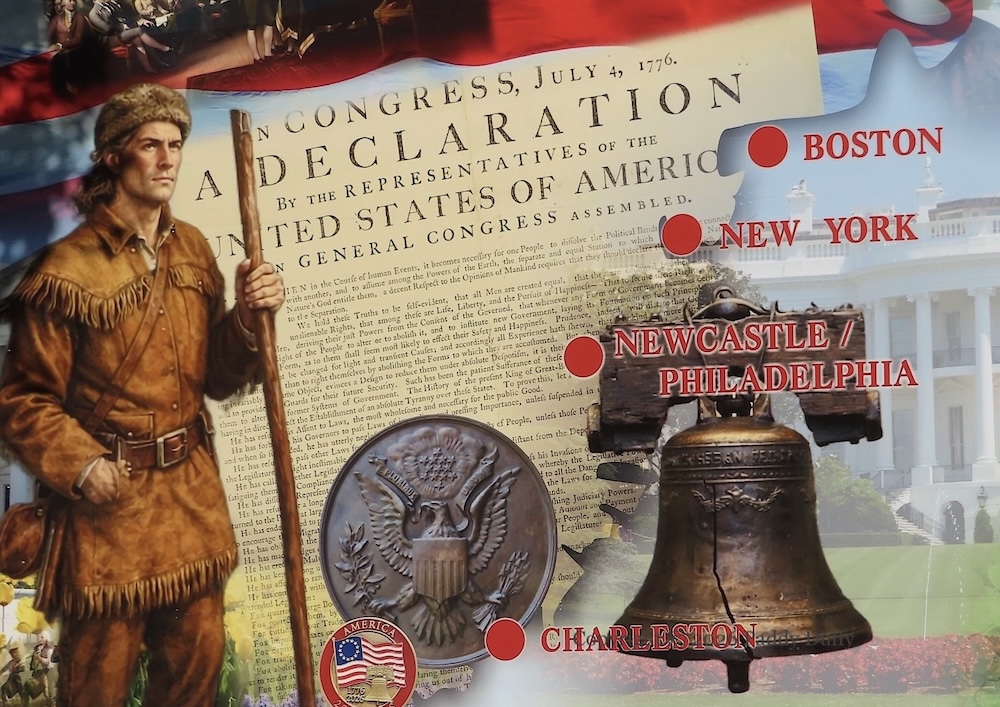
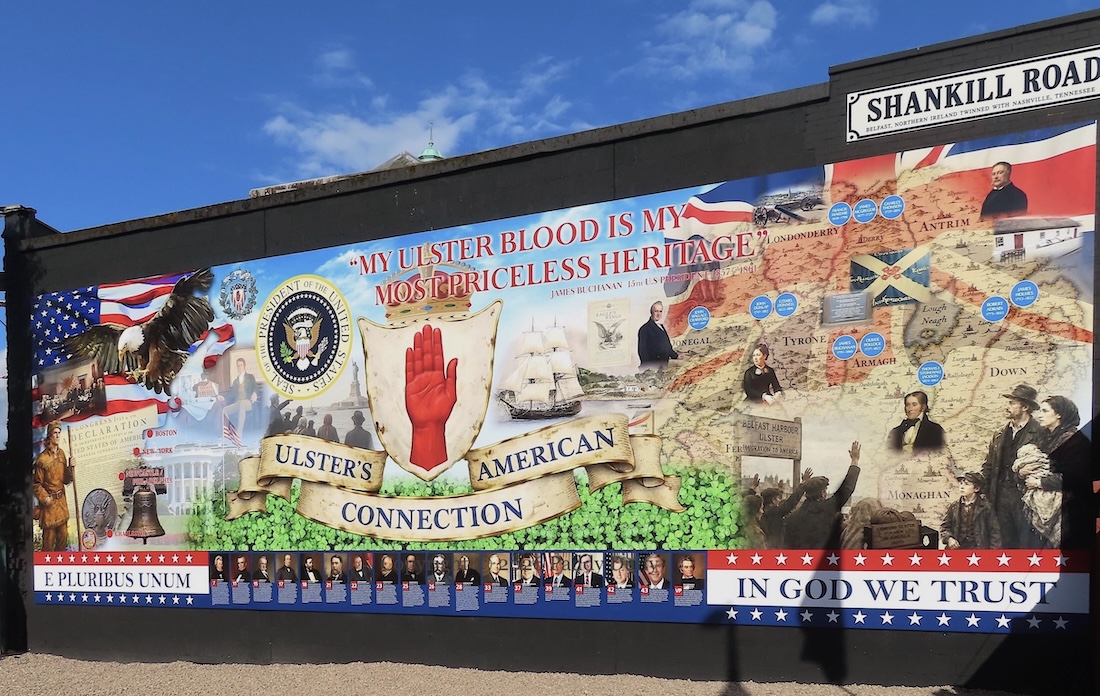
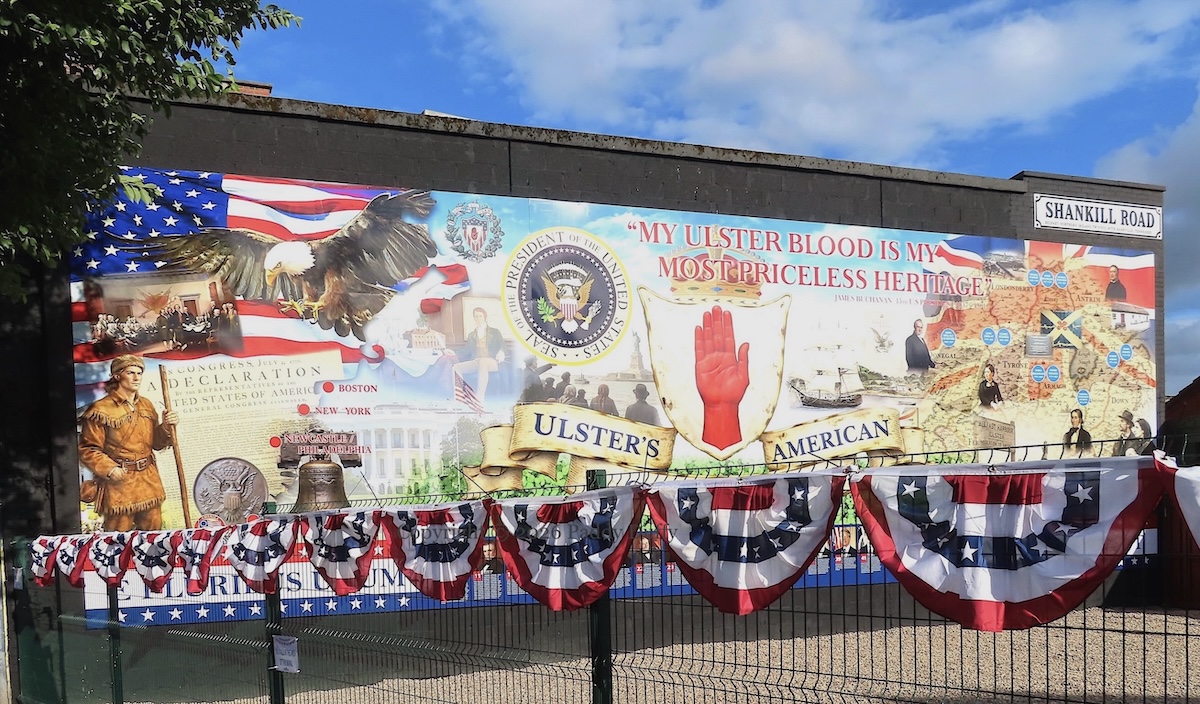
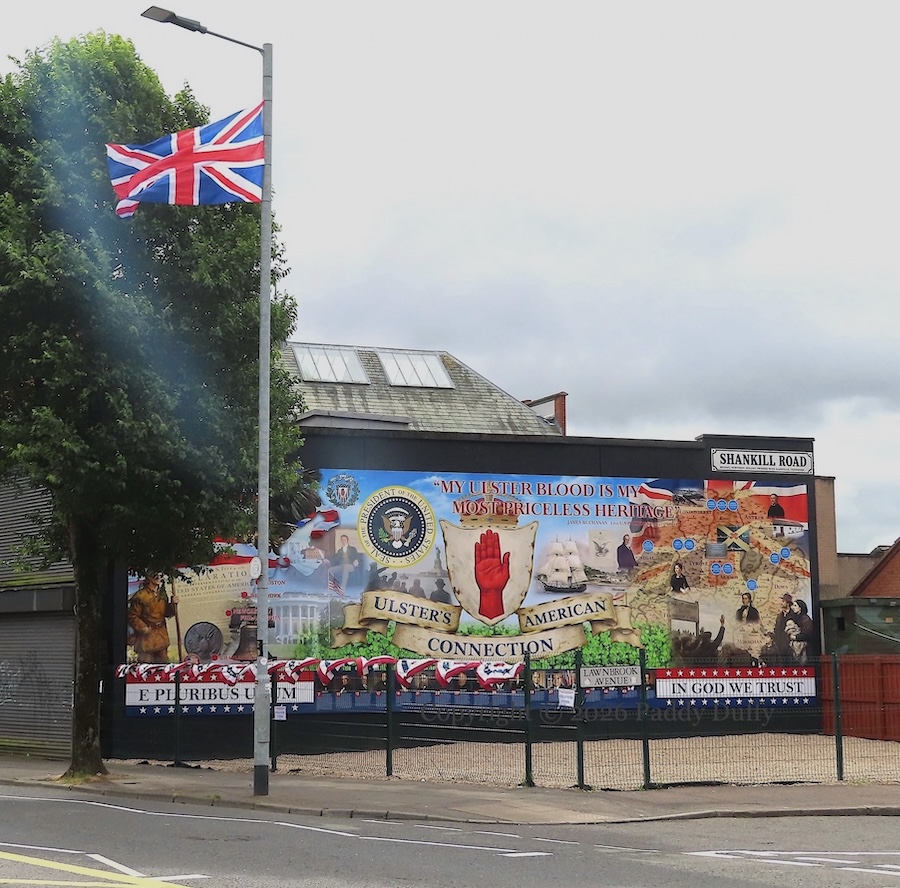
On the left of the board, various symbols of the eventual United States Of America – John Trumbull’s painting ‘Declaration Of Independence’ (image at WP) and a bald eagle upon a Stars And Stripes formed by an outline of the eastern sea-board (which for an unknown reason lists New Castle (not “Newcastle”) alongside Philadelphia), the Liberty Bell, an “America 250 years” pin, the Seal, the Declaration, and a trapper or frontiersman who represents the westward expansion of European Americans – including the Scotch-Irish (Ulster Sails West) – across the continent.
The “liberty and law” emblem, with the red hand against the stars and stripes, surrounded by a garland of thistle and shamrock, is unknown.
The seated gentleman is James Hoban, a Catholic from Co Kilkenny, who studied architecture in Dublin and (after emigrating in 1878) designed the White House – a three-storey model (later reduced to two) is on the desk behind his quill – and (in the framed picture behind him) the Charleston (South Carolina) court-house.
In the centre is a quote attributed to James Buchanan, “My Ulster blood is my most priceless heritage”; for confusion over the quote see James Buchanan. Buchanan is also pictured (next to the word “Donegal”). The Great Seal was designed by Charles Thomson, originally from Maghera. He was also a signatory to the Declaration.
The crown above the red hand is probably the Tudor Crown, destroyed in 1649 (WP). A bed of shamrock supports the title banner.
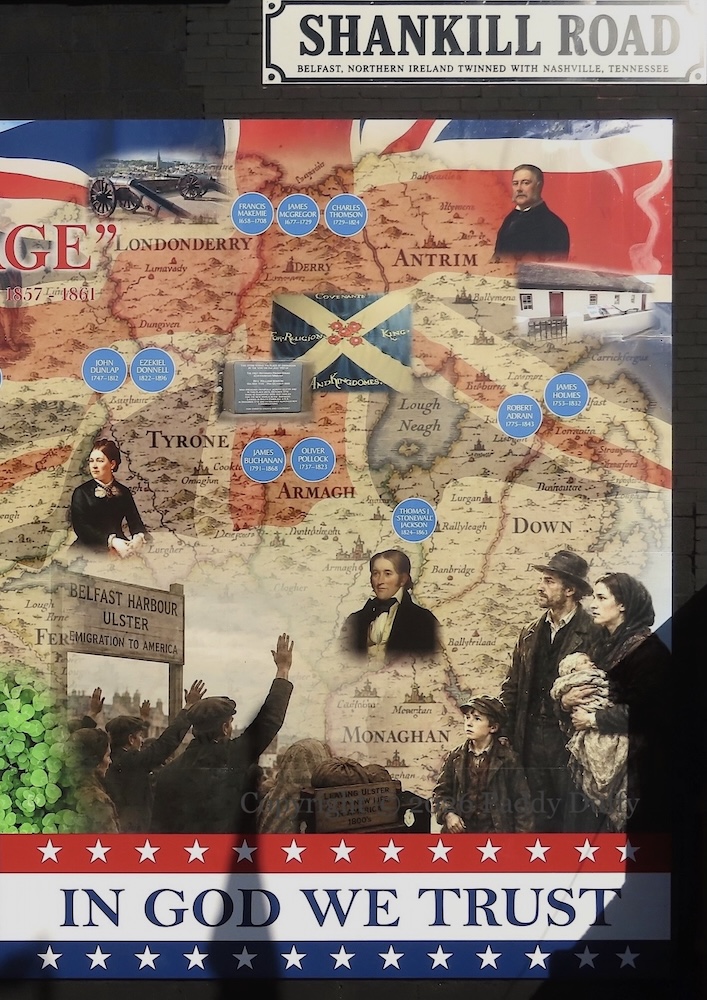
The Ulster-Scots lineage of seventeen presidents (plus vice-president Andrew Calhoun) is presented along the bottom between the mottos “E pluribus unum” and “In God we trust”. (The Ulster-Scots Agency has a pdf of the Presidents.)
On the right, the poster marked “Eagle’s Wings”, under the Buchanan quote, also appears to come from the Ulster-Scots Agency. It is actually about the Eagle Wing, the ship pictured to the poster’s left (as imagined by water-colour painter Dan Parsons) that undertook the first voyage of Scots-Irish to North America in 1636. The journey was not a success: the roughly 140 dissenters returned to Ireland and some went to Scotland to avoid continued persecution (Presbyterian History.)
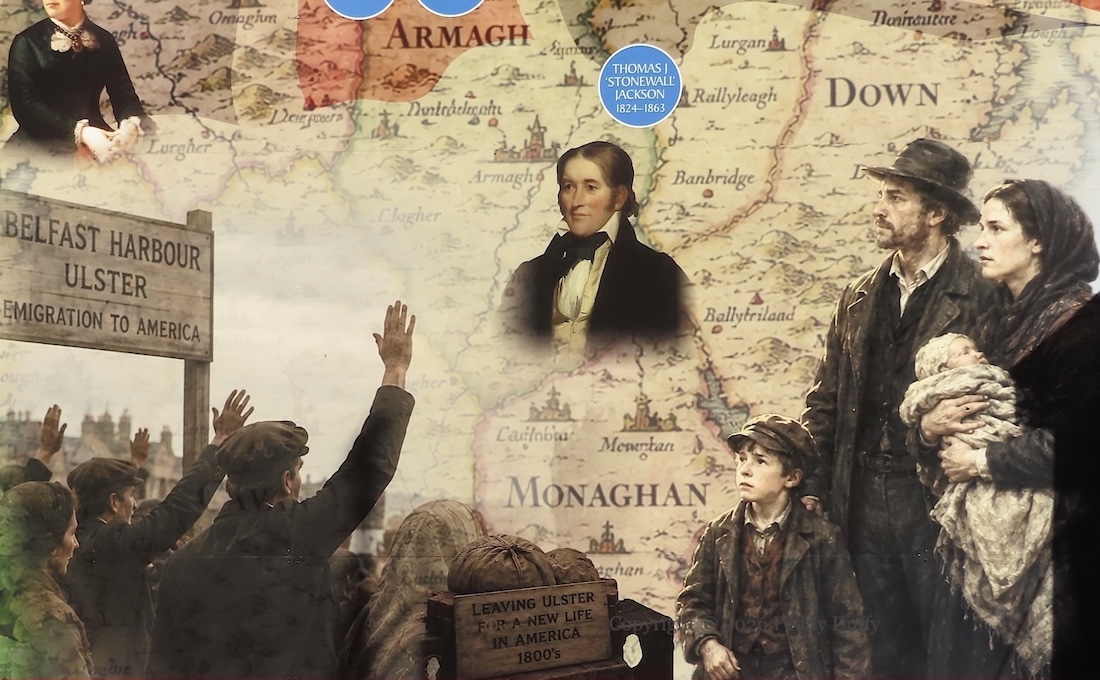
The ‘Blue Plaques’ of various notable figures are superimposed upon a period map: John Wallace Crawford, Francis Makemie, James McGregor, Charles Thomson, John Dunlap, Ezekiel Donnell, James Buchanan, Oliver Pollock, Thomas J ‘Stonewall’ Jackson, Robert Adrain, James Holmes. The portraits are of James Buchanan, Teddy Roosevelt (above Andrew Jackson’s ancestral cottage in Carrickfergus), Davey Crockett, and an unknown female figure (comment/get in touch if you can identify her).
The gravestone is to the Rev William Martin, a Reformed Presbyterian (Covenanter) minister, who led a contingent of 1,000 people in five ships in 1772 to Charlestown, South Carolina (Reformation History | History Ireland). The flag is the flag of the Covenanters (WP).
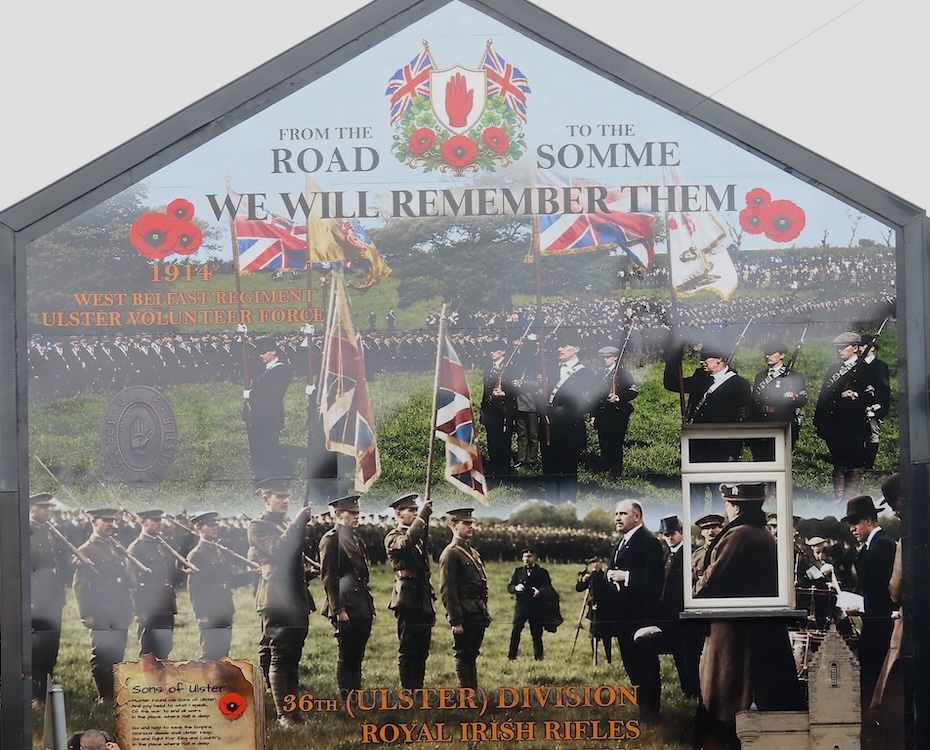
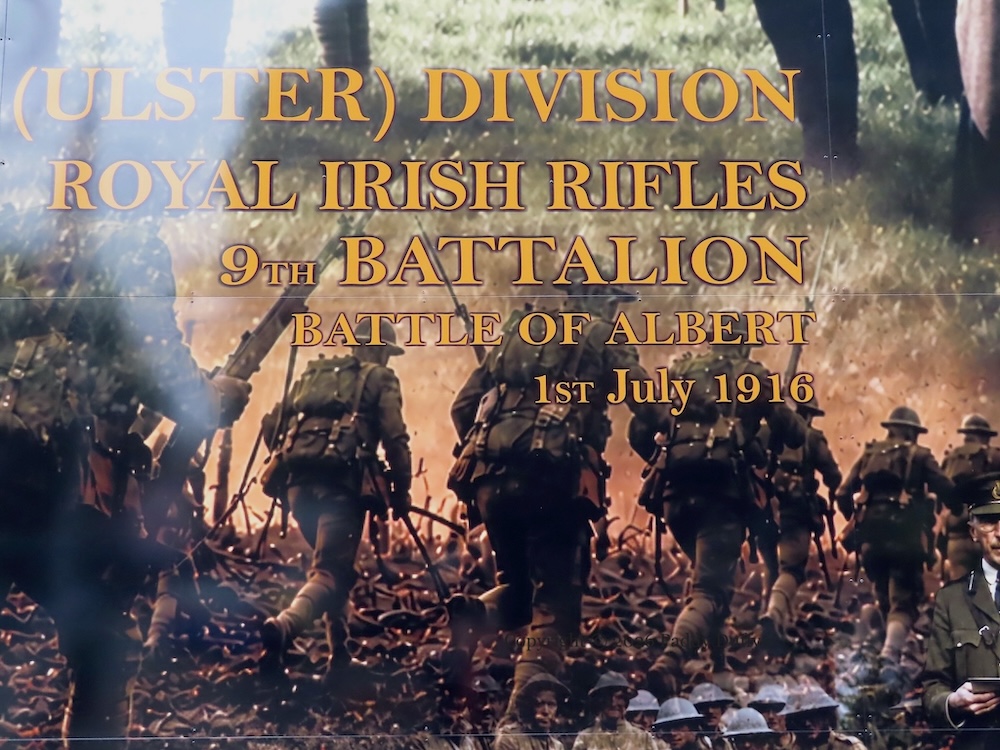
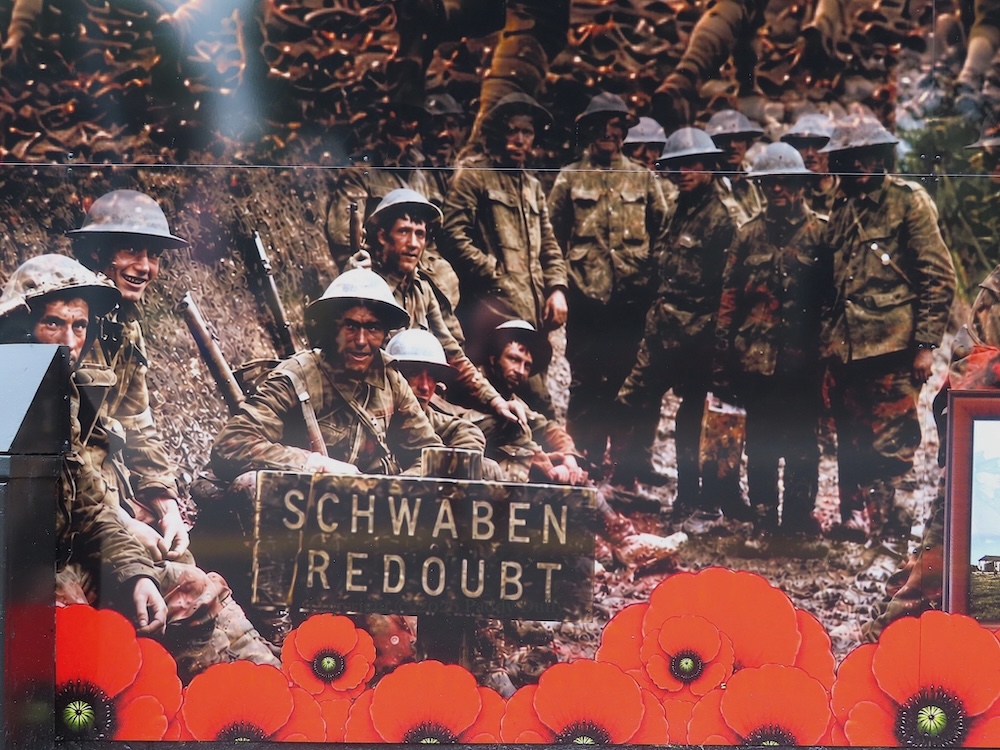
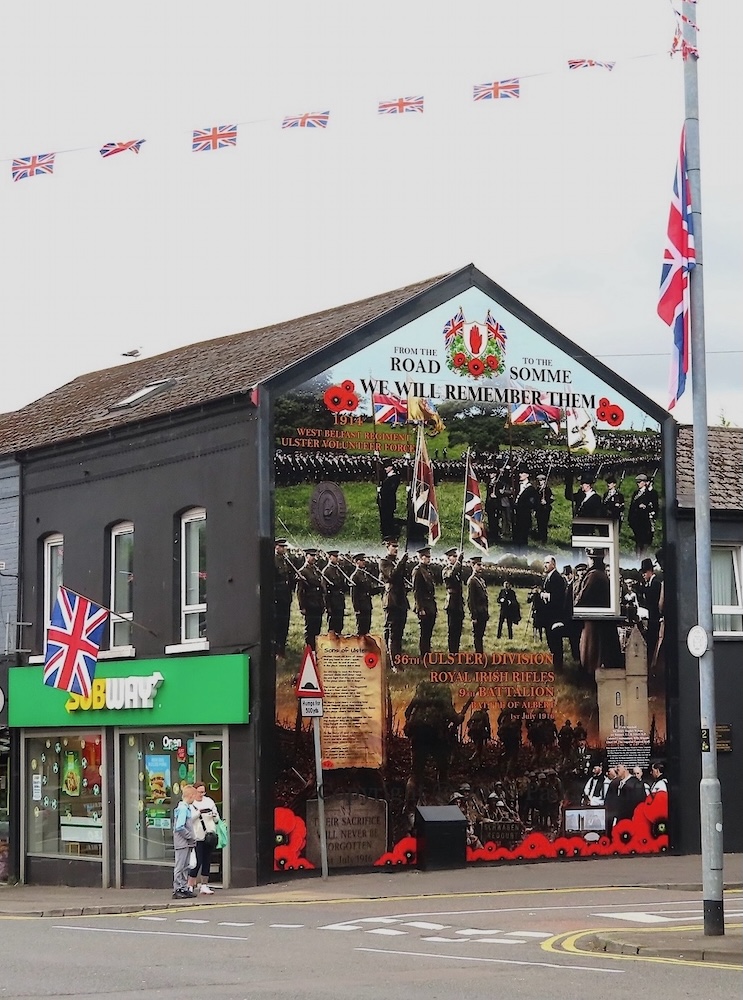
“1914 West Belfast regiment, Ulster Volunteer Force – 36th (Ulster) division, Royal Irish Rifles.” Men from the West Belfast Ulster Volunteers – which included the Shankill and Woodvale areas – joined the 9th battalion of the Royal Irish Rifles, which became part of the 107th brigade of the 36th division.
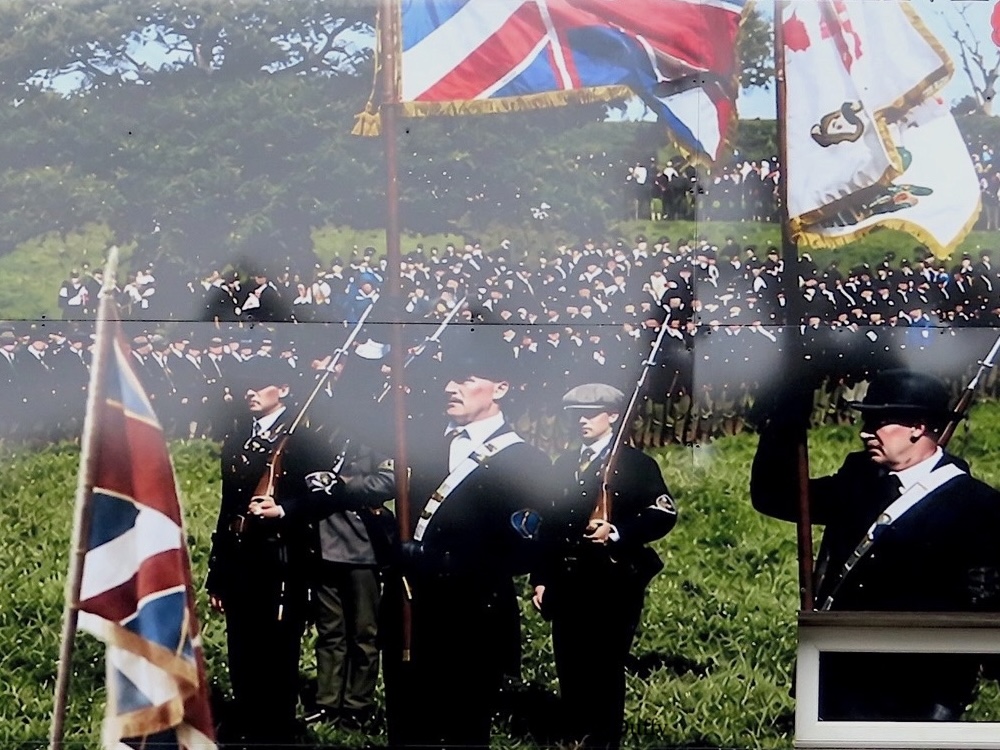
The main part of this new gable-sized board places two colourised photographs on top of each other. The first (upper) photo shows shows the first and second battalions of the West Down regiment being presented with their colours in May, 1914 (CyberProd). The second (lower) photo shows the first and second battalions of the West Belfast regiment receiving the Kings colours in May, 1914 (CyberProd).
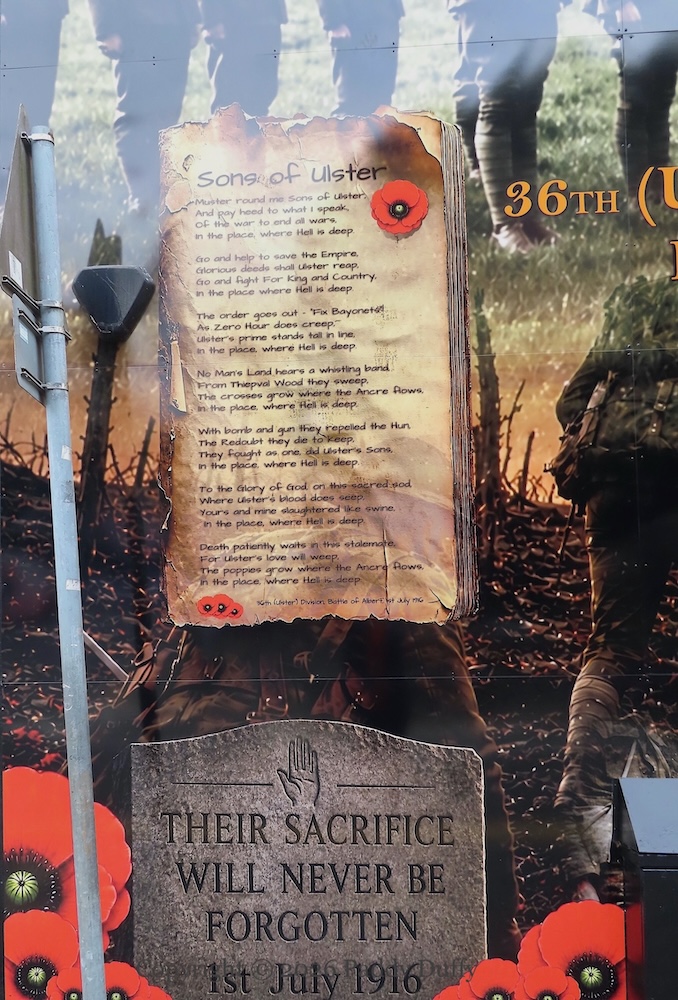
In the bottom left corner is a poem called “Sons of Ulster” written on a scroll: “Muster round me Sons of Ulster,/And pay heed to what I speak,/Of the war to end all wars,/In the place where hell is deep.//Go and help to save the Empire,/Glorious deeds shall Ulster reap./Go and fight for King and Country,/In the place where hell is deep.//The order goes out – “Fix Bayonets!”/As Zero Hour does creep,/Ulster’s prime stands tall in line,/In the place where hell is deep.//No-Man’s Land hears a whistling band,/From Thiepval Wood they sweep./The crosses grow where the Ancre flows,/In the place where hell is deep.//With bomb and gun they repelled the Hun,/The Redoubt they die to keep./They fought as one did Ulster’s Sons,/In the place where hell is deep.//To the Glory of God on this sacred sod,/Where Ulster’s Blood does seep,/Yours and mine slaughtered like swine,/In the place where hell is deep.//Death patiently waits in this stalemate,/For Ulster’s love will weep,/The poppies grow where the Ancre flows,/In the place where hell is deep.”
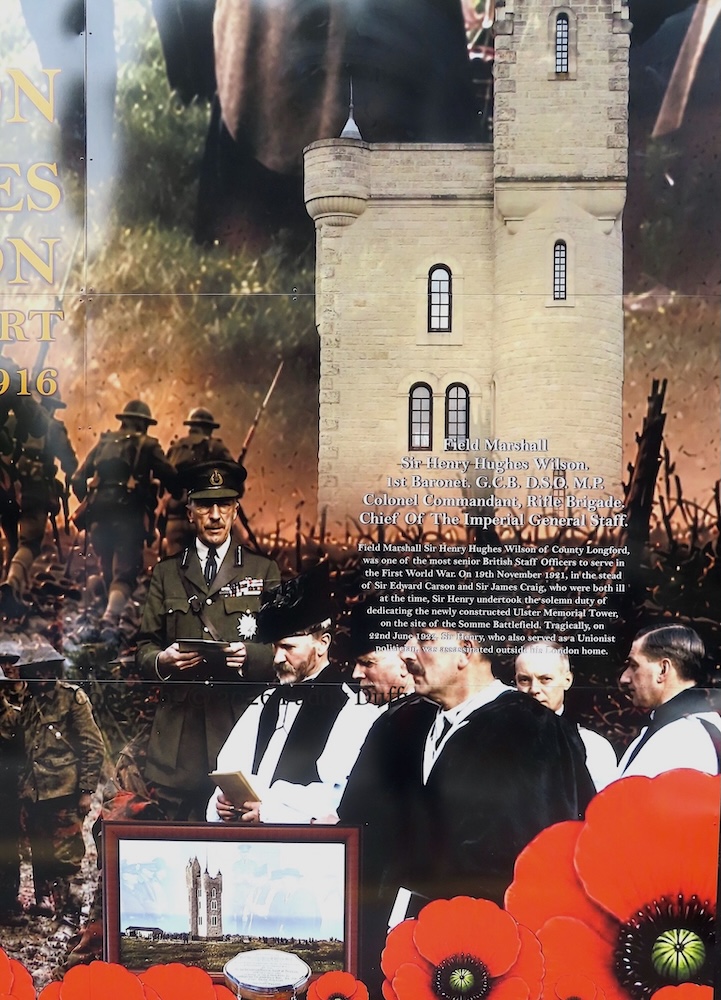
In the bottom right, the Ulster Tower is dedicated: “‘Field Marshall Sir Henry Hughes Wilson, 1st Baronet, GCB, DSO, MP, Colonel Commandant, Rifle Brigade, Chief Of The Imperial General Staff. Field Marshall Sir Henry Hughes Wilson of County Longford, was one of the most senior British Staff Officers to serve int he First World War. On 18th November 1921, in the stead of Sir Edward Carson and Sir James Craig, who were both ill at the time, Sir Henry undertook the solemn duty of dedicating the newly constructed Ulster Memorial Tower, on the site of the Somme battlefield. Tragically, on 22nd June 1922, Sir Henry, who also served as a Unionist politician, was assassinated outside his London home.”
Conway Street, Shankill, west Belfast, replacing Ulster Tower.
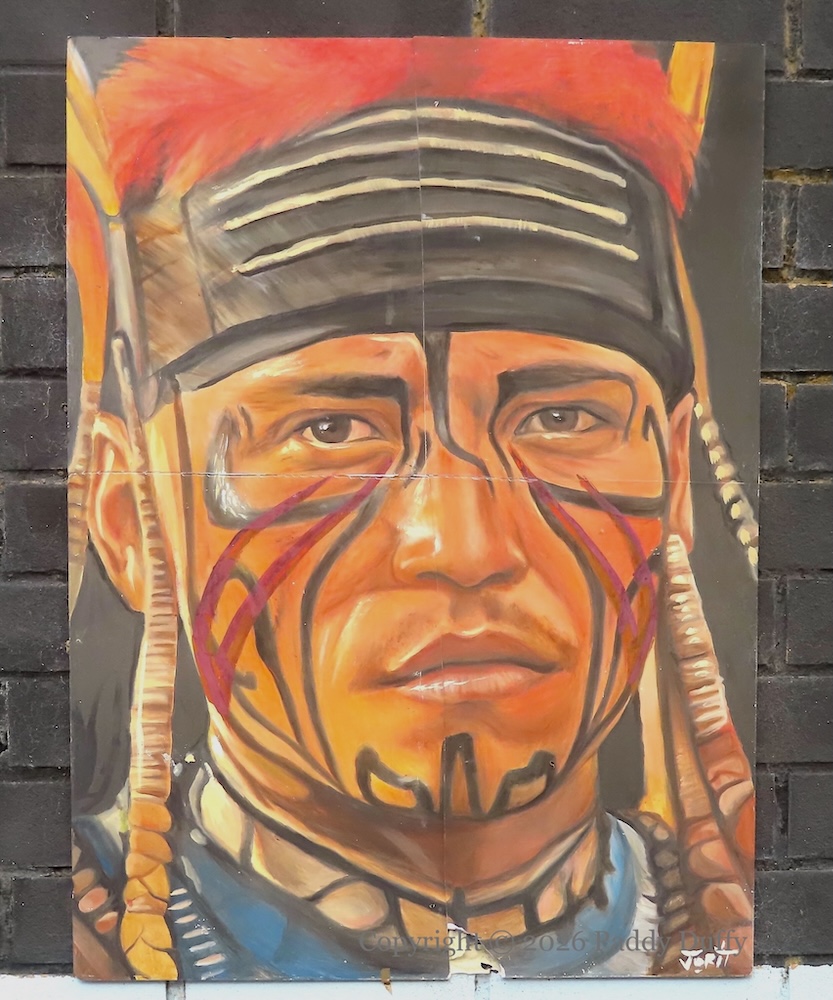
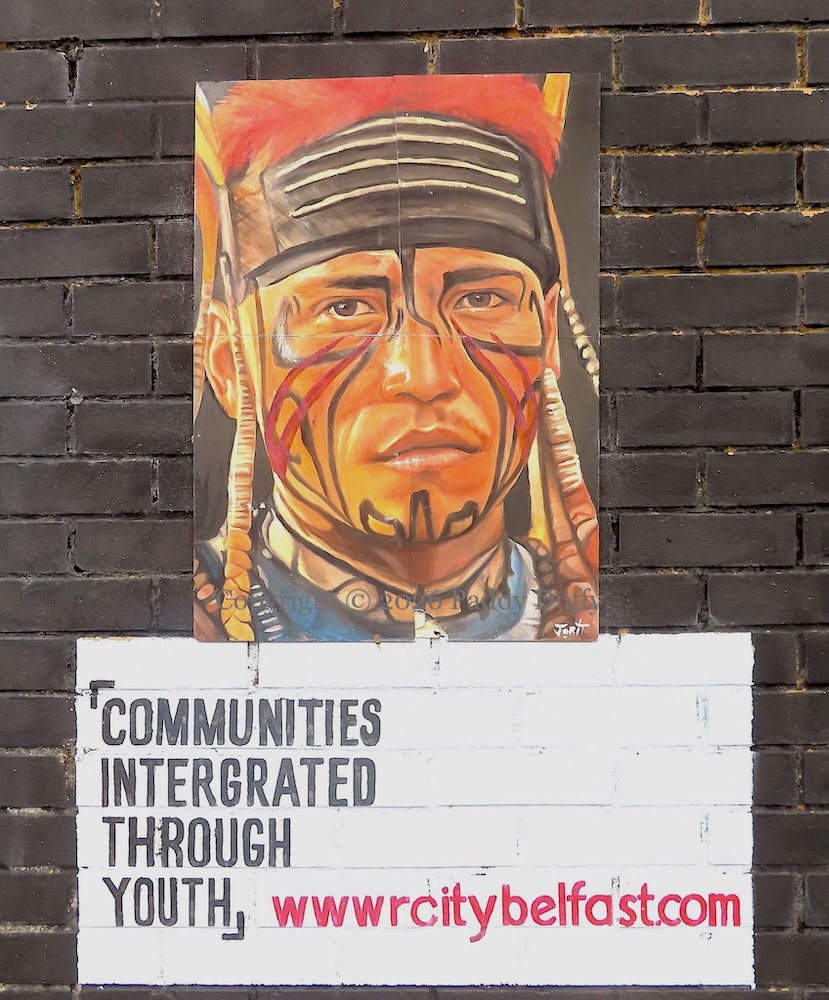
This is a third portrait by Italian artist Jorit (ig) – for two others see Save The Human Tribe. This one is on Lanark Way, inserted above the dash in the R-CITY mural.
A monorail glides by on an arched railway bridge above a field of flowers in which children play Ring-A-Ring-O’-Rosie. This mural is on the Barrack Street side of St Mary’s Primary School (web).
The Irish men’s soccer team is scheduled to play Israel in the Nations’ League, on September 27th and – at home – on October 4th, 2026. A campaign was launched to “Stop the game” in Dublin as a form of protest and disengagement, most prominently in the form of an open letter (instagram) sent to the FAI signed by footballers and various musicians.
The FAI instead appealed to UEFA to have the game played behind closed doors in a neutral country, saying that while it was “deeply conscious” of the suffering in Gaza and the West Bank, it did not want to forfeit the points or be disqualified from the competition (FAI).
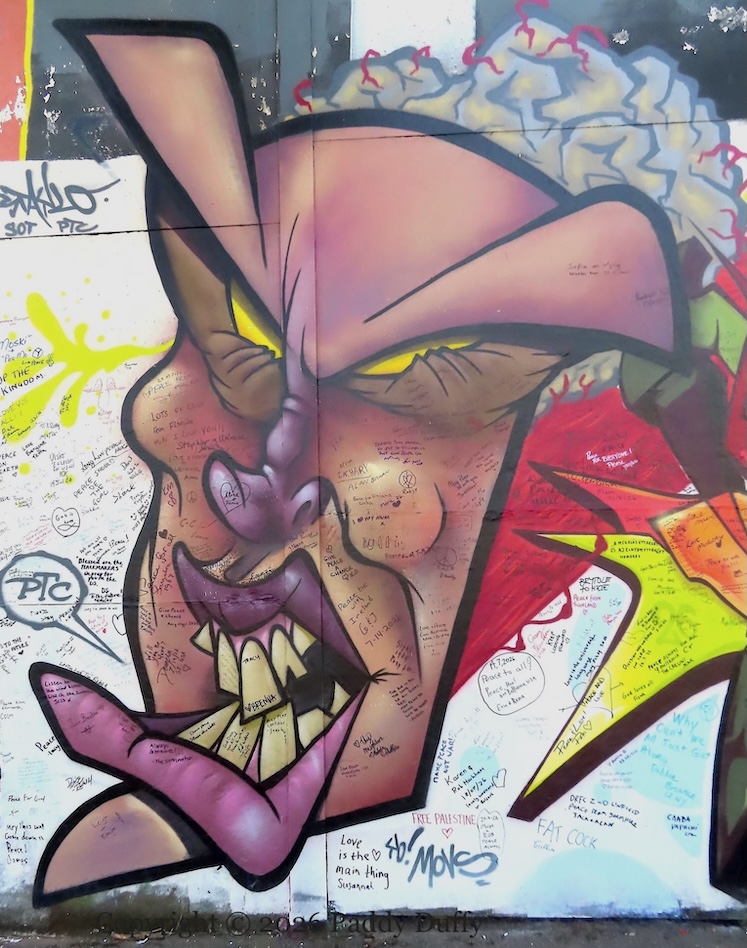
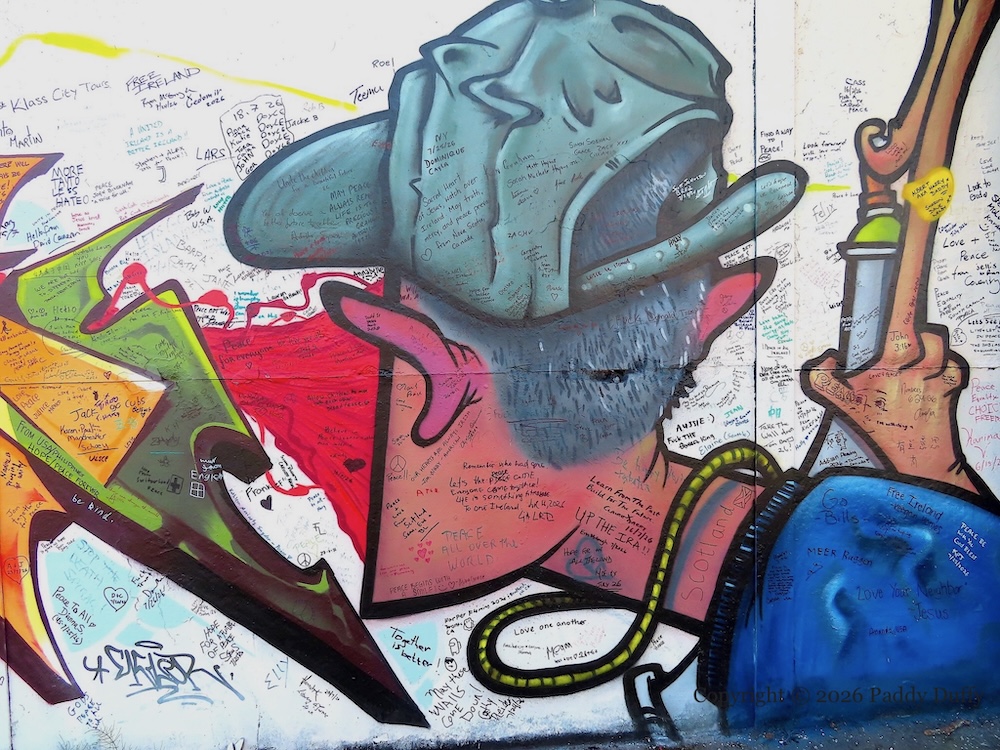
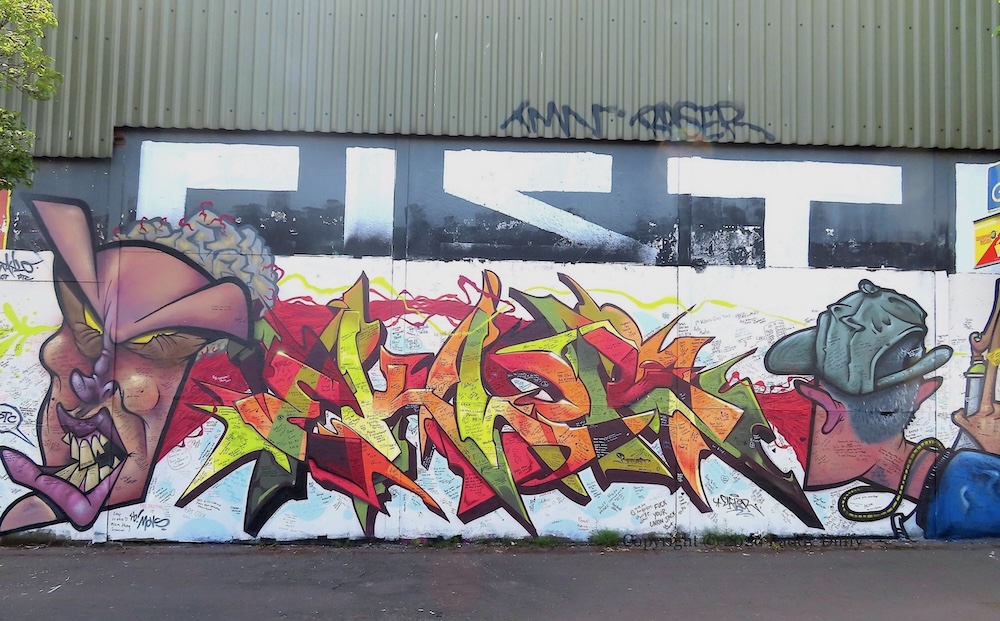
The large tarp shown above has been added (on June 18th) on top of the long Painting For Palestine mural on Divis Street.
The various placards reading “No to hate”, “Fight racism”, and “Yes to all!” were added last week (June 17th) in response to the rioting in east Belfast and elsewhere – see McMaster Street Remembers. (These additions are reminiscent of the ‘Free Marian Price’ additions in 2013 – see Scaoıl Saor Marian Price in the Peter Moloney Collection.)
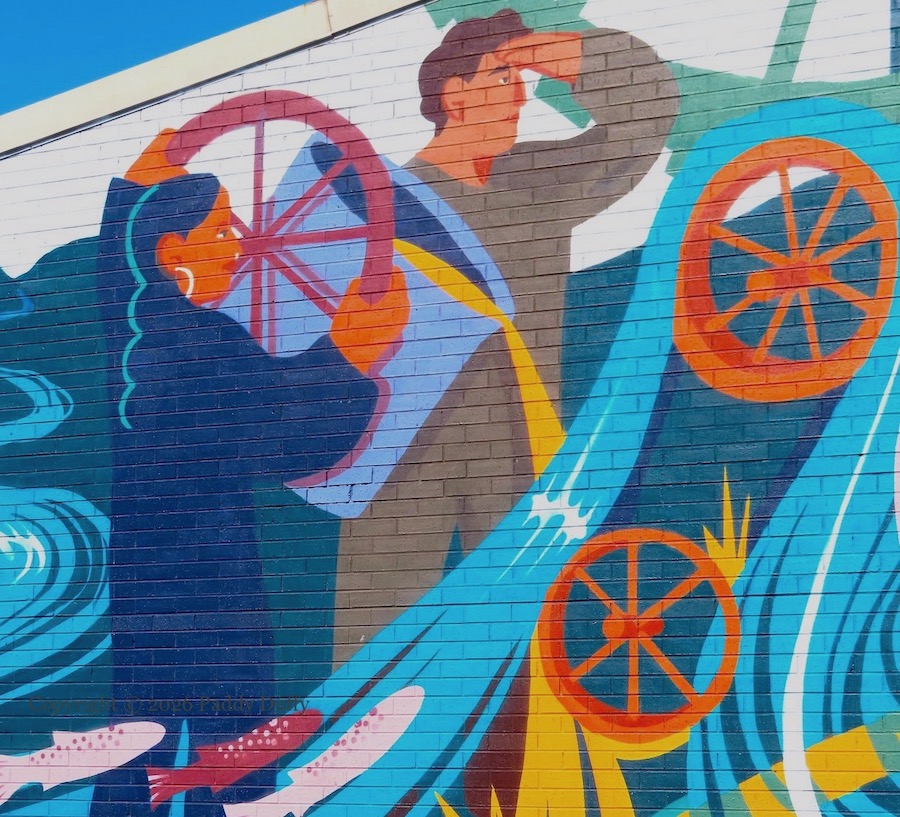
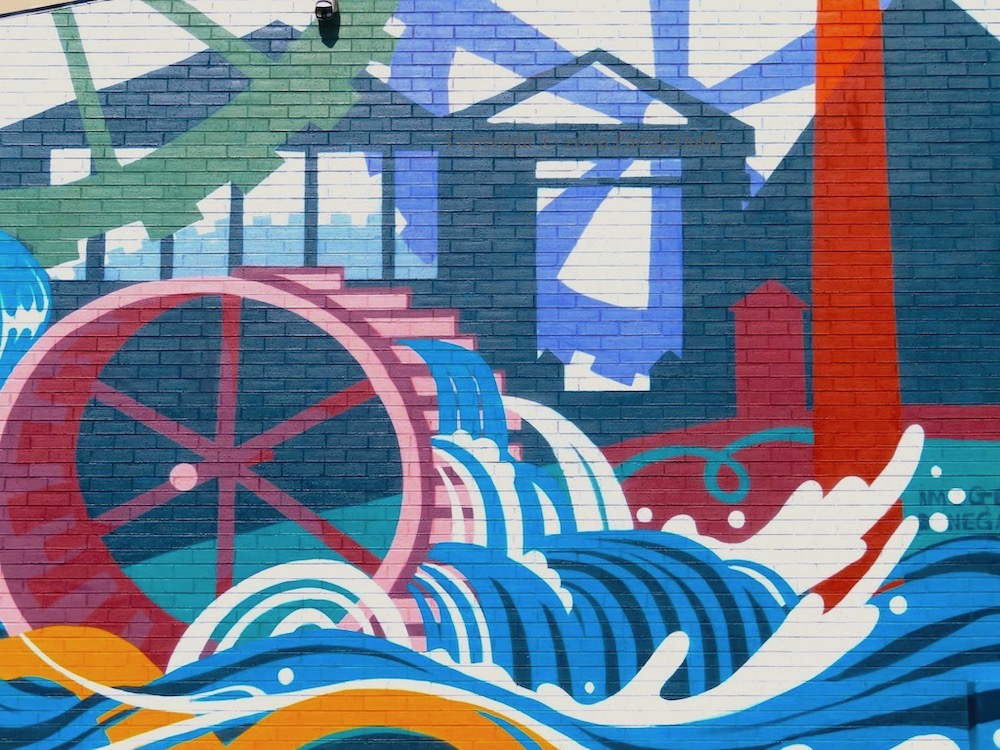
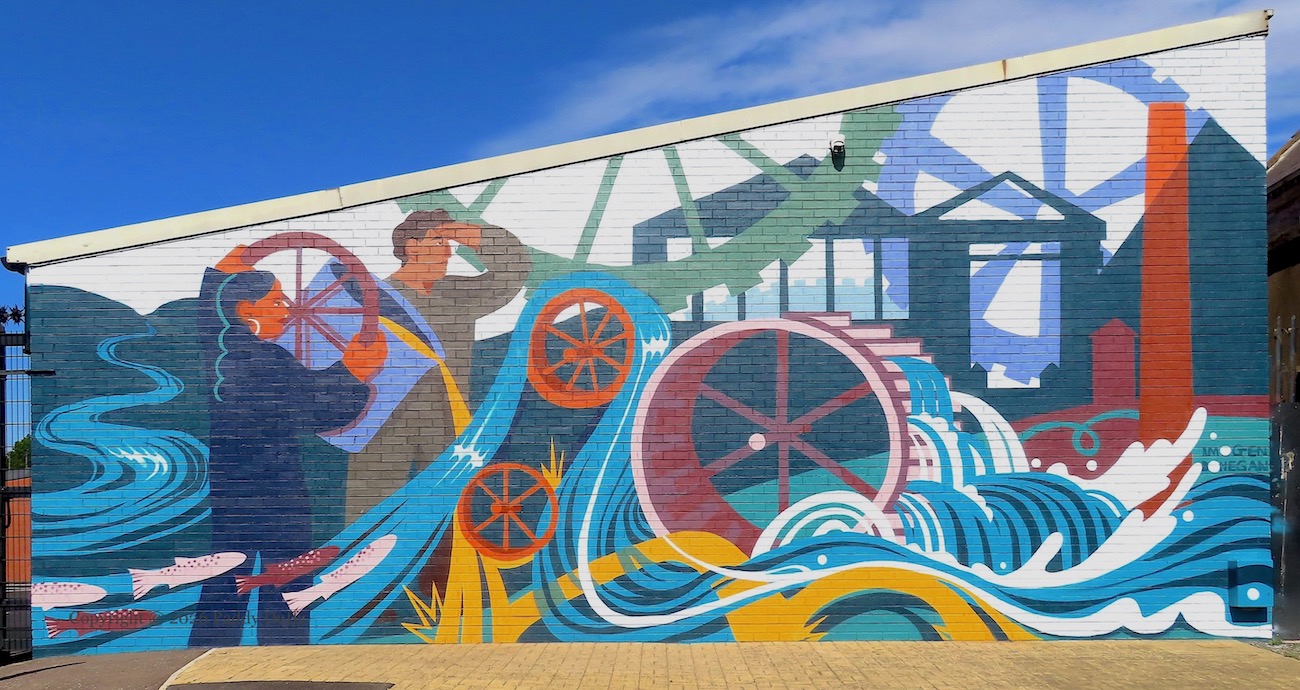
The Townsend Enterprise Park, at the Falls end of Townsend Street, was formerly the site of the Soho Foundry, established by brothers James and Robert Shipboy MacAdam, making (among other things, including scutching machines) large turbines for export across the world – “the largest steam-engine ever made in Ireland” (at 62″ in diameter) went to the Nile in Egypt in 1848 (Grace’s | Grace’s). The river portrayed is the Farset, which gives Belfast its name, and which can still be seen in the Park; the vast majority of the Farset had been paved over by 1848 (BBC).
This new mural on the wall of the Enterprise Park recalls the area’s industrial past. By Imogen Donegan (ig) with support from Daisy Chain (web).