Australian Aid

Above and immediately below: banners of two Australian Republican support-groups, holding banners reading “Australian Aid for Ireland QLD [Queensland] Branch – The Spirit of Freedom” and “The Casement Support Group – Saoirse Melbourne”.

Third is Caırde Sınn Féın.

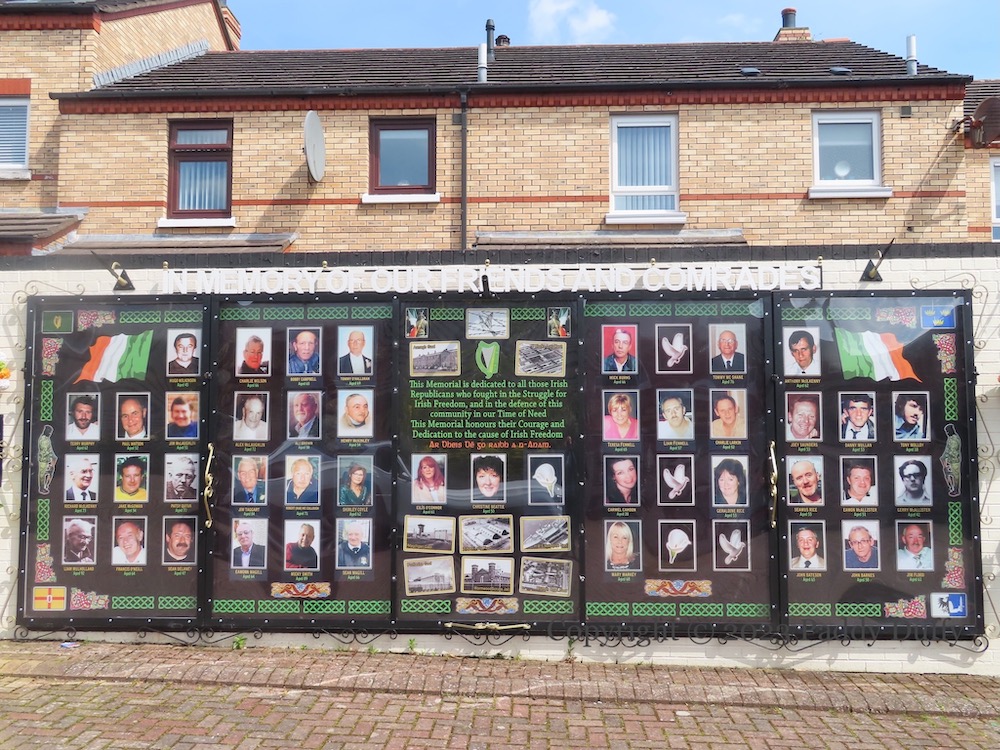
Fourth, Australian Manufacturing Workers Union (amwu.org.au) sponsored the mural above in Conway Street. Then-secretary Craig Johnston is on the left in the back. The flag to the right is the flag of the Eureka Stockade. It joins others sponsored by Australian groups: A Bunch Of Live Wires (sponsored by the Electrical Trades Union) | Caırde Sınn Féın | Australian Aid For Ireland & Saoırse Melbourne. “Casement Memorial – In proud memory of the 10 Republican prisoners who died on hunger strike in “H” blocks of Long Kesh in 1981. ‘It is not those who can inflict the most but those who can endure the most who will conquer’ – Terence McSwiney. Unveiled by Martin McGuinness, Sınn Féın MP MLA Minister for Education Wednesday 6/12/2006 Donated by AMWU, Craig Johnston Secretary.”

Finally, the Australian Electrical Trades Union (ETU) in Victoria. “Says Joe, ‘Those that they forgot to kill went on to organise.’” from ‘(The Ballad Of) Joe Hill’.

Click image to enlarge
Copyright © 2022 Paddy Duffy
T01617 T01616 T01615 T01614 T01613 T01612

The Eileen Hickey Republican Museum

The ‘Eileen Hickey Irish Republican History Museum‘ — which is across the street from this mural and behind the Conway Mill — is named for Eileen Hickey, a Provisional IRA member who served time in Armagh prison; she died in 2006, one year before the opening of the museum (obituary at An Phoblacht).

Next to the opening hours is an image of a prison cell in the Armagh women’s prison. The museum itself contains a cell door and a bed from the prison.

Conway Street, west Belfast

Click image to enlarge
Copyright © 2022 Paddy Duffy
T01618 T01619

The Pogrom Of August 1969

August 2019 was the 50th anniversary of what are euphemistically called “The Troubles”. The Battle Of The Bogside (Derry) began on August 12th; in Belfast, fighting began on the night of August 14th and before dawn three people in the Divis Street area were dead: Protestant Herbert Roy and Catholics Patrick Rooney and Hugh McCabe, both shot in the Divis flats complex by the RUC’s Shorland armoured cars. (Two other Catholics were killed in rioting in Ardoyne.) This board is on Divis tower, next to the plaque commemorating Rooney and McCabe.

Click image to enlarge
Copyright © 2022 Paddy Duffy
T01611

Gateway To West Belfast

Fáılte Feırste Thıar‘s second mural (the first is outside its offices in the middle Falls – see Fáılte Feırste Thıar) reinforces the claim that (republican) west Belfast begins as soon as you cross the motorway, five minutes’ walk from the city centre. Coıste’s tour of republican murals begins at Divis Tower and the new mural already seems to be drawing tourists – see the final image, below. The previous Coıste mural (M04900) has been deleted and incorporated into the mural, promising tourists “a unique walking tour by former political prisoners”.

The mural is a mix of landmarks – the new Raıdıó Fáılte building (which is located just below the mural), Divis tower, St Peter’s, Conway Mill, the “international wall” of murals, the Bobby Sands mural, the Falls library, the new James Connolly centre, Cultúrlann, and Milltown cemetery – cultural images (Irish dancing and Féıle An Phobaıl) – and sporting images (clubs include Immaculata ABC, Gort Na Móna GAC, St Paul’s GAC). A gay pride ‘rainbow’ stripe runs below the Divis Street portion. Before the previous mural was painted (M07533), there was a Gateway To Belfast board at this spot.

Click image to enlarge
Copyright © 2022 Paddy Duffy
T01603 T01608 T01607 T01609 T01610

100 Years Of Partition

Here is a gallery of the smaller piece on the building below Divis tower (except for the Welcome mural – see Gateway To West Belfast). From right to left (top to bottom in this post) we see a 32 County Sovereignty Movement mural, with the island of Ireland in green, white, and orange, and (representing prisoners) barbed wire and a candle; “Black lives matter” from People Before Profit; 32CSM tarp opposing “British political policing”; IRPWA board declaring the PSNI/MI5/British Army unwelcome; a 32CSM tarp against joy-riding; a Lasair Dhearg poster marking 100 years of … “pogroms, sectarianism, job discrimination, police brutality, imprisonment, collusion, housing discrimination, Orange supremacy, torture, internment, special powers, state sponsored death squads, language discrimination, gerrymandering, women’s rights denied, colonialism.”

Click image to enlarge
Copyright © 2022 Paddy Duffy
T01600 T01598 T01599 T01601 T01602

Community Activist Extraordinaire

John Leathem, chairman of the Divis Tower Falls Residents’ Association, died in his flat on the 19th floor of Divis Tower in August last year (2017), after returning to the Tower four years previously when he was diagnosed with cancer (Irish News | Tele). He was described by Sınn Féın MLA Fra McCann as “a champion for the people of no property” (An Phoblacht). This mural is outside his former office on the first floor.

Click image to enlarge
Copyright © 2022 Paddy Duffy
T01597

Neill And Scullion

These two plaques are on the “gateposts” at the entrance to Alton Street in Carrick Hill. Neill (above) is on the right; Scullion (below) is on the left.

Neill: “Óglach Michael Patrick Neill. On Monday the 24th of October 1977 Michael was shot by undercover soldiers while on IRA active service on Cliftonville Road. Michael died from his wounds, aged 16. At the time of Michael’s death he lived at the Neill family home 26 Stanhope Street, Carrickhill.”

Scullion: “Óglach Louis Scullion. At 1:45 a.m. on the 14th of July 1972 Louis was shot four times by the British Army as he walked to his home in Unity flats. Louis was unarmed and died as a result of his injuries. 5th June 1945 – 14th July 1972. Louis lived at 51H Unity Walk.”

Click image to enlarge
Copyright © 2022 Paddy Duffy
T01592 T01593

Unlock Your Lockdown

Domestic abuse reports to PSNI in the second quarter of 2020 (during the first Covid lockdown) increased 4% to 8,302 (BelTel). Women’s Aid NI (web | tw) provides refuge and support to victims of domestic violence. The stencil by Laura Nelson & Leo Boyd from VaultNI is on Carrick Hill. The title of today’s post comes from Women’s Aid CEO Sarah Mason (tw).

Click image to enlarge
Copyright © 2022 Paddy Duffy
T01594

Old Carrick Hill

The collection of images showing “Carrick Hill in the old days” now includes a mural, of two women talking in the street.

In addition to the mural, there are four boards, two on either side: Carrick Hill playground; Regent Street party; Pepper Hill steps, 1894; Carrick Hill 1940s.

There are eleven more boards in Regent Street. (Later increased to fifteen with the addition of 1976 Mandiville dart team; Mary McCusker & Kitty Spotwoods; Maggie Jane Largey & Mary Ann Largey; Richard & Alan Crean – see The Tea Bar for all fifteen.)

The board in the image below (from Stanhope Street) shows Pepper Hill Steps before the turn of the twentieth century. The steps used to lead from Mustard Street (which was what Library Street used to be) towards Upper Library Street (now Carrick Hill, the street).

Stanhope Street, Belfast

Click image to enlarge
Copyright © 2022/2024 Paddy Duffy
T01588 T05285 T05284 T05283 T05282 T01589 [T01590] [T01591] T05281 T05286